




For businesses and investors, private aviation can be a strategic financial asset. In today’s landscape, where time, control, and privacy are of the utmost importance, understanding the financial structures behind private flight options is key to maximizing value. For the sophisticated investor or executive, aligning the right solution with your financial and operational goals can translate into meaningful returns.
In this overview from Magellan Jets, citing a publication from the nationally recognized aviation and tax attorneys at Lewis Brisbois Bisgaard & Smith LLP, we will explore how different private aviation models can deliver distinct financial and tax benefits in 2026, depending on usage, structure, and eligibility.
Understanding the Four Primary Models
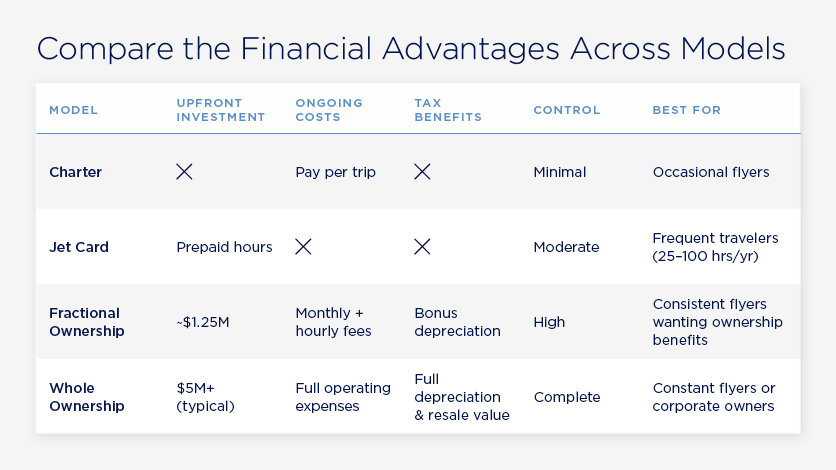
Below, we outline four common private aviation solutions — Charter, Jet Card, Fractional Ownership, and Whole Ownership — and how each can impact upfront cost, operating expenses, and tax outcomes.
1. Charter: Pay-as-You-Fly Flexibility
Ideal for travelers flying a few times per year, chartering provides full flexibility with no long-term commitments.
- Initial Investment: None beyond the trip cost.
- Ongoing Costs: None; pay per trip.
- Tax Implications: Charter flights offer no depreciation or ownership-based deductions.
- Financial Benefit: Flexibility without fixed commitments.
Chartering through Magellan Jets ensures access to aircraft from top-tier operators, vetted for safety, comfort, and reliability.
2. Jet Card: Predictable Access and Cost Control
Jet Cards, such as the Magellan Jet Card, offer prepaid hours (typically 25–100, which can be purchased in increments of 25 hours) for guaranteed aircraft access at fixed rates.
- Initial Investment: Upfront purchase of flight hours.
- Ongoing Costs: None related to maintenance or ownership.
- Financial Benefit: Predictable rates and guaranteed availability within program terms.
- Tax Implications: No ownership, therefore, no depreciation benefit.
This model is ideal for executives who fly regularly but prefer to avoid the complexities of asset management or residual value considerations.
3. Fractional Ownership: Strategic Asset Utilization

Fractional Ownership combines the benefits of access, asset control, and potential tax optimization. Owners purchase a share (often 1/8 or 1/16), typically starting at 50 hours annually.
- Initial Investment: From approximately $1.25 million for a three-year term (varies by aircraft type and provider).
- Ongoing Costs: Monthly management plus occupied hourly rates.
- Financial Benefit: Access to premium fleets with potential residual value at share exit.
- Tax Implications: Potential bonus depreciation and, in some cases, Section 179 benefits may apply based on business use.
Read more from Lewis Brisbois on how The One Big Beautiful Bill Act of 2025 (‘OBBBA’) permanently allows for 100 percent bonus depreciation for new and used aircraft ‘acquired’ and ‘placed in service’ on or after January 20, 2025:
100% Bonus Depreciation, Advanced Technical Implications
This creates significant planning opportunities for aircraft owners, particularly those entering fractional programs that meet IRS guidelines. Eligibility depends on qualified property status, business-use percentage, and proper documentation. Eligibility can depend on business-use percentage and proper documentation.
For many, this means accelerated depreciation, potentially allowing for full expense recognition in the first year, lowering taxable income and improving cash flow.
4. Whole Ownership: Total Control, Maximum Incentive
Whole Ownership represents the highest financial commitment and the greatest control.
- Initial Investment: Purchase price of the aircraft.
- Ongoing Costs: Crew, hangar, maintenance, insurance, and fuel — typically one million+ annually for large-cabin jets.
- Financial Benefit: Full access, asset appreciation potential, and long-term equity.
- Tax Implications: “The OBBBA provides potential advanced planning opportunities for current and prospective aircraft owners… to claim 100% bonus depreciation.”
This may allow a qualifying owner to deduct 100% of the aircraft’s purchase price in the first year it’s placed into service, subject to business-use thresholds and ability to meet definitions of “qualified property.” The result: a powerful tool for offsetting other taxable income while maintaining liquidity and asset control.
Strategic Tax Opportunities Under the OBBBA
According to the report by Lewis Brisbois LLP, The OBBBA permits a 100% bonus depreciation deduction for qualified property acquired and placed in service after January 20, 2025. This permanent change to Section 168(k) of the Internal Revenue Code replaces the previous phase-down of benefits and provides long-term certainty for investors in business aviation.*
In practical terms:
- Both Fractional and Whole Ownership arrangements may qualify if the asset and usage meet IRS requirements.
- Used aircraft may also be eligible if “acquired and placed in service” on or after the effective date.
- Proper structuring, documentation, and business-use substantiation are essential; owners should consult qualified tax counsel.
- Personal entertainment travel remains non-deductible.
The Magellan Jets Advantage
Magellan Jets provides bespoke aviation solutions aligned to each Client’s financial, operations, and lifestyle goals. Whether you’re seeking the flexibility of a Jet Card, the equity of Fractional Ownership, or the control of Whole Ownership, Magellan Jets delivers unparalleled service, compliance, and financial transparency.
Frequently Asked Questions About Private Aviation Financials (FAQ)
The following is general information, not tax or legal advice.
What is 100% bonus depreciation in private aviation?
Under the OBBBA, qualified new or used aircraft may be eligible for 100% bonus depreciation allows qualified aircraft purchases in the year they’re placed in service.
Can Fractional Owners claim depreciation?
Yes, if the ownership share qualifies as a capital investment in an aircraft used primarily for business purposes. Consult a tax attorney to confirm eligibility.
Do Jet Card or Charter programs qualify for bonus depreciation?
No. Because there is no ownership interest, Jet Card and Charter users cannot claim depreciation or related tax benefits.
What makes Whole Ownership financially advantageous?
Qualifying owners may deduct the full aircraft cost under the OBBBA, build asset equity, and benefit from future resale potential.
Take Flight with a Smarter Financial Strategy

Private aviation should advance your goals. Whether you’re seeking to streamline executive travel, optimize your portfolio with asset-based tax advantages, or design a personalized aviation strategy that reflects your lifestyle, Magellan Jets is here to help.
Our team of Private Aviation Advisors can guide you through every option, helping you leverage the full financial power of today’s private aviation landscape.
Connect with Magellan Jets today to explore a tailored solution that maximizes your investment, your time, and your freedom in the sky.
Disclaimer: This overview is for informational purposes only and does not constitute tax, legal, or accounting advice. Readers should consult their own advisors regarding their specific circumstances.
Quotations are provided for general information and may not reflect the latest guidance or specific facts.