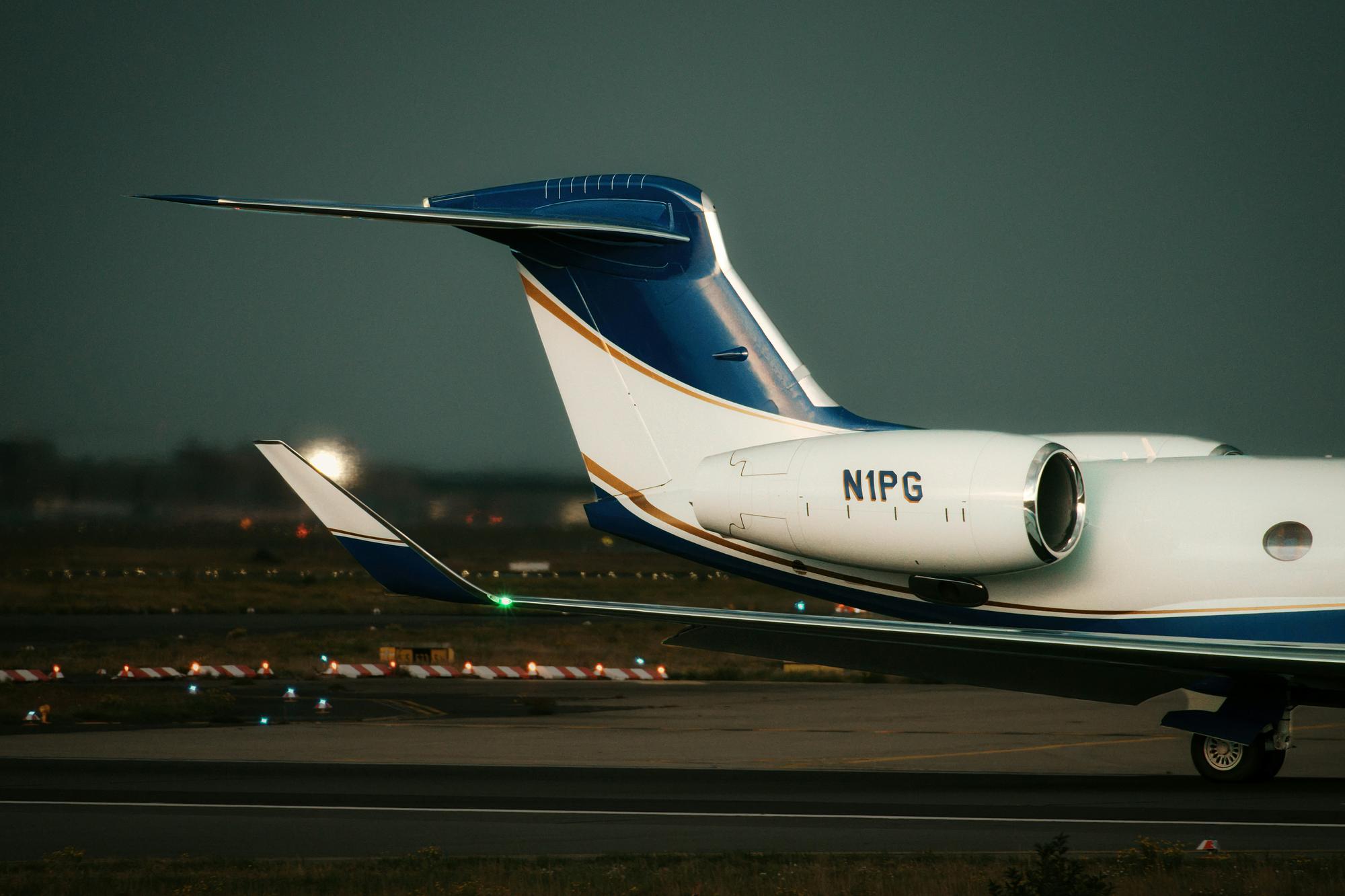
The Gulfstream G650 redefined what a private jet could deliver when it entered service in December 2012. With a maximum operating speed of Mach 0.925, a range of 6,890 nautical miles (7,437 nm for the ER variant), and a cabin designed for both productivity and rest, it remains one of the most sought-after ultra-long-range aircraft in the world.
What is the Gulfstream G650? The Gulfstream G650 is an ultra-long-range, large-cabin business jet manufactured by Gulfstream Aerospace. It seats up to 16 passengers in a flat-floor cabin measuring 46 ft 8 in long, 8 ft 2 in wide, and 6 ft 3 in tall. The aircraft connects distant city pairs nonstop – New York to Tokyo, Los Angeles to London, São Paulo to Dubai – making it the standard against which all ultra-long-range jets are measured.
The Gulfstream G650 Cabin and Interior Experience
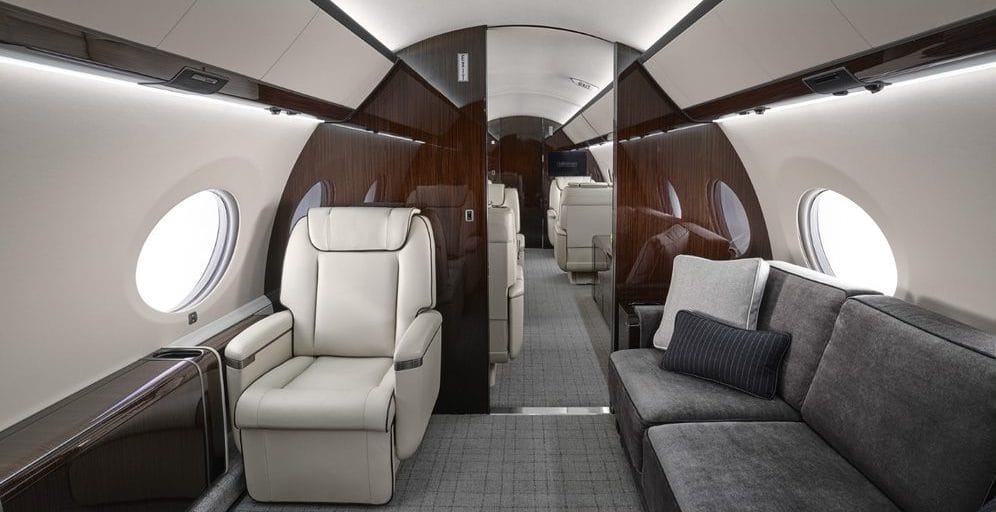
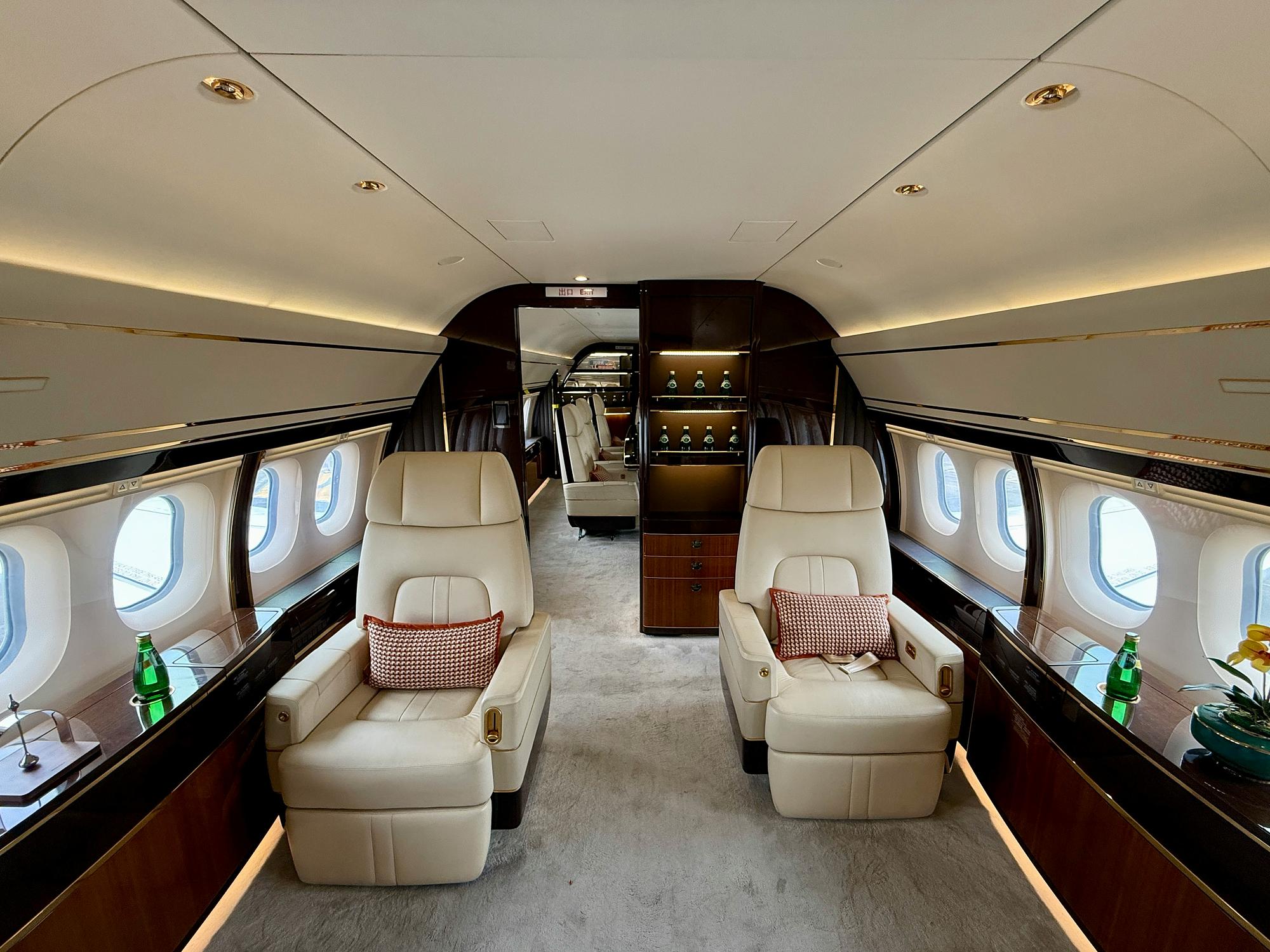
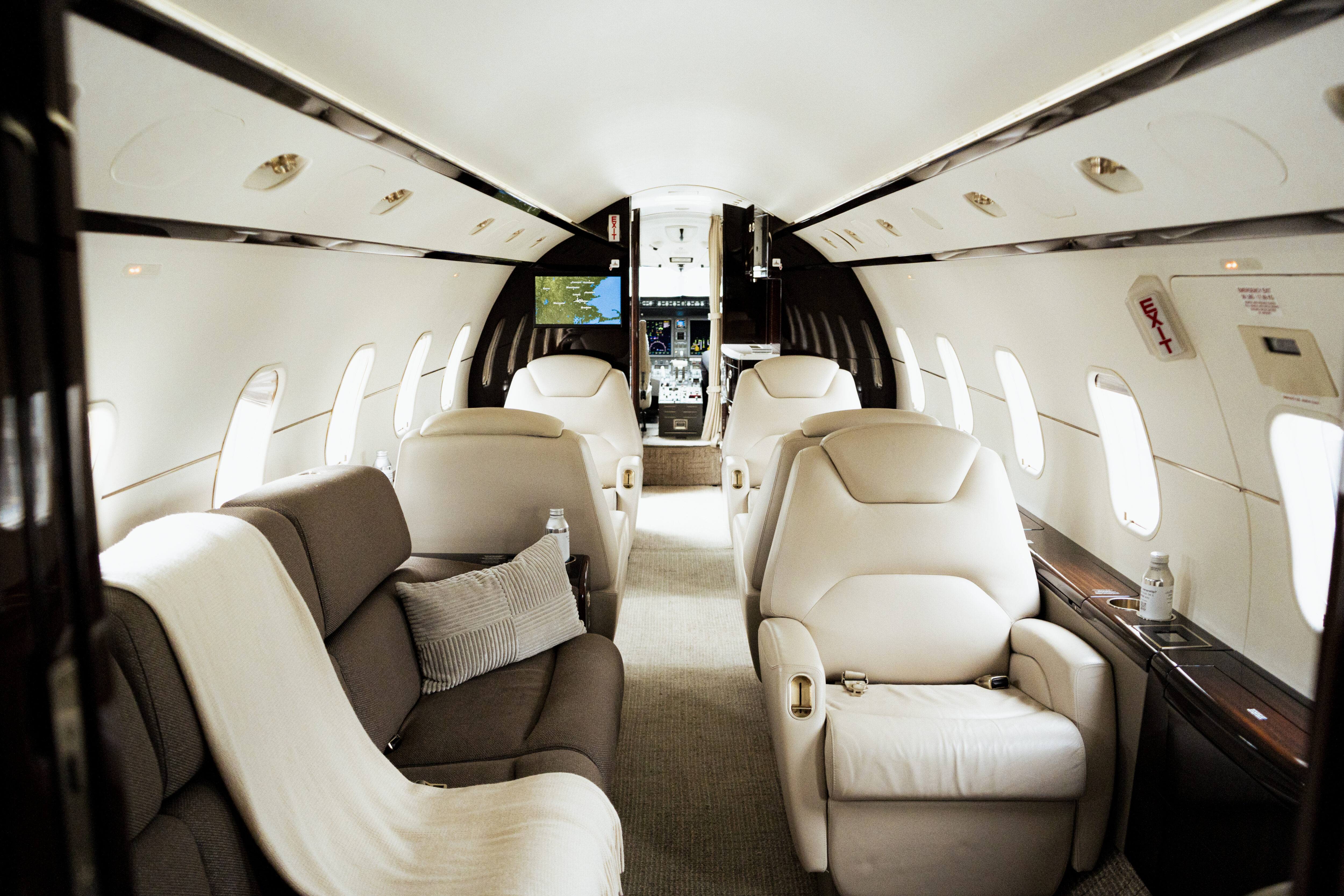
Step aboard the G650 and the cabin geometry speaks immediately. At 8 ft 2 in wide and 6 ft 3 in tall, this is one of the most spacious interiors in the large-cabin class. The flat floor runs the full 46 ft 8 in length, eliminating step-downs and making movement effortless from forward galley to aft stateroom.
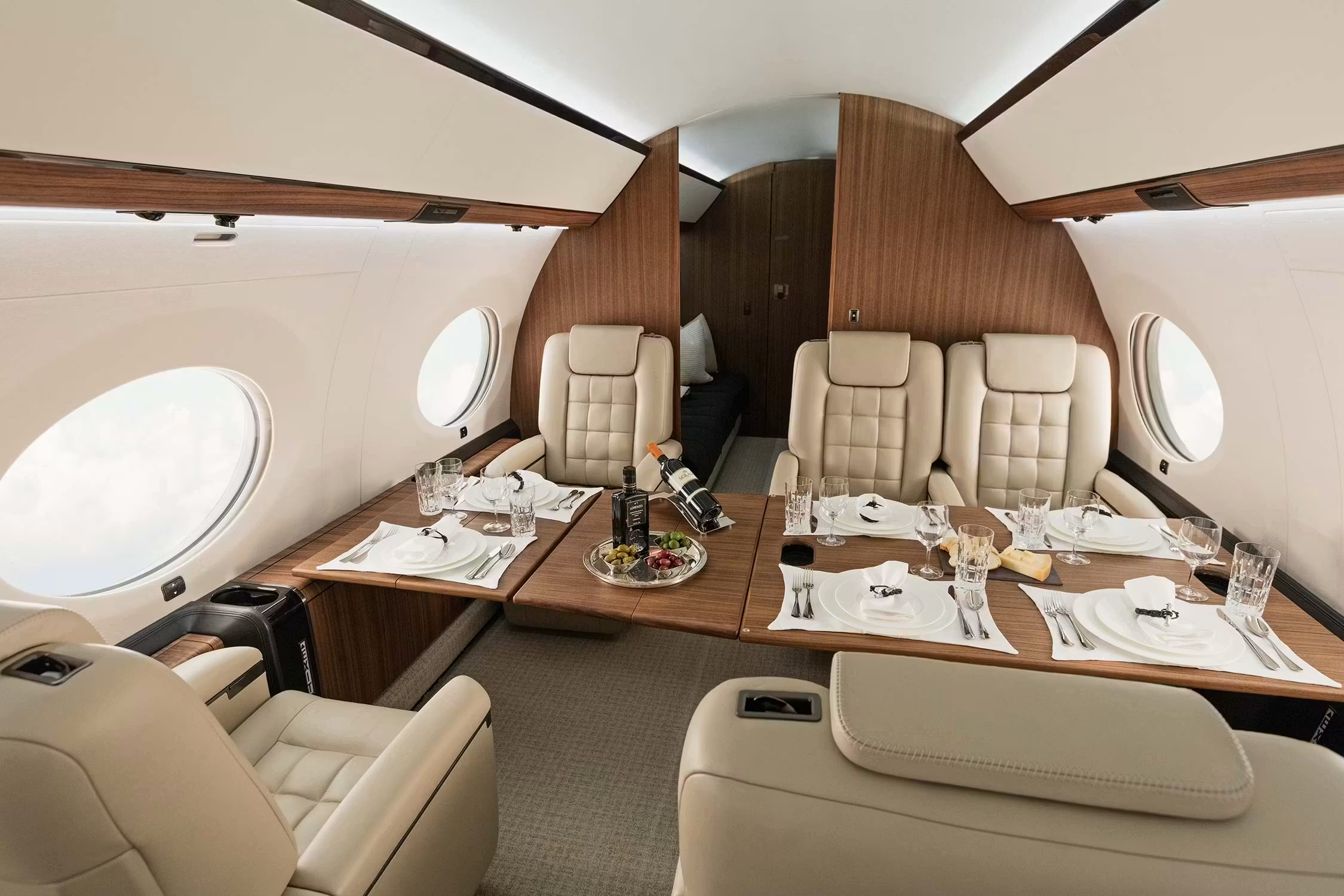
Most configurations seat 12–16 passengers across three or four distinct zones: a forward club section, a mid-cabin conference or dining group, and an aft private suite with convertible divan. Owners and charterers frequently configure the G650 with a full crew rest area and an enclosed lavatory forward, plus a second lavatory aft. Baggage capacity of 195 cubic feet means golf bags, skis, and extended-trip luggage travel with you, not on a separate logistics flight.
The cabin environment stands apart from commercial aviation – and from many competitors. Gulfstream’s environmental system circulates 100% fresh air, replaced approximately every two minutes, with no recirculated air mixing into the cabin. Cabin altitude at a typical 41,000-foot cruise sits around 3,000–4,000 feet – well below the cabin altitude of a typical airliner. The result is reduced fatigue and faster recovery after long-haul legs, an advantage Private Clients notice when stepping off a 12-hour flight ready for a meeting instead of a nap.
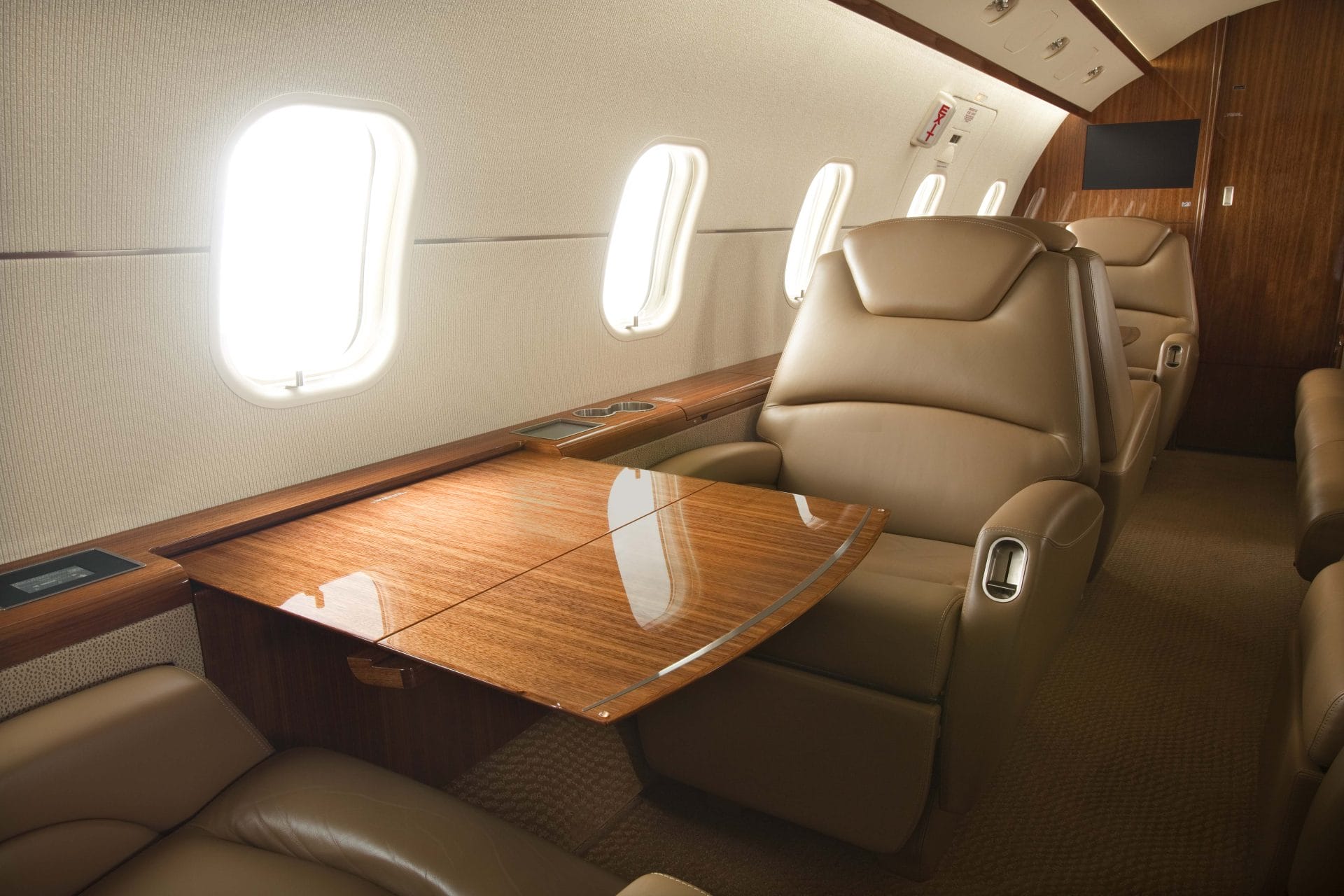
Large oval windows – the largest in the industry when the G650 launched – flood the cabin with natural light and reinforce the sense of space. Soundproofing, LED lighting that can simulate sunrise or sunset, and intuitive cabin-management touchscreens round out an interior engineered for both work and rest.
Speed and Performance: Among the Fastest Ultra-Long-Range Jets
The G650’s maximum operating speed of Mach 0.925 places it among the fastest ultra-long-range jets in widespread operation. That speed translates to concrete time savings: a Los Angeles–Tokyo leg completed in roughly 11 hours instead of 12, a New York–Dubai nonstop completed before the time-zone math becomes punishing.
With twin Rolls-Royce BR725 engines producing 16,900 pounds of thrust each, the aircraft climbs at 3,570 feet per minute – reaching its maximum operating altitude of 51,000 feet quickly and staying above weather and commercial traffic. That altitude also means less fuel burn in thinner air, extending effective range on long legs.
Takeoff field length of 5,858 feet (6,299 feet for the ER) keeps secondary airports accessible. A G650 can depart Teterboro for London nonstop, lift off from Van Nuys for Hong Kong, or use shorter runways in Sun Valley, Aspen, or St. Barts that would exclude larger jets. This combination of speed, range, and runway flexibility is why the G650 remains the reference aircraft for demanding international charter flights.
Range and the Missions It Unlocks
Range is where the G650 earns its reputation. The standard G650 covers 6,890 nm nonstop. The G650ER extends that to 7,437 nm, connecting virtually any two points on Earth with at most one fuel stop.
Transatlantic and Transpacific Capability
New York to Moscow, Los Angeles to Sydney (with one stop), London to Singapore, São Paulo to Cape Town – the G650ER handles these routes routinely. For Private Clients whose business or family commitments span continents, the aircraft removes the need to calculate fuel stops or overnight layovers. Time zones shift beneath you, but your schedule stays intact.
Domestic Coast-to-Coast Efficiency
On shorter legs like Boston to Los Angeles or Miami to Seattle, the G650’s range becomes reserve rather than requirement. That reserve translates to flexibility: alternate airports remain viable, weather diversions don’t strand passengers, and headwinds don’t force an unplanned fuel stop.
Magellan Jets Clients access the G650 through On-Demand Charter for individual missions, through Jet Cards for predictable annual travel, or through Fractional Ownership for those whose schedules require dedicated availability. The G650’s positioning across all three solutions reflects its versatility: it fits the executive who flies 50 hours annually as well as the family that logs 200.
Technical Specifications
How the Gulfstream G650 Compares to Other Ultra-Long-Range Jets
The G650 set the standard in 2012, and it remains competitive more than a decade later. Two aircraft now bracket it in the ultra-long-range segment: the Gulfstream G700 and the Bombardier Global 7500.
Gulfstream G700
Gulfstream’s current flagship, the G700 received FAA certification in March 2024 and began deliveries in April 2024. Its cabin stretches roughly 56 ft 11 in – approximately 10 feet longer than the G650 – and can be configured with five living areas plus a dedicated crew rest. Range reaches 7,750 nm at Mach 0.85, and top speed increases to Mach 0.935. For Clients who need the largest possible Gulfstream cabin, the G700 represents the next step. For those whose missions fit within the G650’s envelope, the older aircraft offers similar performance at lower acquisition and operating costs.
Bombardier Global 7500
The Bombardier Global 7500 competes directly with the G650ER. Baseline range is 7,700 nm, and top speed matches the G650 at Mach 0.925. Cabin width is slightly narrower, but Bombardier’s four-zone layout offers comparable space. The choice between G650ER and Global 7500 often comes down to cabin configuration preference and availability rather than performance.
Both alternatives highlight a key truth about the G650: it established the benchmarks its successors now refine. Clients who don’t require the G700’s additional cabin length or the Global 7500’s specific layout often find the G650 remains the ideal balance of space, speed, range, and cost.
Flying the Gulfstream G650: Crew, Certification, and Who It Suits
The G650 is certificated for a two-pilot crew – it cannot be operated single-pilot. For charter and Jet Card Clients, this is handled transparently; every mission includes a fully qualified flight crew sourced through the Magellan Jets Preferred Network. For owners considering Aircraft Sales & Management, the two-pilot requirement factors into annual crew costs but also ensures redundancy and safety on long international legs.
The G650 is well-suited to several traveler profiles:
International executives who fly transatlantic or transpacific routinely and need to arrive ready to work.
Families traveling together on multi-leg itineraries, with room for children to move and sleep.
Groups of 10–16 who would otherwise split across two smaller aircraft.
Travelers with mobility considerations, since the flat floor and spacious cabin simplify boarding and movement.
Adventurers whose trips include golf clubs, skis, or other bulky gear that fits in the 195-cubic-foot baggage hold.
For more on how Magellan Jets evaluates operators, crew qualifications, and aircraft maintenance standards, see our approach to safety.
For Clients who prefer access without ownership, the G650 charters at an estimated hourly rate of $12,989 for the Heavy Jet category. This rate is inclusive of fuel but does not include contingencies such as de-icing, positioning, overnight fees, catering, ground transportation, or international fees. Final pricing is confirmed at time of quote.
That hourly rate means a five-hour leg – Boston to Los Angeles, for example – falls in a different economic bracket than a 12-hour transatlantic mission. Magellan Jets Private Aviation Advisors help Clients model true trip costs, identify when a Jet Card offers better per-hour economics than On-Demand Charter, and match the aircraft to the mission rather than defaulting to the largest cabin available.
Frequently Asked Questions About the Gulfstream G650 (FAQs):
How much does a Gulfstream G650 cost?
The G650ER had a new list price of approximately $70.5 million before production ended in February 2025. Pre-owned examples recently averaged about $35 million in asking price, with newer, low-time aircraft listed higher (into the low $50 millions).
How much does it cost to charter a Gulfstream G650?
Charter pricing for a G650 starts at an estimated $12,989 per flight hour (Heavy Jet category). This rate is inclusive of fuel but excludes de-icing, positioning, overnight fees, catering, ground transportation, and international fees. Final pricing is confirmed at time of quote.
Can a Gulfstream G650 be flown by one pilot?
No. The G650 is certificated for a two-pilot crew and cannot be operated single-pilot. All charter and Jet Card missions include a fully qualified two-pilot crew as standard.
What are the key specs and dimensions of the Gulfstream G650?
The G650 cabin measures 46 ft 8 in long, 8 ft 2 in wide, and 6 ft 3 in tall. It seats up to 16 passengers. Range is 6,890 nm (G650) or 7,437 nm (G650ER). Maximum operating speed is Mach 0.925, and maximum operating altitude is 51,000 ft.
Can the Gulfstream G650 fly across the Atlantic nonstop?
Yes. The G650 and G650ER both complete transatlantic routes nonstop – New York to London, Los Angeles to Paris, Boston to Geneva. The G650ER extends range to 7,437 nm, covering nearly any city pair on Earth with at most one fuel stop.
How does the G650 compare to the G700, and is the G700 bigger?
Yes, the Gulfstream G700 is larger. Its cabin stretches approximately 56 ft 11 in – about 10 feet longer than the G650. The G700 also offers greater range (7,750 nm) and slightly higher top speed (Mach 0.935). For Clients whose missions fit within the G650’s envelope, the older aircraft remains an excellent value with comparable performance.
Experience the Gulfstream G650 With Magellan Jets
The G650 continues to define ultra-long-range private aviation more than a decade after its debut. Its cabin remains among the most spacious in its class, its range covers the routes that matter, and its performance record – 500+ deliveries, 120+ speed records – speaks to engineering that has held up over time.
Whether you’re evaluating a G650 for charter, considering a Jet Card for predictable annual travel, or exploring pre-owned acquisition through Aircraft Sales & Management, Magellan Jets can help you find the right fit. Every recommendation is made in your interest, backed by the Magellan Jets Preferred Network and a team that has been coordinating complex international missions since 2008.
The Gulfstream G650 is the aircraft that redefined what’s possible in private aviation. With a range of 6,890 nautical miles, a cruise speed of 528 knots, and a cabin configured for up to 16 passengers, this ultra-long-range heavy jet can carry you nonstop from New York to Dubai, Los Angeles to London, or nearly any two points on Earth. For executives, families, and travelers who measure time as their scarcest resource, the G650 offers something rare: the ability to reach virtually anywhere without compromise.
Performance and Range: Reach Any Destination Nonstop
The Gulfstream G650’s performance begins with reach. At 6,890 nautical miles, the range opens routes that other aircraft simply cannot cover in a single leg. New York to Tokyo. London to Buenos Aires. San Francisco to Sydney with one stop. The G650 transforms global travel into direct travel.
Speed amplifies that advantage. A cruise of 528 knots – roughly 608 miles per hour – compresses transcontinental and transoceanic flights into hours rather than the better part of a day. And at a maximum altitude of 51,000 feet, the G650 flies above commercial traffic and most weather, delivering a smoother ride while optimizing fuel efficiency on long sectors.
These numbers translate into something simpler: you leave when you’re ready, arrive on your schedule, and spend less time in transit than any other option allows. For business travel where the meeting is in Singapore tomorrow, or for family travel where you’d rather wake up in Cape Town than connect through two hubs, the G650 delivers.
Inside the Gulfstream G650: A Cabin Built for the Journey
The G650 private jet cabin is where range and speed become experience. At 46 feet 8 inches long, 8 feet 2 inches wide, and 6 feet 3 inches tall, the interior offers more than 2,400 cubic feet of pressurized volume. Most passengers can stand fully upright. The flat floor – a defining feature of the G650 – allows unobstructed movement throughout the cabin, whether you’re walking to a meeting area or allowing children to stretch between time zones.
The multi-zone layout typically includes forward and aft seating areas, a dedicated workspace or dining section, and a private stateroom. Configurations vary by aircraft, but the design philosophy is consistent: distinct zones for work, rest, and conversation, all within a single cabin. Baggage capacity of 195 cubic feet means ski equipment, golf clubs, or luggage for extended travel fits without the compromises commercial travel demands.
For Clients traveling with dogs, those with limited mobility, or families with young children, the flat-floor cabin and generous dimensions make the G650 notably accommodating. The interior is designed for how people actually travel – not for a brochure.
Gulfstream G650 vs. G650ER: Understanding the Extended-Range Variant
The Gulfstream G650ER extends the G650’s already considerable range to 7,437 nautical miles. That additional 547 nautical miles opens a handful of city pairs that fall just outside the G650’s envelope – Hong Kong to New York nonstop, or São Paulo to Moscow without a fuel stop.
Cabin dimensions, passenger capacity (up to 16), and cruise performance remain identical. The G650ER achieves its additional range through fuel system modifications and slightly higher maximum takeoff weight. For most Clients, the decision between G650 and G650ER comes down to specific routing needs. A Private Aviation Advisor can help determine whether those additional miles matter for the destinations on your calendar.
Chartering the Gulfstream G650 With Magellan Jets
Magellan Jets coordinates Gulfstream G650 charter through On-Demand Charter, matching each mission to the right aircraft from the Magellan Jets Preferred Network – a group of fewer than 100 rigorously vetted Part 135 operators out of roughly 3,000 licensed in the United States. This asset-light model means recommendations are made in the Client’s interest, not to fill a company-owned fleet.
The G650 falls within the Heavy Jet category in Magellan Jets’ aircraft classification. Chartering typically begins with a conversation with a Private Aviation Advisor who reviews itinerary requirements, passenger count, baggage needs, and timing. From there, the Magellan Jets team sources available G650 aircraft, confirms operator credentials, and coordinates every detail – ground transportation, catering, customs clearance for international travel, and any specific requests.
For Clients who fly frequently, the Jet Card program offers guaranteed availability with preferred rates locked at purchase. For those acquiring or already owning a G650, Aircraft Sales & Management provides operational oversight and placement into the Preferred Network when the aircraft isn’t in personal use.
Gulfstream G650 Specifications
Frequently Asked Questions About the Gulfstream G650 (FAQs)
How much does it cost to charter a Gulfstream G650?
Chartering a Gulfstream G650 through Magellan Jets starts at an estimated $13,000 to $15,000 per hour for Heavy Jet category aircraft. This hourly estimate is inclusive of fuel but does not include contingencies such as de-icing, positioning, overnight fees, catering, ground transportation, international fees, or other trip-specific costs. Final pricing is confirmed at time of quote by a Magellan Jets Private Aviation Advisor based on route, dates, aircraft availability, and specific trip requirements.
How far can the Gulfstream G650 fly?
The Gulfstream G650 has a range of 6,890 nautical miles, enabling nonstop flights between city pairs such as New York to Dubai, Los Angeles to London, and London to Buenos Aires. The extended-range G650ER increases that figure to 7,437 nautical miles, adding a handful of ultra-long routes to the nonstop envelope.
How many passengers does the Gulfstream G650 seat?
The Gulfstream G650 accommodates up to 16 passengers, though most charter configurations seat 12 to 14 with optimal comfort and workspace. The flat-floor cabin allows flexible zone arrangements for meetings, dining, rest, or mixed-use layouts depending on how your group travels.
How fast is the Gulfstream G650?
The G650 cruises at 528 knots, equivalent to approximately 608 miles per hour. Combined with a maximum cruise altitude of 51,000 feet, the G650 operates above most commercial traffic and weather, reducing turbulence and transit time on long-haul routes.
What is the difference between the G650 and G650ER?
The Gulfstream G650ER adds 547 nautical miles of range over the standard G650, extending total range from 6,890 to 7,437 nautical miles. Cabin dimensions, passenger capacity, cruise speed, and altitude capability are identical. The G650ER is suited to Clients whose regular routes require that additional reach – certain Asia–North America and South America–Europe nonstops, for example.
Ready to Charter a Gulfstream G650?
Whether you’re considering your first charter or evaluating how the G650 fits a demanding international schedule, a Magellan Jets Private Aviation Advisor can walk you through aircraft options, availability, and pricing for your specific itinerary.
Two of the most-requested private jets sit just one cabin class apart. The Phenom 300 vs. Citation Excel decision comes down to a single question: which aircraft matches the mission in front of you. One is a light jet that out-ranges its class, and the other is a midsize jet built for more people and more room. This guide reads the validated numbers so you can choose with confidence.
Two Jets, Two Missions: How the Phenom 300 and Citation Excel Differ
The Phenom 300 is a light jet, and the Citation Excel/XLS is a midsize jet. That single class difference shapes range, cabin size, passenger capacity, cruise speed, and hourly cost. A light jet is built for efficient regional and coast-to-coast trips with a compact cabin.
A midsize jet gives up a little airport access in exchange for more room and more seats. Neither aircraft is better in the abstract. The right answer depends on the mission you fly most often.
Range and Runway: Where the Phenom 300 Punches Above Its Class
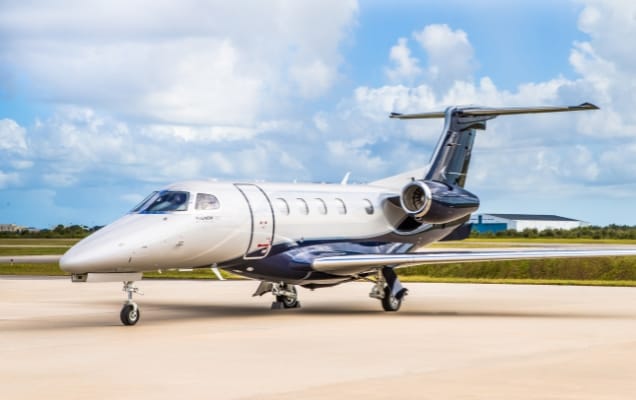
The Phenom 300
Here the lighter aircraft surprises people. The Phenom 300 flies up to 2,019 nm, farther than the Citation Excel/XLS at 1,989 nm. For an East Coast Private Client, that range reaches most transcontinental city pairs nonstop.
The Phenom 300 also needs less runway. Its FAA takeoff field length is 2,220 ft, against 2,739 ft for the Citation Excel/XLS (Magellan Jets Aircraft Specifications). Shorter field performance opens airports closer to your destination, such as Teterboro Airport (KTEB) outside New York or Hanscom Field (KBED) near Boston.
The Phenom 300 series is the world’s best-selling light jet for the 14th consecutive year. That ranking is based on 2025 delivery data. The record translates into broad availability and a deep operator base across charter fleets.
Cabin, Capacity, and Comfort: The Citation Excel’s Advantage
Citation Excel Interior
The Citation Excel/XLS answers with space. Its cabin stands 5 ft 7 in tall, against 4 ft 9 in in the Phenom 300 (Magellan Jets Aircraft Specifications). That taller ceiling lets most passengers stand and move freely.
Cabin volume tells the same story: 422 cu ft in the Citation Excel/XLS versus 324 cu ft in the Phenom 300. The midsize jet seats up to eight passengers, two more than the Phenom’s six. It carries 90 cu ft of baggage against 85 cu ft.
Even so, the Phenom 300 holds the largest baggage capacity in the light-jet class. The Citation Excel/XLS belongs to the Cessna Citation line, the world’s most-delivered series of business jets, prized for reliability and short-field performance. For a Private Client flying with family or a full team, that room earns its keep.
Speed and Ceiling: Reading the Real Numbers
Speed favors the midsize jet. The Citation Excel/XLS holds a normal cruise of 433 kn, faster than the Phenom 300 at 383 kn. On a long transcontinental leg, that 50 kn edge trims time from the schedule.
Both jets share the same service ceiling of 45,000 ft. Flying that high lets crews climb above most weather and commercial traffic. That supports smoother, more direct routing on either aircraft.
What It Costs to Charter Each Jet
Light jet charter for the Phenom 300 starts from an estimated $7,544 per hour. Midsize jet charter for the Citation Excel/XLS starts from an estimated $8,550 per hour. Each rate is inclusive of fuel.
These estimates exclude contingencies such as de-icing, positioning, overnight fees, catering, and ground transportation, with final pricing confirmed at time of quote. The higher midsize rate reflects the larger cabin, greater capacity, and faster cruise. Whether that premium is worth it depends on your passenger count and route.
The Detail Most Comparisons Miss: You Don’t Have to Choose
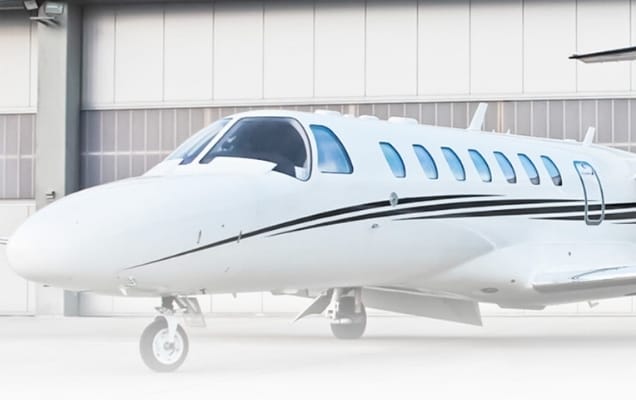
Citation Excel
The Phenom 300 vs. Citation Excel comparison usually ends with “it depends on your trip.” The more useful insight is that you do not have to fly the same jet every time. Magellan Jets is an asset-light private aviation solutions provider offering Jet Cards, On-Demand Charter, Fractional Ownership, and Aircraft Sales & Management.
Because it owns no fleet, Magellan Jets sources each mission from the Magellan Jets Preferred Network of fewer than 100 vetted operators. Every recommendation serves the Private Client’s interest.
The Premium Jet Card gives a Private Client a dedicated Phenom 300. Its callout window, the minimum notice before a flight, runs as low as 24 hours, with de-icing and catering included.
The Jet Card program also offers the Category Jet Card. It lets a Private Client interchange across Light, Midsize, Super-Mid, and Heavy jets as the mission changes.
Safety underwrites every option. Magellan Jets holds WYVERN Wingman certification, a third-party aviation safety designation, and sits on the Air Charter Safety Foundation (ACSF) Board. Its operators carry $100 million to $300 million in liability insurance, and its captains average 9,700+ flight hours.
The Phenom 300 and Citation Excel/XLS are not rivals so much as two answers to two missions. Choose the Phenom 300 when range and airport access lead. Choose the Citation Excel/XLS when cabin room, capacity, and speed matter most.
The sharper decision is often the program, not the airframe, since the right provider puts either jet within reach. To fly the right one on any given day, Contact a Private Aviation Advisor.
Frequently Asked Questions About the Phenom 300 vs. Citation Excel (FAQs):
Which jet has more range, the Phenom 300 or the Citation Excel?
The Phenom 300 flies up to 2,019 nm, slightly farther than the Citation Excel/XLS at 1,989 nm (Magellan Jets Aircraft Specifications). For most regional and transcontinental trips, both aircraft cover the distance nonstop.
Which cabin is larger?
The Citation Excel/XLS has the larger cabin. It offers 422 cu ft of volume and stands 5 ft 7 in tall (Magellan Jets Aircraft Specifications). The Phenom 300 offers 324 cu ft and stands 4 ft 9 in. The Citation Excel/XLS also seats up to eight passengers rather than six.
Is the Phenom 300 or the Citation Excel faster?
The Citation Excel/XLS cruises faster, at a normal cruise of 433 kn compared with 383 kn for the Phenom 300 (Magellan Jets Aircraft Specifications). Both jets share a service ceiling of 45,000 ft.
Which jet can use smaller airports?
The Phenom 300 can access more small airports. It needs an FAA takeoff field length of 2,220 ft, shorter than the 2,739 ft the Citation Excel/XLS requires (Magellan Jets Aircraft Specifications). That opens more runways close to your destination.
How much does it cost to charter each jet?
Light jet charter for the Phenom 300 starts from an estimated $7,544 per hour. Midsize jet charter for the Citation Excel/XLS starts from an estimated $8,550 per hour, inclusive of fuel. Both estimates exclude contingencies such as de-icing, positioning, and catering, with final pricing confirmed at time of quote.
A “G6” jet is the Gulfstream G650, an ultra-long-range business jet. The nickname comes from the 2010 Far East Movement song “Like a G6.” No aircraft is officially named “G6.” The term became shorthand for the top of business aviation. It still points to the Gulfstream G650 today.
Where the “G6” Name Came From
The 2010 song “Like a G6” pushed the phrase into everyday language. The songwriters coined “G6” as an escalation from “G4,” not a specific aircraft. The lyric never referenced the Gulfstream G650. Fans and the private aviation world later connected the two. Over time, “G6” became shorthand for the Gulfstream G650, the flagship of Gulfstream’s lineup.
The label stuck for a reason. The Gulfstream G650 arrived as one of the fastest, longest-range business jets in the world. The nickname still carries that weight, even years after the song faded from the charts.
Culture and aviation rarely overlap so cleanly. A pop lyric gave a technical aircraft a household name. Today, someone searching “what is a G6 jet” is usually asking about the Gulfstream G650. This guide answers that question in full.
Gulfstream G650 Specifications
The Gulfstream G650 pairs long-haul reach with high cruise speed. It entered service in December 2012. The verified specifications are below.
These numbers explain the aircraft’s reputation. A 7,000 nautical mile range links distant business capitals nonstop. A 51,000 foot ceiling lets it climb above much of the traffic and weather. Two Rolls-Royce BR725 engines supply the thrust behind that performance.
Speed adds to the picture. A max operating speed of Mach 0.925 places the Gulfstream G650 among the quickest business jets. Long range and high speed together shorten the calendar. A same-day return across a continent becomes realistic.
G650 vs G650ER
The two aircraft share a cabin and cruise profile. The difference is reach. The Gulfstream G650 flies 7,000 nautical miles. The Gulfstream G650ER extends that to 7,500 nautical miles at Mach 0.85.
Those extra 500 nautical miles open more nonstop city pairs. Routes that once needed a fuel stop can become a single leg. The added range also raises the price.
In 2023, the Gulfstream G650ER carried a new equipped price of $70.5 million. The Gulfstream G650 was $68.5 million. The right choice depends on the routes you fly most. Your Private Aviation Advisor can map that against your travel pattern.
Consider a specific example. A regular nonstop between the U.S. East Coast and the Middle East favors the ER. Its added range removes a fuel stop on that mission. For mostly transatlantic travel, the standard G650 may serve just as well.
How Much Does a Gulfstream G650 Cost
Cost depends on age, hours, and configuration. In 2023, a new equipped Gulfstream G650 was priced at $68.5 million. The Gulfstream G650ER was $70.5 million.
Pre-owned examples trade below those figures. Values shift with the market and each aircraft’s history. Newer jets with lower hours hold their value more firmly.
The purchase price is only the start. Ownership also carries crew salaries, maintenance, insurance, and hangar costs. Those figures add up across a year of flying. For many Private Clients, chartering the aircraft answers the need without that long-term commitment.
Inside the G650 Cabin
The cabin is built around one outcome: you arrive ready. You can rest across long segments, then land prepared for the meeting. You can work in quiet, then step off refreshed.
Space supports that outcome. The cabin measures 8 feet 2 inches wide and 6 feet 3 inches high. It holds 2,138 cubic feet and seats 11 to 18. Room to move matters most on the longest journeys.
The width lets you stand, stretch, and reset between time zones. The volume gives a group space to spread out. On a nonstop transoceanic flight, that space shapes how you feel on landing. The cabin is designed so distance costs you less.
Large windows bring in daylight across the length of the cabin. A lower cabin altitude reduces the fatigue of long flights. These details serve one goal. You should feel better on arrival than you would on any shorter aircraft.
The cabin also adapts to how you travel. A group of colleagues can hold a working session in flight. A family can rest and dine in comfort. The Gulfstream G650 interior is configured to suit the mission, not a single template.
Is the Gulfstream G650 Still in Production
Production of the Gulfstream G650 concluded in February 2025. Gulfstream succeeded it with the Gulfstream G800, alongside the Gulfstream G700. Both build on the G650’s long-range foundation.
The end of production did not retire the aircraft. The Gulfstream G650 remains widely flown around the world. It stays available on the charter and pre-owned markets. Clients can still fly the aircraft today without buying a new airframe.
A mature fleet also brings practical advantages. Operators know the aircraft well, and support networks are established. For a Client who wants the G650 experience, access has rarely been simpler. The aircraft’s standing has not dimmed with its successors.
How to Fly on a Gulfstream G650
You do not have to buy a Gulfstream G650 to fly one. Magellan Jets is a private aviation solutions provider, not an aircraft owner. We source the right aircraft for each mission.
We access the Gulfstream G650 through the Magellan Jets Preferred Network. That network is fewer than 100 rigorously vetted operators. Every recommendation is made in the Client’s best interest, because we own no fleet to fill.
Each path is matched to how you travel. Your Private Aviation Advisor helps you choose the right one. You can also review the full aircraft lineup to compare your options.
Frequently Asked Questions About G650 Jets (FAQs):
Does a G6 plane exist?
Yes, in the sense most people mean. “G6” is a nickname for the Gulfstream G650. No aircraft is officially named “G6.”
What does a Gulfstream G650 cost?
In 2023, a new equipped Gulfstream G650 was priced at $68.5 million. The Gulfstream G650ER was $70.5 million. Pre-owned examples trade lower.
How many passengers can a G650 carry?
The Gulfstream G650 seats 11 to 18 passengers. The final number depends on the cabin configuration.
What is the range of a Gulfstream G650?
The Gulfstream G650 flies 7,000 nautical miles. The Gulfstream G650ER extends that to 7,500 nautical miles.
How fast is the Gulfstream G650?
Its max operating speed is Mach 0.925 (Mmo). Typical cruise sits between Mach 0.85 and Mach 0.90.
Is the Gulfstream G650 still made?
Production ended in February 2025. The Gulfstream G800 succeeded it. The G650 is still flown widely and remains a favorite among high-profile owners.
That thrust-to-weight ratio translates directly to numbers pilots care about. Maximum cruise reaches 486 knots at altitude. The manufacturer states a range of 2,500 nautical miles; under NBAA IFR reserves with four passengers, expect closer to 2,205 nautical miles. Exceptional for a light jet, though not sufficient for nonstop transatlantic crossings.
The 49,000-foot ceiling places the SJ30 above most weather and commercial traffic. Pilots flying at these altitudes experience smoother air and more direct routing. For single-pilot operators covering long distances, this altitude capability matters.
The Cockpit and Cabin: Designed for the Pilot Who Flies Alone
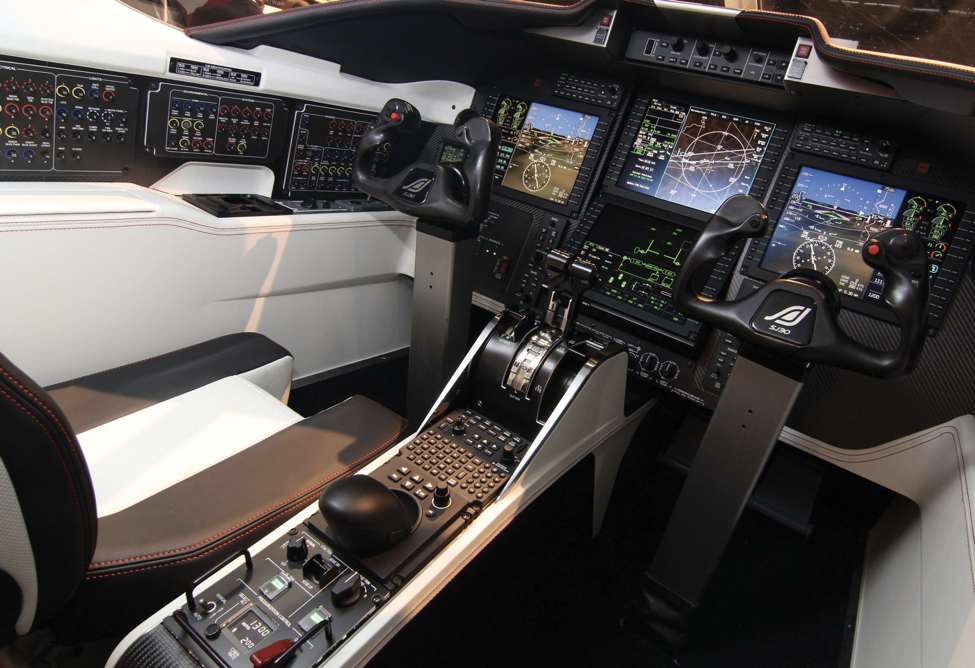
The SJ30 received FAA certification for single-pilot operation. Its cockpit was designed around one pilot managing the full flight envelope without compromise. For owner-operators and professional pilots seeking a light jet that performs at heavy-jet altitudes, the SJ30’s single-pilot capability is central to its appeal.
The practical benefit is tangible. As one SJ30 owner noted, even at 47,000 feet the cabin altitude registers only 800 feet. Passengers arrive less fatigued, and pilots operating long sectors notice the difference in their own alertness.
This cabin environment was not an afterthought. Ed Swearingen, the aeronautical engineer behind the design, built the entire airframe around pressurization. That choice shaped the fuselage structure, the wing integration, and the systems architecture.
That scarcity defines the SJ30’s place in private aviation. This is not an aircraft you charter casually. It is one that a small circle of pilots and collectors know intimately.
What Pilots Say About Flying the SJ30
The pilots who have flown the SJ30 describe an aircraft that responds to precise, deliberate flying. One owner characterized it as “very maneuverable, fast, and with long legs” after logging roughly 120 hours, including a 52-day trip around Africa. The handling qualities reflect Ed Swearingen’s aerodynamic priorities: clean lines, efficient lift, and predictable behavior across the flight envelope.
At high altitude, the SJ30 finds its element. The combination of the 49,000-foot ceiling and the sea-level cabin environment creates conditions that favor long-range single-pilot operations. Pilots report less fatigue on extended sectors, and the ability to climb above weather and traffic provides routing flexibility that lower-ceiling aircraft cannot match.
The record flights tell the story. When the SJ30 flew from San Antonio to the 2007 Dubai Air Show, it covered 7,810 nautical miles in 16 hours and 24 minutes of flight time, averaging 476 knots and setting a record distance for any aircraft under 20,000 pounds in a 24-hour period. That flight showed what the airframe could deliver in skilled hands.
How to Fly a Comparable Light Jet Today
For Private Clients seeking the light jet experience – speed, efficiency, and cabin comfort for up to six passengers – Magellan Jets’ On-Demand Charter program sources aircraft through the Magellan Jets Preferred Network. Because Magellan operates on an asset-light model, every recommendation matches the mission, not a fleet-utilization target.
The Phenom 300, for example, offers modern avionics, seating for up to six passengers, and nonstop capability across the Eastern Seaboard. It represents the current benchmark in the light jet category. For Private Clients intrigued by the SJ30’s specifications but seeking an aircraft readily available for charter, comparable modern light jets deliver similar range and cabin comfort with established support networks.
Jet Card holders can access these aircraft with guaranteed availability 365 days a year. On-Demand Charter serves those flying fewer than 25 hours annually or requiring supplemental lift beyond a card’s profile.
Frequently Asked Questions About the SyberJet SJ30 (FAQs):
The manufacturer states 2,500 nautical miles. Under NBAA IFR reserves with four passengers, expect approximately 2,205 nautical miles – excellent for a light jet, though not sufficient for nonstop transatlantic crossings.
Is the SyberJet SJ30 Certified for Single-Pilot Operation?
Yes. The SJ30 received FAA certification for single-pilot operation, making it suitable for owner-operators and professional pilots who prefer to fly without a second crew member.
How Many SJ30s Were Built, and Can You Charter One?
Approximately 10 airframes were built during the original production run, and only one SJ30 was reportedly flying as of 2023. The type is not available through standard charter networks.
How Much Does It Cost to Charter a Light Jet?
While the SJ30 itself is not a mainstream charter option, comparable modern light jets are available through Magellan Jets. Magellan Jets’ current estimated hourly rate for Light Jet charter is $7,544, inclusive of fuel. This estimate does not include contingencies such as de-icing, positioning, overnight fees, or other trip-specific costs. Final pricing is confirmed at time of quote.
Explore Light Jet Charter With Magellan Jets
The SJ30 represents a singular vision: a light jet built without compromise on altitude, speed, or cabin environment. For Private Clients drawn to that ethos but seeking an aircraft available today, Magellan Jets’ Private Aviation Advisors can match the right light jet to your mission – whether that means a Phenom 300 for regional travel or a larger category for transcontinental range.
Private aviation continues to evolve as travelers prioritize efficiency, flexibility, and comfort. At Magellan Jets, we see clear trends in the aircraft clients request most often. Certain jets consistently rise to the top because they combine performance, cabin comfort, and operational reliability.
The aircraft below represent the 10 most popular private jets requested through Magellan Jets. Each offers a strong balance of range, speed, and cabin experience for business travel, family trips, and international itineraries.
Understanding the strengths of each aircraft helps travelers choose the right jet for every mission. Many of these aircraft also align with the benefits of the Magellan Jets Premium Jet Card, which provides guaranteed access to specific aircraft types, shorter call-out times, and predictable pricing.
1. Citation Excel
The Citation Excel remains one of the most requested aircraft among Magellan Jets clients. It delivers an ideal balance of performance, efficiency, and comfort for regional travel.
This midsize jet seats up to eight passengers and features a stand-up cabin that feels more spacious than many jets in its category. It also performs well at smaller airports, allowing travelers to fly closer to their final destination.
Key features
Seats up to 7 passengers
Range: ~4 hours or fewer
Stand-up cabin with strong baggage capacity
Excellent for regional travel and business trips
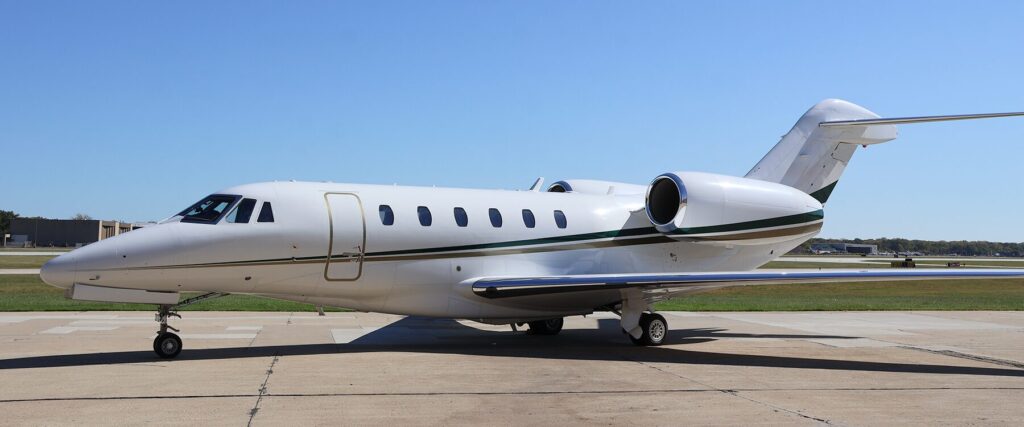
2. Citation X
The Citation X stands out as one of the fastest private jets ever built. When time matters, this aircraft dramatically reduces travel time.
It cruises near Mach 0.92 and is ideal for coast-to-coast missions or tightly scheduled itineraries.
Key features
Cruise speed near Mach 0.92
Seats up to 8 passengers
Range: ~6 hours or fewer
Ideal for fast transcontinental travel
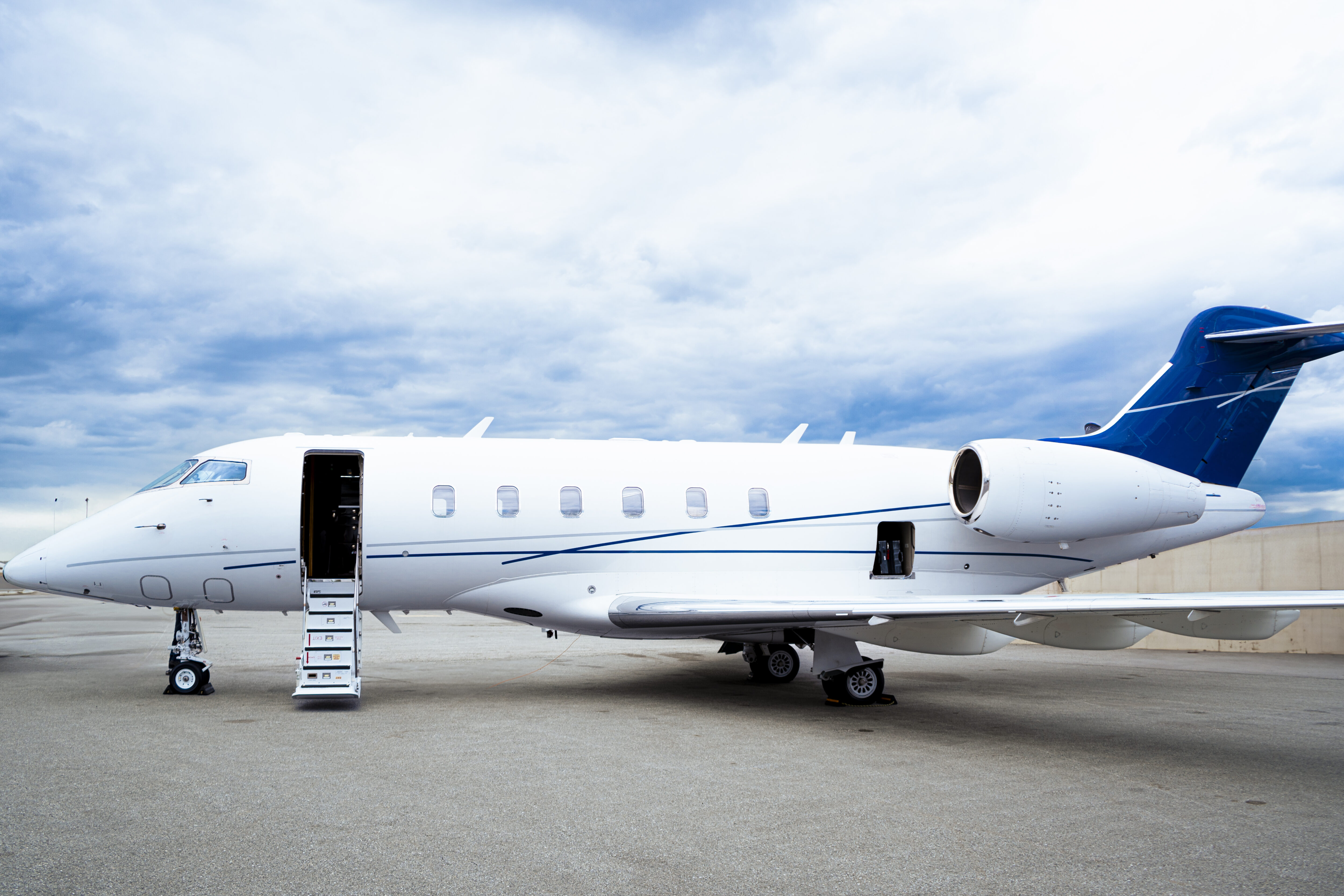
3. Challenger 300 / 350 / 3500
The Challenger 300 family remains a cornerstone of super-midsize private aviation. These aircraft are known for their wide cabins, smooth ride quality, and consistent performance.
The Challenger 350 and 3500 build on the success of the 300 with upgraded avionics and enhanced cabin experience, making them among the most in-demand aircraft in the world.
Key features
Seats 8 to 9 passengers
Range: ~6 hours
Wide stand-up cabin
Ideal for cross-country travel
Premium Jet Card Access: Guaranteed access to Challenger 300/350 aircraft with shorter call-out times and predictable pricing.
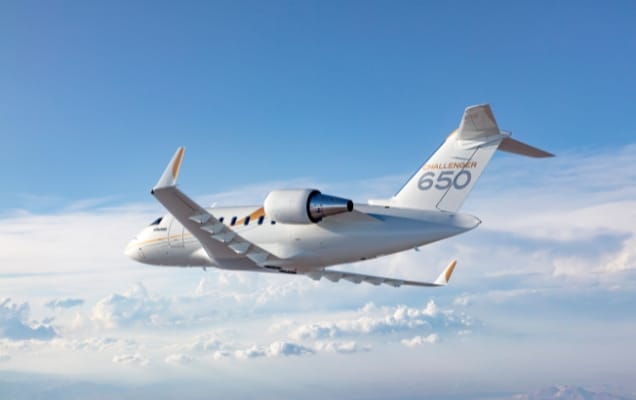
4. Challenger 650
The Challenger 650 is one of the most refined heavy jets in its class, offering a spacious cabin and excellent long-range capability.
Passengers appreciate the quiet cabin, large galley, and multiple seating zones, making it ideal for longer domestic or international flights.
Key features
Seats 10 to 12 passengers
Range: ~8 hours
Wide-body cabin with multiple living areas
Ideal for long-range comfort
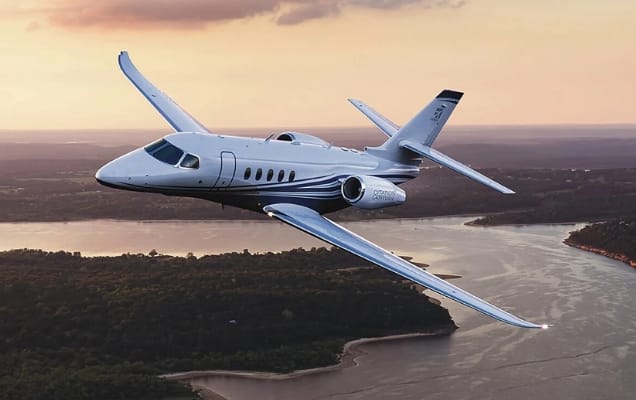
5. Citation Latitude
The Citation Latitude bridges the gap between midsize and super-midsize jets. It offers a flat-floor cabin, stand-up height, and strong range performance.
It’s a popular choice for travelers who want more cabin comfort without moving into a larger aircraft category.
Key features
Seats up to 7-8 passengers
Range: ~6 hours
Flat-floor, stand-up cabin
Excellent balance of comfort and efficiency
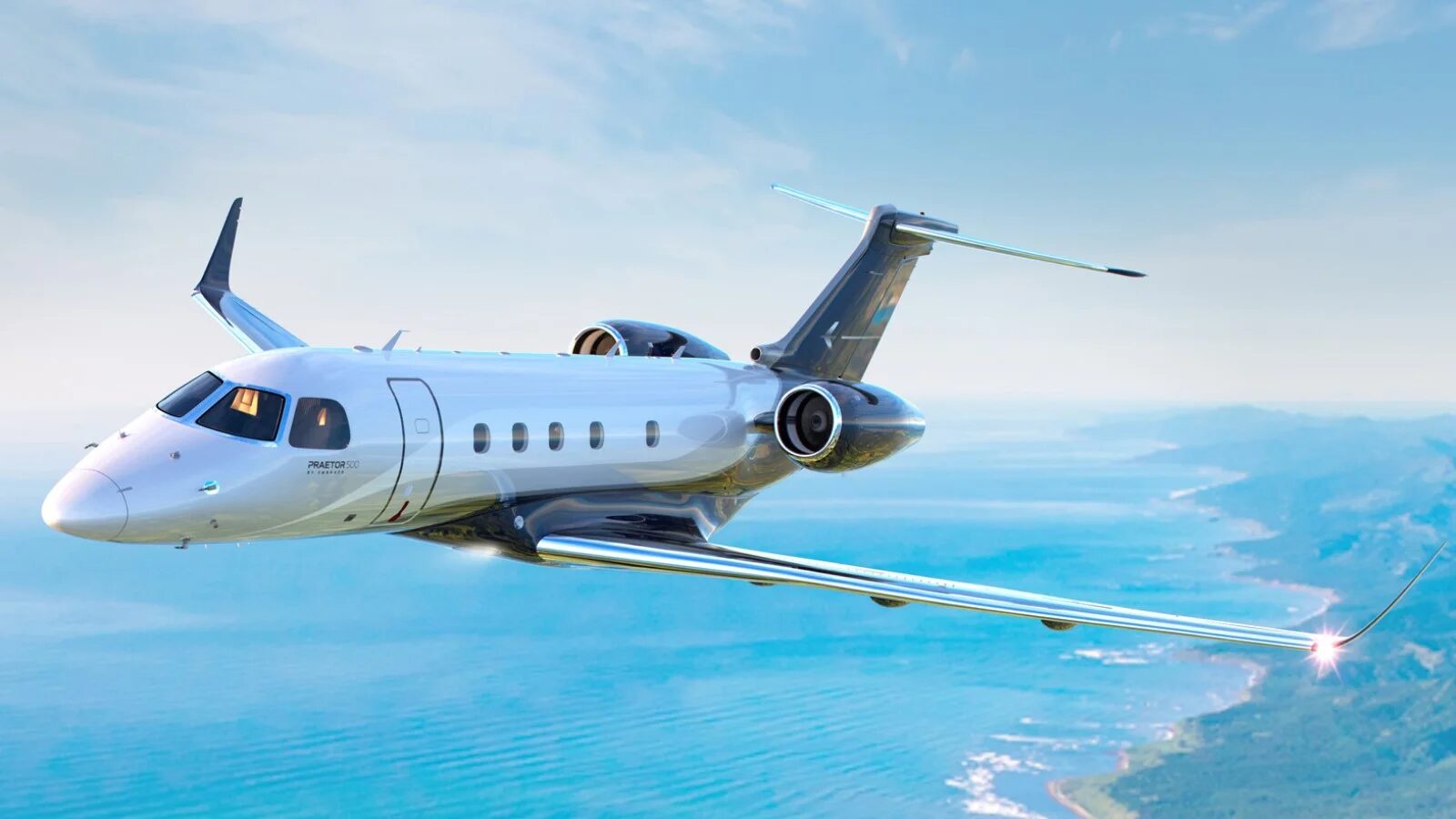
6. Embraer Praetor 500
The Praetor 500 represents a new generation of super-midsize jets with advanced technology and exceptional range.
With fly-by-wire controls and a modern cabin design, it delivers both performance and a premium onboard experience.
Key features
Seats up to 9 passengers
Range: ~7 hours
Advanced avionics and smooth ride
Modern, quiet cabin design
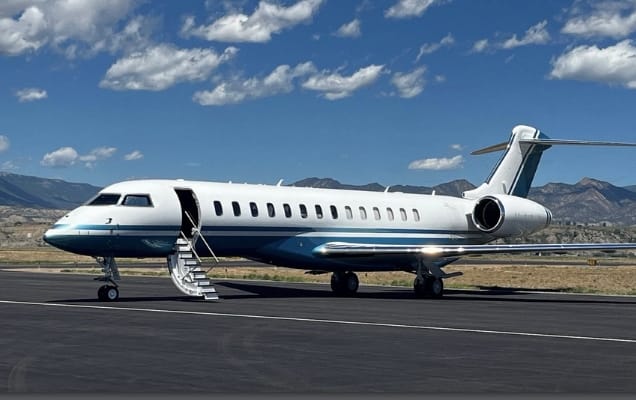
7. Bombardier Global 7500
The Global 7500 is one of the most capable and luxurious private jets available today. Designed for ultra-long-range travel, it connects cities across continents with ease.
Its four-zone cabin delivers a true residential feel, making it ideal for international business or extended trips.
Key features
Seats 13 to 16 passengers
Range: ~14 to 15 hours
Four distinct living spaces
Flagship ultra-long-range performance
8. Phenom 300
The Phenom 300 is one of the most popular light jets in private aviation, known for its speed, efficiency, and modern design.
It’s ideal for shorter trips while still offering a refined cabin experience.
Key features
Seats up to 7 passengers
Range: ~4 hours
Fast for a light jet
Efficient and cost-effective
9. Citation CJ3 / CJ3+
The Citation CJ3 and CJ3+ offer versatility and performance in the light jet category. These aircraft are known for their ability to access smaller airports while maintaining strong range.
They are a top choice for regional travel and point-to-point efficiency.
Key features
Seats up to 7 passengers
Range: ~4 hours
Short runway capability
Ideal for regional missions
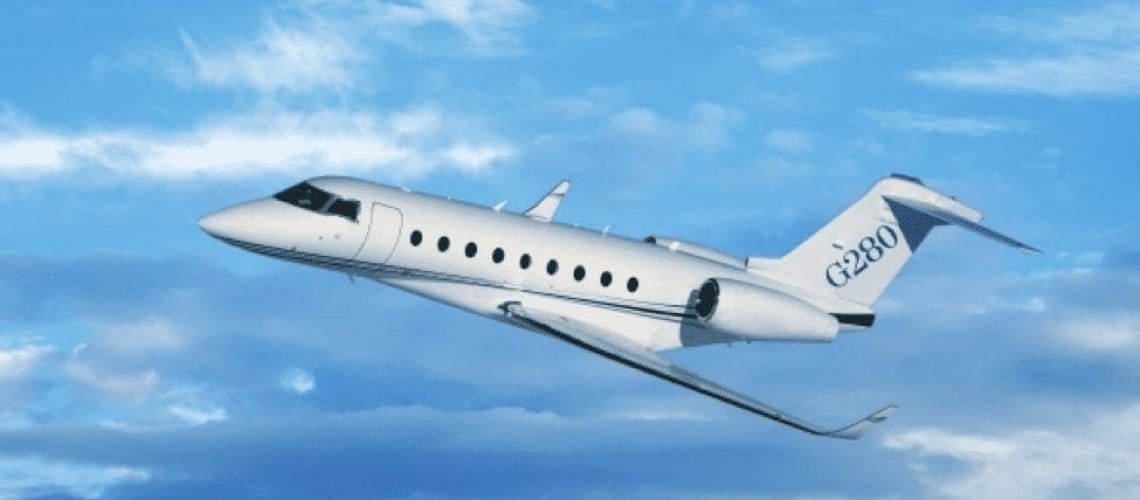
10. Gulfstream G280
The Gulfstream G280 is a high-performing super-midsize jet with intercontinental capability and a premium cabin experience.
It combines Gulfstream’s signature design with strong range and speed, making it a favorite for longer routes.
Key features
Seats up to 10 passengers
Range: ~7 hours
Large cabin with Gulfstream styling
Strong transcontinental performance
Why Travelers Choose the Premium Jet Card
Many frequent flyers want consistent access to a specific aircraft type while avoiding the complexity of managing individual charters. The Magellan Jets Premium Jet Card provides that solution.
This program is ideal for travelers who value cabins they know and trust, especially during busy travel periods when availability can become limited.
Premium Jet Card benefits include:
Access to Challenger 300/350 or Gulfstream G450/G550 aircraft
Call-out notice as low as 24 hours
20 advanced booking days per year
10% round-trip discount
10% long-leg trip discount
Fuel included
Catering included
De-icing included
Wi-Fi included
Repositioning fees included
These features provide a predictable, seamless private aviation experience with transparent pricing.
Build Your Premium Jet Card
The right aircraft can transform the private aviation experience. Whether you prefer the efficiency of the Citation Excel, the versatility of the Challenger series, or the global reach of the Global 7500, choosing the right program ensures reliable access to the jets you trust most.
The Magellan Jets Premium Jet Card was designed for travelers who want consistent cabin experience, shorter call-out times during peak periods, and the convenience of all-inclusive pricing.
Frequently Asked Questions About Popular Private Jets (FAQ):
What is the most popular private jet to charter?
The Citation Excel and Challenger 300/350 family are consistently among the most requested due to their balance of comfort, performance, and reliability.
What is the fastest private jet available for charter?
The Citation X remains one of the fastest private jets, cruising close to Mach 0.92.
What private jet is best for coast-to-coast flights?
Super-midsize jets like the Challenger 350, Praetor 500, and Gulfstream G280 are ideal for coast-to-coast travel.
What private jet is best for international travel?
Aircraft like the Challenger 650 and Global 7500 are designed for long-range and international missions.
How many passengers can a private jet hold?
Passenger capacity varies by category, ranging from 6–7 passengers in light jets to up to 16 passengers in large-cabin aircraft like the Global 7500.
What private jets are available with a Magellan Jets Premium Jet Card?
Premium Jet Card members can access aircraft such as the Challenger 300, Challenger 350, and Gulfstream G450 or G550.
What are the benefits of a private jet card?
Jet Cards provide predictable pricing, guaranteed availability, and faster booking. Programs like the Magellan Jets Premium Jet Card also include Wi-Fi, catering, fuel, and de-icing.
For Private Clients seeking the perfect balance of performance, range, and comfort, the Challenger 300 stands as the definitive choice. This super-midsize jet is crafted for those who demand uncompromising reliability and a seamless private aviation experience. Whether your journey serves business or personal pursuits, the Challenger 300 delivers best-in-class performance, every time.
With its spacious cabin, advanced avionics, and impressive range, this jet has earned the trust of discerning Private Clients. Executives, families, and individuals who value both comfort and efficiency consistently choose this aircraft. In this spotlight, we’ll explore what makes the Challenger 300 a preferred choice in private aviation.
Challenger 300 performance and range
The Bombardier Challenger 300 is built to perform. With a range of 3,100 nautical miles, this super midsize jet can fly nonstop between major cities like New York to Los Angeles, Miami to Seattle, or even transcontinental routes with ease. While optimized for North American routes, the jet’s impressive range enables select transatlantic crossings under favorable conditions, such as New York to the Azores or certain European destinations. Its powerful twin Honeywell HTF7000 engines provide high thrust and efficiency, allowing it to climb quickly and cruise at a speed of Mach 0.80 (approximately 541 mph).
Additionally, the Challenger 300 is known for its exceptional short-runway performance, meaning it can access more airports than larger aircraft in its class. This flexibility allows travelers to land closer to their final destinations, reducing ground transportation time and making business and leisure journeys more efficient. The aircraft requires two qualified pilots to operate, ensuring the highest standards of safety and operational excellence.
Spacious and thoughtful cabin design
Step inside the Challenger 300, and you’ll experience true comfort in the sky. With seating for up to 9 passengers in a comfortable configuration, the spacious, flat-floor cabin provides ample room to move, work, or relax. The aircraft can accommodate up to 16 passengers depending on layout preferences. The generous 6-foot standing height and large windows enhance the open feel, while low cabin altitude and advanced soundproofing make for a peaceful flight.
Cabin features include:
Fully reclining seats with ergonomic design for maximum comfort on long flights.
Large windows that provide stunning views and natural light.
Advanced soundproofing to reduce cabin noise and create a quiet environment.
Customizable interior configurations to suit business meetings, family trips, or leisure travel.
Generous baggage capacity, with 106 cubic feet of storage, so you can bring all your essentials without compromise.
In-flight connectivity and entertainment
Staying connected during your journey is essential for both business and personal travel. The Challenger 300 jet is equipped with high-speed Wi-Fi, allowing passengers to work productively, stream entertainment, or maintain important relationships with colleagues and family throughout their flight.
Other connectivity and entertainment features include:
Multiple power outlets and USB charging ports for all your devices.
Touchscreen cabin management system to adjust lighting, temperature, and entertainment settings.
Premium sound system for high-quality audio enjoyment.
Satellite phone capabilities, ensuring communication even in remote locations.
Whether you need to join a conference call mid-flight, relax with entertainment, or curate the perfect in-flight ambiance, the interior is thoughtfully equipped to meet every Private Client’s needs.
Smooth and reliable flight performance
Designed for efficiency and reliability, this business jet features powerful Honeywell HTF7000 engines and advanced avionics systems, ensuring a smooth ride. Pilots appreciate its Rockwell Collins Pro Line 21 avionics suite, which enhances safety and navigational accuracy with advanced navigation and weather detection capabilities.
Challenger 300 production and ownership insights
The Challenger 300 remains a prominent choice among those seeking an exclusive private aviation experience, even though Bombardier has discontinued its production. Initially introduced to fill the sweet spot in super-midsize performance, this jet quickly attracted the loyalty of Private Clients for its proven reliability. Because no new airframes are rolling off the line, well-maintained pre-owned models can be an exclusive opportunity for Private Clients seeking a relationship-based ownership journey.
Challenger 300 compared to other jets
The Challenger 300 plane is often compared to other super-midsize aircraft, such as the Citation Sovereign, Gulfstream G280, and Legacy 500. The Challenger 300 stands out with its exceptional balance of range, cabin comfort, and operational efficiency that defines this category of private aviation.
More spacious cabin compared to competitors in its class.
Superior baggage capacity for longer trips.
Access to a wide range of regional airports, offering greater travel flexibility.
Better overall operational efficiency, making it a cost-effective option for frequent travelers.
Curious what makes the Challenger 300 different from the Challenger 350? Read more here .
Can the Challenger 300 fly transatlantic?
The Challenger 300 can cross some North Atlantic routes under ideal circumstances, but it is not often regarded as a true transatlantic workhorse. Bombardier’s published performance materials cite a range around 3,065 nautical miles, which can make select eastbound crossings feasible with limited passengers and favorable winds. Westbound journeys, however, frequently require a tech stop due to stronger headwinds and reserve fuel considerations. Your Private Aviation Advisor can help determine what the ideal aircraft is for your transatlantic journey.
Fly the Challenger 300 with Magellan Jets
At Magellan Jets, we provide exclusive access to the Challenger 300 and 350 through both Charter and dedicated Jet Card programs. Whether you’re looking for flexibility, consistency, or a superior private jet experience, our Challenger 300/350 Card provides a seamless way to fly on one of the most trusted aircraft in the industry for Private Clients.
Tips for booking a Challenger 300
Book in Advance for Peak Travel Seasons – The Challenger 300 is a popular choice for business and leisure travelers alike. Secure your preferred itinerary early to avoid scheduling conflicts.
Take Advantage of Short-Runway Capabilities – When booking your trip, ask about regional airports closer to your destination.
Customize Your Onboard Experience – Work with Magellan Jets to tailor in-flight dining, entertainment, and other amenities to your preferences.
Consider a Jet Card for Added Flexibility – With a Challenger 300/350 Card , you can enjoy guaranteed availability and fixed hourly rates with no blackout dates.
Magellan Jets Challenger 300/350 Jet Card
Contact a Private Aviation Advisor today to discover how the Challenger 300 can elevate your private jet travel—fly smarter, fly with confidence, fly with Magellan Jets.
Frequently Asked Questions About the Challenger 300 (FAQs):
How much does a Challenger 300 cost?
The cost of a Challenger 300 in the pre-owned market can vary widely depending on its production year, engine hours, and maintenance records. Magellan’s Private Aviation Advisors can assist with Aircraft Sales and Management.
Does the Challenger 300 require two pilots?
Yes, the Challenger 300 is typically operated by a two-pilot crew in line with its certification requirements. Pilots are generally required to hold a BD-100 type rating, which encompasses both the Challenger 300 and 350 series.
How many passengers can a Challenger 300 seat?
Typical executive seating configurations often accommodate eight or nine Private Clients.
What is the Challenger 300’s typical range?
The Challenger 300 has a published range of about 3,065 nautical miles. Real-world factors such as wind conditions and payload can affect its nonstop capabilities.
Experience the Challenger 300 difference with Magellan Jets
The Challenger 300 is among the top three Private Jets chartered by Magellan Jets Clients. From its impressive 3,100-nautical-mile range to its thoughtfully designed cabin that accommodates up to nine passengers in comfort, this super-midsize jet continues to set the standard for private aviation. Whether you’re flying coast-to-coast for business or planning an international journey, this jet delivers a consistently superior experience that reflects your commitment to quality and efficiency.
At Magellan Jets, we make accessing this exceptional aircraft seamless through our Challenger 300/350 Jet Card program. With guaranteed availability, no blackout dates, and the flexibility to tailor every aspect of your journey, you’ll experience private aviation the way it should be: personal, reliable, and designed around your needs. Connect with a Private Aviation Advisor today .
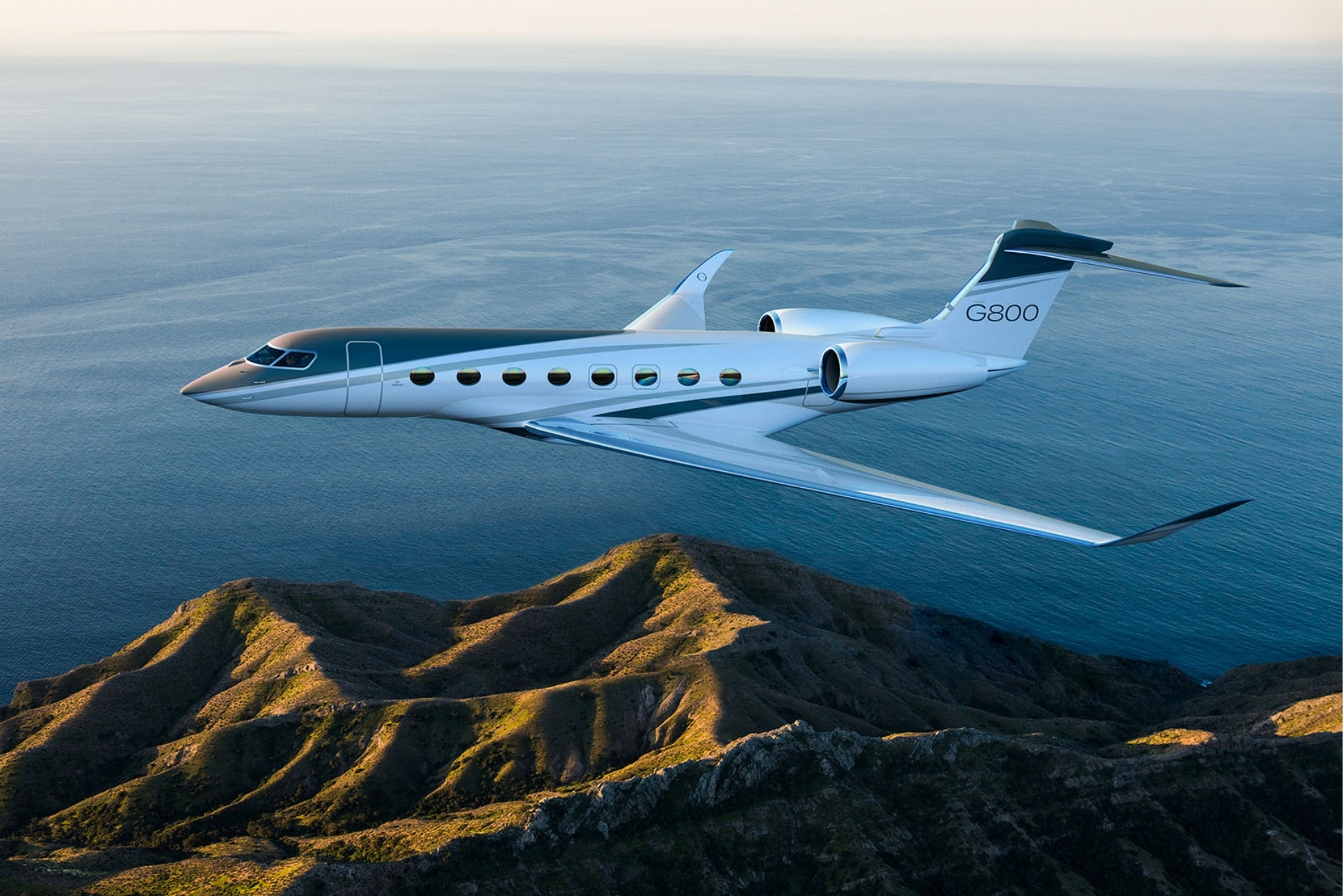
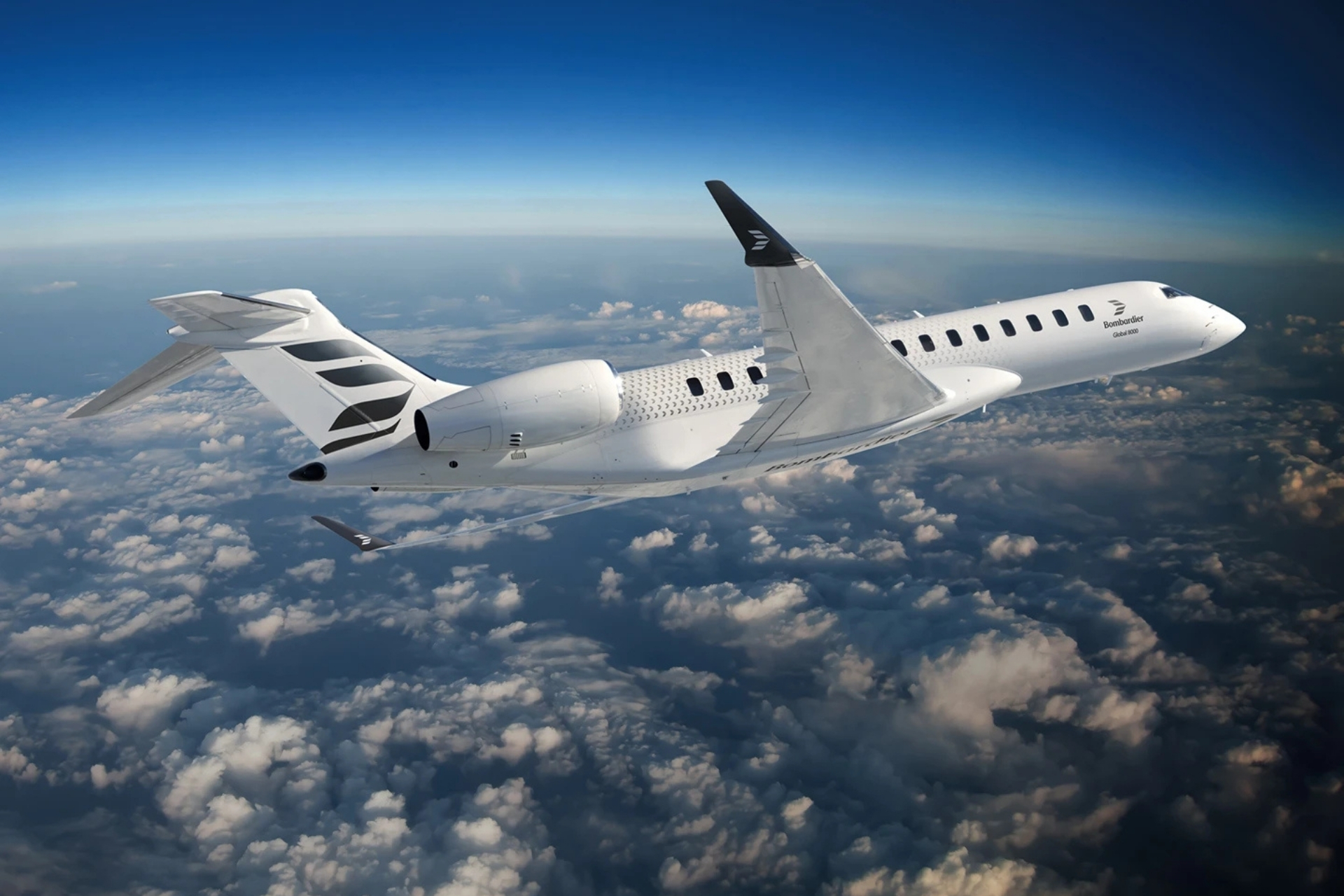
Why do so many people compare the Bombardier Global 8000 vs the Gulfstream G800? Both of these jets represent the newest wave of ultra-long-range capability; Aircraft designed to make the hardest trips feel simpler. They also both sit at the top of their respective families and target nonstop intercontinental missions. And both have become more “real” to the market over the past year as certification and delivery news moved from speculation to milestones.
The current energy around the Global 8000 is especially intense because Bombardier has tied the aircraft to a clear, memorable story: it’s the company’s new flagship, it’s fast enough to grab headlines, and it has now entered service. Reuters reported that the Global 8000 received FAA certification on December 19, 2025, after Transport Canada certification on November 5, 2025, and that it entered service earlier in December 2025. That momentum naturally triggered comparisons to the Gulfstream’s G800, which earned FAA and EASA certifications in April 2025, opening the door to customer deliveries and service entry in major markets.
Comparing the Global 8000 vs. Gulfstream G800
At a distance, both jets solve the same problem: long flights compress time, magnify fatigue, and punish inefficiency. The market compares the Global 8000 to the Gulfstream G800 because both brands promise less compromise across the same kinds of missions. When you zoom in, though, you see two distinct strategies.
Bombardier leads with a bold performance headline and an easy-to-picture cabin concept. On Bombardier’s own Global 8000 page, the company positions the aircraft as the “world’s fastest civilian aircraft since Concorde,” publishes a top speed of Mach 0.95, and pairs that with 8,000 nautical miles of range and “four true living spaces.” In other words: go fast, go far, and live comfortably across a long flight without feeling like you’re stuck in one single-purpose cabin.
Gulfstream tells a slightly different story. The G800 conversation often centers on “range at speed” and certification-tested performance points. Gulfstream’s certification announcement highlights multiple range figures depending on cruise profile: 7,000 nm at Mach 0.90, 8,000 nm at Mach 0.87, and a certification-demonstrated 8,200 nm at Mach 0.85, with a maximum operating speed of Mach 0.935. That framing is less about one headline number and more about flexibility: the aircraft gives you meaningful distance even when you cruise fast.
Speed
Speed is the easiest part of this comparison to understand, and it’s also the main reason the Global 8000 has generated so much buzz. Bombardier publishes Mach 0.95 as the Global 8000’s top speed, and Reuters echoed that figure in its coverage of the FAA certification milestone. That “fastest since Concorde” phrasing travels well because it instantly tells a story: Less time in the air on already-long days, and more schedule control on trips where minutes matter.
The G800 doesn’t trail far behind on speed. Coverage tied to certification states the aircraft’s maximum operating speed increased to Mach 0.935. In real terms, both aircraft live in a rarified tier of business aviation performance. The difference is that Bombardier’s Mach 0.95 is designed to be the conversation starter, while Gulfstream’s speed story tends to appear alongside range and operational flexibility.
Range
Range is where the comparison becomes more nuanced. Bombardier keeps the Global 8000 story clean and direct: 8,000 nautical miles. It’s easy to understand and easy to repeat. That clarity is part of the brand’s positioning: faster and farther, with a flagship cabin, now moving into service.
Gulfstream’s messaging invites a different kind of conversation. The G800 gets discussed as a set of performance points at different cruise speeds: 7,000 nm at Mach 0.90 (high-speed cruise), 8,000 nm at Mach 0.87, and 8,200 nm at Mach 0.85 demonstrated during certification. That approach tends to resonate with travelers and flight departments who think in terms of tradeoffs: how far can we go if we prioritize speed today, and how far can we go if we prioritize maximum distance?
Cabin experience
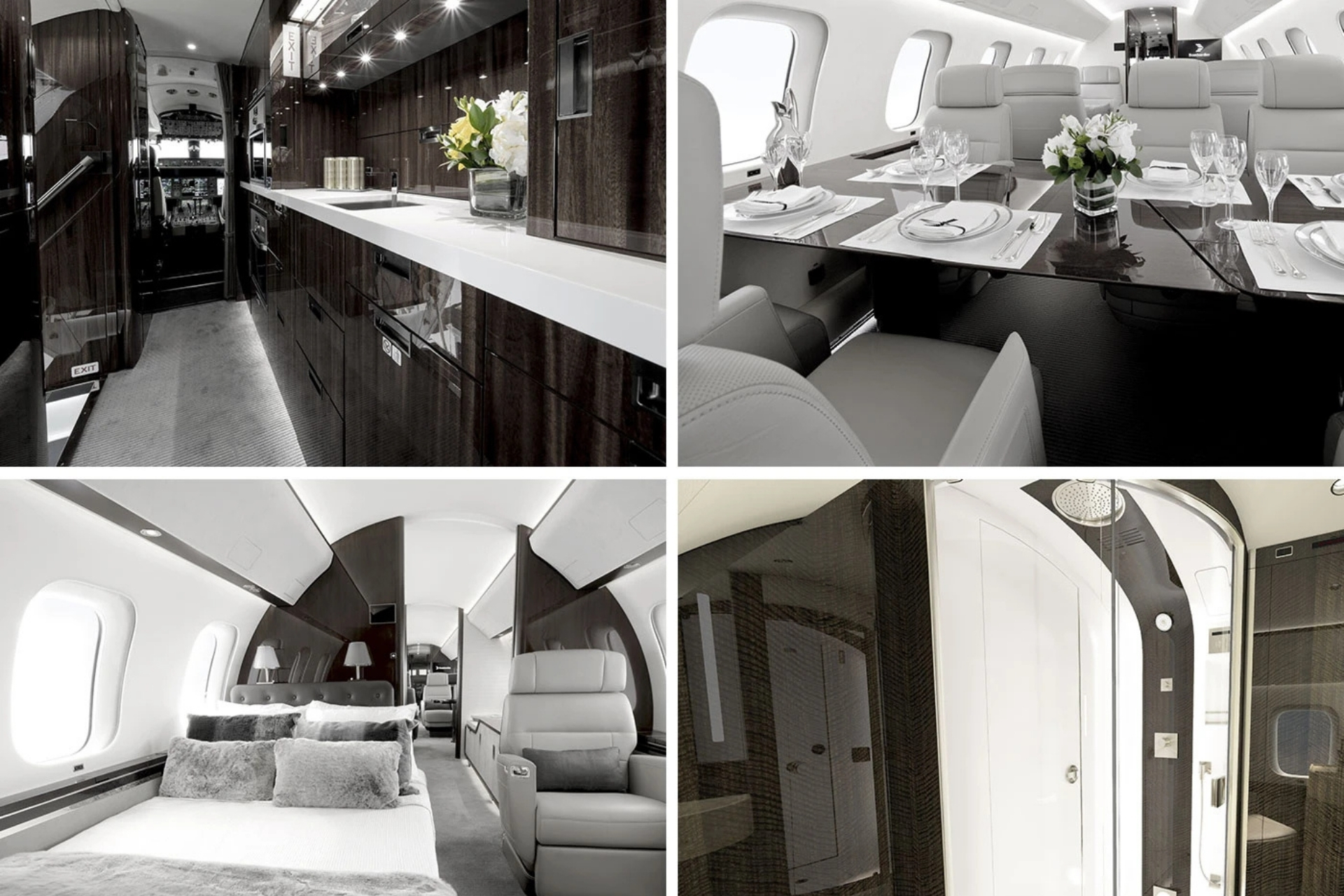
On the cabin side, Bombardier’s Global 8000 positioning is explicit. The company emphasizes “four true living spaces,” which suggests a flight that can move through phases of work, conversation, dining, and rest without forcing every moment into one compromise layout. That matters on long legs where comfort is imperative.
Bombardier Global 8000
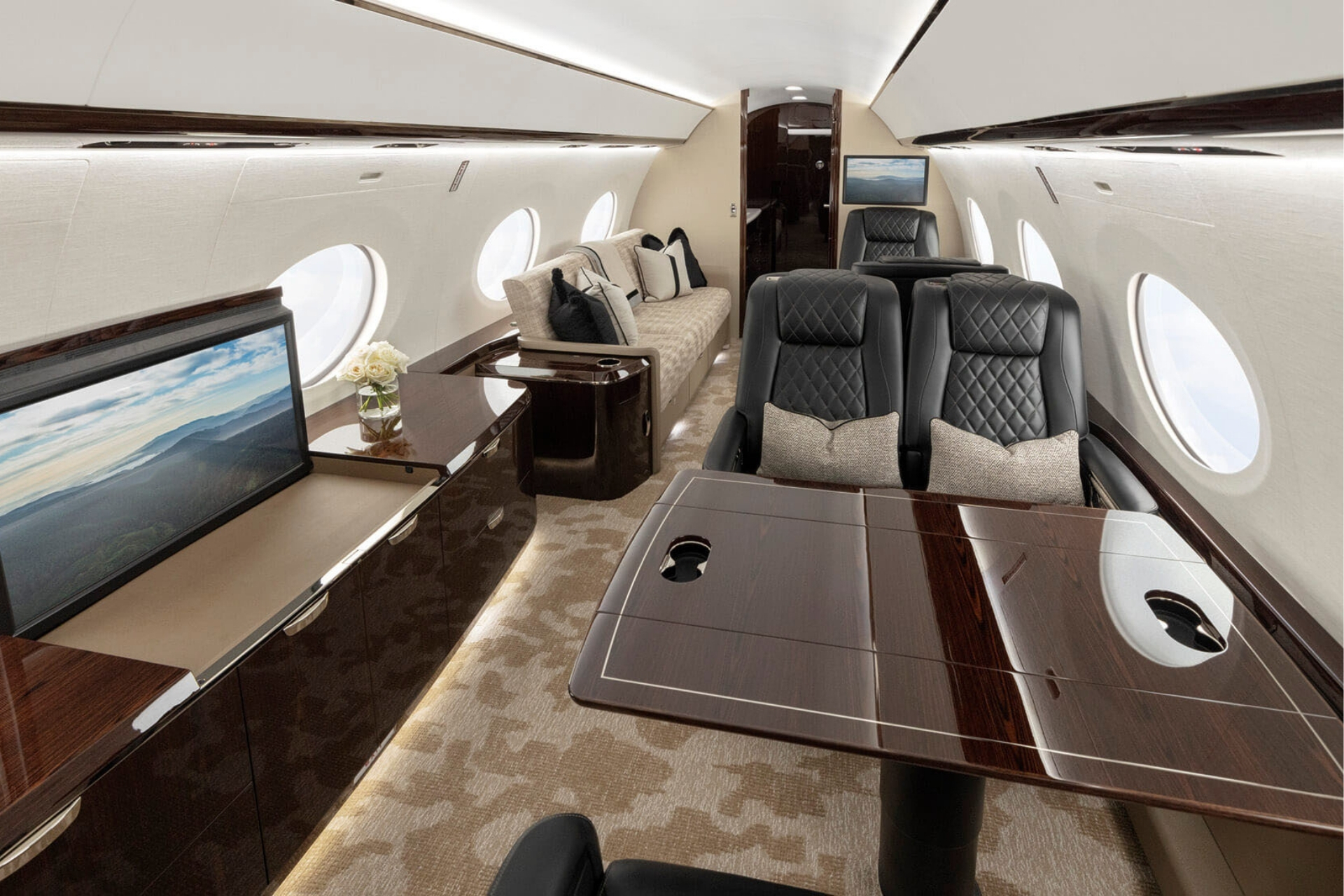
Gulfstream, meanwhile, emphasizes how the G800 supports long missions with a cabin that can be configured in multiple living areas. Gulfstream’s own G800 delivery news notes that the interior can be configured with “up to four living areas,” or with a dedicated crew compartment option, which aligns with the aircraft’s long-haul intent. While specific interiors vary widely by operator, Gulfstream’s narrative often keeps the spotlight on mission capability and performance, with the cabin experience presented as the environment that supports those missions.
Gulfstrem G800 Interior
Global 8000 and G800 in the News
It’s easy to see why this pairing has intensified lately. The Global 8000 has moved into a new chapter: Transport Canada certification on November 5, 2025, entry into service in December 2025, and FAA certification announced December 19, 2025. That creates a surge of fresh attention, new imagery, and new route talk.
At the same time, the G800’s certification story is also current in market memory. Reuters reported FAA and EASA certifications in April 2025, enabling service entry and deliveries. In other words, both aircraft sit in the “new flagship” window, but the Global 8000 is riding a more immediate wave of headlines because its service-entry news is newer.
Frequently Asked Questions about Bombardier Global 8000 vs. Gulfstream G800 (FAQ):
Is the Bombardier Global 8000 in service now?
Yes. Bombardier states the Global 8000 entered service in December 2025 after receiving Transport Canada type certification on November 5, 2025, and Reuters reported FAA certification was granted on December 19, 2025.
Is the Gulfstream G800 certified?
Yes. Reuters reported that Gulfstream’s G800 received FAA and EASA certifications in April 2025, which allowed deliveries and service entry in the U.S. and Europe.
What are the headline speed and range numbers for the Global 8000?
Bombardier publishes a top speed of Mach 0.95, a range of 8,000 nautical miles, and positions the aircraft as the fastest civilian aircraft since Concorde.
How far can the G800 fly, and at what speeds?
Independent coverage and Gulfstream’s certification announcement cite 7,000 nm at Mach 0.90, 8,000 nm at Mach 0.87, and 8,200 nm at Mach 0.85 demonstrated during certification testing.
Which aircraft is faster?
Bombardier publishes Mach 0.95 for the Global 8000. Coverage of the G800’s certification cites a maximum operating speed of Mach 0.935.
The Magellan Jets Way to Compare Aircraft
When people compare these two aircraft, or any aircraft, they often get pulled into spec-sheet sparring. A more useful way to think about it is what each aircraft optimizes for and how it may fit your particular journey.
The Global 8000 is engineered and marketed to make speed feel like a tangible advantage, paired with a long-range promise and a cabin concept that’s easy to imagine. The G800 is engineered and marketed to give you range flexibility at meaningful cruise speeds, with certification-backed performance points that show how far you can go depending on how you choose to fly.
No matter which jet you choose for your mission, long-distance travel should feel less exhausting and more controllable. A Magellan Jets Private Aviation Advisor can help you evaluate your options.
The Dassault Falcon 2000LXS represents the pinnacle of the celebrated 2000 series: a legacy built on exceptional performance and refined elegance. This remarkable aircraft delivers extended range capability, superior runway performance, and an exquisitely appointed cabin, making every journey as effortless as it is exclusive. For private clients seeking a perfect balance of fuel efficiency and uncompromising comfort, the 2000LXS continues to set the standard.
Falcon 2000LXS Cabin Interior
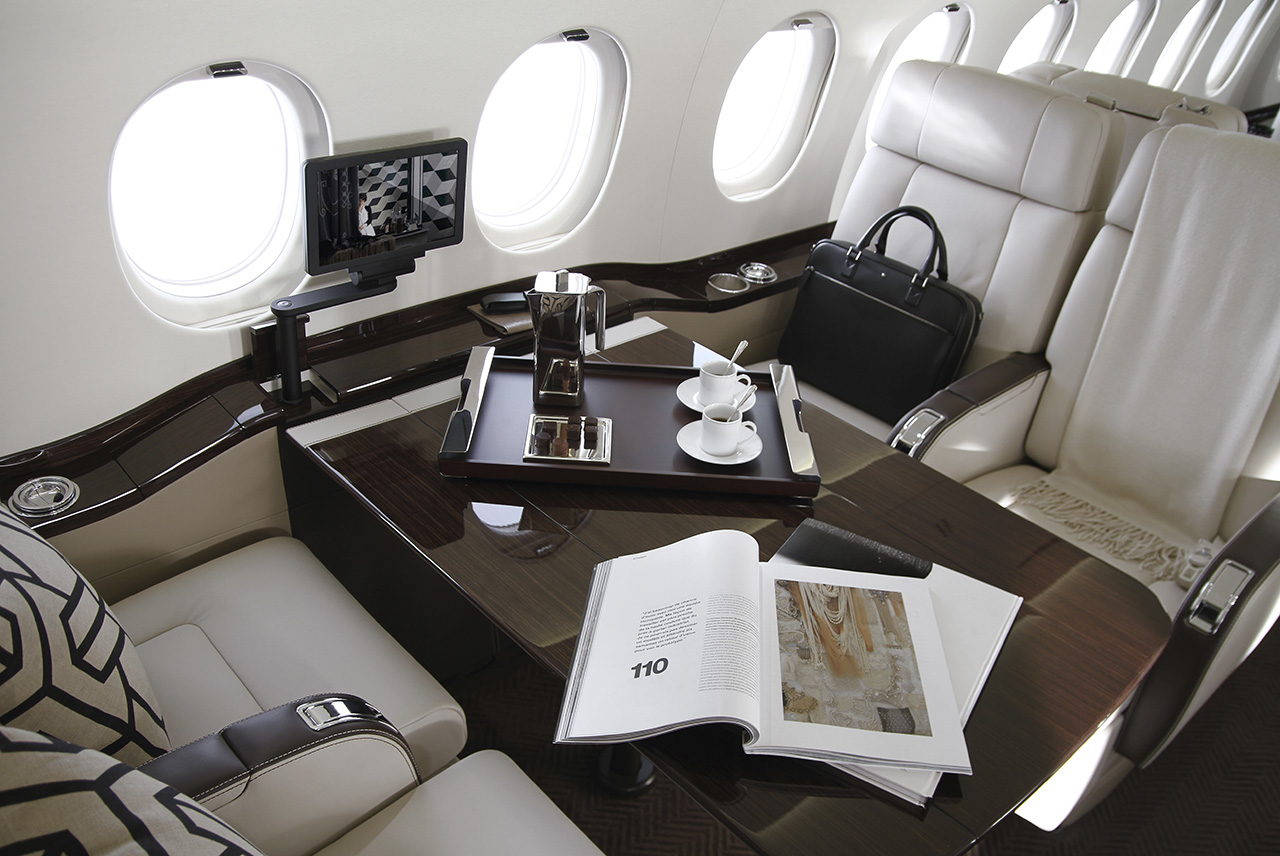
The Dassault Falcon 2000LXS is a wide body aircraft with 18 windows, delivering exceptional comfort and connectivity for discerning travelers. The cabin spans over 26 feet in length, almost 8 feet in width, and 6 feet 2 inches in height—allowing most passengers to stand comfortably throughout the journey. At a total cabin volume of 1,024 cubic feet, there is comfortable seating for up to 10 passengers. The standard interior cabin configuration features a single club section and double club section alongside two single executive style seats. Perfect for conference groupings, this cabin enhances work efficiency and productivity during flight.
The refined cabin features a state-of-the-art entertainment system with personal widescreen displays and seamless connectivity for all modern devices. Universal charging ports and wireless streaming capabilities ensure passengers can connect their preferred devices and maintain complete control of the entertainment system. Advanced cabin management technology allows passengers to adjust lighting, temperature, and entertainment settings directly from their seats.
Falcon 2000LXS performance
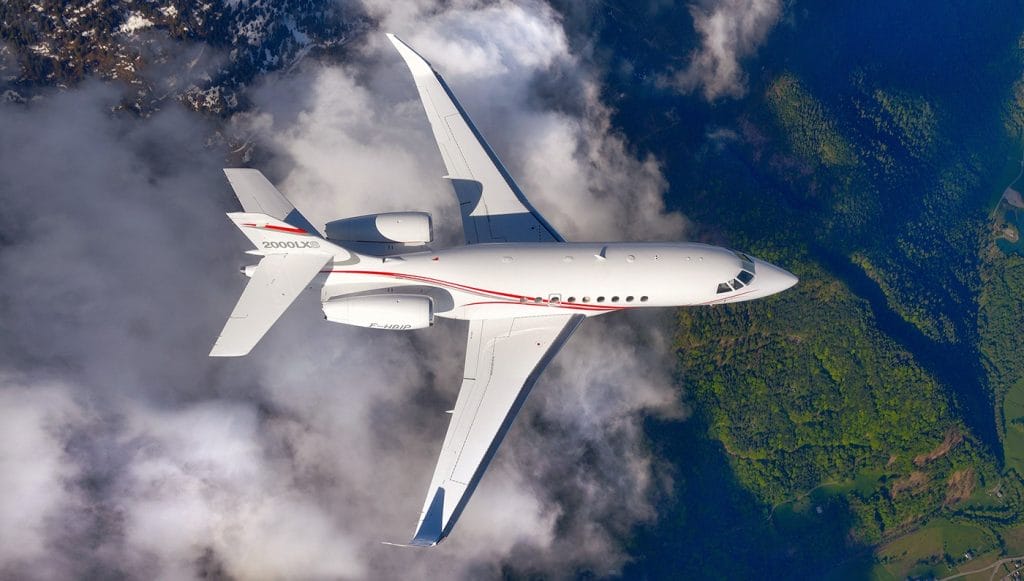
The Falcon 2000LXS delivers a range of 4,000nm and maximum cruise speed of Mach 0.862, enabling nonstop journeys from Los Angeles to London, New York to Paris, Miami to São Paulo, or Dubai to Geneva. Building upon the proven 2000LX platform, the 2000LXS offers enhanced range capabilities and improved payload performance. This aircraft can access more challenging airports and runways than other jets in its category. High-mach blended winglets enhance fuel efficiency and provide superior short-field performance when approaching and landing.
Two P&WC 308C engines power the aircraft and are mounted on the side of the rear fuselage. Within the flight deck, the EASy II avionics suite helps pilots stay organized and increases efficiency. With the added feature of an autobrake system, the twin jet aircraft can easily deliver favorable performance on short runways.
Operating well above other business jets in its category, the Falcon 2000LXS delivers exceptional nonstop connectivity across transcontinental and international routes, making it an ideal choice for long-range missions.
Frequently Asked Questions About the Dassault Falcon 2000LXS
How far can the Dassault Falcon 2000LXS travel nonstop?
The Dassault Falcon 2000LXS can fly nonstop for transcontinental or intercontinental journeys of roughly 4,000 to 4,604 nautical miles. This extended range allows Private Clients to travel between major cities such as New York to Berlin, or Dubai to London in one go.
What unique features does the Falcon 2000LXS offer compared to earlier models?
This upgraded model combines the long-range capabilities of its predecessor with exceptional short-field runway performance. Enhanced Pratt & Whitney PW308C engines and inboard slats allow the jet to access a wide range of airports.
How many passengers can the Dassault Falcon 2000LXS accommodate?
This super-midsize jet typically seats up to 10 Private Clients, ensuring a refined and relaxing environment.
Experience the Falcon 2000LXS with Magellan Jets
The Dassault Falcon 2000LXS combines impressive transcontinental range with the flexibility to access airports that remain out of reach for many aircraft in its class. Its spacious cabin, refined amenities, and superior runway performance create an environment where productivity and comfort coexist seamlessly—whether you’re conducting business across the Atlantic or traveling to destinations that demand exceptional aircraft capability.
At Magellan Jets, we provide Private Clients with access to an extensive network of highly vetted aircraft, including the the Falcon 2000LXS. Our Private Aviation Advisors are here to design a bespoke travel experience tailored to your specific requirements. Talk to a Private Aviation Advisor to discover how the Falcon 2000LXS can redefine your next journey.
If you’re considering adding a Gulfstream G400 to your fleet or purchasing one for private use, you’re likely aware of the brand’s reputation for luxury, performance, and cutting-edge technology. However, there are some critical factors to consider before making this major investment. Here are 10 things you need to know before buying a Gulfstream G400.
1. HERITAGE & LEGACY
The Gulfstream G400 carries the legacy of its predecessor, the GIV-SP, produced over a decade ago, with only 75 units made. The new G400, however, is a modern reinvention of this iconic jet, offering enhanced performance, technology, and customization options. It’s essential to understand how the G400 builds on Gulfstream’s history of innovation.
2. RANGE & PERFORMANCE
One of the biggest selling points of the new G400 is its range. With a 4,200-nautical-mile range, it’s capable of nonstop flights from New York to Rome or from Chicago to Honolulu. If you frequently travel long distances, this aircraft can significantly reduce the need for layovers or fuel stops, improving efficiency for both personal and corporate travel.
3. MULTIPLE CABIN CONFIGURATIONS
The G400 offers three different cabin configurations: 9, 11, and 12-passenger layouts. This flexibility allows buyers to choose a setup that best fits their travel needs. Whether you’re looking for a more business-focused cabin or a luxurious personal space, the G400 can be customized to meet your exact preferences.
4. advanced connectivity & comfort
Connectivity is a priority in today’s world, and the G400 doesn’t disappoint. With Gulfstream’s signature cabin management system, passengers can control the environment from their seats—whether it’s adjusting lighting, climate, or entertainment. The G400 also offers high-speed Wi-Fi, which is crucial for both business and personal use.
5. speed & efficiency
Speed is a hallmark of the Gulfstream brand. The G400 has a maximum cruise speed of Mach 0.85, allowing you to get to your destination faster while enjoying a smoother ride. Additionally, the aircraft is designed for greater fuel efficiency, helping reduce operating costs over time.
6. ideal for jet card & charter PRIVATE clients
The G400 is perfect for both Jet Card and Charter Private Clients. Its range, speed, and comfort make it a popular choice for businesses and individuals who want luxury travel without owning a full fleet. Private Clients will find the G400’s mid-size cabin and long-range capabilities a winning combination for both domestic and international travel.
7. cutting-edge technology
The G400 is equipped with Gulfstream’s most advanced avionics and safety technology. This includes Gulfstream’s Enhanced Vision System (EVS) and Synthetic Vision-Primary Flight Display (SV-PFD), designed to provide pilots with enhanced situational awareness. For buyers who prioritize safety, the G400 is among the best in its class.
8. sustainability
Private aviation has taken strides toward sustainability, and the G400 is no exception. The aircraft is built with a more fuel-efficient design and can operate with Sustainable Aviation Fuel (SAF), reducing its carbon footprint. If environmental impact is a concern, this makes the G400 a forward-thinking choice.
9. maintenance & operating costs
While Gulfstream jets are known for their durability, it’s essential to consider ongoing maintenance and operating costs before purchasing. The G400 is designed with ease of maintenance in mind, but regular inspections, fuel costs, and crew salaries can add up. Be sure to factor in these expenses when calculating the total cost of ownership.
10. resale value
Gulfstream jets traditionally hold their value well in the resale market, and the G400 is expected to follow suit. The combination of advanced technology, long-range capability, and luxury appeal makes it a solid investment for those concerned about long-term value. Whether you plan to hold onto it for years or sell it down the line, the G400’s resale value is likely to remain strong.