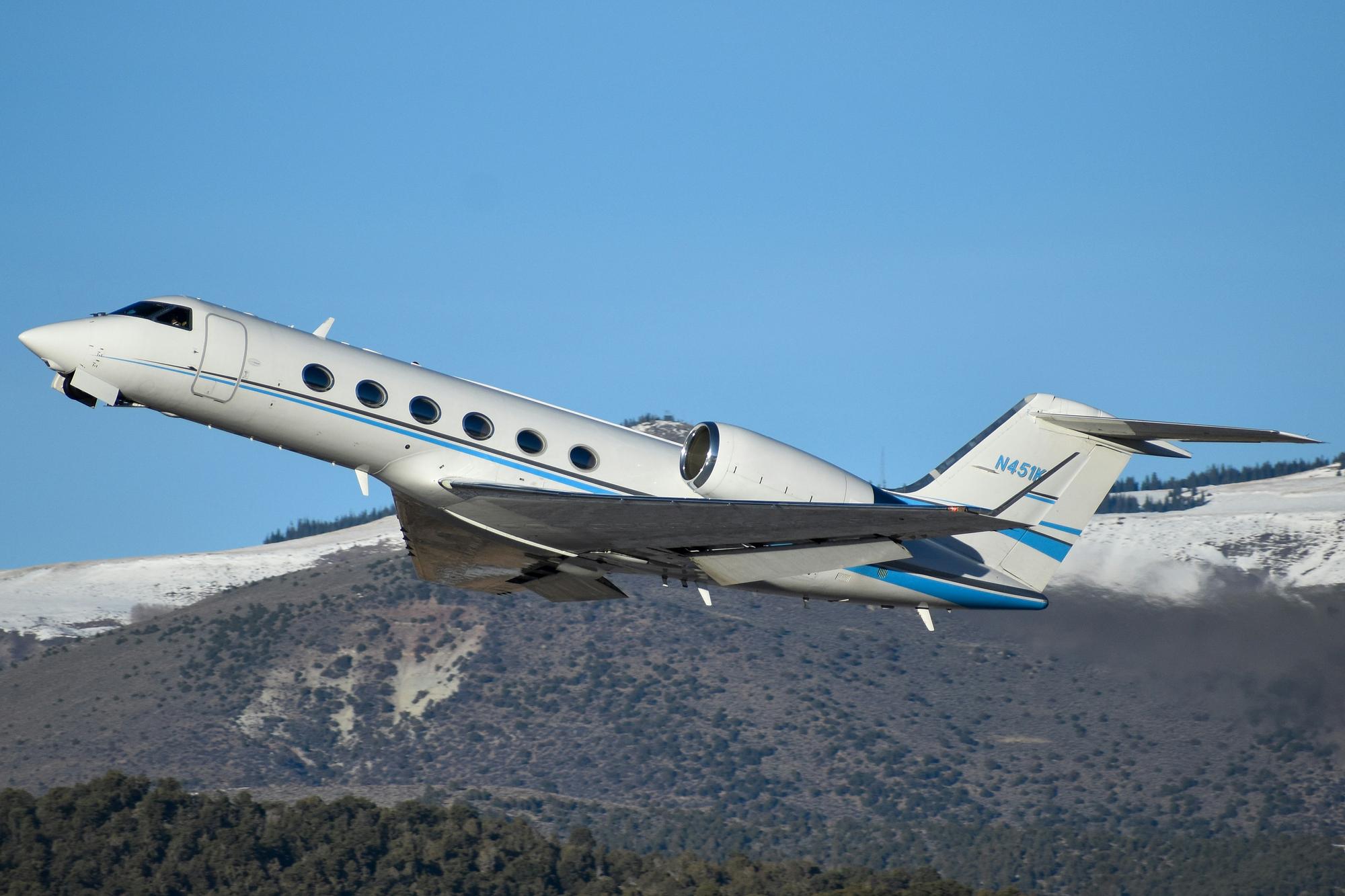
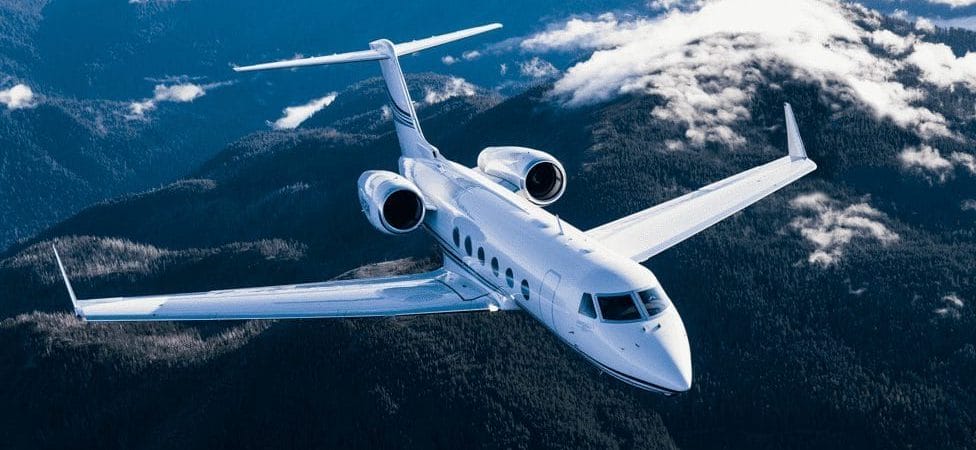
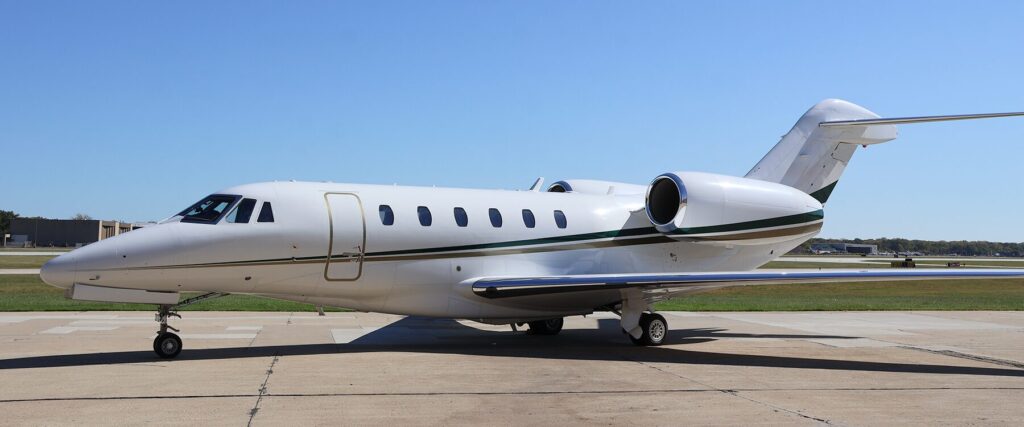
The Gulfstream IV is a large-cabin, long-range heavy jet built for transatlantic and transcontinental missions. Often called the GIV or Gulfstream G4, it carries up to 13 passengers in a stand-up cabin and cruises near Mach 0.80. For more than three decades, the Gulfstream 4 has set the benchmark for how far, how fast, and how comfortably a private aircraft can fly.
What Is the Gulfstream IV?
The Gulfstream IV first flew on September 19, 1985, from Savannah, Georgia, according to Gulfstream IV production records. It earned FAA type certification on April 22, 1987. The aircraft quickly became the choice of corporations, heads of state, and private travelers who needed to cross oceans without stopping.
The GIV is widely credited as the first business jet with an all-glass EFIS (electronic flight instrument system) cockpit, according to Gulfstream IV history. Gulfstream built 196 original GIV aircraft, and about 153 remained in operation as of 2023. The improved GIV-SP followed, with 304 built.
The wider GIV family, including the later Gulfstream G450, exceeded 900 units before its production run ended on January 19, 2018, Gulfstream IV records show, roughly 30 years after the first flight. The lineage runs deep. The GIV and GIV-SP gave rise to the G300, the G400 (a GIV-SP redesignation), and the G450 (a GIV-SP upgrade), while the G350 is a shorter-range G450, as Gulfstream’s model history shows.
That legacy still matters. The Gulfstream IV proved that a private aircraft could reliably link New York and London, or Los Angeles and Honolulu, on a single tank of fuel. That capability reshaped expectations for the entire heavy jet category.
Still in Service: Hurricane Surveillance and Military Missions
The Gulfstream IV’s endurance keeps it working in demanding roles. NOAA operates a GIV-SP, tail number N49RF, as a hurricane-surveillance aircraft that flies at 45,000 feet with roughly 4,000 nautical miles of range, according to NOAA Aircraft Operations. It has flown Atlantic hurricane missions since 1997, per NOAA’s Hurricane Hunters.
The type also served in the military as the C-20F, C-20G, C-20H, and C-20J, according to Gulfstream IV service history. The U.S. Navy describes the C-20G as capable of “all-weather, long-range, high-speed, non-stop transoceanic flights,” per Naval Air Systems Command.
Gulfstream IV Specifications and Performance
For the Client, specifications translate directly into range, comfort, and schedule control. The Gulfstream IV pairs a 4,200-nautical-mile range with a 45,000-foot service ceiling, so it flies above most commercial traffic and weather. The figures below reflect Magellan Jets’ internal data for the type.
Specification
Detail
Class / category
Heavy Jet (large-cabin, long-range)
Passengers
Up to 13
Cabin dimensions
45 ft 1 in long, 6 ft 2 in tall, 7 ft 3 in wide
Cabin volume
1,658 cu ft
Range
4,200 nm (Gulfstream IV); about 4,166 nm (GIV-SP)
Service ceiling
45,000 ft
High-speed cruise
About Mach 0.80 (roughly 470 knots)
Engines
Two Rolls-Royce Tay turbofans
Crew
Two
In practical terms, the GIV connects the U.S. East Coast with Europe nonstop, and it crosses the continental United States with room to spare. Two Rolls-Royce Tay turbofans deliver a high-speed cruise near Mach 0.80, roughly 470 knots. A cabin volume of 1,658 cubic feet gives passengers space to work, dine, and rest across a long journey.
Inside the Cabin: The Gulfstream IV Experience
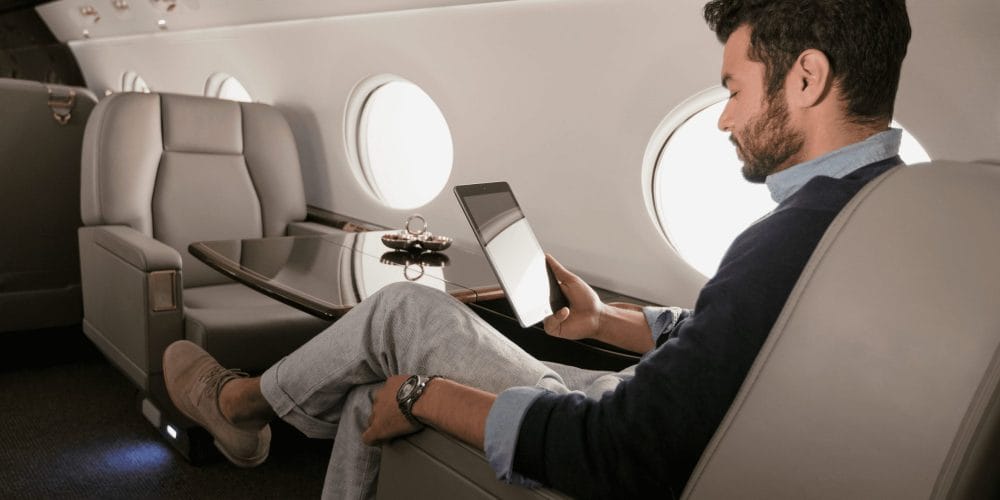
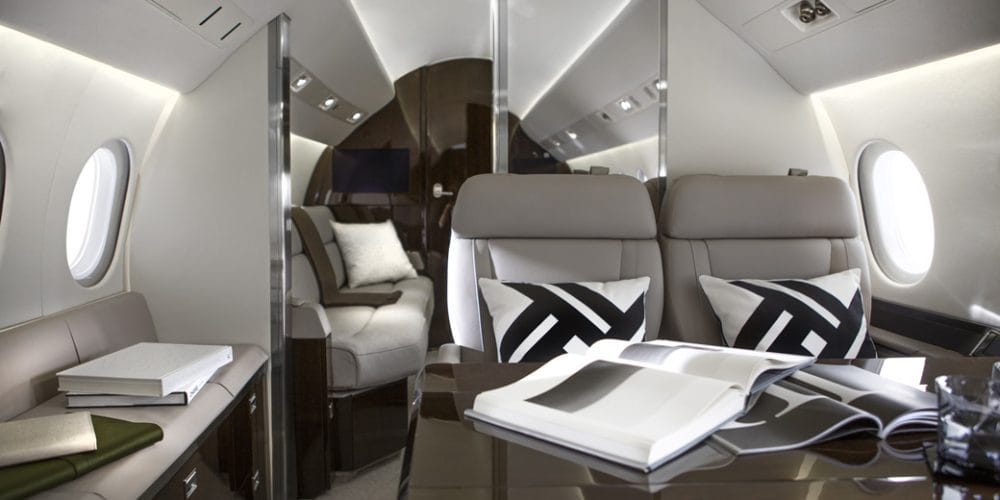
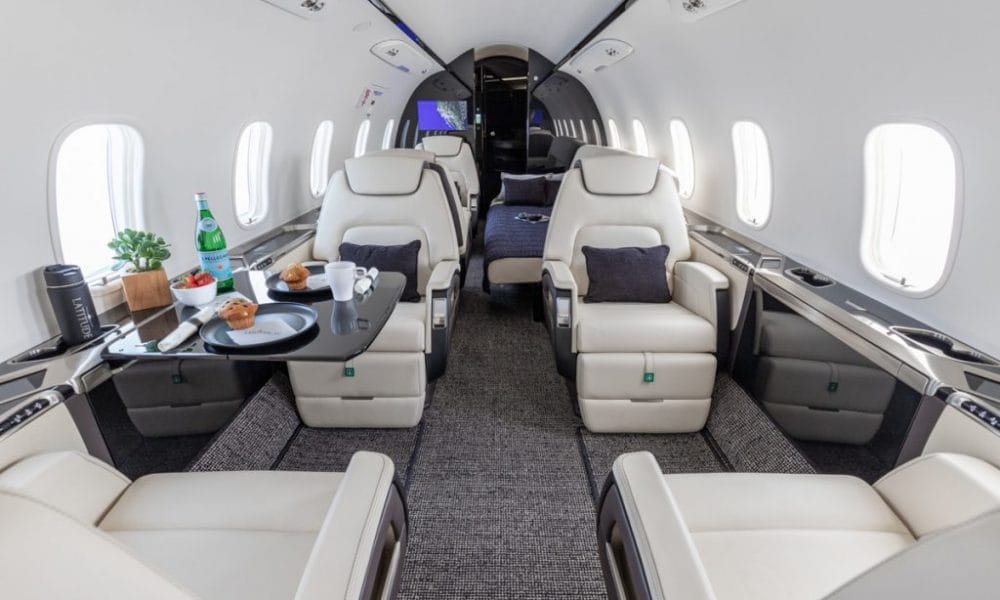
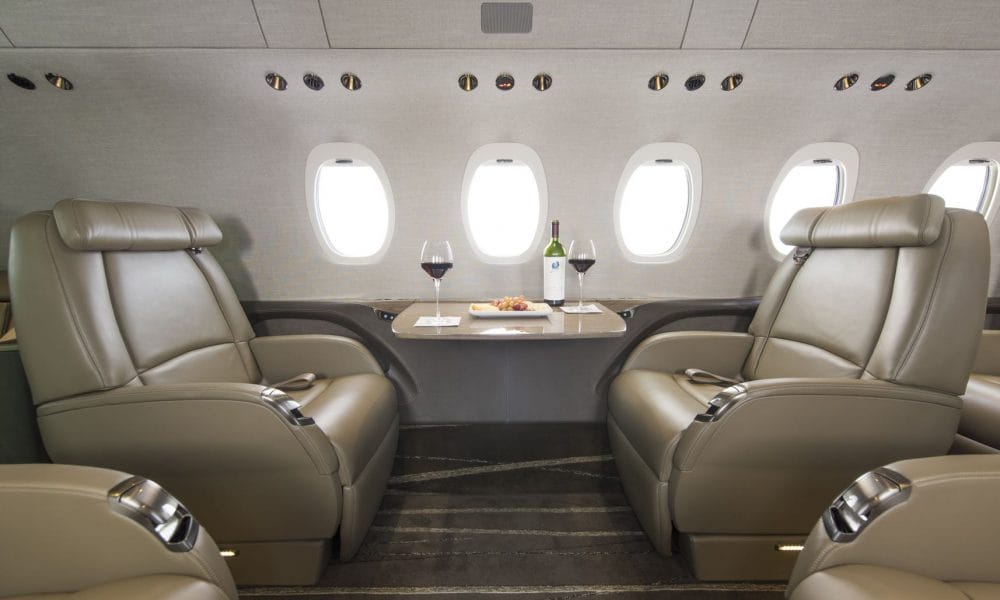
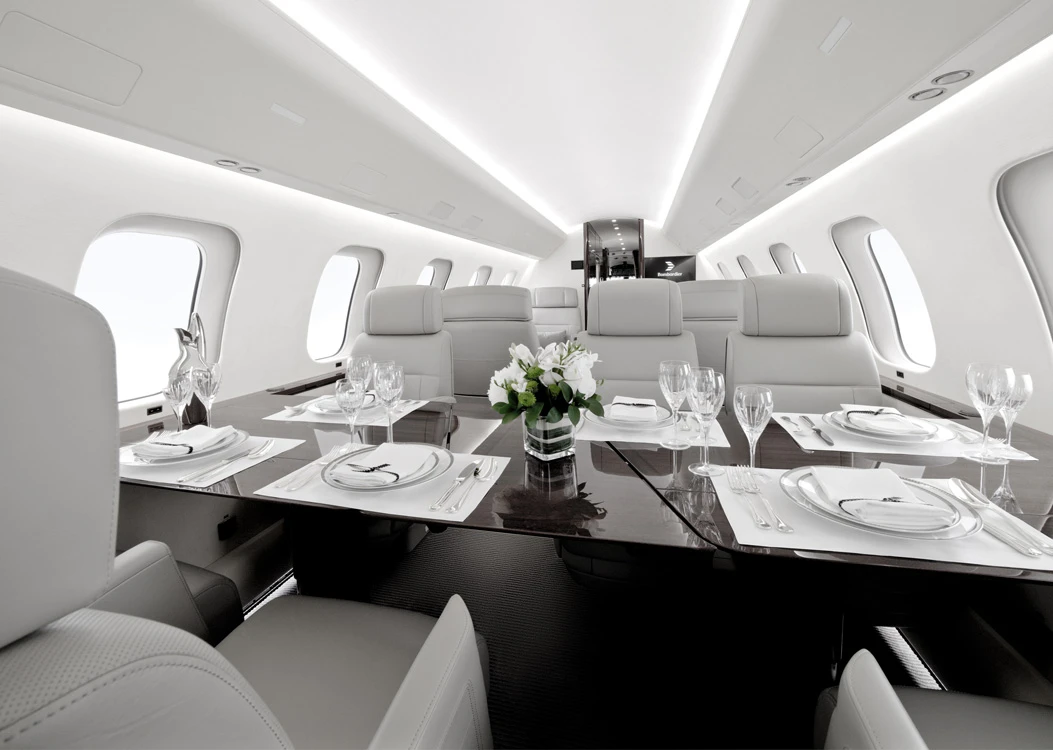
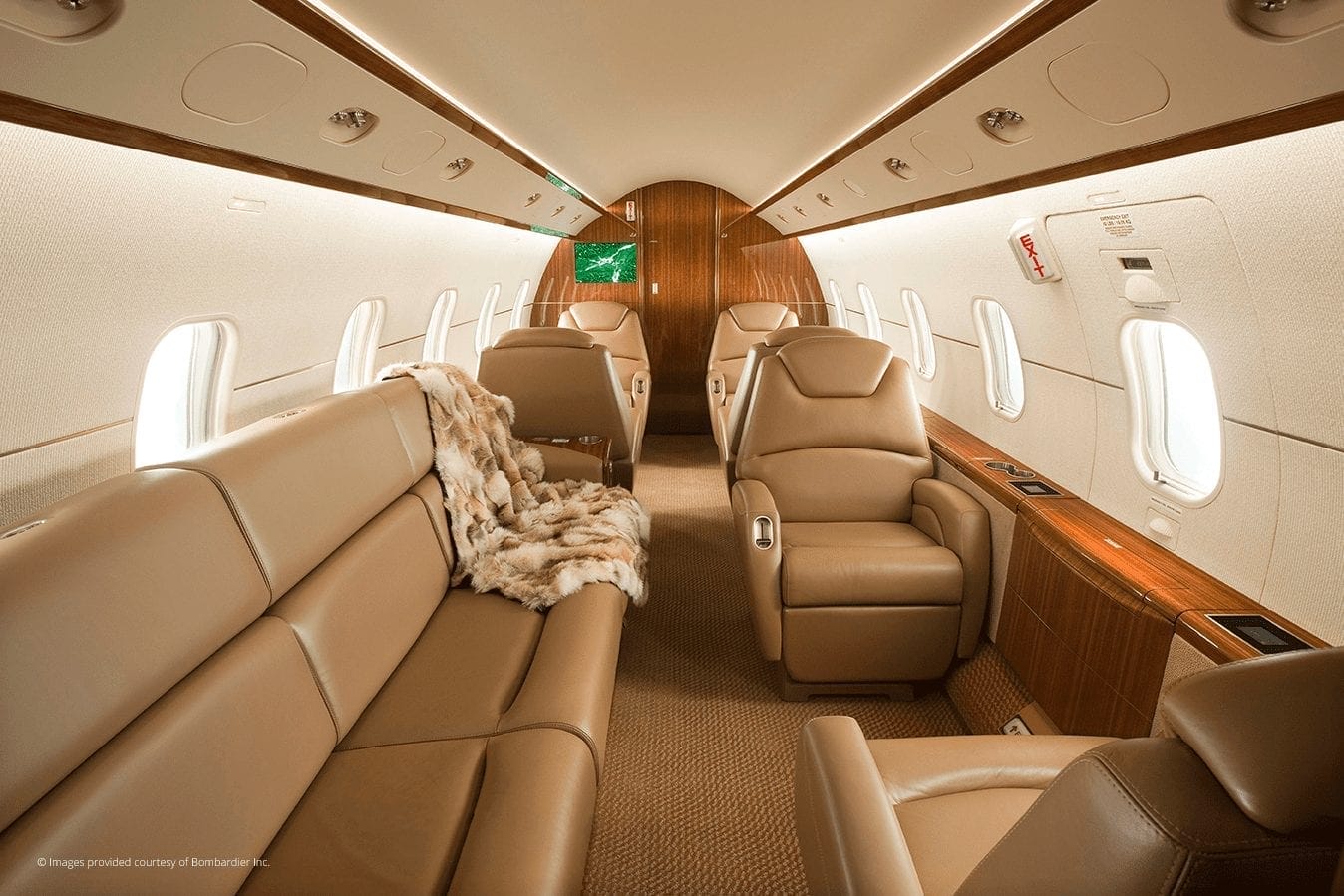
The Gulfstream IV cabin measures 45 feet 1 inch long, 6 feet 2 inches tall, and 7 feet 3 inches wide. That stand-up height and width let passengers move freely on flights that can run eight hours or more. Most configurations seat up to 13 across distinct zones for meetings, meals, and rest.
For Private Clients, the cabin turns a long mission into productive time. Berthable seating, a full galley, and a private lavatory support transoceanic schedules, so a red-eye to Europe becomes an opportunity to arrive rested. Magellan Jets designs each journey around the Client, coordinating catering, ground transportation, and cabin preferences before wheels-up.
Chartering a Gulfstream IV Today
The Gulfstream IV remains a practical choice for long-range travel, and Magellan Jets sources the right heavy jet for each mission through On-Demand Charter. As an asset-light private aviation solutions provider, Magellan Jets does not own or operate aircraft. It matches Private Clients with vetted operators from the Magellan Jets Preferred Network, an exclusive group of fewer than 100 operators out of roughly 3,000 licensed in the United States.
Heavy jet travel aboard a Gulfstream IV or a comparable aircraft starts from an estimated $12,989 per hour. This is an estimated hourly rate for Heavy Jet charter, inclusive of fuel. It does not include contingencies such as de-icing, positioning, overnight fees, or other trip-specific costs. Final pricing is confirmed at time of quote.
For Private Clients who fly often, a Jet Card locks in capped hourly rates and guaranteed availability 365 days a year. Those weighing ownership can rely on the Magellan Jets Aircraft Sales & Management team for acquisition and oversight. Because Magellan Jets owns no fleet, every recommendation serves the Client’s mission, not fleet utilization.
Every Gulfstream IV mission carries the same commitment. A dedicated Private Aviation Advisor plans the trip, and a Client Experience team coordinates the details on the day of travel. That approach has carried Private Clients to more than 100 countries and earned Magellan Jets a 4.9-out-of-5 Client satisfaction rating.
How the Gulfstream IV Compares to Newer Gulfstreams
The Gulfstream IV established the template that newer models refined. The Gulfstream G450 is a direct GIV-SP upgrade, adding gains in range and avionics. The Gulfstream G550 and Gulfstream G650 extend range much further, with the G650 reaching intercontinental city pairs the GIV was never designed to fly nonstop.
The GIV still fits a clear profile. It suits Private Clients who value proven long-range capability and a large cabin at a heavy jet rate below that of the newest ultra-long-range types. A well-maintained Gulfstream IV also keeps a broad base of qualified operators, which supports availability on short notice. For a New York to London crossing or a coast-to-coast mission, the Gulfstream 4 continues to deliver dependable performance.
Frequently Asked Questions About the Gulfstream IV (FAQs):
What Is the Gulfstream IV?
The Gulfstream IV is a large-cabin, long-range heavy jet produced by Gulfstream Aerospace. It carries up to 13 passengers and flies transatlantic and transcontinental missions nonstop. Known as the GIV or Gulfstream G4, it built its reputation on range, cabin size, and reliability.
What Is the Range of the Gulfstream IV, and Can It Cross the Atlantic?
The Gulfstream IV has a range of 4,200 nautical miles, and the GIV-SP variant reaches about 4,166 nautical miles. That range allows nonstop crossings such as New York to London. NOAA has flown a GIV-SP on Atlantic hurricane missions since 1997, which underscores the type’s long-range endurance.
How Many Passengers Does a Gulfstream IV Seat?
Most Gulfstream IV configurations seat up to 13 passengers. The cabin divides into distinct zones for working, dining, and resting. Exact seating depends on how the individual aircraft is configured.
How Much Does It Cost to Charter a Gulfstream IV?
Heavy jet travel aboard a Gulfstream IV starts from an estimated $12,989 per hour. This is an estimated hourly rate for Heavy Jet charter, inclusive of fuel. It does not include contingencies such as de-icing, positioning, overnight fees, or other trip-specific costs. Magellan Jets confirms exact pricing for each mission at time of quote.
Is the Gulfstream IV Still a Good Aircraft Given Its Age?
Yes. Airworthiness depends on maintenance and operator standards, not the year of manufacture. Magellan Jets leads with safety, sourcing only from operators in its Preferred Network who meet rigorous vetting under Part 135, the FAA regulations governing on-demand charter operations. You can review the Magellan Jets safety standards for the full approach.
How Does the Gulfstream IV Compare to Newer Gulfstream Models (G450, G550, G650)?
The Gulfstream G450 is a direct upgrade of the GIV-SP, with improved range and avionics. The Gulfstream G550 and Gulfstream G650 fly considerably farther, reaching city pairs beyond the GIV’s design range. The Gulfstream IV still offers a large cabin and proven transatlantic capability at a lower hourly rate than the newest models.
The Gulfstream IV earned its reputation the hard way, by crossing oceans reliably for more than 30 years. It remains a confident choice for Private Clients who want range, cabin space, and proven performance on their next long-range journey. Tell us where you need to be, and Magellan Jets will match you with the right heavy jet and stand behind every detail of the mission.
Both the Gulfstream G650ER and the Bombardier Global 7500 are Heavy-category, ultra-long-range flagships, and they sit at the top of what private aviation offers today. The Global 7500 leads on outright reach at 7,800 nm and on cabin length, with a dedicated master suite for genuine onboard rest. The G650ER answers with a wider 8 ft 2 in cabin, its signature panoramic oval windows, 7,437 nm of range, and a shorter footprint that opens more airports. In the gulfstream g650er vs bombardier global 7500 conversation, the honest verdict is that neither wins outright — each belongs to a different kind of mission.
The Ultra-Long-Range Field: Where the G650ER and Global 7500 Fit
Ultra-long-range flight is the most rarefied tier in aviation, and only a handful of aircraft truly belong to it. Gulfstream and Bombardier own that conversation. On the Gulfstream side, the lineage now runs from the G650ER through the newer G700 and the G800. On the Bombardier side, it runs from the Global 7500 to its successor, the Global 8000.
Here is what matters for a Client choosing today. The G650ER and the Global 7500 are the two most-flown, most charter-available ultra-long-range jets in the world. They have the deepest operator networks, the longest safety records, and the widest availability when you want a specific tail on a specific day.
The newer arrivals sit just above them. The Gulfstream G700 entered service in 2024 and offers a larger cabin than the G650ER. The Gulfstream G800 earned FAA and EASA certification in 2025 and pushes ultra-long range further still. Bombardier’s Global 8000 is the direct successor to the 7500, certified and entering service in late 2025, marketed at Mach 0.95 and roughly 8,000 nm while sharing the 7500’s cabin dimensions.
Those successors are exceptional, and they are also brand new to the fleet. That scarcity is part of their appeal. For most missions flying now, the G650ER and Global 7500 remain the proven, immediately accessible choice — which is exactly why the g650er vs g700 question so often ends with the G650ER when a Client needs to fly this month rather than next year.
Availability is the quiet advantage here. A jet that entered service years ago has had time to spread across dozens of operators, which means more tails in more regions and more flexibility on short notice. The newest flagships are still concentrated in a small number of fleets, so booking one for a specific date can require patience. When you compare the g650er vs global 7500 against their successors, you are really weighing proven access against the cachet of the latest arrival. For the majority of ultra-long-range travel, access wins.
Cabin and Living Space: G650ER vs. Global 7500
Step aboard either aircraft and you are in a different category of travel. The difference between them is one of character, not quality.The Global 7500 is built around space and separation. Its cabin measures 54 ft 4 in long, 8 ft 0 in wide, and 6 ft 2 in tall, for 2,637 cu ft of volume. That length divides into four living zones, including a dedicated master suite and a full-size galley. It carries up to 17 passengers and holds 195 cu ft of baggage. On a long overnight crossing, that private suite changes the experience entirely — you arrive rested, not merely transported.
The G650ER makes a different argument. Its cabin runs 46 ft 8 in long, 8 ft 2 in wide, and 6 ft 3 in tall, for 2,421 cu ft of volume across four living areas. It seats up to 16 passengers and matches the 7500’s 195 cu ft of baggage. Two extra inches of width and a slightly taller ceiling give the G650ER an open, social feel, and its 16 panoramic oval windows — the largest in business aviation — flood the cabin with daylight.
Both cabins are flat-floor designs with cabin altitudes tuned for comfort, so you step across a level surface from nose to tail and arrive feeling fresher than a long flight would suggest. The details differ in emphasis rather than execution. The 7500 uses its length to create true separation between work, dining, and sleep. The G650ER uses its width and its extra ceiling inch to make a single volume feel larger and more social.
So the choice comes down to atmosphere. The Global 7500 favors travelers who want defined zones and a true bedroom aloft. The G650ER comes alive for those who prize a bright, wide, connected cabin where the group stays together.
Range and Performance: Which Flies Farther?
Range is where these two flagships stake their reputations, and both are extraordinary. The Global 7500 flies up to 7,800 nm nonstop. The G650ER flies up to 7,437 nm. That is roughly a 360 nm advantage for the 7500 — real margin on the longest routes, though both cover the vast majority of intercontinental pairings without a stop.
Consider what that reach unlocks. Both aircraft handle New York–Hong Kong, Singapore–San Francisco, and London–Buenos Aires as nonstop missions. On the truly punishing legs, such as Los Angeles–Sydney, the 7500’s extra range gives more cushion against headwinds and payload trade-offs. For a Client who routinely flies the longest transpacific and transatlantic corridors, that margin is worth having.
Published range figures always describe an ideal, still-air flight, so the real world trims them. A full cabin, heavy baggage, strong seasonal winds, and a demanding routing all draw down the distance an aircraft can cover without stopping. This is where the 7500’s headline 7,800 nm earns its keep on the outer edge of the map. For the routes most Clients actually fly, the G650ER’s 7,437 nm leaves ample room, and its shorter takeoff run can matter more than a few hundred nautical miles at the top end.
Performance is otherwise closely matched. Both climb to a 51,000 ft service ceiling, above most weather and commercial traffic. Both cruise at Mach 0.90-plus, with a maximum near Mach 0.925 — among the fastest civil aircraft flying. The G650ER pairs two Rolls-Royce engines with a takeoff distance near 6,299 ft. The Global 7500 uses two GE Passport engines and needs about 5,760 ft, giving it a slight edge on shorter runways.
A note on the 7500’s history: it was known as the Global 7000 during development and entered service in 2018 as the Global 7500. That maturity matters, because it means a deep, well-understood fleet is available for charter today. Bombardier global 7500 range and reliability are no longer questions — they are established facts.
Speed and altitude shape the journey as much as raw range. Cruising in the low fifties keeps both aircraft above most turbulence and airline traffic, so the ride stays smooth on long legs. At Mach 0.90-plus, an ultra-long-range jet can shave meaningful time off a transatlantic or transpacific crossing compared with slower aircraft. On a fifteen-hour mission, even a fractional speed advantage translates to a measurably earlier arrival. Both the G650ER and the Global 7500 sit at the very front of the civil speed envelope, which is a large part of why they remain the reference points for the entire class.
Specification Comparison: Gulfstream G650ER vs. Global 7500
The table below lays the two flagships side by side on the numbers that decide most missions.
Specification
Gulfstream G650ER
Bombardier Global 7500
Category
Heavy, ultra-long-range
Heavy, ultra-long-range
Passengers
Up to 16
Up to 17
Cabin length
46 ft 8 in
54 ft 4 in
Cabin width
8 ft 2 in
8 ft 0 in
Cabin height
6 ft 3 in
6 ft 2 in
Cabin volume
2,421 cu ft
2,637 cu ft
Baggage
195 cu ft
195 cu ft
Range
7,437 nm
7,800 nm
Service ceiling
51,000 ft
51,000 ft
Cruise speed
Mach 0.90-plus (max ~Mach 0.925)
Mach 0.90-plus (max ~Mach 0.925)
Takeoff distance
~6,299 ft
~5,760 ft
Engines
Two Rolls-Royce
Two GE Passport
Which Mission Does Each Aircraft Suit?
The most useful way to choose between these ultra-long-range jets is to start with how you actually fly, not with the spec sheet.
The Global 7500 belongs to the multi-day itinerary. If your travel spans several time zones and back-to-back commitments, the dedicated master suite lets you sleep on a real bed and land ready to work. It suits families and larger groups who value separate zones — one for rest, one for dining, one for meetings — and it favors anyone whose calendar demands genuine recovery in the air. The full-size galley makes long crossings feel like an extended stay rather than a flight.
The G650ER invites a different traveler. Its wider, brighter cabin creates an open, social atmosphere where a group of principals stays connected across a single continuous space. The shorter takeoff footprint expands airport access, letting you land closer to your final destination at fields the 7500 may skip. For the majority of intercontinental pairings — the routes most Clients fly most often — the G650ER delivers the full ultra-long-range experience with more flexibility on where you touch down.
Think about the shape of a typical week, too. A Client running a multi-city tour across Asia and the Middle East will spend more hours aboard than in any single hotel, and the Global 7500’s suite turns that time into rest. A Client shuttling a leadership team between financial capitals values the G650ER’s open cabin, where the whole group can work face to face for the duration of the flight. The aircraft that suits you is the one that matches the rhythm of how you travel.
Put simply: choose the Global 7500 when onboard rest and defined living zones lead your priorities, and choose the G650ER when cabin openness, daylight, and broader airport access matter more. Both are transatlantic and transpacific machines. The distinction is texture, not capability.
How to Fly the G650ER or Global 7500 With Magellan Jets
Access to aircraft this rare is a matter of who you fly with. Magellan Jets operates an asset-light model, which means we place each Client on the right tail for the mission rather than pushing a jet we happen to own.
That freedom is disciplined by rigorous vetting. Every flight is sourced through the Magellan Jets Preferred Network — fewer than 100 vetted operators out of roughly 3,000 licensed in the United States. Our standards go beyond the industry baseline: Magellan holds the WYVERN Wingman Broker Certification and sits on the Board of the Air Charter Safety Foundation (ACSF). Operators in the network carry $100M to $300M in liability coverage. When you board a G650ER or Global 7500 with us, the safety work is already done.
Clients reach these flagships two ways. On-Demand Charter is ideal for one-off ultra-long-range missions, while the Jet Card guarantees availability with fixed rates for those who fly these routes often. For Clients who want a longer-term stake in the aircraft they fly, Fractional Ownership offers another path. And for those drawn to the very newest flagships, we also provide access to the Global 8000 and Gulfstream G800 — explore that pairing in our Global 8000 vs. Gulfstream G800 comparison.
As a guide to budget, the estimated hourly charter rate for Heavy Jet charter is approximately $12,989, inclusive of fuel. This figure is an estimate. It does not include contingencies such as de-icing, positioning, overnight fees, or other trip-specific costs, and final pricing is confirmed at the time of quote.
Frequently Asked Questions: Gulfstream G650ER vs. Bombardier Global 7500
How big is the G650ER compared to the Global 7500?
The Global 7500 has the longer cabin at 54 ft 4 in, versus 46 ft 8 in for the G650ER, and more total volume at 2,637 cu ft against 2,421 cu ft. The G650ER is the wider of the two at 8 ft 2 in, two inches broader than the 7500. In practice, the 7500 gives you more length to divide into zones, while the G650ER feels more open across.
Which has more range, the G650ER or the Global 7500?
The Global 7500 flies farther, with up to 7,800 nm of range compared with 7,437 nm for the G650ER. That is roughly a 360 nm advantage, which matters most on the longest transpacific legs. Both aircraft, however, cover the great majority of intercontinental routes nonstop.
How many passengers can each jet carry?
The G650ER seats up to 16 passengers and the Global 7500 seats up to 17. Both carry 195 cu ft of baggage, so cargo capacity is identical. For most private missions, both offer far more seating than a typical group requires.
Can the G650ER or Global 7500 fly nonstop across the Pacific?
Yes — both handle many transpacific pairings nonstop, including routes such as Singapore–San Francisco and New York–Hong Kong. The Global 7500’s extra range simply provides more margin on the very longest Asia-Pacific legs, where headwinds and payload can tighten the math. For most Pacific crossings, either flagship does it in a single flight.
Which is better for a group of 10 to 12 passengers on intercontinental trips?
Both aircraft seat comfortably beyond 10 to 12 passengers, so capacity is not the deciding factor. Choose based on how the group wants to travel. The Global 7500’s defined zones and master suite suit trips where rest and privacy lead, while the G650ER’s wide, open cabin suits groups that prefer to stay together in one bright space.
How does the Global 7500 compare to the Gulfstream G700?
The G700 is Gulfstream’s newer, larger flagship, sitting a step above the G650ER in the lineup. The Global 7500 is its closest ultra-long-range peer, and it remains far more available in charter today thanks to a mature, widely operated fleet. Both are ultra-long-range aircraft, so the practical difference for most Clients is availability rather than capability.
How much does it cost to charter a G650ER or Global 7500?
Both fall in the Heavy Jet category, with an estimated hourly charter rate of approximately $12,989, inclusive of fuel. This figure is an estimate. It does not include contingencies such as de-icing, positioning, overnight fees, or other trip-specific costs, and final pricing is confirmed at the time of quote.
Your Next Ultra-Long-Range Mission
The Gulfstream G650ER and Bombardier Global 7500 are the finest ultra-long-range jets flying and chartering today, and the right one depends entirely on the mission in front of you. Whether you value the Global 7500’s private suite and reach or the G650ER’s open, daylit cabin and broader airport access, we will match you to the aircraft that fits. Talk to a Private Aviation Advisor to plan your next flight.
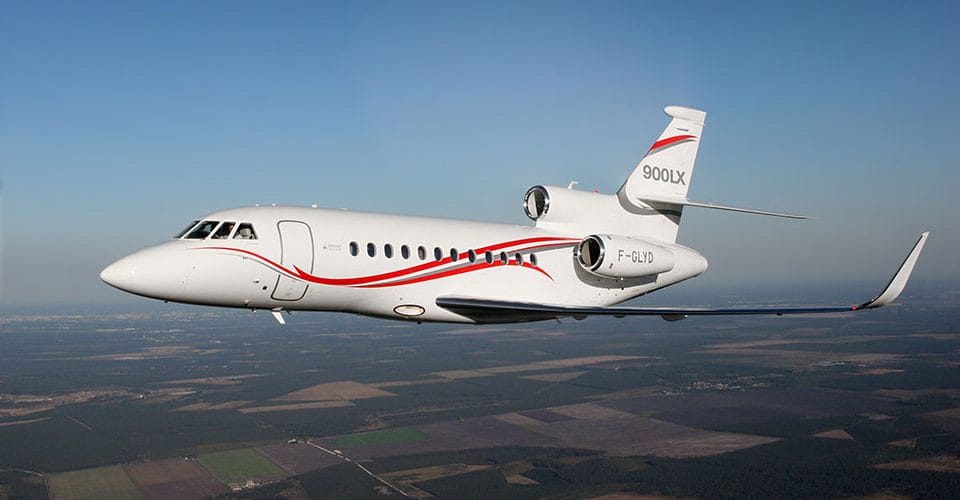
In the Gulfstream G450 vs. Falcon 900 conversation, the two jets play to different strengths. The G450 offers a larger Heavy-category cabin, more baggage room, and a faster cruise. The Falcon 900LX answers with longer range, a higher ceiling, and access to shorter runways, aided by a third engine on long overwater legs. Both are large-cabin jets that discerning Clients cross-shop, and the right choice comes down to how you like to fly.
The Gulfstream G450: Heavy-Cabin Presence
Step aboard a G450 and the room announces itself. This is a proper heavy jet, built for the traveler who wants to stretch out and arrive composed. The cabin runs long, the baggage hold is generous, and the pace is quick.
Gulfstream delivered the last G450 in January 2018, closing a run of 365 aircraft. Today it lives on the pre-owned and charter market, where its blend of space and speed still turns heads. Gulfstream’s G500 and G600, both in service since 2018 and 2019, carry the torch forward, yet the G450 remains a favorite for coast-to-coast and transatlantic days.
The Falcon 900LX: The Trijet That Goes Farther
Dassault built the Falcon 900LX for reach and finesse. It is the current flagship of the storied 900 line, offered with the EASy II flight deck, blended winglets, and an optional FalconEye combined-vision head-up display. On the market you will find it through charter, prized by Clients who value range and short-field composure.
The trijet layout is the signature. Three engines climb the aircraft higher and faster, open access to tighter runways, and add reassurance across long stretches of open water. The cabin is slightly more compact than the G450, yet Dassault’s craftsmanship makes every inch feel considered.
Gulfstream G450 vs. Falcon 900 at a Glance
Here is how the two large-cabin jets stack up side by side.
Category
Gulfstream G450
Dassault Falcon 900LX
Category
Heavy
Super-Midsize
Passengers
Up to 13
Up to 12
Cabin length
45’1″
33’2″
Cabin width
7’3″
7’7″
Cabin height
6’2″
6’2″
Cabin volume
1,658 cu ft
1,270 cu ft
Baggage
169 cu ft
127 cu ft
Range
4,425 nm
4,685 nm
Max cruise speed
476 kn
431 kn
Ceiling
45,000 ft
51,000 ft
Takeoff / landing distance
5,600 ft / 2,663 ft
5,360 ft / 2,455 ft
Engines
Two Rolls-Royce Tay 611-8C
Three Honeywell TFE731-60
Range and Speed: Gulfstream vs. Falcon
Speed is the Gulfstream’s calling card. The G450 cruises at up to 476 knots, trimming precious minutes off long days. When you want to be first on the ground for a dinner or a deal, that pace matters.
The Falcon 900LX plays the long game. It flies up to 4,685 nautical miles, edging past the G450’s 4,425, so it reaches a touch farther on a single leg. For the traveler weighing which private jet for transatlantic crossings, the two are close, and mission profile decides it.
Consider the practical picture. A westbound Atlantic crossing into headwinds can push either jet near its limit, and here the Falcon’s extra reach earns its keep. On a shorter domestic hop, the G450’s speed usually matters more than range. Your typical routes, not a single number, point to the better fit.
Cabin and Comfort
The G450 wins on sheer room. With 1,658 cubic feet of cabin and 169 cubic feet of baggage, it invites full-height movement, dedicated work zones, and space for the whole party’s luggage. It suits the group that packs for two weeks and works the whole way.
The Falcon 900LX is a shade narrower in volume yet slightly wider across the shoulders at 7’7″. Dassault’s cabin favors quiet refinement and thoughtful detail. Both stand at 6’2″ tall, so you move about with ease in either.
Comfort is also about how you spend the hours aloft. The G450’s extra length lends itself to distinct zones: a place to work, a place to dine, a place to rest. The Falcon’s cabin comes alive for smaller groups who prize intimacy and calm. Neither jet asks you to compromise on the finer touches.
Engines and Airport Access
This is where the Dassault vs. Gulfstream story turns most interesting. The G450 runs two Rolls-Royce Tay 611-8C engines, a clean and proven pairing. The Falcon 900LX carries three Honeywell TFE731-60 engines, and that third powerplant changes the character of the aircraft.
Three engines lift the Falcon off shorter runways, needing 5,360 feet to depart and just 2,455 feet to land. That opens mountain airfields, island strips, and city-adjacent runways the G450 may pass over. The trijet also brings added assurance on long overwater legs, and its layout tends toward efficient long-haul cruising.
Avionics and Flight Deck
Both flight decks are built for confident, precise flying. The G450 uses Gulfstream’s PlaneView suite with head-up and enhanced-vision capability, giving crews sharp situational awareness in low visibility.
The Falcon 900LX flies behind Honeywell’s Primus Epic EASy II flight deck, with the optional FalconEye system layering synthetic and enhanced imagery into a single head-up view. Both cockpits keep the experience smooth from wheels-up to touchdown.
Current Market and Availability
Neither jet is fresh off an assembly line, and that is part of their appeal. The G450 trades exclusively pre-owned and by charter now, with the G500 and G600 representing Gulfstream’s newer generation. The Falcon 900LX remains the flagship of the 900 line and comes to Clients primarily through charter.
Access to either aircraft is what keeps them special. Working with the right advisor puts the finest available airframes within reach, tail by tail, without the commitment of ownership.
How to Charter the G450 or Falcon 900
Chartering either jet through Magellan is straightforward and personal. You can fly by on-demand charter or through a Magellan Jet Card. A private aviation advisor then matches the aircraft to your mission, your calendar, and the experience you have in mind.
As a guide to planning, Magellan’s estimated hourly rates by category help set expectations:
Heavy Jet, such as the Gulfstream G450: estimated around $13,000 per hour.
Super-Midsize, such as the Falcon 900LX: estimated around $9,700 per hour.
These figures are estimates only. Actual hourly rates vary by route, date, availability, and the specifics of your trip, and a Magellan advisor confirms exact pricing before you fly.
Which Should You Choose?
Both aircraft belong to travelers with high standards, so the decision comes down to how you fly most.
Choose the G450 if you want the largest cabin, the most baggage room, a faster cruise, and room for a full party of up to 13.
Choose the Falcon 900LX if you want longer range, a higher ceiling, access to shorter and more remote runways, and the assurance of a third engine on transatlantic legs.
Frequently Asked Questions
Is the Gulfstream G450 still in production?
No. Gulfstream delivered the final G450 in January 2018 after building 365 aircraft. It now flies on the pre-owned and charter market, where it remains a sought-after large-cabin choice.
Is the Falcon 900LX still made, and what replaced the G450?
The Falcon 900LX remains the flagship of Dassault’s 900 line and comes to Clients through charter. Gulfstream’s G500 and G600, in service since 2018 and 2019, succeeded the G450 and G550 generation.
Which has longer range, the G450 or the Falcon 900LX?
The Falcon 900LX flies farther, with a range of 4,685 nautical miles against the G450’s 4,425. The margin is modest, so route and payload shape the real difference.
Which jet is faster?
The Gulfstream G450 is quicker, cruising at up to 476 knots compared with the Falcon 900LX’s 431. On long days, that speed can put you on the ground sooner.
How many passengers can each jet carry?
The G450 seats up to 13 passengers, while the Falcon 900LX seats up to 12, and the G450’s larger cabin gives that party more room to spread out. Exact layouts vary by aircraft, and your advisor confirms the configuration.
Why does the Falcon 900 have three engines?
The trijet design lets the Falcon 900LX climb higher, use shorter runways, and cross long stretches of open water with added assurance. It is a hallmark of Dassault’s 900 line.
Which jet needs a shorter runway?
The Falcon 900LX. It departs in about 5,360 feet and lands in roughly 2,455, opening tighter and more remote airfields than the G450 typically reaches.
Which is better for transatlantic flights?
Both handle transatlantic missions well. The Falcon 900LX offers slightly longer range and its third engine adds reassurance over water, while the faster G450 favors speed and cabin space.
Which jet is more fuel-efficient?
Directionally, the Falcon 900LX’s trijet design lends itself to efficient long-haul cruising. Real-world figures depend on route, payload, and mission, which a Magellan advisor can walk through with you.
Talk to a Magellan Private Aviation Advisor
The best way to settle the Gulfstream G450 vs. Falcon 900 question is a conversation about where you are going and how you like to travel. Talk to a Magellan private aviation advisor and let us match the right large-cabin jet to your next journey.
The Challenger 300 vs. Citation Latitude decision comes down to the kind of journey you want to own. The Bombardier Challenger 300 is a super-midsize jet with more range, greater cabin volume, and higher speed. The Cessna Citation Latitude is a midsize jet with a wide, flat-floor cabin and easy access to shorter runways. Choose the Challenger 300 for coast-to-coast reach and pace. Choose the Latitude for a roomy stand-up feel, generous baggage, and the freedom of smaller airports.
The Bombardier Challenger 300, a Super-Midsize Standout
Some jets simply expand what a single day can hold. The Challenger 300 is one of them. It carries you farther, faster, and in a cabin built for the way you actually travel.
This is one of the most versatile super-midsize jets flying. The wide flat-floor cabin and excellent baggage capacity suit both boardroom trips and long weekends. There is room for skis, golf clubs, and larger pets, with space for a party of six to spread out in real comfort even as the cabin seats up to nine. With 3,340 nautical miles of range, coast-to-coast travel opens up without a fuel stop.
The Cessna Citation Latitude, Midsize Comfort Redefined
Space changes how a flight feels. The Citation Latitude leads its midsize category on exactly that promise, with a six-foot flat-floor cabin that lets you stand, stretch, and settle in.
The Latitude favors families, pet-friendly charters, and guests with mobility considerations. It seats up to nine and offers comfort that stands out among midsize jets. Its short-runway performance also opens more airports, so you land closer to where the day really begins. For a pilot’s perspective, read the Citation Latitude pilot review.
Challenger 300 vs. Citation Latitude Specifications at a Glance
The cabin is where a private flight earns its name. Both jets deliver, and each has a signature. The Challenger 300 offers the larger volume at 930 cubic feet, with a cabin 23 ft 7 in long and 7 ft 2 in wide. That extra width invites longer trips and a genuine sense of room.
The Latitude answers with a six-foot flat-floor stand-up cabin at 587 cubic feet. Walking upright, cabin to seat, makes shorter hops feel effortless. Its comfort suits seven to nine passengers, families, and guests who value an easy, level entry.
Range and Performance
Range is freedom measured in miles. It decides whether you arrive nonstop or pause along the way. The Challenger 300 reaches 3,340 nm, enough for confident coast-to-coast travel across the U.S. The Citation Latitude covers 2,700 nm, ideal for regional and many transcontinental missions.
Both jets share a 45,000-foot service ceiling, so each climbs above much of the weather and busier traffic. When your itinerary stretches long, the Challenger 300’s extra reach becomes the deciding advantage.
Speed
Time is the one luxury you cannot buy back, and speed protects it. The Challenger 300 cruises at up to 459 knots, about 528 mph. The Citation Latitude cruises at up to 368 knots, about 423 mph. On longer legs, the Challenger’s pace trims meaningful minutes and keeps a packed calendar intact.
Runway Access and Airport Flexibility
The best destinations are not always served by the biggest airports. That is where the Latitude quietly excels. Its 3,580-foot takeoff and 2,085-foot landing distances open smaller fields closer to your final address.
The Challenger 300 needs 4,810 ft for takeoff and 2,290 ft to land. It still reaches thousands of airports, and it trades a little runway flexibility for its greater range and speed. Both aircraft pair naturally with an on-demand charter approach, so the airport suits the trip rather than the other way around.
Passenger Capacity and Baggage
Great travel makes room for everyone and everything you bring. The Challenger 300 typically seats eight, with capacity for up to nine, and offers 106 cubic feet of internal baggage for skis, clubs, and gear. The Latitude also seats up to nine and carries 127 cubic feet of total baggage.
So the Latitude holds more overall luggage volume, while the Challenger pairs strong baggage capacity with a wider cabin. For a larger group with plenty to pack, both jets welcome the full party in comfort.
Avionics
Confidence in the cockpit shapes the calm you feel in the cabin. The Challenger 300 flies behind Rockwell Collins Pro Line 21 with four LCD displays. The Citation Latitude uses the Garmin G5000 with touchscreen controls, Synthetic Vision, and autothrottle. Both suites give crews clear, current information from takeoff to touchdown.
Charter Access and Cost Guidance
Chartering either jet is less a transaction than an invitation to travel on your own terms. As general guidance by category, the Challenger 300 (super-midsize) is estimated at around $9,700 per hour, and the Citation Latitude (midsize) at around $8,600 per hour.
Both figures are estimates only. Rates vary with routing, availability, repositioning, dates, and other factors, and a Magellan advisor confirms exact pricing for your itinerary. If you are weighing other super-midsize options, compare the Citation X vs. Challenger 300 and the Challenger 350 dossier as well.
Frequently Asked Questions About the Challenger 300 vs. Citation Latitude (FAQs):
Can a Challenger 300 cross the Atlantic?
The Challenger 300 offers 3,340 nm of range. That covers confident coast-to-coast U.S. travel and many longer routes, though a full transatlantic crossing sits beyond its nonstop reach. A Magellan advisor can map the right stop or a longer-range aircraft for ocean itineraries.
Which is better for transcontinental flights?
The Challenger 300 is the stronger choice for transcontinental travel. Its 3,340 nm range and 459-knot cruise favor long nonstop legs. The Latitude, at 2,700 nm, handles many transcontinental missions well, especially with a favorable routing.
How do the cabin sizes compare?
The Challenger 300 has the larger cabin volume at 930 cubic feet and a wider 7 ft 2 in cabin. The Latitude offers 587 cubic feet with a six-foot flat-floor stand-up cabin that many guests love for its easy, upright feel.
What is the range difference?
The Challenger 300 reaches 3,340 nm and the Citation Latitude reaches 2,700 nm. That is a 640 nm advantage for the Challenger, which translates into more nonstop options on longer routes.
Which is faster?
The Challenger 300 is faster. It cruises at up to 459 knots, about 528 mph. The Citation Latitude cruises at up to 368 knots, about 423 mph.
How do charter costs compare?
As general category guidance, the Challenger 300 is estimated at around $9,700 per hour and the Citation Latitude at around $8,600 per hour. These are estimates that vary with routing, availability, repositioning, dates, and other factors, and a Magellan advisor confirms exact pricing.
Which is better for a larger group?
Both jets seat up to nine passengers. The Latitude carries more total baggage at 127 cubic feet and offers an easy stand-up cabin, while the Challenger 300 pairs a wider cabin with longer range for bigger, farther-flung trips.
Find the Right Jet for Your Next Journey
Your ideal aircraft is the one that matches the trip you imagine, and the choice is yours to make with confidence. When you are ready to fly, talk to a private aviation advisor and let a Magellan specialist shape the details around you.
The most popular private jets to charter in 2027 are the aircraft that quietly earn their reputations: the Cessna Citation Excel, the ultra-fast Citation X, the coast-to-coast Challenger 350, the wide-cabin Challenger 650, and the intercontinental Bombardier Global 7500. Each one has become a favorite for a specific reason, whether that is speed, range, cabin comfort, or the ability to reach a short mountain runway. This year the list gains a new flagship: the newly certified Bombardier Global 8000, now the longest-range business jet in production.
Choosing among them is one of the pleasures of flying privately. At Magellan Jets, an asset-light private aviation solutions provider, we match each Client to the right aircraft for the mission at hand. Below, our Private Aviation Advisors break down the jets our Clients request most, what makes each one resonate, and the validated specifications that matter when you plan a trip.
Popularity in private aviation is earned in the details. A jet becomes a favorite when it lands close to where you need to be, carries the whole party in comfort, and arrives on time, every time. The aircraft below have proven themselves on exactly those terms, which is why they fill our Clients’ itineraries year after year.
What Are the Most Popular Private Jets to Charter in 2027?
The most popular private jets to charter in 2027 span every cabin size. In the light category, the Embraer Phenom 300 and Cessna Citation CJ3 lead for regional efficiency. Among midsize and super-midsize aircraft, the Citation Excel, Citation X, Citation Latitude, Embraer Praetor 500, Challenger 350, and Gulfstream G280 dominate. For heavy and ultra-long-range travel, the Challenger 650, Global 7500, and new Global 8000 set the standard. The right choice depends on your distance, passenger count, and runway access.
Private Jet Categories, Explained
Before the list, a quick orientation. Private jets are grouped by cabin size and mission range. Knowing the categories makes it easier to picture where each aircraft fits.
Light jets: Efficient regional aircraft for up to six passengers and trips of roughly two to three hours. They access short runways that larger jets cannot.
Midsize jets: A step up in cabin room and range, comfortable for cross-country hops with a stand-up or near-stand-up cabin.
Super-midsize jets: Flat-floor cabins, transcontinental range, and the room to work or rest across the country nonstop.
Heavy jets: Wide-body cabins with distinct living zones, ideal for larger groups and long international legs.
Ultra-long-range jets: The intercontinental flagships, purpose-built to connect distant cities nonstop in a residence-like cabin.
With that framework in mind, here are the aircraft our Clients charter most often in 2027.
1. Cessna Citation Excel / XLS
Ask any Private Aviation Advisor which midsize jet gets requested most, and the Citation Excel comes up first. Clients love it because it does everything well. The stand-up cabin feels roomy for its class, the baggage hold swallows golf bags and gear, and it slips into short regional runways with ease. It is the dependable choice for a family weekend or a full day of meetings across two cities.
Key Features:
Category: Midsize
Passengers: up to eight
Range: roughly 1,840 to 2,020 nautical miles
Service ceiling: 45,000 feet
Max cruise: about 500 mph
2. Cessna Citation X
Speed is the story here. The Citation X is one of the fastest business jets ever built, cruising near 700 mph and pushing toward the sound barrier. For Clients who value time above all, that pace turns a long afternoon of travel into a short one. The cabin stays quiet and composed even as the aircraft flies higher and faster than most of its peers.
The speed compounds over a busy travel week. Shave an hour off each leg and you gain back a working day across a handful of trips. That is why the Citation X stays in demand with executives who measure travel in hours saved.
Key Features:
Category: Midsize
Passengers: up to eight
Range: roughly 3,125 to 3,380 nautical miles
Service ceiling: 51,000 feet
Max cruise: nearly 700 mph, near Mach 0.9
3. Bombardier Challenger 300 / 350
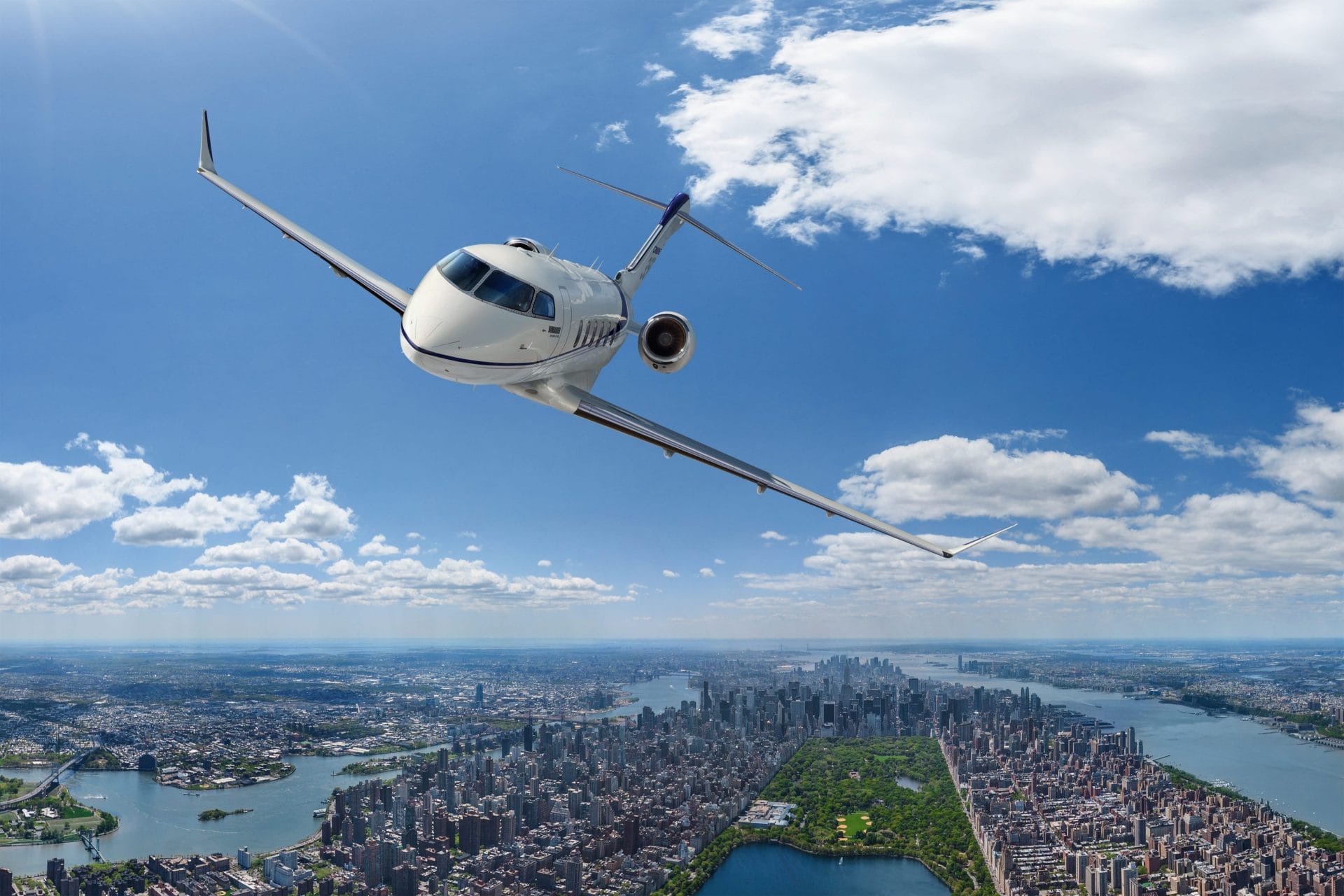
The Challenger 350 is the super-midsize benchmark, and Clients feel it the moment they step aboard. The flat-floor cabin invites you to stretch out, hold a real meeting, or sleep across the country. It flies coast to coast nonstop and does so in near-silence, which is why it stays booked. For many travelers, it is the sweet spot between comfort and efficiency.
Key Features:
Category: Super-midsize
Passengers: up to eight to nine (about six comfortably with full luggage)
Range: roughly 3,270 to 3,340 nautical miles
Max cruise: 459 knots, about 528 mph
4. Bombardier Challenger 650
When a group wants space to spread out, the Challenger 650 answers. Its wide-body cabin is one of the roomiest in its class, with distinct zones for working, dining, and resting. Families gravitate to it because everyone can find their own corner, and the large galley supports full catering on longer legs. It carries the group and the luggage without compromise.
Key Features:
Category: Heavy
Passengers: up to 10
Range: 4,000-plus nautical miles
Max cruise: about 459 knots
5. Cessna Citation Latitude
The Latitude wins Clients over with its cabin. A flat floor and a true six-foot standing height make it feel larger than its category suggests. That openness matters for travelers with mobility needs, for pets, and for anyone who simply wants to move around freely in flight. It pairs that comfort with reliable transcontinental reach.
Key Features:
Category: Midsize
Passengers: up to nine
Range: roughly 2,700 nautical miles
Service ceiling: 45,000 feet
Cabin: flat floor, six-foot stand-up height
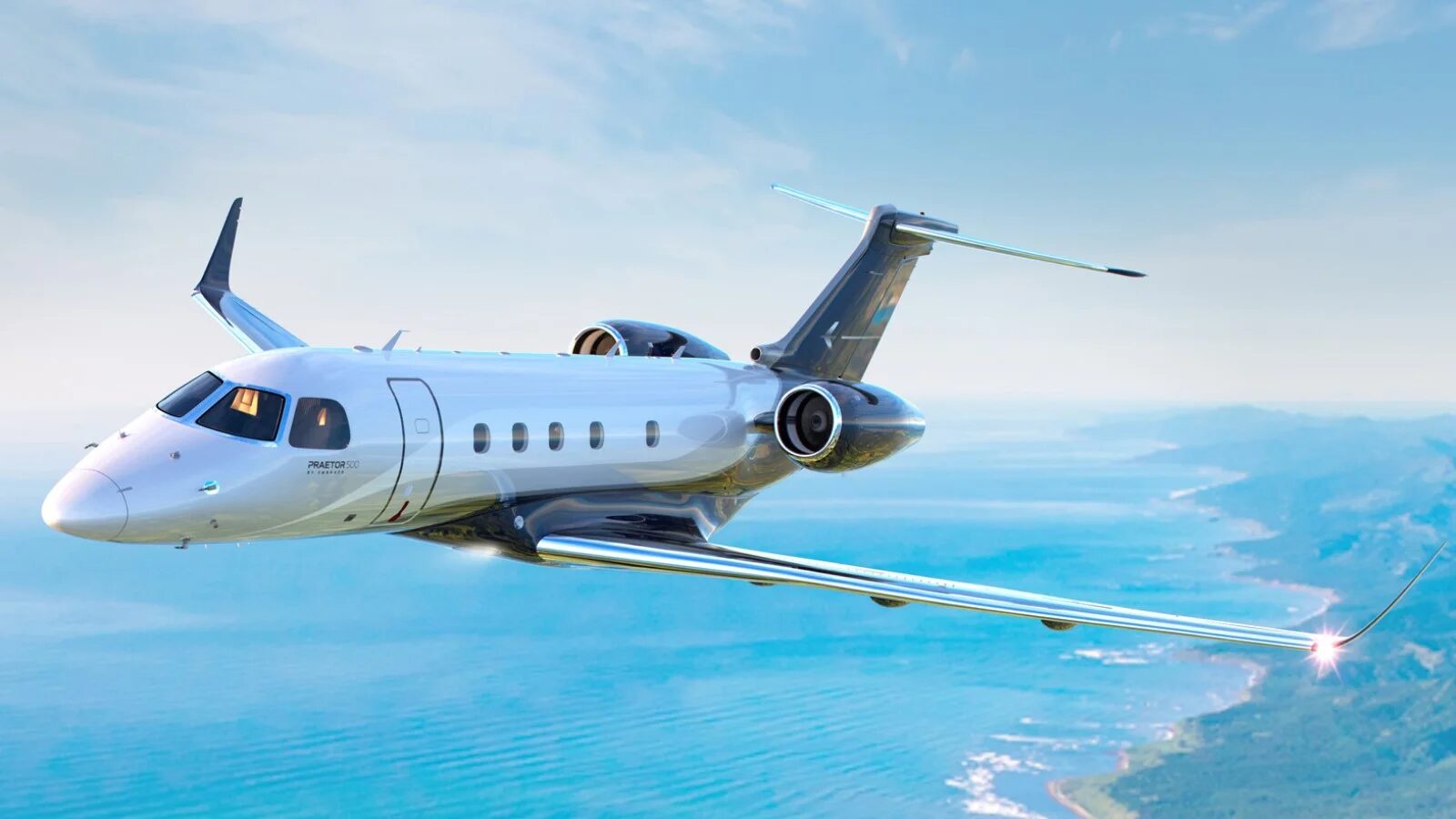
6. Embraer Praetor 500
The Praetor 500 is the modern midsize Clients ask about by name. Its fly-by-wire controls deliver a smooth, precise ride, and the cabin altitude keeps you feeling fresh on landing. It reaches farther than most midsize aircraft, opening up transcontinental trips and beyond without a fuel stop. For frequent flyers, that combination of comfort and range is hard to beat.
Key Features:
Category: Midsize
Passengers: up to nine
Range: roughly 3,340 to 3,412 nautical miles
Controls: full fly-by-wire
7. Bombardier Global 7500
The Global 7500 is where private travel becomes intercontinental in a single leg. Its four distinct living zones and available master suite make a long overnight flight feel like a night at home. Clients choose it to connect distant cities nonstop, arriving rested rather than worn down. It remains the aircraft that redefines what a long-haul cabin can be.
The details matter most to frequent long-haul flyers. A dedicated bedroom, a full galley, and a low cabin altitude turn a fifteen-hour day into something closer to a comfortable evening at home. For a family or a working team crossing oceans, that comfort is the whole point.
Key Features:
Category: Heavy / ultra-long-range
Passengers: up to 17 to 19
Range: roughly 7,700 to 7,800 nautical miles
Service ceiling: 51,000 feet
Cabin: four living zones, available master suite
8. Bombardier Global 8000
New for 2027, the Global 8000 is the flagship every serious traveler is watching. Certified and entering service at the end of 2025, it is now the longest-range business jet in production, capable of connecting almost any two cities on earth nonstop. It cruises at close to Mach 0.95, among the fastest civil aircraft since Concorde, inside the same residence-like cabin that made the Global family famous.
What sets it apart is the combination of reach and pace in one aircraft. A route that once required a fuel stop can now be flown direct, and often faster. Availability is still limited as the fleet grows, so a Private Aviation Advisor can confirm access for your dates and destinations.
Key Features:
Category: Heavy / ultra-long-range (newly certified, limited availability)
Passengers: up to 19
Range: about 8,000-plus nautical miles (up to 8,070)
Service ceiling: 51,000 feet
Max speed: near Mach 0.94 to 0.95
9. Embraer Phenom 300
The Phenom 300 is the most-delivered light jet for a reason. Clients love how much aircraft they get for the category: a bright, well-designed cabin, genuine performance, and the efficiency that makes shorter trips sensible. It flies the Eastern Seaboard nonstop and slips into smaller airports close to your destination. For value in a light jet, it sets the pace.
It is often the first aircraft we suggest for Clients new to private travel. The trip economics make sense for shorter distances, and the flying experience still feels like a genuine step up. Many Clients begin here and move up in category as their travel grows.
Key Features:
Category: Light
Passengers: up to six
Range: roughly 2,000 nautical miles
Service ceiling: 45,000 feet
10. Cessna Citation CJ3 / CJ3+
The CJ3 is the quiet workhorse of regional private travel. Clients favor it for short-runway access and easy efficiency on trips of an hour or two. The cabin is comfortable and well-lit, and the aircraft reaches airports the big jets simply cannot use. When the mission is regional and nimble, the CJ3 is the natural answer.
Key Features:
Category: Light
Passengers: up to six
Range: roughly 1,875 to 1,918 nautical miles
Service ceiling: 45,000 feet
11. Gulfstream G280
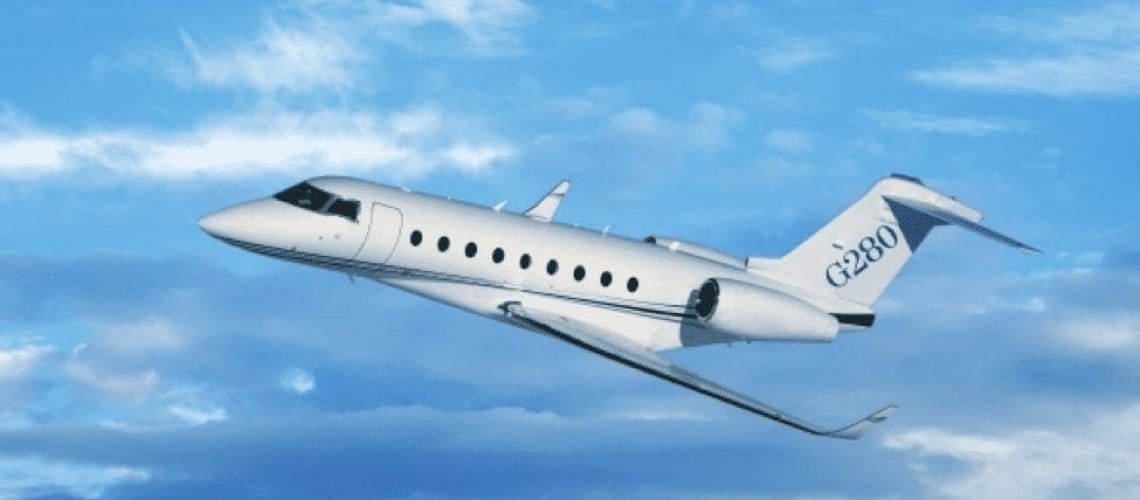
The G280 rounds out the list as a super-midsize favorite. Its flat-floor cabin is welcoming and easy to move through, which appeals to travelers with mobility needs and to groups who value comfort on longer legs. It carries a full load across the country and does so with the refinement Gulfstream is known for. Clients who try it tend to come back.
Key Features:
Category: Super-midsize
Passengers: up to 10
Range: roughly 3,600 to 3,700 nautical miles
Max cruise: about 459 knots
Popular Private Jets to Charter in 2027: Comparison Table
Jet
Category
Passengers
Approx. Range (nm)
Cessna Citation Excel / XLS
Midsize
Up to eight
1,840–2,020
Cessna Citation X
Midsize
Up to eight
3,125–3,380
Bombardier Challenger 300 / 350
Super-midsize
Up to eight to nine
3,270–3,340
Bombardier Challenger 650
Heavy
Up to 10
4,000+
Cessna Citation Latitude
Midsize
Up to nine
~2,700
Embraer Praetor 500
Midsize
Up to nine
3,340–3,412
Bombardier Global 7500
Heavy / ultra-long-range
Up to 17–19
7,700–7,800
Bombardier Global 8000
Heavy / ultra-long-range
Up to 19
8,000+ (8,070)
Embraer Phenom 300
Light
Up to six
~2,000
Cessna Citation CJ3 / CJ3+
Light
Up to six
1,875–1,918
Gulfstream G280
Super-midsize
Up to 10
3,600–3,700
How to Choose the Right Private Jet
The best aircraft is the one that fits the trip in front of you. Four factors guide the decision, and a Private Aviation Advisor weighs them with you.
Range: Match the aircraft to your longest leg so you fly nonstop when it matters.
Passengers and luggage: Count people, bags, and gear, then choose a cabin that carries all three in comfort.
Runway access: Smaller airports near your destination may favor a light or midsize jet.
Mission type: A quick regional hop, a coast-to-coast meeting, and an intercontinental family trip each point to a different category.
Access matters as much as the aircraft. Because Magellan Jets is asset-light, we are not tied to a single fleet. We source every trip from the Magellan Jets Preferred Network of fewer than 100 vetted operators, and we lead with safety on each one. That independence lets us place you on the best available aircraft for your route, with 24/7/365 support behind it.
Frequently Asked Questions About the Most Popular Private Jets to Charter in 2027 (FAQs):
What is the most popular private jet to charter?
Across our Client requests, the Cessna Citation Excel and the Bombardier Challenger 350 lead the midsize and super-midsize categories, while the Embraer Phenom 300 leads among light jets. The most popular jet for you depends on distance, passenger count, and runway access. A Private Aviation Advisor can match the aircraft to your mission.
Who are the most popular private jet charter companies?
Magellan Jets is a leading choice as an asset-light private aviation solutions provider. Because we do not own or operate our own fleet, we source each trip from the Magellan Jets Preferred Network of fewer than 100 vetted operators, then match you to the right aircraft. We lead with safety, offer 24/7/365 availability, and support every Client with a dedicated Private Aviation Advisor.
What is the fastest private jet to charter?
The Cessna Citation X is one of the fastest business jets ever built. It cruises near 700 mph, close to Mach 0.9, which makes it a favorite for time-sensitive trips. Among ultra-long-range flagships, the new Global 8000 reaches near Mach 0.95.
What is the best private jet for coast-to-coast travel?
The Bombardier Challenger 350 is a proven coast-to-coast performer, with a flat-floor cabin and nonstop transcontinental range. The Citation X and Praetor 500 are strong alternatives when speed or extra range matters. Each flies nonstop across the continental United States in comfort.
What is the best private jet for international travel?
For long international legs, the Bombardier Global 7500 and Global 8000 lead the field. Both offer wide-body cabins with distinct living zones and the range to connect distant cities nonstop. The Challenger 650 is a capable choice for shorter international trips with a larger group.
How many passengers can these private jets carry?
Capacity ranges from up to six passengers in light jets like the Phenom 300 and CJ3 to up to 19 in the Global 7500 and Global 8000. Midsize and super-midsize jets typically seat eight to 10. Your passenger and luggage count is one of the first things a Private Aviation Advisor confirms.
How does the Bombardier Global 8000 compare?
The Global 8000 is the newly certified flagship for 2027, entering service at the end of 2025. It is the longest-range business jet in production, with about 8,070 nautical miles of range and speeds near Mach 0.95. It shares the Global 7500’s residence-like cabin while flying farther and faster. Availability is still limited, so early planning helps.
What is the best value light jet to charter?
The Embraer Phenom 300 is the standout value in the light category. It is the most-delivered light jet, with a bright cabin, genuine performance, and the efficiency that suits shorter regional trips. It also reaches smaller airports closer to your destination.
What is the best private jet for family travel?
The Bombardier Challenger 650 is a favorite for families and groups. Its wide-body cabin offers distinct zones for working, dining, and resting, so everyone has space. A large galley supports full catering on longer legs, and it carries the group and the luggage with room to spare.
Talk to a Private Aviation Advisor
The aircraft on this list represent the most popular private jets to charter in 2027, but the right one is always the one matched to your journey. At Magellan Jets, every journey is personal, and our team is available around the clock to plan yours. Talk to a Private Aviation Advisor to find the ideal aircraft for your next trip.
The Challenger 300 Interior: Inside Bombardier’s Super-Midsize Cabin
Updated September 2026
The Bombardier Challenger 300 built its reputation as one of the most requested super-midsize jets in private aviation. Much of that reputation lives inside the cabin. The Challenger 300 interior pairs a wide, stand-up living space with transcontinental range, which is why it remains a favorite for both business and leisure travel.
Here is the short version. The Challenger 300 interior is a super-midsize, flat-floor cabin measuring 23 ft 7 in long, 6 ft 1 in high, and 7 ft 2 in wide. It seats up to 8 passengers and accommodates six comfortably. Inside you will find a stand-up center aisle, double-club leather seating, a three-seat divan, an enclosed lavatory, and a refreshment galley.
Inside The Challenger 300 Interior
The cabin is the reason this aircraft flies so many missions. At 23 ft 7 in long and 6 ft 1 in high, the Challenger 300 interior gives most adults room to stand and walk the aisle without stooping. The flat floor runs the length of the cabin, so moving between seats feels natural rather than cramped.
Width matters as much as length. At 7 ft 2 in across, the cabin holds a true double-club layout with space to spare at the shoulders and knees. The result is a living space that reads more like a private lounge than a narrow tube.
Total cabin volume reaches 930 cubic feet, which explains why the space feels open rather than confined. Toward the rear sits an enclosed lavatory with a door for genuine privacy. Forward, a refreshment galley holds catering, cold storage, and hot beverages for the journey. Large windows line both sides of the cabin, and natural light reaches every seat.
The layout also supports work. The forward club seats face each other across a fixed table, so a small team can review documents or hold a meeting at altitude. On quieter flights, the same seats recline for rest before an early arrival.
Challenger 300 Seating, Layout, And Passenger Capacity
The standard configuration centers on double-club leather seating for six. Four seats face each other in a forward club, and the remaining pair completes the arrangement for face-to-face conversation or heads-down work. Each seat reclines, swivels, and tracks for legroom.
A three-seat divan runs along one side of the cabin. It adds capacity for shorter legs and converts to a bed for rest on longer flights. That flexibility is why the Challenger 300 seats up to 8 passengers, while six travel most comfortably with room to spread out.
The cockpit is certified for two crew, so every Challenger 300 journey flies with a captain and first officer. Passengers gain a quiet, well-appointed cabin behind a flight deck built for precise, professional operation.
Range And Performance: Coast-To-Coast Nonstop
The Challenger 300 backs its cabin with real reach. It carries a range of 3,340 nautical miles, enough to connect New York and Los Angeles nonstop. That coast-to-coast capability is central to the aircraft’s appeal for transcontinental travel.
Speed and altitude round out the picture. The Challenger 300 cruises at up to 459 knots, roughly 528 mph, and climbs at 4,240 feet per minute. A service ceiling of 45,000 feet lets it fly above much of the weather and commercial traffic below.
For routes beyond its nonstop range, the Challenger 300 reaches farther with a single fuel stop. That keeps longer domestic and select international missions well within its profile while preserving the comfort of the cabin along the way.
Luggage And Versatility For Business And Leisure
The Challenger 300 carries 106 cubic feet of baggage, a generous figure for the super-midsize class. That space accommodates the gear real trips require, not just a few carry-ons.
Skis, golf clubs, and larger pets all travel comfortably. A family heading to the mountains, a foursome bound for a coastal course, and a Private Client traveling with a dog are all well matched to this aircraft. The baggage compartment stays accessible, so gear does not have to be surrendered at the terminal or split across a second aircraft.
This versatility is what keeps the Challenger 300 in steady demand. The combination of cabin room, baggage volume, and coast-to-coast range makes it a genuine business-and-leisure aircraft. You can compare it and other options on the Magellan Jets aircraft experience page.
How To Fly The Challenger 300 Interior With Magellan Jets
Magellan Jets is an asset-light private aviation solutions provider. The company does not own or operate aircraft. Instead, it sources the right jet for each mission from the Magellan Jets Preferred Network, so every recommendation is made in the Private Client’s best interest.
Two access paths put the Challenger 300 within reach. On-Demand Charter suits travelers who fly a handful of trips a year and want to book each journey as it comes. A Jet Card suits those flying more regularly who value fixed hourly rates and guaranteed availability. The Challenger 300 and its successor the Challenger 350 both fly under the super-midsize category.
On-Demand Charter of a super-midsize aircraft starts from an estimated $9,816 per hour. This is an estimated hourly rate for Super Mid charter, inclusive of fuel. It does not include contingencies such as de-icing, positioning, overnight fees, or other trip-specific costs. Final pricing is confirmed at time of quote.
Frequently Asked Questions About the Challenger 300 Interior (FAQs):
How many passengers does the Challenger 300 hold?
The Challenger 300 seats up to 8 passengers in its standard configuration. Six travel most comfortably, using the double-club seating with room to spread out. The three-seat divan adds capacity for shorter legs and converts to a bed for rest.
What are the Challenger 300 cabin dimensions?
The Challenger 300 interior measures 23 ft 7 in long, 6 ft 1 in high, and 7 ft 2 in wide. The flat floor and stand-up height let most adults move through the cabin without stooping. It is a true super-midsize living space rather than a narrow tube.
Is the Challenger 300 a good private jet?
The Challenger 300 is one of the most versatile super-midsize jets available. It combines a wide flat-floor cabin, 106 cubic feet of baggage space, and coast-to-coast range. Those qualities make it a strong choice for both business and leisure travel.
Can a Challenger 300 fly coast-to-coast or cross the Atlantic?
Yes, the Challenger 300 flies coast-to-coast nonstop, for example New York to Los Angeles, on its 3,340-nautical-mile range. It can reach farther with a single fuel stop. It is not designed for nonstop transatlantic flights, though a fuel stop extends its reach for longer missions.
How much does it cost to charter a Challenger 300?
On-Demand Charter of a super-midsize aircraft such as the Challenger 300 starts from an estimated $9,816 per hour, inclusive of fuel. That estimate excludes contingencies such as de-icing, positioning, overnight fees, and other trip-specific costs. Final pricing is confirmed at time of quote.
How does the Challenger 300 compare to the Challenger 350?
The Challenger 350 is the successor to the Challenger 300, and both fly under the super-midsize category with similar cabins. The 350 introduced refinements to the wing, avionics, and cabin over the earlier model. Our Challenger 300 vs. Challenger 350 comparison covers the differences in detail.
Plan Your Next Challenger 300 Journey
The Challenger 300 interior earns its place through a rare balance of cabin comfort, baggage capacity, and coast-to-coast range. Whether your next trip is a client meeting across the country or a weekend on the slopes, this aircraft is built to carry you and your gear in comfort.
The Dassault Falcon 2000LXS is a super-midsize business jet with a widebody cabin, a range of 4,100 nautical miles, and short-field performance that reaches airports many comparable jets avoid. It carries up to 10 passengers and flies nonstop across the Atlantic. At maximum takeoff weight, the Falcon 2000LXS needs only 4,675 feet of runway.
The Falcon 2000LXS at a Glance
Dassault engineered the Falcon 2000LXS around one goal: transatlantic reach without heavy-jet runway demands. The result is a genuinely versatile aircraft, at home on business travel, family trips, and international missions. Its widebody cross-section gives passengers room to stand, move, and work, while twin engines keep operating economics disciplined.
Dassault introduced the 2000LXS at the 2012 NBAA convention and began deliveries in 2013, according to Dassault Aviation. The variant added more capable engines and full-length inboard leading-edge slats, sharpening both short-field performance and payload. For Private Clients, that pairing translates into access closer to the destination rather than a longer drive from a larger airport.
The mission profile is broad. The Falcon 2000LXS suits corporate travel, family trips with pets, group golf and ski getaways, and international routings without changing aircraft. As flying patterns shift, Private Clients move between On-Demand Charter and a Jet Card through the same relationship, so the aircraft grows with the need rather than forcing a compromise.
The Falcon 2000LXS range of 4,100 nautical miles is the number most Private Clients care about first. It connects city pairs such as New York and London, or Chicago and Rome, without a fuel stop. Normal cruise sits near Mach 0.80, with a maximum of 437 knots, roughly Mach 0.86, when the schedule is tight.
Altitude matters as much as speed. The Falcon 2000LXS climbs to 47,000 feet, above most commercial traffic and weather, which steadies the ride and shortens flight times. Two Pratt & Whitney Canada PW308C engines, each producing about 7,000 pounds of thrust, deliver that performance while holding fuel burn in check.
Short-field capability is where this aircraft separates itself. A takeoff distance of 4,675 feet at maximum weight opens runways that longer-legged jets simply cannot use, so you land nearer your final destination. That is real time saved on the ground, on both ends of the journey.
Inside the Falcon 2000LXS Cabin Interior
The Falcon 2000LXS interior is built on a true widebody cross-section, rare in this class. The cabin measures 26 feet 2 inches long, 7 feet 7 inches wide, and 6 feet 2 inches high, for 1,028 cubic feet of usable volume. Passengers stand upright and move freely on a flat floor.
Seating configurations carry up to 10 passengers, typically arranged in club groupings that convert for work, conversation, or rest. A pressurization differential of 9.3 psi keeps the cabin altitude low, so you arrive less fatigued after a long leg. Stay productive from wheels-up to touchdown, then step off ready for what follows.
Baggage capacity of 139 cubic feet handles luggage for a full cabin, including golf clubs and ski equipment. On board, a dedicated Client Experience team coordinates catering, ground transportation, and the details that make each journey personal.
Falcon 2000LXS Cockpit and Avionics
The Falcon 2000LXS cockpit is built around the EASy II flight deck, Dassault’s Honeywell Primus Epic-based avionics suite. It consolidates flight, navigation, and systems data into a clear, integrated display that reduces pilot workload and supports precise decision-making. An optional FalconEye Combined Vision System blends synthetic and enhanced imagery for sharper situational awareness in low visibility, as detailed by Dassault Falcon.
Advanced avionics are more than a feature list. They advance the value Magellan Jets leads with: safety. Every aircraft in the Magellan Jets Preferred Network is flown by highly vetted operators, and technology like EASy II supports the disciplined, safety-first operations our Private Clients expect.
Falcon 2000LX vs Falcon 2000LXS
The Falcon 2000LX and Falcon 2000LXS share the same widebody cabin and comparable long-range capability, which is why the two are often confused. The distinction is in performance at the margins. The LXS introduced enhanced Pratt & Whitney Canada PW308C engines and full-length inboard leading-edge slats.
Those slats improve low-speed handling, which shortens takeoff and landing distances and lifts payload flexibility. In practice, the LXS reaches more constrained airports and carries a fuller cabin over demanding legs. For Private Clients choosing between the two, the LXS is the more capable short-field performer.
Frequently Asked Questions About the Dassault Falcon 2000LXS (FAQs):
How Far Can the Falcon 2000LXS Fly Nonstop, and Can It Cross the Atlantic?
Yes. The Falcon 2000LXS has a range of 4,100 nautical miles, enough to fly nonstop across the Atlantic on routes such as New York to London. It comfortably covers transcontinental legs across the United States as well.
What Are the Falcon 2000LXS Specs, Cabin Dimensions, and Passenger Capacity?
The cabin measures 26 feet 2 inches long, 7 feet 7 inches wide, and 6 feet 2 inches high, with 1,028 cubic feet of volume and 139 cubic feet of baggage space. It seats up to 10 passengers. The aircraft cruises at up to 437 knots, climbs to 47,000 feet, and takes off in 4,675 feet at maximum weight.
What Is the Difference Between the Falcon 2000LX and Falcon 2000LXS?
The Falcon 2000LXS added enhanced Pratt & Whitney Canada PW308C engines and full-length inboard leading-edge slats. Those upgrades improve short-field performance and payload compared with the Falcon 2000LX, while the two share a similar cabin and long-range profile.
What Cockpit and Avionics Does the Falcon 2000LXS Use?
The Falcon 2000LXS uses the EASy II flight deck, a Honeywell Primus Epic-based avionics suite. An optional FalconEye Combined Vision System adds blended synthetic and enhanced vision for greater situational awareness in low visibility.
How Much Does It Cost to Charter a Falcon 2000LXS?
Charter estimates for super-midsize aircraft generally run about $10,000 per hour for domestic flying, rising toward roughly $12,700 per hour on international trips. Treat these as estimates only. The rate is inclusive of fuel; it does not include contingencies such as de-icing, positioning, overnight fees, catering, ground transportation, or international fees. Your exact price depends on route, schedule, aircraft, and availability, and a Private Aviation Advisor confirms it at time of quote. You can fly the aircraft through On-Demand Charter or a Jet Card.
Experience the Falcon 2000LXS With Magellan Jets
The Falcon 2000LXS earns its place for a specific traveler: someone who needs transatlantic range, a widebody cabin, and the freedom to use runways a heavy jet cannot. If that describes your next journey, Magellan Jets sources the right Dassault Falcon 2000 for the mission. Magellan Jets coordinates travel with highly vetted, FAA-approved operators and does not own or operate aircraft. Talk to a Private Aviation Advisor to plan your next journey aboard the Falcon 2000LXS.
Magellan Jets does not own or operate aircraft. It coordinates every journey through the Magellan Jets Preferred Network of highly vetted operators, using FAA Part 135, the regulation governing on-demand charter operations, and FAA Part 91K, which governs fractional ownership. That asset-light model means every recommendation is made in your best interest, not to fill a fleet.
Few choices shape a journey more than the aircraft beneath you. The Cessna Citation Latitude and the Cessna Citation Longitude are two of the most requested jets in their classes, and each answers a different ambition. Here is the short version. The citation longitude range reaches 3,500 nm, while the Citation Latitude range covers 2,700 nm. The Latitude is the graceful choice for regional and coast-to-coast flying. The Longitude is the jet you call on when the mission asks for true transcontinental reach, a larger cabin, and more cruise speed.
Both aircraft carry the same quiet confidence that has made the Citation name familiar in private aviation for decades. They share a six-foot flat-floor cabin, the same Garmin G5000 flight deck, and a reputation for reliability that operators trust. Where they part ways is in scale and stamina. Understanding that difference is the difference between a jet that merely fits your calendar and one that expands what your calendar can include.
Citation Latitude Overview (Midsize)
The Cessna Citation Latitude earned its following by making the midsize cabin feel generous. When it entered service in 2015, it introduced a flat floor and a stand-up cabin at a sensible operating cost. That combination put a genuinely comfortable jet within reach of more Private Clients. It is why the Latitude remains a staple across the On-Demand Charter fleet today.
Step aboard and the cabin measures 21 ft 8 in long, 6 ft 4 in wide, and 6 ft 0 in tall, with 587 cu ft of interior volume. It seats up to nine passengers with two crew, and its 127 cu ft baggage hold swallows golf bags, ski gear, and full-length garment bags without negotiation. The Citation Latitude range of 2,700 nm links most major domestic city pairs nonstop, from New York to Los Angeles or Miami to Seattle in favorable conditions.
Under the wing sit two Pratt & Whitney Canada PW306D1 engines producing 5,907 lb of thrust each, pushing a normal cruise of 368 kn up to a ceiling of 45,000 ft. The Citation Latitude wingspan of 72.3 ft gives the aircraft stable, unhurried manners in the air. For a fuller look at the specification sheet, our Citation Latitude aircraft page lays out the details.
What draws Private Clients back to the Latitude is how relaxed the cabin feels for its class. Large oval windows fill the space with natural light, and the seats recline into a genuinely restful position for a midday flight. Picture a design team flying New York to Aspen, or a family repositioning from Boston to Palm Beach. On those missions the aircraft delivers comfort and range in equal measure, without the higher hourly cost of a larger cabin.
Citation Longitude Overview (Super-Midsize)
If the Latitude is about comfortable efficiency, the Citation Longitude is about range and presence. This is the longitude aircraft that stretches the Citation identity into the super-midsize class. It entered service in 2019 as Textron Aviation’s flagship in the segment, and it was built for the traveler whose meetings are separated by continents rather than states.
The headline figure is the citation longitude range of 3,500 nm, roughly 800 nm more than the Latitude. That additional reach changes the map. City pairs that force a fuel stop in a smaller jet open up nonstop, and the cabin that carries you there is larger in every dimension that matters. The Longitude cabin measures 25 ft 2 in long with 755 cu ft of volume, and its 112 cu ft baggage compartment stays accessible in flight.
Two Honeywell HTF7700L engines deliver 7,665 lb of thrust each, lifting the aircraft to a 45,000 ft ceiling at a 449 kn normal cruise. The Citation Longitude wingspan of 68.9 ft is slightly tighter than the Latitude’s, yet the aircraft carries more, flies farther, and moves faster. You can review the full Citation Longitude specs on our Citation Longitude aircraft page.
Presence is the word travelers reach for after their first Longitude flight. The extra cabin length shows in the aisle, the seating, and the sense of space over a five-hour leg. Picture an executive team crossing the country for a morning board meeting, or a family heading west for the holidays. The Longitude turns a long travel day into productive, comfortable time in the air. That is the quiet luxury of the super-midsize class.
Citation Latitude vs. Longitude: Full Specs Comparison Table
The clearest way to read the citation latitude vs longitude question is side by side. The figures below reflect validated manufacturer specifications for each aircraft.
Citation Longitude Range and Performance in the Real World
Range is where the two aircraft separate most decisively, and it deserves an honest read. The citation longitude range of 3,500 nm is real, and it unlocks nonstop city pairs the Latitude simply cannot reach. New York to London sits close to the edge of that book value in still air, which is precisely why nuance matters here. Published range assumes ideal conditions, a light payload, and cooperative winds.
In practice, a headwind across the North Atlantic, a full cabin, or a warm day at altitude will trim usable range. So the candid advisor’s answer is this. The Longitude is an outstanding transcontinental jet for the mainland United States and comfortable regional international flying, and it can cross the Atlantic on favorable eastbound routings from the Northeast. It is not a jet that reaches London from anywhere in the country in any weather, and it is not a mainland-to-Hawaii aircraft. Those missions belong to long-range and ultra-long-range cabins.
The Citation Latitude range of 2,700 nm is best understood as a domestic and near-international tool. It connects the coasts, reaches the Caribbean, and handles most business city pairs without a fuel stop. On speed, the Longitude’s 449 kn normal cruise trims meaningful time off longer legs against the Latitude’s 368 kn, so the farther you fly, the more that difference compounds in hours saved.
Translating those numbers into routes helps. The Latitude comfortably links Chicago to Los Angeles, New York to Denver, or Dallas to the Bahamas nonstop in typical conditions. The Longitude extends that map to legs like Los Angeles to New York against winter headwinds, Seattle to the Northeast, or Teterboro to select European destinations on the right day. When a route sits near the limit of a midsize jet, the Longitude is usually the aircraft that keeps it nonstop.
Cabin, Comfort, and Baggage
Comfort is the quiet reason travelers return to these two jets. Both aircraft carry the same six-foot flat-floor cabin, and that single design decision does more for a long day of travel than any brochure feature. A flat floor means you walk the aisle without stooping or stepping over a dropped center section. That matters as much for a parent with a toddler as it does for an executive stretching between meetings.
That geometry also makes both cabins genuinely accommodating. Families spread out, pet-friendly charters travel easily, and passengers with mobility considerations board and move with dignity. The Latitude’s 587 cu ft feels open for a midsize jet. The Longitude’s 755 cu ft adds real elbow room, wider seating arrangements, and a longer cabin for stand-up movement over multi-hour legs.
Baggage tells its own story. The Latitude offers 127 cu ft of hold, which is generous for its class and ideal for gear-heavy trips. The Longitude carries 112 cu ft, and it keeps that compartment accessible in flight, so a laptop bag or a change of clothes stays within reach at altitude. If you are still weighing which cabin size suits your travel pattern, our guide to choosing the right jet category walks through the trade-offs in plain terms.
The details add up over a full travel day. Both cabins pair natural light from generous windows with quiet acoustics that let a conversation carry without effort. On the Longitude, the added length gives the galley and lavatory more breathing room, which is precisely what you want on the transcontinental legs the aircraft was built to fly. Small margins in space become large margins in comfort the longer you are aboard.
Avionics and Flight Deck
Confidence in a private jet starts in the cockpit, and here the two aircraft speak the same language. Both the Citation Latitude and the Citation Longitude fly behind the Garmin G5000 flight deck, an integrated avionics suite built around large high-resolution touchscreen controllers.
For Private Clients, the practical benefit is consistency. Crews trained across the Citation family work within a familiar interface, which supports precise flight planning, clear situational awareness, and smooth handling in busy airspace. The shared platform is one reason both aircraft hold such a steady reputation among the vetted operators in the Magellan Jets Preferred Network.
That reliability carries real weight for a traveler. A modern, integrated flight deck supports smoother descents into weather, more accurate arrival timing, and fewer surprises on the days when airspace is crowded. The technology stays in the background where it belongs, and the result is a calm, predictable flight from taxi to touchdown. For anyone comparing the citation latitude vs longitude on merit, the shared avionics remove one variable from the decision entirely.
Chartering a Citation Latitude or Longitude
Access to these aircraft does not require ownership, and that is the point. Magellan Jets is a private aviation solutions provider. We do not own or operate aircraft. Instead, we source each flight through the Magellan Jets Preferred Network of fewer than 100 vetted operators. This asset-light model matches the right tail to your mission rather than pushing you toward a single fleet.
Charter pricing is quoted by category. As an estimate, a Citation Latitude in the Mid Jet category runs about $8,550/hr, while a Citation Longitude in the Super-Midsize category runs about $9,816/hr. This is an estimated hourly rate for Mid Jet and Super-Midsize charter, inclusive of fuel. It does not include contingencies such as de-icing, positioning, overnight fees, or other trip-specific costs. Final pricing is confirmed at time of quote.
How you access those hours is a separate and worthwhile question. On-Demand Charter suits travelers with variable schedules who want to select the aircraft trip by trip. A Jet Card suits those who fly often enough to value fixed rates and guaranteed availability. An advisor can map your flying pattern to the option that fits, whether that means the Latitude, the Longitude, or a mix across the year.
The asset-light model matters more than it first appears. Because Magellan does not own or operate aircraft, an advisor has no incentive to steer you toward a fleet that must be kept flying. Every recommendation follows your mission, and every operator in the Preferred Network is vetted before a Client ever steps aboard. That independence is the difference between being sold an aircraft and being matched to the right one.
Which Citation Fits Your Mission
The right aircraft follows the way you actually travel. Start with your typical routes, your usual party size, and how much of your flying crosses the country versus staying regional. From there, the choice tends to make itself.
Choose the Citation Latitude if most of your flying is regional or coast-to-coast, your group runs small to medium, and efficiency drives the decision. It carries up to nine passengers in a comfortable midsize cabin. It also holds the most baggage of the pair, and covers 2,700 nm nonstop. For a golf foursome heading to Scottsdale or a family run to the Caribbean, the Latitude is an elegant, sensible answer.
Choose the Citation Longitude when reach and cabin size lead. The 3,500 nm range, the larger 755 cu ft cabin, and the faster 449 kn cruise make it the stronger companion for coast-to-coast red-eyes, transcontinental business travel, and select international legs. Executives running full cross-country schedules, or groups that want room to work and rest on longer flights, will feel the Longitude’s advantages most on the routes that stretch a smaller jet.
Many Private Clients ultimately use both, and there is wisdom in that. The Latitude handles the frequent regional trips where its efficiency shines, and the Longitude steps in for the long-haul days that demand more range and room. An advisor can build a travel plan that draws on each aircraft as the calendar requires. You always fly the jet the mission actually calls for, rather than the one you happen to own.
Frequently Asked Questions About the Citation Latitude and Longitude (FAQs):
Can a Citation Longitude Fly Across the Atlantic?
In the right conditions, yes. The Citation Longitude’s 3,500 nm range supports transatlantic flying on favorable eastbound routings, such as the Northeast United States to parts of Western Europe. It is not a jet that guarantees a nonstop from any U.S. city to London in any weather, so route planning and winds decide each trip.
Can a Citation Longitude Fly to Hawaii?
Not reliably from the mainland. The overwater distance from the West Coast to Hawaii pushes past the practical limit of a 3,500 nm jet once winds and reserves are factored in. That mission is better suited to a long-range or ultra-long-range aircraft, which an advisor can source for you.
What Is the Range of the Citation Longitude, and How Does It Compare to the Latitude?
The Citation Longitude range is 3,500 nm, while the Citation Latitude range is 2,700 nm. That is roughly 800 nm of additional reach, which translates to more nonstop city pairs and fewer fuel stops on long legs. Both figures assume favorable conditions, so real-world range varies with payload and winds.
What Is the Difference Between the Citation Latitude and Longitude?
The Latitude is a midsize jet, and the Longitude is a super-midsize jet. The Longitude flies farther at 3,500 nm versus 2,700 nm. It also cruises faster at 449 kn versus 368 kn. The Longitude offers a larger 755 cu ft cabin against the Latitude’s 587 cu ft. The Latitude counters with a slightly larger 127 cu ft baggage hold and lower operating costs.
How Many Passengers Does Each Seat?
Both the Citation Latitude and the Citation Longitude seat up to nine passengers with two crew. Typical charter configurations arrange those seats differently, but the certified capacity is the same for both aircraft.
Which Is Better for Cross-Country vs. Transcontinental Business Travel?
For coast-to-coast domestic flying, both aircraft perform well, and the Latitude is the efficient pick. For demanding transcontinental schedules, especially red-eyes and legs near the edge of range, the Longitude’s added speed, range, and cabin size make it the stronger choice.
Do Both Use the Same Cockpit Technology?
Yes. Both aircraft fly behind the Garmin G5000 integrated avionics suite, with touchscreen controllers and modern flight-planning tools. That shared platform supports crew familiarity and consistent handling across the Citation family.
Your Next Flight Starts With a Conversation
The Latitude and the Longitude are both great private jet options. The better one depends entirely on your routes, your people, and your ambitions. That is a conversation worth having with someone who flies these decisions every day. Talk to a Private Aviation Advisor and let us match the right Citation to your next mission.
Two of the most-requested private jets sit just one cabin class apart. The Phenom 300 vs. Citation Excel decision comes down to a single question: which aircraft matches the mission in front of you. One is a light jet that out-ranges its class, and the other is a midsize jet built for more people and more room. This guide reads the validated numbers so you can choose with confidence.
Two Jets, Two Missions: How the Phenom 300 and Citation Excel Differ
The Phenom 300 is a light jet, and the Citation Excel/XLS is a midsize jet. That single class difference shapes range, cabin size, passenger capacity, cruise speed, and hourly cost. A light jet is built for efficient regional and coast-to-coast trips with a compact cabin.
A midsize jet gives up a little airport access in exchange for more room and more seats. Neither aircraft is better in the abstract. The right answer depends on the mission you fly most often.
Phenom 300 vs. Citation Excel: Specifications Side by Side
The table below sets the two jets against each other on the numbers Private Clients ask about most, drawn from Magellan Jets Aircraft Specifications.
Charter rates are estimates inclusive of fuel and exclude contingencies such as de-icing, positioning, overnight fees, catering, and ground transportation, with final pricing confirmed at time of quote.
Range and Runway: Where the Phenom 300 Punches Above Its Class
Here the lighter aircraft surprises people. The Phenom 300 flies up to 2,019 nm, farther than the Citation Excel/XLS at 1,989 nm. For an East Coast Private Client, that range reaches most transcontinental city pairs nonstop.
The Phenom 300 also needs less runway. Its FAA takeoff field length is 2,220 ft, against 2,739 ft for the Citation Excel/XLS (Magellan Jets Aircraft Specifications). Shorter field performance opens airports closer to your destination, such as Teterboro Airport (KTEB) outside New York or Hanscom Field (KBED) near Boston.
The Phenom 300 series is the world’s best-selling light jet for the 14th consecutive year. That ranking is based on 2025 delivery data. The record translates into broad availability and a deep operator base across charter fleets.
Cabin, Capacity, and Comfort: The Citation Excel’s Advantage
The Citation Excel/XLS answers with space. Its cabin stands 5 ft 7 in tall, against 4 ft 9 in in the Phenom 300 (Magellan Jets Aircraft Specifications). That taller ceiling lets most passengers stand and move freely.
Cabin volume tells the same story: 422 cu ft in the Citation Excel/XLS versus 324 cu ft in the Phenom 300. The midsize jet seats up to eight passengers, two more than the Phenom’s six. It carries 90 cu ft of baggage against 85 cu ft.
Even so, the Phenom 300 holds the largest baggage capacity in the light-jet class. The Citation Excel/XLS belongs to the Cessna Citation line, the world’s most-delivered series of business jets, prized for reliability and short-field performance. For a Private Client flying with family or a full team, that room earns its keep.
Speed and Ceiling: Reading the Real Numbers
Speed favors the midsize jet. The Citation Excel/XLS holds a normal cruise of 433 kn, faster than the Phenom 300 at 383 kn. On a long transcontinental leg, that 50 kn edge trims time from the schedule.
Both jets share the same service ceiling of 45,000 ft. Flying that high lets crews climb above most weather and commercial traffic. That supports smoother, more direct routing on either aircraft.
What It Costs to Charter Each Jet
Light jet charter for the Phenom 300 starts from an estimated $7,544 per hour. Midsize jet charter for the Citation Excel/XLS starts from an estimated $8,550 per hour. Each rate is inclusive of fuel.
These estimates exclude contingencies such as de-icing, positioning, overnight fees, catering, and ground transportation, with final pricing confirmed at time of quote. The higher midsize rate reflects the larger cabin, greater capacity, and faster cruise. Whether that premium is worth it depends on your passenger count and route.
The Detail Most Comparisons Miss: You Don’t Have to Choose
The Phenom 300 vs. Citation Excel comparison usually ends with “it depends on your trip.” The more useful insight is that you do not have to fly the same jet every time. Magellan Jets is an asset-light private aviation solutions provider offering Jet Cards, On-Demand Charter, Fractional Ownership, and Aircraft Sales & Management.
Because it owns no fleet, Magellan Jets sources each mission from the Magellan Jets Preferred Network of fewer than 100 vetted operators. Every recommendation serves the Private Client’s interest.
The Premium Jet Card gives a Private Client a dedicated Phenom 300. Its callout window, the minimum notice before a flight, runs as low as 24 hours, with de-icing and catering included.
The Jet Card program also offers the Category Jet Card. It lets a Private Client interchange across Light, Midsize, Super-Mid, and Heavy jets as the mission changes.
Safety underwrites every option. Magellan Jets holds WYVERN Wingman certification, a third-party aviation safety designation, and sits on the Air Charter Safety Foundation (ACSF) Board. Its operators carry $100 million to $300 million in liability insurance, and its captains average 9,700+ flight hours.
The Phenom 300 and Citation Excel/XLS are not rivals so much as two answers to two missions. Choose the Phenom 300 when range and airport access lead. Choose the Citation Excel/XLS when cabin room, capacity, and speed matter most.
The sharper decision is often the program, not the airframe, since the right provider puts either jet within reach. To fly the right one on any given day, Contact a Private Aviation Advisor.
Frequently Asked Questions About the Phenom 300 vs. Citation Excel
Which jet has more range, the Phenom 300 or the Citation Excel?
The Phenom 300 flies up to 2,019 nm, slightly farther than the Citation Excel/XLS at 1,989 nm (Magellan Jets Aircraft Specifications). For most regional and transcontinental trips, both aircraft cover the distance nonstop.
Which cabin is larger?
The Citation Excel/XLS has the larger cabin. It offers 422 cu ft of volume and stands 5 ft 7 in tall (Magellan Jets Aircraft Specifications). The Phenom 300 offers 324 cu ft and stands 4 ft 9 in. The Citation Excel/XLS also seats up to eight passengers rather than six.
Is the Phenom 300 or the Citation Excel faster?
The Citation Excel/XLS cruises faster, at a normal cruise of 433 kn compared with 383 kn for the Phenom 300 (Magellan Jets Aircraft Specifications). Both jets share a service ceiling of 45,000 ft.
Which jet can use smaller airports?
The Phenom 300 can access more small airports. It needs an FAA takeoff field length of 2,220 ft, shorter than the 2,739 ft the Citation Excel/XLS requires (Magellan Jets Aircraft Specifications). That opens more runways close to your destination.
How much does it cost to charter each jet?
Light jet charter for the Phenom 300 starts from an estimated $7,544 per hour. Midsize jet charter for the Citation Excel/XLS starts from an estimated $8,550 per hour, inclusive of fuel. Both estimates exclude contingencies such as de-icing, positioning, and catering, with final pricing confirmed at time of quote.
The Cessna Citation Sovereign is a midsize business jet that delivers transcontinental range, a stand-up cabin, and genuine short-field capability in a single airframe. For Private Clients who need to connect the coasts nonstop (Boston to Los Angeles, New York to Seattle) while traveling with up to eight passengers and luggage for a week, the Sovereign remains one of the most practical aircraft in its category.
What Makes the Citation Sovereign a Private Aviation Staple
The Citation Sovereign (Model 680) is an American business jet developed by Cessna as part of the Citation family. It first flew in 2002 and earned FAA certification in 2004. Cessna produced the original Sovereign from 2004 through 2013, when the upgraded Sovereign+ succeeded it.
Where many midsize jets force a tradeoff between cabin space and range, the Sovereign sidesteps the compromise. Its 3,010-nautical-mile range covers virtually any domestic routing, and the cabin volume – 571 cubic feet – provides enough room for productive work or genuine rest over a five-hour flight. Baggage capacity of 135 cubic feet means golf clubs, skis, or luggage for an extended trip fit without concern.
The aircraft appeals to executives, families, and groups traveling with pets or gear. Its short-field performance opens access to smaller regional airports, reducing ground time and extending where private aviation can realistically take you.
Cabin and Comfort: Room to Work and Rest
The Sovereign’s cabin measures 25 feet 3 inches long, 5 feet 7 inches high, and 5 feet 5 inches wide. Most configurations seat up to eight passengers in a double-club arrangement, with four forward-facing seats and four aft-facing seats that can swivel to create workspaces or conversation areas.
Standing headroom distinguishes the Sovereign from smaller light jets. Passengers move freely through the cabin without ducking, and the extra vertical space reduces the fatigue that accumulates on longer flights. The 135 cubic feet of baggage capacity is among the most generous in the midsize category. This is enough for extended trips or bulky equipment.
For families traveling with small pets, the Sovereign’s cabin proportions and pressurized baggage compartment provide flexibility that tighter light jets cannot match.
Citation Sovereign Performance and Range
The Sovereign cruises at 459 knots with a maximum range of 3,010 nautical miles – enough to fly New York to Los Angeles, Chicago to Anchorage, or Miami to Seattle nonstop. Two Pratt & Whitney Canada PW306C turbofans, each producing roughly 5,770 pounds of thrust, deliver reliable power across a wide envelope of altitudes and temperatures.
Service ceiling reaches 47,000 feet, allowing the aircraft to climb above weather and most commercial traffic for a smoother, more fuel-efficient cruise.
What sets the Sovereign apart operationally is its short-field capability. Takeoff field length of approximately 3,640 feet grants access to regional airports that larger jets cannot use. For Private Clients who need to reach destinations like Aspen, Nantucket, or Teterboro without repositioning to a larger hub, this performance opens meaningful flexibility.
Citation Sovereign Specs at a Glance:
The Flight Deck: Precision for Professional Crews
Pilots value the Sovereign for its well-integrated cockpit and manageable workload. The original aircraft featured the Honeywell Primus Epic avionics suite, which combined flight management, navigation, and engine data on four large-format displays.
With the Sovereign+ upgrade in 2013, Cessna introduced the Garmin G5000 avionics suite – a touchscreen-based system that simplified workflows and reduced pilot fatigue on long missions. The G5000 brought synthetic vision, advanced weather radar integration, and enhanced situational awareness to an already capable platform.
For charter operations, a well-equipped cockpit translates to safer, more predictable flights. Crews familiar with the Sovereign appreciate its straightforward handling characteristics and the redundancy built into its systems.
Citation Sovereign vs. Sovereign+: Key Differences
The Citation Sovereign+ arrived in 2013 as a refined evolution of the original. Winglets improved aerodynamic efficiency, extending range to approximately 3,163 nautical miles – an additional 150 miles over the standard Sovereign. The Garmin G5000 avionics replaced the Honeywell Primus Epic, modernizing the flight deck.
Performance differences are incremental rather than transformative. The Sovereign+ climbs faster and burns slightly less fuel at altitude, but both variants share the same cabin dimensions, seating capacity, and short-field capability. For most charter missions, either aircraft delivers comparable comfort and utility.
Citation Sovereign vs. Citation X
Private Clients sometimes compare the Sovereign to the Citation X, Cessna’s high-speed flagship. The X is faster – it ranks among the fastest civilian jets ever built – but the tradeoff is a narrower cabin and less baggage space.
The Sovereign offers a more comfortable midsize cabin with cross-country range and superior baggage capacity. For travelers prioritizing cabin comfort, room for gear, or the ability to bring a smaller pet, the Sovereign is often the more practical choice. It is also a more cost-effective transcontinental option when speed is not the primary concern.
Chartering a Citation Sovereign With Magellan Jets
Magellan Jets sources Citation Sovereign aircraft through its Preferred Network, an exclusive group of fewer than 100 rigorously vetted operators. Every operator in the network carries liability insurance of $100 million to $300 million, meets WYVERN Wingman certification standards, and undergoes continuous safety audits.
For Private Clients who fly occasionally, On-Demand Charter provides access to the Sovereign without a long-term commitment. Those who fly more frequently may find a Jet Card offers predictable pricing and guaranteed availability.
The estimated hourly rate for midsize charter is approximately $8,550. This is an estimated hourly rate for midsize charter, inclusive of fuel. It does not include contingencies such as de-icing, positioning, overnight fees, or other trip-specific costs. Final pricing is confirmed at time of quote.
Because Magellan Jets operates an asset-light model, Private Clients receive recommendations based on their needs, not on fleet utilization pressures. A Private Aviation Advisor can help determine whether the Sovereign, Sovereign+, or another midsize aircraft is the right fit for a specific mission.
Frequently Asked Questions About the Citation Sovereign (FAQs):
How many passengers can the Citation Sovereign seat?
The Citation Sovereign seats up to eight passengers in a typical double-club configuration. Four seats face forward and four face aft, with swivel capability to create workspaces or conversation areas.
What is the range of a Citation Sovereign?
The Citation Sovereign has a range of 3,010 nautical miles. This covers most domestic U.S. routings nonstop, including transcontinental flights like New York to Los Angeles or Boston to Seattle.
How much does it cost to charter a Citation Sovereign?
Magellan Jets estimates the hourly rate for midsize charter at approximately $8,550, inclusive of fuel. This does not include contingencies such as de-icing, positioning, overnight fees, or other trip-specific costs. Final pricing is confirmed at time of quote.
What is the difference between the Citation Sovereign and the Sovereign+?
The Citation Sovereign+ adds winglets for improved aerodynamic efficiency, extending range to approximately 3,163 nautical miles. It also replaces the original Honeywell Primus Epic avionics with the Garmin G5000 touchscreen suite. Cabin dimensions and seating capacity remain the same.
What airports can the Citation Sovereign access?
With a takeoff field length of approximately 3,640 feet, the Citation Sovereign can operate from shorter runways that larger jets cannot use. This opens access to regional airports like Aspen, Nantucket, Teterboro, and hundreds of smaller fields across the country.
How does the Citation Sovereign compare to the Citation X?
The Citation X is faster but has a narrower cabin and less baggage capacity. The Citation Sovereign offers a more comfortable midsize cabin with cross-country range, superior baggage space (135 cubic feet), and better short-field performance. It is also a more cost-effective transcontinental option for travelers who prioritize comfort over speed.
Book Your Next Mission with Magellan Jets
The Citation Sovereign has earned its place as a midsize workhorse for good reason. Cross-country range, a stand-up cabin, generous baggage capacity, and access to smaller airports combine in an aircraft that handles the demands of serious travelers. Whether the mission is a multi-day business trip, a family ski vacation, or a quiet weekend getaway, the Sovereign delivers without compromise.
Talk to a Private Aviation Advisor to discuss how the Citation Sovereign fits your travel profile, and to receive a quote tailored to your specific journey.