Updated November 2026
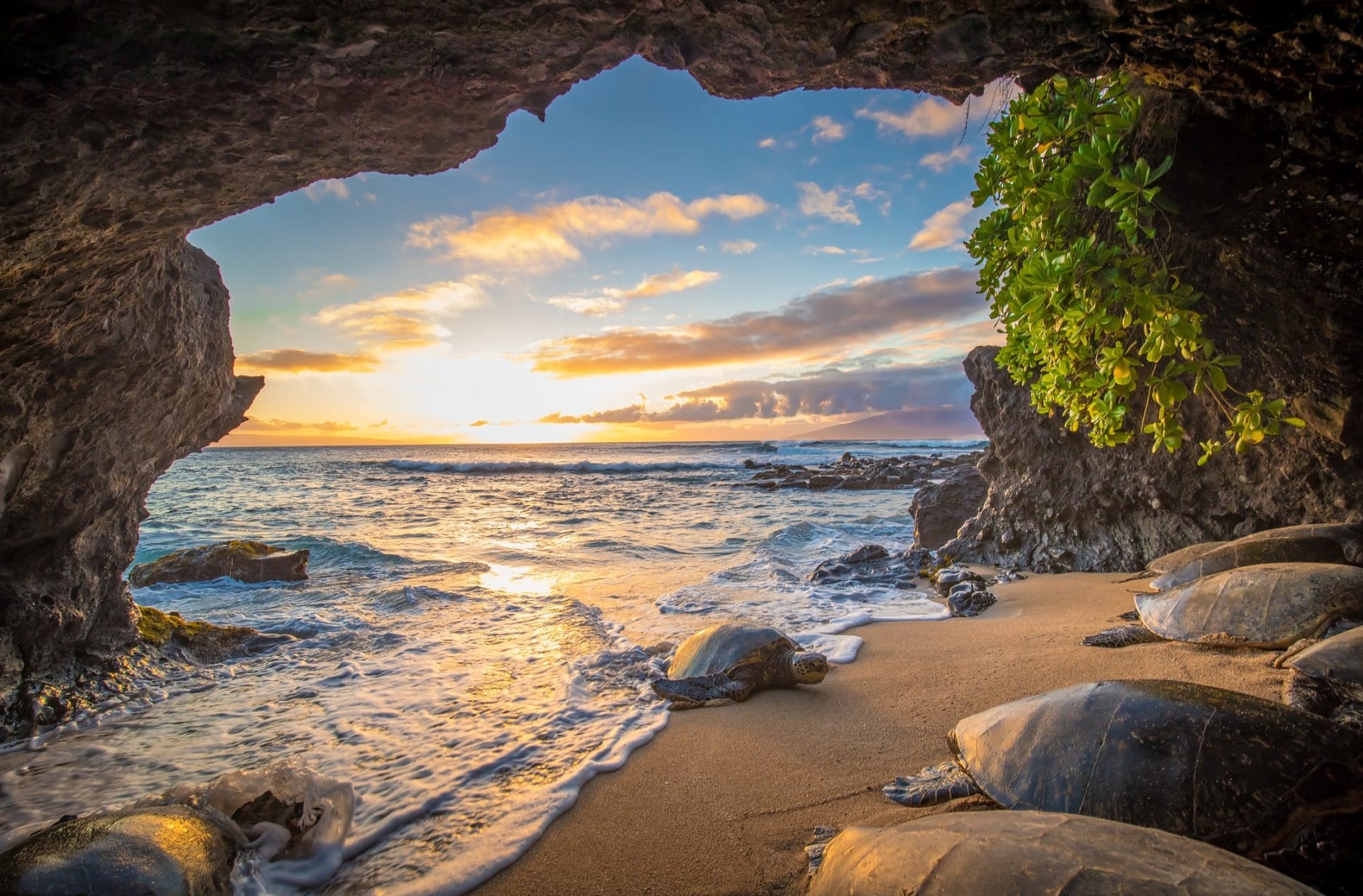
A private jet to Maui lands at Kahului Airport (OGG). From California, a super-midsize jet flies the roughly 2,157 nautical miles nonstop in about 5–6 hours. Denver and Texas departures call for a heavy jet, and East Coast journeys use a longer-range heavy jet or a West Coast fuel stop. Estimated hourly rates are $12,194 (Super-Midsize) and $13,610 (Heavy Jet), inclusive of fuel and excluding trip-specific costs.
Maui holds more variety than its size suggests. In a single day, you can watch dawn break above the clouds from Haleakalā’s summit and swim off a crescent of Wailea sand by noon. By evening, you are at an oceanfront table as the sun sets over the Pacific.
Flying privately keeps that day intact, with a quiet private terminal on arrival, a car waiting at the door, and Wailea well under an hour away by car.
The open ocean between the mainland and the island keeps Maui feeling far removed from mainland life, and it makes the choice of aircraft, timing, and arrival worth getting exactly right.
Arriving at Kahului Airport (OGG): FBOs and Private Terminals
The first minutes on Maui set the tone for the stay, and a private arrival keeps them calm. Your aircraft taxis to a fixed-base operator (FBO), a private terminal that handles fueling, aircraft parking, and passengers apart from the commercial concourse. Bags move from the hold to your car while you step into the trade winds.
Kahului Airport (OGG) is Maui’s jet-capable airport, set on the isthmus between Haleakalā and the West Maui Mountains. Its primary runway, 2/20, measures 6,998 feet, and a second runway, 5/23, measures 4,980 feet.
Two FBOs serve private arrivals. Signature Aviation sits at 25 Kuhea Street and lists daily hours of 8 a.m.–5 p.m., with call-out service on request. Atlantic Aviation, at 220 Eehia Street, is open 7 a.m.–5 p.m. daily and offers on-call service with prior arrangement.
Your Private Aviation Advisor times the departure so the aircraft lands within staffed hours or arranges after-hours service with the FBO well in advance. Over the holidays, Atlantic expects a busy ramp between December 24, 2026, and January 3, 2027, so early planning secures parking for the aircraft.
Maui’s two smaller airports serve a different kind of flying. The State of Hawaii limits Kapalua Airport (JHM), near the northwest coast, to commercial propeller, commuter, and air taxi aircraft during daytime hours. Hana Airport (HNM), on the remote east shore, serves commuter airlines.
From Kahului, a Kahului Airport transportation guide from KBM Resorts puts Wailea roughly 25–30 minutes away, with Kaanapali and Kapalua typically 45 minutes to just over an hour, depending on traffic. Your Client Experience team arranges the car, driver, and resort welcome in advance, so ground transportation is waiting when you step off the aircraft.
Choosing the Right Aircraft for a Private Jet to Maui
About 2,157 nautical miles separate Los Angeles from Kahului, and all of it is open Pacific. That distance is what keeps Maui set apart, and it places the journey in the super-midsize and heavy jet categories. Light jets such as the Phenom 300 are built for regional missions and stay on the mainland.
Magellan Jets sources every Maui mission from the Magellan Jets Preferred Network, working only with operators equipped for overwater flying. These operators hold certificates under FAA Part 135, the federal regulations that govern on-demand commercial air charter. Your Private Aviation Advisor matches the aircraft to your departure city, passenger count, luggage, and the winds forecast for your date.
Departure Region | Approximate Distance to OGG | Approximate Flight Time | Recommended Category | Example Aircraft |
|---|---|---|---|---|
West Coast (Los Angeles, San Francisco, San Diego) | About 2,157 nm from LAX | 5–6 hours | Super-Midsize | Challenger 350 (3,269 nm; comfortably six, up to nine passengers); Praetor 600 (4,040 nm; up to eight passengers) |
Central (Denver, Dallas, Austin) | Varies by city | About 7–8 hours, depending on city and winds | Heavy | Challenger 604 (4,119 nm); Challenger 650 (4,044 nm); up to 10 passengers |
East Coast (New York area) | About 4,257 nm from Teterboro | Approximately 10–11 hours | Long-range heavy, or one planned stop | Gulfstream G450 (4,425 nm), or a planned West Coast fuel stop |
Distances are approximate great-circle figures, and aircraft ranges are published maximums. Actual nonstop capability depends on winds, payload, and fuel reserves, which your Private Aviation Advisor confirms before every departure.
West Coast Departures: Super-Midsize Jets
California departures are the classic Maui journey. Leave after breakfast, lunch over the Pacific, and gain two or three hours on the clock as you fly west.
The Challenger 350 carries six passengers comfortably, with seating for up to nine, in a wide flat-floor cabin with a published range of 3,269 nautical miles. The Praetor 600 extends range to 4,040 nautical miles and seats up to eight. It also offers a large-cabin experience at a super-midsize price point.
Denver and Texas Departures: Heavy Jets
From Denver, Dallas, or Austin, the flight runs about 7–8 hours, depending on city and winds, and a heavy jet adds range margin and cabin space for that longer day aloft. The Challenger 604, with a published range of 4,119 nautical miles, and the Challenger 650, at 4,044 nautical miles, each seat up to 10 passengers. Families traveling across generations have room to dine, work, or sleep before landing.
East Coast Departures: Long-Range Heavy Jets or a West Coast Stop
From New York and the Northeast, Maui is a true long-haul flight of about 4,257 great-circle nautical miles from Teterboro. Expect approximately 10–11 hours in the air. A long-range heavy jet such as the Gulfstream G450, with a published range of 4,425 nautical miles, can make the crossing when winds and payload allow.
The alternative is a planned fuel stop on the West Coast, which adds a chance to stretch and widens the choice of aircraft. Your Private Aviation Advisor compares both plans against forecast winds and payload before you commit.
Estimated Rates for a Private Jet Charter to Maui
Pricing for Hawaii reflects the same qualities that make the journey special: a long overwater flight and an aircraft built for it. Maui falls within Magellan Jets’ Non-Contiguous pricing region, which covers Hawaii, Alaska, and U.S. territories. The same category rates apply whether you depart from Los Angeles or Boston.
A Super-Midsize jet to Maui carries an estimated hourly rate of $12,194.
This is an estimated hourly rate for Super-Midsize charter, inclusive of fuel. It does not include contingencies such as de-icing, positioning, overnight fees, or other trip-specific costs. Final pricing is confirmed at time of quote.
A Heavy Jet to Maui carries an estimated hourly rate of $13,610.
This is an estimated hourly rate for Heavy Jet charter, inclusive of fuel. It does not include contingencies such as de-icing, positioning, overnight fees, or other trip-specific costs. Final pricing is confirmed at time of quote.
How the aircraft spends your stay shapes the quote as much as the flight itself. For a long weekend, the aircraft and crew can remain on Maui, which adds overnight fees but keeps your return time entirely your own. For a longer stay, the aircraft usually flies back to the mainland and returns for you, which adds positioning time instead.
Your Private Aviation Advisor prices both options side by side. Clients flying to Hawaii once or twice a year often book through On-Demand Charter, choosing the aircraft trip by trip. For Clients who fly 25 hours or more a year, a Jet Card adds guaranteed availability 365 days a year, with funds that never expire.
Clients whose annual flying justifies a share of an aircraft can explore Fractional Ownership. Every option runs through the same Private Aviation Advisor, so your Maui plans carry forward as your flying evolves.
Arriving With Pets and Agricultural Declarations
Hawaii’s rabies-free status helps protect the islands, and families traveling with a dog or cat plan around it from the start. According to the Hawaii Department of Agriculture, pets need a microchip, two rabies vaccinations, and a passing FAVN (fluorescent antibody virus neutralization) blood test. A 30-day waiting period follows once the lab receives the sample.
The state’s direct-release program centers on Daniel K. Inouye International Airport in Honolulu. Flying a pet directly into Kahului requires a Neighbor Island Inspection Permit ($165), documents filed at least 30 days ahead, and a booked inspection with an approved Maui veterinarian. The state’s checklist is written for airline arrivals, so your Private Aviation Advisor confirms how it applies to your private flight, months ahead.
Every traveler arriving from the mainland also declares plants, animals, and agricultural items on Hawaii’s Agricultural Declaration Form, as Kahului Airport’s agriculture inspection page explains. Your Private Aviation Advisor makes sure the forms are on board before departure.
Where to Stay in Maui
Maui’s south and west shores hold most of the island’s resort life, and each offers a different mood. Wailea, in South Maui, is sunny and dry, with calm swimming beaches. West Maui’s Kapalua is greener and quieter, with coastal trails and two championship golf courses.
South Maui: Wailea
The Four Seasons Resort Maui at Wailea anchors the Wailea coastline, with pools that step down toward the ocean. In summer 2026, the resort opened Kai Holo Spa, its new spa and wellness center, announced in a Four Seasons press release on July 23, 2026.
Nearby, Grand Wailea, A Waldorf Astoria Resort spreads across expansive grounds with an energy that suits families traveling together. Andaz Maui at Wailea Resort appeals to travelers who prefer contemporary design.
West Maui: Kapalua
The Ritz-Carlton Maui, Kapalua sits on the island’s northwest coast, framed by two championship golf courses and quiet bays. It suits Clients drawn to uncrowded beaches and morning walks along the coastal trail, about an hour or a little more by car from Kahului.
Where to Dine in Maui
Maui’s best meals draw on Upcountry farms and the morning’s catch. At the Four Seasons, Ferraro’s is the table to reserve at sunset. The resort describes it as Wailea’s only oceanfront, open-air Italian restaurant.
Beyond the resorts, Upcountry farms supply many of the island’s kitchens, and coastal menus in Paia and Kihei favor fresh fish and small plates.
In Waikapū, Cafe O’Lei now operates at the former Mill House location at Maui Tropical Plantation, set among the plantation grounds. Your Client Experience team can secure reservations before you land.

What to Experience in Maui
Maui stretches from a 10,023-foot volcanic summit to reef-lined coves, and the best itineraries leave room for both. Each of these four experiences comes alive with a little advance planning.
Haleakalā Sunrise
Watching dawn spread across the clouds from Haleakalā’s 10,023-foot summit is the moment many visitors carry home. Vehicles entering the park between 3 a.m. and 7 a.m. need a sunrise reservation from Recreation.gov, which costs $1 per vehicle. Reservations release 60 days ahead and again two days ahead, both at 7 a.m. HST.
The park entrance fee is separate. Summit temperatures before dawn run far cooler than the coast, so dress warmly, with layers, gloves, and a hat.
The Road to Hana
The Hana Highway trades speed for scenery, winding through rainforest, past waterfalls, and along black-sand beaches. According to Wikipedia’s Hana Highway entry, the road runs about 64 miles and crosses 59 bridges, 46 of them one lane wide. Wailua Falls and the pools at ʻOheʻo Gulch, near the route’s end, are worth the patience.
A private driver lets you watch the coastline instead of the next curve. An overnight in Hana avoids the return drive in fading light.
Whale Watching Season
Each winter, humpback whales return to Hawaii’s warm, shallow waters to breed and calve. According to NOAA’s Hawaiian Islands Humpback Whale National Marine Sanctuary, whales are generally seen from November through April, with peak season from January through March. A private boat from Maalaea Harbor puts you among them at first light.
Molokini Crater
Molokini, a crescent-shaped volcanic crater off South Maui, shelters one of Hawaii’s most celebrated snorkeling sites. The State of Hawaii manages it as a Marine Life Conservation District, established in 1977. The state’s Division of Aquatic Resources calls its marine-life diversity among the most impressive in Hawaii.
Landing on the islet is prohibited, so the crater is reached only by boat. Charters such as Trilogy’s Discover Molokini tour offer morning departures from Maalaea.
Visiting Maui Today: Lahaina’s Recovery and Open Areas
South Maui, West Maui’s Kaanapali and Kapalua resorts, Upcountry, Haleakalā National Park, and Hana are all open and welcoming visitors. Lahaina continues to rebuild after the August 2023 wildfire.
The Lahaina Small Boat Harbor resumed limited commercial operations on December 15, 2025. The Hawaii Department of Land and Natural Resources (DLNR) expects harbor dredging to finish around December 2026, and some nearby streets remain closed during that work.
Maui County reopened Front Street to vehicle traffic on August 1, 2026, as Hawaii News Now confirmed that day. The County notes that temporary closures may still occur.
Visit Lahaina as a guest of a community in recovery. Support local businesses, follow posted closures, and check Maui County’s updates before you go.
Why Fly to Maui With Magellan Jets
On a flight of 5 or more hours over the open Pacific, the operator behind the aircraft matters. Magellan Jets is an asset-light private aviation solutions provider, which means it does not own or operate aircraft. It sources each mission from the Magellan Jets Preferred Network, fewer than 100 rigorously vetted operators out of roughly 3,000 licensed in the U.S.
Because there is no fleet to fill, every recommendation reflects your journey alone. On-Demand Charter and Jet Card flights operate with FAA Part 135 operators. Fractional Ownership flights operate under Part 91K, the FAA regulations written for fractional ownership programs.
Every operator carries between $100 million and $300 million in liability insurance. Magellan Jets also runs a proactive Safety Management System (SMS), a formal framework for identifying and managing risk before it reaches the flight deck. Its full safety standards are published online.
Your dedicated Private Aviation Advisor plans the aircraft, routing, and timing. The Client Experience team handles catering, ground transportation, and resort arrangements. That care shows in a 4.9-out-of-5 Client satisfaction rating and a 90% trip perfection score.
Frequently Asked Questions About Flying Privately to Maui (FAQs):
How much does it cost to charter a private jet to Maui?
A private jet to Maui carries an estimated hourly rate of $12,194 for a Super-Midsize jet and $13,610 for a Heavy Jet, under Magellan Jets’ Non-Contiguous pricing region. These are estimated hourly rates for Super-Midsize and Heavy Jet charter, inclusive of fuel. They do not include contingencies such as de-icing, positioning, overnight fees, or other trip-specific costs. Final pricing is confirmed at time of quote.
Can you fly a private jet nonstop from California to Maui?
Yes, a super-midsize jet such as the Challenger 350 flies nonstop from California to Kahului Airport (OGG) in about 5–6 hours. The great-circle distance from Los Angeles is roughly 2,157 nautical miles. Your Private Aviation Advisor confirms the aircraft against forecast winds and payload for your date.
What airport do private jets use on Maui?
Private jets arriving from the mainland use Kahului Airport (OGG), Maui’s jet-capable airport on the island’s central isthmus. Its primary runway, 2/20, measures 6,998 feet. Kapalua Airport (JHM) is limited to propeller, commuter, and air taxi aircraft in daytime, and Hana Airport (HNM) serves commuter flights.
Which FBOs serve private jets at Kahului Airport?
Two FBOs serve Kahului: Signature Aviation at 25 Kuhea Street and Atlantic Aviation at 220 Eehia Street. Atlantic is open 7 a.m.–5 p.m. daily and Signature lists 8 a.m.–5 p.m., with after-hours service by prior arrangement at both. Your Private Aviation Advisor schedules the arrival within those hours or arranges call-out service in advance.
What size private jet do you need to fly to Hawaii?
A super-midsize jet is the starting point for Hawaii from the West Coast, and a heavy jet suits departures from Denver and Texas. From the East Coast, a long-range heavy jet such as the Gulfstream G450 or a planned West Coast fuel stop makes the journey. Light jets are built for regional missions and stay on the mainland.
Can a Challenger 300 or Challenger 350 fly to Hawaii?
Yes, both fly nonstop to Hawaii from the West Coast, subject to winds and payload. The Challenger 300 has a published range of 3,340 nautical miles and the Challenger 350 reaches 3,269 nautical miles. Both exceed the roughly 2,157 nautical miles from Los Angeles to Kahului. The super-midsize Challenger 300 seats up to eight, and the Challenger 350 seats six comfortably, with room for up to nine.
Can you fly a private jet to Maui from the East Coast?
Yes, East Coast Clients reach Maui in approximately 10–11 hours, either aboard a long-range heavy jet or with a planned fuel stop on the West Coast. The great-circle distance from Teterboro to Kahului is about 4,257 nautical miles, within the Gulfstream G450’s published range of 4,425 nautical miles when winds and payload allow. Your Private Aviation Advisor confirms the nonstop or one-stop plan against the forecast for your departure date.
What is the difference between semi-private flights and a private charter to Maui?
Semi-private flights sell individual seats on shared, scheduled flights, while a private charter reserves the entire aircraft for your group on your schedule. With a private charter to Maui, you choose the departure airport, time, aircraft, and passengers, and you can adjust the plan as it evolves. Semi-private service follows a timetable and route set by the operator.
How far in advance should you book a private jet to Maui?
Book as early as your dates allow, particularly for late December through early January, Presidents’ Day week, and mid-June through mid-August. Early booking widens the choice of aircraft and secures FBO parking during busy weeks. Our guide to private jet holiday travel in 2026 covers what remains available this season.
Can you bring a dog on a private jet to Maui?
Yes, with preparation that begins months before departure. Hawaii requires a microchip, two rabies vaccinations, a passing FAVN blood test, and a 30-day wait after the lab receives the sample. Arriving directly at Kahului also requires a Neighbor Island Inspection Permit and a pre-booked inspection with an approved Maui veterinarian. Your Private Aviation Advisor confirms with the Hawaii Department of Agriculture how these rules apply to your private arrival.
When is the best time to visit Maui?
Maui is worth visiting year-round, and each season brings its own appeal. November through April brings humpback whale season and mild temperatures, with somewhat more rain on the windward north and east coasts. Summer and early fall tend to be drier, with calmer ocean conditions for snorkeling trips to Molokini.
The finest Maui trips begin with the afternoon still ahead: wheels up on the mainland after breakfast, trade winds at the FBO by lunch, and a resort lanai before sunset. Share the day you want to land, and your Private Aviation Advisor builds the aircraft, timing, and arrival around it.