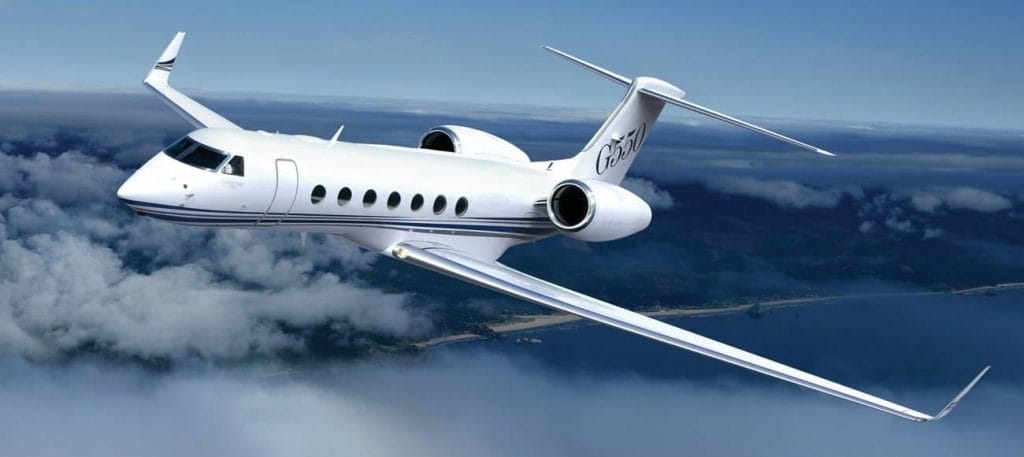
The Gulfstream G550 is Gulfstream’s ultra-long-range flagship. It offers approximately 6,950 nautical miles of range and a four-zone cabin that seats up to 18 passengers. The jet, a clean-sheet 2018 design, is a faster large-cabin jet (Mach 0.925 vs Mach 0.885) with a shorter range of approximately 5,400 nautical miles. The Gulfstream GV – often nicknamed the “G5” – is the 1990s ultra-long-range predecessor from which the G550 evolved; the two share a fuselage and Rolls-Royce BR710 engines.
Meet the Three Gulfstreams: GV, G500, and G550
Few naming conventions cause more confusion in private aviation than Gulfstream’s G-series lineup. Here is the straightforward guide.
The Gulfstream GV (colloquially called the “G5”) entered service in 1997 as Gulfstream’s first purpose-built ultra-long-range jet. Powered by two Rolls-Royce BR710 engines, the GV could connect Los Angeles to London or New York to Tokyo non-stop – a capability that redefined global business travel. Today, the GV remains a cost-effective alternative for Clients who prioritize extended range over the newest avionics.
The Gulfstream G550, introduced in 2003, is a direct evolution of the GV. It retains the same fuselage cross-section and Rolls-Royce BR710 engines but extends range to approximately 6,950 nm and introduces the PlaneView flight deck. The G550 remains one of the most sought-after aircraft in the charter market, offering a proven combination of transcontinental reach and cabin comfort.
The Gulfstream G500 – and this is where the confusion arises – is not simply a smaller G550. The modern G500 is part of Gulfstream’s GVII family, a clean-sheet design that entered service in 2018. It features two Pratt & Whitney engines (not Rolls-Royce), a maximum speed of Mach 0.925, and the Symmetry Flight Deck with active-control sidesticks. The G500’s range of approximately 5,400 nm is shorter than the G550’s. However, its cabin is taller and slightly longer than earlier G-series jets, and its cruise speed is unmatched in the large-cabin class.
In short: the GV and G550 are siblings separated by a decade of refinement. The modern G500 is a different generation entirely – faster, newer, and built from a blank page.
Gulfstream G500 vs G550: The Key Differences
Choosing between the Gulfstream G500 and G550 comes down to mission profile. How far do you need to fly, how fast, and how much cabin space does your travel style require.
Range
The G550’s approximately 6,950 nm range places virtually any destination within non-stop reach. London to Singapore, New York to Dubai, Los Angeles to Melbourne – the G550 handles them all without a fuel stop. The modern G500’s range of approximately 5,400 nm covers most transatlantic and transcontinental routes but may require a stop for the longest ultra-long-haul missions.
Speed
The G500 is the faster aircraft. Its maximum operating speed of Mach 0.925 allows it to shave meaningful time off long flights compared to the G550’s Mach 0.885. For a Client who values time efficiency on heavy domestic schedules or international flights within the G500’s range envelope, this speed advantage is tangible.
Cabin Configuration
Both aircraft offer stand-up cabins and lie-flat seating for overnight travel. The G550’s cabin volume of approximately 1,812 cubic feet accommodates up to four living zones – forward galley, conference area, entertainment lounge, and private stateroom. The G500’s cabin volume of approximately 1,715 cubic feet is slightly smaller, though it features a taller, flat-floor cabin and Gulfstream’s signature oval windows in larger dimensions than earlier models.
Technology Generation
The G550 employs the PlaneView flight deck, introduced in 2003 as an industry first. The modern G500 advances the standard with the Symmetry Flight Deck: touchscreen displays, active-control sidesticks, and fly-by-wire controls adapted from Gulfstream’s G650 development program. For Clients who appreciate the latest in aviation technology and pilot interface, the G500 represents the current state of the art.
Gulfstream GV vs G500 vs G550: Comparison Table

Cabin and Interior
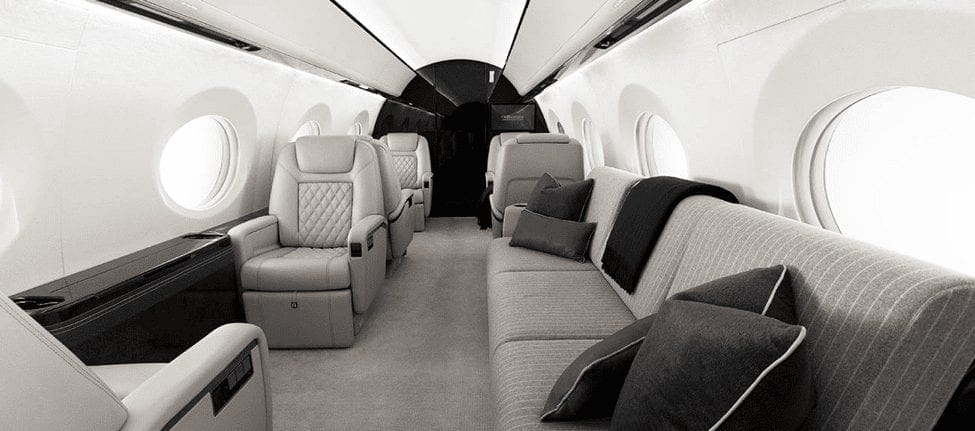
Every Gulfstream in this class delivers a cabin environment built for productive work and restful sleep at altitude. The details differ by generation and design philosophy.
The Gulfstream GV established Gulfstream’s signature oval windows, notably larger than the industry norm, which flood the cabin with natural light. The GV’s cabin volume of approximately 1,812 cubic feet provides space for multiple seating areas, a full galley, and berthing for overnight missions.
The Gulfstream G550 refines the GV formula with improved environmental systems. Its 100% fresh-air system – no recirculated air – reduces fatigue and jet lag on long-haul flights. The cabin can be configured with up to four distinct zones, accommodating work areas, dining space, and a private stateroom. Typical configurations seat 12–14 passengers in comfort, though the G550 can hold up to 18.
The modern Gulfstream G500 introduces Gulfstream’s next-generation cabin. Oval windows are now the largest ever fitted to a Gulfstream, flooding the interior with even more natural light. The flat floor extends the full length of the cabin, and ceiling height is greater than the GV and G550. The G500’s cabin altitude – approximately 4,850 feet when flying at 51,000 feet – is lower than previous generations, meaning passengers arrive feeling fresher. Whisper-quiet acoustics complete the experience.
For Clients who spend significant hours in the air, these interior differences matter. The G550’s four-zone layout suits large travel parties, corporate groups, or Clients who require a dedicated private suite. The G500’s taller, brighter cabin and lower pressurization appeal to frequent travelers prioritizing physical comfort and reduced fatigue.
Flight Deck and Avionics
Gulfstream has long been an industry leader in cockpit technology, and the aircraft in this comparison represent two distinct generations of that leadership.
The Gulfstream GV and G550 share the PlaneView flight deck, introduced with the G550 in 2003 and retrofitted to many GV aircraft. PlaneView integrates four large-format displays with Honeywell Primus Epic-based avionics, providing pilots with enhanced situational awareness through synthetic vision and graphical weather overlays. The system represented a significant leap from earlier analog-heavy cockpits and remains highly capable today.
The Gulfstream G500 introduces the Symmetry Flight Deck, Gulfstream’s most advanced pilot interface. Symmetry features 10 touchscreen displays, active-control sidesticks (adapted from fly-by-wire technology developed for the Gulfstream G650), and a redesigned layout that reduces pilot workload. The sidesticks free up panel space and provide direct, intuitive aircraft control. For operators and crews, Symmetry represents the current benchmark in business aviation cockpit design.
Which Gulfstream Is Right for Your Journey?
Mission profile determines the right aircraft. Here is how to think about the choice.
Choose the Gulfstream G550 when ultra-long-range capability is essential. If your travel regularly takes you from the U.S. to the Middle East, Asia, or Australia non-stop – or from Europe to Asia without a fuel stop – the G550’s approximately 6,950 nm range is purpose-built for these missions. The G550 also suits Clients who travel with larger groups and value the four-zone cabin configuration.
Choose the Gulfstream G500 when speed and modern technology are the priority. The G500 covers nearly all transatlantic routes and most transcontinental missions, arriving faster thanks to its Mach 0.925 cruise speed. Clients who fly heavy domestic schedules, coast-to-coast routes, or transatlantic missions within the 5,400 nm envelope will appreciate the G500’s efficiency, cabin comfort, and cutting-edge Symmetry Flight Deck.
Consider the Gulfstream GV when extended range matters but a newer aircraft is not essential. The GV offers approximately 6,675 nm of range – just 275 nm less than the G550 – at a more accessible price point in the charter market. For budget-conscious ultra-long-range travel, the GV remains a proven, reliable choice.
Each of these aircraft is available through the Magellan Jets Preferred Network, an exclusive group of rigorously vetted operators. Your Private Aviation Advisor can help match your travel profile to the right aircraft and confirm availability for upcoming missions.
Frequently Asked Questions About Gulfstream G500 vs G550 (FAQs):
What is the difference between the Gulfstream G500 and G550?
The Gulfstream G550 is an ultra-long-range jet with approximately 6,950 nm of range, a four-zone cabin seating up to 18, and Rolls-Royce BR710 engines. The modern Gulfstream G500, a 2018 clean-sheet design, has a shorter range of approximately 5,400 nm but is faster (Mach 0.925 vs Mach 0.885), features the Symmetry Flight Deck, and is powered by Pratt & Whitney engines. The G500 is a different generation of aircraft, not simply a smaller G550.
Is the Gulfstream G5 the same as the G500 or the G550?
The “G5” is a common nickname for the Gulfstream GV, which entered service in 1997. The GV is the direct predecessor to the G550, sharing the same fuselage and Rolls-Royce BR710 engines. The modern Gulfstream G500 is a separate, newer aircraft from the GVII family – it is not related to the GV or G550 generation.
Which has better range, the G500 or the G550?
The Gulfstream G550 has significantly longer range. Its approximately 6,950 nm capability exceeds the G500’s approximately 5,400 nm by more than 1,500 nm. The G550 can reach destinations the G500 cannot serve non-stop, such as New York to Dubai or Los Angeles to Sydney.
Can a Gulfstream G550 fly across the Atlantic non-stop?
Yes. The Gulfstream G550’s range of approximately 6,950 nm easily covers transatlantic routes. New York to London is roughly 3,450 nm, well within the G550’s capability with full fuel and passengers. The G550 is designed for intercontinental missions and can reach Europe, the Middle East, and Asia from U.S. departure points without refueling.
How many passengers does the Gulfstream G550 seat?
The Gulfstream G550’s large cabin can accommodate up to 18 passengers in high-density configurations. Most charter configurations seat 12–14 in comfort, with space divided among four living zones: galley, conference area, entertainment lounge, and private stateroom. The configuration depends on operator and mission requirements.
How much does it cost to charter a Gulfstream G500 or G550?
Charter pricing depends on aircraft category, flight distance, positioning, and seasonal availability. Both the Gulfstream G500 and G550 fall within the heavy jet category. A Private Aviation Advisor will confirm an exact quote based on your specific itinerary and travel dates. Talk to a Private Aviation Advisor to receive a personalized quote.
Fly the Gulfstream That Fits Your Mission
The Gulfstream GV, G500, and G550 each serve distinct travel profiles. Understanding the differences – range, speed, cabin configuration, and technology generation – positions you to select the aircraft that aligns with your journey.
When you are ready to fly, Magellan Jets connects you with any of these aircraft through the Magellan Jets Preferred Network: an exclusive group of operators vetted for safety, service, and reliability. Your dedicated Private Aviation Advisor will confirm aircraft availability, build your itinerary, and ensure every detail is coordinated from departure to arrival.
Talk to a Private Aviation Advisor to discuss your next mission.


