Willa Beatrice Brown was the first African American woman to earn a U.S.-issued pilot’s license, a mechanic, an educator, and an organizer who helped build the pipeline that produced the Tuskegee Airmen. She taught, lobbied, and flew at a time when American aviation kept most doors closed to Black Americans and women. Her work turned individual ambition into shared access, and her name still marks the sky she helped open.
Willa Brown Aviation Pioneer: Early Life and Education
Brown was born on January 22, 1906, in Glasgow, Kentucky. Her family valued schooling, and she followed that path north into the classroom before she ever reached a cockpit. Long before flight, she trained her mind for it.
She attended what is now Indiana State University and graduated in 1927 with a bachelor’s degree in business. At age 21, she was hired to teach in Gary, Indiana. Teaching gave her a steady profession, a public voice, and a habit of preparing other people to succeed.
Chicago pulled her next. She wanted more than a secure job, and the city’s Black aviation community was small, determined, and welcoming to newcomers with nerve. Brown arrived with a teacher’s discipline and a plan to master the mechanics of flight, not only the romance of it.
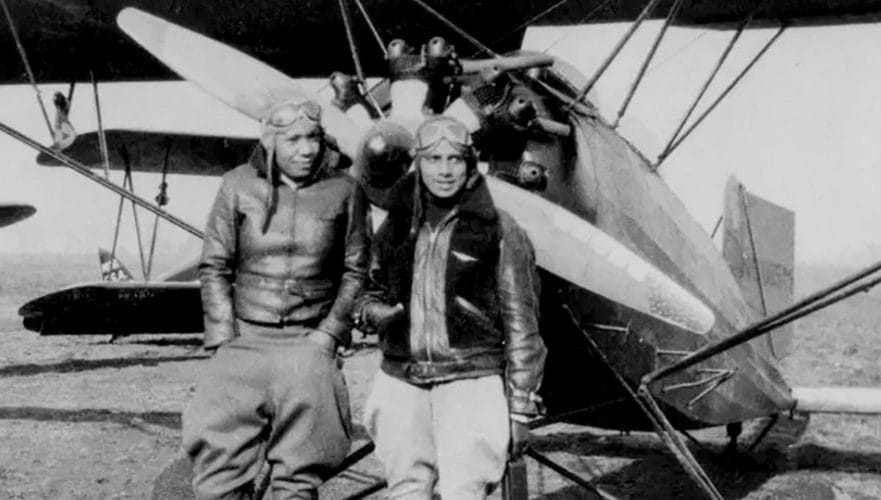
Willa Brown, right, with fellow flyer Lola Albright during the early years of Black aviation in Chicago.
The Barriers of Her Era
To measure what Brown accomplished, it helps to picture the walls in front of her. In the 1930s, most flight schools refused Black applicants outright. Commercial carriers did not hire Black pilots, and the military drew a firm color line across its air arm.
Women faced a second set of assumptions. Aviation was marketed as a masculine frontier, and a woman who wanted to teach flight, repair engines, and run a school was treated as an exception to be explained. Brown was a Black woman doing all three at once, which placed her outside every expectation of the field.
She did not argue with those assumptions so much as outwork them. A mechanic’s certificate answered questions about competence. A licensed school answered questions about seriousness. A record of trained pilots answered questions about results. Brown built her case in credentials that were difficult to dismiss.
Chicago gave her the community to do it. The city held a small circle of Black aviators who had learned from the example of earlier flyers and pooled their money to buy and maintain aircraft. That circle became the foundation for everything Brown built next.
Learning to Fly in Depression-Era Chicago
Brown studied at the Aeronautical University in Chicago and earned her Master Mechanic Certificate from Curtiss-Wright in 1935. That credential mattered. She understood engines and airframes, so she could teach, inspect, and repair rather than depend on others to keep her aircraft safe.
She kept climbing. Brown earned a Master of Business Administration from Northwestern University, pairing technical skill with the ability to run an organization. Few pilots of any background carried that combination in the 1930s.
The pilot’s license itself carries a documented wrinkle. The best-supported scholarship, including the Smithsonian’s National Air and Space Museum, places her private pilot’s license in 1938, and contemporary press from that year agrees. Her tombstone, however, reads “Since 1937, Pilot Certificate #43814.” The National Air and Space Museum notes both the license and the certificate number. Whichever year you mark, certificate No. 43814 made her the first African American woman to hold a U.S.-issued pilot’s license.
That distinction needs one clarification. Bessie Coleman earned her license in France in 1921 and was the first Black woman to become a licensed pilot anywhere. Brown was the first to earn a license issued in the United States, and the two women are now linked across the decades in more ways than one.
In 1939, Brown added a limited commercial pilot’s license, which restricted her to daylight flights within 50 miles. It was a working credential for a working aviator, and it kept her in the air as an instructor and advocate.
The Coffey School of Aeronautics
In 1938, Brown and Cornelius Coffey opened the Coffey School of Aeronautics at Harlem Airport, on Chicago’s southwest side near Oak Lawn. It was the first Black-owned and operated flight school in the United States. The school gave Black students a place to train when most airfields and academies turned them away.
Brown ran the school with a teacher’s rigor and a manager’s eye. She recruited students, kept the books, maintained aircraft, and stood on the flight line in a white flight suit that became part of her public image. The school was a business, a classroom, and a statement of possibility at once.
Over her full career as an instructor, Brown taught roughly 2,000 students. Under a federal government contract during the war years, the Coffey School became a primary training ground for Black aviators between 1940 and 1945. Those numbers describe more than throughput. They describe a generation of Black aviators who finally had somewhere to start.
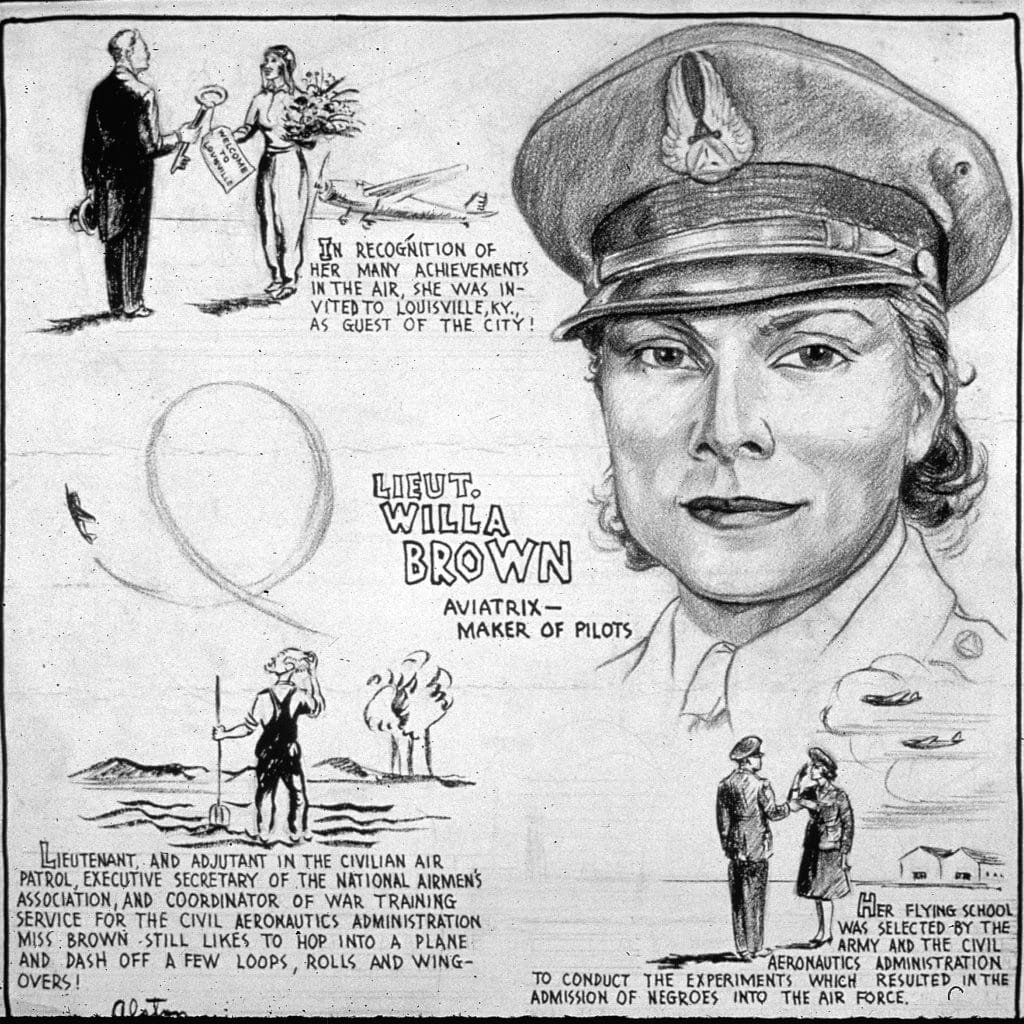
Charles Alston’s wartime drawing “Maker of Pilots” celebrates Willa Brown’s role training a new generation of aviators.
You can trace that lineage in the stories of the men and women she prepared. To understand the school’s founder and co-owner, read our profile of Cornelius Coffey and the first African American aeronautical school.
The Woman on the Flight Line
Brown understood the value of a public image before that phrase was common. Photographers found her in a white flight suit and jodhpurs, poised beside an aircraft, calm and clearly in charge. Those pictures ran in the Black press and beyond, and they carried a plain message: this is what a professional aviator looks like.
The image was earned, not staged for effect. Brown flew, taught, and turned a wrench, and the confidence in the photographs came from real command of the work. Young Black readers who had never seen a pilot who looked like them now had one to point to.
She also knew how to move an argument from the airfield to the front page. Sympathetic journalists documented the Chicago aviation scene, and Brown used that coverage to keep the question of Black participation in flight before the public. Visibility was a tool she wielded with intent.
Training the Tuskegee Airmen
The Coffey School became one of the schools in the Civilian Pilot Training Program, and Brown served as its director and as a coordinator of Chicago-area units. That role placed her at the center of a national argument about who would be allowed to fly for their country.
The 1925 Army War College report had wrongly claimed that Black Americans were unsuited to combat and leadership. You can read the historical record of that discredited report and see the assumptions Brown and her students worked to overturn. Their answer was performance. Approximately 200 of her students went on to become Tuskegee Airmen, joining the cadets and instructors who proved the report wrong in the sky.
The pipeline she ran was concrete, not abstract. Students arrived at Harlem Airport with little more than determination, and they left with logged hours, mechanical training, and the discipline to pass federal standards. Brown set that standard high because she knew her students would be judged twice, once as pilots and once as a test of a whole argument.
She understood the stakes better than most. If her graduates faltered, critics would use it to justify continued exclusion. If they excelled, the exclusion became indefensible. Brown prepared them to excel, and the record at Tuskegee did the rest.
Brown lobbied for Black inclusion in the federal training programs and pressed the case that talent existed and only needed a runway. The results speak in the record of the airmen themselves. Learn more in our dossiers on the Tuskegee Airmen and on Benjamin O. Davis Jr., the first African American Air Force general.
The National Airmen’s Association of America
Organizing came naturally to Brown, and she knew that isolated pilots had little standing against a segregated system. In August 1937, she, Coffey, and 10 others founded the National Airmen’s Association of America. The group formally incorporated in 1939.
The association grew to more than 2,000 members with chapters across the Midwest and the East Coast. It pushed for Black participation in civilian and military aviation and gave scattered flyers a shared national voice. The National Archives records the association’s founding and reach.
The group did more than hold meetings. Its members staged public flights, lobbied lawmakers, and made the case that Black Americans were ready to serve in the air. When the federal government expanded pilot training, the association had already built the argument and the roster to answer the call.
The journalist Enoch Waters chronicled this Chicago aviation scene and helped carry its story to a wider readership. The Smithsonian’s account of early African American aviator Willa Brown captures how press attention and organizing worked together to change minds.
A Lieutenant in the Civil Air Patrol
Brown understood that policy changes require the right people to read the right letter at the right moment. On December 6, 1941, she wrote to Eleanor Roosevelt, describing her work in civilian defense and asking to meet. You can view her letter to Eleanor Roosevelt in the National Archives collection.
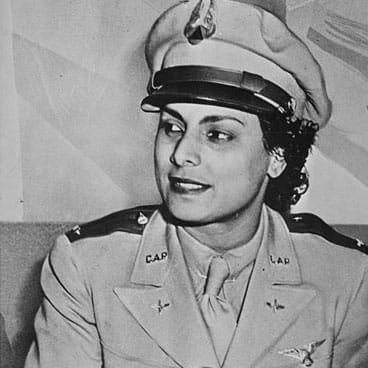
Lt. Willa Brown in her Civil Air Patrol uniform. She was the first African American officer in the organization.
In 1942, Brown was commissioned as a lieutenant in the Civil Air Patrol, becoming the first African American officer in the organization. The commission was both practical and symbolic. It put a Black woman in uniform and in command at a time when the armed services still drew hard color lines. The Civil Air Patrol’s own history of the organization records the era she helped shape.
Eleanor Roosevelt’s advocacy for Black participation in wartime aviation ran alongside Brown’s efforts. The FDR Presidential Library documents the First Lady’s support for the Tuskegee program and the pressure that helped open military flight training. Brown’s contribution sat on the training side of that fight, preparing candidates and making the case that they were ready. The National WWII Museum profiles her wartime service in detail.
Breaking Ground in Politics and Public Life
Brown did not stop at the flight line. In 1946, she became the first African American woman to run in a U.S. congressional primary, campaigning in the Republican primary for Illinois’s 1st congressional district. She ran again in 1948 and 1950.
She did not win any of those races. Shirley Chisholm would later become the first Black woman elected to Congress. Brown’s campaigns still mattered, because they placed a Black woman’s name on the ballot and in the debate when few expected it there.
She kept teaching for decades and retired from the classroom in 1971. In 1972, she became the first Black woman named to the Federal Aviation Administration’s Women’s Advisory Committee, carrying her expertise into national policy near the end of her career. Public service, for Brown, was one long continuous flight plan.
Her political runs fit the same pattern as her aviation work. She entered rooms that had never held someone like her and made the case that she belonged there. Each campaign widened the field of what a Black woman could plausibly seek, whether or not the votes followed.
Brown treated aviation and civic life as parts of the same project. Access to the cockpit and access to the ballot were both questions of who counted as a full participant. She pressed on both fronts because she saw them as one fight fought in different arenas.
Legacy: Hall of Fame and a School That Bears Her Name
Willa Brown died of a stroke on July 18, 1992, in Chicago. She was buried at Lincoln Cemetery, near Bessie Coleman, the pilot whose example had helped inspire the Chicago aviation community Brown later led. The two pioneers rest close together, their stories bound by the same ground.
Recognition has continued to grow. In 2022, Brown was enshrined in the National Aviation Hall of Fame, a formal place among the figures who shaped American flight. The honor confirmed what her students and colleagues had long understood about her standing.
Her name also lives in active use. The Willa Brown Aviation Academy, a youth-aviation nonprofit founded in 2021 in the Madison, Wisconsin area, was named in her honor and introduces young people to flight. It is a modest, fitting echo of a woman who spent her life turning newcomers into aviators.
The academy’s purpose rhymes with her own. It reaches students who might otherwise never sit in a cockpit and shows them that the path exists. Nearly a century after Brown pooled resources with a handful of Chicago flyers, the same idea carries forward: open the door early, and talent walks through it.
That is the shape of her legacy. A pilot’s license, a school, an association, a commission, and a place in the National Aviation Hall of Fame all point in one direction. Willa Brown spent her life making room in the sky for people who had been told to stay on the ground.
Historians and museums have steadily restored her to the center of the story. The Smithsonian, the National Archives, and Tuskegee Airmen Inc. all keep detailed accounts of her career, correcting years of relative neglect. Her students told the story first; institutions caught up later.
What endures is the model she built. Brown proved that a single well-run school, backed by organizing and public pressure, could change who had access to an entire industry. She turned a private ambition to fly into a public infrastructure for others to follow.
Brown belongs in a line of aviators who each opened a door for the next. That line reaches back to Bessie Coleman, the first Black woman to earn a pilot’s license, and forward to the Tuskegee Airmen she helped train. Documentation of her life continues through institutions such as Tuskegee Airmen Inc., which keeps her biography in front of new readers.
Read More About Black History and Aviation
Willa Brown’s story connects to a wider history of Black aviators who expanded access to the sky. Continue with these related dossiers.
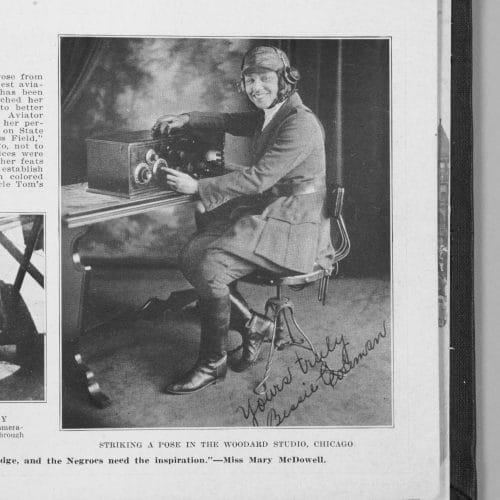
Bessie Coleman, the first Black woman to earn a pilot’s license.
Bessie Coleman: The First Black Woman to Earn a Pilot’s License
Cornelius Coffey and the First African American Aeronautical School
Benjamin O. Davis Jr.: First African American Air Force General
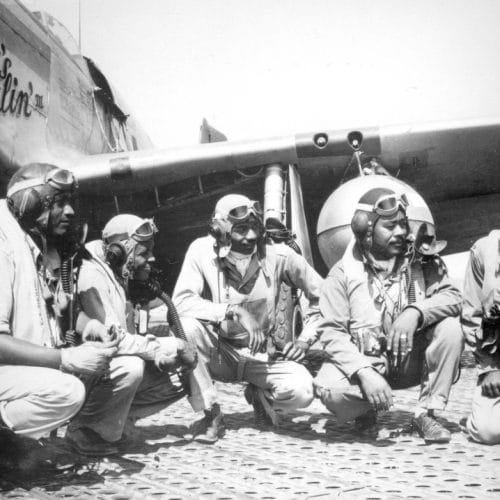
The Tuskegee Airmen, roughly 200 of whom began with training tied to Willa Brown’s program.
Frequently Asked Questions About Willa Brown Aviation (FAQs):
Who Was Willa Brown?
Willa Beatrice Brown (1906–1992) was an aviator, mechanic, and educator who became the first African American woman to earn a U.S.-issued pilot’s license. She co-founded the Coffey School of Aeronautics and helped train roughly 200 students who became Tuskegee Airmen.
How Did Willa Brown Die?
Brown died of a stroke on July 18, 1992, in Chicago. She was buried at Lincoln Cemetery, near Bessie Coleman.
Was Willa Brown the First Black Woman to Fly?
No. Bessie Coleman earned her license in France in 1921 and was the first Black woman to become a licensed pilot. Brown was the first Black woman to earn a pilot’s license issued in the United States.
How Many Tuskegee Airmen Did Willa Brown Train?
Approximately 200 of her students went on to become Tuskegee Airmen, joining the cadets and instructors who served in World War II.
What Was the Coffey School of Aeronautics?
The Coffey School of Aeronautics was the first Black-owned and operated flight school in the United States. Brown and Cornelius Coffey opened it in 1938 at Harlem Airport on Chicago’s southwest side.
What Is the Willa Brown Aviation Academy?
The Willa Brown Aviation Academy is a youth-aviation nonprofit founded in 2021 in the Madison, Wisconsin area. It was named in Brown’s honor and introduces young people to flight.
Did Willa Brown Win Her Run for Congress?
No. Brown ran in Republican congressional primaries in 1946, 1948, and 1950 and did not win. She was the first African American woman to run in a U.S. congressional primary.
Carrying the Legacy of Access Forward
Willa Brown’s life was about access: who gets to learn, who gets to fly, and who gets to lead. She built schools, organizations, and careers so that talent would meet opportunity instead of a closed door. That belief in widening access, rather than guarding it, still guides how the best of aviation serves people today.
Her story resists easy summary, and that is part of its power. She was a mechanic and a teacher, an organizer and a candidate, a private citizen and a public figure. Each role fed the others, and together they moved American aviation toward something closer to fair. That is a legacy worth carrying, not just commemorating.
If her story leaves you thinking about the possibilities of flight, we would welcome the conversation. Talk to a Private Aviation Advisor at Magellan Jets to explore what modern private aviation can open for you.