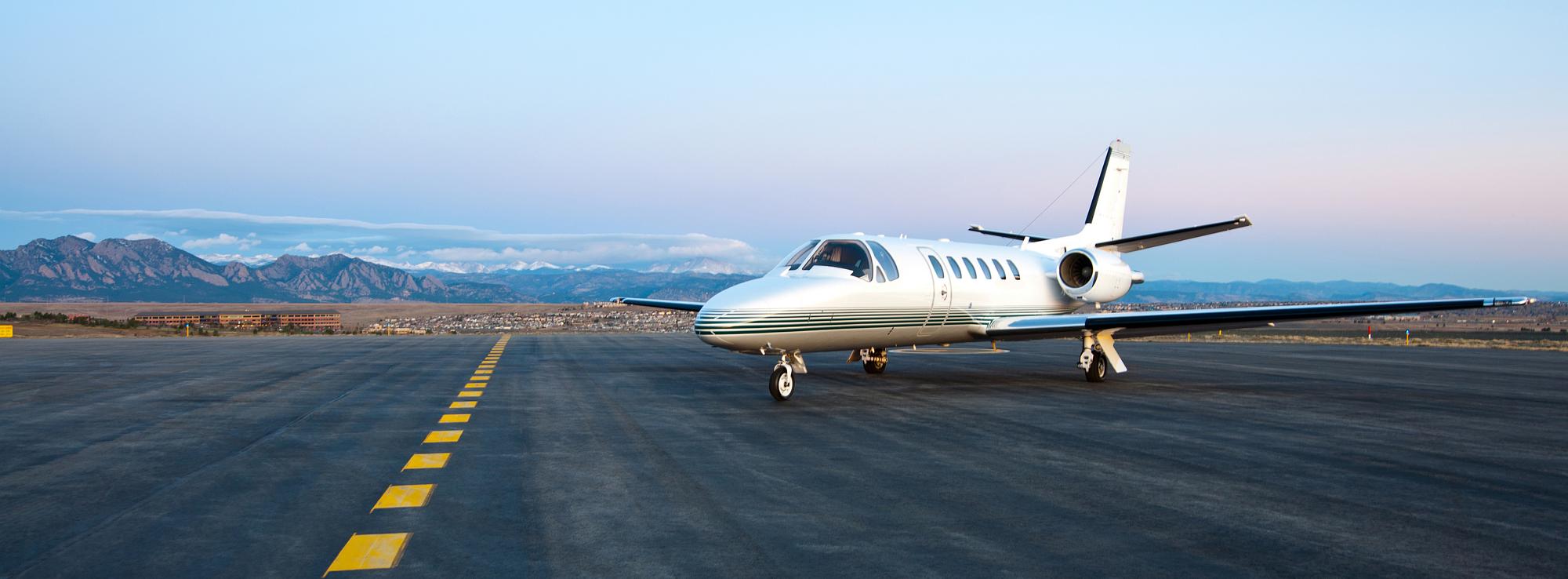
Private jets cannot land at certain airports for reasons that fall into three categories: physical infrastructure (runway length, pavement strength, taxiway and ramp clearance, high-elevation or high-temperature performance limits), service limitations (fuel type availability, customs and port-of-entry status), and regulatory or operational restrictions (noise curfews, slot controls, prior-permission requirements, private or military field status, weather conditions). Understanding these factors reveals why your Private Aviation Advisor may recommend an alternate airport – and why that alternate is often the better choice.
Runway Length and Balanced Field Length
Every takeoff and landing requires a runway long enough for the aircraft to accelerate, lift off, and – in an emergency – stop safely. This calculation is called the balanced field length, and Part 135 charter operators must compute it for every flight based on actual conditions that day: aircraft weight, passenger and baggage load, temperature, wind direction, and runway elevation.
Light jets typically need far less runway than large-cabin or long-range jets. A short regional strip that welcomes a light jet may be off-limits to a heavy jet simply because the physics don’t allow a safe margin. Your Private Aviation Advisor matches the aircraft to the mission – including the runway at each end of the journey.
Runway Surface and Pavement Strength
Not all runways are created equal. A pavement’s ability to support an aircraft’s weight is rated by a system called Pavement Classification Number (PCN). If an aircraft’s weight exceeds what the surface can handle, the airport authority will deny access to protect the runway from damage.
Additionally, certain runways are certified only for dry operations. A wet or contaminated runway – snow, ice, standing water – reduces braking effectiveness and extends stopping distance. Some fields restrict landings when the surface is anything but dry, making them seasonal options or fair-weather-only destinations.
Aircraft Size, Wingspan, and Ramp Clearance
An aircraft must fit the airport, not just the runway. Taxiways and ramps at smaller fields may lack the clearance for wide-bodied or long-wingspan aircraft to maneuver safely. Wing tips, tail height, and turning radius all matter. A large-cabin jet physically may not fit through a narrow taxiway or onto a compact ramp – even if the runway length is adequate.
High and Hot: Elevation and Temperature Effects
Air density affects aircraft performance. At higher elevations and higher temperatures – a condition pilots call “high and hot” – the air is thinner, engines produce less thrust, and wings generate less lift. The result: longer takeoff rolls and reduced climb rates.
A mountain airfield at 6,000 feet on a summer afternoon demands significantly more runway than the same aircraft needs at a sea-level airport on a cool morning. Operators calculate these margins before every departure to ensure safe performance, and certain aircraft simply cannot operate safely from high-and-hot fields during peak temperatures.

Fuel Availability
Jet-A, the standard fuel for turbine-powered aircraft, is widely available at most airports that accommodate private jets. Turboprops and jets both rely on it. However, piston-engine aircraft require 100LL (low-lead aviation gasoline), which is stocked at fewer locations.
If your flight plan includes a remote or smaller airport without the correct fuel type, the aircraft either cannot land there or must carry enough fuel for a round trip to a nearby airport that does have it – adding time, cost, and complexity.
Weather and Atmospheric Conditions
Weather dictates access more often than any fixed infrastructure constraint. Fog, low ceilings, thunderstorms, and icing conditions can close an airport to all traffic – or restrict it to aircraft with specific instrument capabilities.
Many smaller airports lack precision approach systems, meaning they require higher visibility minimums. When conditions drop below those minimums, the airport closes regardless of aircraft capability. Coastal and mountain destinations are especially susceptible to sudden weather changes that can reroute a journey to an alternate field.
Noise Restrictions and Night Curfews
Communities surrounding airports – particularly in residential or environmentally sensitive areas – often impose noise limits. These may restrict:
- Hours of operation (night curfews prohibiting arrivals or departures during certain hours)
- Aircraft types (certain older or louder engines may be banned entirely)
- Total daily movements (caps on the number of jet operations per day)
European airports are especially known for strict curfews. A late-evening arrival into certain fields simply is not an option, requiring either an adjusted schedule or an alternate airport.
Slot Controls and Traffic Caps
Major hubs like New York’s JFK or London Heathrow manage congestion through slot allocations – pre-approved windows for takeoff and landing. Private aviation traffic competes for limited general aviation slots, and during peak periods, securing access can be difficult or impossible on short notice.
Slot-controlled airports require advance coordination. Your Private Aviation Advisor handles this complexity, but when slots are unavailable, a nearby reliever airport often proves faster and more convenient.
Customs and Port of Entry Requirements
International arrivals into the United States must clear customs at a designated Port of Entry. Not every airport holds this designation. A flight arriving from abroad cannot simply land at the closest convenient field; it must first stop at a customs-equipped airport for inspection and clearance.
Many Private Clients flying internationally route through a Port of Entry, clear customs efficiently, and then continue on a domestic leg to their final destination. Your Client Experience team coordinates this sequence so the process feels uninterrupted.
Prior Permission Required and Restricted Access Fields
Some airports require prior permission before any arrival – a system known as Prior Permission Required (PPR). These include:
- Private airfields owned by individuals, resorts, or corporations
- Military installations with occasional civilian access
- Airports with limited ground handling that restrict traffic volume
PPR airports may require 24–72 hours’ notice and formal approval. Access is not guaranteed, and operators must secure permission well in advance. Exclusive destinations often fall into this category – the very remoteness that makes them desirable also limits who can arrive.
What Happens When Your Preferred Airport Is Unavailable
Airport access limitations are not obstacles – they are considerations your Private Aviation Advisor factors into every trip. When a first-choice airport cannot accommodate your aircraft or schedule, the solution typically involves one of two approaches:
Matching the Aircraft to the Airport
If the destination airport requires it, your Advisor may recommend a different aircraft category. A light jet or turboprop can reach fields that exclude larger jets, often landing closer to your actual destination. This is not a compromise; it is strategic access to places larger aircraft cannot go.
Selecting the Optimal Alternate Airport
When the aircraft cannot change, an alternate airport enters the plan. But “alternate” does not mean inferior. Consider:
- Proximity to your destination: Regional airports are often located closer to where you actually need to be than the commercial hub.
- FBO efficiency: A Fixed Base Operator (FBO) at a smaller airport typically means less time between wheels-down and departure. No crowded terminals, no long taxi sequences, no waiting for commercial traffic.
- Privacy and exclusivity: Smaller airports see less traffic. Arrivals and departures draw less attention. For Clients who value discretion, this matters.
When your Advisor recommends a different airport than the one you initially requested, the recommendation reflects a calculation: which airport actually gets you to your destination faster, more comfortably, and with less friction?
For island destinations like Nantucket, for instance, runway constraints at the local airport favor smaller aircraft categories. The right aircraft selection means direct access rather than a connection through a larger hub – arriving on the island, not miles away from it.
Why Your Advisor May Recommend a Different Airport
Private aviation is not about landing at the biggest or most famous airport. It is about reaching your destination efficiently. A Private Aviation Advisor at Magellan Jets evaluates every factor – runway length, weather forecasts, slot availability, noise restrictions, ground transportation logistics – and presents the option that serves your journey best.
The flexibility of On-Demand Charter or a Jet Card means you are not locked into a fixed fleet or a single aircraft type. When one airport closes or cannot accommodate your schedule, alternatives exist. When a smaller aircraft opens access to a remote runway, that aircraft is available. When conditions shift mid-trip, plans adapt.
Magellan Jets sources every mission from the Magellan Jets Preferred Network – fewer than 100 operators selected from roughly 3,000 licensed in the U.S., each rigorously vetted for safety, maintenance, and operational standards. This network exists so that the right aircraft is always available for the right mission, including missions to demanding airports.
Frequently Asked Questions About Private Jet Airport Access (FAQs):
Can a private jet land anywhere?
No. Private jets can access far more airports than commercial airlines – approximately 5,000 in the U.S. compared to roughly 500 with scheduled commercial service – but each airport has physical and regulatory limits. Runway length, pavement strength, fuel availability, noise rules, and customs status all determine whether a specific aircraft can operate there.
Can every private jet land at every airport?
No. Different aircraft have different performance requirements. A light jet needs less runway and has a smaller footprint than a large-cabin jet. The aircraft that works for a 5,000-foot runway in the mountains may not be the same aircraft suited for a transcontinental journey. Aircraft selection is part of mission planning.
Why can’t larger private jets use certain airports?
Large-cabin and heavy jets require longer runways, stronger pavement, and wider taxiways. Smaller regional airports often lack one or more of these features. Additionally, high-elevation airports or hot-weather operations reduce aircraft performance, extending takeoff and landing distances beyond what the runway allows.
Do private jets go through customs and security?
International private jet flights must clear customs at a designated Port of Entry before proceeding to a final domestic destination. Security screening differs from commercial aviation – passengers do not pass through TSA checkpoints – but Customs and Border Protection (CBP) inspection is required for all international arrivals. Your Client Experience team coordinates these requirements.
Why does my Advisor sometimes recommend a different airport than the closest one?
The closest airport is not always the best airport. Runway limitations, slot availability, curfews, or weather may make an alternate field faster or more reliable. A regional airport 20 minutes farther by car may save 45 minutes of ground time compared to a congested hub. Your Advisor evaluates every factor and recommends the option that actually gets you to your destination with the least total travel time and friction.
Ready to plan your next journey? Talk to a Private Aviation Advisor to explore which airports, aircraft, and routes serve your travel best.


