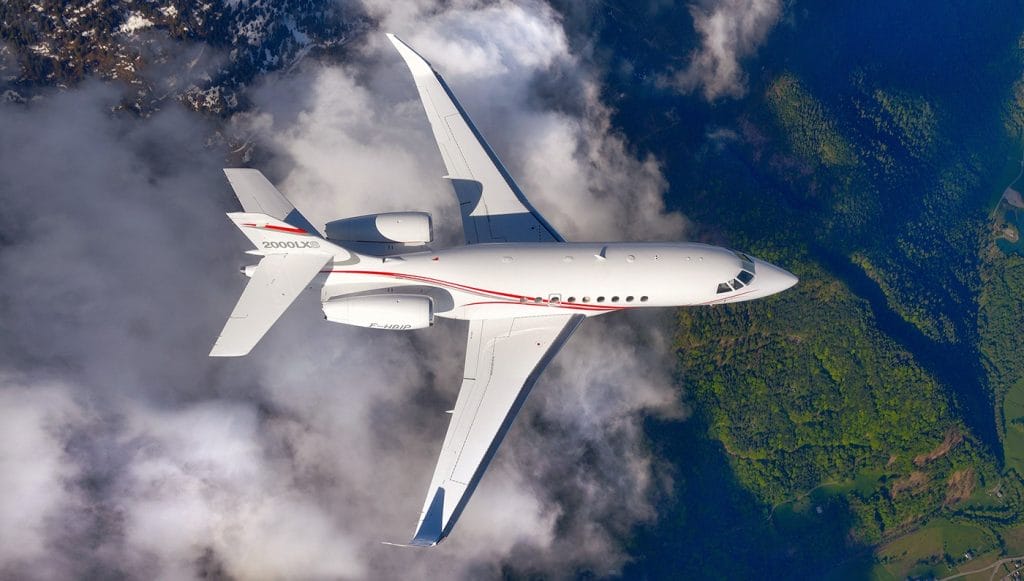
The Dassault Falcon 2000LXS is a super-midsize business jet with a widebody cabin, a range of 4,100 nautical miles, and short-field performance that reaches airports many comparable jets avoid. It carries up to 10 passengers and flies nonstop across the Atlantic. At maximum takeoff weight, the Falcon 2000LXS needs only 4,675 feet of runway.
The Falcon 2000LXS at a Glance
Dassault engineered the Falcon 2000LXS around one goal: transatlantic reach without heavy-jet runway demands. The result is a genuinely versatile aircraft, at home on business travel, family trips, and international missions. Its widebody cross-section gives passengers room to stand, move, and work, while twin engines keep operating economics disciplined.
Dassault introduced the 2000LXS at the 2012 NBAA convention and began deliveries in 2013, according to Dassault Aviation. The variant added more capable engines and full-length inboard leading-edge slats, sharpening both short-field performance and payload. For Private Clients, that pairing translates into access closer to the destination rather than a longer drive from a larger airport.
The mission profile is broad. The Falcon 2000LXS suits corporate travel, family trips with pets, group golf and ski getaways, and international routings without changing aircraft. As flying patterns shift, Private Clients move between On-Demand Charter and a Jet Card through the same relationship, so the aircraft grows with the need rather than forcing a compromise.
If you are weighing aircraft classes, our guide to which private jet category is right for you places the super-midsize segment in context. You can also explore the full Magellan Jets aircraft experience to see where the Falcon 2000 line fits.
Falcon 2000LXS Range and Performance
The Falcon 2000LXS range of 4,100 nautical miles is the number most Private Clients care about first. It connects city pairs such as New York and London, or Chicago and Rome, without a fuel stop. Normal cruise sits near Mach 0.80, with a maximum of 437 knots, roughly Mach 0.86, when the schedule is tight.
Altitude matters as much as speed. The Falcon 2000LXS climbs to 47,000 feet, above most commercial traffic and weather, which steadies the ride and shortens flight times. Two Pratt & Whitney Canada PW308C engines, each producing about 7,000 pounds of thrust, deliver that performance while holding fuel burn in check.
Short-field capability is where this aircraft separates itself. A takeoff distance of 4,675 feet at maximum weight opens runways that longer-legged jets simply cannot use, so you land nearer your final destination. That is real time saved on the ground, on both ends of the journey.
Inside the Falcon 2000LXS Cabin Interior
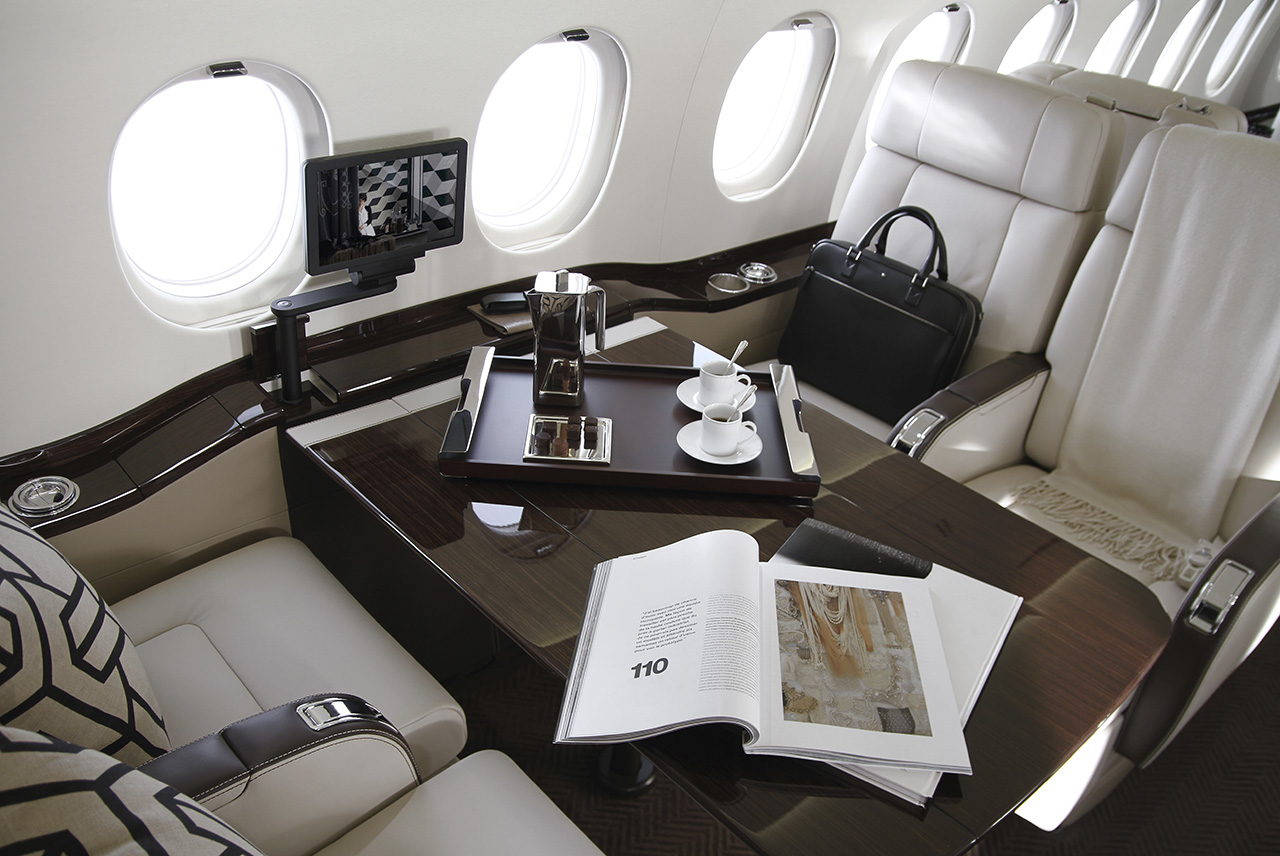
The Falcon 2000LXS interior is built on a true widebody cross-section, rare in this class. The cabin measures 26 feet 2 inches long, 7 feet 7 inches wide, and 6 feet 2 inches high, for 1,028 cubic feet of usable volume. Passengers stand upright and move freely on a flat floor.
Seating configurations carry up to 10 passengers, typically arranged in club groupings that convert for work, conversation, or rest. A pressurization differential of 9.3 psi keeps the cabin altitude low, so you arrive less fatigued after a long leg. Stay productive from wheels-up to touchdown, then step off ready for what follows.
Baggage capacity of 139 cubic feet handles luggage for a full cabin, including golf clubs and ski equipment. On board, a dedicated Client Experience team coordinates catering, ground transportation, and the details that make each journey personal.
Falcon 2000LXS Cockpit and Avionics
The Falcon 2000LXS cockpit is built around the EASy II flight deck, Dassault’s Honeywell Primus Epic-based avionics suite. It consolidates flight, navigation, and systems data into a clear, integrated display that reduces pilot workload and supports precise decision-making. An optional FalconEye Combined Vision System blends synthetic and enhanced imagery for sharper situational awareness in low visibility, as detailed by Dassault Falcon.
Advanced avionics are more than a feature list. They advance the value Magellan Jets leads with: safety. Every aircraft in the Magellan Jets Preferred Network is flown by highly vetted operators, and technology like EASy II supports the disciplined, safety-first operations our Private Clients expect.
Falcon 2000LX vs Falcon 2000LXS
The Falcon 2000LX and Falcon 2000LXS share the same widebody cabin and comparable long-range capability, which is why the two are often confused. The distinction is in performance at the margins. The LXS introduced enhanced Pratt & Whitney Canada PW308C engines and full-length inboard leading-edge slats.
Those slats improve low-speed handling, which shortens takeoff and landing distances and lifts payload flexibility. In practice, the LXS reaches more constrained airports and carries a fuller cabin over demanding legs. For Private Clients choosing between the two, the LXS is the more capable short-field performer.
Frequently Asked Questions About the Dassault Falcon 2000LXS (FAQs):
How Far Can the Falcon 2000LXS Fly Nonstop, and Can It Cross the Atlantic?
Yes. The Falcon 2000LXS has a range of 4,100 nautical miles, enough to fly nonstop across the Atlantic on routes such as New York to London. It comfortably covers transcontinental legs across the United States as well.
What Are the Falcon 2000LXS Specs, Cabin Dimensions, and Passenger Capacity?
The cabin measures 26 feet 2 inches long, 7 feet 7 inches wide, and 6 feet 2 inches high, with 1,028 cubic feet of volume and 139 cubic feet of baggage space. It seats up to 10 passengers. The aircraft cruises at up to 437 knots, climbs to 47,000 feet, and takes off in 4,675 feet at maximum weight.
What Is the Difference Between the Falcon 2000LX and Falcon 2000LXS?
The Falcon 2000LXS added enhanced Pratt & Whitney Canada PW308C engines and full-length inboard leading-edge slats. Those upgrades improve short-field performance and payload compared with the Falcon 2000LX, while the two share a similar cabin and long-range profile.
What Cockpit and Avionics Does the Falcon 2000LXS Use?
The Falcon 2000LXS uses the EASy II flight deck, a Honeywell Primus Epic-based avionics suite. An optional FalconEye Combined Vision System adds blended synthetic and enhanced vision for greater situational awareness in low visibility.
How Much Does It Cost to Charter a Falcon 2000LXS?
Charter estimates for super-midsize aircraft generally run about $10,000 per hour for domestic flying, rising toward roughly $12,700 per hour on international trips. Treat these as estimates only. The rate is inclusive of fuel; it does not include contingencies such as de-icing, positioning, overnight fees, catering, ground transportation, or international fees. Your exact price depends on route, schedule, aircraft, and availability, and a Private Aviation Advisor confirms it at time of quote. You can fly the aircraft through On-Demand Charter or a Jet Card.
Experience the Falcon 2000LXS With Magellan Jets
The Falcon 2000LXS earns its place for a specific traveler: someone who needs transatlantic range, a widebody cabin, and the freedom to use runways a heavy jet cannot. If that describes your next journey, Magellan Jets sources the right Dassault Falcon 2000 for the mission. Magellan Jets coordinates travel with highly vetted, FAA-approved operators and does not own or operate aircraft. Talk to a Private Aviation Advisor to plan your next journey aboard the Falcon 2000LXS.
Magellan Jets does not own or operate aircraft. It coordinates every journey through the Magellan Jets Preferred Network of highly vetted operators, using FAA Part 135, the regulation governing on-demand charter operations, and FAA Part 91K, which governs fractional ownership. That asset-light model means every recommendation is made in your best interest, not to fill a fleet.
When you are ready to put a Falcon 2000LXS on your schedule, one conversation sets it in motion. Talk to a Private Aviation Advisor.


