A private jet tax deduction is available when a qualifying aircraft is used more than 50% for legitimate business purposes and accessed through an ownership interest. Under current federal law, owners of qualifying business aircraft may claim 100% first-year bonus depreciation, while On-Demand Charter and Jet Card flyers may instead deduct qualifying flight costs as ordinary business travel. Whether private jets are tax deductible comes down to two questions: how you access the aircraft, and how rigorously you document its use. Every path below carries a different answer.
The 2025 tax law changes reset the calculus for business owners, CFOs, and high-net-worth flyers who have been weighing aviation on the margin. For the first time in years, the depreciation math and the operational reality point in the same direction. The opportunity is real, and so is the scrutiny that comes with it.
Understanding the Four Primary Models
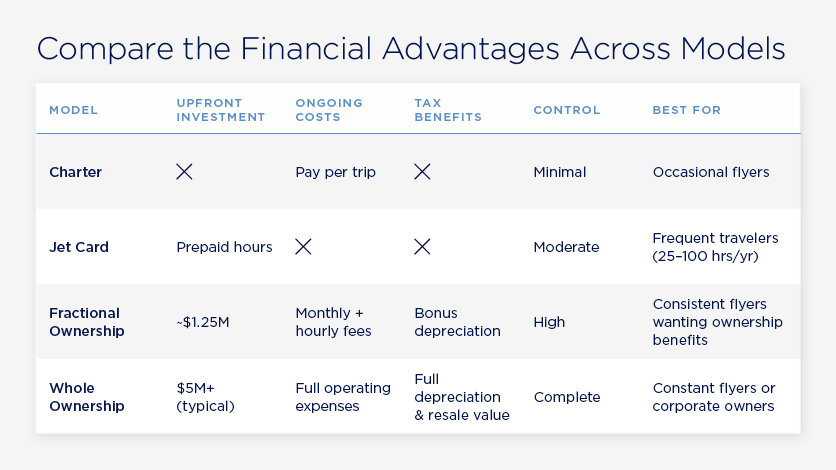
Private aviation is not a single product. It is a spectrum of four access models, each suited to a different flight profile and a different financial posture. The tax treatment of each turns on one distinction: whether you hold an ownership interest in the aircraft or simply buy access to it. That single line separates depreciation from deduction, and it shapes every strategy that follows.
On-Demand Charter
On-Demand Charter is access by the trip, with no commitment and no capital outlay. You pay for the specific mission you fly. Cost is driven by aircraft category, trip distance, and positioning requirements, and a Private Aviation Advisor confirms exact figures for each journey.
The financial benefit is flexibility. You commit nothing until you fly, and you scale up or down as the year unfolds. On the tax side, On-Demand Charter involves no ownership, so it generates no depreciation. On-Demand Charter costs tied to a business trip may be deductible as ordinary and necessary business travel under IRC §162, subject to a separate analysis and full substantiation. Treat that as distinct from depreciation.
The Jet Card
A Jet Card is prepaid access with guaranteed availability and fixed hourly rates. You purchase hours in advance and draw against them across the year. Cost depends on aircraft category and the number of hours committed, and Magellan Jets protects Client funds so they never expire and are never co-mingled with operational accounts.
The benefit is certainty. You lock a rate, secure availability 365 days a year, and remove the trip-by-trip pricing question. Like On-Demand Charter, a Jet Card is prepaid access rather than ownership, so it produces no depreciation. Business-use flights may still be deductible as travel expenses under IRC §162 with proper records.
Fractional Ownership

Fractional Ownership gives you a deeded share of a specific aircraft, along with a defined number of guaranteed flight days each year. This is where the tax picture changes. Because you hold a real ownership interest, you hold a depreciable asset.
Fractional owners may claim depreciation on their share of the aircraft, including bonus depreciation, provided the more-than-50% business-use test is met. The deduction is prorated to the ownership percentage and to the business-use percentage. Cost is a function of share size, aircraft category, and program term, and your Private Aviation Advisor models the exact structure alongside your tax counsel.
Whole Aircraft Ownership
Whole ownership means sole title to the aircraft and full operational control. It carries the highest commitment and the widest tax opportunity. Because the entire aircraft basis sits on your books, the full depreciation schedule, including 100% first-year bonus depreciation, applies to a qualifying business aircraft.
Cost spans acquisition, crew, maintenance, and management, all of which a Private Aviation Advisor helps structure. Magellan Jets supports owners through Aircraft Sales & Management, handling acquisition and day-to-day oversight so the asset performs against both the flight schedule and the financial plan. Owners who need lift beyond their aircraft can supplement with On-Demand Charter or a Jet Card through the same relationship.
Qualifying Business Use: How a Private Jet Tax Deduction Actually Works
The largest gap in most aviation tax conversations is the qualifying-use standard. Depreciation is not triggered by buying an aircraft. It is earned by using it for business, and by proving it.
Business aircraft are treated as listed property under IRC §280F. To claim bonus or accelerated depreciation, the aircraft must be used more than 50% for qualified business use. Below that threshold, only straight-line depreciation under the Alternative Depreciation System is available, and bonus depreciation is disallowed. IRS Publication 946 sets out these rules, and the National Business Aviation Association (NBAA) covers the technical implications in further depth.
Documentation carries the claim. The IRS expects contemporaneous flight logs that record the date, route, passengers, and business purpose of every leg. As The Tax Adviser reports, substantiation, not intent, is what survives an audit.
Several rules narrow the picture further. Personal and entertainment use is non-deductible, and it reduces your business-use percentage. The deduction is prorated to that percentage. And if business use later drops below 50%, recapture can claw back depreciation you have already claimed. The IRS has expanded its corporate-aircraft audit activity, which The Tax Adviser documents, so the aircraft tax planning that holds up is the kind built on records from the first flight, not reconstructed afterward.
Strategic Tax Opportunities Under the OBBBA
The One Big Beautiful Bill Act (OBBBA, Public Law 119-21), signed July 4, 2025, reshaped the depreciation landscape for business aircraft. It permanently restored 100% first-year bonus depreciation under IRC §168(k) for qualified property, including business aircraft acquired and placed in service after January 19, 2025. The IRS has issued implementing guidance on the amended deduction.
“Permanent” here means there is no scheduled sunset under current law. It does not mean the provision is beyond change. A future Congress could revise or repeal it, so treat the current 100% rate as today’s opportunity rather than a fixed constant.
Both new and used aircraft can qualify for private jet bonus depreciation. Under the OBBBA, a used aircraft must be acquired from an unrelated party and must not have been previously used by the taxpayer. The eligibility tests are specific, and you should confirm them with a tax professional before you rely on them.
Section 179 offers a parallel path for smaller expensing. For tax years beginning in 2025, the maximum deduction is $2,500,000, with the phase-out beginning at $4,000,000 and eliminated at $6,500,000. For 2026, those figures rise to $2,560,000 and $4,090,000 under IRS Rev. Proc. 2025-32. These limits sit well below the cost of most business aircraft, so bonus depreciation typically does the heavier lifting.
One caveat deserves attention. State tax conformity to federal bonus depreciation varies, and some states decouple from IRC §168(k) entirely. Model the federal and state treatment together, and make no assumption about total savings until both are confirmed by your advisor.
The Magellan Jets Advantage
Magellan Jets is an asset-light private aviation solutions provider. It does not own or operate aircraft. Instead, it sources the right aircraft for each mission from the Magellan Jets Preferred Network, an exclusive group of fewer than 100 rigorously vetted operators out of roughly 3,000 licensed in the United States.
That structure matters for a financial decision. Because Magellan Jets holds no fleet, it has no utilization quota to fill, so every recommendation is made in the Client’s interest rather than the company’s. A Client can move from On-Demand Charter to a Jet Card, into Fractional Ownership, and on to whole ownership without leaving the relationship, matching the aviation structure to the tax structure as needs evolve.
Every Client works with a dedicated Private Aviation Advisor who coordinates the strategy and a Client Experience team who manages the details of each journey. Safety anchors the model: Magellan Jets is the sole private jet solutions provider represented on the Air Charter Safety Foundation (ACSF) Board, holds WYVERN Wingman Broker Certification, and works only with operators carrying $100M to $300M in liability insurance. The same asset-light model that protects your capital also removes the pressure to keep a fleet flying, which is what keeps safety and financial advice aligned.
Frequently Asked Questions About Private Jet Tax Deductions (FAQs):
What is 100% bonus depreciation in private aviation?
It is a provision under IRC §168(k) that lets a business deduct the full cost of a qualifying aircraft in the year it is placed in service, rather than spreading it across many years. The OBBBA permanently restored the 100% rate for qualified aircraft acquired and placed in service after January 19, 2025. Eligibility still depends on the more-than-50% business-use test.
Can you write off 100% of a private jet?
Potentially, if you own a qualifying business aircraft, place it in service after January 19, 2025, and use it more than 50% for qualified business purposes. The private jet tax write off is prorated to your business-use percentage, so personal and entertainment flights reduce it. A tax professional should confirm your specific eligibility.
Which private aviation model offers the best tax deductions?
Ownership models offer the most, because only ownership creates a depreciable asset. Whole ownership carries the full aircraft basis, and Fractional Ownership allows depreciation on your share. On-Demand Charter and Jet Cards do not generate depreciation, though their flight costs may be deductible as business travel.
Can fractional owners claim depreciation?
Yes. A fractional owner holds a real interest in a specific aircraft and may depreciate that share, including bonus depreciation, when the more-than-50% business-use test is met. The deduction is prorated to both the ownership percentage and the business-use percentage.
Do Jet Card or On-Demand Charter programs qualify for bonus depreciation?
No. Both are access rather than ownership, so neither creates a depreciable asset and neither qualifies for bonus depreciation aircraft treatment. Flights taken for business may still be deductible as ordinary business travel under IRC §162, with proper substantiation.
What qualifies as business use for a private jet deduction?
Flights taken for a genuine business purpose, documented with contemporaneous logs that record the date, route, passengers, and reason for travel. Personal and entertainment flights do not count and reduce your business-use percentage. Because aircraft are listed property under IRC §280F, business use must exceed 50% to claim accelerated or bonus depreciation.
Does the “Big Beautiful Bill” give private jet owners a $6,000 tax deduction?
No. The $6,000 figure is a separate senior deduction for taxpayers age 65 and older, available for tax years 2025 through 2028. It phases out above $75,000 of modified adjusted gross income for single filers and $150,000 for joint filers, and disappears entirely at $175,000 and $250,000. It has no connection to private aviation, and most high-net-worth readers are phased out of it anyway.
What makes whole ownership financially advantageous?
Whole ownership places the entire aircraft basis on your books, so the full depreciation schedule, including 100% bonus depreciation, applies to a qualifying business aircraft. It also gives you complete control over scheduling, configuration, and crew. The tradeoff is the highest commitment across acquisition, crew, maintenance, and management, which is why owners pair it with Aircraft Sales & Management support.
Take Flight With a Smarter Financial Strategy

The right answer is not the model with the largest deduction. It is the model that fits how you actually fly, structured so the tax treatment follows the flight profile rather than the other way around. Ten trips a year and 150 hours a year lead to very different conclusions, and the difference between a defensible deduction and a costly one is the documentation behind it. If you are comparing aircraft alongside the numbers, our Phenom 300 versus Citation Excel comparison is a useful companion read.
A Private Aviation Advisor can map your flight profile, your ownership options, and your tax picture in a single conversation, then bring in your tax counsel to confirm the structure. Connect with Magellan Jets to build the strategy around the way you fly.
This article is general information only and does not constitute tax, legal, or accounting advice. Tax outcomes depend on your specific facts, and rules change. State tax conformity to federal bonus depreciation varies by jurisdiction. Consult your own qualified tax, legal, and accounting advisors before acting on any strategy described here.


