The Most Popular Private Jets to Charter in 2027
Updated September 2026
The most popular private jets to charter in 2027 are the aircraft that quietly earn their reputations: the Cessna Citation Excel, the fast Cessna Citation X, the coast-to-coast Bombardier Challenger 350, the wide-cabin Bombardier Challenger 650, and the intercontinental Bombardier Global 7500. Each has become a favorite for a specific reason, whether speed, range, cabin comfort, or the ability to reach a short mountain runway. This year the list gains a new flagship, the newly certified Bombardier Global 8000, now the longest-range business jet in production.
At Magellan Jets, an asset-light private aviation solutions provider, we match each Client to the right aircraft for the mission at hand. Our Private Aviation Advisors break down the jets Clients request most, what makes each resonate, and the validated specifications that matter.
Popularity in private aviation is earned in the details. The right aircraft lands close to where you need to be, carries the whole party in comfort, and arrives on time.
What Are the Most Popular Private Jets to Charter in 2027?
The most popular private jets to charter in 2027 span five categories, and the right choice follows the mission rather than the badge on the tail. A short hop to a resort airport calls for a light jet. A transcontinental board meeting favors a super-midsize or heavy cabin. A nonstop to Europe or Asia belongs to the ultra-long-range flagships.
Here is the shortlist Clients request most, grouped by category:
Light jets: Embraer Phenom 300, Cessna Citation CJ3 and CJ3+ for regional trips and short runways.
Midsize jets: Cessna Citation Excel and XLS, Cessna Citation X, Cessna Citation Latitude, and Embraer Praetor 500 for coast-to-coast reach with a stand-up cabin.
Super-midsize jets: Bombardier Challenger 350 and Gulfstream G280 for transcontinental range and a wide cabin.
Heavy jets: Bombardier Challenger 650 for a large cabin and long domestic legs.
Ultra-long-range jets: Bombardier Global 7500 and the new Bombardier Global 8000 for nonstop intercontinental travel.
The names below repeat across charter requests because each one solves a real travel goal with precision. What follows is the insider read on why.
Two shifts define this year’s list. The Bombardier Global 8000 enters as the new long-range benchmark, and demand continues to concentrate around versatile midsize and super-midsize cabins that handle the widest range of missions. Popularity, in other words, still tracks usefulness more than novelty.
Private Jet Categories, Explained
Category is the fastest way to narrow the field. Each tier is defined by cabin size, range, and the kind of journey it flies best. Understanding the trade-offs is what separates a good charter from the right one.
There is no single best category, only the best fit for a given day. The same traveler might charter a light jet midweek and an ultra-long-range flagship the following month. Knowing how the tiers differ lets you spend on capability you will actually use.
Light Jets
Light jets are the specialists of the regional trip. They seat up to six or seven, cruise comfortably for two to three hours, and slip into shorter runways that larger aircraft cannot use. That runway access is the quiet advantage. A light jet opens up mountain, island, and secondary airports that put you minutes from your destination rather than a long drive away.
Midsize Jets
Midsize jets add a stand-up cabin, a larger baggage hold, and the range to cross the country with one stop, or nonstop in the right conditions. They are the natural step up for travelers who want to work, stretch, and arrive rested. The trade-off is favorable: near-transcontinental capability without the cost profile of a heavy jet.
Super-Midsize Jets
Super-midsize jets are the coast-to-coast workhorses. They pair genuine transcontinental range with a wide, quiet cabin and a flat floor. For a Los Angeles to New York board meeting with a full party and luggage, this is often the most balanced aircraft in the sky.
Heavy Jets
Heavy jets are built for the long domestic leg with a large group. Think open cabins, full galleys, and the space to hold a working session at altitude. Their appeal is presence and comfort over distance, and many will reach across an ocean when the winds cooperate.
Ultra-Long-Range Jets
Ultra-long-range jets are the flagships. They fly nonstop between continents, carry multiple living zones, and let you sleep across time zones in a bedroom-grade suite. Availability is deliberately limited, and that scarcity is part of the appeal. Chartering one is less about getting somewhere and more about arriving ready.
1. Cessna Citation Excel and XLS

The Citation Excel and its XLS successor are the reason so many first-time charter Clients become repeat ones. This midsize jet seats up to eight, offers a comfortable stand-up cabin, and carries a range of roughly 1,840 to 2,020 nautical miles at a ceiling of 45,000 feet. Max cruise sits near 500 mph.
Its popularity comes from balance. The Excel is quick to board, easy to position, and versatile enough for a weekend escape or a two-city business day. For travelers who want capability without excess, it remains a favorite year after year.
Advisors often suggest the Excel for a first charter, precisely because it rarely disappoints. It reaches secondary airports near major metros, which puts you closer to the meeting or the house than a larger jet would.
2. Cessna Citation X
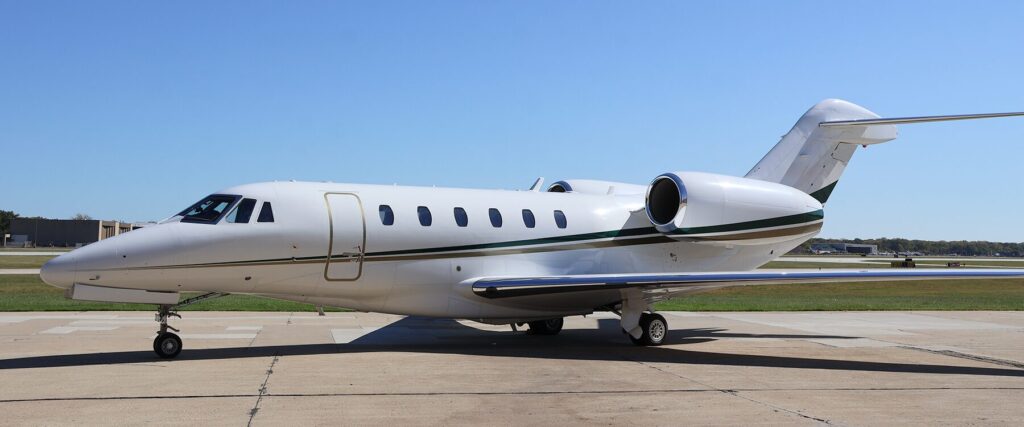
The Citation X is one of the fastest business jets ever built, and speed is exactly why Clients request it. This midsize jet cruises at about 600 mph, near Mach 0.9, with a range of roughly 3,125 to 3,380 nautical miles and a ceiling of 51,000 feet. It seats up to eight.
The payoff is time. On a long domestic leg, the Citation X can shave meaningful minutes off the block, which matters when the schedule is tight and the day is long. It flies high, fast, and above much of the weather.
Executives on demanding schedules gravitate to it for the Los Angeles to New York run. Fewer minutes aloft means more time on the ground where it counts.
3. Bombardier Challenger 300 and 350
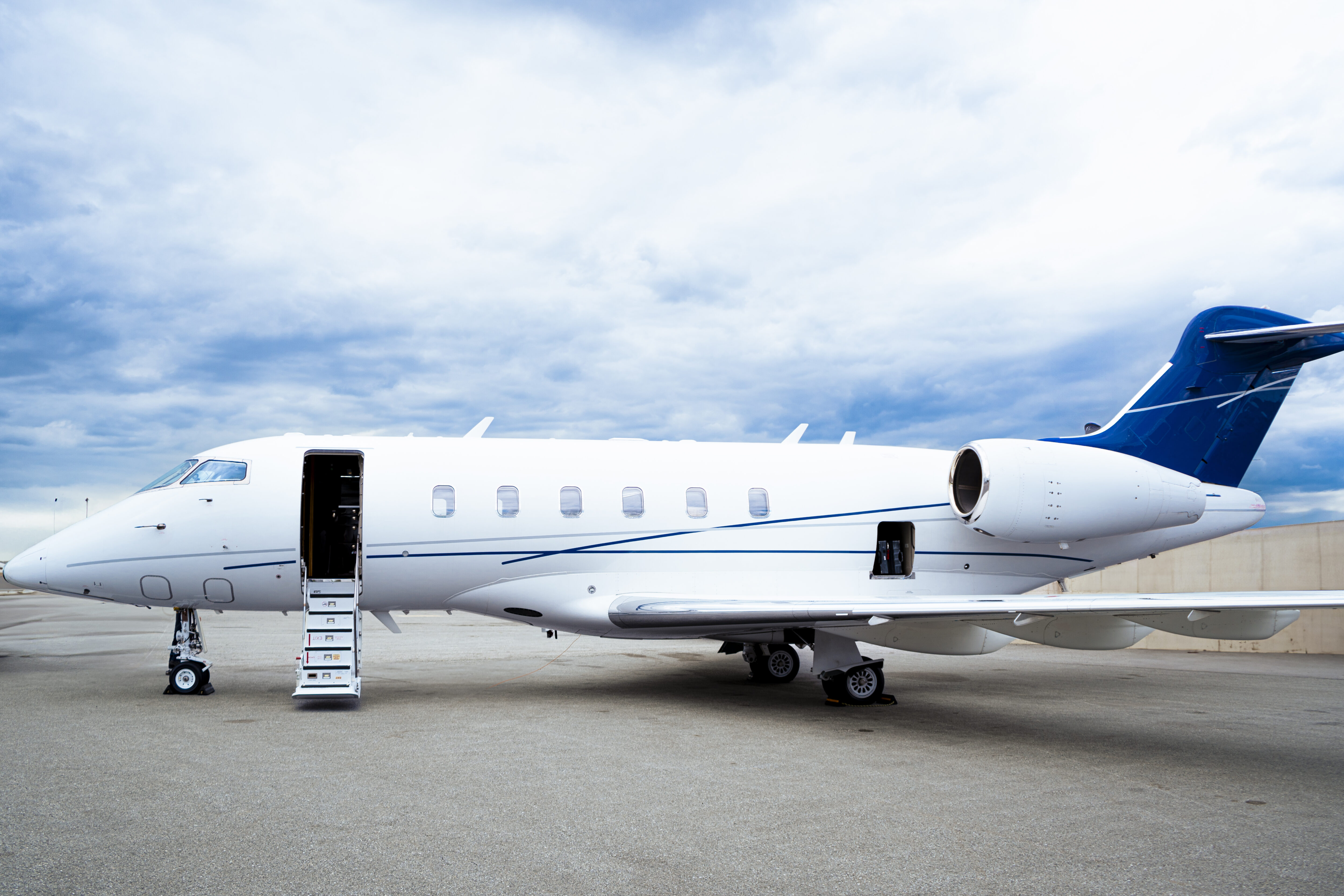
The Bombardier Challenger 300 and its refined 350 variant define the super-midsize category. The cabin seats eight to nine, and about six travel comfortably with full luggage on a longer leg. Range runs roughly 3,270 to 3,340 nautical miles, with a max cruise near 459 knots, about 528 mph.
This is the coast-to-coast aircraft Clients name first. The flat floor, the wide seats, and the genuine transcontinental reach make it the balanced choice for a demanding travel day. It carries the whole party without asking anyone to compromise.
For a full board flying west to east, the cabin holds a working session without the fatigue of a connection. Its reliability and ramp presence have made it a fixture of corporate flight departments and charter alike.
4. Bombardier Challenger 650
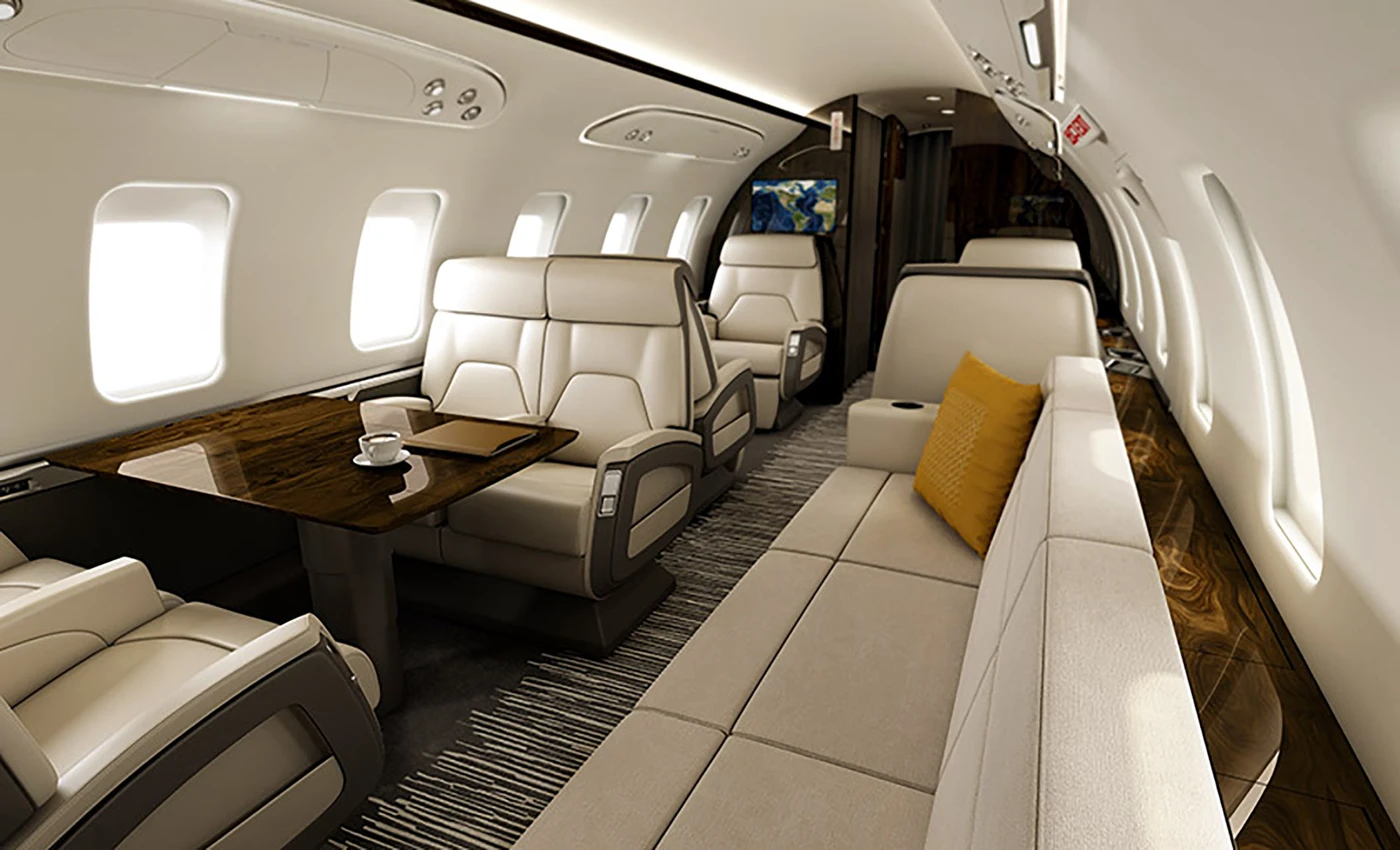
The Challenger 650 brings the heavy-jet cabin to the long domestic leg. It seats up to 10, carries a range beyond 4,000 nautical miles, and cruises at about 459 knots. The cabin is the story: one of the widest in its class, with room to hold a real meeting or spread out and rest.
Clients choose the 650 when the group is larger and the trip is longer. It is presence and comfort in equal measure, and it will reach far when the mission calls for it.
The 650 belongs to the executive team that travels together and works en route. With a full galley and a cabin wide enough to sit face to face, it turns a long leg into productive time.
5. Cessna Citation Latitude

The Citation Latitude has climbed the popularity charts on cabin comfort. This midsize jet seats up to nine, carries a range near 2,700 nautical miles, and reaches a ceiling of 45,000 feet. The cabin features a flat floor and a six-foot stand-up height that feels larger than the category suggests.
For travelers who value walking the aisle without stooping, the Latitude delivers. It is a comfortable, quiet choice for regional and near-transcontinental journeys alike.
It has become a favorite for growing families and small teams who want space without stepping up to a heavier cabin. The wide oval fuselage sets the tone the moment you step aboard.
6. Embraer Praetor 500
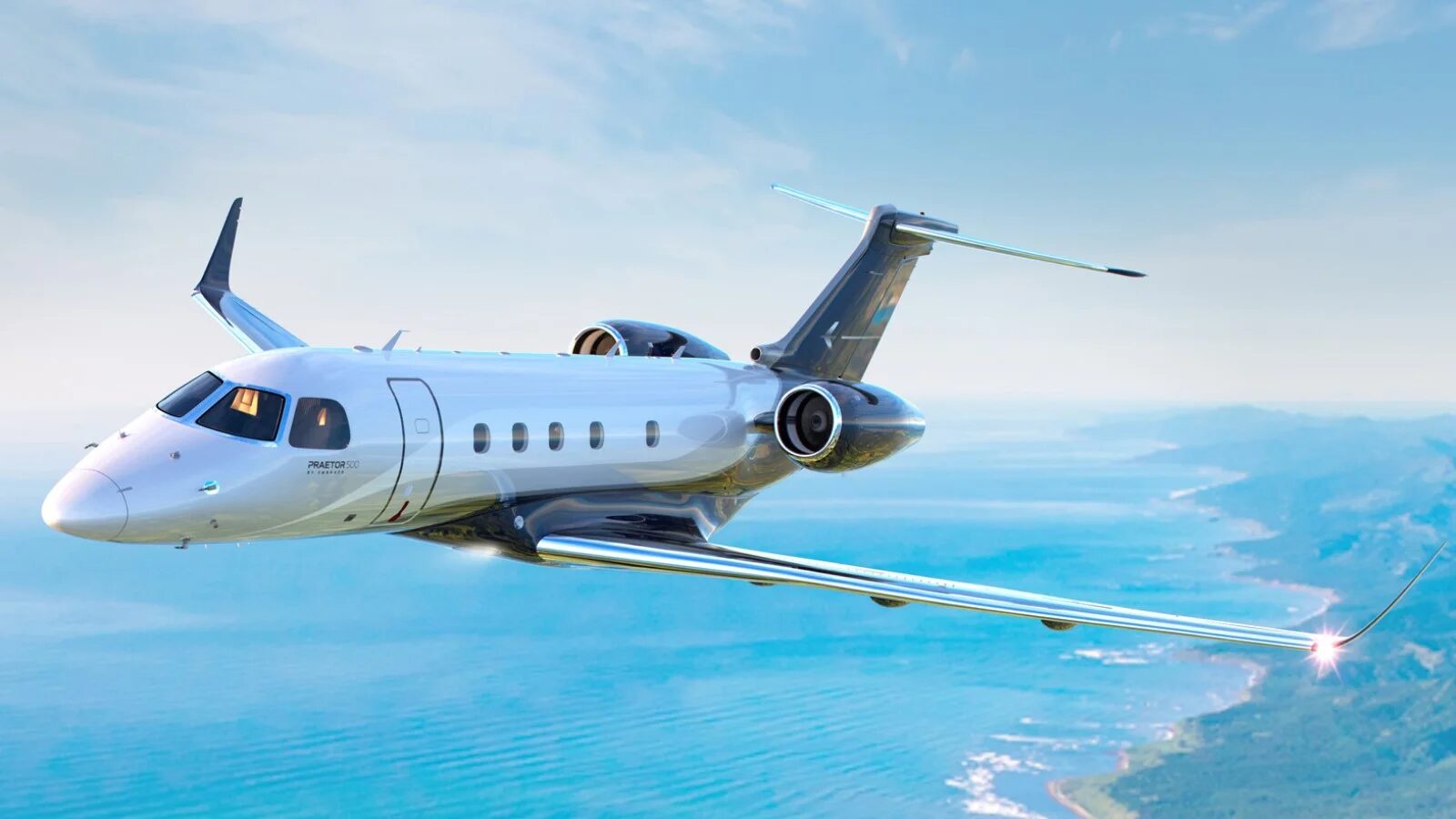
The Praetor 500 is the technologist’s midsize jet. It seats up to nine, carries a range of roughly 3,340 to 3,412 nautical miles, and flies with full fly-by-wire controls that deliver a smooth, precise ride. That range is unusually generous for the category.
Clients favor the Praetor 500 when they want midsize economics with heavier-jet reach. It quietly outperforms expectations, which is exactly why it keeps appearing on charter requests.
Travelers who cross the country on a midsize budget find it punches above its class. The fly-by-wire system also smooths turbulence, which regular flyers notice on longer legs.
7. Bombardier Global 7500
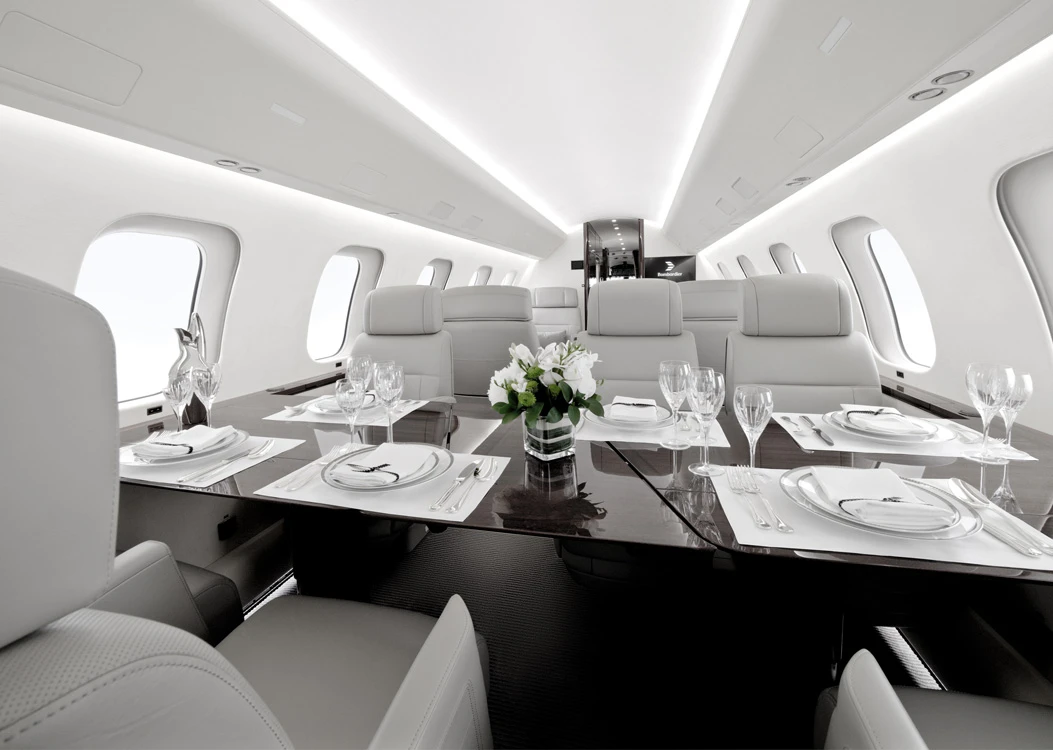
The Global 7500 is a flagship in every sense. This heavy, ultra-long-range jet seats up to 17 to 19, carries a range of roughly 7,700 to 7,800 nautical miles, and reaches a ceiling of 51,000 feet. The cabin divides into four living zones, with an available master suite.
This is the aircraft for the nonstop intercontinental journey. Boston to Dubai, New York to Tokyo, the 7500 makes the world feel closer, and it lets you arrive rested rather than recovered. At this range, comfort is precisely what you are chartering for.
It anchors the travel of those who cross oceans on their own schedule. The master suite and dedicated crew rest make an overnight flight feel closer to a private residence than a cabin.
8. Bombardier Global 8000
The Global 8000 is the new benchmark, and the reason this year’s list looks different. Certified and entered into service at the end of 2025, it is now the longest-range business jet in production. It seats up to 19, carries a range of about 8,000 nautical miles and up to 8,070, and reaches a ceiling of 51,000 feet. Its max speed approaches Mach 0.94 to 0.95.
Availability is limited, and that exclusivity is part of what makes it coveted. When a Client asks for the farthest, fastest cabin in the sky, the Global 8000 is the answer. Reaching it takes an Advisor with the right network, which is exactly how the most sought-after aircraft stay special.
Because it entered service so recently, only a small number are flying, and access depends on relationships rather than open availability. For the Client who values being among the first, that scarcity is the appeal. An Advisor who knows where these aircraft sit can turn a hard-to-source cabin into a confirmed journey.
9. Embraer Phenom 300

The Phenom 300 is the most-delivered light jet, and its popularity is well earned. It seats up to six, carries a range near 2,000 nautical miles, and reaches a ceiling of 45,000 feet. For regional trips and short-runway airports, few aircraft match its blend of speed, comfort, and efficiency.
Clients love the Phenom 300 for the weekend getaway and the quick business hop. It is the light jet that feels a class above, which is why it remains the category’s benchmark.
It has introduced a generation of travelers to private aviation, and many stay with it for years. Owners and charter Clients alike praise its ride quality and the confidence of its avionics.
10. Cessna Citation CJ3 and CJ3+

The Citation CJ3 and its CJ3+ update are the dependable light jets Clients return to. Seating up to six, with a range of roughly 1,875 to 1,918 nautical miles and a ceiling of 45,000 feet, the CJ3 is efficient, quiet, and easy to position.
Its appeal is simple confidence. For regional travel and access to smaller fields, the CJ3 does exactly what a light jet should, without fuss and without excess.
For a family flying to a mountain retreat or a quick intrastate meeting, the CJ3 is a natural fit. Its efficiency also tends to keep it accessible when demand tightens.
11. Gulfstream G280

The Gulfstream G280 rounds out the list as a super-midsize favorite. It seats up to 10, carries a range of roughly 3,600 to 3,700 nautical miles, and cruises at about 459 knots. That range gives it a genuine coast-to-coast profile with room to spare.
Clients choose the G280 for its combination of range, cabin, and the Gulfstream pedigree. It is a confident choice for the traveler who wants transcontinental capability in a well-appointed cabin. It suits those who want that refinement without stepping into an ultra-long-range flagship, and on a coast-to-coast leg its range leaves a comfortable margin. For a deeper look at that pedigree, our retrospective on the Gulfstream IV traces where the family’s reputation began.
What Determines the Cost of Chartering a Popular Private Jet?
The cost of chartering a popular private jet is shaped by the mission, not by a fixed sticker price. Four factors do most of the work, and understanding them puts you in a stronger position before you ever request a quote.
Aircraft category and size: a light jet and an ultra-long-range flagship serve different missions and sit at very different points on the cost scale.
Flight time: longer legs and higher cruise speeds change the equation, since most charter is priced around time in the air.
Positioning and repositioning: where the aircraft starts and where it must go next affects the trip, especially for one-way journeys.
Demand and timing: peak travel windows and popular routes tighten availability, which shapes what the right aircraft costs to secure.
Positioning deserves a closer look, because it is the driver travelers see least. When an aircraft has to fly empty to reach your departure airport, or continue elsewhere after dropping you, that movement factors into the trip. One-way journeys often carry more of this than round trips, which is one reason two similar routes can price differently.
Timing works the same way. Popular corridors and peak travel weekends draw more demand, and the most requested cabins are secured first. Magellan Jets does not add peak-day surcharges, so the value of planning early is access to the right aircraft rather than avoidance of a premium.
Because these variables move together, a precise number only means something once the route, dates, and aircraft are known. That is where a Private Aviation Advisor earns their place, confirming the exact quote for your specific mission rather than a range that may not fit. Our guide to private jet charter costs walks through how these drivers interact in more detail.
Safety, Technology, and Comfort on the Most Popular Private Jets
The aircraft is only half of the charter. The other half is how the trip is sourced, vetted, and cared for, and this is where an asset-light model becomes a genuine advantage.
Magellan Jets does not own or operate aircraft. Every journey is sourced from the Magellan Jets Preferred Network, an exclusive group of fewer than 100 rigorously vetted operators. That selectivity is deliberate. It means the aircraft that reaches you has cleared a standard most of the market never sees.
Safety leadership here is measurable. Magellan Jets holds the WYVERN Authorized Broker Certification, which assures adherence to the highest safety intelligence and standards on every charter flight. Our Advisors ask about safety before anything else on a trip.
Independence is part of that standard. Because Magellan Jets is asset-light and tied to no single fleet, every recommendation stays in the Client’s interest, matched to the safest available aircraft for the route rather than to whatever happens to be on the ramp.
The technology on these popular jets matches the standard. Modern avionics, synthetic vision, and terrain awareness are common across the category, and cabin technology keeps you connected and productive from wheels-up to touchdown. Comfort follows the same logic: quiet cabins, flat floors, and thoughtful layouts designed around how you actually travel. You can read more about how we lead with safety on every journey.
Popular Private Jets to Charter in 2027: Comparison Table
Jet | Category | Passengers | Approx. Range (nm) |
|---|---|---|---|
Cessna Citation Excel / XLS | Midsize | Up to 8 | 1,840–2,020 |
Cessna Citation X | Midsize | Up to 8 | 3,125–3,380 |
Bombardier Challenger 300 / 350 | Super-Midsize | 8–9 | 3,270–3,340 |
Bombardier Challenger 650 | Heavy | Up to 10 | 4,000+ |
Cessna Citation Latitude | Midsize | Up to 9 | ~2,700 |
Embraer Praetor 500 | Midsize | Up to 9 | 3,340–3,412 |
Bombardier Global 7500 | Heavy / Ultra-Long-Range | 17–19 | 7,700–7,800 |
Bombardier Global 8000 | Heavy / Ultra-Long-Range | Up to 19 | ~8,000+ (up to 8,070) |
Embraer Phenom 300 | Light | Up to 6 | ~2,000 |
Cessna Citation CJ3 / CJ3+ | Light | Up to 6 | 1,875–1,918 |
Gulfstream G280 | Super-Midsize | Up to 10 | 3,600–3,700 |
How to Choose the Right Private Jet
The most popular jet is not automatically the right one for you. The right aircraft is the one that fits your mission, and four questions bring it into focus.
Work through them in order. Each answer narrows the field, and by the fourth you usually have a category and one or two aircraft in view. An Advisor then refines the choice against live availability and the specifics of your route.
Range
Start with the distance. A nonstop from New York to London belongs to an ultra-long-range flagship, while a Boston to Nantucket hop is a light-jet mission. Matching range to route keeps you from paying for capability you will not use, or landing short of where you meant to be.
Passengers and Luggage
Count the party and the bags honestly. A cabin rated for nine seats may carry six in comfort once full luggage is aboard. The right cabin holds everyone and everything without asking anyone to travel light.
Golf clubs, ski gear, and a full week of luggage change the math quickly. It is worth telling your Advisor what you are bringing, since baggage volume often decides the aircraft as much as seat count does.
Runway Access
Consider where you actually want to land. Shorter runways at resort, mountain, and island airports favor light and midsize jets, and reaching the closest field can save an hour on the ground. Access, not just distance, defines the best aircraft for many trips.
Mission Type
Finally, match the aircraft to the day. A quick regional meeting, a family holiday, and a transcontinental deal each call for a different cabin. This is where the portfolio matters: for occasional trips, On-Demand Charter gives you the right aircraft on request, and for those approaching 25 hours a year, a Jet Card or the Premium Jet Card brings guaranteed availability and fixed rates. Clients whose flying is heavier still can weigh Fractional Ownership against charter or step further into fractional versus full ownership. Because Magellan Jets owns no fleet, every recommendation is made in your best interest, and a Private Aviation Advisor sources the right match from the Preferred Network.
One relationship carries you across all of it. A Client who starts with On-Demand Charter and begins flying more often can move to a Jet Card without changing partners, and a Jet Card holder who decides to acquire an aircraft has the same team for that step. Needs change over time, and the portfolio is built to change with them.
Frequently Asked Questions About the Most Popular Private Jets to Charter (FAQs):
What Is the Most Popular Private Jet to Charter?
The Embraer Phenom 300 is the most-delivered light jet and one of the most requested aircraft in charter, prized for regional reach and short-runway access. Among midsize jets, the Cessna Citation Excel and XLS are perennial favorites. The right answer depends on your mission, and a Private Aviation Advisor can match one to your specific route.
What Are the Most Popular Private Jet Charter Companies?
Well-known names in the category include NetJets, Flexjet, Wheels Up, and Magellan Jets. Magellan Jets is distinct as an asset-light private aviation solutions provider that owns no fleet and sources every trip from the Magellan Jets Preferred Network of fewer than 100 vetted operators. That independence means each recommendation is made in the Client’s best interest rather than to fill a specific aircraft.
What Is the Fastest Private Jet You Can Charter?
The Cessna Citation X is one of the fastest business jets ever built, cruising at about 600 mph, near Mach 0.9. The newer Bombardier Global 8000 edges past it, with a max speed approaching Mach 0.94 to 0.95. For most travelers, either aircraft turns a long day into a manageable one.
What Is the Best Private Jet for a Coast-to-Coast Flight?
Super-midsize and heavy jets suit coast-to-coast travel best. The Bombardier Challenger 350 and Gulfstream G280 offer genuine transcontinental range with a wide, quiet cabin, and the Cessna Citation X adds speed for a faster block time. Each carries a full party and luggage across the country in comfort.
What Is the Best Private Jet for International Travel?
For nonstop intercontinental journeys, the ultra-long-range flagships lead. The Bombardier Global 7500 flies roughly 7,700 to 7,800 nautical miles with four living zones, and the new Global 8000 extends that to about 8,000 nautical miles and beyond. Both let you sleep across time zones and arrive ready.
How Many Passengers Can the Most Popular Private Jets Carry?
Capacity ranges widely by category. Light jets such as the Phenom 300 and Citation CJ3 seat up to six, midsize and super-midsize jets seat eight to 10, and ultra-long-range flagships like the Global 7500 seat up to 17 to 19. Comfortable capacity is often lower than the maximum once full luggage is aboard, which an Advisor will factor into the recommendation.
How Does the Bombardier Global 8000 Compare to the Global 7500?
The Global 8000 is the newer and longer-range of the two, carrying about 8,000 nautical miles and up to 8,070 versus roughly 7,700 to 7,800 for the 7500. It is also faster, approaching Mach 0.94 to 0.95, and seats up to 19. The 7500 remains widely available with four living zones and an available master suite, while the 8000’s availability is more limited.
What Is the Best-Value Light Jet to Charter?
The Embraer Phenom 300 and the Cessna Citation CJ3 and CJ3+ are the standout light jets for value. Both handle regional trips and short runways with efficiency, and the Phenom 300’s popularity keeps it widely available. An Advisor can weigh availability and routing to find the better fit for your dates.
What Is the Best Private Jet for Family Travel?
Families tend to favor midsize and super-midsize cabins for the stand-up room and generous baggage space. The Cessna Citation Latitude offers a flat floor and six-foot stand-up height, and the Bombardier Challenger 350 adds transcontinental range for longer holidays. The right choice balances the size of the party against the length of the trip.
How Far in Advance Should I Book a Popular Private Jet?
Same-day and next-day charter is often feasible, which is part of the appeal of private travel. That said, peak dates and specific in-demand aircraft favor earlier planning, since the most requested cabins are secured first. A Private Aviation Advisor can lock in the right aircraft as soon as your plans take shape.
Can I Charter an Ultra-Long-Range Jet for a Short Regional Flight?
Yes, and there is no rule against it. For a short regional hop, though, a lighter category is usually the better-value match and can reach smaller airports an ultra-long-range flagship cannot. An Advisor will recommend the aircraft that fits the mission rather than defaulting to the largest cabin available.
Are Light Jets Safe for Night Flights and Poor Weather?
Yes. Light jets are certified for instrument flight rules and are equipped with modern avionics, synthetic vision, and terrain awareness that support night and low-visibility operations. Every aircraft Magellan Jets sources is flown by an operator vetted through the Preferred Network, so the standard holds regardless of the hour or the forecast.
What Determines the Cost of Chartering a Popular Private Jet?
Cost is driven by aircraft category and size, flight time, positioning and repositioning, and demand around your dates and route. Because these move together, a precise figure only holds once the mission is defined. A Private Aviation Advisor confirms the exact quote for your specific trip rather than quoting a range that may not apply.
What Is the Difference Between a Light, Midsize, Super-Midsize, and Heavy Jet?
Light jets seat up to six or seven and specialize in short regional trips and small runways. Midsize jets add a stand-up cabin and near-transcontinental range, while super-midsize jets deliver genuine coast-to-coast reach in a wider cabin. Heavy jets carry larger groups over long legs with the most cabin space, and each step up trades runway flexibility for range and room.
Talk to a Private Aviation Advisor
The most popular private jets earn their reputations one journey at a time, and the right one for you is the aircraft that fits your mission exactly. That match is what a Private Aviation Advisor delivers, sourced from a Preferred Network built on safety and confirmed with a precise quote for your route. When you are ready to fly, one conversation puts the whole portfolio to work for you.
Talk to a Private Aviation Advisor


