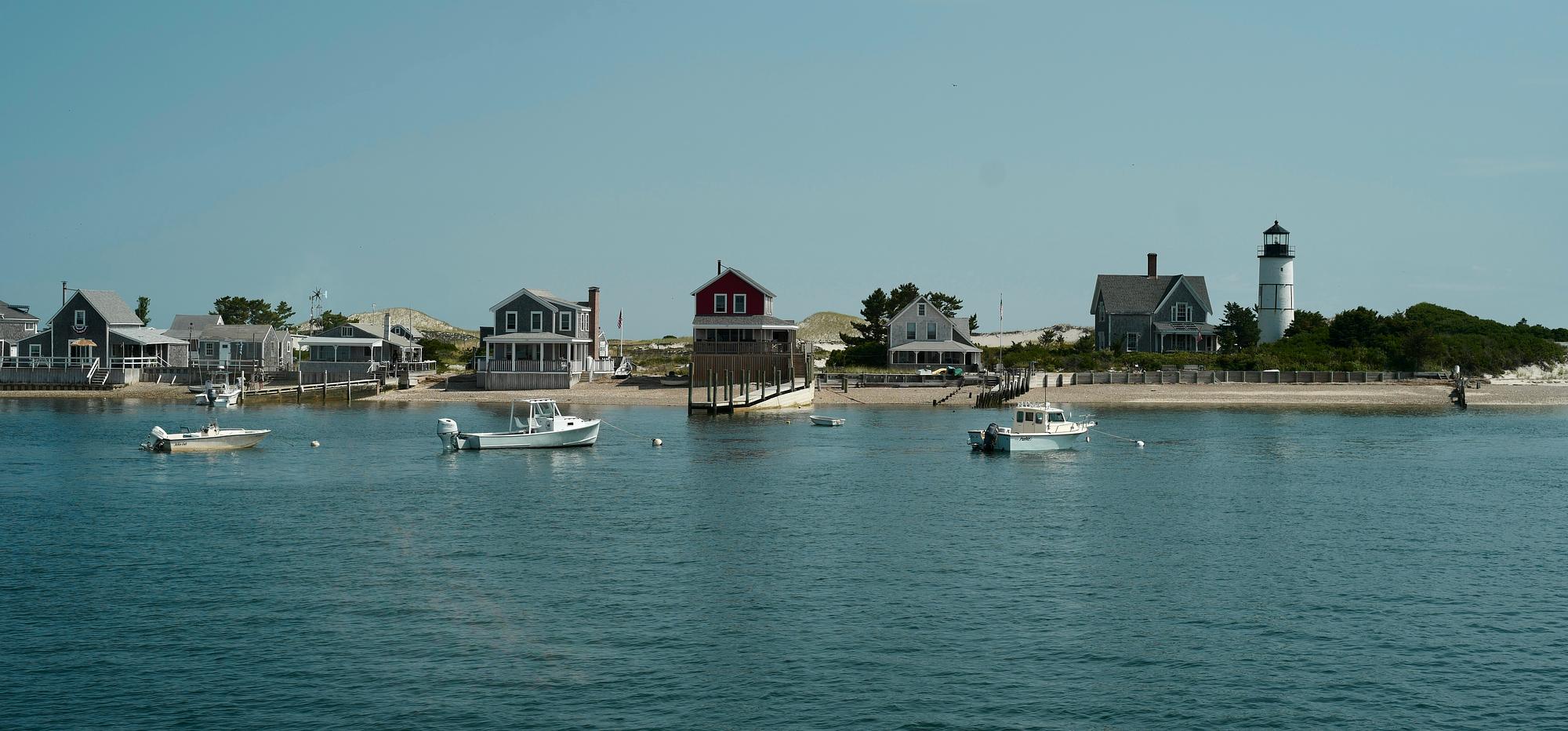
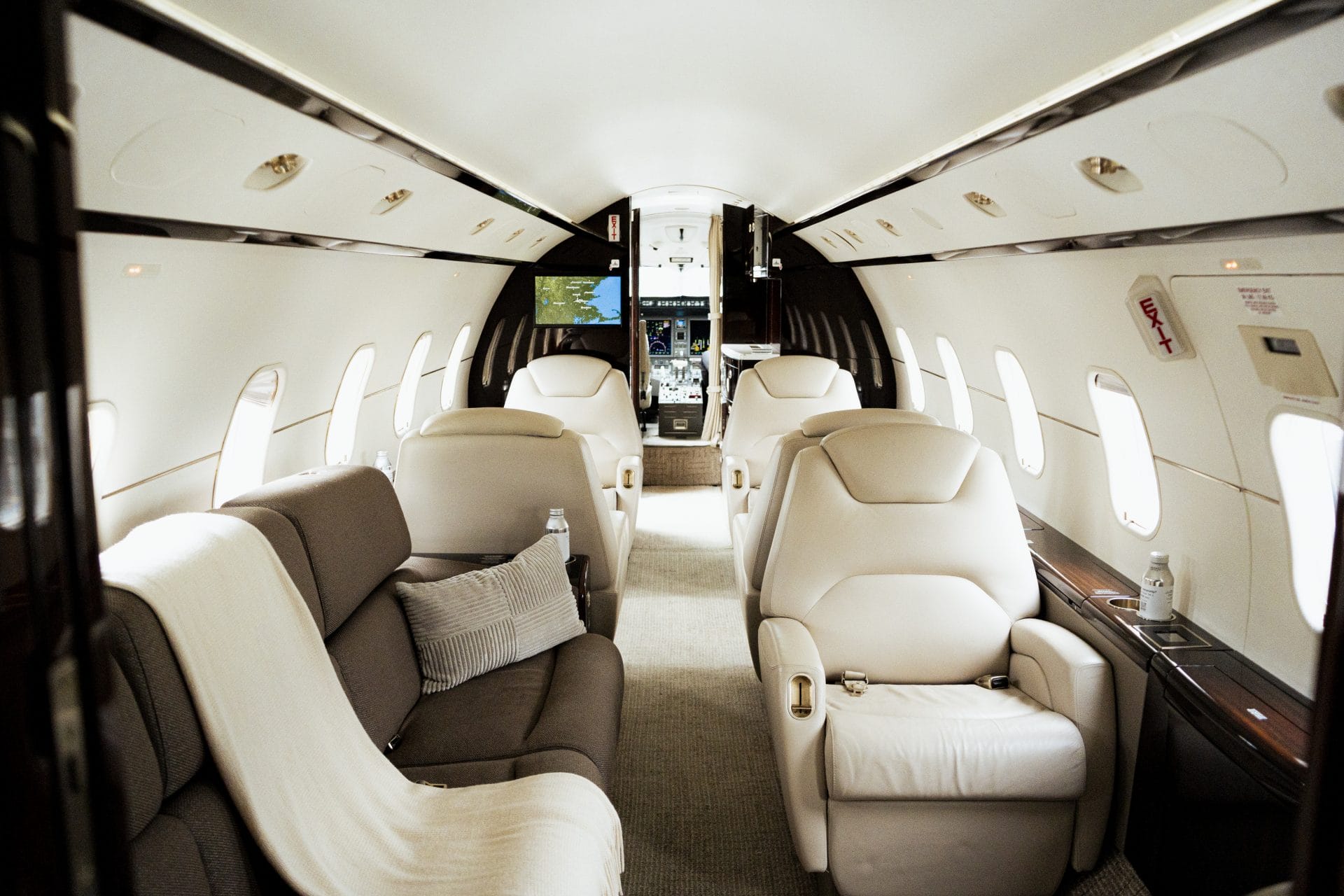
A private jet to Nantucket, Martha’s Vineyard, or the Hamptons puts you on the sand within 30–60 minutes of departure from New York or Boston. Nantucket Memorial Airport (KACK) and Martha’s Vineyard Airport (KMVY) serve the islands directly; in the Hamptons, most private flights land at East Hampton Town Airport (KJPX, formerly HTO), with larger jets using Francis S. Gabreski Airport (KFOK) in Westhampton Beach. These three destinations share the Atlantic seaboard’s best beaches, the Northeast’s most discerning seasonal communities, and runways built for turboprops and light jets.
Why Fly Private to the Northeast Coast in Early Fall
Nantucket, Martha’s Vineyard, and the Hamptons stay uncrowded because they are hard to reach casually. That limited access is exactly why these places hold their character. In early fall, the payoff grows. The summer crowds have gone, the ocean still runs warm, and the light turns golden by late afternoon. Locals and regulars often call September the secret season.
The appeal of early fall carries across all three destinations. Water stays warm into September, the afternoon light turns long and golden, and the dinner reservations that filled all summer open again. Prices ease from their peak, while the beaches, shops, and tasting rooms stay in full swing. For travelers who prize quiet over spectacle, this is the window they wait for.
Commercial routes are limited, often routed through congested hubs. Ferries fill up weeks in advance. The drive from Manhattan to Montauk can stretch past four hours on a Friday in season. Private aviation clears those constraints while keeping the exclusivity intact. You depart on your schedule, land at a field minutes from your destination, and arrive before the weekend traffic has cleared the tunnel.
For Private Clients who move between homes, boats, and events across these destinations, a Jet Card makes repeat travel predictable. For those testing the waters with a single trip, On-Demand Charter offers the same access without a long-term commitment.
Private Jet to Nantucket: An Island Built on Understatement
Nantucket favors travelers who value understatement. The island’s cobblestone streets, gray-shingled cottages, and protected shoreline have changed little in decades. There are no chain hotels, no billboards, and no high-rises. What remains is a community that prizes preservation, discretion, and the Atlantic wind.
September days begin with fog lifting over Brant Point and end with oysters at a harbor-side raw bar. The beaches empty further once the summer fleet thins. Mid-month brings the Nantucket Island Fair, with its farm stand, barnyard, and baking competitions. The Sustainable Nantucket Farmers and Artisans Market runs Saturdays into October, drawing more than 80 island growers and makers. On September 19, the Land Bank Cross Island Hike traces a route from Quidnet to Madaket Harbor. These draw a particular kind of guest, one who values substance over spectacle. Scalloping season opens October 1, a fall draw on the horizon just weeks after Labor Day.
In early fall, Nantucket settles into an unhurried rhythm. Harbor-side inns near Straight Wharf keep their tables easy to reserve, and the town’s kitchens turn toward the season. You might start with oysters at a downtown raw bar, then walk the cobblestone lanes as the evening light softens. Farm-to-table dinners draw on the late harvest, and the wine lists lengthen for autumn. Days stay warm enough for the beach, yet the sand belongs to a handful of walkers rather than a crowd.
Flying private to Nantucket means landing at Nantucket Memorial Airport (KACK), a single-runway field roughly three miles from downtown. The airport handles turboprops and light jets with ease. Flight time from New York is approximately 50–60 minutes; from Boston, closer to 30 minutes.
Insider knowledge: early-fall sea fog can occasionally close KACK on short notice. When it does, Hyannis (HYA) on Cape Cod serves as the nearest alternative, with ferry or helicopter connections to the island. Your Private Aviation Advisor will monitor conditions and adjust your itinerary before you leave for the airport.
Private Jet to Martha’s Vineyard: An Island of Quiet Variety
Martha’s Vineyard is larger and more varied than its neighbor to the east. The island divides into distinct villages, each with its own rhythm. Edgartown offers colonial architecture, white-tablecloth dining, and a harbor full of sailboats. Oak Bluffs is looser and more colorful, famous for its gingerbread cottages. Up-island, Chilmark and Aquinnah feel almost rural, with rolling farmland, clay cliffs, and beaches that empty by late afternoon.
September suits the island’s quieter character. The Martha’s Vineyard International Film Festival runs September 8–13, 2026, with filmmaker talks, showcases, and live music. Tivoli Day fills downtown Oak Bluffs on September 19–20, an old-fashioned street fair marking the turn toward autumn. The Striped Bass and Bluefish Derby runs September 13 through October 17, a five-week tournament and a New England fall classic. For families, the Vineyard provides room to spread out. For couples, it offers quiet beaches and farm-to-table dinners where the chef knows your name. The island has long attracted writers, artists, and political figures who value its relative anonymity.
September gives the Vineyard back to its regulars. In Edgartown, a harbor-view inn on North Water Street sits within a short walk of white-tablecloth dining and quiet morning coffee. Up-island, farm stands in Chilmark and West Tisbury stock the last of the summer produce alongside early autumn crops. Evenings cool enough for a sweater, and the reservations that vanished in August open again. Couples find empty beaches at Aquinnah, and families spread out across the island without competing for space.
Private jets land at Martha’s Vineyard Airport (KMVY), near Vineyard Haven and set between West Tisbury and Edgartown. The runway accommodates turboprops and light jets comfortably. Flight time from New York runs 50–60 minutes; from Boston, approximately 25–35 minutes.
Private Jet to the Hamptons: The Shortest Distance Between the City and the Shore
The Hamptons sit close to New York yet feel a world apart. East Hampton’s hedgerows conceal estates that have hosted generations of American artists, financiers, and tastemakers. Southampton’s Main Street feels like a New England village transplanted to Long Island. Montauk, at the island’s eastern tip, keeps a rougher edge, with surfers, fishing boats, and a lighthouse that has stood since 1796.
After Labor Day, the Hamptons enter their secret season. The Hampton Classic wraps over Labor Day weekend, the season’s signature equestrian finale. The ocean reaches its warmest of the year, usually the upper 60s to low 70s. Crowds thin, the restaurants and shops stay open, and the East End’s vineyards move into harvest from mid-September through October. Lunch at Sant Ambroeus is easier to book, and the beach still feels like an extension of the living room.
After the summer rush, the East End slows to a pace that rewards lingering. Southampton’s farm stands and the East End tasting rooms fill with the harvest, and dinner reservations in East Hampton come without a wait. You can take a long morning on an empty ocean beach, then drive to a vineyard for an afternoon among the vines. Inns and cottages that stayed booked all summer reopen to weekend guests. The light lengthens, the air turns crisp by evening, and the shore feels private again.
Most private flights to the Hamptons land at East Hampton Town Airport (KJPX, formerly HTO), a single-runway facility minutes from the village center. The airport suits turboprops and light jets. Larger aircraft, including midsize and super-midsize jets, use Francis S. Gabreski Airport (KFOK) in Westhampton Beach, roughly 20 minutes west. Flight time from Teterboro or Westchester is approximately 20–35 minutes.
Island-Hopping the Northeast in Early Fall
Many Private Clients treat Nantucket, Martha’s Vineyard, and the Hamptons as one early-fall circuit rather than three separate trips. A long weekend might open with a morning on Nantucket, move to the Vineyard for a Derby afternoon, and close in East Hampton for a harvest dinner. The short distances make it practical. Each hop runs well under an hour in the air.
The shoulder season makes a multi-leg itinerary easier to arrange. Ramp space at KACK, KMVY, and KJPX loosens midweek once the summer fleet thins. Aircraft positioning and parking come with fewer constraints than a peak-summer Friday. Departure slots open, and ground handlers move faster.
A turboprop suits this kind of trip especially well. The Pilatus PC-12 and the King Air series handle each island’s runway, carry the luggage for a multi-stop weekend, and reposition quickly between fields. Your Private Aviation Advisor coordinates the full sequence: the routing, the FBO arrangements at each stop, ground transportation, and catering timed to your plans. You keep one point of contact across every leg.
Early-fall weather rewards a little flexibility, and a multi-leg plan builds it in. Sea fog can settle over the islands on short notice, most often in the morning. When KACK closes, Hyannis on Cape Cod serves as the nearest alternative. Your Advisor can reorder the legs so the trip keeps moving, and a turboprop’s wider range of suitable airports opens further options.
Choosing the Right Aircraft for Short Northeast Hops
Flights from New York or Boston to the islands are short, often under an hour in the air. That brevity shapes aircraft selection more than range or speed. What matters here is runway compatibility, baggage capacity, and cabin comfort for a brief but frequent mission.
Turboprops: The Island Specialist
The Pilatus PC-12 is the benchmark for short-haul island flying in the Northeast. It handles shorter runways with ease, carries generous baggage, and moves a family of four or five with golf clubs, luggage, and a dog without compromise. For Private Clients who island-hop between Nantucket, the Vineyard, and the Cape, the PC-12 offers flexibility that jets cannot match. The King Air 90 and King Air B200 serve similar missions well.
Light Jets: Speed and Polish
For travelers who prefer jet travel even on short legs, the Embraer Phenom 300 suits Eastern Seaboard hops. It carries up to six passengers with ample baggage space, a strong choice for families, foursomes heading to Shinnecock, or pet-friendly travel. The Citation CJ series serves two to four passengers comfortably on these routes.
On a short leg, the choice between a turboprop and a light jet often comes down to preference. Both cover these routes in well under an hour. A light jet offers a quieter cabin and a stand-up feel that some travelers favor, while a turboprop reaches the shortest island runways with room to spare. Your choice can shift from trip to trip, and your Advisor keeps the options open.
Party size, baggage, and the specific runways on your itinerary drive the recommendation. A foursome carrying golf clubs to Shinnecock has different needs than a couple traveling with a dog to Nantucket for the weekend. Shorter island runways favor the turboprop specialists, while travelers who want a jet cabin on a nonstop Eastern Seaboard hop lean toward the Phenom 300 or a Citation CJ. Baggage volume matters as much as seat count on these routes, since golf bags, luggage, and pet crates fill a cabin quickly.
Your Private Aviation Advisor can recommend the aircraft that best fits your party size, luggage requirements, and the specific airports on your itinerary.
Booking Early-Fall Travel: After Labor Day, Before the Season Closes
Early fall is the East End’s shoulder season. From September into October, availability comes easier than on peak summer Fridays. Even so, the best aircraft and departure slots still go early for foliage weekends, the Derby, and Labor Day-adjacent trips.
Ramp space at KACK, KMVY, and KJPX still tightens on foliage weekends and holiday-adjacent dates. Fixed-base operators (FBOs) fill their parking grids in advance. Aircraft availability across the Magellan Jets Preferred Network remains strong, though positioning options narrow as popular weekends fill.
For Private Clients planning regular travel, booking early secures preferred departure times, optimal aircraft, and room to adjust plans. A Jet Card locks in access and rates ahead of demand.
Jet Card holders traveling short routes like Boston to Nantucket benefit from the short-leg waiver, a program feature that adjusts the hourly minimum for flights under a certain distance. A Client flying Boston to Nantucket can save up to $10,000 on a single trip through the short-leg waiver. For travelers who fly these routes repeatedly from September into October, the savings compound quickly.
Ground details matter as much as the flight in shoulder season. Car service, FBO handling, and catering stay easier to arrange once the summer peak passes, though popular foliage weekends still book up. Your Advisor confirms each arrangement in advance, from the transfer waiting on the ramp to the table held for dinner. The result is a trip that unfolds on your schedule.
For those planning a single trip or exploring private aviation for the first time, On-Demand Charter provides the same aircraft quality and service without a card commitment. Your Advisor will coordinate ground transportation, catering, and any special requests for your journey.
Frequently Asked Questions About Flying Private to the Northeast (FAQs):
Where do private jets land in the Hamptons?
Most private jets land at East Hampton Town Airport (KJPX, formerly HTO), located minutes from the village. Larger aircraft, including midsize and super-midsize jets, typically use Francis S. Gabreski Airport (KFOK) in Westhampton Beach, approximately 20 minutes west of East Hampton.
How long is a private flight from New York to Nantucket?
A private flight from the New York area to Nantucket takes approximately 50–60 minutes, depending on departure airport and weather conditions. Flights from Teterboro or Westchester are typical departure points for this route.
Can you fly private to Martha’s Vineyard?
Yes. Martha’s Vineyard Airport (KMVY) accepts private aircraft, including turboprops and light jets. The airport sits near Vineyard Haven, centrally positioned for access to all island villages. Flight time from New York is approximately 50–60 minutes; from Boston, 25–35 minutes.
How much does it cost to charter a private jet to Nantucket?
Charter pricing depends on aircraft type, departure city, and trip-specific factors. Final pricing is confirmed at time of quote.
When should I book a private jet for early-fall travel in the Northeast?
Book ahead for foliage weekends, the Martha’s Vineyard Derby, and holiday-adjacent dates. Early fall is easier than peak summer, but preferred aircraft and departure slots still fill as the calendar develops. Private Clients with Jet Cards benefit from guaranteed availability and rate protection when they book ahead.
What size jet is best for flying to Nantucket, Martha’s Vineyard, or the Hamptons?
For short island hops, turboprops like the Pilatus PC-12 and King Air series are ideal. They handle shorter runways, carry ample baggage, and accommodate families comfortably. For travelers who prefer jet travel, light jets such as the Embraer Phenom 300 or Citation CJ series serve these routes well, offering speed and cabin comfort for up to six passengers.
Can I visit Nantucket, Martha’s Vineyard, and the Hamptons in one trip?
Yes. The three destinations sit within short hops of one another, and many Private Clients string them into a single early-fall itinerary. A turboprop such as the Pilatus PC-12 moves easily between the islands and the East End. Your Private Aviation Advisor coordinates each leg, the ground transportation, and the timing.
Is early fall a good time to visit Nantucket and Martha’s Vineyard?
Yes. Locals and regulars often cite September as a preferred time to visit. The summer crowds thin after Labor Day, the restaurants and shops stay open, and rental costs ease from their peak. Days stay warm, and the beaches turn quiet.
What is the weather like on the Northeast islands in September?
September is mild, with warm days and cooler evenings. The Atlantic reaches its warmest of the year in early September, usually the upper 60s to low 70s Fahrenheit. Early-fall sea fog is possible, especially in the mornings, and it can occasionally affect island flights.
Your Early Fall Starts With a Single Call
The Northeast’s coastal destinations are best discovered on your own terms. Whether you are closing out the season, joining friends for a foliage weekend, following the Derby, or attending an event that cannot wait, private aviation ensures you arrive when you intend to, not when the ferry schedule or traffic allows.
Magellan Jets has flown Private Clients to these destinations for nearly two decades. Our Advisors know the airports, the timing, and the details that make early-fall travel feel effortless. If you are considering a private jet to Nantucket, Martha’s Vineyard, or the Hamptons this September, we are ready to build your itinerary.
The 2026 holiday season will test private aviation like no year before it. Private jet holiday travel 2026 planning starts now. The math is straightforward. Finite aircraft. Record demand. Six weeks of peak travel compressed into the tightest window the industry has faced.
The FAA projected 2025 Thanksgiving as the busiest holiday travel period in 15 years, with peak days exceeding 52,000 flights. That trajectory has only steepened for 2026 — and Magellan’s own five-year booking history tells the same story: 2025 closed as the strongest peak season on record, up roughly 25% over 2024. Private Clients who wait until October to think about Thanksgiving, or November to plan Christmas, are already behind.
For 2026 private jet holiday travel, the booking window opens in the summer. It narrows extremely by mid-October. Magellan Jets recommends locking Thanksgiving travel by mid-September. Christmas departures should be confirmed by early October. New Year’s flights need commitment by mid-October. Jet Card holders carry a structural advantage: zero blackout dates and zero peak-day surcharges. Even guaranteed-availability programs benefit from early crew and logistics coordination.
Why Summer 2026 Is the Real Deadline for Private Jet Holiday Travel
Most private flyers underestimate how early peak-season availability tightens. The instinct is to plan holidays after summer. By Labor Day, the best aircraft and most experienced crews are committed for Thanksgiving week.
Consider the numbers. The 2025 Thanksgiving period saw peak days exceeding 52,000 flights. That pressure compounds at private terminals. Operators begin reserving crew and positioning aircraft for the holiday corridor as early as August.
This isn’t a one-year spike, either. Magellan’s own peak-season data shows a sharply accelerating, climb over the last four years, with 2025 marking a clear step up in baseline demand rather than a one-off. Every additional year of growth means less slack in the system by the time Thanksgiving week arrives.
This is not about panic. It is about understanding how supply works. Private aviation operates on a finite fleet with fixed crew rosters. Every week of delay narrows your options for aircraft type, departure time, and routing flexibility.
How Peak-Day Restrictions Shape Your Holiday Options
Peak days are the industry’s mechanism for managing demand surges. The number of peak days ranges from 10 to over 60 per year, depending on the program. These cover Thanksgiving week, December 20 through January 3, and other high-demand windows. Surcharges of 5% to 20% are typical, with some providers charging up to 40%.
The intensity isn’t spread evenly across that window, either. Magellan’s multi-year departure data shows late December, specifically December 26 through 28, running roughly double the daily volume of the early-to-mid-December baseline, every year without exception. That single three-day stretch is consistently the busiest of the entire season, ahead even of Thanksgiving weekend and New Year’s.
Some large fleet operators restrict access on dozens of high-demand dates each year. Other programs apply surcharges that transform a $15,000 flight into an $18,000 or $21,000 one without any change in aircraft or service. Understanding how peak days affecting your holiday travel work is essential before committing to any program.
Magellan Jets operates with zero blackout dates and zero peak-day surcharges across On-Demand Charter flights and every Jet Card tier. This is a structural difference, not a promotional offer. The asset-light model sources aircraft from the Preferred Network, not a captive fleet. That eliminates the fleet-utilization conflicts forcing other providers to restrict peak-period access.
Your 2026 Holiday Booking Timeline: Week by Week
The following timeline reflects operational reality. These windows are based on aircraft positioning cycles, crew scheduling requirements, and destination-specific constraints.
Thanksgiving (November 26, 2026)
Book by mid-September, 13 weeks in advance. Thanksgiving routes concentrate on a narrow set of corridors. KBOS and KTEB to KPBI. KTEB to KACK. Northeast-to-Caribbean legs. Departures cluster Tuesday through Wednesday, with returns on Sunday.
Caribbean destinations require even earlier planning. Caribbean peak season runs late November through mid-April. Advance slot scheduling at island airports is critical.
Christmas (December 25, 2026)
Book by early October, 11 weeks in advance. Christmas travel splits into two waves. Departures cluster December 22 through 24. Returns concentrate December 26 through 28 — the single busiest stretch of the entire season. Ski destinations like KASE (Aspen) and KMVL (Morrisville/Stowe) face weather-compounded slot constraints.
New Year’s (January 1, 2027)
Book by mid-October, 10 weeks in advance. The December 30 through January 2 window is the single tightest corridor in private aviation. KPBI, the gateway for South Florida and Caribbean connections, reaches capacity well before commercial airports feel the same strain. Return-flight demand also builds a secondary ski corridor out of Aspen and Bozeman as holiday travelers head home.
Magellan Jets publishes Advanced Booking Days data by cabin category. It helps Private Clients match aircraft preferences to realistic availability.
What Time of Day You’ll Feel the Squeeze
Timing matters as much as timing your booking. Across four years of holiday departures, the late-morning-to-early-afternoon window — roughly 10 a.m. to 2 p.m. — is consistently the busiest stretch of the day across every peak period, accounting for around half of all departures during Thanksgiving weekend and an even larger share during Dec 26–28 and Jan 1–3. Departures before 8 a.m. or after 6 p.m. see meaningfully lighter traffic and typically faster ground handling.
Clients with flexibility on departure time can use this pattern to their advantage — a 7 a.m. or evening departure on a peak day often means less time on the ramp and fewer scheduling conflicts than a mid-day slot.
Why Aircraft Type Matters More Than Ever
The aircraft categories driving holiday demand have shifted meaningfully over the past several years. Light jet bookings have declined as a share of holiday travel, while Super-Midsize aircraft have become an increasingly common choice — nearly doubling their share of holiday bookings since 2022. Heavy jets and Super-Mid aircraft are also the categories that quote furthest in advance and sell out fastest during peak weeks.
Practically, this means Private Clients requesting a Super-Mid or Heavy Jet for Thanksgiving, Christmas, or New Year’s should plan on the earliest end of the booking timeline above — and should strongly consider a Jet Card’s surcharge-free aircraft interchange, which allows an upgrade to a larger cabin at no additional cost if the requested category isn’t available.
Which Private Aviation Program Protects You Through Peak Season
Choosing the right program for holiday travel depends on three factors: frequency, flexibility, and peak-season risk tolerance. A Magellan Jets Jet Card provides guaranteed 365-day availability and zero peak-day surcharges. Rate locks extend from 12 to 24 months depending on commitment level. Aircraft interchange carries no surcharge. For Private Clients flying 25 or more hours annually, the Jet Card answers holiday uncertainty structurally.
On-Demand Charter serves Private Clients who fly fewer than 25 hours per year. It also fits those who need a single holiday trip outside their regular pattern. There is no upfront commitment, and Magellan sources every flight from its Preferred Network of rigorously vetted operators.
Fractional Ownership through Magellan Jets guarantees access on a Bombardier Challenger 850 with 50 annual hours. For high-frequency travelers who want ownership benefits and predictable scheduling, it delivers holiday certainty backed by a guaranteed share repurchase.
The distinction that matters most during peak season is whether your program penalizes you for traveling when everyone else does. Programs with 15 to 60 or more peak days per year create a structural disadvantage. The restriction hits precisely when you need access most. The Jet Card is the smartest holiday travel decision for Private Clients who refuse to accept that trade-off.
The Airports That Face The Most Holiday Travel Pressure
Holiday demand does not distribute evenly. A handful of airports absorb most peak-season private aviation traffic, largely along one dominant corridor: Northeast hub airports — Bedford, Teterboro, Westchester, and Philadelphia — fanning out to Florida, the Gulf Coast, and the Caribbean in the classic holiday snowbird pattern. That corridor is at its densest during the December 26–28 stretch, more concentrated than any other window in the season. Understanding their constraints is part of informed planning.
KTEB (Teterboro): The Northeast’s primary private aviation hub faces extreme congestion during Thanksgiving and Christmas. Slot availability narrows weeks before each holiday. Departures after 10 a.m. on peak Wednesdays become difficult to secure.
KPBI (Palm Beach): The gateway to South Florida and the Caribbean. Ramp space is limited, and ground handling slows when volume spikes. Arriving crews often face repositioning delays.
KASE (Aspen): Winter peak demand is compounded by weather restrictions and a challenging approach. Slot requests submitted after October for Christmas week face significant competition.
KACK (Nantucket): Seasonal operations and limited infrastructure create a narrow window for winter travel. Short-leg waivers, which can save up to $10,000 per trip on routes like KBOS to KACK, become especially valuable here.
KBOS (Boston): Post-Thanksgiving return traffic and pre-Christmas departures create two distinct pressure peaks in November and December.
KMVL (Morrisville/Stowe): Limited winter operations and weather variability make early booking essential for ski-season travel.
Coordinating with your Private Aviation Advisor on ground handling and alternative airports adds meaningful flexibility. The difference shows most at these high-pressure locations.
What Experienced Private Flyers Do Differently
Private jets and aircrafts in the airport of Engadine St Moritz in winter time
The Private Clients who navigate holiday seasons most effectively share a few habits. None of them are complicated, but all of them require acting before the calendar forces your hand.
Lock rates early. Jet Card rate locks range from 12 months at 25 hours to 24 months at 100 hours. They protect against price increases from rising fuel costs and tightening supply. A rate secured in July holds through December.
Use aircraft interchange. Surcharge-free interchange across all aircraft categories gives Private Clients options when their preferred cabin size is unavailable — increasingly relevant given the shift toward Super-Mid and Heavy Jet demand. A Super-Midsize request that cannot be filled becomes a Heavy Jet upgrade at no additional cost.
Coordinate ground logistics now. Holiday ground transportation at KPBI or KASE books out weeks in advance. Your Client Experience team handles this, but they need lead time to secure preferred vehicles and drivers.
Submit catering preferences early. Holiday menus, dietary requirements, and special occasion requests benefit from advance coordination with FBO catering partners.
Book return flights immediately. The most common mistake is securing outbound travel and delaying the return. Both legs compete for the same finite supply — and returns cluster into the same 10 a.m.–2 p.m. window as outbound trips. Book them together.
Start Your Holiday Planning Now
Three decisions define your 2026 holiday travel experience. When you book. Which program protects your access. How you handle airport-specific constraints. July is not early for private jet holiday travel. It is the baseline for Private Clients who expect their holidays to go exactly as planned.
Magellan Jets holds one of private aviation’s highest safety standards. The company sits on the Air Charter Safety Foundation Board. It holds WYVERN Wingman certification. Captains across the Preferred Network average 9,700 or more flight hours. A 4.9 out of 5 satisfaction rating reflects 18 years of delivering on one promise: every journey is personal.
The conversation starts with a single question: where does your family want to be this Thanksgiving, Christmas, and New Year’s? Your Private Aviation Advisor will build the plan from there.
Frequently Asked Questions About Private Jet Holiday Travel (FAQs)
How far in advance should I book a private jet for Thanksgiving 2026?
Magellan Jets recommends confirming Thanksgiving travel by mid-September, roughly 13 weeks before the holiday. Peak corridors like KBOS and KTEB to KPBI see crew and aircraft commitments begin as early as August. Waiting until November leaves few options for aircraft type, routing, or departure time.
Do private jet programs charge extra during the holidays?
Most programs impose peak-day surcharges of 5% to 20%, with some charging up to 40% on high-demand dates. Some providers also restrict access entirely on certain dates. Magellan Jets charges zero peak-day surcharges and maintains zero blackout dates across every solution, 365 days a year.
What is the difference between peak days and blackout dates?
Peak days allow travel under modified terms, typically higher prices and longer notice requirements. Blackout dates restrict travel entirely, meaning your provider cannot guarantee an aircraft on those dates. The number of restricted days ranges from 10 to over 60 per year depending on the program.
Which airports are hardest to fly into during the holiday season?
KTEB (Teterboro), KPBI (Palm Beach), KASE (Aspen), and KACK (Nantucket) face the most intense holiday pressure. Slot availability at KTEB narrows weeks before Thanksgiving and Christmas. KASE adds weather-related approach restrictions during winter. Early booking and coordination with your Private Aviation Advisor are essential at these locations.
What time of day is hardest to book a private jet during the holidays?
Late morning through early afternoon — roughly 10 a.m. to 2 p.m. — is the busiest departure window across every major holiday period, accounting for as much as half or more of all departures. Clients with flexibility can often secure smoother handling with an early-morning or evening departure.
Is a Jet Card or On-Demand Charter better for holiday travel?
A Jet Card provides guaranteed availability, fixed pricing, and no peak-day surcharges, making it the stronger option for anyone flying 25 or more hours per year. On-Demand Charter works well for Private Clients who need a single holiday trip or supplemental lift outside their regular travel pattern, with no upfront commitment required.
The best jet cards pair guaranteed access with fixed, all-inclusive pricing and independently verified safety. They protect your capital, honor your hours without expiration, and place a dedicated advisor within reach at any hour. Choosing well comes down to a short list of criteria: safety standards, price transparency, availability, flexibility across cabins, and how a provider treats your money. At Magellan Jets, the 50-hour Challenger Jet Card leads the lineup for Private Clients who value a consistent cabin and coast-to-coast range. This guide explains how a jet card works, what separates a strong program from a thin one, and how to match a card to the way you actually fly.
What a Jet Card Is and How It Works
A jet card is a prepaid block of private flight hours at a fixed hourly rate. You buy hours in advance, then draw them down trip by trip with a single phone call or message to your advisor. The rate is locked, the availability is guaranteed, and the pricing is all-inclusive, so you know the number before you fly.
The model sits between two other options. On-demand charter is booked one trip at a time, while fractional ownership asks you to buy a share of a specific aircraft. A jet card gives you consistent access without the capital commitment of a share or the trip-by-trip variability of charter. For a fuller primer, read our guide on what a jet card is.
Magellan is an asset-light private aviation solutions provider. Rather than owning a fixed fleet, it sources every trip from the Magellan Jets Preferred Network: fewer than 100 vetted operators out of roughly 3,000 licensed in the United States. That structure lets an advisor match the right aircraft to each mission instead of fitting your trip to one company’s tail numbers. You can explore the full program on the Jet Card solutions page.
How to Choose Among the Best Jet Cards
Providers market themselves on price, but the best jet cards are decided on a wider set of criteria. Use this checklist to compare programs on the terms that matter once you are in the air.
Safety verification: Look for independent audits, a formal Safety Management System, and disclosed insurance limits, not marketing claims.
Pricing transparency: Confirm the rate is fixed and all-inclusive, with no peak-day surcharges or hidden repositioning fees.
Guaranteed availability: Ask about blackout dates, call-out windows, and how the provider handles high-demand days.
Fund protection: Confirm your deposit is refundable, kept separate from operating accounts, and never expires.
Flexibility: Check whether you can move across cabin categories and whether short trips carry a daily minimum.
Service depth: A dedicated advisor and Client Experience team should own your account, not a rotating call center.
Grade every provider against the same list. A low headline rate means little if it comes with surcharges, expiring hours, or thin safety disclosure. Our Jet Card recommender can help you weigh these factors against your travel pattern.
Are Jet Cards Worth It?
A jet card earns its place once you fly private consistently. The common threshold is roughly 25 or more flight hours a year, which is the point where a prepaid program tends to make sense over booking each trip separately. Below that, on-demand charter often fits better, and you can review the tradeoffs in our jet card vs charter guide.
Value shows up in more than the hourly rate. You gain locked pricing, guaranteed availability 365 days a year, and time back on every trip. For business travelers, that means predictable budgeting and reliable lift for teams. For personal travel, it means your family flies on your schedule, with the same standard of service each time.
Jet Card Pricing by Cabin and Tier
Magellan’s Jet Card is fully customizable. You purchase any number of hours at or above a 25-hour minimum, rather than being locked into rigid increments. Pricing is fixed and all-inclusive across 49 states (excluding Alaska), the Caribbean, Mexico, Canada, and within Europe. A deeper commitment unlocks a lower rate and richer benefits.
25 Hours (entry): hourly rate starting at $7,500, with 10% round-trip and long-leg savings and a 12-month rate lock.
50 Hours (flagship): hourly rate starting at $7,250, with 15% round-trip and long-leg savings, an 18-month rate lock, a 7% discount on Advantage Routes, and 4 short-leg waivers.
100 Hours (top tier): hourly rate starting at $7,000, with 20% round-trip and long-leg savings, a 24-month rate lock, a 7% Advantage Routes discount, and 8 short-leg waivers.
The 50-hour Challenger Jet Card is the flagship, and it is where most Client conversations begin. It balances a strong rate with the flexibility of Advantage Routes and short-leg waivers, which matters most for travelers who mix business and leisure.
Your card tier sets the hourly rate, while your cabin choice guides which aircraft you fly. Light jets suit short regional hops for small groups. Super-Midsize aircraft such as the Challenger 350 offer a wide, flat-floor cabin, coast-to-coast range, and room for skis or golf clubs. Heavy jets such as the Gulfstream G450 and G550 carry larger groups on transcontinental and international routes. Because the rate is all-inclusive, fuel price protection is built in, and category interchange on the Category card carries no surcharge.
Advantage Routes and Short-Leg Waivers
Two benefits reflect how Clients actually fly. Advantage Routes are Client-selected high-demand corridors with preferred pricing, set by where you travel rather than where an operator is based. They start at the 50-hour tier, and the program launched with two eastern-region corridors, expanding to 10 by Fall 2026. Sample corridors include Boston to Palm Beach, Dallas to Washington DC, and Los Angeles to New York.
Short-leg waivers reduce the daily-minimum burden on qualifying short trips. As a concrete example, a Client flying Boston to Nantucket can save up to $10,000 on a single trip through the short-leg waiver. Advantage Routes are not combinable with other discounts and do not apply on advanced booking days.
How Magellan Protects Your Jet Card Funds
Fund safety separates a durable program from a risky one. Magellan Jet Card funds are refundable, fully protected, and never co-mingled with operating accounts. Your hours never expire, so a schedule change does not cost you the capital you committed.
Safety leadership carries the same weight. Magellan holds the WYVERN Wingman Broker Certification and runs a proactive Safety Management System. It is the only private aviation company represented on the Air Charter Safety Foundation (ACSF) Board, where its leadership held the Chairman seat for more than six years. Preferred Network operators carry $100M–$300M in liability insurance, and their captains average more than 9,700 flight hours.
Category vs Premium Jet Card
Within any tier, you choose between two card types. Both carry the same fixed hourly rates, so the decision comes down to how much flexibility or consistency you want.
The Category Jet Card lets you interchange freely across Light, Midsize, Super-Midsize, and Heavy categories. De-icing and catering are add-ons, advanced booking days run as low as 40, and the standard call-out is 48 hours. It suits Clients who want to right-size the aircraft to each trip.
The Premium Jet Card gives you a dedicated aircraft type, such as the Phenom 300, Challenger 350, or Gulfstream G450 or G550. De-icing and catering are included, advanced booking days run as low as 20, and call-out can be as low as 24 hours. It suits Clients who want the same cabin experience on every flight.
Jet Card vs On-Demand Charter vs Fractional Ownership
Each model fits a different flight pattern. The table below compares them on the terms buyers ask about most. For deeper reading, see our guides on on-demand charter and fractional ownership.
Many Clients begin with a jet card and add other solutions as their travel grows. Owners and fractional shareholders also use Magellan for Supplemental Lift when an owned jet is in maintenance, needs more cabin space, or requires range beyond existing assets. Those hours never expire, and you can fly multiple aircraft in a single day. For a side-by-side view, read our fractional ownership vs jet card guide.
How Magellan Compares to Other Jet Card Providers
Searches for the best jet cards often surface a familiar set of names, each built around a different model. Knowing the distinction helps you choose on facts rather than reputation.
NetJets and Flexjet operate owned fleets and center their programs on fractional shares and lease products.
VistaJet focuses on a global membership built around its own aircraft.
Jet Linx pairs a jet card with local base memberships.
Magellan takes an asset-light approach instead. It sources each trip from the Preferred Network, which lets an advisor select the right operator and aircraft for a given mission rather than defaulting to a single owned fleet.
Behind the model is a company founded in 2008 by Joshua Marc Hebert and Anthony Tivnan, which has flown Private Clients to more than 100 countries. Magellan reports a 4.9 out of 5 Client satisfaction score and 90% trip perfection, and it has earned recognition on the Inc. 5000 and in the Robb Report “Best of the Best.”
Frequently Asked Questions About Jet Cards (FAQs):
What Is the Best Jet Card?
The best jet card is the one whose safety standards, pricing, and flexibility match how you fly. Look for independently verified safety, a fixed all-inclusive rate, guaranteed availability, and protected funds that never expire. For Private Clients who value a consistent cabin and coast-to-coast range, Magellan’s 50-hour Challenger Jet Card is the flagship choice.
Are Jet Cards Worth It?
Jet cards are worth it once you fly private consistently, generally around 25 or more hours a year. At that level, prepaid hours deliver locked pricing, guaranteed access, and predictable budgeting that trip-by-trip booking cannot match. Below that threshold, on-demand charter is usually the better fit.
How Do I Choose the Best Jet Card?
Compare providers on safety verification, pricing transparency, guaranteed availability, fund protection, and flexibility across cabins. A low headline rate matters little if it carries surcharges, expiring hours, or limited safety disclosure. Grade every option against the same criteria, then match the card to your real travel pattern.
What Fees Come With a Jet Card?
Magellan’s Jet Card uses a fixed, all-inclusive hourly rate with no peak-day surcharges and built-in fuel price protection. On the Category card, de-icing and catering are add-ons, while the Premium card includes them. Category interchange carries no surcharge, so moving between cabin sizes does not add a fee.
Do Jet Card Hours Expire?
Magellan Jet Card hours never expire. Your funds are refundable, fully protected, and never co-mingled with operating accounts. A change in your schedule does not cost you the capital you committed.
Jet Card vs Fractional Ownership: Which Is Better?
A jet card gives you guaranteed access without buying an aircraft share, while fractional ownership suits very frequent flyers who want an owned asset. Cards keep your capital flexible with protected, non-expiring hours, whereas fractional ties capital to the aircraft. Many Clients start with a card and use Supplemental Lift alongside an owned or fractional jet.
Find the Right Jet Card for the Way You Fly
The right program should fit your calendar, your cabin preference, and your standard for safety. Start with the 50-hour Challenger Jet Card, then let an advisor tailor the hours and card type to your travel. Talk to a Private Aviation Advisor.
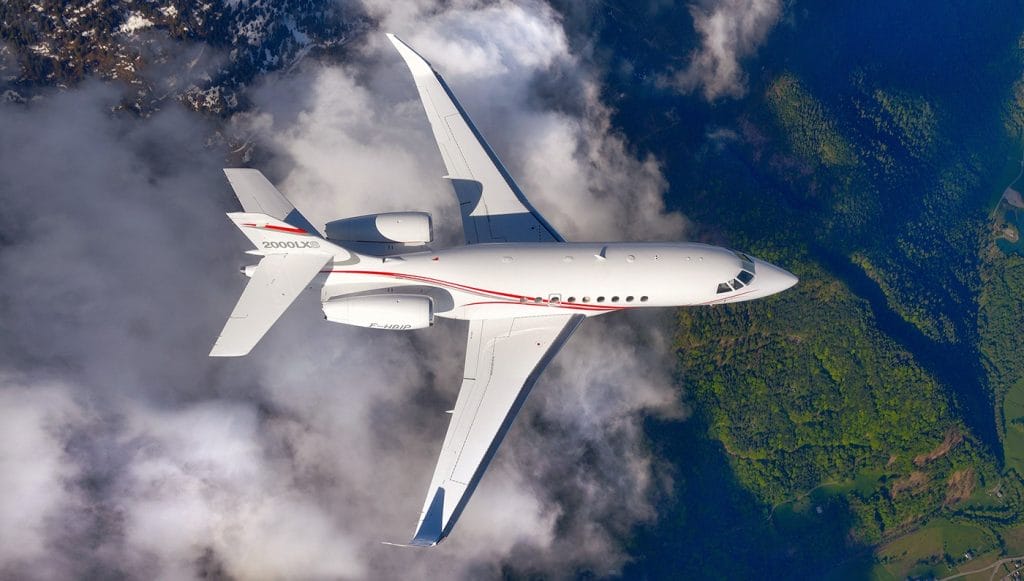
The Dassault Falcon 2000LXS is a super-midsize business jet with a widebody cabin, a range of 4,100 nautical miles, and short-field performance that reaches airports many comparable jets avoid. It carries up to 10 passengers and flies nonstop across the Atlantic. At maximum takeoff weight, the Falcon 2000LXS needs only 4,675 feet of runway.
The Falcon 2000LXS at a Glance
Dassault engineered the Falcon 2000LXS around one goal: transatlantic reach without heavy-jet runway demands. The result is a genuinely versatile aircraft, at home on business travel, family trips, and international missions. Its widebody cross-section gives passengers room to stand, move, and work, while twin engines keep operating economics disciplined.
Dassault introduced the 2000LXS at the 2012 NBAA convention and began deliveries in 2013, according to Dassault Aviation. The variant added more capable engines and full-length inboard leading-edge slats, sharpening both short-field performance and payload. For Private Clients, that pairing translates into access closer to the destination rather than a longer drive from a larger airport.
The mission profile is broad. The Falcon 2000LXS suits corporate travel, family trips with pets, group golf and ski getaways, and international routings without changing aircraft. As flying patterns shift, Private Clients move between On-Demand Charter and a Jet Card through the same relationship, so the aircraft grows with the need rather than forcing a compromise.
The Falcon 2000LXS range of 4,100 nautical miles is the number most Private Clients care about first. It connects city pairs such as New York and London, or Chicago and Rome, without a fuel stop. Normal cruise sits near Mach 0.80, with a maximum of 437 knots, roughly Mach 0.86, when the schedule is tight.
Altitude matters as much as speed. The Falcon 2000LXS climbs to 47,000 feet, above most commercial traffic and weather, which steadies the ride and shortens flight times. Two Pratt & Whitney Canada PW308C engines, each producing about 7,000 pounds of thrust, deliver that performance while holding fuel burn in check.
Short-field capability is where this aircraft separates itself. A takeoff distance of 4,675 feet at maximum weight opens runways that longer-legged jets simply cannot use, so you land nearer your final destination. That is real time saved on the ground, on both ends of the journey.
Inside the Falcon 2000LXS Cabin Interior
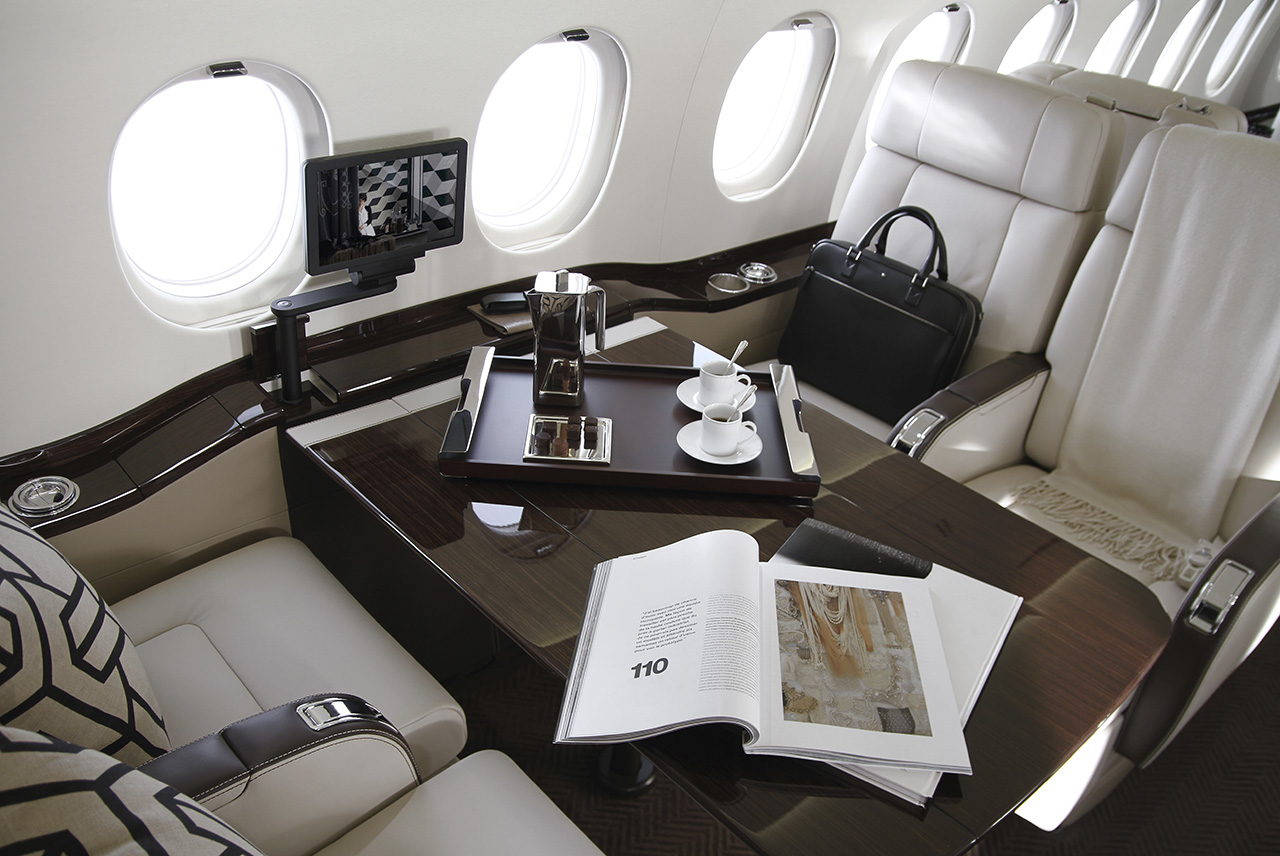
The Falcon 2000LXS interior is built on a true widebody cross-section, rare in this class. The cabin measures 26 feet 2 inches long, 7 feet 7 inches wide, and 6 feet 2 inches high, for 1,028 cubic feet of usable volume. Passengers stand upright and move freely on a flat floor.
Seating configurations carry up to 10 passengers, typically arranged in club groupings that convert for work, conversation, or rest. A pressurization differential of 9.3 psi keeps the cabin altitude low, so you arrive less fatigued after a long leg. Stay productive from wheels-up to touchdown, then step off ready for what follows.
Baggage capacity of 139 cubic feet handles luggage for a full cabin, including golf clubs and ski equipment. On board, a dedicated Client Experience team coordinates catering, ground transportation, and the details that make each journey personal.
Falcon 2000LXS Cockpit and Avionics
The Falcon 2000LXS cockpit is built around the EASy II flight deck, Dassault’s Honeywell Primus Epic-based avionics suite. It consolidates flight, navigation, and systems data into a clear, integrated display that reduces pilot workload and supports precise decision-making. An optional FalconEye Combined Vision System blends synthetic and enhanced imagery for sharper situational awareness in low visibility, as detailed by Dassault Falcon.
Advanced avionics are more than a feature list. They advance the value Magellan Jets leads with: safety. Every aircraft in the Magellan Jets Preferred Network is flown by highly vetted operators, and technology like EASy II supports the disciplined, safety-first operations our Private Clients expect.
Falcon 2000LX vs Falcon 2000LXS
The Falcon 2000LX and Falcon 2000LXS share the same widebody cabin and comparable long-range capability, which is why the two are often confused. The distinction is in performance at the margins. The LXS introduced enhanced Pratt & Whitney Canada PW308C engines and full-length inboard leading-edge slats.
Those slats improve low-speed handling, which shortens takeoff and landing distances and lifts payload flexibility. In practice, the LXS reaches more constrained airports and carries a fuller cabin over demanding legs. For Private Clients choosing between the two, the LXS is the more capable short-field performer.
Frequently Asked Questions About the Dassault Falcon 2000LXS (FAQs):
How Far Can the Falcon 2000LXS Fly Nonstop, and Can It Cross the Atlantic?
Yes. The Falcon 2000LXS has a range of 4,100 nautical miles, enough to fly nonstop across the Atlantic on routes such as New York to London. It comfortably covers transcontinental legs across the United States as well.
What Are the Falcon 2000LXS Specs, Cabin Dimensions, and Passenger Capacity?
The cabin measures 26 feet 2 inches long, 7 feet 7 inches wide, and 6 feet 2 inches high, with 1,028 cubic feet of volume and 139 cubic feet of baggage space. It seats up to 10 passengers. The aircraft cruises at up to 437 knots, climbs to 47,000 feet, and takes off in 4,675 feet at maximum weight.
What Is the Difference Between the Falcon 2000LX and Falcon 2000LXS?
The Falcon 2000LXS added enhanced Pratt & Whitney Canada PW308C engines and full-length inboard leading-edge slats. Those upgrades improve short-field performance and payload compared with the Falcon 2000LX, while the two share a similar cabin and long-range profile.
What Cockpit and Avionics Does the Falcon 2000LXS Use?
The Falcon 2000LXS uses the EASy II flight deck, a Honeywell Primus Epic-based avionics suite. An optional FalconEye Combined Vision System adds blended synthetic and enhanced vision for greater situational awareness in low visibility.
How Much Does It Cost to Charter a Falcon 2000LXS?
Charter estimates for super-midsize aircraft generally run about $10,000 per hour for domestic flying, rising toward roughly $12,700 per hour on international trips. Treat these as estimates only. The rate is inclusive of fuel; it does not include contingencies such as de-icing, positioning, overnight fees, catering, ground transportation, or international fees. Your exact price depends on route, schedule, aircraft, and availability, and a Private Aviation Advisor confirms it at time of quote. You can fly the aircraft through On-Demand Charter or a Jet Card.
Experience the Falcon 2000LXS With Magellan Jets
The Falcon 2000LXS earns its place for a specific traveler: someone who needs transatlantic range, a widebody cabin, and the freedom to use runways a heavy jet cannot. If that describes your next journey, Magellan Jets sources the right Dassault Falcon 2000 for the mission. Magellan Jets coordinates travel with highly vetted, FAA-approved operators and does not own or operate aircraft. Talk to a Private Aviation Advisor to plan your next journey aboard the Falcon 2000LXS.
Magellan Jets does not own or operate aircraft. It coordinates every journey through the Magellan Jets Preferred Network of highly vetted operators, using FAA Part 135, the regulation governing on-demand charter operations, and FAA Part 91K, which governs fractional ownership. That asset-light model means every recommendation is made in your best interest, not to fill a fleet.
Two of the most-requested private jets sit just one cabin class apart. The Phenom 300 vs. Citation Excel decision comes down to a single question: which aircraft matches the mission in front of you. One is a light jet that out-ranges its class, and the other is a midsize jet built for more people and more room. This guide reads the validated numbers so you can choose with confidence.
Two Jets, Two Missions: How the Phenom 300 and Citation Excel Differ
The Phenom 300 is a light jet, and the Citation Excel/XLS is a midsize jet. That single class difference shapes range, cabin size, passenger capacity, cruise speed, and hourly cost. A light jet is built for efficient regional and coast-to-coast trips with a compact cabin.
A midsize jet gives up a little airport access in exchange for more room and more seats. Neither aircraft is better in the abstract. The right answer depends on the mission you fly most often.
Phenom 300 vs. Citation Excel: Specifications Side by Side
The table below sets the two jets against each other on the numbers Private Clients ask about most, drawn from Magellan Jets Aircraft Specifications.
Charter rates are estimates inclusive of fuel and exclude contingencies such as de-icing, positioning, overnight fees, catering, and ground transportation, with final pricing confirmed at time of quote.
Range and Runway: Where the Phenom 300 Punches Above Its Class
Here the lighter aircraft surprises people. The Phenom 300 flies up to 2,019 nm, farther than the Citation Excel/XLS at 1,989 nm. For an East Coast Private Client, that range reaches most transcontinental city pairs nonstop.
The Phenom 300 also needs less runway. Its FAA takeoff field length is 2,220 ft, against 2,739 ft for the Citation Excel/XLS (Magellan Jets Aircraft Specifications). Shorter field performance opens airports closer to your destination, such as Teterboro Airport (KTEB) outside New York or Hanscom Field (KBED) near Boston.
The Phenom 300 series is the world’s best-selling light jet for the 14th consecutive year. That ranking is based on 2025 delivery data. The record translates into broad availability and a deep operator base across charter fleets.
Cabin, Capacity, and Comfort: The Citation Excel’s Advantage
The Citation Excel/XLS answers with space. Its cabin stands 5 ft 7 in tall, against 4 ft 9 in in the Phenom 300 (Magellan Jets Aircraft Specifications). That taller ceiling lets most passengers stand and move freely.
Cabin volume tells the same story: 422 cu ft in the Citation Excel/XLS versus 324 cu ft in the Phenom 300. The midsize jet seats up to eight passengers, two more than the Phenom’s six. It carries 90 cu ft of baggage against 85 cu ft.
Even so, the Phenom 300 holds the largest baggage capacity in the light-jet class. The Citation Excel/XLS belongs to the Cessna Citation line, the world’s most-delivered series of business jets, prized for reliability and short-field performance. For a Private Client flying with family or a full team, that room earns its keep.
Speed and Ceiling: Reading the Real Numbers
Speed favors the midsize jet. The Citation Excel/XLS holds a normal cruise of 433 kn, faster than the Phenom 300 at 383 kn. On a long transcontinental leg, that 50 kn edge trims time from the schedule.
Both jets share the same service ceiling of 45,000 ft. Flying that high lets crews climb above most weather and commercial traffic. That supports smoother, more direct routing on either aircraft.
What It Costs to Charter Each Jet
Light jet charter for the Phenom 300 starts from an estimated $7,544 per hour. Midsize jet charter for the Citation Excel/XLS starts from an estimated $8,550 per hour. Each rate is inclusive of fuel.
These estimates exclude contingencies such as de-icing, positioning, overnight fees, catering, and ground transportation, with final pricing confirmed at time of quote. The higher midsize rate reflects the larger cabin, greater capacity, and faster cruise. Whether that premium is worth it depends on your passenger count and route.
The Detail Most Comparisons Miss: You Don’t Have to Choose
The Phenom 300 vs. Citation Excel comparison usually ends with “it depends on your trip.” The more useful insight is that you do not have to fly the same jet every time. Magellan Jets is an asset-light private aviation solutions provider offering Jet Cards, On-Demand Charter, Fractional Ownership, and Aircraft Sales & Management.
Because it owns no fleet, Magellan Jets sources each mission from the Magellan Jets Preferred Network of fewer than 100 vetted operators. Every recommendation serves the Private Client’s interest.
The Premium Jet Card gives a Private Client a dedicated Phenom 300. Its callout window, the minimum notice before a flight, runs as low as 24 hours, with de-icing and catering included.
The Jet Card program also offers the Category Jet Card. It lets a Private Client interchange across Light, Midsize, Super-Mid, and Heavy jets as the mission changes.
Safety underwrites every option. Magellan Jets holds WYVERN Wingman certification, a third-party aviation safety designation, and sits on the Air Charter Safety Foundation (ACSF) Board. Its operators carry $100 million to $300 million in liability insurance, and its captains average 9,700+ flight hours.
The Phenom 300 and Citation Excel/XLS are not rivals so much as two answers to two missions. Choose the Phenom 300 when range and airport access lead. Choose the Citation Excel/XLS when cabin room, capacity, and speed matter most.
The sharper decision is often the program, not the airframe, since the right provider puts either jet within reach. To fly the right one on any given day, Contact a Private Aviation Advisor.
Frequently Asked Questions About the Phenom 300 vs. Citation Excel
Which jet has more range, the Phenom 300 or the Citation Excel?
The Phenom 300 flies up to 2,019 nm, slightly farther than the Citation Excel/XLS at 1,989 nm (Magellan Jets Aircraft Specifications). For most regional and transcontinental trips, both aircraft cover the distance nonstop.
Which cabin is larger?
The Citation Excel/XLS has the larger cabin. It offers 422 cu ft of volume and stands 5 ft 7 in tall (Magellan Jets Aircraft Specifications). The Phenom 300 offers 324 cu ft and stands 4 ft 9 in. The Citation Excel/XLS also seats up to eight passengers rather than six.
Is the Phenom 300 or the Citation Excel faster?
The Citation Excel/XLS cruises faster, at a normal cruise of 433 kn compared with 383 kn for the Phenom 300 (Magellan Jets Aircraft Specifications). Both jets share a service ceiling of 45,000 ft.
Which jet can use smaller airports?
The Phenom 300 can access more small airports. It needs an FAA takeoff field length of 2,220 ft, shorter than the 2,739 ft the Citation Excel/XLS requires (Magellan Jets Aircraft Specifications). That opens more runways close to your destination.
How much does it cost to charter each jet?
Light jet charter for the Phenom 300 starts from an estimated $7,544 per hour. Midsize jet charter for the Citation Excel/XLS starts from an estimated $8,550 per hour, inclusive of fuel. Both estimates exclude contingencies such as de-icing, positioning, and catering, with final pricing confirmed at time of quote.
Private aviation spans seven distinct aircraft categories, each suited to different journey profiles. Turboprops excel on short hops and unpaved runways. Very light and light jets handle regional travel with speed and efficiency. Midsize jets introduce stand-up cabins for coast-to-coast comfort. Super-midsize jets stretch transcontinental range further. Heavy jets cross oceans with room for full work or rest. Ultra-long-range jets fly nonstop between continents. VIP airliners turn the sky into a mobile boardroom – or private residence.
Understanding these categories helps you match the aircraft to your mission – whether it’s a 90-minute hop to the islands or a 14-hour crossing to Asia. This guide covers capacity, range, representative aircraft, and estimated hourly rates for each tier.
Turboprops: Versatile Access to Remote Destinations
Turboprop aircraft open doors other jets cannot reach. Their ability to operate on short runways – including grass and gravel strips – makes them ideal for island retreats, mountain resorts, and rural airfields. For Clients traveling to destinations like Nantucket, Aspen’s nearby fields, or Caribbean outposts, a turboprop often offers the most direct routing.
Turboprops seat approximately six to nine passengers in comfort. Range varies by model, but most regional missions fall within two hours of flight time. Representative aircraft in the Magellan Jets On-Demand Charter network include the Pilatus PC-12, King Air 350, and King Air B200.
Estimated hourly charter rates start from about $5,500 per hour. This is an estimated hourly rate inclusive of fuel. It does not include contingencies such as de-icing, positioning, overnight fees, or other trip-specific costs. Final pricing is confirmed at time of quote.
Very Light and Light Jets: Speed for Regional Travel
Light jets deliver jet speed without the footprint of larger aircraft. Climbing quickly to altitudes above commercial traffic, they reach cruising altitude in minutes – ideal for a morning departure that puts you in a meeting two states away before lunch.
Very light jets like the Phenom 100 carry up to five passengers with a range of roughly 1,071 nm (about two hours). Light jets such as the Phenom 300, Learjet 75, and Citation CJ series seat approximately six passengers and extend range to around 1,900–2,019 nm (roughly three hours nonstop). Ceilings reach 41,000 to 45,000 feet, placing you above most weather.
Estimated hourly rates run about $7,500–$8,500. This is an estimated hourly rate inclusive of fuel. It does not include contingencies such as de-icing, positioning, overnight fees, or other trip-specific costs. Final pricing is confirmed at time of quote.
Midsize Jets: Stand-Up Comfort Coast to Coast
The midsize category marks a turning point in cabin experience. Full stand-up headroom, enclosed lavatories, and dedicated luggage space mean arriving refreshed rather than cramped. Business travelers find room to work; families appreciate the extra space for children to move.
Midsize jets seat roughly seven to nine passengers. Ranges span from approximately 2,000 nm to over 3,400 nm – enough for transcontinental U.S. flights of four to six hours nonstop. Models available through the Magellan Jets network include the Citation Latitude (9 passengers, 2,700 nm), Citation XLS (8 passengers, ~2,000 nm), Praetor 500 (9 passengers, 3,412 nm), and Citation Sovereign (8 passengers, ~3,000 nm).
Estimated hourly rates fall between about $8,000 and $9,600. This is an estimated hourly rate inclusive of fuel. It does not include contingencies such as de-icing, positioning, overnight fees, or other trip-specific costs. Final pricing is confirmed at time of quote.
Super-Midsize Jets: Transcontinental Range, Refined Space
Super-midsize jets blend the cabin comfort of a heavy jet with the efficiency of a midsize. Flat floors, wider seats, and enhanced galley service suit travelers who need to host meetings, dine properly, or simply stretch out on longer missions.
Seating ranges from eight to 10 passengers. Transcontinental range reaches approximately 3,269–4,040 nm (roughly five to seven hours nonstop). Notable models include the Challenger 350 (9 passengers, 3,269 nm), Gulfstream G280 (10 passengers, 3,700 nm), Praetor 600 (8 passengers, 4,040 nm), and Citation Longitude.
Estimated hourly rates range from about $9,000 to $10,500. This is an estimated hourly rate inclusive of fuel. It does not include contingencies such as de-icing, positioning, overnight fees, or other trip-specific costs. Final pricing is confirmed at time of quote.
Heavy Jets: Intercontinental Capability and Full Cabin Amenities
Heavy jets bring the cabin space to work, rest, and dine as you would on the ground. Multiple seating zones allow some passengers to sleep while others conduct calls. Large baggage holds accommodate golf clubs, ski equipment, or luggage for extended trips abroad.
Capacity runs from 10 to 14 passengers. Ranges of 4,044–6,415 nm cover intercontinental routes – New York to London, Los Angeles to Hawaii – in a single leg of eight to 12 hours. Aircraft available through the Magellan Jets Jet Card and charter programs include the Challenger 650 (12 passengers, 4,044 nm), Gulfstream G450 (13 passengers, 4,425 nm), Falcon 8X (14 passengers, 6,415 nm), and Legacy 650.
Estimated hourly rates fall between approximately $11,600 and $15,200. This is an estimated hourly rate inclusive of fuel. It does not include contingencies such as de-icing, positioning, overnight fees, or other trip-specific costs. Final pricing is confirmed at time of quote.
Ultra-Long-Range Jets: Nonstop to Anywhere
When the destination is Singapore, Dubai, or Sydney, ultra-long-range jets eliminate the detour of a fuel stop. These aircraft sustain crews and Clients for 14 hours or more with sleeping quarters, full galleys, and cabin pressure optimized for reduced fatigue.
Capacity spans 14 to 19 passengers, with dedicated rest areas and often a private stateroom. Ranges extend from 6,954 nm to 8,070 nm – roughly 13 to 16 hours of nonstop flight. Ceilings reach up to 51,000 feet, and maximum cruise speeds hit 528 knots. Aircraft in this tier include the Gulfstream G650ER (16 passengers, 7,437 nm), Bombardier Global 7500 (17 passengers, 7,800 nm), Global 8000 (19 passengers, 8,070 nm), and Gulfstream G550 (18 passengers, 6,954 nm).
For guidance on chartering ultra-long-range aircraft, speak directly with a Private Aviation Advisor who can confirm availability, routing, and pricing for your specific mission.
VIP Airliners: The Ultimate in Airborne Privacy
VIP airliners convert widebody commercial aircraft into private residences. Multiple rooms – including conference areas, bedrooms, and full-size showers – allow heads of state, corporate delegations, and families traveling with staff to operate independently during flight.
Configured for up to 19 passengers in ultra-luxury layouts, VIP airliners carry ranges from 3,965 nm to 6,750 nm depending on the aircraft and configuration. Models include the Airbus ACJ319neo (19 passengers, 6,750 nm), Boeing BBJ MAX (19 passengers), and Embraer Lineage 1000E (19 passengers, 3,965 nm).
Pricing for VIP airliners varies widely by aircraft, crew requirements, and routing. A Private Aviation Advisor can provide a tailored quote.
Private Jet Category Comparison
Rates are estimates inclusive of fuel and do not include contingencies such as de-icing, positioning, overnight fees, or other trip-specific costs. Final pricing is confirmed at time of quote.
Explore the Magellan Jets Category Jet Card
The right category shifts with every trip. A Light jet suits a quick regional hop, while a Heavy jet carries the full team coast to coast. The Magellan Jets Category Jet Card gives Private Clients the freedom to fly across Light, Midsize, Super-Midsize, and Heavy aircraft, interchanging freely as group size, route, and mission change. This is the guide in practice: the right category for every journey, without owning an aircraft.
Rates stay fixed and transparent, matching the Premium Jet Card’s hourly pricing with no hidden fees and no peak-day surcharges. De-icing and catering are available as add-ons, advanced booking runs as low as 40 days, and standard call-out times are 48 hours. The Premium Jet Card instead locks you to a dedicated aircraft type, such as the Phenom 300, Challenger 350, or Gulfstream G450, with de-icing and catering included and call-out as low as 24 hours.
Every Jet Card includes guaranteed access to the Magellan Jets Preferred Network of fewer than 100 vetted operators, 24/7/365 availability, no blackout dates, fuel price protection, surcharge-free interchange, and WYVERN Wingman-certified safety standards. Cards scale by committed hours, and deeper commitments unlock better rates, Advantage Routes, and short-leg waivers:
25 hours: rates starting around $7,800/hr, with a 12-month rate lock.
50 hours: rates starting around $7,250/hr, with an 18-month lock, Advantage Route pricing, and short-leg waivers.
100 hours: rates starting around $7,000/hr, with a 24-month lock.
Frequently Asked Questions About Types of Private Jets (FAQs):
How much does a two-hour private jet flight cost?
A two-hour charter cost depends on the aircraft category and routing. Light jets, well-suited to flights of this length, run approximately $7,800–$8,500 per hour – placing a two-hour flight in the range of $15,000–$17,000 before contingencies. Midsize jets cost slightly more but offer stand-up cabins for added comfort. These are estimated hourly rates inclusive of fuel; actual pricing varies by aircraft availability, routing, repositioning, taxes, and fees. A Private Aviation Advisor confirms the exact quote for your specific trip.
How many passengers does each private jet size hold?
Capacity rises with aircraft category. Very light and light jets seat four to six passengers. Midsize jets accommodate seven to nine. Super-midsize jets hold eight to 10. Heavy jets carry 10 to 14 passengers. Ultra-long-range jets and VIP airliners seat 14 to 19 in spacious configurations that include sleeping quarters and separate work areas.
What is the difference between a light jet and a midsize jet?
Light jets prioritize efficiency on shorter routes of one to three hours, seating up to six passengers with ranges around 1,900–2,019 nm. Midsize jets add stand-up headroom, enclosed lavatories, and larger luggage holds, seating seven to nine passengers with ranges up to 3,412 nm. Choose a light jet for quick regional hops; choose a midsize jet when cabin comfort and transcontinental range matter.
Which private jets have the longest range?
Ultra-long-range jets fly the farthest. The Bombardier Global 8000 reaches 8,070 nm – enough to connect New York to Hong Kong nonstop. The Global 7500 covers 7,800 nm, and the Gulfstream G650ER reaches 7,437 nm. These aircraft are designed for 13- to 16-hour flights with onboard rest facilities, reduced cabin altitude, and full meal service.
How do I choose the right private jet for my trip?
Start with three questions: How many passengers are traveling? How far is the destination? What cabin amenities do you need? A two-hour regional flight with four passengers suits a light jet. A six-hour transcontinental trip with eight passengers calls for a super-midsize. A nonstop transatlantic crossing requires a heavy or ultra-long-range jet. Your Private Aviation Advisor matches the aircraft to your mission, budget, and preferences – ensuring you pay for exactly the capability you need.
The U.S. Open is the loudest, most electric fortnight in tennis, and the way you arrive sets the tone for everything that follows. To fly private to the U.S. Open, you charter a jet into one of the general aviation airports serving New York City, then transfer by car or helicopter to the USTA Billie Jean King National Tennis Center in Flushing Meadows, Queens. Teterboro, Westchester County, and Republic Airport are the three private-jet gateways closest to Arthur Ashe Stadium. The rest of this guide covers the 2026 schedule, the airports, the right aircraft, the cost, and how far ahead to reserve.
Private travel turns a demanding day into part of the occasion. You set the schedule, arrive minutes before your car, and land close enough to reach your seats without the airport crush that defines late-August travel into New York. The match becomes the only thing you have to think about.
The 2026 U.S. Open: What To Know
This is the last Grand Slam of the season, the one where a New York summer peaks under the lights of Arthur Ashe Stadium. The 2026 tournament is the 146th edition, and at 22 days it is the longest in the event’s history. The energy of Flushing Meadows in early September is unlike anything else on the tennis calendar.
The U.S. Open runs August 23 through September 13, 2026, at the USTA Billie Jean King National Tennis Center in Flushing Meadows-Corona Park, Queens. Fan Week opens the gates August 23 through 29, with qualifying matches, the reimagined Mixed Doubles Championship, and Arthur Ashe Kids’ Day. Singles main-draw play begins Sunday, August 30, now in its second year of the 15-day format.
The finals close the fortnight in prime time. The women’s singles final is set for September 12 and the men’s singles final for September 13. Carlos Alcaraz returns as the defending men’s champion, and Aryna Sabalenka defends the women’s title she held in 2024 and 2025.
Timing shapes the experience as much as the tennis. The first week belongs to day-session crowds and the outer courts, where you can watch rising talent up close. The second week narrows to headline night matches under the roof, and demand for both seats and aircraft climbs accordingly.
Arthur Ashe Stadium remains the largest tennis stadium in the world, seating 23,771 under a retractable roof. 2026 marks the first phase of a roughly $800M transformation of the venue, adding about 2,000 courtside seats. If courtside is the goal, the earlier you plan the whole trip, the better your seat and your flight.
Best Airports For Private Jets Near Flushing Meadows
One of the quiet luxuries of private aviation is choice. Commercial travelers funnel through two crowded hubs, while you can select from several dedicated general aviation airports that ring New York City. Each offers a different balance of drive time and calm on the ground, and the right one depends on where your seats are and where you begin.
Teterboro (KTEB)
Teterboro in New Jersey is the premier general aviation airport for New York City, and the one most private flyers choose. It sits roughly 45 to 60 minutes from Flushing Meadows by car, depending on traffic. A helicopter transfer trims that to about 12 minutes and skips the bridges entirely.
Westchester County (KHPN)
Westchester County Airport lies about 45 minutes north of the tennis center and tends to be less congested than the New Jersey gateways. It is a comfortable choice for Clients arriving from Connecticut, Boston, or the northern suburbs. The calmer ramp makes for an easy start and an easier return.
Republic (KFRG)
Republic Airport in Farmingdale, Long Island, is the closest general aviation option east of Queens, roughly 35 to 45 minutes from Arthur Ashe Stadium. For anyone weighing the closest airport to Flushing Meadows, Republic is the strongest answer among dedicated private-jet fields. It is especially convenient for Clients staying out on Long Island.
LaGuardia And JFK
LaGuardia sits closest of all, about 10 to 15 minutes from the courts, yet strict slot rules and limited private handling make it impractical for most private lift. JFK accepts private jets but gives priority to commercial traffic and carries slot restrictions of its own. In practice, Teterboro, Westchester, and Republic serve U.S. Open travelers far better than either commercial hub.
Ground Transfers From The Tarmac To Arthur Ashe
The last few miles matter as much as the flight. Your Private Aviation Advisor and Client Experience team arrange ground transportation before you land, so a car is waiting at the aircraft steps when you arrive. Nothing about match day is left to chance.
From Teterboro, a chauffeured car reaches Flushing Meadows in about 45 to 60 minutes, and a helicopter transfer covers it in roughly 12 minutes above the traffic. From Westchester or Republic, expect a 35- to 45-minute drive. Every detail, from catering to the return pickup, is coordinated around your schedule rather than the airport’s.
The helicopter option is worth weighing for the final weekend, when bridge and tunnel traffic peaks. Lifting off from the ramp at Teterboro and setting down near the tennis center keeps the day unhurried, and your Client Experience team can hold the return leg until the last point is played.
Choosing The Right Aircraft For Your U.S. Open Journey
The right aircraft depends on where you start, how many are traveling, and what you are bringing. A weekend for two from Boston calls for something different than a transatlantic party of 10 for the men’s final. Matching the cabin to the mission is where a Private Aviation Advisor earns their keep.
For short hops from Boston or Washington, a Light Jet such as the Phenom 300 carries up to six passengers nonstop along the Eastern Seaboard, with room for golf clubs or a dog.
Midsize jets add cabin room and range. The Citation Latitude and Longitude seat seven to nine passengers with a flat floor, and the Citation XLS is a favorite for its baggage capacity. For a closer look at this class, our review of the Citation Sovereign walks through the midsize experience in detail.
Super-Midsize jets like the Challenger 350 and Praetor 600 handle coast-to-coast routes with ease, ideal for Clients flying in from California. Heavy Jets such as the Challenger 650 carry up to 10 passengers in a stand-up cabin, while the Gulfstream G550 and Gulfstream G650 fly London to New York nonstop for international guests. For the largest parties, airliner conversions such as the ACJ and BBJ extend that capacity further.
What It Costs To Fly Private To The U.S. Open
Pricing in private aviation is a function of aircraft category, flight time, and the specifics of your itinerary. Because New York sits in the Northeast market, the estimates below reflect that region’s hourly rates by category. They are a starting point for the conversation, not a firm quote.
Estimated hourly rates (Sell/Hr) for the Northeast, inclusive of fuel:
Light Jet: from an estimated $7,425/hr
Mid Jet: from an estimated $8,924/hr
Super-Midsize: from an estimated $9,366/hr
Heavy Jet: from an estimated $13,390/hr
Turboprop: from an estimated $5,338/hr
These are estimated hourly rates, inclusive of fuel. They exclude contingencies such as de-icing, positioning, overnight fees, catering, and ground transportation. Final pricing is confirmed at the time of quote. For a precise figure built around your route and dates, request a quote below.
Booking Timeline: How Far Ahead To Reserve
The U.S. Open draws private traffic from across the country and abroad, which tightens aircraft and airport availability across the fortnight. Reserving early is how you secure both the aircraft you want and the airport closest to your seats. Think of it as claiming the best view before the crowd arrives.
For most match days, four to eight weeks of lead time is comfortable. Two stretches draw the heaviest demand: the middle weekend around Labor Day on Monday, September 7, when the round of 16 fills the grounds, and the final week, which overlaps New York Fashion Week. For either, plan several months ahead. The earlier you engage your Private Aviation Advisor, the more options stay open.
The Magellan Jets Advantage
Magellan Jets is an asset-light private aviation solutions provider, which means it does not own or operate aircraft. It sources the right aircraft for each journey from the Magellan Jets Preferred Network, fewer than 100 rigorously vetted operators out of roughly 3,000 licensed in the U.S. Every recommendation is made in your interest, not to fill a fleet.
For an event this busy, that model has a concrete payoff. Jet Card Clients receive guaranteed availability with no blackout dates and no peak-day surcharges, even during the U.S. Open, Thanksgiving, and every summer Friday. When a journey falls outside a Jet Card’s profile, On-Demand Charter covers it through the same relationship.
The continuity matters too. A Client who charters for the U.S. Open one year and flies more often the next can move into a Jet Card through the same relationship, without starting over with a new provider. Your Private Aviation Advisor stays constant as your travel evolves.
Safety leads every decision. Magellan Jets is the sole private jet solutions provider represented on the Air Charter Safety Foundation (ACSF) Board, holds WYVERN Wingman Broker Certification, and works only with operators carrying $100M to $300M in liability insurance. You can review the full private jet safety program before you fly.
Frequently Asked Questions About Flying Private To The U.S. Open (FAQs):
What Is The Closest Airport To Arthur Ashe Stadium And Flushing Meadows?
LaGuardia is geographically closest, about 10 to 15 minutes away, but its slot rules and limited private handling make it impractical for private jets. Among dedicated general aviation airports, Republic Airport in Farmingdale is the closest at roughly 35 to 45 minutes, followed by Westchester County and Teterboro. Most private flyers choose Teterboro, Westchester, or Republic.
Can You Fly Private Into JFK Or LaGuardia For The U.S. Open?
Yes, both accept private jets, but neither is ideal. LaGuardia enforces strict slot rules and offers limited private handling, and JFK prioritizes commercial traffic with slot restrictions of its own. Teterboro, Westchester County, and Republic are more convenient, calmer gateways for the tournament.
How Far In Advance Should You Book A Private Jet To The U.S. Open?
For most match days, four to eight weeks of lead time is comfortable. For the finals weekend, which overlaps Labor Day and New York Fashion Week, reserve several months ahead. Booking early protects both your aircraft choice and access to the airport closest to your seats.
Which Airports Can Private Jets Use That Commercial Flights Cannot?
Private jets can operate from dedicated general aviation airports that scheduled airlines do not serve, including Teterboro in New Jersey and Republic in Farmingdale. These fields offer private terminals, faster ground handling, and closer parking to your waiting car. That access is a core reason to fly private to the U.S. Open rather than connect through a commercial hub.
Can The Return Flight Flex If A Match Runs Late?
Yes. A private itinerary is built around you, so a five-set thriller does not mean missing your flight. Your Private Aviation Advisor can adjust the departure time, and your Client Experience team keeps ground transportation in step with the change.
How Much Does It Cost To Fly Private To The U.S. Open?
Cost depends on aircraft category, flight time, and your itinerary. For the Northeast, estimated hourly rates start from about $7,425/hr for a Light Jet, $8,924/hr for a Mid Jet, $9,366/hr for a Super-Midsize, and $13,390/hr for a Heavy Jet, inclusive of fuel. These estimates exclude contingencies such as de-icing, positioning, and catering, and final pricing is confirmed at the time of quote.
Your Seat Is Waiting
The best U.S. Open memories start before the first serve, in the quiet of a cabin that leaves when you do and lands where the crowds do not. Choose your airport, your aircraft, and your schedule, and let the tournament come to you.
Flying private to Bandon Dunes means landing at Southwest Oregon Regional Airport (KOTH) in North Bend, Oregon, the closest airport to the resort. From the ramp, the drive to the first tee runs about 25 to 35 minutes. OTH is the only airport on the Oregon Coast with commercial service, and its runway comfortably handles the light, midsize, and super-midsize jets Private Clients favor for this journey. Eugene (KEUG) is a fallback, but it sits roughly a 2.5-hour drive away.
Why Flying Private to Bandon Dunes is the Easiest Way
Part of what makes Bandon Dunes Golf Resort feel like a place apart is how far it sits from everything else. The resort opened in 1999 on Oregon’s southern coast, the vision of owner Mike Keiser, and its isolation is the point. There are no crowds spilling in from a nearby city. The dunes, the wind, and the Pacific set the mood the moment you arrive.
That same remoteness is what makes access worth planning with care. Commercial routings into the region are limited, and the connections are long. A private journey compresses the trip to a single, unhurried leg, so you trade a full travel day for a short hop and a scenic drive.
What waits on the ground is a rota of five walking-only links courses, each played with a caddie. Bandon Dunes, Pacific Dunes, Bandon Trails, and Old Macdonald anchor the property. Sheep Ranch, the newest, opened in 2020 from Bill Coore and Ben Crenshaw, its cliff-top holes tracing the ocean’s edge. Between rounds, the par-3 Bandon Preserve, the Punchbowl putting course, and Shorty’s fill the hours that daylight allows.
The rhythm of a stay here is unlike resort golf almost anywhere else. Players walk every hole, always with a caddie, so the game slows to the pace it was built to keep. Days settle into golf, shared meals, and the quiet of a property designed for exactly that. That kind of immersion arrives more easily when the travel behind it collapses into a single flight.
The Closest Airport to Bandon Dunes: Southwest Oregon Regional Airport (KOTH)
Anticipation builds in the final minutes of any great golf trip, and here it arrives fast. When you are flying to Bandon Dunes, Southwest Oregon Regional Airport (KOTH) in North Bend puts you closer to the first tee than any other option. The drive south to the resort takes about 25 to 35 minutes along the coast.
Knowing how to get to Bandon Dunes starts with understanding the airports near Bandon Dunes. KOTH is the practical answer for a private jet to Bandon Dunes. Its longest runway measures roughly 5,980 feet, which comfortably accommodates the light, midsize, and super-midsize jets used for these trips. As the only Oregon Coast airport with commercial service, it is built to receive arriving travelers rather than route them onward.
Eugene (KEUG) remains an alternative for aircraft or schedules that call for it, though it adds about a 2.5-hour drive each way. For West Coast travelers, the math is compelling. Seattle to Bandon Dunes is roughly a 90-minute hop by private jet, and a super-midsize aircraft can reach KOTH nonstop from the East Coast. Your Private Aviation Advisor weighs runway, range, and drive time before recommending where you land.
Arrival at KOTH is refreshingly simple. Private travelers are met planeside, bags move straight to the waiting car, and there are no terminals to cross. Within minutes you are heading south on Highway 101, the Pacific on one side and the resort ahead. It is the kind of arrival that sets the tone for the days that follow.
Which Private Jets Suit the Trip to Bandon Dunes
The right aircraft is the one that matches your foursome, your clubs, and where you are starting from. KOTH’s runway handles the full range of jets these trips call for, so the choice comes down to comfort and origin rather than limits on the ground.
For West Coast regional legs, the Embraer Phenom 300 is a natural fit. This light jet offers generous baggage space, a taller cabin, and seating for up to six, which suits a compact golf group traveling light on hours. For a step up in cabin and cargo room, the Cessna Citation XLS earns its place. This midsize jet delivers outstanding short-runway performance and exceptional baggage capacity, an ideal pairing for golf travel into OTH.
When the journey runs coast to coast, the Bombardier Challenger 350 and its predecessor, the Challenger 300, make the strongest case. Their wide, flat-floor cabins carry clubs and luggage with ease, and their range supports a nonstop East Coast-to-OTH leg. Your advisor matches the aircraft to group size, luggage, and departure city, then confirms that your chosen jet operates comfortably from the runway at North Bend.
Golf travel has its own packing math, and cabin choice follows from it. A foursome with full bags and hard cases is comfortable in a midsize cabin. A larger party, or one connecting from across the country, benefits from the room a super-midsize jet provides. The goal is fit, not excess, and an advisor who flies these routes knows the difference.
Journey to Bandon Dunes: A Fully Curated Golf Experience
A great golf trip should feel considered from the first phone call. The Journey to Bandon Dunes is a curated Magellan Jets Journey built around exactly that. Your foursome arrives rested, on schedule, and ready for the opening round.
Your Private Aviation Advisor arranges the private flight into KOTH, with catering set to your preferences for the leg out. A car waits planeside for the short drive south to the resort. Tee-time logistics and ground transfers are coordinated by your Client Experience team before you leave home.
Nothing here is a fixed package. The itinerary is arranged around your foursome, your dates, and the round you came to play. You confirm the schedule, and the logistics follow. When you are ready to map the details, begin with the Journey to Bandon Dunes.
Inside the Magellan Jets Journeys Program
Every Journey to Bandon Dunes draws on the wider approach behind Magellan Jets Journeys. This is curated travel designed around the Client, not a booking pushed through a portal. The same care applies whether the destination is a links course or a boardroom.
As an asset-light private aviation solutions provider, Magellan Jets does not own or operate aircraft. Instead, your Private Aviation Advisor sources the right jet from the Magellan Jets Preferred Network. That is an exclusive group of fewer than 100 rigorously vetted operators, all approved to fly under FAA Part 135 or Part 91K authority. That structure means every recommendation serves your journey, not a fleet-utilization target.
Safety sits at the center of that sourcing. Magellan Jets holds WYVERN Wingman Broker Certification and works only with operators carrying $100M to $300M in liability insurance. It is the sole private jet solutions provider represented on the Air Charter Safety Foundation (ACSF) Board. For a journey into a coastal runway like OTH, that vetting is the reason you can put your attention on the round instead of the flight.
The care shows in the numbers as much as the language. Magellan Jets maintains a 4.9-out-of-5 Client satisfaction rating and a 90% trip perfection score across Private Clients flown to more than 100 countries. Those results come from a model in which your advisor answers to your journey, not to a fleet.
The Magellan Jets relationship extends well beyond a single trip. A dedicated Client Experience team supports every journey, and it does not end at the ramp. Travelers who begin flying more often can move from On-Demand Charter to a Jet Card without changing partners. The Advisor who plans one Bandon Dunes Journey can plan the next season’s.
Planning Your Visit: Seasons and the Links Character
Bandon Dunes belongs to golfers who understand that weather is part of the game, not an interruption to it. The resort plays true to Scotland’s ancient links, and coastal wind and fog are woven into that character year-round. That is what keeps the courses honest, and what draws players back.
Summer, roughly June through September, offers the most stable weather and the longest playing days. It is the window most Private Clients favor, which makes early planning worthwhile. Shoulder seasons invite a quieter property and firmer turf, with a higher chance of squalls rolling off the Pacific.
Because demand concentrates in those summer months, aircraft availability tightens alongside tee times. Booking ahead through On-Demand Charter or a Jet Card keeps your preferred aircraft and window within reach. Your advisor holds both open as you finalize dates.
Tee times at the resort are released well ahead of the season, and the most sought-after mornings go quickly. Aligning your flight to those times is straightforward when the aircraft is reserved in parallel. Bring your Private Aviation Advisor into the plan as soon as the dates firm up, and the two calendars move together rather than in competition.
What It Costs to Charter a Private Jet to Bandon Dunes
Cost clarity lets you plan the trip you actually want, so it is worth grounding expectations early. Bandon Dunes sits in the West Coast region, and the estimates below reflect Magellan Jets’ own hourly rates for that region by aircraft category. They are starting points, not firm quotes.
Turboprop: estimated, from $7,525/hr
Light jet: estimated, from $7,955/hr
Midsize jet: estimated, from $9,557/hr
Super-midsize jet: estimated, from $9,844/hr
Heavy jet: estimated, from $11,551/hr
These are estimated hourly rates, inclusive of fuel, and they vary with aircraft availability, routing, repositioning, taxes, and other trip-specific factors such as de-icing and overnight fees. Your Private Aviation Advisor confirms an exact quote at the time of booking.
What you ultimately pay depends on flight time, the aircraft you choose, and whether repositioning is needed to bring the jet to your departure city. A West Coast origin keeps flight time short and the estimate lean. A transcontinental journey runs longer, yet reaches OTH nonstop on the right aircraft. To weigh the two paths, compare On-Demand Charter for a single journey against a Jet Card for travelers flying 25 hours or more each year.
Frequently Asked Questions About Flying Private to Bandon Dunes (FAQs):
What Is the Closest Airport to Bandon Dunes?
Southwest Oregon Regional Airport (OTH) in North Bend, Oregon, is the closest airport to Bandon Dunes. The resort sits about 25 to 35 minutes south by car. It is the only airport on the Oregon Coast with commercial service.
How Do I Fly Private to Bandon Dunes?
You fly directly into OTH in North Bend, then drive about 25 to 35 minutes to the resort. A Private Aviation Advisor arranges the aircraft, coordinates ground transfers, and handles catering. Magellan Jets sources the jet from vetted operators in its Preferred Network for the journey.
What Size Private Jet Can Land Near Bandon Dunes?
OTH’s longest runway measures roughly 5,980 feet, which comfortably handles light, midsize, and super-midsize jets. Popular choices include the Embraer Phenom 300, the Cessna Citation XLS, and the Bombardier Challenger 350. Your advisor matches the aircraft to your group size, luggage, and departure city.
How Much Does It Cost to Fly Private to Bandon Dunes?
For the West Coast region, Magellan Jets’ estimated hourly rates start from about $7,955/hr for a light jet, $9,557/hr for a midsize jet, and $9,844/hr for a super-midsize jet. These are estimates, inclusive of fuel, and exclude contingencies such as positioning and overnight fees. Your advisor confirms an exact quote at the time of booking.
When Is the Best Time to Visit Bandon Dunes?
Summer, roughly June through September, brings the most stable weather and the longest days for golf. Coastal wind and fog are part of the links character in every season. Shoulder-season trips trade the chance of squalls for a quieter property and firmer turf.
Is There a Shuttle From the Airport to Bandon Dunes?
The resort is about a 25-to-35-minute drive from OTH, and ground transfers are typically arranged as part of the trip. When you travel with Magellan Jets, your Client Experience team coordinates the car so it is waiting when you land. That keeps the transition from ramp to first tee unhurried.
Plan Your Journey to Bandon Dunes
Few destinations reward the effort of getting there quite like this stretch of the Oregon coast. The wind, the dunes, and five walking courses wait at the end of a short flight. When the timing is yours to choose, the only step left is the aircraft. Contact a Private Aviation Advisor to design a journey to Bandon Dunes built around your foursome, your schedule, and the round you came to play.
Europe is rewriting the paperwork that precedes a great trip, and the ETIAS travel authorization sits at the center of it. Planning a spring in Provence, a summer on the Amalfi Coast, or a working week between Zurich and Milan? This is the entry rule to understand before you fly. Here is the fastest answer for anyone traveling this year.
Is ETIAS Required Yet? The Short Answer
No. As of August 2026, the ETIAS travel authorization is not in effect, and you cannot apply for one. No traveler needs an ETIAS to enter Europe today. The European Union removed its earlier launch target in mid-July 2026, and the most likely start is now sometime in 2027. Until the system goes live, your current travel documents are all you need for short visits. The European Union has also committed to giving travelers several months of advance notice before the requirement begins. When ETIAS does launch, it will apply to visa-exempt visitors, including U.S. citizens, traveling to 30 European countries.
What Is the ETIAS Travel Authorization?
ETIAS stands for the European Travel Information and Authorization System. It is a pre-travel screening that visa-exempt visitors will complete online before entering most of Europe. The closest reference point for American travelers is the U.S. ESTA, the electronic authorization foreign visitors already use to enter the United States. The idea is familiar: register your details in advance, receive an approval linked to your passport, and carry that clearance with you when you travel.
One point deserves emphasis. ETIAS is not a visa. It does not grant the right to work, study long term, or settle in Europe. This lightweight EU travel authorization targets short stays and keeps the visa-free arrangement that citizens of the United States and dozens of other countries already enjoy. According to the European Commission, ETIAS is intended to strengthen border security while keeping travel open for eligible visitors (European Commission, official ETIAS portal).
Your passport carries the authorization, which covers multiple trips during its validity once issued. You register once, then travel repeatedly within the rules. For the private flyer who crosses the Atlantic several times a year, that structure matters, and we return to it below.
When Does ETIAS Go Into Effect? The 2027 Start Date
The honest answer is that the exact ETIAS start date is not yet set. For much of the past year, the official guidance pointed to the last quarter of 2026. That target is gone. In mid-July 2026, the European Union removed the 2026 timeframe from its official ETIAS communications. Eu-LISA, the agency running the system, told the Financial Times that a 2026 launch is no longer feasible, and officials now widely expect a 2027 start.(Forbes).
A 2027 launch is now the most likely outcome. A revised timeline is expected after eu-LISA’s board meeting in September 2026, and the European Union has said it will give travelers several months of advance notice before the exact date. That notice window is the signal to watch. Once it appears, you will have ample time to register before your first post-launch trip.
This is not the first time the calendar has moved. ETIAS was first floated years ago, then repeatedly rescheduled as the European Union sequenced it behind the border infrastructure it depends on. A frequent traveler should read this pattern correctly: the direction has settled; only the date remains fluid. Rather than track every rumored quarter, watch for the official advance notice, and let your travel team confirm the specifics as they land.
Part of the delay traces back to a related system. The Entry/Exit System, or EES, saw queue and readiness issues during the summer of 2026 rollout, and those complications contributed to pushing ETIAS further out. The EU has chosen to stabilize one program before turning on the next. For travelers, the practical takeaway is simple: no application is possible right now, and there is nothing you need to do until the notice period opens.
Who Needs an ETIAS, and What Documents Are Required?
Once ETIAS is live, it will apply to travelers from roughly 60 visa-exempt countries, 59 nationalities in the current guidance, who visit Europe for short stays. That group includes U.S., Canadian, Australian, and British citizens, among many others. If you already travel to Europe without a visa, you are almost certainly in scope.
The requirement covers 30 European countries, which include the Schengen Area nations plus Cyprus. Do note two boundaries. The United Kingdom is not part of this system and runs its own authorization, covered below. Ireland is not in the Schengen Area and does not participate in ETIAS, so a trip to Dublin follows different rules than a trip to Paris.
To complete an application, you will need a valid passport, a payment method, and an email address. Your passport must be valid for at least three months beyond your intended departure from Europe. The application itself asks for standard identity details, contact information, and a few background questions. There is no biometric collection at this stage and no health information required.
A passport valid for at least three months beyond your planned stay.
A current email address, since your approval and reference number arrive electronically.
A credit or debit card to pay the application fee.
Your basic travel details, including your intended country of first entry.
EES vs. ETIAS: Two Systems, Two Jobs
Travelers often confuse ETIAS with the Entry/Exit System, and it helps to separate them cleanly. They are different tools that do different jobs at the border.
The Entry/Exit System is an automated border-control system that records non-EU travelers as they enter and exit. It replaces manual passport stamping with a digital record of your name, travel document, entry and exit dates, and biometric data such as fingerprints and a facial image. EES began a progressive rollout in October 2025 and has been fully operational since April 10, 2026. You do not pre-register for EES online; your record is created at the border on arrival.
ETIAS, by contrast, is something you obtain before you leave home. EES tracks your movements at the crossing. ETIAS pre-screens your eligibility to make the crossing in the first place. When both are running, you will hold an ETIAS travel authorization tied to your passport, and the EES will log each entry and exit against it. Together they modernize a border process that ran on ink stamps for decades.
How to Apply for ETIAS When It Launches
Applying will be quick, and the process is worth walking through now so it holds no surprises later. When the system opens, you will apply through the official European Union portal on the europa.eu domain. You complete a short online form, pay the fee, and submit.
Officials expect to approve most applications within minutes. Some take longer. If a reviewer flags your details for additional review, the decision can take up to 30 days,which is precisely why applying well ahead of departure is wise. For a traveler who values control over the calendar, registering early removes the only real timing risk in the process.
A word of caution that applies the day the portal opens. Unofficial websites already market themselves around European entry rules, often charging inflated fees for a service the government provides directly. Apply only through the official europa.eu portal. If a site adds a markup or asks for information the official form does not, treat it as a red flag and step away.
How Much Does the ETIAS Travel Authorization Cost?
The ETIAS fee is 20 euros for each adult applicant aged 18–70. Applicants under 18 or over 70 pay no fee, though they must still complete an application and hold a valid authorization to travel. For a family, that means everyone registers, and only the qualifying adults are charged.
The fee is modest by any measure, and it buys a multi-year clearance rather than a single-trip permit. For travelers who cross into Europe more than once during the validity period, the cost per journey becomes almost incidental. You will make a payment at the time of application through the official portal, and your approval and reference number arrive by email. Keep that reference number on hand, since it identifies your authorization if a question ever arises at the border.
Validity, Renewal, and the 90/180 Rule
An approved ETIAS travel authorization is valid for three years, or until your passport expires, whichever comes first. If you renew your passport, you apply for a new ETIAS, since the authorization links to that specific document. Keep the two aligned and you avoid the most common renewal misstep.
Validity does not mean unlimited time on the ground. ETIAS operates within the Schengen short-stay limit, the 90/180 rule. You may spend up to 90 days in any 180-day period across the participating countries. The clock counts days across the whole zone, not per country, so time in Italy, France, and Spain draws from the same allowance. Travelers who want to stay longer, work, or study for a full term need the appropriate national visa instead.
One more distinction protects you at the gate. An ETIAS travel authorization permits you to travel to a European border and request entry. It does not guarantee admission. The border officer makes the final decision on entry, exactly as officers do under visa-free travel today. Carrying a valid authorization, a passport with adequate validity, and clear travel details is how you make that conversation a formality.
How the ETIAS Travel Authorization Affects Private Jet Travel
Flying privately changes almost everything about the airport, and very little about the rules of entry. That distinction is worth stating plainly. Private aviation removes the terminal crowds, the security lines, and the schedule dictated by someone else. It does not exempt you from a country’s entry requirements. When ETIAS is live, every eligible passenger on your aircraft will need a valid authorization, just as they would flying commercially.
The difference shows up in how that requirement fits into your day. Arriving through a private terminal, or fixed-base operator, means immigration and customs are handled with discretion and pace rather than in a queue. The authorization becomes one more detail confirmed before wheels-up, not a line you stand in. For Private Clients who fly to Europe several times a year, the three-year validity means a single registration quietly covers a long run of journeys.
This is where a private aviation partner earns its place. At Magellan Jets, your dedicated Private Aviation Advisor and Client Experience team keep the details of each journey in view, from ground transportation to catering to the entry requirements at your destination. When European rules shift, as they are shifting now, you hear about it from a team that is already tracking the timeline. Our On-Demand Charter solution is built for exactly this kind of travel, where the destination changes often and the standard of service does not.
Magellan Jets operates on an asset-light model, sourcing each aircraft from the Magellan Jets Preferred Network, an exclusive group of fewer than 100 rigorously vetted operators. That structure means every recommendation serves the mission in front of you rather than a fleet-utilization target. The result is a journey planned around you, with the paperwork handled long before you reach the ramp.
Common ETIAS Mistakes to Avoid
Most ETIAS problems are avoidable with a little foresight. These are the ones worth guarding against as the system approaches.
Waiting until the last minute. Approval is usually quick, but flagged applications can take up to 30 days, so register well before departure.
Using an unofficial website. Apply only through the official europa.eu portal to avoid inflated fees and data-collection risks.
Letting your passport and ETIAS fall out of sync. A new passport requires a new authorization, since the two are linked.
Assuming approval guarantees entry. The border officer still makes the final call, so travel with complete documents.
Overlooking the United Kingdom and Ireland. Each follows separate rules, so a multi-country itinerary may need more than an ETIAS.
Forgetting children and seniors. Applicants under 18 and over 70 travel free of the fee, yet they still need their own authorization.
A Note on the United Kingdom and Ireland
If your European itinerary includes London or Edinburgh, plan for a separate step. The United Kingdom runs its own electronic travel authorization, the UK ETA, which is distinct from ETIAS. It costs 20 pounds, remains valid for two years or until your passport expires, and permits short visits. A trip that pairs Paris with London will eventually call for both authorizations, so budget the time and the small fees for each.
Ireland sits outside the Schengen Area and outside ETIAS. American travelers currently need neither a visa nor an electronic authorization for short visits to Ireland, though it is always worth confirming the latest requirements before you fly. Time spent in Ireland also does not count against your Schengen 90-day allowance, which can work in your favor on a longer European itinerary. Cyprus, by contrast, is covered by ETIAS even though it is not yet a full Schengen member.
Frequently Asked Questions About ETIAS Travel Authorization (FAQs):
Has ETIAS launched yet? Is it required now?
No. As of August 2026, ETIAS is not in effect and no application is possible. No traveler needs an ETIAS to enter Europe today, and current documents are sufficient for short visits.
What date will ETIAS start?
The exact start date is not set. The European Union removed its 2026 target in mid-July 2026, and a 2027 launch is now most likely. A revised timeline is expected after eu-LISA’s September 2026 board meeting, with several months of advance notice before the requirement begins (Travel Market Report).
Do Americans need ETIAS in 2026?
No. Throughout 2026, U.S. citizens can travel to Europe for short stays without ETIAS. Once the system launches, expected in 2027, Americans will register online before traveling to the 30 participating countries.
Can you travel to Europe without ETIAS?
Right now, yes. Until ETIAS is in effect, eligible travelers enter Europe under the existing visa-free rules. Once it launches, a valid ETIAS travel authorization will be required for entry to the participating countries.
Do I need ETIAS if I already have a Schengen visa?
No. ETIAS is for visa-exempt travelers. If you hold a valid Schengen visa, you travel on that visa and do not need a separate ETIAS authorization.
How is ETIAS different from a Schengen visa, an ESTA, or an e-visa?
ETIAS is a travel authorization, not a visa, and it works much like the U.S. ESTA: a quick online pre-screening linked to your passport. A Schengen visa is a full visa required of travelers who are not visa-exempt. An e-visa is an electronic visa issued by other countries under their own systems.
Will private jet passengers need ETIAS?
Yes. Flying privately does not change a country’s entry requirements. When ETIAS is in effect, every eligible passenger on a private aircraft will need a valid authorization, exactly as they would on a commercial flight. The advantage of private travel is how efficiently that requirement is handled around your schedule, not an exemption from it.
Can you pre-register for EES?
No. The Entry/Exit System is not something you apply for in advance. Your record is created automatically at the border when you enter, using your passport and biometric data. EES has been fully operational since April 10, 2026.
How long does ETIAS approval take?
Most applications are expected to be approved within minutes. If your application is flagged for additional review, a decision can take up to 30 days, so apply well before you travel.
How long is an ETIAS valid?
An approved ETIAS is valid for three years, or until your passport expires, whichever comes first. A new passport requires a new authorization.
Planning Your Next Journey to Europe
Europe is not becoming harder to reach. It is becoming better organized, and the travelers who understand the new rhythm will move through it with the least friction. The ETIAS travel authorization is a short online step that, once complete, quietly clears the way for three years of journeys. Watch for the official advance notice, register early when it opens, and keep your passport and authorization in step.
The finest trips are the ones where the logistics disappear and only the experience remains. That is the standard a private aviation partner should hold, from the first planning call to the moment you step onto the ramp. When you are ready to map your next European journey around your schedule rather than an airline’s, we are ready to help.
The Cessna Citation Sovereign is a midsize business jet that delivers transcontinental range, a stand-up cabin, and genuine short-field capability in a single airframe. For Private Clients who need to connect the coasts nonstop (Boston to Los Angeles, New York to Seattle) while traveling with up to eight passengers and luggage for a week, the Sovereign remains one of the most practical aircraft in its category.
What Makes the Citation Sovereign a Private Aviation Staple
The Citation Sovereign (Model 680) is an American business jet developed by Cessna as part of the Citation family. It first flew in 2002 and earned FAA certification in 2004. Cessna produced the original Sovereign from 2004 through 2013, when the upgraded Sovereign+ succeeded it.
Where many midsize jets force a tradeoff between cabin space and range, the Sovereign sidesteps the compromise. Its 3,010-nautical-mile range covers virtually any domestic routing, and the cabin volume – 571 cubic feet – provides enough room for productive work or genuine rest over a five-hour flight. Baggage capacity of 135 cubic feet means golf clubs, skis, or luggage for an extended trip fit without concern.
The aircraft appeals to executives, families, and groups traveling with pets or gear. Its short-field performance opens access to smaller regional airports, reducing ground time and extending where private aviation can realistically take you.
Cabin and Comfort: Room to Work and Rest
The Sovereign’s cabin measures 25 feet 3 inches long, 5 feet 7 inches high, and 5 feet 5 inches wide. Most configurations seat up to eight passengers in a double-club arrangement, with four forward-facing seats and four aft-facing seats that can swivel to create workspaces or conversation areas.
Standing headroom distinguishes the Sovereign from smaller light jets. Passengers move freely through the cabin without ducking, and the extra vertical space reduces the fatigue that accumulates on longer flights. The 135 cubic feet of baggage capacity is among the most generous in the midsize category. This is enough for extended trips or bulky equipment.
For families traveling with small pets, the Sovereign’s cabin proportions and pressurized baggage compartment provide flexibility that tighter light jets cannot match.
Citation Sovereign Performance and Range
The Sovereign cruises at 459 knots with a maximum range of 3,010 nautical miles – enough to fly New York to Los Angeles, Chicago to Anchorage, or Miami to Seattle nonstop. Two Pratt & Whitney Canada PW306C turbofans, each producing roughly 5,770 pounds of thrust, deliver reliable power across a wide envelope of altitudes and temperatures.
Service ceiling reaches 47,000 feet, allowing the aircraft to climb above weather and most commercial traffic for a smoother, more fuel-efficient cruise.
What sets the Sovereign apart operationally is its short-field capability. Takeoff field length of approximately 3,640 feet grants access to regional airports that larger jets cannot use. For Private Clients who need to reach destinations like Aspen, Nantucket, or Teterboro without repositioning to a larger hub, this performance opens meaningful flexibility.
Citation Sovereign Specs at a Glance:
The Flight Deck: Precision for Professional Crews
Pilots value the Sovereign for its well-integrated cockpit and manageable workload. The original aircraft featured the Honeywell Primus Epic avionics suite, which combined flight management, navigation, and engine data on four large-format displays.
With the Sovereign+ upgrade in 2013, Cessna introduced the Garmin G5000 avionics suite – a touchscreen-based system that simplified workflows and reduced pilot fatigue on long missions. The G5000 brought synthetic vision, advanced weather radar integration, and enhanced situational awareness to an already capable platform.
For charter operations, a well-equipped cockpit translates to safer, more predictable flights. Crews familiar with the Sovereign appreciate its straightforward handling characteristics and the redundancy built into its systems.
Citation Sovereign vs. Sovereign+: Key Differences
The Citation Sovereign+ arrived in 2013 as a refined evolution of the original. Winglets improved aerodynamic efficiency, extending range to approximately 3,163 nautical miles – an additional 150 miles over the standard Sovereign. The Garmin G5000 avionics replaced the Honeywell Primus Epic, modernizing the flight deck.
Performance differences are incremental rather than transformative. The Sovereign+ climbs faster and burns slightly less fuel at altitude, but both variants share the same cabin dimensions, seating capacity, and short-field capability. For most charter missions, either aircraft delivers comparable comfort and utility.
Citation Sovereign vs. Citation X
Private Clients sometimes compare the Sovereign to the Citation X, Cessna’s high-speed flagship. The X is faster – it ranks among the fastest civilian jets ever built – but the tradeoff is a narrower cabin and less baggage space.
The Sovereign offers a more comfortable midsize cabin with cross-country range and superior baggage capacity. For travelers prioritizing cabin comfort, room for gear, or the ability to bring a smaller pet, the Sovereign is often the more practical choice. It is also a more cost-effective transcontinental option when speed is not the primary concern.
Chartering a Citation Sovereign With Magellan Jets
Magellan Jets sources Citation Sovereign aircraft through its Preferred Network, an exclusive group of fewer than 100 rigorously vetted operators. Every operator in the network carries liability insurance of $100 million to $300 million, meets WYVERN Wingman certification standards, and undergoes continuous safety audits.
For Private Clients who fly occasionally, On-Demand Charter provides access to the Sovereign without a long-term commitment. Those who fly more frequently may find a Jet Card offers predictable pricing and guaranteed availability.
The estimated hourly rate for midsize charter is approximately $8,550. This is an estimated hourly rate for midsize charter, inclusive of fuel. It does not include contingencies such as de-icing, positioning, overnight fees, or other trip-specific costs. Final pricing is confirmed at time of quote.
Because Magellan Jets operates an asset-light model, Private Clients receive recommendations based on their needs, not on fleet utilization pressures. A Private Aviation Advisor can help determine whether the Sovereign, Sovereign+, or another midsize aircraft is the right fit for a specific mission.
Frequently Asked Questions About the Citation Sovereign (FAQs):
How many passengers can the Citation Sovereign seat?
The Citation Sovereign seats up to eight passengers in a typical double-club configuration. Four seats face forward and four face aft, with swivel capability to create workspaces or conversation areas.
What is the range of a Citation Sovereign?
The Citation Sovereign has a range of 3,010 nautical miles. This covers most domestic U.S. routings nonstop, including transcontinental flights like New York to Los Angeles or Boston to Seattle.
How much does it cost to charter a Citation Sovereign?
Magellan Jets estimates the hourly rate for midsize charter at approximately $8,550, inclusive of fuel. This does not include contingencies such as de-icing, positioning, overnight fees, or other trip-specific costs. Final pricing is confirmed at time of quote.
What is the difference between the Citation Sovereign and the Sovereign+?
The Citation Sovereign+ adds winglets for improved aerodynamic efficiency, extending range to approximately 3,163 nautical miles. It also replaces the original Honeywell Primus Epic avionics with the Garmin G5000 touchscreen suite. Cabin dimensions and seating capacity remain the same.
What airports can the Citation Sovereign access?
With a takeoff field length of approximately 3,640 feet, the Citation Sovereign can operate from shorter runways that larger jets cannot use. This opens access to regional airports like Aspen, Nantucket, Teterboro, and hundreds of smaller fields across the country.
How does the Citation Sovereign compare to the Citation X?
The Citation X is faster but has a narrower cabin and less baggage capacity. The Citation Sovereign offers a more comfortable midsize cabin with cross-country range, superior baggage space (135 cubic feet), and better short-field performance. It is also a more cost-effective transcontinental option for travelers who prioritize comfort over speed.
Book Your Next Mission with Magellan Jets
The Citation Sovereign has earned its place as a midsize workhorse for good reason. Cross-country range, a stand-up cabin, generous baggage capacity, and access to smaller airports combine in an aircraft that handles the demands of serious travelers. Whether the mission is a multi-day business trip, a family ski vacation, or a quiet weekend getaway, the Sovereign delivers without compromise.
Talk to a Private Aviation Advisor to discuss how the Citation Sovereign fits your travel profile, and to receive a quote tailored to your specific journey.