WYVERN Authorized Broker Certification: What Charter Safety Credentials Really Mean
Updated September 2026
A WYVERN authorized broker is a charter arranger that the aviation safety auditor WYVERN has independently reviewed and certified. Today that audited, certified tier carries the name WYVERN Wingman Broker. The credential signals that a company’s flight-vetting practices were examined against a defined standard, giving Private Clients verified due diligence before they ever board.
If you are researching private jet charter safety, you have likely encountered a tangle of acronyms: WYVERN, ARGUS, IS-BAO, Part 135. Each one answers a different question about who is flying you and how carefully that flight was vetted. This guide explains what the terms mean, how they fit together, and how to confirm a company’s credentials before you book.
What WYVERN Is and What It Does
WYVERN is a third-party safety audit company for business aviation. It sits independently of the operators and brokers it evaluates, which is what gives its findings weight.
WYVERN was founded in 1991, and by its own description it is regarded as the world’s first business aviation audit company. It created the Wingman Standard, a benchmark now used across the industry to measure safety practices against criteria that exceed regulatory minimums.
In practice, a third-party safety audit does two things. It verifies that an operator’s stated safety practices are real and current, and it translates that verification into a form a traveler can actually check. That second part matters. A safety culture you cannot confirm is difficult to trust with a significant decision.
The WYVERN Authorized Broker Program, Then and Now
The phrase “WYVERN authorized broker” has history. In February 2010, per Magellan Jets’ own announcement, the company was recognized under WYVERN’s Authorized Broker program, an early framework for holding charter arrangers to a documented safety process.
That program name is now obsolete. WYVERN has since restructured how it certifies charter arrangers, and the current audited tier is the WYVERN Wingman Broker certification. In August 2024, Magellan Jets earned WYVERN Wingman Broker certification, the present-day standard.
The distinction is worth keeping straight. A broker certification examines how a charter arranger sources aircraft, vets each trip, and documents its safety decisions. It does not certify the aircraft or the flight crew directly. That responsibility belongs to a separate operator-level standard, covered further down.
The WYVERN PASS Report and Its Two Tiers
The clearest expression of WYVERN vetting is the WYVERN PASS report. A PASS report is a trip-specific due-diligence document. It verifies the operator, the pilots, and the aircraft assigned to one scheduled flight, rather than offering a general assurance about a company.
PASS reports come in two tiers, and the difference is meaningful.
Wingman Standard PASS: the more rigorous tier, drawing on 150+ data points. It requires the operator to be a certified Wingman Operator, so the report reflects both trip-level and operator-level scrutiny.
Registered Standard PASS: a lighter report built on fewer data points, useful for a baseline check when a Wingman Operator report is not available.
A PASS report also updates with the trip. If the aircraft, crew, or operator assigned to your flight changes, the vetting reflects the flight you will actually take, not a version of it booked weeks earlier. That is the advantage of a trip-specific document over a one-time badge.
For a paying passenger, the practical takeaway is simple. A Wingman Standard PASS on your specific trip is a strong, checkable signal that the flight in front of you was vetted, not just the company in the abstract.
The Wingman Standard for Operators vs. the Broker Program
Two credentials share the Wingman name, and confusing them is common. They apply to different parties.
The Wingman Standard is an operator certification. An operator meets defined criteria, undergoes an initial on-site audit, and is re-audited roughly every 24 months. The criteria are set above FAA minimums, which is the point of a voluntary standard.
The Wingman Broker program, by contrast, certifies the charter arranger, not the aircraft operator. One credential speaks to who flies the aircraft. The other speaks to who arranges and vets the trip on your behalf. A well-run company that arranges charter should care about both, because they cover different links in the same chain.
How ARGUS, WYVERN, and IS-BAO Compare in Private Jet Charter Safety
ARGUS and WYVERN are among the most widely recognized third-party charter safety auditors, and the industry recognizes a clear distinction between them. ARGUS emphasizes operator-level ratings and history through its CHEQ reports, with ratings such as Gold Certified, Platinum, and Platinum Elite. WYVERN adds per-flight trip validation through the PASS report, backed by a granular pilot database.
IS-BAO plays a different role. The International Standard for Business Aircraft Operations was launched in 2002 by the International Business Aviation Council (IBAC) and is the only ICAO-recognized standard developed for business aviation. It awards Stage 1, 2, or 3 based on the maturity of an operator’s Safety Management System (SMS), the formal framework a company uses to identify and manage risk.
The three are complementary rather than competing. Read together, they describe a company from three angles: its track record, the vetting of your individual trip, and the maturity of its safety systems.
Standard
What It Evaluates
Key Deliverable
Level or Tier Language
ARGUS
Operator-level history and ratings
CHEQ report
Gold Certified, Platinum, Platinum Elite
WYVERN
Per-flight trip validation plus operator and broker certification
PASS report
Wingman Standard PASS, Registered Standard PASS
IS-BAO
Maturity of an operator’s Safety Management System
Registration
Stage 1, Stage 2, Stage 3
What Part 135 vs. Part 91 Means for a Paying Passenger
Regulatory framework matters as much as any audit. In the United States, two sets of Federal Aviation Administration (FAA) rules govern how a flight is conducted, and the difference is consequential for anyone paying to fly.
Part 135 governs commercial, on-demand charter for hire. It carries stricter requirements, because the passengers are paying customers. Those requirements reach pilot experience minimums, duty and rest limits, maintenance oversight, and operational control. Part 91 covers non-commercial general aviation, with lighter standards suited to private, non-revenue flying.
The rule of thumb is straightforward. A paid charter should be flown under Part 135. There is also Part 91K, the framework for fractional ownership programs, which sits apart from both. When you evaluate a private jet charter safety record, confirm the flight is being conducted under the framework that fits how you are paying for it.
How to Verify a Broker’s or Operator’s Safety Credentials Before You Book
Credentials only help if you check them. The good news is that verification takes minutes when you know what to ask.
Ask for the current certification by name. A WYVERN certified charter arranger should hold WYVERN Wingman Broker certification, the present tier, not a legacy title.
Request a WYVERN PASS report for your trip. Confirm which tier applies. A Wingman Standard PASS reflects the deepest level of trip-specific vetting.
Confirm the operator’s standing. Ask whether the operator carries ARGUS ratings, WYVERN Wingman Operator status, or an IS-BAO stage.
Verify the regulatory framework. A paid charter should be conducted under Part 135. Ask the question directly.
Check the certifying body, not just the logo. WYVERN, ARGUS, and IBAC each publish current standing, so a claim can be independently confirmed.
Magellan Jets is a private aviation solutions provider built on an asset-light model. It does not own or operate aircraft. Instead, it contracts approved FAA Part 135 operators for On-Demand Charter and Jet Card programs, and Part 91K operators for its Fractional Ownership program.
That structure shapes how safety works here. Magellan Jets holds WYVERN Wingman Broker certification and is a member of the Air Charter Safety Foundation (ACSF), the industry body focused on advancing charter safety practices. Because it sources aircraft rather than flying them, its role is to vet each operator and each trip on the Private Client’s behalf.
You can review the full framework on the Magellan Jets safety program page, and see how it applies to a single trip through On-Demand Charter. These credentials are where a careful evaluation starts. Confirmed audits let a Private Client board a flight with the operator, pilots, and aircraft already checked in advance.
Frequently Asked Questions About WYVERN Authorized Broker Certification (FAQs):
What Is a WYVERN Authorized Broker?
A WYVERN authorized broker is a charter arranger that WYVERN has audited and certified. The term dates to an earlier WYVERN program. The current, audited tier is the WYVERN Wingman Broker certification, which examines how a company sources aircraft and vets each trip.
What Is the Difference Between WYVERN Wingman Broker and WYVERN Registered Broker?
The naming mirrors WYVERN’s two levels of scrutiny. Wingman is the more rigorous, audited tier, while a registered-level designation reflects a lighter baseline. When precision matters, ask which specific certification a company currently holds and request documentation.
What Is a WYVERN PASS Report?
A WYVERN PASS report is a trip-specific due-diligence document. It verifies the operator, pilots, and aircraft assigned to one scheduled flight. A Wingman Standard PASS draws on 150+ data points and requires a certified Wingman Operator, while a Registered Standard PASS uses fewer data points.
What Is the Difference Between ARGUS and WYVERN?
The ARGUS vs WYVERN distinction comes down to focus. ARGUS emphasizes operator-level ratings and history through CHEQ reports. WYVERN adds per-flight validation through PASS reports and a granular pilot database. Many careful travelers look for both.
Is WYVERN Certification Required for Private Jet Brokers, or Just Operators?
Neither WYVERN certification is legally required; both are voluntary standards that exceed FAA minimums. WYVERN offers an operator certification through the Wingman Standard and a separate certification for charter arrangers through the Wingman Broker program. A thorough company pursues the credentials relevant to its role.
How Do I Verify a Private Jet Company Is WYVERN Certified?
Ask for the certification by its current name, request a WYVERN PASS report for your specific trip, and confirm the tier. Because WYVERN publishes current standing, you can verify a claim independently rather than relying on a logo alone.
Charter safety credentials matter most to the traveler who reads them closely, and the right questions turn a string of acronyms into genuine peace of mind. When you are ready to see how a WYVERN Wingman Broker vets a specific journey for you, Talk to a Private Aviation Advisor.
Both the Gulfstream G650ER and the Bombardier Global 7500 are Heavy-category, ultra-long-range flagships, and they sit at the top of what private aviation offers today. The Global 7500 leads on outright reach at 7,800 nm and on cabin length, with a dedicated master suite for genuine onboard rest. The G650ER answers with a wider 8 ft 2 in cabin, its signature panoramic oval windows, 7,437 nm of range, and a shorter footprint that opens more airports. In the gulfstream g650er vs bombardier global 7500 conversation, the honest verdict is that neither wins outright — each belongs to a different kind of mission.
The Ultra-Long-Range Field: Where the G650ER and Global 7500 Fit
Ultra-long-range flight is the most rarefied tier in aviation, and only a handful of aircraft truly belong to it. Gulfstream and Bombardier own that conversation. On the Gulfstream side, the lineage now runs from the G650ER through the newer G700 and the G800. On the Bombardier side, it runs from the Global 7500 to its successor, the Global 8000.
Here is what matters for a Client choosing today. The G650ER and the Global 7500 are the two most-flown, most charter-available ultra-long-range jets in the world. They have the deepest operator networks, the longest safety records, and the widest availability when you want a specific tail on a specific day.
The newer arrivals sit just above them. The Gulfstream G700 entered service in 2024 and offers a larger cabin than the G650ER. The Gulfstream G800 earned FAA and EASA certification in 2025 and pushes ultra-long range further still. Bombardier’s Global 8000 is the direct successor to the 7500, certified and entering service in late 2025, marketed at Mach 0.95 and roughly 8,000 nm while sharing the 7500’s cabin dimensions.
Those successors are exceptional, and they are also brand new to the fleet. That scarcity is part of their appeal. For most missions flying now, the G650ER and Global 7500 remain the proven, immediately accessible choice — which is exactly why the g650er vs g700 question so often ends with the G650ER when a Client needs to fly this month rather than next year.
Availability is the quiet advantage here. A jet that entered service years ago has had time to spread across dozens of operators, which means more tails in more regions and more flexibility on short notice. The newest flagships are still concentrated in a small number of fleets, so booking one for a specific date can require patience. When you compare the g650er vs global 7500 against their successors, you are really weighing proven access against the cachet of the latest arrival. For the majority of ultra-long-range travel, access wins.
Cabin and Living Space: G650ER vs. Global 7500
Step aboard either aircraft and you are in a different category of travel. The difference between them is one of character, not quality.The Global 7500 is built around space and separation. Its cabin measures 54 ft 4 in long, 8 ft 0 in wide, and 6 ft 2 in tall, for 2,637 cu ft of volume. That length divides into four living zones, including a dedicated master suite and a full-size galley. It carries up to 17 passengers and holds 195 cu ft of baggage. On a long overnight crossing, that private suite changes the experience entirely — you arrive rested, not merely transported.
The G650ER makes a different argument. Its cabin runs 46 ft 8 in long, 8 ft 2 in wide, and 6 ft 3 in tall, for 2,421 cu ft of volume across four living areas. It seats up to 16 passengers and matches the 7500’s 195 cu ft of baggage. Two extra inches of width and a slightly taller ceiling give the G650ER an open, social feel, and its 16 panoramic oval windows — the largest in business aviation — flood the cabin with daylight.
Both cabins are flat-floor designs with cabin altitudes tuned for comfort, so you step across a level surface from nose to tail and arrive feeling fresher than a long flight would suggest. The details differ in emphasis rather than execution. The 7500 uses its length to create true separation between work, dining, and sleep. The G650ER uses its width and its extra ceiling inch to make a single volume feel larger and more social.
So the choice comes down to atmosphere. The Global 7500 favors travelers who want defined zones and a true bedroom aloft. The G650ER comes alive for those who prize a bright, wide, connected cabin where the group stays together.
Range and Performance: Which Flies Farther?
Range is where these two flagships stake their reputations, and both are extraordinary. The Global 7500 flies up to 7,800 nm nonstop. The G650ER flies up to 7,437 nm. That is roughly a 360 nm advantage for the 7500 — real margin on the longest routes, though both cover the vast majority of intercontinental pairings without a stop.
Consider what that reach unlocks. Both aircraft handle New York–Hong Kong, Singapore–San Francisco, and London–Buenos Aires as nonstop missions. On the truly punishing legs, such as Los Angeles–Sydney, the 7500’s extra range gives more cushion against headwinds and payload trade-offs. For a Client who routinely flies the longest transpacific and transatlantic corridors, that margin is worth having.
Published range figures always describe an ideal, still-air flight, so the real world trims them. A full cabin, heavy baggage, strong seasonal winds, and a demanding routing all draw down the distance an aircraft can cover without stopping. This is where the 7500’s headline 7,800 nm earns its keep on the outer edge of the map. For the routes most Clients actually fly, the G650ER’s 7,437 nm leaves ample room, and its shorter takeoff run can matter more than a few hundred nautical miles at the top end.
Performance is otherwise closely matched. Both climb to a 51,000 ft service ceiling, above most weather and commercial traffic. Both cruise at Mach 0.90-plus, with a maximum near Mach 0.925 — among the fastest civil aircraft flying. The G650ER pairs two Rolls-Royce engines with a takeoff distance near 6,299 ft. The Global 7500 uses two GE Passport engines and needs about 5,760 ft, giving it a slight edge on shorter runways.
A note on the 7500’s history: it was known as the Global 7000 during development and entered service in 2018 as the Global 7500. That maturity matters, because it means a deep, well-understood fleet is available for charter today. Bombardier global 7500 range and reliability are no longer questions — they are established facts.
Speed and altitude shape the journey as much as raw range. Cruising in the low fifties keeps both aircraft above most turbulence and airline traffic, so the ride stays smooth on long legs. At Mach 0.90-plus, an ultra-long-range jet can shave meaningful time off a transatlantic or transpacific crossing compared with slower aircraft. On a fifteen-hour mission, even a fractional speed advantage translates to a measurably earlier arrival. Both the G650ER and the Global 7500 sit at the very front of the civil speed envelope, which is a large part of why they remain the reference points for the entire class.
Specification Comparison: Gulfstream G650ER vs. Global 7500
The table below lays the two flagships side by side on the numbers that decide most missions.
Specification
Gulfstream G650ER
Bombardier Global 7500
Category
Heavy, ultra-long-range
Heavy, ultra-long-range
Passengers
Up to 16
Up to 17
Cabin length
46 ft 8 in
54 ft 4 in
Cabin width
8 ft 2 in
8 ft 0 in
Cabin height
6 ft 3 in
6 ft 2 in
Cabin volume
2,421 cu ft
2,637 cu ft
Baggage
195 cu ft
195 cu ft
Range
7,437 nm
7,800 nm
Service ceiling
51,000 ft
51,000 ft
Cruise speed
Mach 0.90-plus (max ~Mach 0.925)
Mach 0.90-plus (max ~Mach 0.925)
Takeoff distance
~6,299 ft
~5,760 ft
Engines
Two Rolls-Royce
Two GE Passport
Which Mission Does Each Aircraft Suit?
The most useful way to choose between these ultra-long-range jets is to start with how you actually fly, not with the spec sheet.
The Global 7500 belongs to the multi-day itinerary. If your travel spans several time zones and back-to-back commitments, the dedicated master suite lets you sleep on a real bed and land ready to work. It suits families and larger groups who value separate zones — one for rest, one for dining, one for meetings — and it favors anyone whose calendar demands genuine recovery in the air. The full-size galley makes long crossings feel like an extended stay rather than a flight.
The G650ER invites a different traveler. Its wider, brighter cabin creates an open, social atmosphere where a group of principals stays connected across a single continuous space. The shorter takeoff footprint expands airport access, letting you land closer to your final destination at fields the 7500 may skip. For the majority of intercontinental pairings — the routes most Clients fly most often — the G650ER delivers the full ultra-long-range experience with more flexibility on where you touch down.
Think about the shape of a typical week, too. A Client running a multi-city tour across Asia and the Middle East will spend more hours aboard than in any single hotel, and the Global 7500’s suite turns that time into rest. A Client shuttling a leadership team between financial capitals values the G650ER’s open cabin, where the whole group can work face to face for the duration of the flight. The aircraft that suits you is the one that matches the rhythm of how you travel.
Put simply: choose the Global 7500 when onboard rest and defined living zones lead your priorities, and choose the G650ER when cabin openness, daylight, and broader airport access matter more. Both are transatlantic and transpacific machines. The distinction is texture, not capability.
How to Fly the G650ER or Global 7500 With Magellan Jets
Access to aircraft this rare is a matter of who you fly with. Magellan Jets operates an asset-light model, which means we place each Client on the right tail for the mission rather than pushing a jet we happen to own.
That freedom is disciplined by rigorous vetting. Every flight is sourced through the Magellan Jets Preferred Network — fewer than 100 vetted operators out of roughly 3,000 licensed in the United States. Our standards go beyond the industry baseline: Magellan holds the WYVERN Wingman Broker Certification and sits on the Board of the Air Charter Safety Foundation (ACSF). Operators in the network carry $100M to $300M in liability coverage. When you board a G650ER or Global 7500 with us, the safety work is already done.
Clients reach these flagships two ways. On-Demand Charter is ideal for one-off ultra-long-range missions, while the Jet Card guarantees availability with fixed rates for those who fly these routes often. For Clients who want a longer-term stake in the aircraft they fly, Fractional Ownership offers another path. And for those drawn to the very newest flagships, we also provide access to the Global 8000 and Gulfstream G800 — explore that pairing in our Global 8000 vs. Gulfstream G800 comparison.
As a guide to budget, the estimated hourly charter rate for Heavy Jet charter is approximately $12,989, inclusive of fuel. This figure is an estimate. It does not include contingencies such as de-icing, positioning, overnight fees, or other trip-specific costs, and final pricing is confirmed at the time of quote.
Frequently Asked Questions: Gulfstream G650ER vs. Bombardier Global 7500
How big is the G650ER compared to the Global 7500?
The Global 7500 has the longer cabin at 54 ft 4 in, versus 46 ft 8 in for the G650ER, and more total volume at 2,637 cu ft against 2,421 cu ft. The G650ER is the wider of the two at 8 ft 2 in, two inches broader than the 7500. In practice, the 7500 gives you more length to divide into zones, while the G650ER feels more open across.
Which has more range, the G650ER or the Global 7500?
The Global 7500 flies farther, with up to 7,800 nm of range compared with 7,437 nm for the G650ER. That is roughly a 360 nm advantage, which matters most on the longest transpacific legs. Both aircraft, however, cover the great majority of intercontinental routes nonstop.
How many passengers can each jet carry?
The G650ER seats up to 16 passengers and the Global 7500 seats up to 17. Both carry 195 cu ft of baggage, so cargo capacity is identical. For most private missions, both offer far more seating than a typical group requires.
Can the G650ER or Global 7500 fly nonstop across the Pacific?
Yes — both handle many transpacific pairings nonstop, including routes such as Singapore–San Francisco and New York–Hong Kong. The Global 7500’s extra range simply provides more margin on the very longest Asia-Pacific legs, where headwinds and payload can tighten the math. For most Pacific crossings, either flagship does it in a single flight.
Which is better for a group of 10 to 12 passengers on intercontinental trips?
Both aircraft seat comfortably beyond 10 to 12 passengers, so capacity is not the deciding factor. Choose based on how the group wants to travel. The Global 7500’s defined zones and master suite suit trips where rest and privacy lead, while the G650ER’s wide, open cabin suits groups that prefer to stay together in one bright space.
How does the Global 7500 compare to the Gulfstream G700?
The G700 is Gulfstream’s newer, larger flagship, sitting a step above the G650ER in the lineup. The Global 7500 is its closest ultra-long-range peer, and it remains far more available in charter today thanks to a mature, widely operated fleet. Both are ultra-long-range aircraft, so the practical difference for most Clients is availability rather than capability.
How much does it cost to charter a G650ER or Global 7500?
Both fall in the Heavy Jet category, with an estimated hourly charter rate of approximately $12,989, inclusive of fuel. This figure is an estimate. It does not include contingencies such as de-icing, positioning, overnight fees, or other trip-specific costs, and final pricing is confirmed at the time of quote.
Your Next Ultra-Long-Range Mission
The Gulfstream G650ER and Bombardier Global 7500 are the finest ultra-long-range jets flying and chartering today, and the right one depends entirely on the mission in front of you. Whether you value the Global 7500’s private suite and reach or the G650ER’s open, daylit cabin and broader airport access, we will match you to the aircraft that fits. Talk to a Private Aviation Advisor to plan your next flight.
Financial stability varies widely across private aviation, shaped by each company’s business model and balance sheet. A debt-free, asset-light provider that holds Client funds in segregated accounts carries far less exposure than a fleet-owned operator financing dozens of aircraft. Before you prepay, examine three things: the strength of the balance sheet, how Client funds are held, and the company’s record across full market cycles.
Why Financial Stability Matters Before You Prepay
When you commit to a Jet Card, a membership, or a charter deposit, you place capital with a company months before you fly. That decision deserves the scrutiny you would give any financial partner. Your money sits on someone else’s books until the day of your flight, so the health of those books is your concern.
The stakes are direct. If a provider becomes insolvent, prepaid deposits, Jet Card balances, and membership dollars can be swept into the failure. Recovery through bankruptcy proceedings is slow, uncertain, and rarely complete. The industry has watched well-known names pause programs or wind down, which is why discerning travelers now vet the company as closely as the aircraft.
Consistent access depends on solvency as well. A provider under financial strain may struggle to source aircraft, honor guaranteed availability, or maintain service standards. Understanding a company’s financial stability is the first measure of whether it can deliver on every commitment it makes to you.
For corporate travel managers, the exposure is often multiplied across an entire team and a full fiscal year. For a high-net-worth individual, prepaid hours may represent a meaningful sum sitting outside your direct control. In both cases, the safeguards a provider puts around your money tell you how it will behave under pressure. Companies that treat Client capital as a shared operating account behave very differently from those that ring-fence it.
How to Evaluate a Private Jet Company’s Financial Stability
Vetting a provider is a matter of discernment, not guesswork. A handful of clear questions separate companies built to endure from those exposed to the next downturn. Work through this checklist before you sign anything or transfer funds.
Is the company debt-free, or carrying heavy fleet debt? A provider financing a large owned fleet services that debt in every economic climate, including the ones that reduce flight demand.
Are Client funds held in segregated accounts? Your money should sit in a dedicated account, never co-mingled with the company’s operating expenses or payroll.
Is the model asset-light or fleet-based? Owned fleets tie up capital in acquisition, depreciation, and maintenance; asset-light models direct that capital elsewhere.
What is the track record across market cycles? A company that has operated through recessions, fuel spikes, and demand swings has already proven its durability.
Are Advisor recommendations unbiased? If a provider owns aircraft, there is pressure to fill them; ask whether guidance is shaped by your trip or by fleet utilization.
Are the terms transparent? Clear language on fund handling, expiration, fees, and cancellation signals a company confident in how it treats your capital.
No single answer tells the whole story. Read them together, and a clear picture of a provider’s resilience emerges. A company that answers all six with confidence and in writing has little reason to obscure how it handles your money.
Asset-Light vs. Fleet-Based: Which Model Protects Your Investment
The business model behind a private jet company shapes its financial exposure more than its logo or marketing. Understanding the difference helps you see where your capital actually goes once you hand it over.
A fleet-based operator owns or finances its aircraft. That structure carries real fixed costs: acquisition, financing, depreciation, hangarage, insurance, and maintenance continue whether the jets fly or sit idle. When demand softens, those costs remain, and the balance sheet absorbs the strain. Fractional Ownership programs sit closer to this model, since capital is tied to specific aircraft over time. None of this makes fleet ownership unsound; it simply carries a different financial profile, stated plainly.
An asset-light private aviation solutions provider does not own aircraft. Instead of committing capital to acquisition and depreciation, it directs resources to the Client Experience and sources aircraft from a vetted network of operators. That structure removes the largest fixed liabilities from the balance sheet. It also means recommendations follow the trip rather than the need to keep owned jets in the air.
The distinction becomes clearest in a downturn. A fleet owner still faces loan payments and depreciation when bookings slow, and that pressure can reach the way Client funds are managed. An asset-light provider scales its aircraft sourcing to actual demand, so its cost base moves with its revenue. That flexibility is precisely what protects the capital you have placed on account, and it is the quality that separates providers that endure from those that overextend during boom years.
How Magellan Jets Is Built to Last
Hi, I’m Anthony Tivnan, founder and president of Magellan Jets. Magellan Jets was founded in 2008 and the inspiration was really an opportunity that we saw in the marketplace for an asset light full service aviation platform. Our passion here at Magellan Jets is helping people live their best lives and of course the first way we do that is by leading with which is our first core value. Safety is really starts with a culture and at Magellan Jets we, our entire team, really live by a safety culture that starts first inside these walls from the security of our clients data to the security of our own colleagues and of course the safety and security on each and every flight segment that goes through Magellan Jets. We’re extremely proud of being a debt free company and this really provides our clients with the peace of mind knowing that their investment into private aviation is specifically going towards their private aviation use. We’ve very proudly flown our clients to over a 100 countries worldwide, resulting in an NPS score of 88 and that has translated into a retention rate of our JetCard programs of over 90%.
Longevity is not an accident of size; it is the result of deliberate financial design. Magellan Jets is privately owned, asset-light, and completely debt-free. There is no fleet debt to service and no acquisition costs to recover, which keeps the company steady through the cycles that test the industry.
Client capital is treated as Client capital. Funds are held in fully segregated accounts and are never co-mingled with operational expenses. Money stays in your dedicated account until you fly, and those funds never expire. The asset-light model removes fleet acquisition and depreciation costs, directing capital instead toward the Preferred Network and the Client Experience.
The record supports the structure. Since 2008, Magellan Jets has flown Private Clients to more than 100 countries, through a financial crisis and every disruption that followed. Clients rate the experience 4.9 out of 5, the company holds one of the highest Net Promoter Scores in the industry, and it maintains a 90% Trip Perfection score. Recognition follows the results: Magellan Jets is an Inc. 5000 honoree, a Robb Report “Best of the Best” selection, and a Modern Luxury “Best Private Charter” honoree.
Because there is no fleet to fill, guidance from a Private Aviation Advisor stays unbiased. Recommendations answer to your itinerary, not to aircraft utilization targets. That independence is a financial safeguard as much as a service standard. When an Advisor has nothing to sell beyond the right aircraft for your trip, the advice you receive aligns with your interests rather than an owned asset waiting on the ramp.
Safety and Financial Strength Go Together
A financially sound company can afford to hold the line on safety, and rigorous safety discipline reflects an organization managed with care. The two reinforce each other. Magellan Jets treats safety leadership as a standard, not a selling point.
The company holds the WYVERN Wingman Broker Certification and is a member of the Air Charter Safety Foundation (ACSF). It is the only private aviation solutions provider whose CEO and COO have held the ACSF Chairman seat for more than six years. A Safety Management System (SMS) and a 24/7 Systems Operations Center (SOC) support every trip from planning through arrival.
The Magellan Jets Preferred Network is deliberately selective. It partners with roughly 100 operators out of more than 2,500 in the United States, and each one is continuously audited. Preferred Network operators carry $100M to $300M in liability insurance. The safety record shows in the numbers: more than 120,000 passengers safely flown, 520 training hours per flight operations agent, and 7,800 average flight hours per flight crew.
These standards also clarify what Magellan Jets is and is not. The company coordinates travel using approved FAA Part 135 vendors for charter and Jet Card programs, and FAA Part 91K vendors for the Fractional program. Part 135 governs on-demand charter operations, and Part 91K governs fractional ownership programs. Magellan Jets does not own or operate aircraft; it vets, sources, and manages them on your behalf.
Flexible Solutions That Adapt With You
Financial stability is only useful if it comes with the freedom to change course. Your travel needs shift with business cycles, family plans, and the seasons, and your private aviation solution should move with them.
A Jet Card offers fixed hourly commitments with guaranteed availability and consistent service. On-Demand Charter suits travelers who prefer to book trip by trip without a longer commitment. In both, your funds stay in a dedicated account until you fly, and they never expire, so unused capital remains yours rather than a use-it-or-lose-it balance.
You are not locked into a single path. As needs evolve, you can move between solutions, and the same financial protections follow you. Travelers weighing structures often compare providers directly; our Magellan Jets vs. NetJets guide lays out the differences, and the recent NetJets Jet Card sales pause is a useful reminder that program access can change with a provider’s circumstances.
Frequently Asked Questions About Private Jet Financial Stability (FAQs):
Is my deposit or Jet Card safe if a private jet company goes out of business?
It depends entirely on how the company holds your money. If funds are co-mingled with operations, they can be exposed to creditors during an insolvency. When funds are held in fully segregated accounts, as they are at Magellan Jets, they remain in your dedicated account until you fly and are not treated as operating capital.
What makes an asset-light private jet company more financially stable than a fleet-owned operator?
An asset-light private aviation solutions provider does not carry the fixed costs of owning aircraft, such as acquisition, financing, depreciation, and maintenance. Those liabilities stay on a fleet owner’s balance sheet whether the jets fly or not. Removing them reduces the debt a company must service through slower markets, which supports steadier operations across cycles.
How do I evaluate the financial stability of a private jet provider?
Ask whether the company is debt-free or carrying fleet debt, and whether Client funds sit in segregated accounts. Review its track record across recessions and demand swings, and confirm that Advisor guidance is not driven by fleet utilization. Transparent terms on fund handling, expiration, and cancellation round out the picture.
Are Magellan Jets funds refundable or do they expire?
Magellan Jets holds Client funds in fully segregated accounts that are never co-mingled with operating expenses. Your money stays in your dedicated account until you fly, and those funds never expire. That structure keeps unused capital yours rather than a balance you must spend by a deadline.
Does a debt-free private aviation company protect my money better?
A debt-free company has no fleet loans to service when travel demand falls, which lowers the risk of financial strain reaching your funds. Combined with segregated accounts, a debt-free structure adds a meaningful layer of protection. Magellan Jets is privately owned, asset-light, and completely debt-free.
Is a bigger private jet company automatically safer?
Size alone does not guarantee stability or safety. A large company financing a sizable owned fleet may carry substantial debt, while a smaller debt-free provider may hold a stronger balance sheet. Look at the model, the balance sheet, how the company holds funds, and the safety record, not headcount or fleet size.
Vet the Company, Then Fly With Confidence
The right question is not whether private jet companies are financially stable as a category, but whether the specific provider you are considering is. Discernment protects your capital and your access alike. A company built to last shows a debt-free, asset-light structure, segregates Client funds, offers unbiased guidance, and maintains a long record across market cycles. For a deeper look at the numbers behind the model, review our Financial Stability Whitepaper.
When you are ready to vet a provider on these terms, we welcome the scrutiny. Talk to a Private Aviation Advisor to see how Magellan Jets protects your investment and your travel.
Prepaid private aviation programs ask for a large deposit up front, and across much of the industry, whatever you do not fly is money you forfeit. A Refundable Jet Card breaks that pattern by returning your unused prepaid funds instead of absorbing them. That single distinction changes how a capital-conscious buyer should evaluate every program on the table.
The promise sounds simple. Whether a provider can actually keep it depends on how the company is built, not on how the offer is marketed. Refundability is a function of financial architecture, and only a specific kind of company can deliver it credibly.
This article explains what refundability really means and how it differs from a non-expiring balance. It also shows why the structure behind a provider matters more than the language on its website, and what to confirm before you move any capital.
What a Refundable Jet Card Means for Your Unused Funds
A Jet Card is a prepaid program. You fund an account, then draw down prepaid flight hours, meaning flight time you have already purchased in advance. Your pricing and access are set the day you fund the account.
A Refundable Jet Card adds one term that most programs leave out. If you stop flying with a balance remaining, the provider returns your unused funds rather than keeping them. It helps to understand how a Jet Card works, but the refund term is the part worth real scrutiny.
How Jet Card Refund and Expiration Policies Vary Across the Industry
Terms differ sharply from one program to the next. Some programs expire funds, typically 12 to 36 months from the funding date, while others place no expiration on them at all (Private Jet Card Comparisons, 2025).
Refund treatment varies just as widely. Some providers refund unused funds, some allow rollover into a later term, some are non-refundable, and some deduct a service fee before returning anything.
Refundable jet card hours do exist, but they are the exception rather than the norm. Refundability is rare unless a program’s contract specifically provides for it, and non-refundable cards that must be used within a set window remain common.
Why “Non-Expiring” and “Refundable” Are Not the Same Thing
These two terms are often treated as interchangeable. They are not. Non-expiring means your hours stay valid indefinitely, with no deadline to use them. Refundable means you can take the money back and walk away.
A program can be non-expiring and still non-refundable. In that case your funds are safe from a clock but locked to the provider. One term keeps you in the program, the other lets you leave with your capital intact. For a capital-conscious buyer, that is the whole distinction.
Why Most Providers Can’t Offer Refundable Funds
Refundability is not a marketing decision. It is a function of how a company holds and uses your money. Many programs co-mingle deposits, meaning they mix Client prepayments with the company’s own operating accounts.
Once your prepayment funds day-to-day operations, it becomes working capital the business is relying on. Programs that carry debt or use prepayments as operating float sit in the same position. The money you deposited may already be committed elsewhere.
A provider in that position cannot credibly promise to return funds on demand, because the funds are not simply sitting there. This is why refundability tracks a company’s financial architecture, not the size of its fleet or the polish of its brochure.
How Magellan Jets Keeps Its Jet Card Funds Refundable and Protected
Magellan Jets is a Boston-founded private aviation solutions provider built on an asset-light model, meaning it owns and operates no aircraft of its own. It sources each mission from the Magellan Jets Preferred Network, fewer than 100 rigorously vetted operators out of roughly 3,000 licensed in the United States. Its differentiators are safety leadership, debt-free financial stability, and that Preferred Network.
On safety, Magellan Jets is the only private aviation provider on the Air Charter Safety Foundation (ACSF) Board, with leadership holding the Chairman seat for more than six years. It holds WYVERN Wingman Broker Certification, works with operators carrying $100M to $300M in liability insurance, and its captains average more than 9,700 flight hours. The company also maintains a 4.9-out-of-5 Client satisfaction rating and a 90% trip perfection score across more than 100 countries.
The financial structure is what makes the refund promise hold. Magellan Jets is privately owned, profitable, and debt-free, and its Jet Card funds are held in fully segregated accounts, meaning they are kept separate from operating money, never co-mingled, and never expire (Magellan Jets). Because your prepayment never becomes the company’s working capital, this structure keeps your investment protected until the funds are used for travel.
The Magellan Jets Jet Card is also the first fully customizable Jet Card in private aviation. Private Clients buy any number of hours at or above a 25-hour minimum, and thresholds at 25, 50, and 100 hours unlock deeper benefits, with the 50-hour Challenger Jet Card as the flagship. There are no blackout dates, no peak-day surcharges, and pricing is fixed and all-inclusive, with call-out windows, the notice required before a flight, as short as 24 hours. Magellan describes its Jet Cards as refundable, a term it calls unprecedented for the industry.
Frequently Asked Questions About Refundable Jet Cards (FAQs):
Are Jet Card Funds Refundable?
It depends entirely on the provider. Magellan Jets Jet card funds are held in a completely separate account and are refundable regardless of market conditions. Some programs refund unused funds, some allow rollover, and some are non-refundable or charge a service fee. Always confirm the refund term in writing before funding an account.
Do Jet Card Hours Expire?
Often, yes. Many programs expire funds 12 to 36 months from the funding date, though some place no expiration on them (Private Jet Card Comparisons, 2025). Magellan Jets Jet Card funds never expire.
What Happens to My Unused Funds If I Cancel?
With a non-refundable program, you typically forfeit the remaining balance. With a Refundable Jet Card, the provider returns your unused prepaid funds instead. The difference comes down to how the company holds your money.
Is a Non-Expiring Jet Card the Same as a Refundable One?
No. Non-expiring means your hours stay valid with no deadline. Refundable means you can take your unused money back and leave. A program can be one without being the other.
Are Magellan Jets Jet Card Funds Refundable?
Yes. Magellan Jets holds Jet Card funds in fully segregated accounts, never co-mingled with operating money, and describes them as refundable. Because the company is debt-free and asset-light, it does not rely on your prepayment as working capital.
Refundability is not a feature a provider can bolt on. A company must be built specifically to produce this result. Confirm it before you fund any account. To see exactly how the terms would apply to your travel, Contact a Private Aviation Advisor.
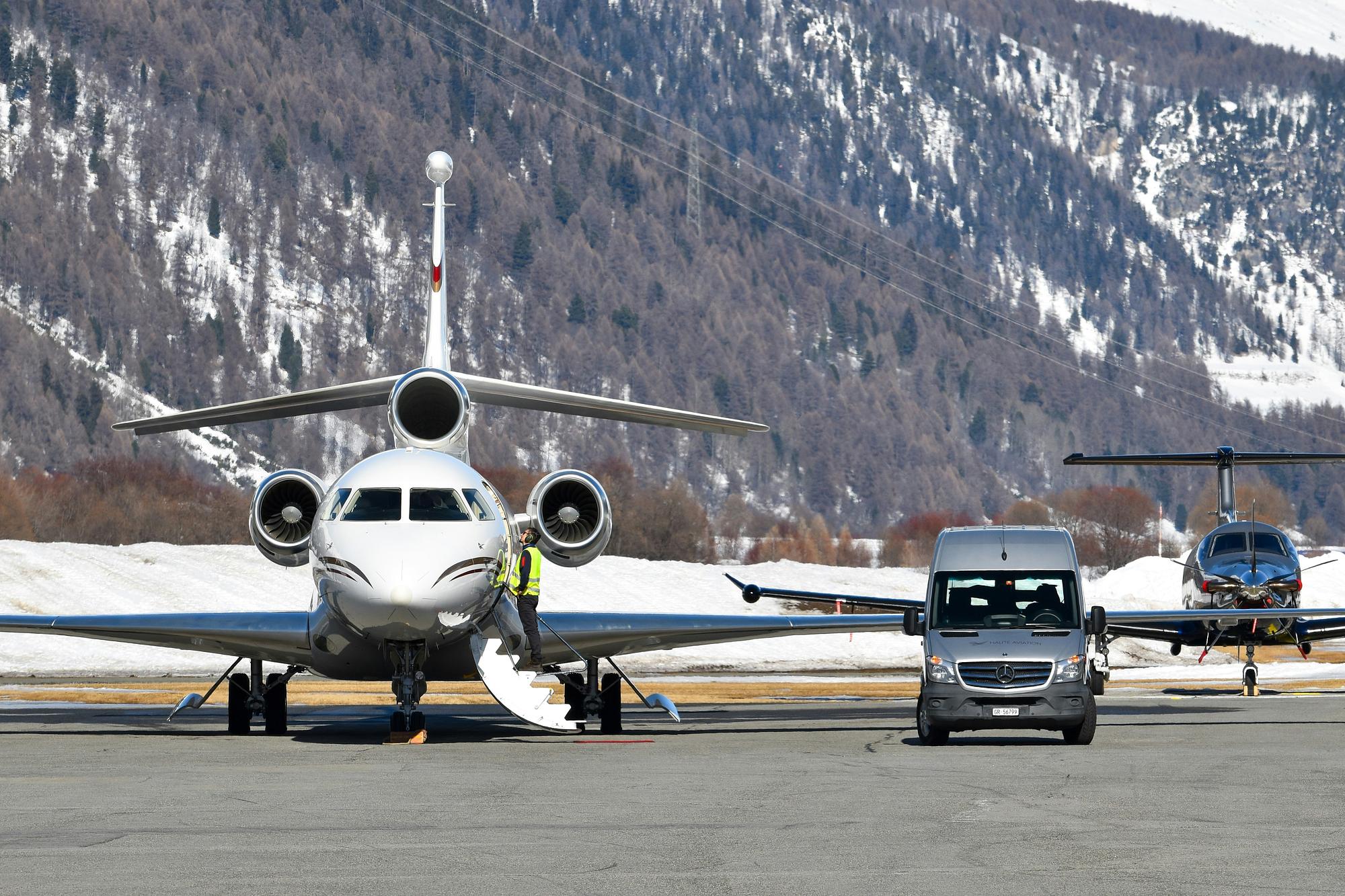
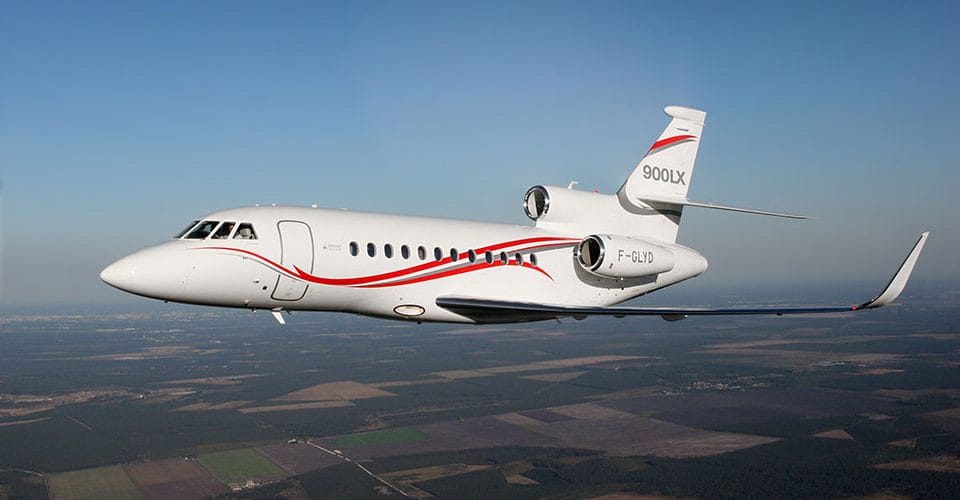
In the Gulfstream G450 vs. Falcon 900 conversation, the two jets play to different strengths. The G450 offers a larger Heavy-category cabin, more baggage room, and a faster cruise. The Falcon 900LX answers with longer range, a higher ceiling, and access to shorter runways, aided by a third engine on long overwater legs. Both are large-cabin jets that discerning Clients cross-shop, and the right choice comes down to how you like to fly.
The Gulfstream G450: Heavy-Cabin Presence
Step aboard a G450 and the room announces itself. This is a proper heavy jet, built for the traveler who wants to stretch out and arrive composed. The cabin runs long, the baggage hold is generous, and the pace is quick.
Gulfstream delivered the last G450 in January 2018, closing a run of 365 aircraft. Today it lives on the pre-owned and charter market, where its blend of space and speed still turns heads. Gulfstream’s G500 and G600, both in service since 2018 and 2019, carry the torch forward, yet the G450 remains a favorite for coast-to-coast and transatlantic days.
The Falcon 900LX: The Trijet That Goes Farther
Dassault built the Falcon 900LX for reach and finesse. It is the current flagship of the storied 900 line, offered with the EASy II flight deck, blended winglets, and an optional FalconEye combined-vision head-up display. On the market you will find it through charter, prized by Clients who value range and short-field composure.
The trijet layout is the signature. Three engines climb the aircraft higher and faster, open access to tighter runways, and add reassurance across long stretches of open water. The cabin is slightly more compact than the G450, yet Dassault’s craftsmanship makes every inch feel considered.
Gulfstream G450 vs. Falcon 900 at a Glance
Here is how the two large-cabin jets stack up side by side.
Category
Gulfstream G450
Dassault Falcon 900LX
Category
Heavy
Super-Midsize
Passengers
Up to 13
Up to 12
Cabin length
45’1″
33’2″
Cabin width
7’3″
7’7″
Cabin height
6’2″
6’2″
Cabin volume
1,658 cu ft
1,270 cu ft
Baggage
169 cu ft
127 cu ft
Range
4,425 nm
4,685 nm
Max cruise speed
476 kn
431 kn
Ceiling
45,000 ft
51,000 ft
Takeoff / landing distance
5,600 ft / 2,663 ft
5,360 ft / 2,455 ft
Engines
Two Rolls-Royce Tay 611-8C
Three Honeywell TFE731-60
Range and Speed: Gulfstream vs. Falcon
Speed is the Gulfstream’s calling card. The G450 cruises at up to 476 knots, trimming precious minutes off long days. When you want to be first on the ground for a dinner or a deal, that pace matters.
The Falcon 900LX plays the long game. It flies up to 4,685 nautical miles, edging past the G450’s 4,425, so it reaches a touch farther on a single leg. For the traveler weighing which private jet for transatlantic crossings, the two are close, and mission profile decides it.
Consider the practical picture. A westbound Atlantic crossing into headwinds can push either jet near its limit, and here the Falcon’s extra reach earns its keep. On a shorter domestic hop, the G450’s speed usually matters more than range. Your typical routes, not a single number, point to the better fit.
Cabin and Comfort
The G450 wins on sheer room. With 1,658 cubic feet of cabin and 169 cubic feet of baggage, it invites full-height movement, dedicated work zones, and space for the whole party’s luggage. It suits the group that packs for two weeks and works the whole way.
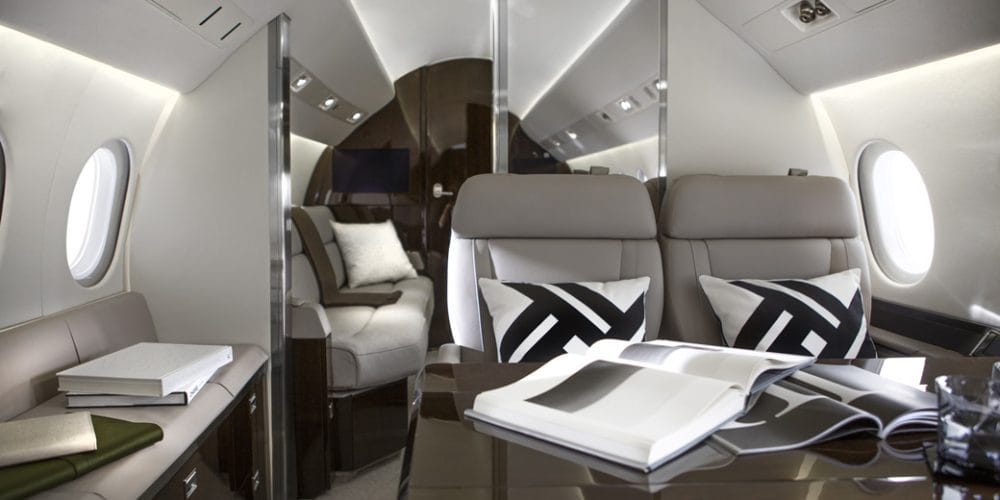
The Falcon 900LX is a shade narrower in volume yet slightly wider across the shoulders at 7’7″. Dassault’s cabin favors quiet refinement and thoughtful detail. Both stand at 6’2″ tall, so you move about with ease in either.
Comfort is also about how you spend the hours aloft. The G450’s extra length lends itself to distinct zones: a place to work, a place to dine, a place to rest. The Falcon’s cabin comes alive for smaller groups who prize intimacy and calm. Neither jet asks you to compromise on the finer touches.
Engines and Airport Access
This is where the Dassault vs. Gulfstream story turns most interesting. The G450 runs two Rolls-Royce Tay 611-8C engines, a clean and proven pairing. The Falcon 900LX carries three Honeywell TFE731-60 engines, and that third powerplant changes the character of the aircraft.
Three engines lift the Falcon off shorter runways, needing 5,360 feet to depart and just 2,455 feet to land. That opens mountain airfields, island strips, and city-adjacent runways the G450 may pass over. The trijet also brings added assurance on long overwater legs, and its layout tends toward efficient long-haul cruising.
Avionics and Flight Deck
Both flight decks are built for confident, precise flying. The G450 uses Gulfstream’s PlaneView suite with head-up and enhanced-vision capability, giving crews sharp situational awareness in low visibility.
The Falcon 900LX flies behind Honeywell’s Primus Epic EASy II flight deck, with the optional FalconEye system layering synthetic and enhanced imagery into a single head-up view. Both cockpits keep the experience smooth from wheels-up to touchdown.
Current Market and Availability
Neither jet is fresh off an assembly line, and that is part of their appeal. The G450 trades exclusively pre-owned and by charter now, with the G500 and G600 representing Gulfstream’s newer generation. The Falcon 900LX remains the flagship of the 900 line and comes to Clients primarily through charter.
Access to either aircraft is what keeps them special. Working with the right advisor puts the finest available airframes within reach, tail by tail, without the commitment of ownership.
How to Charter the G450 or Falcon 900
Chartering either jet through Magellan is straightforward and personal. You can fly by on-demand charter or through a Magellan Jet Card. A private aviation advisor then matches the aircraft to your mission, your calendar, and the experience you have in mind.
As a guide to planning, Magellan’s estimated hourly rates by category help set expectations:
Heavy Jet, such as the Gulfstream G450: estimated around $13,000 per hour.
Super-Midsize, such as the Falcon 900LX: estimated around $9,700 per hour.
These figures are estimates only. Actual hourly rates vary by route, date, availability, and the specifics of your trip, and a Magellan advisor confirms exact pricing before you fly.
Which Should You Choose?
Both aircraft belong to travelers with high standards, so the decision comes down to how you fly most.
Choose the G450 if you want the largest cabin, the most baggage room, a faster cruise, and room for a full party of up to 13.
Choose the Falcon 900LX if you want longer range, a higher ceiling, access to shorter and more remote runways, and the assurance of a third engine on transatlantic legs.
Frequently Asked Questions
Is the Gulfstream G450 still in production?
No. Gulfstream delivered the final G450 in January 2018 after building 365 aircraft. It now flies on the pre-owned and charter market, where it remains a sought-after large-cabin choice.
Is the Falcon 900LX still made, and what replaced the G450?
The Falcon 900LX remains the flagship of Dassault’s 900 line and comes to Clients through charter. Gulfstream’s G500 and G600, in service since 2018 and 2019, succeeded the G450 and G550 generation.
Which has longer range, the G450 or the Falcon 900LX?
The Falcon 900LX flies farther, with a range of 4,685 nautical miles against the G450’s 4,425. The margin is modest, so route and payload shape the real difference.
Which jet is faster?
The Gulfstream G450 is quicker, cruising at up to 476 knots compared with the Falcon 900LX’s 431. On long days, that speed can put you on the ground sooner.
How many passengers can each jet carry?
The G450 seats up to 13 passengers, while the Falcon 900LX seats up to 12, and the G450’s larger cabin gives that party more room to spread out. Exact layouts vary by aircraft, and your advisor confirms the configuration.
Why does the Falcon 900 have three engines?
The trijet design lets the Falcon 900LX climb higher, use shorter runways, and cross long stretches of open water with added assurance. It is a hallmark of Dassault’s 900 line.
Which jet needs a shorter runway?
The Falcon 900LX. It departs in about 5,360 feet and lands in roughly 2,455, opening tighter and more remote airfields than the G450 typically reaches.
Which is better for transatlantic flights?
Both handle transatlantic missions well. The Falcon 900LX offers slightly longer range and its third engine adds reassurance over water, while the faster G450 favors speed and cabin space.
Which jet is more fuel-efficient?
Directionally, the Falcon 900LX’s trijet design lends itself to efficient long-haul cruising. Real-world figures depend on route, payload, and mission, which a Magellan advisor can walk through with you.
Talk to a Magellan Private Aviation Advisor
The best way to settle the Gulfstream G450 vs. Falcon 900 question is a conversation about where you are going and how you like to travel. Talk to a Magellan private aviation advisor and let us match the right large-cabin jet to your next journey.
The Challenger 300 vs. Citation Latitude decision comes down to the kind of journey you want to own. The Bombardier Challenger 300 is a super-midsize jet with more range, greater cabin volume, and higher speed. The Cessna Citation Latitude is a midsize jet with a wide, flat-floor cabin and easy access to shorter runways. Choose the Challenger 300 for coast-to-coast reach and pace. Choose the Latitude for a roomy stand-up feel, generous baggage, and the freedom of smaller airports.
The Bombardier Challenger 300, a Super-Midsize Standout
Some jets simply expand what a single day can hold. The Challenger 300 is one of them. It carries you farther, faster, and in a cabin built for the way you actually travel.
This is one of the most versatile super-midsize jets flying. The wide flat-floor cabin and excellent baggage capacity suit both boardroom trips and long weekends. There is room for skis, golf clubs, and larger pets, with space for a party of six to spread out in real comfort even as the cabin seats up to nine. With 3,340 nautical miles of range, coast-to-coast travel opens up without a fuel stop.
The Cessna Citation Latitude, Midsize Comfort Redefined
Space changes how a flight feels. The Citation Latitude leads its midsize category on exactly that promise, with a six-foot flat-floor cabin that lets you stand, stretch, and settle in.
The Latitude favors families, pet-friendly charters, and guests with mobility considerations. It seats up to nine and offers comfort that stands out among midsize jets. Its short-runway performance also opens more airports, so you land closer to where the day really begins. For a pilot’s perspective, read the Citation Latitude pilot review.
Challenger 300 vs. Citation Latitude Specifications at a Glance
The cabin is where a private flight earns its name. Both jets deliver, and each has a signature. The Challenger 300 offers the larger volume at 930 cubic feet, with a cabin 23 ft 7 in long and 7 ft 2 in wide. That extra width invites longer trips and a genuine sense of room.
The Latitude answers with a six-foot flat-floor stand-up cabin at 587 cubic feet. Walking upright, cabin to seat, makes shorter hops feel effortless. Its comfort suits seven to nine passengers, families, and guests who value an easy, level entry.
Range and Performance
Range is freedom measured in miles. It decides whether you arrive nonstop or pause along the way. The Challenger 300 reaches 3,340 nm, enough for confident coast-to-coast travel across the U.S. The Citation Latitude covers 2,700 nm, ideal for regional and many transcontinental missions.
Both jets share a 45,000-foot service ceiling, so each climbs above much of the weather and busier traffic. When your itinerary stretches long, the Challenger 300’s extra reach becomes the deciding advantage.
Speed
Time is the one luxury you cannot buy back, and speed protects it. The Challenger 300 cruises at up to 459 knots, about 528 mph. The Citation Latitude cruises at up to 368 knots, about 423 mph. On longer legs, the Challenger’s pace trims meaningful minutes and keeps a packed calendar intact.
Runway Access and Airport Flexibility
The best destinations are not always served by the biggest airports. That is where the Latitude quietly excels. Its 3,580-foot takeoff and 2,085-foot landing distances open smaller fields closer to your final address.
The Challenger 300 needs 4,810 ft for takeoff and 2,290 ft to land. It still reaches thousands of airports, and it trades a little runway flexibility for its greater range and speed. Both aircraft pair naturally with an on-demand charter approach, so the airport suits the trip rather than the other way around.
Passenger Capacity and Baggage
Great travel makes room for everyone and everything you bring. The Challenger 300 typically seats eight, with capacity for up to nine, and offers 106 cubic feet of internal baggage for skis, clubs, and gear. The Latitude also seats up to nine and carries 127 cubic feet of total baggage.
So the Latitude holds more overall luggage volume, while the Challenger pairs strong baggage capacity with a wider cabin. For a larger group with plenty to pack, both jets welcome the full party in comfort.
Avionics
Confidence in the cockpit shapes the calm you feel in the cabin. The Challenger 300 flies behind Rockwell Collins Pro Line 21 with four LCD displays. The Citation Latitude uses the Garmin G5000 with touchscreen controls, Synthetic Vision, and autothrottle. Both suites give crews clear, current information from takeoff to touchdown.
Charter Access and Cost Guidance
Chartering either jet is less a transaction than an invitation to travel on your own terms. As general guidance by category, the Challenger 300 (super-midsize) is estimated at around $9,700 per hour, and the Citation Latitude (midsize) at around $8,600 per hour.
Both figures are estimates only. Rates vary with routing, availability, repositioning, dates, and other factors, and a Magellan advisor confirms exact pricing for your itinerary. If you are weighing other super-midsize options, compare the Citation X vs. Challenger 300 and the Challenger 350 dossier as well.
Frequently Asked Questions About the Challenger 300 vs. Citation Latitude (FAQs):
Can a Challenger 300 cross the Atlantic?
The Challenger 300 offers 3,340 nm of range. That covers confident coast-to-coast U.S. travel and many longer routes, though a full transatlantic crossing sits beyond its nonstop reach. A Magellan advisor can map the right stop or a longer-range aircraft for ocean itineraries.
Which is better for transcontinental flights?
The Challenger 300 is the stronger choice for transcontinental travel. Its 3,340 nm range and 459-knot cruise favor long nonstop legs. The Latitude, at 2,700 nm, handles many transcontinental missions well, especially with a favorable routing.
How do the cabin sizes compare?
The Challenger 300 has the larger cabin volume at 930 cubic feet and a wider 7 ft 2 in cabin. The Latitude offers 587 cubic feet with a six-foot flat-floor stand-up cabin that many guests love for its easy, upright feel.
What is the range difference?
The Challenger 300 reaches 3,340 nm and the Citation Latitude reaches 2,700 nm. That is a 640 nm advantage for the Challenger, which translates into more nonstop options on longer routes.
Which is faster?
The Challenger 300 is faster. It cruises at up to 459 knots, about 528 mph. The Citation Latitude cruises at up to 368 knots, about 423 mph.
How do charter costs compare?
As general category guidance, the Challenger 300 is estimated at around $9,700 per hour and the Citation Latitude at around $8,600 per hour. These are estimates that vary with routing, availability, repositioning, dates, and other factors, and a Magellan advisor confirms exact pricing.
Which is better for a larger group?
Both jets seat up to nine passengers. The Latitude carries more total baggage at 127 cubic feet and offers an easy stand-up cabin, while the Challenger 300 pairs a wider cabin with longer range for bigger, farther-flung trips.
Find the Right Jet for Your Next Journey
Your ideal aircraft is the one that matches the trip you imagine, and the choice is yours to make with confidence. When you are ready to fly, talk to a private aviation advisor and let a Magellan specialist shape the details around you.
The 2027 Kentucky Derby runs on Saturday, May 1, 2027. Taking a private jet to the Kentucky Derby begins at Louisville Muhammad Ali International Airport (SDF). This is the closest airport to Churchill Downs at roughly five to six miles by road. From wheels down at SDF, most Clients reach the track in minutes, well ahead of the crowds. This guide walks you through the date, the airports near Churchill Downs, the right aircraft category, and the hospitality that makes the journey worth every mile.
When Is the 2027 Kentucky Derby?
The Derby has always kept its date close to spring, and 2027 holds the tradition. The 153rd running falls on Saturday, May 1, 2027, the first Saturday in May. The Kentucky Oaks is the day before on Friday, April 30, 2027. Two days, two marquee races, and one of the most storied weekends in American sport.
Timing shapes everything about the weekend. The first Saturday in May draws owners, celebrities, and lifelong enthusiasts to Louisville at the same moment. The earlier you set your travel intentions, the more open the field of choices remains for aircraft, arrival airport, and hospitality.
Many Clients build the full two-day arc into their plans. They arrive before the Oaks on Friday and stay through Derby Saturday. That approach turns a single race day into a proper weekend in Louisville, with time for the city’s bourbon houses, its dining, and the pageantry that surrounds the track. Deciding early whether you want one day or two gives your travel plans their shape.
Why Take a Private Jet to the Kentucky Derby
The Derby is theater, and your arrival is the opening scene. Landing near Churchill Downs and stepping into a waiting car sets a tone that commercial travel simply cannot match. There is no terminal, no queue, and no compromise between your schedule and someone else’s.
That ease matters most on a weekend defined by its energy. When tens of thousands descend on Louisville at once, the private path keeps your day unhurried. Set your own hour of arrival and leave when the last toast is made. The flight becomes part of the occasion rather than a preface to it.
The scale of private travel to Louisville tells the story of the weekend’s magnetism. More than 900 private jets flew into the Louisville area for the 2023 Derby, a 389% jump over the prior week. Derby-weekend activity at the region’s main airports accounted for about 8.5% of the area’s annual private-jet traffic in 2022, and Atlantic Aviation reported more than 250 aircraft on its SDF ramp at once for the 149th Derby in 2023. This is not congestion to endure. It is proof that you are arriving at the center of the moment, in the company of people who value the same experience.
Because demand rises so sharply, the FAA issues annual Special Air Traffic Procedures for Derby week covering the primary Louisville-area airports. This can include departure clearance timing, ground delays, airborne holding, and preferred routing. None of this is an obstacle when the planning starts early. It is one more reason to work with a dedicated Private Aviation Advisor who choreographs your arrival and departure windows around the weekend’s rhythm.
Where to Fly In: Airports Near Churchill Downs
Louisville offers more than one gateway to the Derby, and the best airports near Louisville each carry their own character. Your choice depends on aircraft category, how close you want to land, and how you prefer to move from ramp to track. Here is how the three main options compare.
Louisville Muhammad Ali International Airport (SDF)
SDF is the closest airport to Churchill Downs. It is roughly five to six miles from the track and only minutes away by road. The airport carried the name Louisville International Airport before it was renamed in 2019 to honor the city’s most famous son. Atlantic Aviation operates the sole FBO (fixed-base operator, the private terminal that handles arrivals, fueling, and ground services) on the field, and it welcomes the largest share of Derby traffic. For proximity and full-service handling, SDF is the natural first choice.
Bowman Field (LOU)
Bowman Field sits about 10 minutes from the Kentucky Derby and offers a more intimate arrival. It is an FAA-designated general-aviation reliever airport, and its FBO, Louisville Executive Aviation, runs a complimentary track shuttle for Derby guests. Its longest runway measures about 4,326 feet, which suits Light and Midsize jets rather than larger cabins. For the right aircraft, Bowman blends closeness with a quieter, more private feel.
Clark Regional Airport (JVY)
Just across the river in Sellersburg, Indiana, about seven miles north of Louisville, Clark Regional is a strong overflow option when SDF and Bowman fill. Its longest runway stretches 7,000 feet, so it accommodates a wider range of aircraft, and the drive to Churchill Downs runs roughly 15–18 minutes. When the weekend’s demand peaks, JVY keeps your plans flexible without adding meaningful distance.
Choosing the Right Aircraft for the Derby
The right aircraft for the Derby is the one matched to your group, your origin, and the airport you prefer. At the category level, Light and Midsize jets open the widest range of options, including runway-limited Bowman Field, while Super-Midsize and Heavy jets deliver more cabin room and range and favor the longer runways at SDF and Clark Regional. Runway length is the practical fact that guides the shortlist, since Bowman’s shorter runway rules out the larger categories.
Beyond runway realities, the choice comes down to how far you are flying, how many are in your party, and the comfort you want in the air. A short hop from a nearby city calls for a different cabin than a transcontinental leg with a full party aboard. Rather than fix on a single model, let a Private Aviation Advisor match the mission to the aircraft with the current network in view. For a sense of the cabins Private Clients favor, our dossier on the most popular private jets to charter is a useful place to begin.
The Derby Experience: Hospitality Worth the Journey
Once you reach the track, Churchill Downs offers a tiered world of hospitality. The Mansion is the most exclusive of them, set on the sixth floor above Millionaires Row and hosting fewer than 300 guests, renovated ahead of the 2026 Derby. It is where the weekend feels most rarefied, a room apart from the roar below.
Millionaires Row, the fourth-level dining tier overlooking the track, remains the classic Derby setting for those who want the full sweep of the grandstand and the stretch. The Finish Line Suites, 15 suites positioned right at the finish line, put you where the race is decided, and the Turf Club within the Clubhouse carries a timeless, members’ club atmosphere. Each tier suits a different mood, from ceremony to celebration.
Where you stay completes the weekend. The Brown Hotel has anchored downtown Louisville since 1923 and remains a grande dame of Southern hospitality. The Omni Louisville, opened in 2018, brings a contemporary counterpoint, and the Galt House, the city’s waterfront property, serves as the official hotel of the Kentucky Derby Festival. Any of the three sets the right stage for the days around the race.
Planning Your Derby Journey
The most rewarding Derby weekends are the ones planned early. Aircraft availability, arrival airports, and hospitality all tighten as the first Saturday in May approaches, so the sooner you set your dates, the more the weekend opens to you. Booking ahead is not about avoiding trouble. It is about claiming the arrangements that make the experience yours.
Early planning also gives your advisor room to work around the FAA’s Derby-week procedures, choosing arrival and departure windows that keep your schedule calm on both ends. Industry-wide demand rises across the weekend, and setting your plans in motion months ahead is the surest way to secure the aircraft and airport you prefer. The result is a weekend that unfolds exactly as you pictured it.
Every Magellan Jets Client works with a dedicated Private Aviation Advisor and a Client Experience concierge who coordinate the details beyond the flight, from in-flight catering to ground transportation waiting on the ramp. For Private Clients who travel to marquee events year after year, a Jet Card locks in guaranteed access and fixed rates, so the Derby becomes one confident call rather than an annual scramble. Client funds are held with care, and your plans are protected from first inquiry to final leg.
Frequently Asked Questions About Flying Private to the Kentucky Derby (FAQs):
What Is the Closest Airport to the Kentucky Derby?
Louisville Muhammad Ali International Airport (SDF) is the closest airport to the Kentucky Derby. It is roughly five to six miles from Churchill Downs and only minutes away by road. Atlantic Aviation operates the sole FBO on the field and handles the largest share of Derby traffic. For proximity and full-service handling, it is the most common choice for Private Clients.
Where Should I Fly In for the Kentucky Derby?
Three airports serve Churchill Downs. SDF is closest and best equipped for larger aircraft, Bowman Field (LOU) sits about 10 minutes away and suits Light and Midsize jets, and Clark Regional (JVY) in Sellersburg, Indiana is a strong overflow option about 15–18 minutes out. Your best choice depends on your aircraft category and how the weekend’s demand fills each field.
How Early Should I Book a Private Jet for the Derby?
As early as you can. Demand rises sharply across the weekend, and the FAA issues annual Special Air Traffic Procedures for Derby week that can affect arrival and departure timing. Booking well ahead gives you the widest choice of aircraft and airports, and it lets your Private Aviation Advisor plan around the weekend’s schedule with room to spare.
How Much Does It Cost to Fly Private to the Kentucky Derby?
Kentucky sits in the Southeast region, where Magellan Jets’ own estimated hourly rates by aircraft category run from an estimated $7,290 per hour for a Light Jet to $8,211 for a Mid Jet, $9,638 for a Super-Midsize, and $12,854 for a Heavy Jet. These are Magellan Jets’ estimated hourly rates for Southeast charter, inclusive of fuel. They do not include contingencies such as de-icing, positioning, overnight fees, catering, or ground transportation. Final pricing is confirmed at time of quote.
Is It Better to Fly Private or Commercial to the Derby?
Flying private lets you land minutes from Churchill Downs. You can keep your own schedule, and skip the terminal entirely during one of the busiest travel weekends of the year. Commercial routes into Louisville fill quickly around the Derby and rarely align with the pace of the weekend. For most Clients, the arrival experience and the control over timing make private travel the natural fit.
What About Catering and Ground Transportation?
Both are handled for you. Magellan’s Client Experience team arranges in-flight catering to your taste. They also coordinate ground transportation so a car is waiting when you land. The goal is a single, considered journey from your door to the track, with no detail left for you to manage.
Plan Your 2027 Kentucky Derby Arrival
The 2027 Kentucky Derby is a weekend to arrive well, and the planning starts now. Set your dates, choose your gateway, and let a dedicated advisor shape the rest around the experience you want. Talk to a Private Aviation Advisor and begin your Derby journey.
The Challenger 300 Interior: Inside Bombardier’s Super-Midsize Cabin
Updated September 2026
The Bombardier Challenger 300 built its reputation as one of the most requested super-midsize jets in private aviation. Much of that reputation lives inside the cabin. The Challenger 300 interior pairs a wide, stand-up living space with transcontinental range, which is why it remains a favorite for both business and leisure travel.
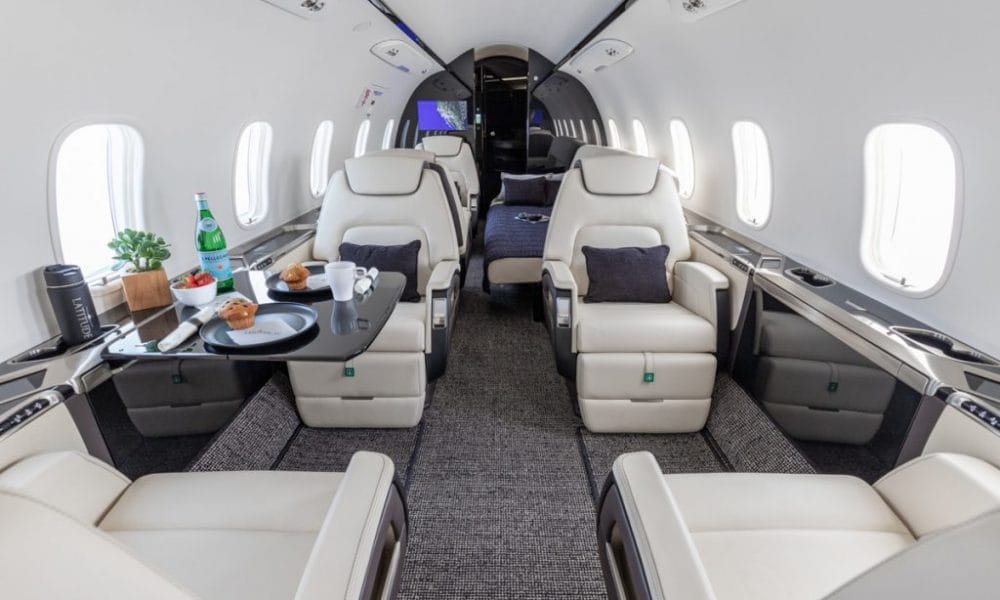
Here is the short version. The Challenger 300 interior is a super-midsize, flat-floor cabin measuring 23 ft 7 in long, 6 ft 1 in high, and 7 ft 2 in wide. It seats up to 8 passengers and accommodates six comfortably. Inside you will find a stand-up center aisle, double-club leather seating, a three-seat divan, an enclosed lavatory, and a refreshment galley.
Inside The Challenger 300 Interior
The cabin is the reason this aircraft flies so many missions. At 23 ft 7 in long and 6 ft 1 in high, the Challenger 300 interior gives most adults room to stand and walk the aisle without stooping. The flat floor runs the length of the cabin, so moving between seats feels natural rather than cramped.
Width matters as much as length. At 7 ft 2 in across, the cabin holds a true double-club layout with space to spare at the shoulders and knees. The result is a living space that reads more like a private lounge than a narrow tube.
Total cabin volume reaches 930 cubic feet, which explains why the space feels open rather than confined. Toward the rear sits an enclosed lavatory with a door for genuine privacy. Forward, a refreshment galley holds catering, cold storage, and hot beverages for the journey. Large windows line both sides of the cabin, and natural light reaches every seat.
The layout also supports work. The forward club seats face each other across a fixed table, so a small team can review documents or hold a meeting at altitude. On quieter flights, the same seats recline for rest before an early arrival.
Challenger 300 Seating, Layout, And Passenger Capacity
The standard configuration centers on double-club leather seating for six. Four seats face each other in a forward club, and the remaining pair completes the arrangement for face-to-face conversation or heads-down work. Each seat reclines, swivels, and tracks for legroom.
A three-seat divan runs along one side of the cabin. It adds capacity for shorter legs and converts to a bed for rest on longer flights. That flexibility is why the Challenger 300 seats up to 8 passengers, while six travel most comfortably with room to spread out.
The cockpit is certified for two crew, so every Challenger 300 journey flies with a captain and first officer. Passengers gain a quiet, well-appointed cabin behind a flight deck built for precise, professional operation.
Range And Performance: Coast-To-Coast Nonstop
The Challenger 300 backs its cabin with real reach. It carries a range of 3,340 nautical miles, enough to connect New York and Los Angeles nonstop. That coast-to-coast capability is central to the aircraft’s appeal for transcontinental travel.
Speed and altitude round out the picture. The Challenger 300 cruises at up to 459 knots, roughly 528 mph, and climbs at 4,240 feet per minute. A service ceiling of 45,000 feet lets it fly above much of the weather and commercial traffic below.
For routes beyond its nonstop range, the Challenger 300 reaches farther with a single fuel stop. That keeps longer domestic and select international missions well within its profile while preserving the comfort of the cabin along the way.
Luggage And Versatility For Business And Leisure
The Challenger 300 carries 106 cubic feet of baggage, a generous figure for the super-midsize class. That space accommodates the gear real trips require, not just a few carry-ons.
Skis, golf clubs, and larger pets all travel comfortably. A family heading to the mountains, a foursome bound for a coastal course, and a Private Client traveling with a dog are all well matched to this aircraft. The baggage compartment stays accessible, so gear does not have to be surrendered at the terminal or split across a second aircraft.
This versatility is what keeps the Challenger 300 in steady demand. The combination of cabin room, baggage volume, and coast-to-coast range makes it a genuine business-and-leisure aircraft. You can compare it and other options on the Magellan Jets aircraft experience page.
How To Fly The Challenger 300 Interior With Magellan Jets
Magellan Jets is an asset-light private aviation solutions provider. The company does not own or operate aircraft. Instead, it sources the right jet for each mission from the Magellan Jets Preferred Network, so every recommendation is made in the Private Client’s best interest.
Two access paths put the Challenger 300 within reach. On-Demand Charter suits travelers who fly a handful of trips a year and want to book each journey as it comes. A Jet Card suits those flying more regularly who value fixed hourly rates and guaranteed availability. The Challenger 300 and its successor the Challenger 350 both fly under the super-midsize category.
On-Demand Charter of a super-midsize aircraft starts from an estimated $9,816 per hour. This is an estimated hourly rate for Super Mid charter, inclusive of fuel. It does not include contingencies such as de-icing, positioning, overnight fees, or other trip-specific costs. Final pricing is confirmed at time of quote.
Frequently Asked Questions About the Challenger 300 Interior (FAQs):
How many passengers does the Challenger 300 hold?
The Challenger 300 seats up to 8 passengers in its standard configuration. Six travel most comfortably, using the double-club seating with room to spread out. The three-seat divan adds capacity for shorter legs and converts to a bed for rest.
What are the Challenger 300 cabin dimensions?
The Challenger 300 interior measures 23 ft 7 in long, 6 ft 1 in high, and 7 ft 2 in wide. The flat floor and stand-up height let most adults move through the cabin without stooping. It is a true super-midsize living space rather than a narrow tube.
Is the Challenger 300 a good private jet?
The Challenger 300 is one of the most versatile super-midsize jets available. It combines a wide flat-floor cabin, 106 cubic feet of baggage space, and coast-to-coast range. Those qualities make it a strong choice for both business and leisure travel.
Can a Challenger 300 fly coast-to-coast or cross the Atlantic?
Yes, the Challenger 300 flies coast-to-coast nonstop, for example New York to Los Angeles, on its 3,340-nautical-mile range. It can reach farther with a single fuel stop. It is not designed for nonstop transatlantic flights, though a fuel stop extends its reach for longer missions.
How much does it cost to charter a Challenger 300?
On-Demand Charter of a super-midsize aircraft such as the Challenger 300 starts from an estimated $9,816 per hour, inclusive of fuel. That estimate excludes contingencies such as de-icing, positioning, overnight fees, and other trip-specific costs. Final pricing is confirmed at time of quote.
How does the Challenger 300 compare to the Challenger 350?
The Challenger 350 is the successor to the Challenger 300, and both fly under the super-midsize category with similar cabins. The 350 introduced refinements to the wing, avionics, and cabin over the earlier model. Our Challenger 300 vs. Challenger 350 comparison covers the differences in detail.
Plan Your Next Challenger 300 Journey
The Challenger 300 interior earns its place through a rare balance of cabin comfort, baggage capacity, and coast-to-coast range. Whether your next trip is a client meeting across the country or a weekend on the slopes, this aircraft is built to carry you and your gear in comfort.
Across the American West, wildfire season has become a travel-planning problem long before any flame reaches a property line. For a Private Client, the disruption rarely comes from the fire itself. It comes from losing control over departure.
Smoke drifts hundreds of miles from its source and closes visibility at major airports far from any active burn. Regulators lock the airspace directly over fires to protect the aircraft fighting them. A family with homes in Napa (KAPC), Lake Tahoe (KTRK), or Aspen (KASE) can find its schedule frozen while the local sky still looks navigable.
So the real question is one of access. Will the airports you depend on stay open, and will the route between them stay clear? Both can close on a day your own horizon looks calm, and that is the gap worth planning for.
When Wildfire Season Runs and Why It Keeps Growing More Severe
Western wildfire season runs roughly from May through November, with the most active stretch falling between July and September. That window has grown less predictable at its edges. In 2024, the season wound down about three weeks later than the average end date, extending the period when travel disruption stays on the table.
In 2024, 64,897 wildfires burned 8,924,884 acres across the United States, which is 127% of the 10-year average. NOAA attributes the surge in western wildfire frequency and severity to rising temperatures, declining snowpack, and frequent drought.
How Wildfire Smoke Triggers Ground Stops and Flight Delays
Smoke does not respect the distance between a fire and a runway. When it thickens over an airport, visibility drops, and air traffic control must space arriving and departing aircraft farther apart, which cuts the number of flights the airport can handle each hour. The result is a slower system, felt at gates hundreds of miles from any flame, where disruptions ripple across the commercial network.
In June 2023, smoke from Canadian wildfires reached the Northeast corridor with measurable operational effect. The FAA delayed flights bound for Newark (KEWR) nationwide, grounded departures to Philadelphia (KPHL), and delayed flights bound for LaGuardia (KLGA). More than 230 flights across the country were delayed in a single morning.
What a Temporary Flight Restriction Over a Wildfire Does to Airspace
A Temporary Flight Restriction (TFR) is a temporary FAA restriction on flight operations over a defined area, communicated to pilots through a NOTAM, or Notice to Air Missions. Under federal rule 14 CFR 91.137, the FAA issues TFRs over active wildfires to protect the aircraft dropping water and retardant. Every non-participating aircraft, private jets included, must comply.
These restrictions are common. The FAA processed 1,362 wildfire and disaster-related TFRs in 2024 and 1,251 in 2025, with wildfire restrictions dominating the summer months. Private aviation carries no exemption from them. What it carries is the flexibility to plan around them, choosing routes and departure points that keep a mission clear of restricted airspace.
Why Private Aviation Holds Up Better Than Commercial Schedules in Fire Season
Wildfire season affects flying primarily through smoke and restricted airspace rather than direct flame. Smoke lowers visibility and slows air traffic at major hubs, while Temporary Flight Restrictions close the airspace over active fires. Private aviation helps because it reaches more than 5,000 US airports, against roughly 500 served by commercial carriers, letting Private Clients depart from smaller regional fields away from smoke-choked hubs and route around restricted airspace.
Magellan Jets is a private aviation solutions provider founded in Boston in 2008, offering On-Demand Charter, Jet Cards, Fractional Ownership, and Aircraft Sales & Management. It works through an asset-light Preferred Network of fewer than 100 vetted operators, and it is the only private aviation provider represented on the Air Charter Safety Foundation Board.
That structure matters in fire season. Large-fleet programs and fixed-block operators route around the airports and aircraft they already control. An asset-light model sources each mission to fit the conditions on the day, including which fields are actually clear of smoke.
How to Fly Out of a Wildfire-Prone Western Home on Short Notice
When a departure has to happen within a day, On-Demand Charter is the trip-by-trip solution. It requires no membership and no pre-committed hours, which suits the unpredictable timing that smoke and Temporary Flight Restrictions impose. For each mission, Magellan Jets sources the right aircraft from the Preferred Network, matched to the route, the size of the group, and the fields that are actually open.
Pricing for On-Demand Charter is estimate-based, calculated per mission rather than fixed in advance. A Midsize jet out of the West Coast region starts from an estimated $9,557/hr, which your Private Aviation Advisor confirms against the specific routing and conditions before you commit.
This is an estimated hourly rate for Midsize charter, inclusive of fuel. It does not include contingencies such as de-icing, positioning, overnight fees, catering, ground transportation, or other trip-specific costs, and final pricing is confirmed at time of quote.
When the season is active and the timing is yours to control, the fastest path to a confirmed plan is a direct conversation. Contact a Private Aviation Advisor.
How to Lock In Travel Certainty Before Wildfire Season Starts
Corporations with western operations often formalize this readiness through corporate travel programs such as Magellan Jets for Business, keeping leadership moving when a region’s flights seize up. Whether the need covers one home or an entire executive team, a Private Aviation Advisor can structure the right plan before smoke ever reaches the field.
Wildfire Season Is Now a Planning Reality, and Control Is the Answer
Fire season is now a fixed feature of the western calendar, and its reach extends far beyond any burn scar. Smoke and restricted airspace turn a settled itinerary into a waiting game whenever the season peaks. Private aviation restores the one thing those conditions take away, which is control over when and how you leave. The next step is a short conversation about what that certainty looks like for your homes and your year. Contact a Private Aviation Advisor.
Frequently Asked Questions About Wildfire Season and Private Aviation (FAQs):
When is wildfire season in the western United States?
Western wildfire season generally runs from May through November, with the most active period falling between July and September. The edges have grown less predictable, and in 2024 the national season wound down about three weeks later than the average end date. Timing varies year to year and by region.
How does wildfire smoke cause flight delays?
When smoke settles over an airport, it reduces visibility, and air traffic control must space aircraft farther apart, which lowers how many flights the airport can handle each hour. Smoke travels far, so hubs hundreds of miles from a fire can slow down. In June 2023, Canadian wildfire smoke delayed more than 230 flights across the country in a single morning.
Can private jets fly through a wildfire Temporary Flight Restriction (TFR)?
No. A Temporary Flight Restriction over an active wildfire prohibits non-participating aircraft from the airspace, and private jets are not exempt. The advantage of private aviation is planning flexibility: choosing routes and departure fields that stay clear of the restricted area rather than waiting on a fixed schedule.
Is it better to fly private during wildfire season?
Private aviation reaches more than 5,000 US airports, compared with roughly 500 served by commercial carriers, which allows departures from smaller regional fields away from smoke-choked hubs. It also allows flexible routing around restricted airspace. That combination preserves departure options on days when commercial schedules stall.
How quickly can I arrange a private flight to leave during a wildfire?
On-Demand Charter can be arranged trip by trip for short-notice departures, with aircraft sourced per mission from the Preferred Network. Jet Card holders have guaranteed availability 365 days a year with call-out windows as short as 24 hours and no blackout dates. A Private Aviation Advisor coordinates the aircraft, routing, and open fields for the specific situation.
South Florida, the Bahamas, and the Caribbean draw their heaviest private travel during the same stretch when the Atlantic grows most unsettled. Hurricane Season overlaps directly with peak leisure and second-home trips to these destinations, which puts pressure on every Client who owns property or holds meetings in the region. The advantage of private aviation is not immunity from weather. It is control over how you respond to it, from earlier departures to alternate airports to guaranteed aircraft when commercial networks stall.
When Atlantic Hurricane Season Runs and Why It Shapes Florida and Caribbean Travel
The Atlantic hurricane season runs June 1 to November 30. NOAA notes the basin covers the Atlantic Ocean, the Caribbean Sea, and the Gulf, and that an average season produces 14 named storms, 7 hurricanes, and 3 major hurricanes.
Not every month carries equal risk. Peak activity concentrates from mid-August through mid-October, according to NOAA. That stretch is also when many Private Clients fly south for early-season events, property visits, and family travel.
Conditions shift year to year. For 2026, NOAA predicts a below-normal season and has raised the below-normal probability to 75%, with a growing El Niño increasing wind shear that tends to suppress storm formation. A seasonal outlook is not a landfall forecast, so it guides planning rather than predicting where any single storm will go.
How Private Aviation Keeps Your Trip on Schedule When a Storm Threatens
Private aviation keeps a trip on schedule by providing you more flexibility in routing, aircraft type, and schedule. A dedicated Flight Support team tracks weather and airspace in real time, moves a departure earlier to fly ahead of a system, routes to an alternate airport near your destination, and re-sources a different aircraft if conditions demand one. Guaranteed availability means the aircraft is there when the forecast turns, without the rebooking scrums that follow commercial cancellations.
That control depends on the model behind the flight. Magellan Jets is a Boston-founded private aviation solutions provider offering Jet Cards, On-Demand Charter, Fractional Ownership, and Aircraft Sales and Management. Its asset-light model means it owns no aircraft, so there is no fleet-utilization conflict pulling a specific tail toward a specific route.
Instead, missions draw from the Preferred Network, fewer than 100 vetted operators out of roughly 3,000 licensed in the U.S. That depth lets an advisor match the right aircraft to the day’s conditions rather than the nearest available jet.
What to Do If You Need to Evacuate Ahead of a Storm
When a hurricane warning turns into a mandatory evacuation order, commercial options thin out fast, and the Clients who wait longest pay the most and have the fewest seats left to choose from. This is where a Private Aviation Advisor earns their keep. The moment a storm’s track firms up, your advisor can move quickly to source an aircraft, confirm a departure window ahead of the worst weather, and get you and your family out of the affected area before airspace restrictions or airport closures take hold. If your home airport is under threat, the team can reroute departure to a nearby field that remains open longer, so the evacuation itself does not become the delay.
Which Aircraft Suit Hurricane-Season Routes to Florida and the Caribbean
Aircraft selection matters more in storm season, because range headroom and short-field ability widen your options when a plan changes. For most Florida and Bahamas missions, a super-midsize cabin balances comfort, baggage room, and the reach to divert without a fuel stop.
Challenger 300 and Challenger 350: super-midsize aircraft with a wide flat-floor cabin, coast-to-coast range, seating for up to six passengers, and room for baggage.
Gulfstream G280: a super-midsize aircraft with a flat-floor cabin, strong runway performance, and range that supports flexible routing.
Dassault Falcon 900: a large flat-floor cabin with strong short-field performance, which suits more challenging routes and smaller island fields.
Gulfstream G500: a heavy jet with extended range for longer Caribbean legs and greater distance between fueling points.
The right choice depends on your passengers, baggage, and destination field. An advisor confirms the match against runway length, distance, and the day’s weather rather than a fixed fleet.
What Real-Time Flight Monitoring and Alternate Airports Actually Do
Flying private does not mean flying through storms. No one flies into a hurricane, and no responsible operator would attempt it. The edge is operational, not aerial heroics.
Real-time monitoring means the in-house Flight Support team watches developing systems, airspace restrictions, and airport conditions well before departure. When a system approaches, the team can move a departure earlier, route around the weather, and stage the aircraft at an alternate field so you are positioned to fly the moment a window opens.
Alternate airports are part of that flexibility. If KMIA or KFLL faces closures, a mission can shift to KPBI or KOPF, and northbound repositioning can stage through fields such as KTEB. These moves happen through the FBO, the private terminal that handles arrivals and departures, coordinated by advisors who plan for contingencies before you feel them.
Many Caribbean island airports operate under daylight-only restrictions and posted curfews, so a late arrival on a storm-disrupted day can force an overnight or a diversion. Your Private Aviation Advisor builds the schedule around those windows and stages through larger fields with longer operating hours, such as TJSJ in San Juan or TNCM in St. Maarten. That routing discipline is what keeps a Caribbean journey moving when weather compresses the flying day into a narrow band.
What It Costs to Charter to Florida During Hurricane Season
Pricing depends on aircraft category, routing, and timing. As a planning reference, a super-midsize charter to Florida starts from an estimated $9,638 per hour, and a heavy jet starts from an estimated $12,854 per hour. Both figures are estimates, not final quotes.
Each rate is inclusive of fuel but excludes contingencies such as de-icing, positioning, overnight fees, catering, ground transportation, and international fees. Final pricing is confirmed at the time of quote. Caribbean legs are international and priced at quote, since they carry additional requirements beyond domestic Florida routing.
When a system threatens, operators reposition aircraft late in the cycle, and those repositioning flights, known as dead legs, fly empty to reach a departure point. Dead legs add cost and shrink availability across the region at exactly the wrong moment. Booking earlier in storm season secures better-positioned aircraft and preserves your routing choices. A rate-locked program shields the Private Client from the surge that follows every major storm.
If a storm-season trip is already on your calendar, the earlier your advisor sees it, the more routing and aircraft options stay open. Contact a Private Aviation Advisor to map the plan before the forecast narrows your choices.
Which Magellan Jets Program Fits Hurricane-Season Travel
The right program depends on how often you fly and how much certainty you want. On-Demand Charter suits Clients taking a handful of Florida or Bahamas trips a year, with real-time monitoring and alternate-airport routing on every mission. It gives you flexibility without a longer commitment.
For frequent travelers who cannot absorb disruption, the Jet Card adds guaranteed 24/7/365 availability, zero blackout dates, no peak-day surcharges, guaranteed mechanical recovery, and surcharge-free aircraft interchange. Those terms are what keep a storm-season itinerary intact when demand surges. The flagship 50-hour Challenger Jet Card anchors the program for Clients who want that certainty locked in.
Clients with steady, high-volume travel to the islands may prefer Fractional Ownership, whose service coverage includes Bahamas and Caribbean routings. Across all three, the same safety leadership applies. Magellan Jets is the only asset-light provider on the ACSF (Air Charter Safety Foundation) Board, holding the Chairman seat for more than six years, and works only with operators carrying $100M to $300M in liability insurance and captains averaging 9,700 or more flight hours, all under Part 135, the FAA rules governing commercial charter operators. Founded in Boston in 2008 and rated 4.9 out of 5 by Private Clients, the firm gives you a single advisor who keeps your trip moving before the forecast forces the question.
Storm season rewards the traveler who decides early and holds the right program. Match your travel pattern to the structure that protects it, and the months from June through November stop dictating your plans. Contact a Private Aviation Advisor to build a hurricane-season plan around how you actually fly.
Frequently Asked Questions About Flying Private During Hurricane Season (FAQs):
When is Atlantic hurricane season?
The Atlantic hurricane season runs June 1 to November 30 each year, and it covers the Atlantic Ocean, the Caribbean Sea, and the Gulf. Activity is not evenly spread across those months. Peak activity concentrates from mid-August through mid-October, which is when travel planning to Florida and the Caribbean deserves the most attention.
Is it safe to fly private during hurricane season?
Yes. No one flies into a hurricane, and no responsible operator would attempt it. The safety advantage of private aviation is flexibility: a Flight Support team monitors weather and airspace in real time and reroutes, retimes, or restages your flight around a system. Every Magellan Jets mission is flown by Preferred Network operators vetted well beyond FAA minimums.
Can a private jet reroute around a hurricane?
Yes. Because the schedule is built around you, a departure can move earlier to fly ahead of a system, and the aircraft can route to an alternate airport near your destination. If a primary field like KMIA closes, the mission can shift to KPBI or KOPF, coordinated by your advisor before it affects your day.
What happens if a storm disrupts my flight?
Your advisor and Flight Support team adjust the plan proactively, moving the departure, changing airports, or re-sourcing an aircraft as conditions require. Jet Card holders also carry guaranteed availability and guaranteed mechanical recovery, and optional charter journey insurance can protect against qualifying cancellations and interruptions.
Should I choose On-Demand Charter or a Jet Card for hurricane season?
It depends on how often you fly. On-Demand Charter fits Clients taking a few Florida or Bahamas trips a year, while the Jet Card suits frequent travelers who want guaranteed availability, zero blackout dates, and no peak-day surcharges through the busy months. A Private Aviation Advisor can match the structure to your travel pattern.