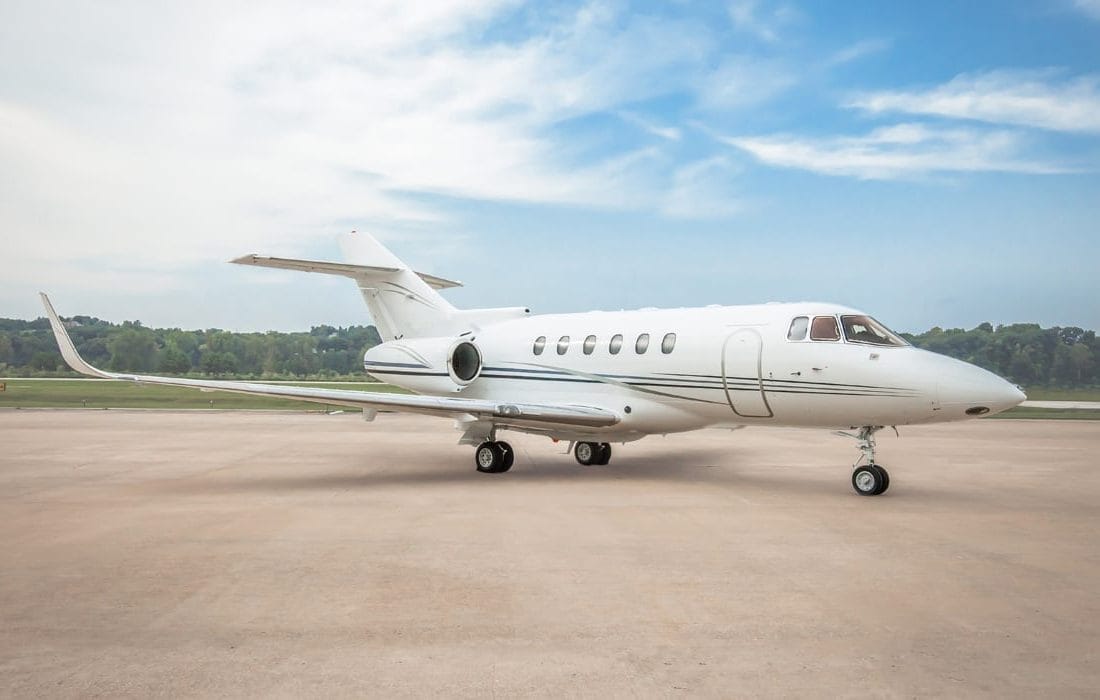
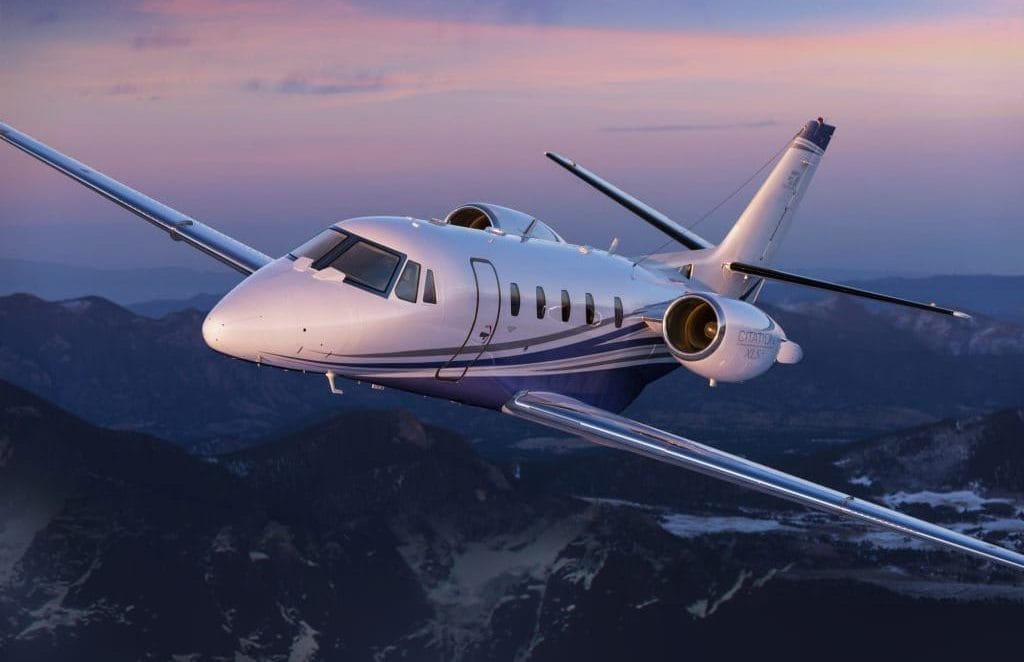
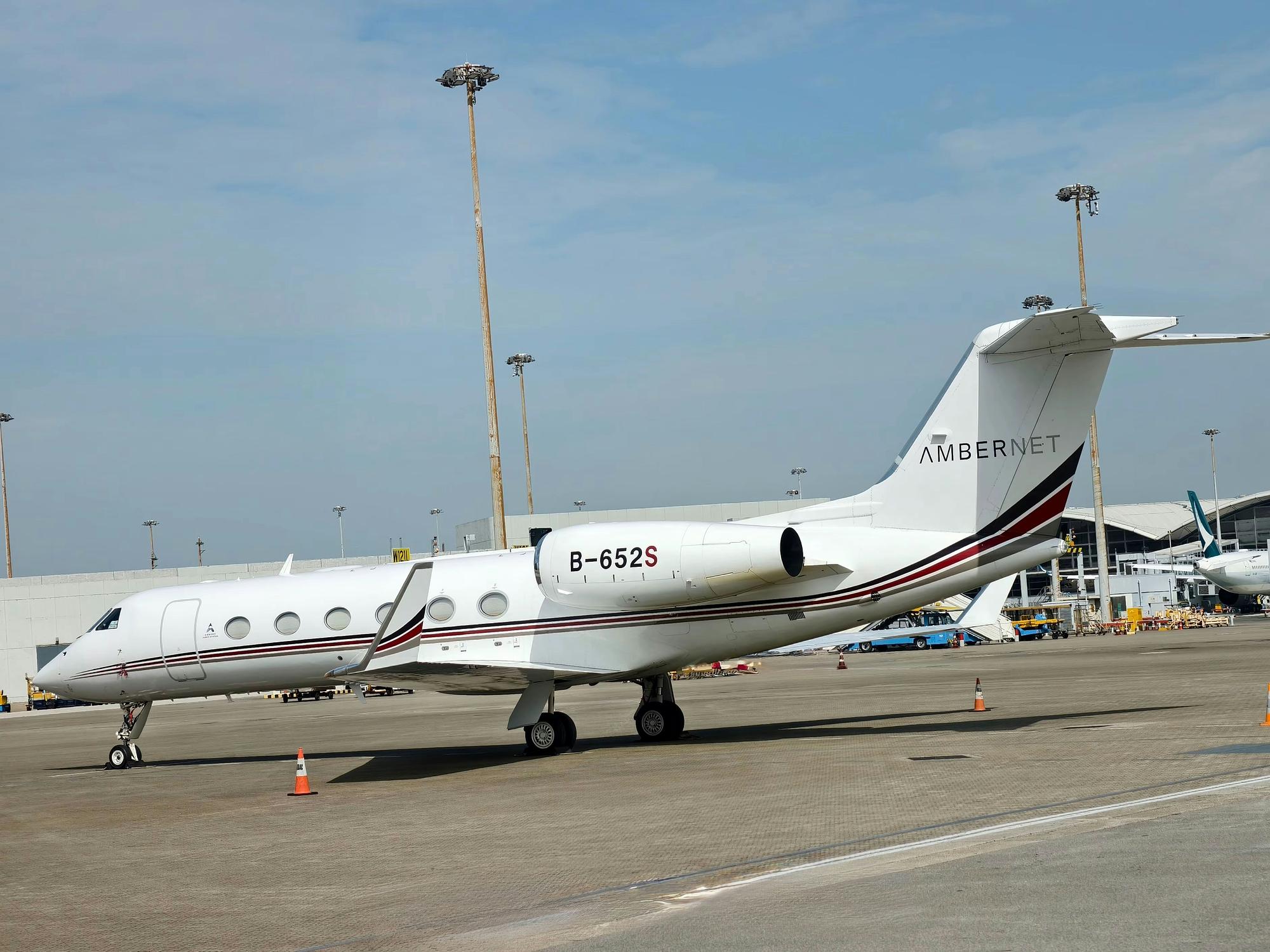
The Cessna Citation X is a super-midsize business jet built for travelers who measure time in minutes, not miles. Cruising at up to Mach 0.935, the Citation X and its successor, the Citation X+, held the title of the world’s fastest certified civilian aircraft from 2014 until December 2025. With a range exceeding 3,100 nautical miles, a service ceiling of 51,000 feet, and seating for up to eight passengers in executive configuration, the Citation X remains one of the most capable transcontinental business jets ever produced. Cessna manufactured the aircraft from 1996 through 2018, delivering approximately 339 airframes to owners worldwide.
For Private Clients who need to cross the country in a single morning or reach a meeting on the opposite coast before dinner, the Citation X offers something rare: speed without compromise. This is the aircraft that set coast-to-coast records, introduced Rolls-Royce power to the Cessna lineup, and pioneered avionics that would shape business aviation for a generation. Here’s what most travelers don’t know about it.
1. The Citation X Held the Civilian Speed Record for Over a Decade
Speed is the Citation X’s defining characteristic. From 2014 until 2025, the Citation X+ was the fastest certified civilian aircraft in the world, cruising at a maximum operating Mach number of 0.935 – roughly 717 mph. That record stood for more than a decade until Bombardier’s Global 8000, certified at Mach 0.95, entered service in December 2025.
The numbers translate directly into time saved. On a cross-country flight from Los Angeles to New York, the Citation X can complete the journey in approximately four hours and 15 minutes under typical conditions – shaving 45 minutes to an hour off what comparable super-midsize jets require. That margin means arriving in time for a morning meeting that otherwise would have demanded an overnight stay.
Cessna proved the aircraft’s speed in October 2014, when a Citation X+ set an official National Aeronautic Association record flying from Seattle to Miami – a distance of 2,375 nautical miles – in four hours and 52 minutes. The jet maintained an average speed of Mach 0.916 across the two-day record attempt. For travelers comparing transcontinental options, the Citation X remains the benchmark for how quickly a super-midsize cabin can move.
2. It Was the First Cessna Powered by Rolls-Royce Engines
When Cessna engineers designed the Citation X in the early 1990s, they faced a fundamental challenge: producing enough thrust to sustain near-supersonic cruise speeds while maintaining the fuel efficiency a business jet requires. The solution marked a departure from company tradition.
The Citation X became the first Cessna aircraft to carry Rolls-Royce engines – specifically, the AE 3007C series turbofans. Each engine produces between 6,442 and 6,764 pounds of thrust on the original Citation X, depending on the production sub-variant (AE 3007C or AE 3007C1). The updated Citation X+ upgraded to the AE 3007C2 variant with full-authority digital engine control (FADEC), delivering 7,034 pounds of thrust per engine and improving both performance and fuel efficiency.
This powerplant choice gave the Citation X its signature capability. The Rolls-Royce engines provide the sustained thrust needed to cruise at Mach 0.92 while burning fuel at rates competitive with slower aircraft in the category. For operators, that combination means fewer fuel stops and more direct routings on long-range missions.
3. The Citation X Cockpit Evolved Dramatically From 1996 to 2018
Aviation technology advanced considerably during the Citation X’s 22-year production run, and the cockpit tells that story clearly. Understanding the difference matters when chartering, as flight deck capabilities affect everything from weather routing to operational flexibility.
The original Citation X, produced from 1996 through 2013, featured the Honeywell Primus 2000 integrated avionics suite. The flight deck displayed information across five 7-by-8-inch CRT screens – state-of-the-art for its era but a generation behind current glass cockpit technology. The system delivered reliable performance and remains fully capable for domestic operations.
When Cessna introduced the Citation X+ in 2014, the cockpit transformation was substantial. The upgraded aircraft replaced the Primus 2000 with the Garmin G5000 avionics suite, featuring three 14-inch widescreen displays and four touchscreen controllers. The G5000 provides synthetic vision, georeferenced charts, and advanced weather integration that pilots consistently praise for reducing workload during complex approaches.
Both versions remain in active charter service. Private Clients who prioritize the latest avionics technology can request a Citation X+ specifically. Those focused purely on speed and cabin experience will find either variant delivers the aircraft’s core value proposition.
4. The Citation X Arrived with a Famous First Owner
When Cessna delivered the first production Citation X in July 1996, the buyer wasn’t a Fortune 500 corporation. It was Arnold Palmer.
The legendary golfer had been a Cessna customer for decades, and taking delivery of the inaugural Citation X continued that relationship at its highest level. Palmer’s endorsement carried weight in the aviation community, signaling that the aircraft’s performance claims were more than marketing – they represented genuine capability that one of the sport’s most discerning travelers chose for his own missions.
The aircraft had flown for the first time in December 1993, with FAA type certification following in June 1996. Palmer’s delivery marked the beginning of a 22-year production run that would see approximately 339 Citation X and X+ aircraft enter service worldwide.
5. You Can Still Charter a Citation X Despite Production Ending in 2018
Cessna ended Citation X production in 2018, but the aircraft remains readily available for charter. The 339 aircraft built continue to serve owners and operators, with many maintained to exacting standards and configured for charter service.
Why did production end? Market dynamics shifted. Customers increasingly sought larger cabins, and Cessna’s development resources moved toward the Citation Longitude, which offers more interior space at the expense of top-end speed. The Citation X’s niche – maximum velocity in a super-midsize package – narrowed as travel patterns evolved.
For Private Clients who value speed above all, the Citation X’s availability through charter represents an opportunity. Through Magellan Jets’ access to the Preferred Network of vetted operators, Citation X aircraft can be sourced for missions where the aircraft’s specific capabilities apply – transcontinental business travel, time-sensitive journeys, or simply the experience of flying one of aviation’s most distinctive designs.
Citation X Interior: Cabin Comfort at 51,000 Feet
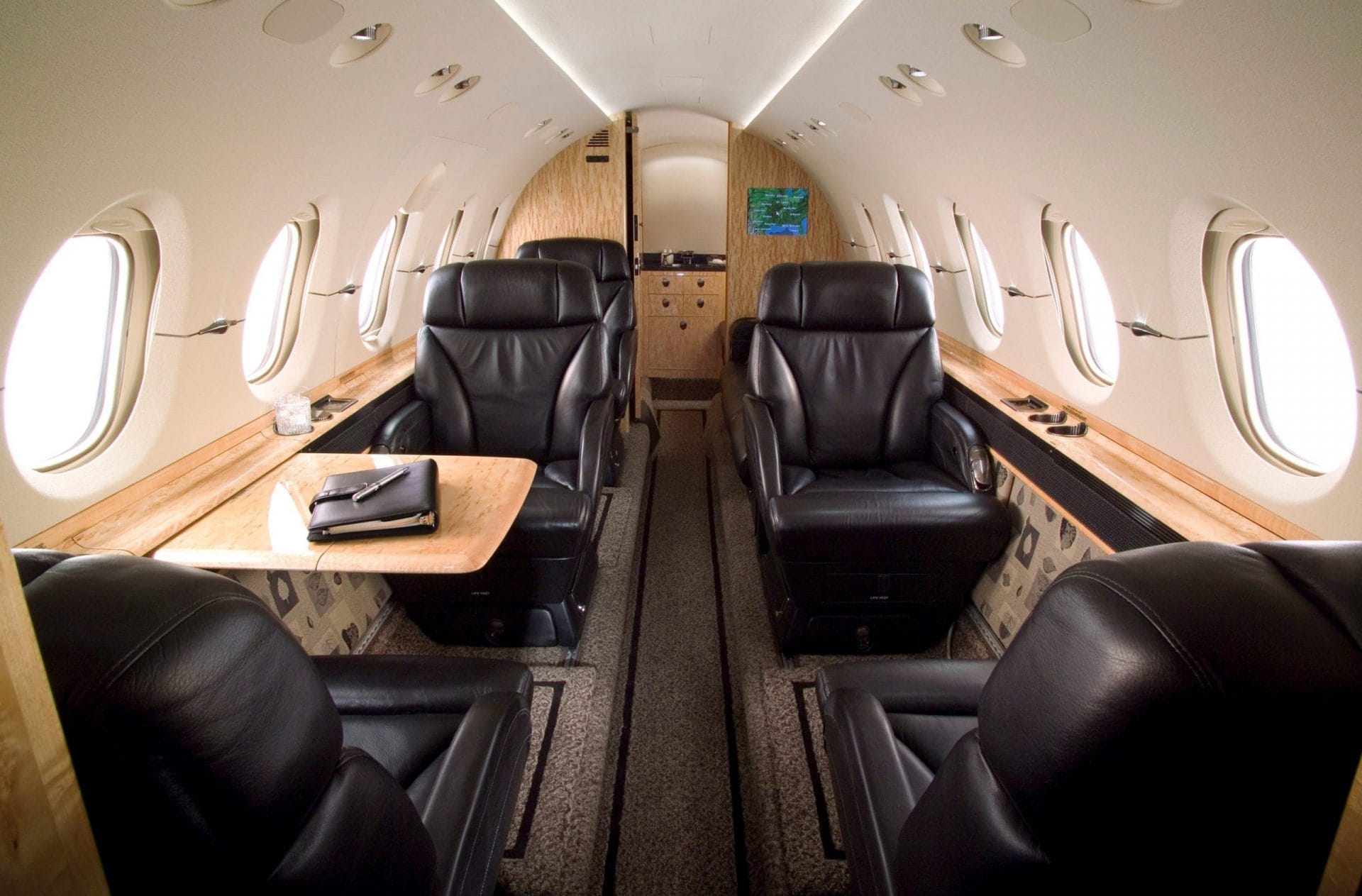
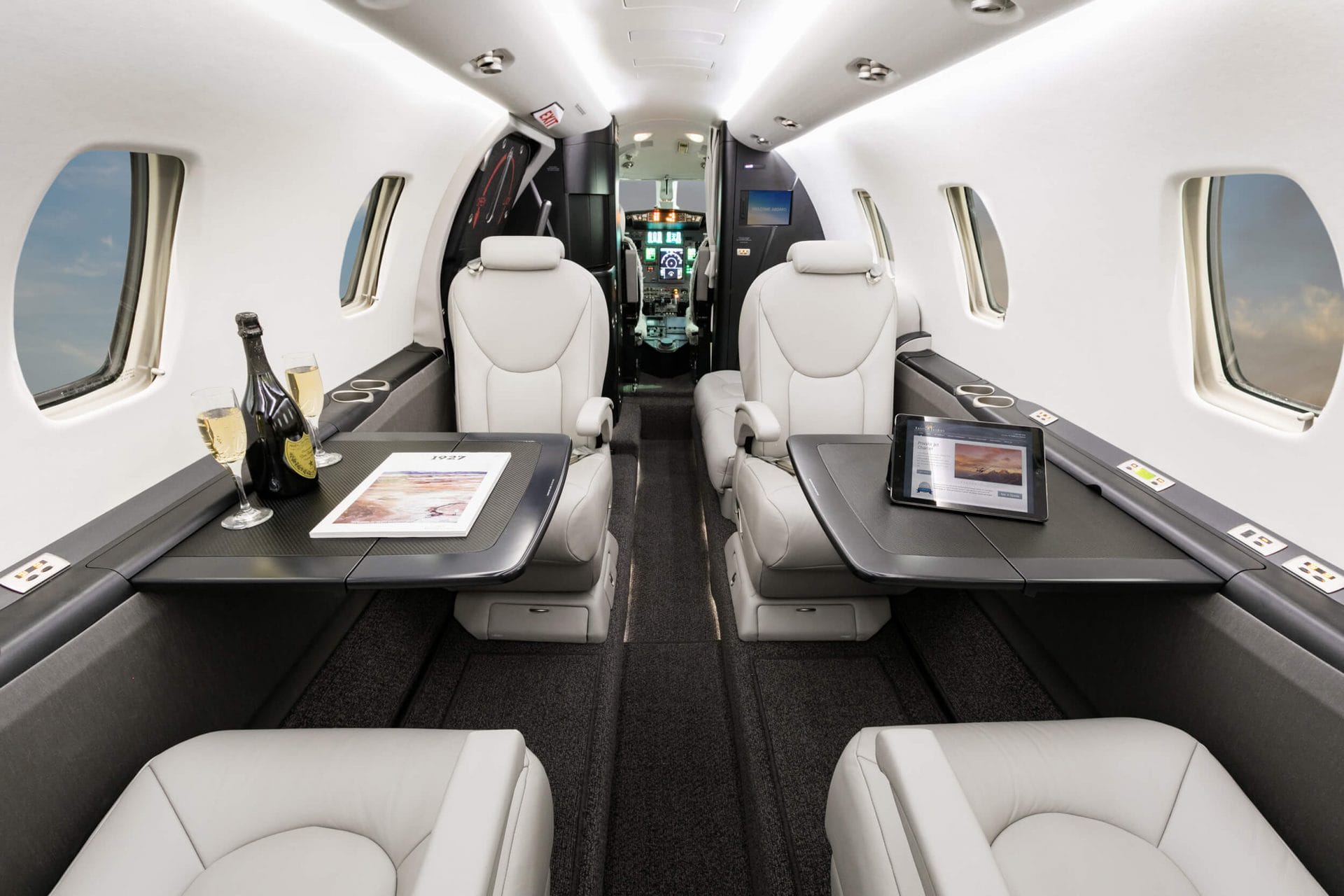
Step aboard a Citation X and the cabin immediately signals that speed hasn’t come at the expense of comfort. The interior measures 23 feet 8 inches long, 5 feet 7 inches wide, and 5 feet 5 inches tall – dimensions that allow most passengers to stand upright and move freely through the aisle.
The standard executive configuration seats eight passengers in a club arrangement: four forward-facing seats paired with four rear-facing seats, creating two natural conversation areas. The layout works particularly well for small teams traveling together, with facing seats enabling productive discussions throughout the flight. Certified capacity extends to 12 passengers in certain configurations, though most charter operations optimize for the eight-seat arrangement that balances comfort with capability.
Total cabin volume reaches 538 cubic feet in the original Citation X and 593 cubic feet in the Citation X+, both figures generous for the super-midsize category. The external baggage compartment provides 82 cubic feet of storage – enough for golf bags, skis, or the luggage a family of four needs for an extended trip.
At the rear of the cabin, a fully enclosed lavatory provides privacy on longer missions. In-flight connectivity, entertainment systems, and catering vary by operator and specific aircraft. Magellan Jets’ Client Experience team coordinates these details before departure, ensuring the cabin is configured precisely for each journey.
Cabin Comfort Across Missions
The Citation X interior proves most valuable on transcontinental flights, where passengers spend four to five hours aboard. The cabin altitude – lower than commercial aircraft due to the 51,000-foot service ceiling – reduces fatigue, and the smooth ride above most weather systems makes the time genuinely productive.
For Private Clients flying coast-to-coast regularly, the Citation X cabin offers a meaningful advantage. Work continues uninterrupted. Rest comes easier. And arrival feels more like the start of a day than recovery from travel.
Citation X Range and Mission Capability
Understanding the Citation X’s range puts its capabilities in practical context. The original Citation X reaches up to 3,125 nautical miles under optimal conditions. The Citation X+ extends that figure to approximately 3,400 nautical miles.
These numbers translate into specific real-world routings. The Citation X handles any domestic U.S. mission nonstop, including transcontinental routes like New York to Los Angeles or Boston to Seattle. It reaches Hawaii from the West Coast, the Caribbean from the Eastern Seaboard, and most Canadian and Mexican destinations from virtually any U.S. departure point.
However, the Citation X is not a transatlantic aircraft. The distance from New York to London exceeds 3,000 nautical miles before accounting for winds and reserves, placing true transatlantic capability beyond the aircraft’s range envelope. Private Clients with international charter requirements spanning oceans typically choose heavy jets or ultra-long-range aircraft for those specific missions.
The 51,000-foot service ceiling merits attention here. Flying above most commercial traffic and weather systems, the Citation X operates in cleaner air with more direct routing options. That altitude capability contributes to both the speed advantage and the smooth, quiet ride passengers experience aboard.
How the Citation X Compares to Other Super-Midsize Jets
Selecting the right aircraft for a mission involves balancing speed, cabin space, range, and economics. The Citation X occupies a specific position in the super-midsize category that suits certain travel patterns better than others.
Citation X vs. Citation Sovereign
The Citation Sovereign offers a compelling counterpoint within Cessna’s own lineup. The Sovereign provides a larger cabin – wider, taller, and configured for up to 12 passengers – along with greater baggage capacity. These advantages make it preferable for larger groups or missions where cabin comfort outweighs time savings.
The trade-off is speed. The Sovereign cruises at approximately 460 knots compared to the Citation X’s 525+ knots. On a coast-to-coast flight, that difference adds roughly 30 to 45 minutes to travel time. For Private Clients traveling alone or in small groups where every minute matters, the Citation X wins. For those prioritizing space or traveling with more than six people, the Sovereign deserves consideration.
Citation X in the Broader Super-Midsize Field
Against competitors like the Bombardier Challenger 350 or Gulfstream G280, the Citation X’s speed advantage remains its calling card. No other aircraft in the category approaches its maximum cruise Mach number. The trade-off involves cabin width – some competitors offer slightly more shoulder room – and range variations that matter primarily on specific international routings.
Magellan Jets’ Private Aviation Advisors help match aircraft to missions. Through On-Demand Charter, Private Clients access Citation X aircraft when speed is paramount and alternative super-midsize options when other factors take priority. The Magellan Jets aircraft page details the full range of aircraft categories available.
What It Costs to Charter a Cessna Citation X
Charter pricing depends on multiple factors: the aircraft category, distance, positioning requirements, and timing. For the Citation X, which operates in the super-midsize category, pricing reflects both the aircraft’s capabilities and the economics of operating a high-performance jet.
Chartering a Citation X starts from an estimated $8,550 per hour. This is an estimated hourly rate, inclusive of fuel. It does not include contingencies such as de-icing, positioning, overnight fees, catering, or other trip-specific costs. Final pricing is confirmed at time of quote.
Several factors influence total trip cost beyond the hourly rate. Positioning – moving the aircraft from where it’s based to where you need it – adds time that affects pricing. Overnight fees apply when crews must remain away from home base. De-icing in winter months, international handling fees, and catering requests contribute to the final figure.
For Private Clients who fly regularly, Jet Cards provide predictable pricing and guaranteed availability. The super-midsize category, which includes the Citation X, offers access to aircraft suited for coast-to-coast travel and missions requiring both speed and cabin comfort.
Speaking with a Private Aviation Advisor clarifies pricing for specific missions. They provide quotes that account for your departure point, destination, timing, and preferences. These are the variables that determine what a particular journey actually costs.
Frequently Asked Questions About the Cessna Citation X (FAQs):
How much does it cost to charter a Citation X?
Chartering a Citation X starts from an estimated $8,550 per hour, inclusive of fuel. This is an estimated rate and does not include contingencies such as de-icing, positioning fees, overnight expenses, or catering. A Private Aviation Advisor can provide a quote for your specific mission.
Can the Citation X fly coast-to-coast nonstop?
Yes. The Citation X handles any U.S. transcontinental route nonstop, including New York to Los Angeles or Boston to Seattle. It is not a transatlantic aircraft – the distance to Europe exceeds its range envelope when accounting for winds and fuel reserves.
Why was the Citation X discontinued, and can you still charter one?
Cessna ended Citation X production in 2018 as market preferences shifted toward larger cabins. The approximately 339 aircraft built remain in service, and many are available for charter through operators in the Magellan Jets Preferred Network.
How many passengers does the Citation X seat?
The Citation X typically seats eight passengers in executive club configuration. The aircraft is certified for up to 12 passengers in certain layouts, though most charter configurations optimize for comfort with eight seats.
What made the Citation X+ the fastest jet of its size?
The Citation X+ cruised at up to Mach 0.935, powered by Rolls-Royce AE 3007C2 turbofan engines producing 7,034 pounds of thrust each. This speed held the record for the fastest certified civilian aircraft from 2014 until December 2025, when the Bombardier Global 8000 took the title at Mach 0.95.
Does the Citation X have a lavatory?
Yes. The Citation X features a fully enclosed lavatory at the rear of the cabin. This private facility makes the aircraft well-suited for transcontinental flights lasting four hours or more.
Experience the Citation X With Magellan Jets
The Cessna Citation X represents a specific philosophy: that reaching your destination faster creates value beyond the hours saved. For Private Clients whose schedules demand transcontinental mobility measured in mornings rather than days, the Citation X delivers.
Magellan Jets sources Citation X aircraft through the Preferred Network – fewer than 100 rigorously vetted operators out of more than 2,500 licensed in the United States. Every operator meets Magellan’s highest safety standards, which include WYVERN Wingman certification and require liability insurance coverage of $100 million to $300 million. Your Private Aviation Advisor handles the details, from aircraft selection to in-flight catering, so the journey aligns precisely with your expectations.
The Bombardier Challenger 300 is a super-midsize jet with a spacious 930-cubic-foot cabin, 3,340 nautical miles of range, and 106 cubic feet of baggage space – ideal for coast-to-coast travel with gear, pets, or a full group. The Beechcraft Hawker 800XP is a midsize jet with 2,620 nautical miles of range and a more compact cabin, best suited for travelers who prioritize range over cargo capacity. Both seat up to eight passengers.
When Private Clients ask which aircraft fits their next mission, the conversation often centers on two questions: how much space do you need, and how far are you going? The Challenger 300 and Hawker 800XP represent two distinct answers. One delivers a wide, flat-floor cabin that swallows skis, golf bags, and larger pets without compromise. The other offers proven reliability and respectable range for those traveling light. Understanding the difference shapes the kind of journey you’ll experience – and that’s worth getting right before you book.
Bombardier Challenger 300: The Super-Midsize Benchmark
Step aboard a Challenger 300 and the first impression is space. The cabin stretches 23 feet 7 inches long, rises 6 feet 1 inch high, and spans 7 feet 2 inches wide. It is one of the most generous interiors in the super-midsize category. That 930 cubic feet of cabin volume translates to room for a productive meeting, an uninterrupted nap, or simply the freedom to move.
With 106 cubic feet of baggage capacity, the Challenger 300 accommodates the gear-heavy trips other aircraft strain to handle. Skis, golf clubs, large suitcases, a dog crate – they all fit. For families relocating between homes or executives traveling with presentation materials and luggage for a week, this aircraft removes the “what do we leave behind?” calculation entirely.
Range completes the picture. At 3,340 nautical miles, the Challenger 300 connects Boston to Los Angeles, New York to Aspen, or Miami to San Francisco without a fuel stop. Its high-speed cruise of 459 knots (approximately 528 mph) and 45,000-foot service ceiling mean you arrive faster and above most commercial traffic and weather.
This is one of the most versatile super-midsize jets available and is equally suited to business missions and leisure escapes where comfort and capacity matter.
For frequent flyers seeking this class of aircraft, the Challenger 300/350 Jet Card membership offers guaranteed access and transparent pricing across the Magellan Jets Preferred Network.
Beechcraft Hawker 800XP: Midsize Range and Reliability
The Hawker 800XP earned its reputation the hard way, through decades of reliable service. This midsize jet delivers a cabin measuring 21 feet 3 inches long, 5 feet 8 inches high, and 6 feet wide, providing 551 cubic feet of interior volume. It’s a comfortable space for six to seven passengers traveling without bulky cargo.
Where the Hawker 800XP distinguishes itself is range for its class: 2,620 nautical miles connects most North American city pairs without issue. You can fly New York to Denver, Chicago to Phoenix, or Atlanta to Los Angeles nonstop. High-speed cruise reaches 430 knots (approximately 495 mph) with a 41,000-foot ceiling.
Baggage capacity sits at 48 cubic feet – adequate for carry-ons, briefcases, and moderate luggage, but not the aircraft for a family moving ski gear or golf equipment for four. The Hawker 800XP suits travelers who pack efficiently and value proven performance over cabin volume.
For longer trips where passengers travel light and cabin atmosphere matters more than cargo space, the Hawker 800XP remains a respected choice in the midsize category.
Private Clients who fly frequently on midsize aircraft may benefit from the Midsize Jet Card, which locks in preferred rates and availability.
Challenger 300 vs Hawker 800XP: Side-by-Side Comparison
Which Private Jet Should You Charter?
The right aircraft depends on how you travel, not just where you’re going.
Choose the Challenger 300 when:
You’re flying coast-to-coast (New York to Los Angeles, Boston to San Francisco, Miami to Seattle)
You’re traveling with substantial baggage – ski equipment, golf clubs, full-size suitcases for extended trips
A larger pet is joining the journey
You need a flat-floor cabin with room for eight passengers to work and move comfortably
Speed matters – the Challenger 300’s 459-knot cruise saves time on longer routes
Choose the Hawker 800XP when:
Your group is six or fewer passengers traveling with light luggage
The route falls within 2,500 nautical miles – transcontinental is comfortable, but range is the limiting factor for longer distances
You prefer a proven midsize platform with decades of operational history
Budget matters – the hourly rate differential between midsize and super-midsize can add up over multiple trips
Estimated Charter Costs: Challenger 300 vs Hawker 800XP
Charter pricing varies by itinerary, positioning, aircraft availability, and trip-specific factors. The figures below provide directional guidance based on Magellan Jets’ estimated hourly rates for each aircraft category:
Challenger 300 (Super-Mid category): Estimated ~$9,700 per hour
Hawker 800XP (Midsize category): Estimated ~$8,700 per hour
These are estimated hourly rates inclusive of fuel. They do not include contingencies such as de-icing, overnight fees, repositioning, catering, ground transportation, or other trip-specific costs. Final pricing is confirmed at time of quote by your Magellan Jets Private Aviation Advisor.
On a five-hour transcontinental flight, the hourly difference translates to approximately $5,000 in additional cost for the Challenger 300 – a meaningful premium, but one that buys substantially more cabin volume, baggage space, range, and speed.
Frequently Asked Questions About Challenger 300 vs Hawker 800XP (FAQs):
Can a Challenger 300 cross the Atlantic?
The Challenger 300’s 3,340-nautical-mile range supports many transatlantic routes under favorable conditions. City pairs like New York to Shannon (Ireland), Boston to Lisbon, or Teterboro to the Azores fall within range. Winds, payload, and weather affect feasibility for any specific mission – your Magellan Jets Private Aviation Advisor confirms route viability during trip planning.
Can a Challenger 300 fly nonstop from New York to London?
New York to London spans approximately 3,000–3,500 nautical miles depending on specific airports. Under ideal conditions – favorable winds, lighter passenger load – the Challenger 300 can make this crossing. Most transatlantic charters on super-midsize aircraft include a technical fuel stop (often in Newfoundland, Iceland, or Shannon) as standard practice. Your Private Aviation Advisor assesses each routing individually.
Is the Hawker 800XP a good private jet?
Yes. The Hawker 800XP has earned its reputation through decades of reliable service. Its 2,620-nautical-mile range, comfortable six-to-seven passenger cabin, and proven systems make it a respected choice for midsize charter. It is best suited for travelers who prioritize range and cabin comfort over baggage capacity.
Is the Challenger 300 reliable?
The Bombardier Challenger 300 is considered one of the most dependable super-midsize jets in service. Its airframe, engines, and avionics benefit from a mature design with strong manufacturer support. The aircraft remains a popular choice for On-Demand Charter and Jet Card programs precisely because operators can count on its dispatch reliability.
How many passengers do the Challenger 300 and Hawker 800XP seat?
Both aircraft seat up to eight passengers with two crew members. The Challenger 300 offers more cabin space per passenger (930 cubic feet versus 551 cubic feet), which affects comfort on longer flights.
Find the Right Aircraft for Your Next Journey
Whether your trip calls for the Challenger 300’s expansive cabin and coast-to-coast range or the Hawker 800XP’s efficient footprint for shorter missions, the right choice starts with a conversation about how you travel.
Magellan Jets’ Private Aviation Advisors source aircraft from the Magellan Jets Preferred Network. The Network holds fewer than 100 rigorously vetted operators out of roughly 3,000 licensed in the U.S. Every recommendation reflects your itinerary, your timeline, and your priorities.
If you’re evaluating private aviation programs in 2026, the comparison between Magellan Jets and NetJets has shifted significantly. NetJets, operator of more than 850 aircraft and one of the most recognized names in fractional ownership, began limiting new Jet Card and lease sales in late July 2026 to focus on its core fractional business, as reported by Forbes. Current cardholders may renew, but prospective buyers face a narrower path to entry.
Magellan Jets, by contrast, offers a complete private aviation ecosystem: Jet Cards, On-Demand Charter, Fractional Ownership, and Aircraft Sales & Management, all under one relationship, all accepting new Clients without restriction. This guide compares the Magellan Jets Jet Card to NetJets’ fractional ownership model and its Jet Card programs, so you can determine which approach fits your travel profile and financial outlook.
Jet Card vs. Fractional Ownership: A Foundational Difference
Jet Cards provide prepaid access to private aviation with guaranteed availability, defined pricing, and flexible terms. Magellan Jets is the first provider to offer a fully customizable Jet Card, built around individual Client travel patterns, aircraft preferences, and hourly commitment levels. Clients purchase any number of hours at or above a 25-hour minimum.
Traditional fractional ownership involves purchasing a share of an aircraft, with ongoing management costs and multi-year commitments. Even with that investment, aircraft access is shared among multiple owners.
The practical distinction: Jet Cards prioritize flexibility and ease of use. Fractional ownership introduces higher upfront capital, longer-term obligations, and additional cost layers that exist whether or not you fly.
Magellan Jets Jet Card vs. NetJets Fractional Ownership
Financial Structure and Risk
Magellan Jets operates an asset-light model. It does not own aircraft, and Client funds are never co-mingled with operational costs. Funds are segregated, fully protected, and never expire until used for travel.
NetJets fractional ownership requires capital investment in an aircraft share, plus ongoing management and operational fees that continue regardless of flight activity. Market depreciation on the owned share is an additional consideration.
Availability and Access
Magellan Jets Jet Card: 365-day guaranteed availability, zero blackout dates, zero peak-day surcharges
NetJets Fractional: No blackout dates, but 10 peak days annually require advance coordination
Flexibility and Usage
With Magellan Jets, hours never expire. Clients purchase any commitment at or above the 25-hour minimum and unlock additional benefits at the 50-hour and 100-hour thresholds. Access spans seven aircraft categories with no interchange fees, and multi-aircraft access (up to eight aircraft in a single day at 100 hours) supports complex travel requirements.
50 hours: Preferred hourly pricing, Advantage Routes (preferred pricing on high-demand corridors), short-leg waivers (a Client flying Boston to Nantucket can save up to $10,000 per trip), deeper discounts
100 hours: The deepest preferred pricing, maximum short-leg waiver access, strongest discounts
NetJets fractional owners are allocated access by ownership share size, and fractional programs carry 10 peak days per year. Using aircraft outside the owned category can involve interchange arrangements.
Pricing Transparency
Magellan Jets uses point-to-point pricing billed on estimated flight time. Rate lock terms protect against cost increases: 12 months at 25 hours, 18 months at 50 hours, 24 months at 100 hours. Pricing is transparent and all-inclusive on Premium Jet Cards.
NetJets fractional combines acquisition cost, monthly management fees, occupied hourly rates, and fuel surcharges into a layered structure that fluctuates with usage and market conditions.
Commitment Timeline
Magellan: Customizable hours at or above a 25-hour minimum; no multi-year lock-in required
NetJets Fractional: Typically a larger annual hour commitment across a multi-year ownership term
Magellan Jets Jet Card vs. NetJets Jet Card (Card275 and Card320)
Important context: In late July 2026, NetJets began limiting new Jet Card and lease sales, the second such pause in five years (the first occurred in 2021). Current cardholders may renew, but new buyers should verify availability. The comparisons below reflect the structure of NetJets’ Card275 and Card320 programs as they were offered prior to this change.
Availability
Magellan: 365 days, zero blackout dates, zero peak-day surcharges
NetJets Card275: 275 access days, approximately 90 blackout dates annually
NetJets Card320: 320 access days, 45 blackout dates plus 45 peak days that carry longer booking windows rather than surcharges, per Private Jet Card Comparisons
Pricing and Entry Point
NetJets Jet Card pricing (when programs were accepting new sales) started at approximately $8,600 per hour on the Phenom 300 for Card275 and approximately $11,200 per hour on the Phenom 300 for Card320, sold in 25- or 50-hour blocks, according to Private Jet Card Comparisons.
Magellan Jets offers two card types at any commitment level starting at 25 hours:
Category Jet Card: From $7,800 per hour (inclusive of fuel). Features include daily minimum of 1.3 hours, 40 advanced booking days for guaranteed availability, no peak-day surcharges, no blackout dates, and repositioning included. De-icing and catering are additional.
Premium Jet Card: From $9,375 per hour (all-inclusive: fuel, catering, de-icing, Wi-Fi). Features include daily minimum of 1 hour, 20 advanced booking days, and long-leg plus round-trip discounts.
At the 50-hour level, Advantage Routes deliver a 7% rate reduction on Client-selected high-demand corridors. Currently live on two eastern routes, expanding to seven by Fall 2026.
Notice Time
Magellan: As short as 24 hours, depending on aircraft category and membership tier
Magellan Jets provides access to seven aircraft categories with fee-free interchange, allowing Clients to match the aircraft to the mission, from a Light Jet for a short regional hop to a Heavy Jet for a transatlantic crossing. Premium Jet Card holders can select specific models: Phenom 300, Challenger 350, or Gulfstream G450/550.
NetJets operates a large owned fleet of more than 850 aircraft, according to Forbes. Its jet card programs offered a limited lineup of aircraft, with category upgrades contingent on availability. Every Magellan Jets Client receives equal booking priority, with multi-aircraft access scaling by commitment: up to four aircraft per day at 25 hours, six at 50 hours, and eight at 100 hours.
Short-Leg Waivers
Most private aviation programs apply a daily minimum flight charge regardless of actual air time. Magellan Jets’ short-leg waivers eliminate these minimums on qualifying regional routes, delivering significant savings on short missions. A Client flying Boston to Nantucket can save up to $10,000 on a single trip. Waivers scale with commitment: four at 50 hours, eight at 100 hours.
Magellan Jets charges no peak-day surcharges and no interchange fees. Pricing models are clearly delineated: Category Jet Cards itemize optional add-ons, while Premium Jet Cards bundle everything into a single hourly rate. Clients know their exposure before booking.
NetJets structured its card programs with pricing limits tied to access days, plus fees for upgrading or downgrading aircraft category mid-trip.
Which Program Should You Choose?
NetJets brings a highly structured approach, a large fleet, and long-standing presence in the market. For travelers comfortable with defined systems and standardized offerings, and who qualify for the currently limited availability, it remains a recognized option.
Magellan Jets offers the first fully customizable Jet Card, an asset-light model that protects Client funds, and a complete private aviation ecosystem. Clients never outgrow the relationship: as travel patterns evolve, they move fluidly between Jet Cards, On-Demand Charter, Fractional Ownership, and Aircraft Sales & Management through a single trusted partner.
That full suite is the point. Jet Cards deliver prepaid, flexible access with guaranteed availability for Clients who fly regularly. On-Demand Charter fits occasional or one-off trips, including complex multi-aircraft itineraries, with no long-term commitment. Fractional Ownership suits higher-frequency flyers who want an owned asset on more flexible terms than the traditional model. Aircraft Sales & Management supports Clients who already own an aircraft, or plan to, pairing acquisition guidance with day-to-day operational oversight. As needs shift, a Client moves between these solutions without ever changing partners.
For travelers evaluating options in 2026, the question is straightforward: Do you want to navigate restricted availability and multi-year ownership commitments, or would you prefer guaranteed access, flexible terms, and a partner designed around how you actually fly?
Frequently Asked Questions About NetJets vs. Magellan Jets (FAQs):
Does Magellan Jets offer more than Jet Cards?
Yes. Magellan Jets provides a complete private aviation ecosystem: Jet Cards, On-Demand Charter, Fractional Ownership, and Aircraft Sales & Management. Clients can access any solution as their needs evolve, without changing providers.
What is the difference between NetJets fractional and Jet Card programs?
Fractional ownership requires capital investment in an aircraft share with ongoing management fees, regardless of flight activity. Jet Cards provide prepaid flight hours without ownership, typically with greater flexibility and lower upfront commitment.
Which program offers better availability?
Magellan Jets guarantees availability 365 days a year with zero blackout dates and zero peak-day surcharges. NetJets Card275 restricts approximately 90 days annually; Card320 restricts 45 blackout days plus 45 peak days that carry longer booking windows rather than surcharges, per Private Jet Card Comparisons.
How much does a NetJets Jet Card cost?
When accepting new sales, NetJets Card275 started at approximately $8,600 per hour on the Phenom 300, and Card320 started at approximately $11,200 per hour, per Private Jet Card Comparisons. As of late July 2026, NetJets has limited new Jet Card sales, so pricing for new customers may not be available.
Is a NetJets Jet Card still available in 2026?
NetJets announced in late July 2026 that it is limiting new Jet Card and lease sales to focus on its core fractional ownership business, as reported by Forbes. Current cardholders may renew, but prospective buyers should confirm availability directly with NetJets.
Which Jet Card is best for occasional travel?
For travelers flying 25–50 hours annually, Magellan Jets’ Category Jet Card offers a competitive entry point with full availability and no peak-day surcharges. The 25-hour minimum provides access without requiring the capital or commitment of fractional ownership.
How quickly can I book a flight?
Magellan Jets offers call-out windows as short as 24 hours, depending on aircraft category and membership tier. NetJets requires a 48-hour callout on both card tiers for guaranteed availability.
What is a NetJets Peak Day?
Peak days are high-demand dates when NetJets applies longer booking windows and can shift departure times, with fractional owners generally receiving access priority. On Card320 the 45 peak days carry no surcharge; fractional ownership includes 10 peak days. Magellan Jets has no peak-day surcharges.
What is a Blackout Date?
A blackout date is a day when a Jet Card provider does not guarantee aircraft availability. NetJets Card275 includes approximately 90 blackout dates annually. Magellan Jets has zero blackout dates, with availability guaranteed 365 days a year.
What is an Advanced Booking Day?
Advanced booking days (ABDs) refer to the minimum notice required to guarantee availability at standard rates. Magellan Jets Category Jet Cards require 40 ABDs; Premium Jet Cards require 20 ABDs. Shorter notice may still be accommodated depending on aircraft availability.
How does a NetJets Jet Card work?
A NetJets Jet Card is a prepaid block of flight hours (typically 25) that provides access to NetJets’ fleet without aircraft ownership. Cardholders pay an upfront deposit plus hourly rates, with availability subject to blackout dates and notice requirements. Note: New sales are currently limited as of late July 2026.
Is a NetJets Jet Card worth it?
A NetJets Jet Card can suit travelers who value a large single-operator fleet and brand recognition, provided they accept blackout dates, peak-day restrictions, and 48-hour notice windows. With new sales limited as of late July 2026, travelers who want guaranteed 365-day access and flexible terms increasingly compare Magellan Jets, whose fully customizable Jet Card carries no blackout dates and no peak-day surcharges.
The Challenger 350 jet is the direct evolution of the Challenger 300, sharing the same 23 ft 7 in cabin and CL-30 type rating but delivering more thrust, redesigned winglets, and updated avionics. Both are super-midsize jets capable of coast-to-coast missions across North America. The 300 was built from 2003 to 2014; the 350 launched in 2014 and was superseded by the Challenger 3500 in 2022.
If you’ve flown aboard a Challenger 300 or are considering your first flight on a Challenger 350, the two jets may look nearly identical on the ramp. They share a common lineage, common cockpit credentials, and a cabin that remains one of the most generous in the super-midsize category. Yet the differences matter when you’re matching an aircraft to a specific mission – or deciding whether to request a 350 over a 300 through On-Demand Charter or a Jet Card.
This comparison covers what Private Clients and aviation professionals need to know: specs, range, cabin dimensions, engine performance, and how each jet fits into Bombardier’s current lineup.
The Challenger 300: A Super-Midsize Standard
Bombardier introduced the Challenger 300 in 2003 as a clean-sheet design aimed at bridging the gap between midsize and heavy jets. Over its eleven-year production run, the 300 earned a loyal following among operators and Private Clients alike. It offered a flat-floor, stand-up cabin without the operating costs of a larger aircraft.
Challenger 300 Key Specifications
Category: Super-Midsize
Passengers: 8
Cabin: 23 ft 7 in long × 7 ft 2 in wide × 6 ft 1 in tall; 930 cu ft volume
Baggage: 106 cu ft
Range: 3,340 nm
Max cruise speed: 459 kn (~528 mph)
Ceiling: 45,000 ft
Engines: 2× Honeywell HTF7000, 7,000 lbs thrust each
Wingspan: 63.8 ft
Crew: 2 pilots
The 300’s range of 3,340 nm covers transcontinental missions with ease – Los Angeles to New York, Miami to Seattle, or Boston to Denver with reserves. Its 45,000-ft ceiling lets it cruise above most commercial traffic, and its 459-knot cruise speed keeps flight times competitive with larger jets.
Production ended in 2014 when the Challenger 350 took its place. The 300 remains popular on the secondary market and is widely available for charter through operators in the Magellan Jets Preferred Network.
The Challenger 350 Jet: What Changed
When Bombardier launched the Challenger 350 in 2014, the goal was evolution rather than revolution. The airframe, cabin cross-section, and systems architecture carry over from the 300, but three changes stand out: the engines, the winglets, and the avionics.
Challenger 350 Jet Key Specifications
Category: Super-Midsize
Passengers: Up to 9
Cabin: 23 ft 7 in long × 7 ft 2 in wide × 6 ft 1 in tall; 930 cu ft volume
Baggage: 106 cu ft
Range: 3,269 nm
Max cruise speed: 459 kn (~528 mph)
Ceiling: 45,000 ft
Engines: 2× Honeywell HTF7350, 7,323 lbs thrust each
Wingspan: 69.0 ft (redesigned winglets)
Avionics: Collins Pro Line 21 Advanced
Crew: 2 pilots
More Thrust, Better Climb Performance
The Honeywell HTF7350 engines produce 7,323 lbs of thrust per engine – roughly 4.6% more than the HTF7000 engines in the 300. That additional power translates to improved hot-and-high performance, shorter runway requirements at challenging airports, and faster time-to-altitude.
Redesigned Winglets
The 350’s most visible change is its wingspan. At 69.0 ft, the 350’s wingspan is more than five feet greater than the 300’s 63.8 ft, thanks to redesigned winglets. These winglets reduce induced drag, improve fuel efficiency, and contribute to better short-field performance. They also give the 350 a distinctive silhouette that Private Clients often recognize on approach.
Collins Pro Line 21 Advanced
Bombardier upgraded the flight deck with Collins Pro Line 21 Advanced avionics, featuring synthetic vision, enhanced situational awareness displays, and streamlined pilot workload. For passengers, the practical benefit is a crew better equipped to navigate challenging weather and congested airspace.
Cabin Experience: What It’s Like Onboard
Both the Challenger 300 and Challenger 350 share the same flat-floor stand-up cabin: 6 ft 1 in of headroom, 23 ft 7 in of length, and 7 ft 2 in of width. Private Clients walk freely, stretch, and work without ducking through transitions or stepping over obstacles. Large windows line both sides, drawing natural light deep into the cabin and keeping even midday transcons bright and open.
The Challenger 350 adds a Collins Pro Line 21 Advanced cabin management system, giving passengers direct control of lighting zones, temperature, and entertainment from touchscreen interfaces at each seat. Noise levels remain remarkably low in both aircraft, thanks to Bombardier’s acoustic insulation engineering. Side-ledge storage runs beneath the windows, offering convenient compartments for devices, documents, and personal items without cluttering the main cabin area. The result is a working or relaxing environment that justifies the super-midsize category’s reputation for comfort.
Operating Efficiency and Range in Practice
The Challenger 350’s HTF7350 engines produce 7,323 lbs of thrust each, a measurable step up from the Challenger 300’s HTF7000 engines at 7,000 lbs. Paired with redesigned winglets that extend the wingspan to 69.0 ft (compared to the 300’s 63.8 ft), the 350 delivers improved fuel efficiency and stronger performance from short runways and high-elevation airports. Both aircraft cruise at 459 kn (approximately 528 mph) and reach a ceiling of 45,000 ft, keeping Private Clients above weather and commercial traffic.
In practice, these numbers mean coast-to-coast capability on domestic missions. A Los Angeles–New York trip, a Miami–Aspen ski run, or a Teterboro–Las Vegas roundtrip all fall comfortably within either jet’s range. The Challenger 300 covers 3,340 nm; the 350 reaches 3,269 nm. Both handle transcontinental routes without refueling stops. The 350’s edge appears on challenging departures: shorter fields, thinner air, hotter tarmac. Where the 300 performs well, the 350 performs with margin to spare.
The Challenger 350 remained in production until 2022, when Bombardier introduced the Challenger 3500 as its successor. Today, the 350 is widely available for charter and remains one of the most requested super-midsize jets in the Magellan Jets Preferred Network.
Head-to-Head Specs Comparison: Challenger 300 vs 350
Challenger 300
Category: Super-Midsize
Passengers: 8
Cabin length: 23 ft 7 in
Cabin width: 7 ft 2 in
Cabin height: 6 ft 1 in
Cabin volume: 930 cu ft
Baggage capacity: 106 cu ft
Range: 3,340 nm
Max cruise speed: 459 kn (~528 mph)
Ceiling: 45,000 ft
Engines: 2× Honeywell HTF7000
Thrust per engine: 7,000 lbs
Wingspan: 63.8 ft
Avionics: Collins Pro Line 21
Type rating: CL-30
Crew: 2 pilots
Production: 2003–2014
Challenger 350
Category: Super-Midsize
Passengers: Up to 9
Cabin length: 23 ft 7 in
Cabin width: 7 ft 2 in
Cabin height: 6 ft 1 in
Cabin volume: 930 cu ft
Baggage capacity: 106 cu ft
Range: 3,269 nm
Max cruise speed: 459 kn (~528 mph)
Ceiling: 45,000 ft
Engines: 2× Honeywell HTF7350
Thrust per engine: 7,323 lbs
Wingspan: 69.0 ft
Avionics: Collins Pro Line 21 Advanced
Type rating: CL-30
Crew: 2 pilots
Production: 2014–2022
Which Should You Charter?
For most Private Clients, the differences between the Challenger 300 and 350 come down to mission specifics and personal preference rather than capability. Both aircraft cover the same routes, seat similar passenger counts, and offer nearly identical cabin environments.
Choose the Challenger 300 When:
Availability or positioning makes it the more practical option for your departure date
Your mission falls well within its 3,340-nm range
Cabin finishes and model year are less important than schedule and cost
Choose the Challenger 350 Jet When:
You want the latest cabin interiors and avionics
Your departure airport has elevation or temperature factors where extra thrust helps
You prefer newer aircraft in your charter profile
Both jets are available through Magellan Jets’ On-Demand Charter and Jet Card programs. A Private Aviation Advisor can help identify which aircraft best fits your specific trip.
Real-World Missions: Where Each Jet Excels
For coast-to-coast business travel – New York to Los Angeles, Boston to San Francisco – both the Challenger 300 and Challenger 350 deliver nonstop capability, ample workspace, and arrival times that outpace commercial alternatives by hours. Teams of six to eight Private Clients travel together without compromise.
The 350 earns its advantage on missions involving shorter or higher-elevation runways. Aspen, Telluride, Sun Valley, and similar mountain destinations benefit from the 350’s enhanced takeoff performance. For family trips within North America and the Caribbean – spring break in the Turks and Caicos, summer in Nantucket – both aircraft carry the full party plus luggage in a cabin designed for comfort over long sectors.
When a mission stretches beyond North America – nonstop transatlantic to London, Paris, or Geneva – Private Clients should consider stepping up to a heavy jet. The super-midsize category handles most domestic and Caribbean itineraries with ease; transcontinental Europe requires the range and endurance of a larger aircraft. Through Magellan Jets’ On-Demand Charter service, Private Clients access the right aircraft for every journey, whether that means a Challenger for a week of domestic meetings or a Gulfstream for an overseas closing.
Where the Challenger 3500 Fits
In 2022, Bombardier introduced the Challenger 3500 as the successor to the 350. The 3500 retains the same proven airframe and CL-30 type rating but adds a redesigned cabin with new seating, larger windows in certain configurations, and an updated environmental control system. It is currently in production and represents the latest iteration of the Challenger 300/350 lineage.
For Private Clients who value the newest interiors and technology, the Challenger 3500 is an option worth discussing with your Private Aviation Advisor. For those prioritizing availability and mission fit, the 300 and 350 remain excellent choices and are more widely available across the charter market.
Challenger 350 Charter Cost
Charter pricing for the Challenger 350 jet – or the Challenger 300 – varies by route, season, and trip-specific factors. As a general reference, the estimated hourly rate for Super-Midsize charter is approximately $9,816 per hour.
This is an estimated hourly rate for Super-Midsize charter, inclusive of fuel. It does not include contingencies such as de-icing, positioning, overnight fees, or other trip-specific costs. Final pricing is confirmed at time of quote.
Magellan Jets’ safety standards apply to every aircraft sourced through the Preferred Network, whether you fly a Challenger 300, 350, or another super-midsize jet. Every operator is vetted against rigorous criteria, and every trip is backed by the company’s 24/7 support.
Frequently Asked Questions About the Challenger 300 vs Challenger 350 (FAQs):
How much is a Challenger 350 jet?
For charter, the estimated hourly rate for a Super-Midsize jet like the Challenger 350 is approximately $9,816 per hour, inclusive of fuel. This estimate does not include de-icing, positioning, overnight fees, or other trip-specific costs. Final pricing is confirmed at the time of quote. Magellan Jets does not publish aircraft purchase or sale prices in this context.
Can a Challenger 350 fly to Europe or cross the Atlantic?
The Challenger 350’s range of 3,269 nm is not sufficient for nonstop transatlantic crossings from the U.S. East Coast to most European destinations. However, with a fuel stop in Iceland, Greenland, or the Azores, the 350 can complete transatlantic missions. For nonstop service to Europe, a heavy jet or ultra-long-range aircraft is typically required.
Is the Challenger 300 and 350 the same type rating?
Yes. Both aircraft share the CL-30 type rating, meaning pilots certified on one can fly the other without additional training. This commonality benefits operators and contributes to the availability of both jets in the charter market.
What is the difference between a Challenger 350 and Challenger 3500?
The Challenger 3500, introduced in 2022, is the successor to the 350. It shares the same airframe and CL-30 type rating but features a redesigned cabin with new seating, updated environmental controls, and refinements to passenger amenities. The 3500 is currently in production; the 350 is no longer manufactured but remains widely available for charter.
How fast does a Challenger 350 go?
The Challenger 350 has a maximum cruise speed of 459 knots, or approximately 528 mph. This is identical to the Challenger 300’s cruise speed.
How many passengers does the Challenger 350 seat?
The Challenger 350 seats up to 9 passengers in a typical charter configuration. The Challenger 300 seats 8. Both offer a cabin that is 23 ft 7 in long, 7 ft 2 in wide, and 6 ft 1 in tall – one of the most spacious in the super-midsize category.
What is the Challenger 350 wingspan?
The Challenger 350 has a wingspan of 69.0 ft, more than five feet greater than the Challenger 300’s 63.8-ft wingspan. The difference comes from redesigned winglets that improve fuel efficiency and short-field performance.
Can the Challenger 300 fly New York to London?
No. The Challenger 300’s range of 3,340 nm falls short of the roughly 3,450 nm required for a nonstop New York-to-London flight. With a fuel stop – typically in Iceland or eastern Canada – the 300 can complete the journey. For nonstop transatlantic flights, a heavy jet such as a Gulfstream G450 or G550 is a better fit.
Find the Right Jet for Your Next Mission
Whether you’re comparing the Challenger 300 and 350 for a specific trip or exploring which super-midsize jet fits your travel profile, a conversation with a Private Aviation Advisor can clarify your options. Magellan Jets’ team can match the aircraft to your route, passenger count, and schedule – drawing from the Preferred Network’s inventory of vetted operators.
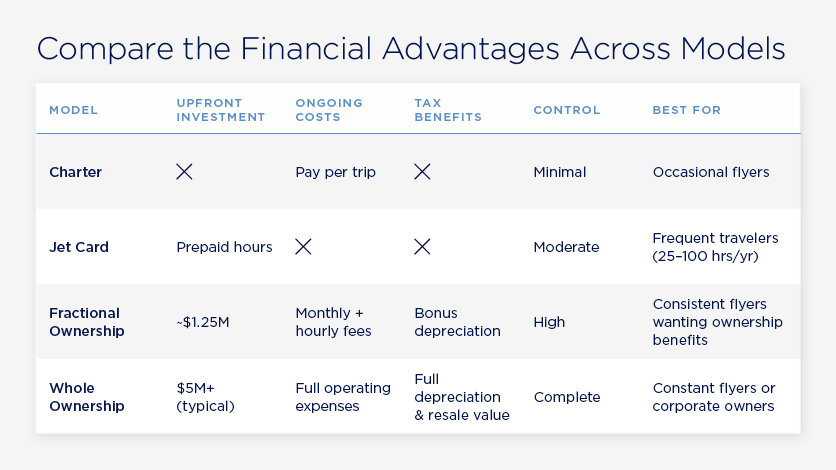
A private jet tax deduction is available when a qualifying aircraft is used more than 50% for legitimate business purposes and accessed through an ownership interest. Under current federal law, owners of qualifying business aircraft may claim 100% first-year bonus depreciation, while On-Demand Charter and Jet Card flyers may instead deduct qualifying flight costs as ordinary business travel. Whether private jets are tax deductible comes down to two questions: how you access the aircraft, and how rigorously you document its use. Every path below carries a different answer.
The 2025 tax law changes reset the calculus for business owners, CFOs, and high-net-worth flyers who have been weighing aviation on the margin. For the first time in years, the depreciation math and the operational reality point in the same direction. The opportunity is real, and so is the scrutiny that comes with it.
Understanding the Four Primary Models
Private aviation is not a single product. It is a spectrum of four access models, each suited to a different flight profile and a different financial posture. The tax treatment of each turns on one distinction: whether you hold an ownership interest in the aircraft or simply buy access to it. That single line separates depreciation from deduction, and it shapes every strategy that follows.
On-Demand Charter
On-Demand Charter is access by the trip, with no commitment and no capital outlay. You pay for the specific mission you fly. Cost is driven by aircraft category, trip distance, and positioning requirements, and a Private Aviation Advisor confirms exact figures for each journey.
The financial benefit is flexibility. You commit nothing until you fly, and you scale up or down as the year unfolds. On the tax side, On-Demand Charter involves no ownership, so it generates no depreciation. On-Demand Charter costs tied to a business trip may be deductible as ordinary and necessary business travel under IRC §162, subject to a separate analysis and full substantiation. Treat that as distinct from depreciation.
The Jet Card
A Jet Card is prepaid access with guaranteed availability and fixed hourly rates. You purchase hours in advance and draw against them across the year. Cost depends on aircraft category and the number of hours committed, and Magellan Jets protects Client funds so they never expire and are never co-mingled with operational accounts.
The benefit is certainty. You lock a rate, secure availability 365 days a year, and remove the trip-by-trip pricing question. Like On-Demand Charter, a Jet Card is prepaid access rather than ownership, so it produces no depreciation. Business-use flights may still be deductible as travel expenses under IRC §162 with proper records.
Fractional Ownership
Fractional Ownership gives you a deeded share of a specific aircraft, along with a defined number of guaranteed flight days each year. This is where the tax picture changes. Because you hold a real ownership interest, you hold a depreciable asset.
Fractional owners may claim depreciation on their share of the aircraft, including bonus depreciation, provided the more-than-50% business-use test is met. The deduction is prorated to the ownership percentage and to the business-use percentage. Cost is a function of share size, aircraft category, and program term, and your Private Aviation Advisor models the exact structure alongside your tax counsel.
Whole Aircraft Ownership
Whole ownership means sole title to the aircraft and full operational control. It carries the highest commitment and the widest tax opportunity. Because the entire aircraft basis sits on your books, the full depreciation schedule, including 100% first-year bonus depreciation, applies to a qualifying business aircraft.
Cost spans acquisition, crew, maintenance, and management, all of which a Private Aviation Advisor helps structure. Magellan Jets supports owners through Aircraft Sales & Management, handling acquisition and day-to-day oversight so the asset performs against both the flight schedule and the financial plan. Owners who need lift beyond their aircraft can supplement with On-Demand Charter or a Jet Card through the same relationship.
Qualifying Business Use: How a Private Jet Tax Deduction Actually Works
The largest gap in most aviation tax conversations is the qualifying-use standard. Depreciation is not triggered by buying an aircraft. It is earned by using it for business, and by proving it.
Business aircraft are treated as listed property under IRC §280F. To claim bonus or accelerated depreciation, the aircraft must be used more than 50% for qualified business use. Below that threshold, only straight-line depreciation under the Alternative Depreciation System is available, and bonus depreciation is disallowed. IRS Publication 946 sets out these rules, and the National Business Aviation Association (NBAA) covers the technical implications in further depth.
Documentation carries the claim. The IRS expects contemporaneous flight logs that record the date, route, passengers, and business purpose of every leg. As The Tax Adviser reports, substantiation, not intent, is what survives an audit.
Several rules narrow the picture further. Personal and entertainment use is non-deductible, and it reduces your business-use percentage. The deduction is prorated to that percentage. And if business use later drops below 50%, recapture can claw back depreciation you have already claimed. The IRS has expanded its corporate-aircraft audit activity, which The Tax Adviser documents, so the aircraft tax planning that holds up is the kind built on records from the first flight, not reconstructed afterward.
Strategic Tax Opportunities Under the OBBBA
The One Big Beautiful Bill Act (OBBBA, Public Law 119-21), signed July 4, 2025, reshaped the depreciation landscape for business aircraft. It permanently restored 100% first-year bonus depreciation under IRC §168(k) for qualified property, including business aircraft acquired and placed in service after January 19, 2025. The IRS has issued implementing guidance on the amended deduction.
“Permanent” here means there is no scheduled sunset under current law. It does not mean the provision is beyond change. A future Congress could revise or repeal it, so treat the current 100% rate as today’s opportunity rather than a fixed constant.
Both new and used aircraft can qualify for private jet bonus depreciation. Under the OBBBA, a used aircraft must be acquired from an unrelated party and must not have been previously used by the taxpayer. The eligibility tests are specific, and you should confirm them with a tax professional before you rely on them.
Section 179 offers a parallel path for smaller expensing. For tax years beginning in 2025, the maximum deduction is $2,500,000, with the phase-out beginning at $4,000,000 and eliminated at $6,500,000. For 2026, those figures rise to $2,560,000 and $4,090,000 under IRS Rev. Proc. 2025-32. These limits sit well below the cost of most business aircraft, so bonus depreciation typically does the heavier lifting.
One caveat deserves attention. State tax conformity to federal bonus depreciation varies, and some states decouple from IRC §168(k) entirely. Model the federal and state treatment together, and make no assumption about total savings until both are confirmed by your advisor.
The Magellan Jets Advantage
Magellan Jets is an asset-light private aviation solutions provider. It does not own or operate aircraft. Instead, it sources the right aircraft for each mission from the Magellan Jets Preferred Network, an exclusive group of fewer than 100 rigorously vetted operators out of roughly 3,000 licensed in the United States.
That structure matters for a financial decision. Because Magellan Jets holds no fleet, it has no utilization quota to fill, so every recommendation is made in the Client’s interest rather than the company’s. A Client can move from On-Demand Charter to a Jet Card, into Fractional Ownership, and on to whole ownership without leaving the relationship, matching the aviation structure to the tax structure as needs evolve.
Every Client works with a dedicated Private Aviation Advisor who coordinates the strategy and a Client Experience team who manages the details of each journey. Safety anchors the model: Magellan Jets is the sole private jet solutions provider represented on the Air Charter Safety Foundation (ACSF) Board, holds WYVERN Wingman Broker Certification, and works only with operators carrying $100M to $300M in liability insurance. The same asset-light model that protects your capital also removes the pressure to keep a fleet flying, which is what keeps safety and financial advice aligned.
Frequently Asked Questions About Private Jet Tax Deductions (FAQs):
What is 100% bonus depreciation in private aviation?
It is a provision under IRC §168(k) that lets a business deduct the full cost of a qualifying aircraft in the year it is placed in service, rather than spreading it across many years. The OBBBA permanently restored the 100% rate for qualified aircraft acquired and placed in service after January 19, 2025. Eligibility still depends on the more-than-50% business-use test.
Can you write off 100% of a private jet?
Potentially, if you own a qualifying business aircraft, place it in service after January 19, 2025, and use it more than 50% for qualified business purposes. The private jet tax write off is prorated to your business-use percentage, so personal and entertainment flights reduce it. A tax professional should confirm your specific eligibility.
Which private aviation model offers the best tax deductions?
Ownership models offer the most, because only ownership creates a depreciable asset. Whole ownership carries the full aircraft basis, and Fractional Ownership allows depreciation on your share. On-Demand Charter and Jet Cards do not generate depreciation, though their flight costs may be deductible as business travel.
Can fractional owners claim depreciation?
Yes. A fractional owner holds a real interest in a specific aircraft and may depreciate that share, including bonus depreciation, when the more-than-50% business-use test is met. The deduction is prorated to both the ownership percentage and the business-use percentage.
Do Jet Card or On-Demand Charter programs qualify for bonus depreciation?
No. Both are access rather than ownership, so neither creates a depreciable asset and neither qualifies for bonus depreciation aircraft treatment. Flights taken for business may still be deductible as ordinary business travel under IRC §162, with proper substantiation.
What qualifies as business use for a private jet deduction? Flights taken for a genuine business purpose, documented with contemporaneous logs that record the date, route, passengers, and reason for travel. Personal and entertainment flights do not count and reduce your business-use percentage. Because aircraft are listed property under IRC §280F, business use must exceed 50% to claim accelerated or bonus depreciation.
Does the “Big Beautiful Bill” give private jet owners a $6,000 tax deduction? No. The $6,000 figure is a separate senior deduction for taxpayers age 65 and older, available for tax years 2025 through 2028. It phases out above $75,000 of modified adjusted gross income for single filers and $150,000 for joint filers, and disappears entirely at $175,000 and $250,000. It has no connection to private aviation, and most high-net-worth readers are phased out of it anyway.
What makes whole ownership financially advantageous? Whole ownership places the entire aircraft basis on your books, so the full depreciation schedule, including 100% bonus depreciation, applies to a qualifying business aircraft. It also gives you complete control over scheduling, configuration, and crew. The tradeoff is the highest commitment across acquisition, crew, maintenance, and management, which is why owners pair it with Aircraft Sales & Management support.
Take Flight With a Smarter Financial Strategy
The right answer is not the model with the largest deduction. It is the model that fits how you actually fly, structured so the tax treatment follows the flight profile rather than the other way around. Ten trips a year and 150 hours a year lead to very different conclusions, and the difference between a defensible deduction and a costly one is the documentation behind it. If you are comparing aircraft alongside the numbers, our Phenom 300 versus Citation Excel comparison is a useful companion read.
A Private Aviation Advisor can map your flight profile, your ownership options, and your tax picture in a single conversation, then bring in your tax counsel to confirm the structure. Connect with Magellan Jets to build the strategy around the way you fly.
This article is general information only and does not constitute tax, legal, or accounting advice. Tax outcomes depend on your specific facts, and rules change. State tax conformity to federal bonus depreciation varies by jurisdiction. Consult your own qualified tax, legal, and accounting advisors before acting on any strategy described here.
Yes, you can plan last-minute summer vacations by private jet with the right partner. Jet Card holders receive priority access during peak season. A Private Aviation Advisor works with Clients to secure aircraft and airports within hours, if necessary.
This guide shows where to go and how to book, one confident decision at a time.
How Last-Minute Private Jet Travel Works in Summer
Short-notice travel is one of private aviation’s most appreciated privileges. Peak summer belongs to travelers who hold the right access. Commercial airlines cannot offer this kind of freedom.
Booking windows can be remarkably short. Many journeys come together within 24–48 hours. Some depart the same day.
The Jet Card program rewards this kind of spontaneity. Card holders benefit from fixed hourly rates and don’t have to worry about demand surging due to limited aircraft availability, or about securing an aircraft at all.
On-Demand Charter opens the same freedom for trip-by-trip travelers. You book each journey as inspiration strikes. Both routes give you insider standing during the busiest weeks.
Private terminals make the experience feel effortless. You arrive minutes before departure at a private FBO, a fixed-base operator reserved for private travelers. There are no long lines and no crowded gates.
Airport reach is a key advantage. Private aircraft serve thousands of airports commercial airlines never touch. That places you closer to the destination itself.
Aircraft positioning and crew scheduling happen behind the scenes. Your Advisor coordinates both so your timeline holds. The details stay with us, and the ease stays with you.
Certain summer weeks draw exceptional demand. The Fourth of July, Labor Day weekend, and festival weekends fill quickly. Priority access is what keeps these dates open to you.
The Jet Card also removes the friction of repeated negotiation. Your rate and terms are set well in advance. Each summer trip begins from a position of certainty.
Magellan Jets guarantees availability 365 days a year. There are no blackout dates, even on the busiest summer weekends. Your access holds when demand peaks.
Short-notice travel is not about compromise. It is about readiness. The infrastructure exists to move the moment you decide.
Weather, timing, and preference can all shift at the last moment. Private travel absorbs those changes with ease. You adjust, and the journey adjusts with you.
Several things make short-notice booking possible:
Priority access for Jet Card holders during peak-season demand
A dedicated Private Aviation Advisor who sources aircraft within hours
The Magellan Jets Preferred Network of rigorously vetted operators
Private terminals that shorten your time on the ground
Airport flexibility that places you nearer your final destination
Choosing between programs deserves a closer look. Our Jet Card vs Charter guide compares both paths in detail. Your Private Aviation Advisor helps you decide with confidence.
Newport, Rhode Island
Newport wears its Gilded Age history in plain view. Grand mansions line Bellevue Avenue above the Atlantic. Marble halls recall an era of American extravagance.
The Cliff Walk traces the shoreline for three and a half miles. Ocean breaks on one side, mansion lawns on the other. Few coastal walks in the country rival it.
Sailing defines Newport’s summer identity. The harbor fills with racing yachts and classic wooden hulls, while regattas draw crews and spectators from around the world.
Harborside dining rewards a long summer evening. Fresh oysters and local catch anchor most menus. Tables near the water fill quickly in July and August.
Newport rewards travelers who can decide on short notice. A spontaneous weekend lets you claim the season at its peak. The finest tables and moorings favor those who move quickly.
Newport State Airport sits minutes from the harbor and the mansions. Nearby Rhode Island T. F. Green also serves the area. You could walk the Cliff Walk within hours of deciding to go.
A Light Jet here starts from an estimated $8,096 per hour. A Super-Midsize runs from an estimated $8,953 per hour. Every hourly estimate in this guide is inclusive of fuel. Each excludes de-icing, positioning, catering, and other trip-specific costs. A Private Aviation Advisor confirms final pricing at quote.
Charleston, South Carolina
Charleston moves at the pace of its cobblestone streets. Pastel row houses line the historic district downtown. Church steeples still define the skyline.
Antebellum architecture gives the city its distinctive character. Wrought-iron gates open onto hidden garden courtyards. Every block rewards an unhurried walk.
Lowcountry cuisine is reason enough to visit. Shrimp and grits, she-crab soup, and fresh oysters fill the menus. Chefs draw on Gullah traditions and coastal ingredients.
Barrier islands sit a short drive from downtown. Kiawah offers wide beaches and quiet resorts and Sullivan’s Island rewards a slower, less-crowded afternoon.
Charleston rewards spontaneity in the summer months. A last-minute departure lets you arrive before the weekend crowds. The best tables and rooms favor travelers who move early.
Charleston Executive Airport sits just west of the historic peninsula. You could stroll the cobblestones within hours of deciding to go. That proximity makes a short-notice Southern escape genuinely simple.
A Light Jet here starts from an estimated $7,290 per hour. A Super-Midsize runs from an estimated $9,638 per hour. Both figures are estimates that exclude trip-specific contingencies. Your Advisor confirms the final quote.
Sun Valley, Idaho
Sun Valley is a summer resort long before it is a winter one. Visitors enjoy alpine air and open meadows. The pace slows the moment you arrive.
Bald Mountain rises above the valley floor. Hiking trails climb through wildflowers and pine. The summit rewards an early start with long mountain views.
Fly-fishing draws anglers to the Big Wood River. Guides know where the trout hold through summer. A quiet morning on the water sets the tone for the day.
The arts shape Sun Valley’s cultural summer. The Sun Valley Music Festival fills evenings with live performance. Galleries and open-air concerts round out the calendar.
Sun Valley rewards those who can leave on short notice. A spontaneous departure lets you trade city heat for mountain cool. The finest lodges favor travelers who decide quickly.
Friedman Memorial Airport in Hailey sits minutes from the resort. You could stand on a mountain trail within hours of deciding to go. That access makes a last-minute alpine escape genuinely simple.
A Midsize here starts from an estimated $9,557 per hour. A Super-Midsize runs from an estimated $9,844 per hour. Both figures are estimates that exclude trip-specific contingencies. Your Advisor confirms the final quote.
Lake Tahoe, California
Lake Tahoe holds some of the clearest water in the country. The alpine lake sits high in the Sierra Nevada. Pine forest rings the shoreline on every side.
Summer days invite time on the water. Boating and paddleboarding fill the calm mornings. The lake stays cool even at the height of July.
Pine-forest trails climb from the shore into the mountains. Day hikes reward you with views across the water. Evenings cool quickly at altitude.
Lakeside lodges pair rustic character with genuine luxury. Many sit directly on the water. The best rooms book early through the summer.
Tahoe rewards travelers who can move on short notice. A spontaneous weekend lets you claim the lake at its finest. Our Magellan Jets Journeys collection turns that fast decision into a considered trip.
Lake Tahoe Airport sits close to the south shore. Nearby Truckee Tahoe serves the north end of the lake. You could stand on the shoreline within hours of deciding to go.
A Light Jet here starts from an estimated $7,955 per hour. A Super-Midsize runs from an estimated $9,844 per hour. Both figures are estimates that exclude trip-specific contingencies. Your Advisor confirms the final quote.
San Juan Islands, Washington
The San Juan Islands sit in the far corner of Washington State. The archipelago scatters across the waters of the Salish Sea. Forested shorelines meet quiet coves at every turn.
Orca and whale watching define the summer season. Resident and transient pods move through these waters. Few places in the country offer sightings this reliable.
Sea kayaking rewards the patient traveler. Paddlers trace the shoreline past seals and eagles. The water stays calm through the long summer mornings.
Secluded luxury lodges dot the larger islands. Many sit hidden among the pines and the coves. Privacy comes built into the setting.
The islands’ remoteness is precisely the reward. Most travelers rely on ferries and long detours to arrive. Private access turns that distance into insider standing.
Friday Harbor Airport sits on San Juan Island itself. You could reach a secluded cove within hours of deciding to go. That access is a privilege reserved for those who travel privately.
A Midsize here starts from an estimated $9,557 per hour. A Heavy Jet runs from an estimated $11,551 per hour. Both figures are estimates that exclude trip-specific contingencies. Your Advisor confirms the final quote.
The Magellan Jets Difference for Spontaneous Summer Travel
Magellan Jets is an asset-light private aviation solutions provider. The company owns no aircraft and operates none. That independence shapes everything about the experience.
Instead of a fixed fleet, Magellan Jets sources the right aircraft for each mission. Options come from the Magellan Jets Preferred Network of vetted operators. Every recommendation serves your interest first.
Spontaneous travel demands people, not only aircraft. Your dedicated Private Aviation Advisor knows your preferences and your schedule. A Client Experience team coordinates catering, ground transportation, and every detail.
Both are available 24/7/365, whenever inspiration strikes. Priority access is the practical payoff for Jet Card holders. You move to the front during peak-summer demand.
Safety leads every decision Magellan Jets makes. The company works only with rigorously vetted operators from its Preferred Network. That discipline protects you on every journey, planned or spontaneous.
Magellan Jets is privately owned, profitable, and debt-free. Client funds stay protected and never expire. Your investment remains secure until you travel.
Your needs may also change as you travel more. An On-Demand Charter Client can move into the Jet Card program through the same relationship. The partnership never starts over.
The result is travel that feels personal at every step. Your preferences carry from one journey to the next. Nothing is generic, and nothing is rushed.
Our Magellan Jets Journeys collection turns a fast decision into a considered experience. Each itinerary is curated for Private Clients who expect more. Short notice never means a lesser trip.
Frequently Asked Questions About Last-Minute Summer Travel by Private Jet (FAQs):
Can You Book a Private Jet Last Minute for Summer Travel?
Yes. Many journeys come together within 24–48 hours, and some depart the same day. Jet Card holders receive priority access during peak-summer demand. A Private Aviation Advisor confirms your aircraft and airports quickly.
How Far in Advance Should You Book for Peak Summer?
Earlier is always easier during July and August. Booking several days ahead widens your aircraft options. That said, short-notice departures remain possible with the right access. Jet Card holders and Advisor relationships make tight timelines far more workable.
Jet Card or On-Demand Charter for a Spontaneous Trip?
Both work well for short-notice travel. A Jet Card suits travelers who fly often and value priority access with hours that never expire. On-Demand Charter fits those who prefer to book trip by trip. Our Jet Card vs Charter guide compares the two in depth.
What Drives the Cost of a Summer Private Jet Trip?
Three factors shape the cost of any summer journey. Aircraft category matters most, followed by distance and peak-season demand. Larger cabins and longer routes carry higher rates. Any rates you see are estimated hourly figures that exclude trip-specific contingencies. A Private Aviation Advisor confirms your final quote before you travel.
Which Airports Work Best for Summer Destinations?
Private aircraft reach thousands of airports the airlines never serve. That reach usually places you closer to your final destination. Charleston Executive and Friday Harbor are two summer favorites. Your Advisor selects the airport that shortens your journey most.
Can My Itinerary Change During the Trip?
Yes. Plans evolve, and private travel is built to move with you. Your Private Aviation Advisor and Client Experience team adjust flights, timing, and ground details. Support is available 24/7/365 throughout your journey.
Flying privately to Maui means departing from nearly any U.S. airport aboard a super-midsize or heavy jet, arriving at Kahului Airport (OGG), and stepping into the Hawaiian sun within minutes of landing. The flight takes roughly five hours from Los Angeles or San Francisco, eight hours from Austin or Dallas, and 10–11 hours from the East Coast. A Private Aviation Advisor matches the right aircraft to your route and confirms availability, so the only decision left is where to go first.
Few destinations in the Pacific carry Maui’s particular pull. The island offers volcanic peaks, quiet bays, and stretches of coast where the light shifts hourly. Private aviation makes that world immediate: no layovers, no gate changes, no crowds parsing their boarding groups. You arrive in Maui the way it deserves to be entered – unhurried, present, ready.
Arriving in Maui: Airports and FBOs
Kahului Airport (OGG) is Maui’s primary airport and the only facility on the island that accommodates private jets. Located on the island’s north-central coast, Kahului sits between Haleakala’s slopes and the West Maui Mountains, offering clear approaches in most conditions. Kahului’s primary runway (Runway 2/20, roughly 7,000 feet) accommodates aircraft up to heavy jets, with a shorter secondary runway serving smaller aircraft.
Two fixed-base operators (FBOs) serve private arrivals at Kahului: Signature Aviation and Atlantic Aviation. Both offer ground handling, fueling, customs clearance for international flights, and concierge coordination for onward ground transportation. Private terminals are separate from the commercial concourse, allowing passengers to move directly from aircraft to vehicle.
Kapalua Airport (JHM), located near the island’s northwest tip, handles only propeller-driven and inter-island flights – no jets. Hana Airport (HNM), on the remote east coast, is limited to light propeller and turboprop aircraft. For any private jet arriving from the mainland, Kahului is the destination.
From Kahului, South Maui’s resort corridor along Wailea and Makena is roughly a 40- to 45-minute drive along the Piilani Highway, depending on traffic. West Maui’s Kaanapali and Kapalua resorts lie about 50 to 55 minutes to the northwest via the Honoapiilani Highway, depending on traffic. Many Private Clients arrange car service in advance through their Magellan Jets Client Experience team, ensuring ground transportation is waiting at the FBO upon arrival.
Choosing the Right Aircraft for a Private Jet Charter to Maui
The mainland-to-Hawaii routing presents one of private aviation’s true overwater challenges. The distance from California alone exceeds 2,400 nautical miles, well beyond the range of light jets and most midsize aircraft. The flight requires a super-midsize jet or larger – aircraft with the fuel capacity, range certification, and overwater equipment to cross the Pacific nonstop.
Magellan Jets works exclusively with operators equipped and certified for overwater missions, drawn from the Magellan Jets Preferred Network of rigorously vetted FAA Part 135 carriers.
West Coast Departures
For flights from Los Angeles, San Francisco, or San Diego, a super-midsize jet is often the ideal match. The Challenger 350 offers a range of approximately 3,269 nautical miles and seats up to nine passengers in a spacious stand-up cabin. The Praetor 600 extends range to approximately 4,040 nautical miles with seating for up to eight.
Longer Departures: Denver, Austin, Dallas, and the East Coast
Flights originating from Central or East Coast cities require a heavy jet for nonstop service. The Challenger 650 and Challenger 604 both deliver a range of approximately 4,119 nautical miles with seating for up to 10 passengers. These aircraft offer extended cabin comfort for longer flights – space to work, dine, or rest before arrival.
Your advisor will recommend the right category based on your departure city, passenger count, and travel preferences. Explore the full On-Demand Charter offering or lock in guaranteed access through a Jet Card.
What It Costs to Charter a Private Jet to Maui
Charter pricing to Hawaii reflects the distance, overwater routing, and aircraft category required for the mission. As a destination in the Non-Contiguous U.S. region, Maui flights typically command higher hourly rates than domestic mainland routes.
Magellan Jets’ estimated hourly rates for Hawaii routings:
Super-Midsize Jet: approximately $12,200 per hour (estimate)
Heavy Jet: approximately $13,700 per hour (estimate)
These are estimated hourly rates inclusive of fuel. They do not include contingencies such as de-icing, positioning, overnight fees, or other trip-specific costs. Final pricing is confirmed at time of quote.
A round-trip charter to Maui from the West Coast aboard a super-midsize jet would involve roughly 10 flight hours; from the East Coast aboard a heavy jet, roughly 20–22 flight hours. Your Private Aviation Advisor will provide a complete quote based on your itinerary and preferences.
Empty Legs to Maui
Empty-leg flights – repositioning legs flown without passengers – occasionally become available on Hawaii routes. Because Maui is a premium leisure destination, aircraft often reposition back to the mainland after one-way drop-offs. When timing aligns, empty legs can offer value for flexible travelers.
Availability is limited and opportunistic. If you have flexible travel dates, your advisor can monitor for matching inventory. Reach out through Talk to a Private Aviation Advisor to express interest.
Where to Stay in Maui
Maui’s South Shore and West Side host the island’s most distinguished resorts, each calibrated to different rhythms of travel. South Maui’s Wailea corridor offers proximity to calm beaches and reliable weather, while West Maui provides a more lush, tropical setting with access to world-class golf and protected marine areas.
South Maui: Wailea
The Four Seasons Resort Maui at Wailea anchors the Wailea coastline with the island’s most refined service. A new Spa and Wellness Centre opened in July 2026, featuring a co-ed aquathermal experience, a hyperbaric chamber, and extensive wellness treatments. The resort’s three pools descend toward the ocean in a tiered design that feels integrated with the landscape. Ferraro’s Restaurant & Bar remains the only oceanfront open-air restaurant in Wailea – a table worth reserving at sunset.
Nearby, Grand Wailea, A Waldorf Astoria Resort delivers expansive grounds and a family-friendly energy, while Andaz Maui at Wailea Resort appeals to travelers seeking a more contemporary aesthetic.
West Maui: Kapalua
The Ritz-Carlton Kapalua sits on the island’s quieter northwest coast, surrounded by two championship golf courses and protected marine preserves. It offers a more secluded alternative for visitors drawn to West Maui’s coastal trails and uncrowded beaches.
Where to Dine in Maui
Ferraro’s Restaurant & Bar at Four Seasons Maui sets the standard for oceanfront dining in South Maui – Italian-inflected seafood, local ingredients, and an open-air setting directly on the water. For Private Clients staying in Wailea, it is the evening destination.
Beyond the resorts, Maui’s dining landscape rewards curiosity. Upcountry farms supply many of the island’s best kitchens. Small plates and fresh fish dominate coastal menus in Paia and Kihei. Your concierge or Client Experience team can secure reservations at sought-after spots in advance.
What to Experience in Maui
Maui’s geography spans volcanic summits, tropical rainforest, and hundreds of miles of coastline. The island invites both active exploration and quiet days anchored to a single stretch of sand.
Haleakala National Park
Watching sunrise from the summit of Haleakala – 10,023 feet above the Pacific – remains one of Maui’s defining experiences. Sunrise viewing requires advance reservations through recreation.gov, available up to 60 days ahead. Entry is restricted between 3 a.m. and 7 a.m.; plan to arrive early and dress warmly. Temperatures at the summit often hover near freezing before dawn.
Road to Hana
The winding 64-mile route to Hana crosses 59 bridges, 46 of them just one lane wide, and passes waterfalls, black-sand beaches, and dense rainforest. Notable stops include Twin Falls near the start, the cascading Wailua Falls, and the pools at Oheo Gulch (Seven Sacred Pools) near the journey’s end. The drive is best experienced over a full day or, better still, with an overnight in Hana to avoid the return drive in fading light. Private touring services can handle the driving, allowing passengers to focus on the scenery.
Whale Watching
Humpback whales migrate to Maui’s warm, shallow waters each winter. The season runs from November through April, with peak activity in January through March. Morning excursions from Lahaina or Maalaea harbors often encounter mothers and calves within minutes of leaving port.
Molokini Crater
The crescent-shaped volcanic crater off Maui’s south shore shelters some of the clearest snorkeling waters in Hawaii. Visibility often exceeds 100 feet, revealing coral formations and more than 250 species of tropical fish. Morning departures offer the calmest conditions; by midday, trade winds typically pick up and stir the surface. Private charters departing from Maalaea or Kihei harbors reach the crater in roughly 30 minutes. Molokini is a protected Marine Life Conservation District, so expect regulated access and limited vessel capacity.
Visiting Maui Today
South Maui – including Wailea, Kihei, and Makena – is fully open and welcoming visitors. So is West Maui’s Kaanapali coast, the Kapalua area, Upcountry Maui, Haleakala National Park, and the Road to Hana.
Lahaina’s historic town core remains under restricted access as the community rebuilds following the August 2023 wildfire. In a milestone for the island’s recovery, Lahaina’s Small Boat Harbor reopened in December 2025 for limited daytime commercial ocean tours. Visitors are asked to respect these boundaries while supporting Maui’s ongoing recovery through their presence elsewhere on the island.
Why Fly to Maui with Magellan Jets
Magellan Jets arranges private travel through an exclusive network of fewer than 100 rigorously vetted operators – all FAA Part 135 (charter and Jet Card) or Part 91K (fractional) certificate holders. The company does not own or operate aircraft. This asset-light model ensures every aircraft recommendation reflects your needs, not fleet utilization pressures.
Operators in the Magellan Jets Preferred Network carry liability insurance between $100 million and $300 million, exceed federal safety requirements, and are continuously audited through a proactive Safety Management System (SMS). Magellan Jets is the only private aviation solutions provider whose CEO and COO have held the Air Charter Safety Foundation (ACSF) Chairman seat, a role held for over six years.
For international charter flights or transoceanic routings like mainland-to-Hawaii, Magellan’s operational team confirms overwater certification, fuel contingencies, and customs handling before every departure. Your dedicated Private Aviation Advisor coordinates every detail, from aircraft selection to ground transportation, while the Client Experience team handles catering preferences and resort arrangements.
Frequently Asked Questions About Flying Privately to Maui (FAQs):
How much does it cost to charter a private jet to Maui?
Magellan Jets’ estimated hourly rates for Hawaii routings are approximately $12,200 per hour for a super-midsize jet and approximately $13,700 per hour for a heavy jet. These estimates are inclusive of fuel but do not include contingencies such as de-icing, positioning, overnight fees, or other trip-specific costs. Final pricing is confirmed at time of quote by your Private Aviation Advisor.
Can you fly a private jet from California to Hawaii?
Yes. A super-midsize jet or larger can fly nonstop from California to Maui. The route is approximately 2,400 nautical miles, requiring an aircraft with sufficient range and overwater certification. Light jets do not have the range for this mission.
What airport do private jets use in Maui?
Kahului Airport (OGG) is the only airport on Maui that accommodates private jets. Two FBOs – Signature Aviation and Atlantic Aviation – handle private arrivals. Kapalua and Hana airports serve only propeller and turboprop aircraft.
What size jet do you need to fly to Maui?
The mainland-to-Hawaii route requires a super-midsize jet for West Coast departures or a heavy jet for longer routings from Denver, Texas, or the East Coast. Aircraft like the Challenger 350 (range approximately 3,269 nm) or Challenger 650 (range approximately 4,119 nm) are commonly recommended.
How far in advance should you book a private jet to Maui?
For peak travel periods – including winter holidays, spring break, and summer weeks – booking two to four weeks in advance is advisable. Shoulder seasons offer more flexibility, though overwater-certified aircraft availability can vary. Your advisor can confirm current lead times.
When is the best time to visit Maui?
Maui offers year-round appeal. Winter months (November through April) bring humpback whale season and comfortable temperatures, though slightly higher rainfall on the windward (north and east) sides of the island. Summer and early fall deliver drier conditions and calmer ocean swells, ideal for snorkeling and beach days. Haleakala sunrise and the Road to Hana are accessible throughout the year. Peak travel periods include late December through early January, Presidents’ Day week, and mid-June through mid-August.
Choosing between the Hawker 800XP and the Cessna Citation Excel comes down to mission profile. Both are proven midsize jets, but the Hawker 800XP vs. Citation Excel comparison reveals distinct strengths: the Hawker offers a larger cabin and longer range (up to 2,540 nautical miles), making it the choice for longer legs and larger groups. The Citation Excel counters with strong short-runway access, 90 cubic feet of baggage capacity, and a lineage (the XLS and XLS+) that remains in active production. Both are available through On-Demand Charter and Jet Card programs.
Hawker 800XP vs. Citation Excel: How They Compare at a Glance
The Hawker 800XP descends from the British Aerospace HS.125 line and was built by Raytheon (later Hawker Beechcraft) between 1995 and 2005. It remains a cabin-space benchmark in the midsize category, with a longer fuselage and wider interior than most direct competitors.
The Citation Excel, certified in 1998 under the Cessna Model 560XL designation, was engineered for a different priority: accessing shorter runways that heavier midsize jets cannot reach. Its lineage continues today in the Citation XLS+, giving operators and Clients access to factory support and ongoing upgrades.
The core trade-off: cabin volume and range favor the Hawker; runway flexibility and baggage volume favor the Excel.
The Hawker 800XP: A Spacious Midsize Benchmark
The Hawker 800XP seats up to eight passengers in a cabin measuring about 21.3 feet long, 6.0 feet wide at its widest point, and 5.7 feet tall. That combination of length and width places it among the most spacious midsize interiors of its era. Passengers can move comfortably, work across from one another, or configure the cabin for rest on longer flights.
Range is the Hawker’s calling card. With four passengers and NBAA IFR reserves (the industry-standard range measurement that accounts for fuel reserves, an alternate airport, and a 45-minute hold), the 800XP can cover up to 2,540 nautical miles nonstop. That connects city pairs like New York to Denver, Boston to Miami, or Los Angeles to Chicago without a fuel stop.
Two Honeywell TFE731-5BR turbofans, each producing about 4,660 pounds of thrust, power the aircraft to a high-speed cruise of 447 knots. Service ceiling reaches 41,000 feet, where the 800XP can climb above most commercial traffic and weather.
The flight deck features a Honeywell SPZ-8000 avionics suite with a five-screen EFIS (electronic flight instrument system, which replaces traditional analog gauges with digital displays). While the SPZ-8000 was state-of-the-art when these aircraft were delivered, many in-service Hawkers have been upgraded with modern glass cockpits.
Production ended in 2005 after approximately 426 deliveries. The 800XP is no longer manufactured, but well-maintained examples remain active on the pre-owned and charter market. Clients who prioritize cabin space and range over access to factory-new airframes will find strong options in this fleet.
Baggage volume is 48 cubic feet, adequate for soft bags and a few hard cases but noticeably smaller than the Excel’s hold.
The Cessna Citation Excel: Short-Runway Access and Baggage Room
The Citation Excel was designed around a specific mission: midsize performance with light-jet runway requirements. Two Pratt & Whitney PW545 turbofans give the Excel the thrust to operate from runways that would ground heavier midsize aircraft. That opens access to mountain airports, island strips, and regional fields closer to final destinations.
The cabin seats up to seven passengers (the later XLS and XLS+ seat up to eight). Interior dimensions measure 18.4 feet long, 5.6 feet wide, and 5.4 feet tall, with a total cabin volume of 422 cubic feet. The proportions are tighter than the Hawker, but Cessna optimized the layout for efficiency.
Where the Excel stands out: baggage. The 90-cubic-foot baggage compartment is nearly double the Hawker’s capacity. For Clients traveling with golf clubs, ski equipment, or pets in large carriers, that difference can determine whether an aircraft works for the mission.
Range is 1,839 nautical miles using NBAA IFR reserves. High-speed cruise is 433 knots, and service ceiling reaches 45,000 feet. The Excel will not match the Hawker on transcontinental routes, but for regional and mid-range flights, the performance gap narrows considerably.
The Citation Excel was FAA-certified in 1998. Cessna (now Textron Aviation) succeeded it with the Citation XLS in 2004 and the Citation XLS+ in 2008. The XLS+ remains in production today, which means factory parts, service bulletins, and avionics upgrades continue to flow. Clients who value that support infrastructure often favor the Excel lineage.
Side-by-Side Specifications
Note: Range figures use NBAA IFR reserves (fuel for the planned flight, an alternate airport, and a 45-minute hold). Actual range varies with passenger count, baggage weight, winds, and atmospheric conditions.
Which Midsize Jet Is Right for Your Mission?
The answer depends on where you fly, how often, and what you bring.
Choose the Hawker 800XP when:
Range is a priority. The 2,540-nautical-mile envelope covers more city pairs nonstop, reducing fuel stops and total travel time.
Your group is larger. Eight passengers travel comfortably, with room to work or rest.
Cabin space matters. The Hawker’s wider, taller, and longer interior accommodates taller passengers and more flexible seating arrangements.
Choose the Citation Excel when:
Your destinations include short or challenging runways. Mountain airports, coastal strips, and regional fields are within reach.
You travel with significant baggage. Golf trips, ski weekends, or traveling with large pet carriers benefit from 90 cubic feet of hold space.
Factory support and parts availability are important. The XLS+ production line keeps the Excel family current.
Both aircraft are available through Magellan Jets’ On-Demand Charter and Jet Card programs. Every operator in the Magellan Jets Preferred Network is held to rigorous safety standards, including independent third-party auditing and a formal Safety Management System (a structured framework for managing operational risk). Your Private Aviation Advisor can match the aircraft to your specific mission, whether that means a single On-Demand Charter flight or a Jet Card with guaranteed availability.
What It Costs to Charter a Midsize Jet
Both the Hawker 800XP and Citation Excel fall into the midsize (Mid Jet) charter category. Because this comparison is not tied to a specific route, the general estimated hourly rate applies: an estimated $8,550 per flight hour.
This is an estimated hourly rate for midsize (Mid Jet) charter, inclusive of fuel. It does not include contingencies such as de-icing, positioning, overnight fees, catering, or other trip-specific costs. Final pricing is confirmed at the time of quote, and your Private Aviation Advisor can provide an exact figure for your mission.
For Clients who fly regularly, a Jet Card locks in rates and guarantees availability without the commitment of aircraft ownership. For occasional travelers, On-Demand Charter offers access to the same aircraft categories on a per-trip basis.
Frequently Asked Questions About the Hawker 800XP vs. Citation Excel (FAQs):
What is the main difference between the Hawker 800XP and the Citation Excel?
The Hawker 800XP offers a larger cabin and longer range, while the Citation Excel provides superior short-runway access and nearly double the baggage space. The Hawker suits longer flights and larger groups. The Excel is ideal for regional trips to challenging airports with substantial luggage.
Which has longer range?
The Hawker 800XP has the longer range at up to 2,540 nautical miles with four passengers and NBAA IFR reserves. The Citation Excel reaches up to 1,839 nautical miles under the same conditions. The Hawker can cover more transcontinental routes nonstop.
How many passengers can each carry?
The Hawker 800XP accommodates up to eight passengers. The original Citation Excel seats up to seven, while the later XLS and XLS+ variants seat up to eight. Both aircraft offer comfortable midsize interiors for business or leisure travel.
Is the Hawker 800XP still in production?
No. Production of the Hawker 800XP ended in 2005 after approximately 426 aircraft were delivered. The 800XP is available only on the pre-owned and charter market. Well-maintained examples with updated avionics remain popular in the midsize category.
Is the Citation Excel still in production?
The original Citation Excel is no longer produced, but its successor, the Citation XLS+, remains in active production by Textron Aviation. This means factory support, parts availability, and avionics updates continue for the entire Excel family.
How much does it cost to charter a midsize jet like these?
The estimated hourly rate for a midsize (Mid Jet) charter is $8,550, inclusive of fuel. This does not include variable costs such as de-icing, overnight fees, positioning, catering, or international fees. Your Private Aviation Advisor can provide an exact quote based on your specific route and requirements.
Find the Right Aircraft for Your Next Mission
The Hawker 800XP and Citation Excel represent two distinct approaches to midsize private aviation. One prioritizes cabin volume and transcontinental range. The other prioritizes runway flexibility and baggage capacity. The right choice depends on how you travel, where you go, and what you need to bring.
Magellan Jets’ Private Aviation Advisors can help you identify the aircraft that fits your mission profile, whether that means a Hawker for cross-country legs or an Excel for a weekend in Aspen. Every aircraft in the Preferred Network meets the same safety and service standards.
When comparing the Cessna Citation X vs. Challenger 300, the decision hinges on what you value most in a super-midsize charter. The Citation X delivers exceptional speed – its X+ variant reaches Mach 0.935, the mark that long made it the fastest civilian production jet, matched only recently by the Gulfstream G700 in 2024. The Bombardier Challenger 300 counters with a wider, taller cabin, more baggage capacity, and roughly 200 additional nautical miles of range. Both seat up to eight passengers and remain proven charter workhorses, even though production has ended on each. Your ideal aircraft depends on the mission: tight schedules favor the Citation X; coast-to-coast comfort and luggage-heavy trips favor the Challenger 300.
Citation X vs. Challenger 300 at a Glance
Before diving into nuance, a side-by-side view clarifies the core trade-offs. The table below reflects current specifications; earlier sources sometimes confused knots with miles per hour, so the figures here are corrected.
Both aircraft occupy the super-midsize category. Yet the numbers reveal distinct philosophies: the Citation X prioritizes altitude and velocity, while the Challenger 300 invests its engineering budget in cabin volume and range.
Speed: The Citation X’s Defining Edge
The Citation X was built to move. At roughly 525 knots, it cruises faster than any other super-midsize jet, and the Citation X+ variant pushed that ceiling to Mach 0.935 – a mark that stood as the fastest in civilian production until the Gulfstream G700 matched it in 2024 and the Bombardier Global 8000 surpassed it at Mach 0.95 in 2025. For travelers whose calendars do not flex, that speed translates into tangible time savings.
A typical transcontinental leg – say, Teterboro to Van Nuys – runs close to 2,100 nautical miles. The Citation X completes it in roughly four hours; the Challenger 300 adds about 30 minutes. Over a year of frequent travel, those half-hours compound. Executives connecting back-to-back meetings on opposite coasts often find the Citation X’s velocity decisive.
Speed also interacts with altitude. The Citation X’s 51,000-foot ceiling places it above most commercial traffic and weather, shortening routing and smoothing the ride. The Challenger 300’s 45,000-foot ceiling is respectable but leaves it sharing airspace with more congestion on busy corridors.
Range and Everyday Reach
The Challenger 300’s 3,340-nautical-mile range edges out the Citation X’s 3,125 nm. In practical terms, both aircraft cover any coast-to-coast U.S. mission nonstop. The Challenger 300’s extra reach matters on specific routes: Hawaii from the West Coast, deep Caribbean itineraries, or pushing into Central America without a fuel stop.
Neither jet reliably crosses the North Atlantic nonstop. Flights from the East Coast to London or Paris require a fuel stop (Gander, Reykjavik, or the Azores are common) or a step up to a heavy or ultra-long-range aircraft. If transatlantic nonstop capability is essential, Magellan Jets can source a Gulfstream G550 or similar through its On-Demand Charter solution – one of several options within a full private aviation portfolio that includes Jet Cards, Fractional Ownership, and Aircraft Sales & Management.
For domestic and short-haul international missions, however, both jets deliver ample range. The decision between them rarely turns on nautical miles unless your regular routes consistently push the 3,000 nm threshold.
Cabin Comfort and Space
Step inside a Challenger 300 and the difference is immediate. At 7 ft 2 in wide and 6 ft 1 in tall, the cabin offers nearly flat-floor stand-up headroom for most passengers and a sense of openness unusual in the super-midsize class. The 930 cu ft of cabin volume – roughly 73% more than the Citation X – allows for a genuine in-flight office layout or a comfortable rest area on longer legs.
The Citation X cabin, at 5 ft 5 in wide and 5 ft 7 in tall, is tighter. Passengers above six feet will notice the lower ceiling. Seat-to-seat shoulder room is noticeably less. For solo travelers or couples on quick hops, that may be irrelevant. For groups of four to eight or trips where productivity matters, the Challenger 300’s cabin earns its keep.
Seating configurations vary by operator, but both jets commonly accommodate club-four seating plus additional aft seats or a divan. The Challenger 300’s width allows wider seats and more aisle space, easing movement during flight. Its larger windows also let in more natural light, an underrated comfort factor on longer missions.
Baggage and Practical Payload
The Challenger 300’s 106 cu ft of baggage space outpaces the Citation X’s 82 cu ft. That 24 cu ft difference is the equivalent of two extra full-size suitcases or a set of golf clubs. For ski trips, extended vacations, or executives traveling with presentation materials and samples, the Challenger 300 offers useful margin.
Both aircraft load baggage through external compartments, so stowing and retrieving luggage is straightforward. Neither requires the trade-offs common in smaller jets, where bags sometimes compete with passengers for cabin space.
Payload capacity matters beyond bags. The Challenger 300’s generous payload allows full passengers and full fuel on most missions. The Citation X occasionally requires a trade-off between range and passengers on longer legs – something your Private Aviation Advisor will clarify during trip planning.
Flight Deck and Avionics
Both aircraft fly with modern, integrated glass cockpits. The Challenger 300 launched with the Rockwell Collins Pro Line 21 suite, featuring four large LCD displays, synthetic vision options, and advanced flight-management systems. Most in-service Challenger 300s have received software and hardware upgrades over time.
The Citation X originally shipped with Honeywell Primus 2000 avionics, later upgraded in the X+ model to the Garmin G5000 suite – a touchscreen-driven, highly intuitive system favored by pilots. Operators have retrofitted older Citation X airframes with updated avionics, so the specific panel varies by tail number.
For charter passengers, the practical impact is minimal: both platforms support datalink, TCAS II, TAWS, and the modern safety technologies that operators in the Magellan Jets Preferred Network maintain as baseline. The real avionics differentiation occurs at the operator level, not the airframe level. Magellan’s safety standards ensure every aircraft sourced meets rigorous avionics and maintenance criteria regardless of model.
What It Costs to Charter Each Jet
Super-midsize charter starts from an estimated $9,816 per hour. This is an estimated hourly rate for Super-Midsize charter, inclusive of fuel. It does not include contingencies such as de-icing, positioning, overnight fees, or other trip-specific costs. Final pricing is confirmed at time of quote.
The Citation X and Challenger 300 typically fall within a similar hourly range, though specific quotes depend on aircraft availability, positioning, and trip details. Speed differences can offset hourly costs: a faster flight in a Citation X may result in fewer billable hours even if the hourly rate edges higher.
Magellan Jets offers multiple ways to access super-midsize aircraft. On-Demand Charter provides maximum flexibility for occasional travelers. For those flying 25 hours or more annually, a Jet Card locks in rates and guarantees availability – including peak days when charter inventory tightens. Private Clients flying 100+ hours may find Fractional Ownership or full ownership through Aircraft Sales & Management a better fit. A Private Aviation Advisor can model the economics for your specific travel pattern.
The Verdict: Matching the Jet to Your Journey
The Citation X and Challenger 300 serve different priorities, and neither is universally superior. Choose the Citation X when speed is the deciding factor – when shaving 30 minutes off a transcontinental leg means catching a meeting, making a connection, or simply spending less time in transit. Its higher ceiling adds routing efficiency and ride comfort in turbulent weather.
Choose the Challenger 300 when cabin space, baggage, and range take precedence. Longer missions with full passenger loads, trips requiring extra luggage, or flights where in-cabin productivity matters favor its wider, taller cabin and additional 200 nm of reach.
Both aircraft remain widely available in the charter market. Bombardier ended Challenger 300 production in 2014 after roughly 457 deliveries; most remain active in charter fleets, and the line continues through the Challenger 350 and Challenger 3500 (for a deeper comparison, see Challenger 300 vs. Challenger 350). Cessna delivered the first Citation X in 1996 and concluded with the Citation X+ in 2018 after about 338 aircraft; the Citation Longitude now carries the brand’s super-midsize flag. Hundreds of both models fly regular charter missions today.
The right jet is the one matched to your mission. A Private Aviation Advisor can review your routes, travel patterns, and preferences to recommend the aircraft – or combination of aircraft across trips – that fits. Explore the full Magellan Jets aircraft experience or start a conversation today.
Frequently Asked Questions About the Citation X vs. Challenger 300 (FAQs):
Which jet is faster, the Citation X or the Challenger 300?
The Citation X is faster. It cruises at roughly 525 knots (~604 mph), while the Challenger 300 cruises at approximately 459 knots (~528 mph). The Citation X+ variant reaches Mach 0.935, a speed that long ranked it the fastest civilian jet in production, a title the Gulfstream G700 matched in 2024 and the Bombardier Global 8000 surpassed in 2025.
Which super-midsize jet has more range?
The Challenger 300 has greater range at 3,340 nautical miles compared to the Citation X’s 3,125 nm. Both aircraft cover any U.S. coast-to-coast mission nonstop, but the Challenger 300’s extra reach helps on routes to Hawaii, the deep Caribbean, or Central America.
Which cabin is bigger, the Citation X or the Challenger 300?
The Challenger 300 cabin is substantially larger. It measures 7 ft 2 in wide and 6 ft 1 in tall with 930 cu ft of volume – compared to the Citation X’s 5 ft 5 in width, 5 ft 7 in height, and 538 cu ft volume. The Challenger 300 offers near-flat-floor stand-up headroom and more spacious seating.
Can the Citation X or Challenger 300 fly transatlantic nonstop?
Neither jet reliably crosses the North Atlantic nonstop. Eastbound flights from the U.S. to Europe typically require a fuel stop in Gander, Reykjavik, or the Azores. For true transatlantic nonstop capability, a heavy or ultra-long-range aircraft like a Gulfstream G550 is a better fit – and Magellan Jets can source one through On-Demand Charter.
Which is cheaper to charter, the Citation X or the Challenger 300?
Both fall within the super-midsize category, which starts from an estimated $9,816 per hour. Specific charter rates depend on aircraft availability, positioning, and trip details. The Citation X’s speed advantage may reduce total flight hours on longer legs, partially offsetting any hourly rate difference.
Is the Challenger 300 still available for charter?
Yes. Bombardier ended Challenger 300 production in 2014 after delivering roughly 457 aircraft; approximately 454 remain in service. The model continues as the Challenger 350 (2014) and Challenger 3500 (2022), and all three variants are widely chartered through operators in the Magellan Jets Preferred Network.
The Falcon 2000 vs Gulfstream G450 comparison pits two exceptional aircraft against each other – but they belong to different categories, serve different missions, and suit different traveler profiles. Choosing between them is less about which is better and more about which is right for you.
The direct answer: The Dassault Falcon 2000 is a super-midsize jet offering efficient transcontinental range (up to 4,100 nm in the LXS variant) with seating for up to 10 passengers – ideal for smaller groups prioritizing operating economy and runway flexibility. The Gulfstream G450 is a heavy jet with a substantially larger cabin (1,658 vs 1,028 cu ft), room for up to 13 passengers, and 4,425 nm of range – the choice for larger groups or those who value maximum cabin space for overnight flights and onboard meetings.
Falcon 2000 vs Gulfstream G450: Specifications at a Glance
Cabin Experience: Refined Efficiency vs. Expansive Comfort
The Falcon 2000’s cabin reflects Dassault’s philosophy of thoughtful proportion. At 7 ft 7 in wide, it is actually four inches wider than the G450 – a difference you notice when settling into a club seat or working at the drop-down table. The fuselage cross-section traces back to the Falcon 900 trijet, a lineage that gives the aircraft an established, refined feel.
Where the G450 dominates is sheer volume. Its 45 ft 1 in cabin stretches nearly 20 feet longer than the Falcon 2000’s 26 ft 2 in interior. That additional space typically configures into three distinct zones – forward club seating, a mid-cabin work area, and an aft lounge or berthing section. For executive teams traveling together or families seeking room to spread out, the difference is unmistakable.
Both cabins stand 6 ft 2 in tall, comfortable for most passengers to move about freely. The G450’s Honeywell Primus Epic PlaneView flight deck keeps the cockpit modern; the Falcon 2000LXS counters with the EASy II avionics suite, known for its pilot-friendly design. Private Clients rarely see these systems – but they benefit from the safety margins and operational flexibility they enable.
Range and Speed: Transcontinental Reach vs. Ocean-Crossing Capability
The Falcon 2000 family spans several variants, from the original model (approximately 3,130 nm range) to the current-production LXS (approximately 4,100 nm). That upper figure covers routes like New York to Los Angeles, Boston to London’s closer alternates, or Miami to São Paulo with favorable winds.
The G450’s 4,425 nm range adds roughly 325 nm to the envelope – enough to open certain transatlantic routings or extend legs that would otherwise require a fuel stop. It also cruises faster, reaching 476 knots versus the Falcon’s 437 knots. On a coast-to-coast flight, that speed advantage translates to roughly 20–25 minutes saved.
Yet the Falcon 2000 holds an advantage of its own: a 47,000 ft ceiling compared to the G450’s 45,000 ft. At those altitudes, the aircraft rides above most weather and competing traffic. Pilots often cite this when explaining the Falcon’s reputation for smooth, efficient flights.
Mission Profiles: Which Aircraft Fits Your Travel Pattern?
Choose the Falcon 2000 when your typical group runs four to six passengers, your routes stay within North America or reach to the Caribbean and northern South America, and operating efficiency matters alongside comfort. The super-midsize category also unlocks shorter runways, expanding your access to regional airports near coastal retreats or mountain destinations.
Choose the G450 when you regularly travel with eight or more passengers, conduct onboard meetings that require space to spread out, or fly routes that push past 4,000 nm. The additional baggage capacity (169 vs 139 cu ft) also suits extended trips with golf clubs, skis, or presentation materials.
Neither choice is wrong. They serve distinct purposes. A Private Client who flies quarterly to Europe with a full team has different needs than one who travels monthly between New York and Aspen with a spouse.
Chartering the Falcon 2000 or G450 With Magellan Jets
Magellan Jets coordinates charter access to both the Falcon 2000 and G450 through the On-Demand Charter program. Working with rigorously vetted operators in the Magellan Jets Preferred Network, Private Aviation Advisors match each journey to the right aircraft – whether that means a super-midsize Falcon for a quick transcontinental hop or a G450 for a longer leg with a larger group.
Estimated hourly charter rates:
Dassault Falcon 2000 (Super-Midsize): starting from an estimated $9,816/hr
Gulfstream G450 (Heavy Jet): starting from an estimated $12,989/hr
These are estimated hourly rates, inclusive of fuel. They do not include contingencies such as de-icing, positioning, overnight fees, catering, or other trip-specific costs. Final pricing is confirmed at time of quote.
For Private Clients who fly 25 hours or more annually, the Jet Card program locks in rates and guarantees availability with call-out windows as short as 24 hours. The Magellan Jets portfolio also extends to Fractional Ownership and Aircraft Sales & Management – ensuring that as your travel patterns evolve, your aviation partner evolves with you.
Frequently Asked Questions About the Falcon 2000 vs. Gulfstream G450 (FAQs):
Is the Falcon 2000 a heavy jet?
No. The Dassault Falcon 2000 is classified as a super-midsize jet. While the current LXS variant’s range of approximately 4,100 nm approaches heavy-jet territory, its cabin volume (1,028 cu ft) and passenger capacity (up to 10) place it firmly in the super-midsize category.
Which has the longer range – the Falcon 2000 or the G450?
The Gulfstream G450 offers approximately 4,425 nm of range compared to the Falcon 2000LXS’s 4,100 nm. That 325 nm difference can determine whether certain transatlantic routings require a fuel stop.
Which has the bigger cabin?
The G450’s cabin is substantially larger at 1,658 cu ft versus 1,028 cu ft for the Falcon 2000. The G450’s 45 ft 1 in cabin length is nearly 20 feet longer than the Falcon’s 26 ft 2 in interior. However, the Falcon 2000 is four inches wider (7 ft 7 in vs 7 ft 3 in).
How much does it cost to charter each aircraft?
Estimated hourly charter rates start from $9,816/hr for a super-midsize Falcon 2000 and $12,989/hr for a heavy-jet G450. These rates are inclusive of fuel but exclude positioning, de-icing, catering, and other trip-specific costs. Final pricing is confirmed at time of quote.
Which should I choose for a transatlantic trip?
For most transatlantic missions, the G450’s combination of longer range (4,425 nm), faster cruise speed (476 knots), and larger cabin for overnight comfort makes it the stronger choice. The Falcon 2000LXS can reach closer European destinations with favorable winds, but the G450 provides more margin and more space for long-haul travel.
The best aircraft is the one that fits your mission, your group, and your standards for comfort. Whether you lean toward the Falcon 2000’s efficient elegance or the G450’s expansive capability, your Private Aviation Advisor can map both options to your specific routes and preferences.