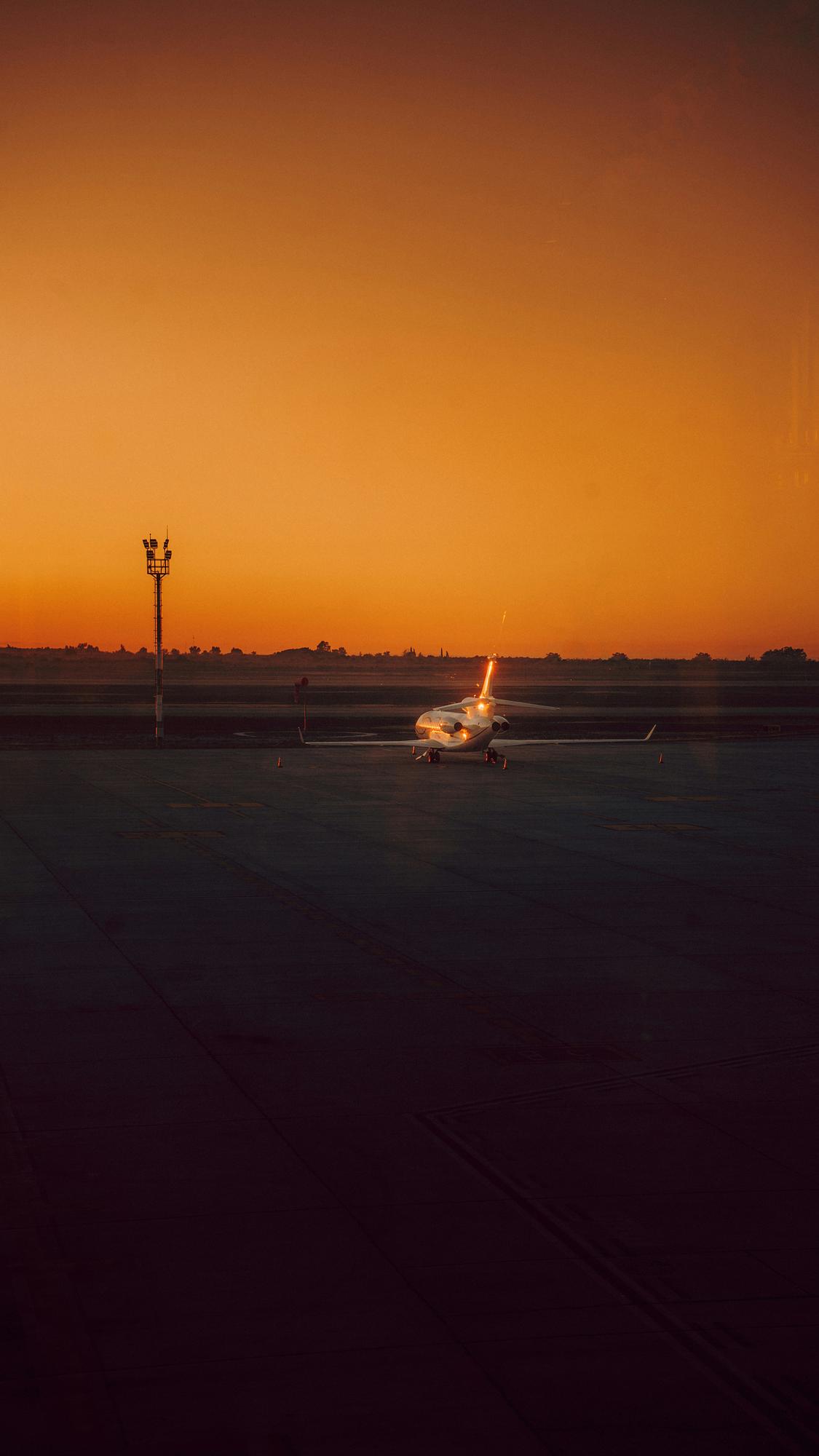
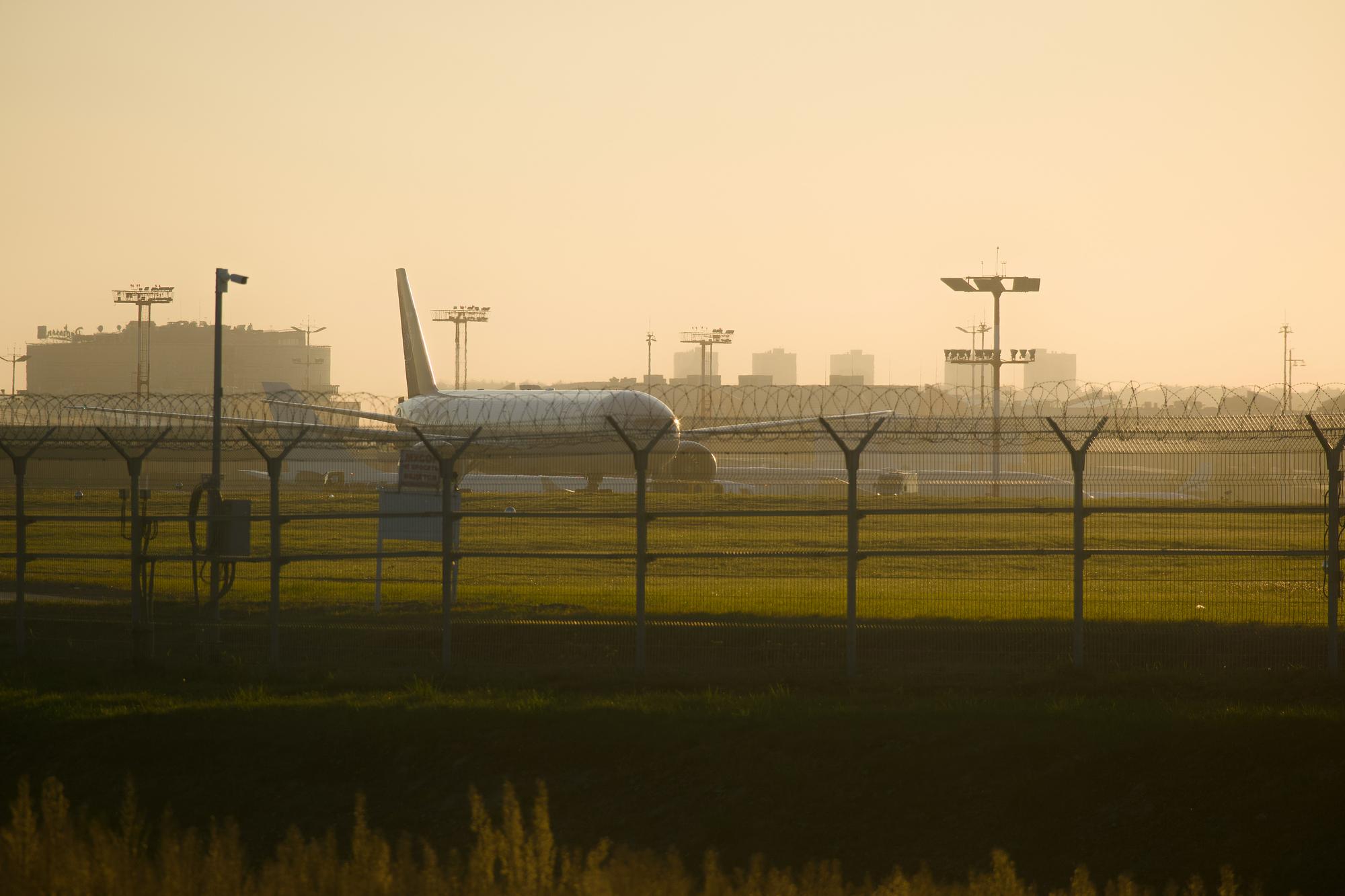
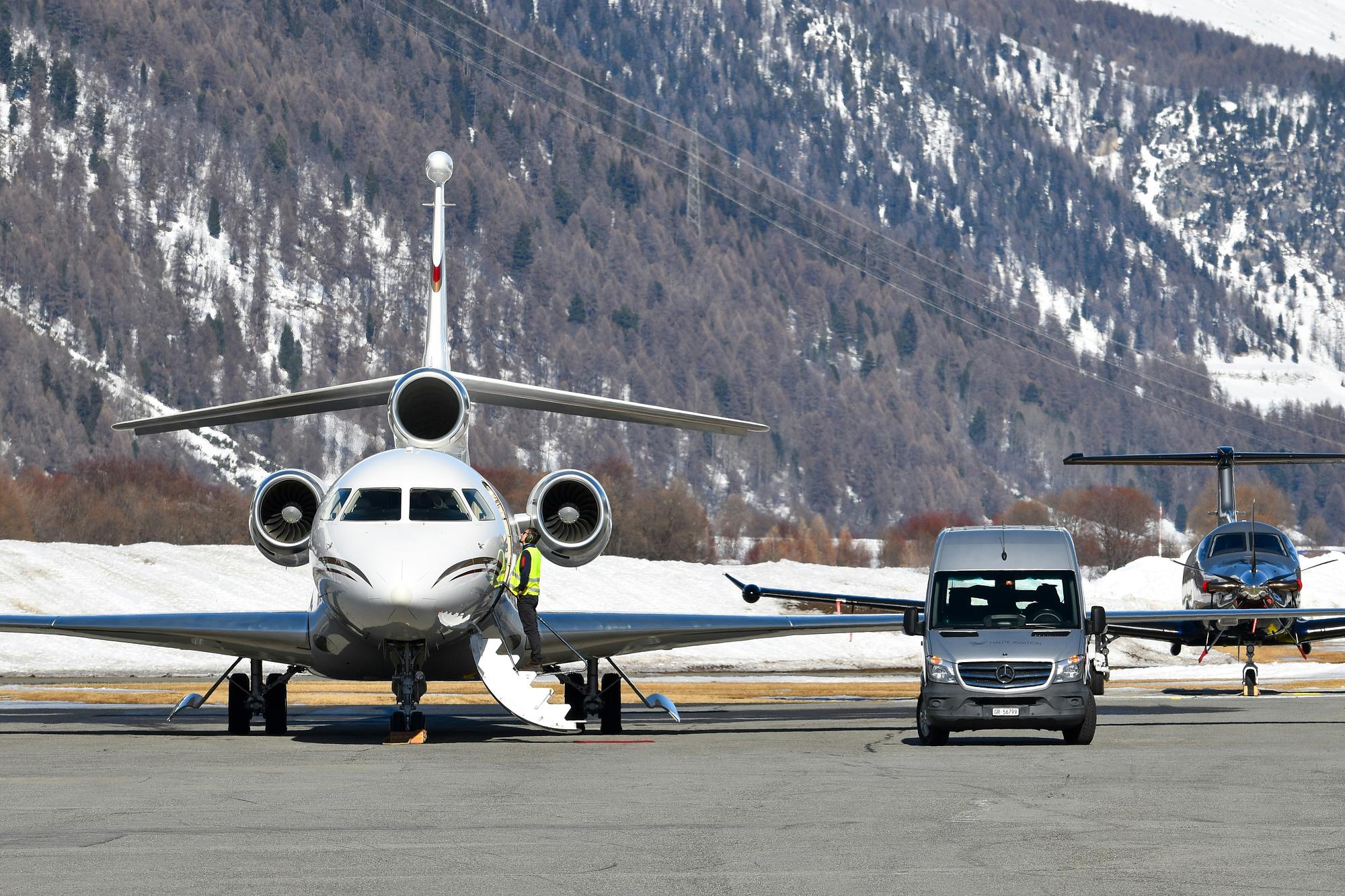
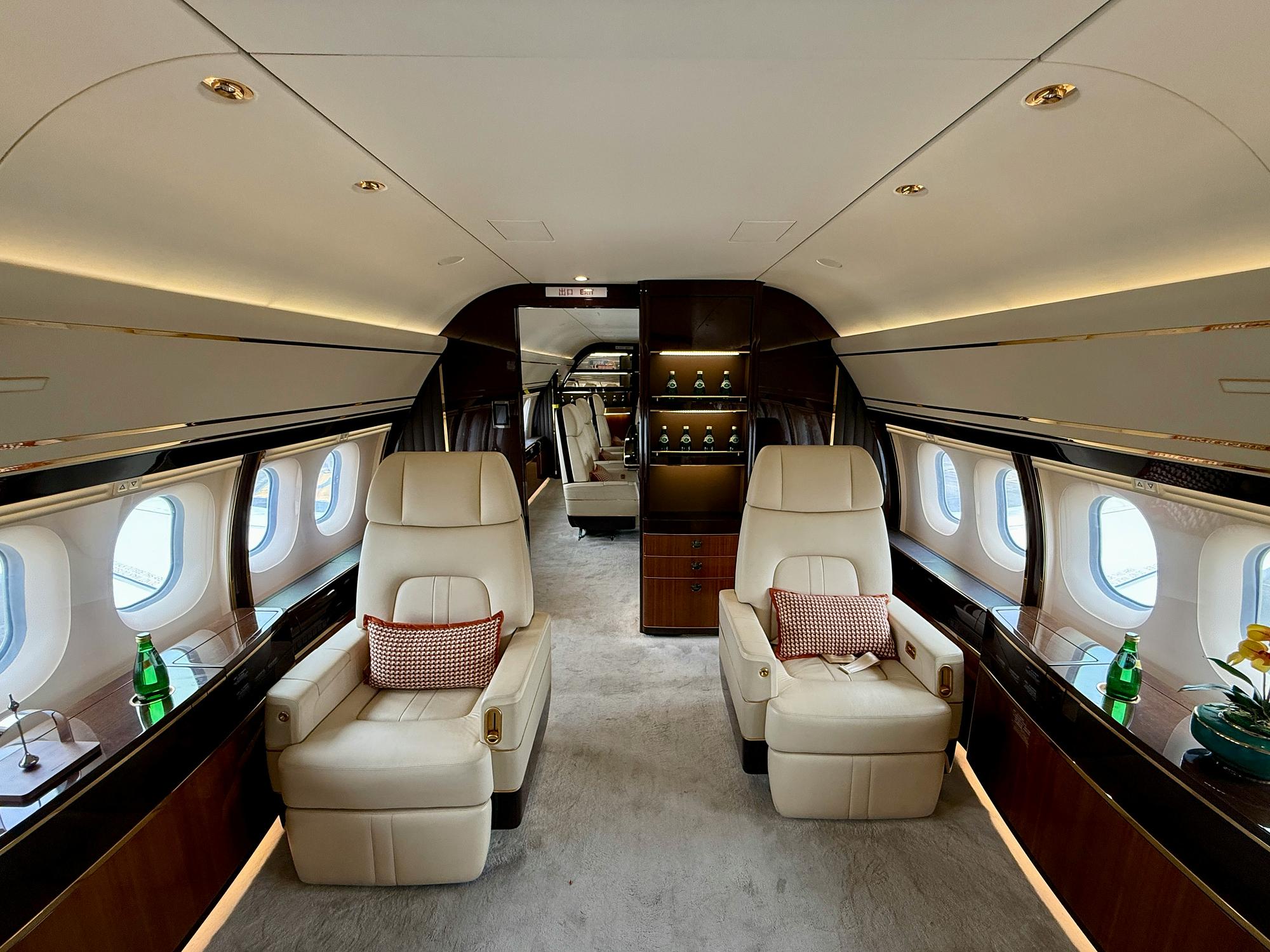
The Embraer Legacy 650E is a heavy jet with a three-zone cabin that seats up to 13 passengers. With a range of 3,953 nautical miles at a high-speed cruise of 425 knots, it connects city pairs most heavy jets handle comfortably – New York to London, Los Angeles to Honolulu, Miami to São Paulo – without a fuel stop. The 650E combines transcontinental reach with one of the largest flat-floor cabins in its category, making it a favored choice for executive groups, extended families, and Private Clients who value space and range over brand prestige.
What the Embraer Legacy 650E Is
The “E” in Legacy 650E stands for Evolution. Embraer unveiled the aircraft at NBAA in October 2016 and brought it to market in 2017 as the final refinement of a proven airframe lineage. The Legacy 650E descends from the Legacy 650 and Legacy 600, themselves derived from the Embraer ERJ-135 regional jet. That commercial DNA shows up where it matters: a cabin cross-section generous enough for passengers to move freely, systems mature enough to earn a reputation for dependable dispatch, and operating economics that compare favorably to newer entrants.
Embraer wound down Legacy production around 2019–2020. The company now centers its executive lineup on the Phenom and Praetor families. For Private Clients, that shift creates opportunity. The Legacy 650E is no longer available new, but well-maintained examples circulate on the pre-owned and charter market – offering heavy-jet capability at a value-oriented positioning compared to flagship alternatives. Rarity, in this case, means fewer passengers competing for the same aircraft on high-demand weekends.
Embraer Legacy 650E Performance and Specifications
The Legacy 650E earns its heavy-jet classification through range, cabin volume, and payload – not just list price. Two Rolls-Royce AE 3007A2 turbofans, each rated at roughly 9,020 lbf of thrust, power the aircraft to a service ceiling of 41,000 feet. At that altitude, the 650E cruises above most commercial traffic and weather, shortening flight times and smoothing the ride.
Aircraft category: Heavy jet
Range: 3,953 nautical miles
High-speed cruise: 425 knots
Service ceiling: 41,000 feet
Engines: Two Rolls-Royce AE 3007A2 turbofans, approximately 9,020 lbf each
Avionics: Honeywell Primus Elite with advanced-features upgrade – synthetic vision, TCAS symbology, XM weather, autothrottle
Cabin length: 42 ft 4 in
Cabin width: 6 ft 0 in
Cabin height: 6 ft 9 in
Cabin volume: 1,656 cubic feet
Baggage capacity: Up to 286 cubic feet (pressurized, temperature-controlled, accessible in flight)
Passenger capacity: Up to 13, across three distinct cabin zones
The Honeywell Primus Elite flight deck, upgraded on the 650E with synthetic vision and autothrottle, gives crews situational awareness typically reserved for newer-design aircraft. Embraer marketed the type with a long warranty and invested in reliability; the result is a heavy jet with mature systems and a track record that operators trust for long-haul missions.
Inside the Legacy 650E Three-Zone Cabin
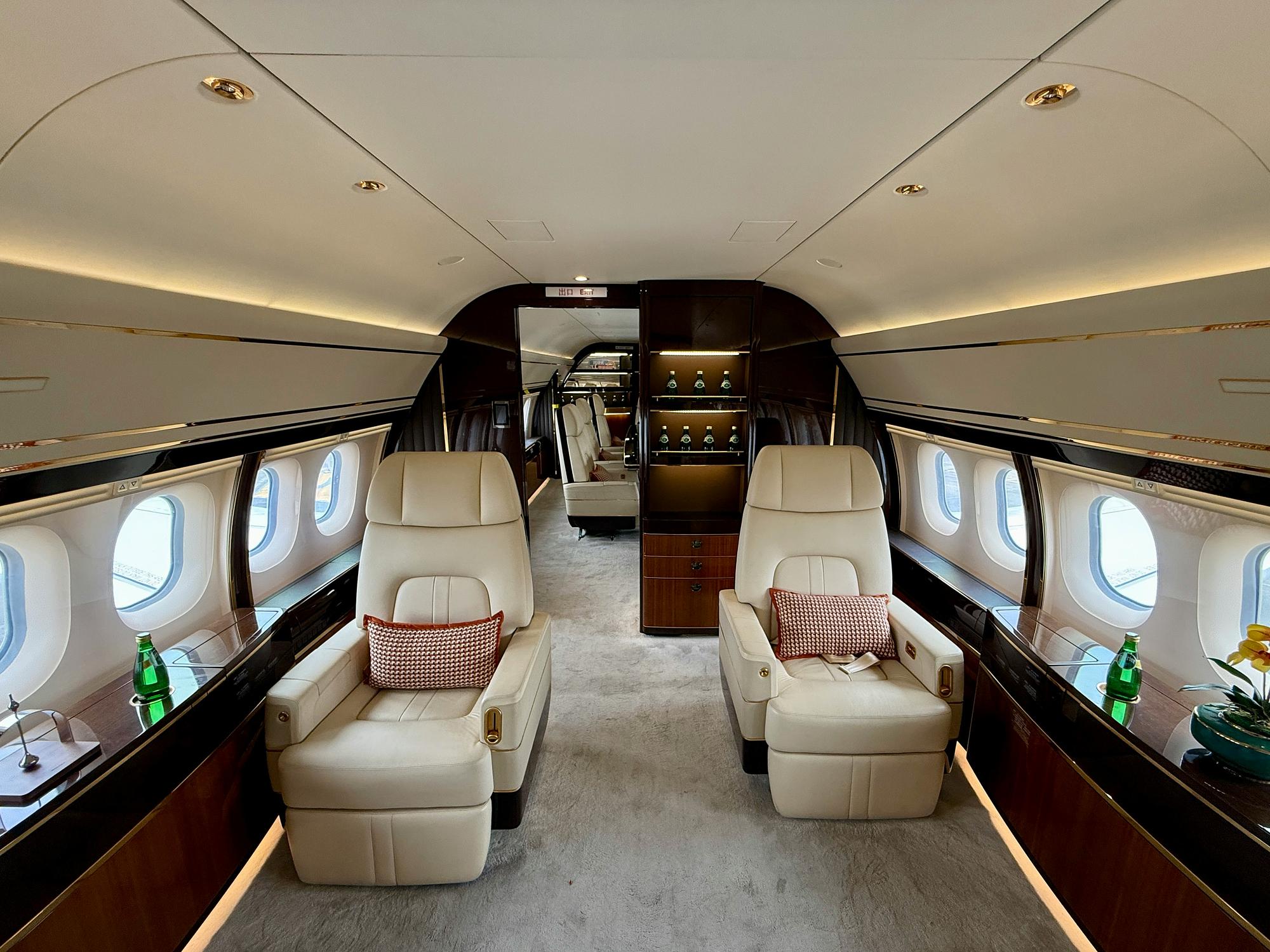
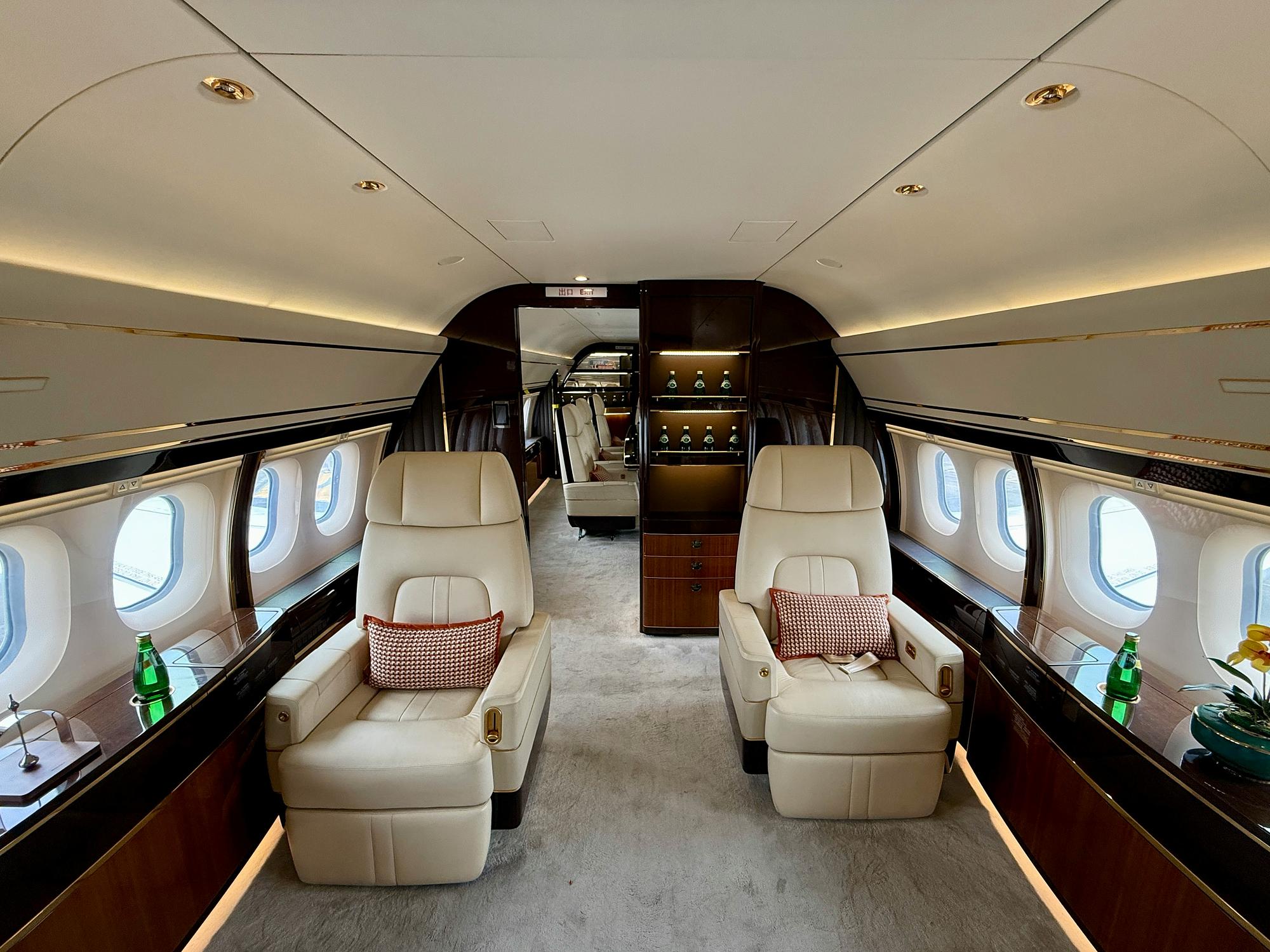
At 42 feet 4 inches long and 6 feet 9 inches tall, the Legacy 650E interior rivals or exceeds many jets marketed as “large cabin.” The flat floor runs the full length – no step-downs, no awkward transitions – so passengers move between zones without ducking or climbing. Three distinct zones allow a traveling party to separate work from rest from conversation.
A typical configuration places a forward club grouping suitable for meetings, a mid-cabin zone with facing seats or a divan for relaxation, and an aft section that can serve as a private lounge or second workspace. Operators configure these zones to Client preference; divan arrangements, lie-flat seating, and enclosed lavatories (forward, aft, or both) all appear in the charter fleet.
The 1,656 cubic feet of cabin volume translates to space that breathes. Thirteen passengers can travel without crowding. For smaller parties, the cabin simply feels generous. The 286 cubic feet of baggage capacity – pressurized, temperature-controlled, and accessible in flight – accommodates golf bags, skis, sample cases, or the luggage a family of six actually packs for two weeks abroad.
Noise levels run quieter than the aircraft’s regional-jet heritage might suggest. Embraer engineered significant sound insulation into the executive variants, and the Legacy 650E benefits from incremental improvements across the lineage. Private Clients routinely hold conversations at normal volume, take calls, or sleep during transatlantic crossings.
Who the Legacy 650E Is For
The Legacy 650E suits Private Clients whose missions demand range without compromise on interior space. Consider the executive team flying coast-to-coast for a board meeting who need to work en route and arrive ready to present. Or the family departing Boston for a European vacation with enough luggage – and possibly pets – to fill a midsize jet’s hold twice over.
International charter flights become more practical when the aircraft can fly nonstop. The Legacy 650E’s 3,953-nautical-mile range covers most transatlantic city pairs and reaches deep into Central and South America from the eastern U.S. For international charter flights, the 650E removes the fuel stop that adds hours and complexity to itineraries.
The aircraft also excels on domestic routes where passenger count or baggage volume exceeds midsize-jet limits. A group of 10 flying New York to Aspen with ski gear, for instance, fits comfortably. The Legacy 650E handles short runways competently, opening access to mountain and resort airports that challenge heavier, faster alternatives.
Private Clients who charter frequently may find the Legacy 650E an efficient choice within a Jet Card program or through On-Demand Charter. The aircraft’s value positioning relative to flagship heavy jets often translates to favorable hourly rates, stretching flight hours further for those who fly 50 or more hours annually.
What It Costs to Charter the Embraer Legacy 650E
Estimated charter rates for a heavy jet like the Legacy 650E generally run approximately $11,600 to $15,200 per hour. That range reflects typical market conditions and includes fuel. It does not include contingencies such as de-icing, repositioning fees, overnight charges, catering, ground transportation, or international fees.
Final pricing depends on route, schedule, aircraft availability, repositioning requirements, taxes, and fees. A Magellan Jets Private Aviation Advisor confirms the exact quote based on your specific mission. Because Magellan Jets sources aircraft from the Preferred Network – an exclusive group of rigorously vetted operators – every recommendation reflects the best available option for your itinerary, not a need to fill fleet seats.
How the Legacy 650E Compares
The Legacy 650E occupies a distinct position in the heavy-jet category. It offers a larger cabin than most super-midsize jets – compare it to a Challenger 350 or Citation Longitude and the difference in interior volume becomes obvious. Yet it costs less to operate than flagship heavy jets like the Gulfstream G650 or Bombardier Global 6000.
Where the G650 and Global 6000 stretch range beyond 6,000 nautical miles, the Legacy 650E’s 3,953 nm covers most missions Private Clients actually fly. The tradeoff is a lower acquisition and operating cost structure that often results in more competitive charter rates. For a transcontinental domestic flight or a transatlantic crossing to Western Europe, the 650E delivers comparable comfort at a value-oriented price point.
The Legacy 650E’s flat-floor cabin, three-zone layout, and generous baggage hold distinguish it from competitors that sacrifice interior space for speed or range. Private Clients who prioritize onboard experience – enough room to spread out, work, dine, and rest – often find the 650E the better fit.
Frequently Asked Questions About the Embraer Legacy 650E (FAQs):
How far can the Embraer Legacy 650E fly?
The Legacy 650E has a range of 3,953 nautical miles. That covers New York to London, Los Angeles to Honolulu, or Miami to most South American capitals without a fuel stop.
How many passengers does the Legacy 650E seat?
The Legacy 650E seats up to 13 passengers across three distinct cabin zones. Typical charter configurations accommodate 10 to 13 comfortably, with seating arrangements tailored to the mission.
What is the difference between the Legacy 650 and the 650E?
The “E” stands for Evolution. Embraer introduced the 650E in 2017 with upgraded Honeywell Primus Elite avionics, including synthetic vision, autothrottle, and enhanced cockpit displays. The cabin and airframe carry over from the Legacy 650 with incremental refinements.
Is the Embraer Legacy 650E still in production?
No. Embraer wound down Legacy production around 2019–2020 and now focuses its executive jet lineup on the Phenom and Praetor families. The Legacy 650E is available on the pre-owned and charter market, where well-maintained examples remain in active service.
How much does it cost to charter an Embraer Legacy 650E?
Estimated charter rates for a heavy jet like the Legacy 650E generally run approximately $11,600 to $15,200 per hour, inclusive of fuel. Final pricing depends on route, schedule, aircraft availability, repositioning, taxes, and fees. A Magellan Jets Private Aviation Advisor confirms the exact quote for your specific itinerary.
How does the Legacy 650E compare to a Gulfstream G650 or Global 6000?
The Legacy 650E offers a large flat-floor cabin and transcontinental range at a value-oriented price point. The G650 and Global 6000 extend range beyond 6,000 nm and cruise faster, but cost more to charter. For most domestic and transatlantic missions, the Legacy 650E provides comparable cabin space at lower hourly rates.
Charter the Embraer Legacy 650E With Magellan Jets
The Legacy 650E delivers heavy-jet range, a three-zone cabin, and value-oriented economics – a combination that explains why the aircraft remains in demand years after production ended. Whether your next mission is a board retreat to Sun Valley, a family trip to Paris, or a client meeting in São Paulo, the 650E has the range and the room.
Ready to explore how the Legacy 650E fits your travel profile? Talk to a Private Aviation Advisor to discuss aircraft options, availability, and pricing tailored to your itinerary.
The SyberJet SJ30 is one of the most distinctive aircraft in the light jet category: an FAA-certified, twin-engine design capable of cruising at 475 knots and climbing to 49,000 feet – performance figures that still outpace many larger jets. Only a handful were ever built, making it a rare specimen in private aviation circles and a touchstone for what compact, high-performance jet travel can achieve.
What Makes the SyberJet SJ30 Stand Out
The SJ30 was designed to be fast. Very fast. Its high-speed cruise of 475 KTAS places it among the quickest light jets ever certified by the FAA, and its maximum operating speed (Vmo) of 486 knots at Mach 0.83 exceeds what most business jets in this class can achieve today. For travelers who value efficiency – reaching a destination before fatigue sets in – the SJ30’s speed translates directly into utility.
Range complements that speed. With approximately 2,500 nautical miles on maximum fuel, the SJ30 can connect coast-to-coast nonstop in favorable conditions. The more conservative NBAA IFR range with four passengers is 2,205 nautical miles – still enough for New York to Denver or Miami to Seattle with a single fuel stop. These are capabilities more often associated with midsize jets.
Then there is altitude. The SJ30 climbs to a service ceiling of 49,000 feet, well above commercial traffic and most weather. At that altitude, the aircraft flies in thinner air with less drag, contributing to both speed and fuel efficiency. The cabin maintains sea-level pressure up to 41,000 feet thanks to a 12 psi differential – a feature that keeps passengers more comfortable on longer flights.
For context, these specifications rival – and in some cases exceed – jets with considerably higher acquisition costs. The SJ30’s ability to deliver midsize-jet performance in a light jet footprint made it a compelling proposition for private aviators who fly long sectors regularly.
Cabin and Comfort
The SJ30’s cabin is compact by necessity – this is a light jet – but intelligently configured. At just over 12 feet long and nearly five feet wide, the interior seats six passengers in club configuration, with executive seating that faces inboard. An optional seventh seat can be installed for short hops with additional passengers.
The signature feature for passenger comfort is that 12 psi cabin differential. Most light jets pressurize to an equivalent cabin altitude of 8,000 feet or higher when cruising at their service ceilings. The SJ30’s system keeps the cabin at sea level up to 41,000 feet, reducing fatigue on longer flights and allowing passengers to arrive more rested.
Baggage space is modest but sufficient for soft luggage and golf clubs. Travelers flying coast-to-coast for business typically find the cabin suitable for working en route, though those accustomed to stand-up cabins in larger jets should set expectations accordingly.
Avionics and Single-Pilot Certification
The certified SJ30-2 features a Honeywell Primus Epic 2.0 flight deck – an integrated avionics suite with large-format displays, synthetic vision, and terrain awareness that gives pilots situational awareness across all phases of flight. The system was among the more advanced glass cockpits available when the SJ30-2 received FAA type certification in October 2005.
The aircraft is certified for single-pilot operation under FAA Part 135 (the regulation governing commercial air charter operations). This certification means qualified operators can fly the SJ30 with one pilot, reducing operating costs and simplifying crew scheduling for owner-operators. For Private Clients chartering light jets, single-pilot certification is common across the category.
Note: SyberJet announced a planned avionics upgrade called “SyberVision” (based on the Honeywell Apex platform) for a future variant designated SJ30i. This upgrade has not been certified or delivered to date. All in-service SJ30-2 aircraft operate with the original Primus Epic 2.0 installation.
Program History: Swearingen to SyberJet
The SJ30’s origin traces to legendary aircraft designer Ed Swearingen, who began the program in the late 1980s with the goal of building the fastest, longest-range light jet in existence. Development proceeded under Sino Swearingen in the mid-1990s, with international investment funding certification efforts.
Only about eight to 10 airframes were built across the entire program, with approximately four production SJ30-2 aircraft delivered to customers. Under new ownership, SyberJet announced the all-new SJ36 in September 2025 – a next-generation light jet targeting certification around 2032.
How the SyberJet SJ30 Compares to Modern Light Jets
On paper, the SJ30 still holds its own against the current light jet standard-bearer: the Embraer Phenom 300E. The Phenom 300 cruises at approximately 464 KTAS with an NBAA range of around 2,010 nautical miles and a service ceiling of 45,000 feet – all respectable figures, but below the SJ30’s published specifications in each category.
The difference lies in availability and support. The Phenom 300 remains in active production with an extensive global service network. The SJ30, by contrast, has not been in production since around 2009, and the handful of airframes that exist are rarely available for charter. For Private Clients seeking high-performance light jet travel today, the Phenom 300 and comparable aircraft in active production represent the practical choice.
The SJ30 remains notable as a design that proved what was aerodynamically possible in the light jet segment. Its performance benchmarks influenced subsequent designs and demonstrated that small cabins need not mean modest capabilities.
How to Charter a High-Performance Light Jet
While the SJ30 itself is exceptionally rare – and effectively unavailable for charter – Private Clients seeking similar performance have excellent alternatives. The current generation of light jets offers transcontinental range, high cruise speeds, and cabin comfort that approaches what the SJ30 envisioned two decades ago.
Magellan Jets arranges access to high-performance light jets through its On-Demand Charter program. Every aircraft is sourced from the Magellan Jets Preferred Network, an exclusive group of rigorously vetted FAA Part 135 operators (Part 135 is the federal regulation governing commercial air charter). Magellan Jets does not own or operate aircraft – it recommends the right solution for each mission, free from fleet-utilization conflicts.
For travelers who fly frequently, Jet Cards provide guaranteed availability with locked-in rates and hours that never expire. The Magellan Jets aircraft access spans every category from light jets to heavy jets and beyond, so the right aircraft is always available for the mission at hand.
Light jet charter starts from an estimated $7,544 per hour. This is an estimated hourly rate for light jet charter, inclusive of fuel. It does not include contingencies such as de-icing, positioning, overnight fees, or other trip-specific costs. Final pricing is confirmed at time of quote.
Every journey is personal. Whether replicating the coast-to-coast capability the SJ30 promised or simply reaching a destination with time to spare, a Private Aviation Advisor can identify the right aircraft and route for your specific needs.
Frequently Asked Questions About the SyberJet SJ30 (FAQs):
Is SyberJet still in business?
Yes. SyberJet Aircraft remains an active company under new ownership. In September 2025, the company announced the SJ36, an all-new light jet design targeting FAA certification around 2032. However, the original SJ30 is not currently in production.
What happened to Sino Swearingen and Emivest?
The SJ30 program changed hands multiple times. Sino Swearingen developed the aircraft through FAA certification in 2005. Dubai investors acquired the company in 2008 and renamed it Emivest Aerospace. Emivest declared bankruptcy in October 2010. A Metalcraft Technologies affiliate purchased the assets in 2011 and rebranded the company as SyberJet Aircraft.
How fast and how far can the SJ30 fly?
The SJ30 cruises at 475 KTAS with a maximum operating speed of 486 knots (Mach 0.83). Range is approximately 2,500 nautical miles with maximum fuel, or 2,205 nm under NBAA IFR reserves with four passengers – enough for coast-to-coast flights in favorable conditions.
How many passengers does the SJ30 seat?
The SJ30 seats six passengers plus one pilot in its standard configuration. An optional seventh seat can be installed for shorter flights. The cabin measures 12 ft 6 in long by 4 ft 10 in wide by 4 ft 4 in tall.
How much does it cost to charter a comparable light jet?
Light jet charter through Magellan Jets starts from an estimated $7,544 per hour, inclusive of fuel. This rate does not include contingencies such as de-icing, positioning, overnight fees, or other trip-specific costs. Final pricing is confirmed when you request a quote from a Private Aviation Advisor.
How does the SJ30 compare to the Embraer Phenom 300?
On published specifications, the SJ30 exceeds the Phenom 300 in speed (475 vs. 464 KTAS), range (2,205 vs. 2,010 nm NBAA), and ceiling (49,000 vs. 45,000 feet). However, the Phenom 300 is in active production with a global support network, while the SJ30 has not been produced since around 2009 and remains exceedingly rare.
>
The Gulfstream G450 is a heavy jet built for nonstop transatlantic travel, seating up to 13 passengers across a 45-foot flat-floor cabin. With 4,425 nautical miles of range, it connects city pairs like New York to London and Dallas to Paris without a fuel stop. Produced from 2004 to 2018 and succeeded by the Gulfstream G500, the G450 remains a mainstay of charter fleets – a proven aircraft for Private Clients who need transcontinental and international reach without the operating costs of larger ultra-long-range jets.
For business travelers, families, and those flying with golf clubs, skis, or pets, the G450 delivers a cabin volume and baggage capacity that lighter jets cannot match. Its two Rolls-Royce Tay engines produce the thrust to depart from shorter runways and climb quickly to 45,000 feet, above most commercial traffic and weather.
Cabin and Interior Experience
The G450 cabin measures 45 feet 1 inch long, 7 feet 3 inches wide, and 6 feet 2 inches tall – dimensions that allow most passengers to stand upright and move freely. Total cabin volume reaches 1,658 cubic feet, providing space for work, rest, and conversation without compromise.
Baggage capacity stands at 169 cubic feet, accessible in flight on most configurations. That volume accommodates golf bags, ski equipment, and luggage for extended trips without the hard choices lighter jets impose.
The flat-floor design makes the cabin accessible for passengers with reduced mobility and practical for those traveling with dogs. Families with children appreciate the ability to move between seating areas without awkward steps or obstructions.
Seating configurations vary by operator, but most G450s in charter fleets offer club seating forward, a credenza or work surface midcabin, and a divan or additional seating aft. Some feature enclosed lavatories with additional privacy, while others provide a full galley for catering on longer flights.
Range and Performance for Transatlantic Missions
With 4,425 nautical miles of range, the G450 opens nonstop access to routes that define its utility: New York to London, Boston to Paris, Dallas to most Western European capitals, and any U.S. transcontinental leg. For Private Clients splitting time between coasts or maintaining business interests abroad, this range eliminates fuel stops that add hours to each journey.
Cruise speed averages 476 knots, placing the G450 among the faster heavy jets in its generation. A New York–London crossing takes roughly seven hours in favorable winds.
The aircraft’s two Rolls-Royce Tay Mk 611-8C engines each produce 13,850 pounds of thrust, managed by Full Authority Digital Engine Control (FADEC). This power enables a maximum takeoff weight of 74,600 pounds and a takeoff field length of 5,600 feet – opening access to regional airports that larger ultra-long-range jets cannot use. Landing distance of 2,663 feet expands the list of available destinations further.
Service ceiling reaches 45,000 feet, where the G450 cruises above congested commercial airspace and most turbulence. Wingspan measures 77.8 feet, and standard crew complement is three.
PlaneView Cockpit and Avionics
The G450 introduced the PlaneView cockpit, built around the Honeywell Primus Epic avionics suite. Four large LCD displays replaced conventional analog instruments in the flight deck, reducing pilot workload and improving situational awareness.
The aircraft also carried the Gulfstream Enhanced Vision System (EVS), the first of its type to receive FAA certification. EVS uses infrared imaging to display terrain, runway environments, and obstacles in low-visibility conditions, projected onto a head-up display. For Private Clients, this translates to improved access during fog, precipitation, and nighttime arrivals – conditions that might otherwise delay or divert a flight.
These avionics represented a generational leap when the G450 entered service and remain capable today. Operators in the Magellan Jets Preferred Network maintain these systems to current standards.
Who the Gulfstream G450 Is For
The G450 fits Private Clients whose travel patterns include at least some of the following:
Transcontinental U.S. flights – Los Angeles to New York, San Francisco to Miami – where range eliminates fuel stops
Transatlantic crossings to London, Paris, or other Western European cities from the East Coast or Central U.S.
Group travel with six to 12 passengers who need space to work, meet, or rest en route
Trips with golf clubs, skis, or significant luggage where 169 cubic feet of baggage capacity matters
Family travel with children or dogs, where the flat-floor cabin simplifies movement
Passengers with reduced mobility who benefit from the G450’s accessible cabin design
For Private Clients considering how the G450 compares to midsize alternatives, the Gulfstream G450 vs. Challenger 300 comparison details the trade-offs in range, cabin volume, and operating costs. Those evaluating super-midsize options may also find the Challenger 300 vs. Gulfstream G280 comparison useful for understanding where the category boundaries fall.
Chartering a Gulfstream G450 With Magellan Jets
Magellan Jets sources G450 charter flights from the Preferred Network, an exclusive group of fewer than 100 rigorously vetted operators. Every operator meets WYVERN Wingman certification standards and carries liability insurance of $100 million to $300 million. This vetting process ensures the aircraft you fly has been maintained to exacting standards by crews who meet Magellan Jets’ safety requirements.
For Private Clients who fly heavy jets regularly, a Jet Card locks in rates and guarantees availability with call-out windows as short as 24 hours. For occasional trips or one-time missions, On-Demand Charter provides access to the same Preferred Network aircraft without a prepaid commitment. And for those whose annual flight hours justify an ownership stake, Fractional Ownership offers equity in specific aircraft with access to supplemental lift through the broader Magellan Jets portfolio.
An estimated hourly rate for Heavy Jet charter, inclusive of fuel, is $12,989 per hour. This is an estimated rate; it does not include contingencies such as de-icing, positioning, overnight fees, or other trip-specific costs. Final pricing is confirmed at time of quote.
Your Private Aviation Advisor can walk through which solution fits your travel patterns, whether that means a Jet Card for predictable flying, On-Demand Charter for flexibility, or a combination of both.
Gulfstream G450 vs. Gulfstream G550
The Gulfstream G550, the G450’s larger sibling, offers approximately 6,954 nautical miles of range – enough for nonstop flights from New York to Tokyo or Los Angeles to London. For Private Clients whose missions regularly require that reach, the G550 is the appropriate aircraft.
The G450, however, serves transatlantic routes at lower hourly operating costs. A Private Client flying New York to London six times a year does not need 6,954 nautical miles of range on each leg. The G450 handles that route comfortably, with cabin dimensions and passenger capacity that match the G550 in most configurations.
Think of the G450 as the transatlantic heavy jet that delivers the Gulfstream cabin experience without paying for range you may not use. For missions within its 4,425-nautical-mile envelope, it represents excellent value in the heavy-jet category.
Frequently Asked Questions About the Gulfstream G450 (FAQs):
How many passengers can a Gulfstream G450 seat?
The Gulfstream G450 accommodates up to 13 passengers. Most charter configurations seat eight to 12 comfortably, with club seating, a divan, and work surfaces distributed throughout the 45-foot cabin.
Can a Gulfstream G450 fly across the Atlantic?
Yes. With 4,425 nautical miles of range, the G450 connects New York to London, Boston to Paris, and Dallas to most Western European capitals nonstop. Westbound legs against strong headwinds may need a fuel stop depending on payload.
How much does it cost to charter a Gulfstream G450 per hour?
An estimated hourly rate for Heavy Jet charter is $12,989 per hour, inclusive of fuel. This estimate does not include contingencies such as de-icing, positioning, overnight fees, or other trip-specific costs. Final pricing is confirmed at time of quote.
What is the difference between a Gulfstream G450 and a Gulfstream G550?
The G550 offers longer range – approximately 6,954 nautical miles compared to the G450’s 4,425 nautical miles. Cabin dimensions are similar. The G450 serves transatlantic routes efficiently, while the G550 extends reach to transpacific and ultra-long-haul missions.
Is the Gulfstream G450 still in production?
No. Gulfstream produced the G450 from 2004 to 2018, when it was succeeded by the Gulfstream G500. The G450 remains widely flown in charter fleets, with well-maintained aircraft available through vetted operators.
What runway length does a Gulfstream G450 need?
The G450 requires approximately 5,600 feet of runway for takeoff at maximum weight and 2,663 feet for landing. This performance opens access to regional airports that larger ultra-long-range jets cannot use, expanding your options for both departure and arrival.
The Cessna Citation X is a super-midsize business jet and Model 750 in Cessna’s Citation family, built to outrun nearly everything else in the sky. With a maximum cruise speed of 525 knots—roughly Mach 0.92—and a range of 3,125 nautical miles, it carries up to eight passengers coast-to-coast without refueling. For executives and Private Clients who measure time in deals closed rather than hours logged, the Citation X remains one of the most compelling aircraft in private aviation.
Speed and Performance: Why the Citation X Earned Its Reputation
Speed defines the Citation X. At 525 knots, it cruises faster than most business jets in production today. The upgraded Citation X+ reaches a maximum operating speed of Mach 0.935, making it one of the fastest civilian aircraft ever certified.
This performance comes from two Rolls-Royce AE 3007C turbofan engines, mounted aft on the fuselage. The design keeps the cabin quiet while pushing the airframe to a service ceiling of 51,000 feet. At that altitude, the Citation X climbs above most commercial traffic and weather, finding smoother air and more direct routing.
What does this mean in practice? A Los Angeles to New York flight that might take four hours and 45 minutes on other super-mids can drop closer to four hours on a Citation X. Multiply that savings across a year of transcontinental travel, and the arithmetic becomes compelling.
Cabin and Onboard Experience
The Citation X cabin seats up to eight passengers in a double-club configuration. At 23 feet 8 inches long, 5 feet 7 inches high, and 5 feet 5 inches wide, the interior offers room to work, hold conversations, or simply settle into a coast-to-coast flight without feeling confined.
Natural light enters through oversized windows. Most Citation X interiors feature fold-out tables sized for laptops and working meals. Wi-Fi connectivity—common on charter aircraft—keeps passengers productive from wheels-up to touchdown.
A fully enclosed lavatory sits at the aft of the cabin, separated from the seating area for privacy. With 82 cubic feet of baggage space, there’s room for golf clubs, presentation materials, or luggage for a week-long trip—stowed in the external compartment and accessible upon landing.
The cabin volume of 538 cubic feet strikes a balance: larger than light jets, intimate enough for confidential discussions. It belongs to travelers who want speed without sacrificing comfort.
Range and the Missions It Flies Best
With 3,125 nautical miles of range, the Citation X connects city pairs that define executive travel. Boston to Los Angeles. Miami to Seattle. New York to the Caribbean. Chicago to nearly anywhere in the continental U.S. without a fuel stop.
The aircraft comes alive for time-sensitive missions: board meetings that require same-day round trips, investor roadshows spanning multiple cities, and travel to airports too small for commercial service. Its takeoff field length of approximately 5,140 feet opens access to thousands of general aviation airports closer to final destinations.
Transatlantic crossings are not the Citation X’s natural territory. For Europe-bound travel, a heavy jet with larger fuel reserves is the better fit. But for domestic routes and Caribbean hops, few aircraft match its combination of speed and range.
Technical Specifications
Aircraft category: Super-midsize (priced as Mid Jet)
How It Compares: Citation X vs. Citation Sovereign
Choosing between the Citation X and the Citation Sovereign depends on what matters most: speed or space.
The Citation X is faster. Its 525-knot cruise speed outpaces the Sovereign by a meaningful margin, shaving time off transcontinental routes. For travelers whose schedules demand efficiency above all, the X is the clear choice.
The Citation Sovereign offers a wider cabin and more baggage capacity. It is often the better match for groups traveling with extensive luggage or passengers who prioritize cabin comfort on longer flights. Its slightly lower operating costs can also factor into the decision for frequent charter travelers.
Both aircraft share transcontinental range. Both seat up to eight passengers. The difference lies in priorities: the Citation X favors travelers who want to arrive first, while the Sovereign favors those who want more room en route.
Chartering the Citation X with Magellan Jets
Magellan Jets sources Citation X aircraft through the Magellan Jets Preferred Network—an exclusive group of rigorously vetted operators. Every aircraft in the network meets strict safety standards, including independent third-party safety audits and comprehensive liability coverage.
Because Magellan Jets operates an asset-light model, your Private Aviation Advisor matches each mission to the right aircraft without fleet-utilization bias. If the Citation X fits your itinerary, that’s the recommendation. If another aircraft suits the route better, you’ll hear that instead.
On-Demand Charter with Magellan Jets includes 24/7 availability, personalized catering, ground transportation coordination, and a Client Experience team managing every detail. The focus stays on your journey, not the logistics behind it.
Cessna Citation X Frequently Asked Questions (FAQs):
How fast is the Citation X?
The Citation X cruises at 525 knots, approximately Mach 0.92. The upgraded Citation X+ reaches a maximum operating speed of Mach 0.935, placing it among the fastest civilian aircraft ever certified. At these speeds, a coast-to-coast flight takes roughly four hours.
How far can the Citation X fly? Can it cross the Atlantic?
The Citation X has a range of 3,125 nautical miles—enough to fly nonstop from New York to Los Angeles, Miami to Seattle, or Boston to nearly any point in the continental U.S. Transatlantic crossings require fuel stops or a larger aircraft with greater range.
How many passengers does the Citation X seat, and what is the cabin like?
The cabin accommodates up to eight passengers in a double-club configuration. The interior measures 23 feet 8 inches long, 5 feet 7 inches high, and 5 feet 5 inches wide, with 538 cubic feet of cabin volume. Expect fold-out work tables, natural light from large windows, and a fully enclosed lavatory.
Does the Citation X have a lavatory?
Yes. A fully enclosed lavatory is located at the aft of the cabin, providing privacy separate from the main seating area.
Why was the Citation X discontinued?
Cessna ended Citation X production in 2018 as market demand shifted toward larger-cabin super-midsize jets. The original Citation X was produced from 1996 to 2012; the upgraded X+ ran from 2013 to 2018. Well-maintained Citation Xs remain sought-after on the charter market for their speed and performance.
How much does it cost to charter a Citation X?
Magellan Jets estimates an hourly rate of approximately $8,550 for Mid Jet charter, inclusive of fuel. This is an estimate only. Actual pricing varies based on routing, positioning, fuel surcharges, taxes, and fees. Your Private Aviation Advisor confirms the exact all-in price at the time of your quote.
Ready to experience the speed of the Citation X on your next journey? Magellan Jets connects you with rigorously vetted aircraft and personalized service from the first call to touchdown.
Winter in the American West belongs to those who seek it out. The terrain is vast, the snow is deep, and the most coveted mountain towns remain quietly beyond the reach of crowded terminals and connecting flights. For Private Clients planning a private jet ski trip this season, three luxury ski destinations stand apart: Aspen, Colorado; Jackson Hole, Wyoming; and Bozeman, Montana.
Each offers a distinct character. Aspen pairs legendary terrain with a refined town culture built over generations. Jackson Hole delivers raw vertical and wild backcountry framed by the Tetons. Bozeman combines uncrowded slopes with Montana’s understated authenticity. All three are best discovered by private aviation, where the journey itself becomes part of the experience.
Aspen, Colorado
Aspen has earned its reputation over more than a century. What began as a silver mining town evolved into one of the best luxury ski resorts in the US, a place where serious skiers and cultural sophisticates coexist without friction. The town itself feels unhurried. Victorian architecture lines streets where galleries, independent boutiques, and restaurants with genuine culinary ambition occupy storefronts that have resisted homogenization.
On the Mountain
Four ski areas operate under the Aspen Snowmass banner: Aspen Mountain, Aspen Highlands, Buttermilk, and Snowmass. Together, they span more than 5,700 acres of skiable terrain. Each mountain has its own personality. Aspen Mountain rises directly from town, offering steep terrain and no beginner runs. Aspen Highlands draws experts to the iconic Highland Bowl. Buttermilk hosts progression parks and gentler pitches. Snowmass, the largest at 3,342 acres, delivers everything from mellow groomers to serious steeps.
The variety matters. A Private Client traveling with family or a mixed group finds terrain for everyone without driving between resorts. One lift ticket unlocks all four mountains.
Beyond the Slopes
Aspen’s après scene requires no introduction. Decades of refinement have produced a town where the options run from casual mountainside sun decks to multi-course tasting menus. The Wheeler Opera House hosts live performances. Cross-country trails wind through the valley. Fat-tire biking, dog sledding, and backcountry touring extend the day for those who want more.
What distinguishes Aspen is the integration. The mountain and the town exist as a single ecosystem. Walking from the base of Aspen Mountain to dinner takes minutes. The resort never feels like a resort in the anonymous, manufactured sense.
Where to Stay
Aspen’s lodging scene reflects the town’s dual identity: historic mining outpost turned international ski capital. Grande-dame hotels line the streets of the walkable downtown core, many just steps from the Silver Queen Gondola. These properties carry a refined, almost European sensibility, with spa programs, curated wine cellars, and après-ski lounges that draw guests back each evening.
For Clients who prefer slopeside mornings, Snowmass Base Village offers a newer style of mountain residence. Ski-in, ski-out access puts you on the lifts within minutes of waking. The architecture tends toward contemporary alpine, with floor-to-ceiling glass and open living spaces designed for multi-generational gatherings.
Aspen also supports a thriving culture of private chalet rentals. These range from intimate log cabins to sprawling estates with dedicated staff, private chefs, and wellness suites. The town’s walkability means even a secluded rental keeps you connected to galleries, dining, and nightlife.
Flying In
Aspen/Pitkin County Airport sits at approximately 7,820 feet elevation with a single runway of about 8,006 feet. The airport enforces a 95-foot wingspan limit and 100,000-pound weight cap. These restrictions mean heavy and ultra-long-range jets cannot typically operate there. Light jets and midsize jets are the standard aircraft for Aspen arrivals, with super-midsize options subject to performance evaluation.
For Private Clients, these constraints translate to exclusivity. The airport’s limitations preserve the town’s character by keeping traffic manageable. Arriving by private jet means stepping off the aircraft and reaching your hotel within minutes. A Private Aviation Advisor matches the right aircraft category to the mission, confirming that the selected jet meets Aspen’s operational requirements before departure.
Jackson Hole, Wyoming
Jackson Hole invites a different kind of traveler. The valley sits at the base of the Teton Range, where 13,000-foot peaks rise abruptly from the flats. Wilderness defines the experience here. Grand Teton National Park and the Bridger-Teton National Forest surround the town of Jackson. The scale is immense and unapologetic.
On the Mountain
Jackson Hole Mountain Resort averages 458 inches of snow per year. The resort is known for steep terrain, continuous vertical, and in-bounds access to expert-level chutes and bowls. Corbet’s Couloir remains a rite of passage. But the mountain accommodates intermediate skiers as well, with long groomers descending from the Bridger Gondola and Sweetwater areas.
The Jackson Hole area includes two additional ski areas. Grand Targhee Resort, on the western slope of the Tetons, collects even more snow and draws powder seekers willing to make the drive through Idaho. Snow King Mountain, the in-town hill, offers night skiing and a local alternative when the main resort feels crowded.
Beyond the Slopes
Wildlife defines Jackson Hole as much as skiing does. The National Elk Refuge borders the town and draws thousands of wintering elk each year. From roughly mid-December to early April, horse-drawn sleigh rides carry visitors into the refuge among thousands of wintering elk. Eagles, bison, and the occasional wolf sighting add to the experience.
Yellowstone National Park lies an hour north. Winter access by snowcoach or guided snowmobile tour opens the park to a quieter season, when geysers steam against frozen landscapes and wildlife moves through deep snow. Hot springs, fine dining in Jackson’s town square, and western art galleries round out days off the mountain.
Where to Stay
Lodging in Jackson Hole sits against one of the most dramatic backdrops in North American skiing. The Teton Range rises abruptly from the valley floor, framing every property with a sense of scale and wildness that defines the destination.
Near Teton Village, slopeside lodges and residences offer direct access to the mountain. Many properties here embrace a wilderness-forward aesthetic: natural stone, reclaimed timber, expansive windows oriented toward the peaks. Wellness programs often incorporate the surrounding landscape, with guided snowshoe excursions, forest bathing, and hydrotherapy informed by the high-altitude climate.
Further into the valley, ranch-style luxury prevails. Guest ranches combine rustic heritage with refined comfort, offering horseback riding, wildlife safaris, and private dining under open skies. These properties suit Clients seeking immersion in the Western landscape, with skiing as one element of a broader mountain experience.
Flying In
Jackson Hole Airport holds a distinction no other commercial airport in the US can claim: it is located entirely within a national park. Grand Teton National Park surrounds the runway. Descending into Jackson Hole by private jet means watching the Tetons fill the windows before touching down minutes from town.
The airport welcomes a range of aircraft categories. On-Demand Charter flights frequently serve this route during ski season. A Private Aviation Advisor confirms aircraft availability and handles ground arrangements, so the transition from aircraft to mountain is direct and considered.
Bozeman, Montana
Bozeman operates at a different tempo. The town retains the character of a genuine mountain community. Main Street features locally owned shops, breweries, and restaurants that serve residents year-round. The university adds cultural depth. Ranches and open land surround the valley. This is Montana, unhurried and unpolished in the best sense.
On the Mountain
Big Sky Resort, one of the largest ski areas in North America, spans over 5,850 acres. The resort absorbed the former Moonlight Basin terrain in 2013, creating a sprawling network of lifts and runs that rarely feels crowded. Lone Peak, the summit, offers steep chutes and backcountry access. Lower elevations deliver long intermediate runs through gladed terrain.
Bridger Bowl, about 16 miles from downtown Bozeman, offers a different experience. The nonprofit, community-owned ski area favors locals and families. Ridge terrain challenges experts. Lift lines stay short. The vibe is authentic Montana: no frills, serious skiing.
Beyond the Slopes
Bozeman’s winter extends well past the ski areas. Hyalite Canyon, located south of town, is the most concentrated natural ice-climbing venue in North America. Over 150 routes within three square miles draw climbers from around the world. Cross-country skiing, snowshoeing, and backcountry touring fill the surrounding national forest land.
The Gallatin Valley supports a thriving craft-brewery scene. After a day on the slopes, a brewery tour through Bozeman offers a low-key alternative to formal après. Hot springs, both developed and primitive, dot the region. Yellowstone’s northern entrance lies about 90 miles south, opening winter wildlife viewing and geothermal exploration.
Where to Stay
Big Sky’s lodging concentrates in two distinct zones: the Mountain Village at the resort’s base and the Gallatin Valley corridor stretching toward Bozeman. Each offers a different expression of Montana hospitality.
At Mountain Village, contemporary alpine lodges provide ski-in, ski-out convenience. The design ethos leans modern and clean, with interiors that favor natural materials and restrained palettes. Après-ski here is quieter than in Aspen or Jackson, with a focus on fireside gatherings, spa treatments, and early dinners before another day on uncrowded terrain.
The Gallatin Valley supports a tradition of guest ranches and private estates. These properties offer space, solitude, and a more intimate connection to the Montana landscape. Clients who prefer distance from the resort bustle find appeal here, with fly-fishing lodges, working cattle ranches, and wellness retreats providing an understated alternative to slopeside living.
Flying In
Bozeman Yellowstone International Airport is Montana’s busiest airport and a year-round gateway to Yellowstone. The airport welcomed a record 2,809,419 passengers in 2025, an increase of 6.3% over 2024. Private aviation traffic benefits from a well-equipped facility with FBO (fixed-base operator) services capable of handling a range of aircraft categories.
For Private Clients considering a Jet Card, Bozeman represents an ideal use case. The destination is underserved by direct commercial flights from many origins. Flying private eliminates connections and delivers direct access to Big Sky or Bridger Bowl within an hour of landing.
How to Choose Between Aspen, Jackson Hole, and Bozeman
Each of these three destinations offers a distinct version of the Western ski experience. The right choice depends less on which mountain ranks highest and more on what kind of trip you are looking for.
Aspen belongs to the traveler who values town culture as much as terrain. Four interconnected mountains offer variety across all ability levels, while the walkable downtown provides galleries, dining, and nightlife within easy reach of your hotel. Après-ski is integral to the experience here. The town’s social energy suits Clients traveling with groups that include non-skiers or those who want full days on the slopes followed by evenings out.
Jackson Hole is best discovered by the skier drawn to challenge and wildness. The mountain’s expert terrain, including Corbet’s Couloir and the backcountry gates, attracts committed skiers seeking vertical and variety. Beyond the resort, Grand Teton and Yellowstone National Parks extend the adventure. Wildlife viewing, cross-country skiing, and snowmobiling round out the itinerary. Jackson suits Clients who want immersion in landscape, not just a ski trip.
Bozeman and Big Sky favor the traveler seeking space, quiet, and authentic Montana character. Big Sky’s terrain rivals Jackson Hole’s in scale, but lift lines remain rare. The town of Bozeman offers a genuine Western community, with local restaurants, independent shops, and a pace that feels unhurried. For Clients prioritizing uncrowded skiing and room to breathe, this corridor delivers without the density of more established resorts.
Aspen: Four mountains, walkable town, cultural depth, vibrant après-ski.
Jackson Hole: Expert terrain, national park access, wilderness immersion, wildlife.
Bozeman/Big Sky: Uncrowded slopes, authentic Montana, space and solitude.
None of these destinations settles for less on quality. Each simply emphasizes a different aspect of what a ski trip can be.
When to Plan Your Winter Trip
The Rocky Mountain ski season typically runs from late November through early April, but conditions and crowds vary considerably across those months.
Early season, from late November through mid-December, offers festive atmosphere and fresh anticipation. Snow coverage depends on the year, but the mountains are quiet and holiday programming begins to take shape. This window suits Clients who value calm over peak conditions.
Midwinter, from January through February, delivers the most reliable snow. Storms cycle through consistently, and base depths reach their annual peaks. This is the period for Clients prioritizing powder days and full-mountain access. Temperatures run cold, but the skiing justifies the layers.
Spring, from March into early April, brings longer days, softer snow, and a more relaxed pace. Morning groomers give way to afternoon corn snow. On-mountain restaurants open their decks. The trade-off is less consistent coverage, particularly at lower elevations, and a shift in atmosphere from high-season intensity to end-of-year celebration.
Holiday weeks and long weekends, especially Presidents’ Day, see peak demand across all three destinations. Aircraft availability tightens, and preferred departure times fill early. Clients planning travel during these windows benefit from working with a Private Aviation Advisor well in advance. For one-off ski weeks, On-Demand Charter provides access without a long-term commitment. Clients flying 25 hours or more annually often find the Jet Card a better fit, with guaranteed availability and locked rates through the season.
Booking lift and flight together, early, keeps options open when everyone else is competing for the same windows.
Flying Private to the Slopes
Private jet travel to luxury ski destinations is about more than convenience. It is about reclaiming the time that commercial travel consumes and arriving in condition to enjoy the mountain. Ski boots, gear bags, and equipment travel with you in the cabin. No checked luggage lines, security queues, or risk of lost equipment arriving a day late.
Timing matters in ski travel. Powder days wait for no one. Private aviation allows departure when conditions align, not when an airline schedule permits. For Clients coordinating group travel or family vacations, a single aircraft simplifies logistics that would otherwise require multiple bookings, seat assignments, and ground transfers.
Magellan Jets offers solutions for every travel pattern. On-Demand Charter serves the spontaneous trip or the one-time ski week. Jet Card programs suit Private Clients who fly 25 hours or more annually, locking in rates and guaranteeing availability during peak ski season. A Private Aviation Advisor helps match the solution to the Client’s needs, aircraft category to the destination’s requirements, and timing to the mountain’s conditions.
Frequently Asked Questions About Luxury Ski Destinations (FAQs):
What are the best luxury ski resorts in the US?
Aspen, Jackson Hole, and Bozeman consistently rank among the best luxury ski destinations in the US. Aspen offers four interconnected mountains and a refined town culture. Jackson Hole delivers challenging terrain and access to Grand Teton National Park. Bozeman provides Big Sky Resort’s vast acreage alongside Montana’s authentic mountain-town character.
Where do the wealthy go skiing?
Affluent travelers often choose Aspen, Jackson Hole, Vail, Park City, and Deer Valley. These destinations combine high-quality skiing with luxury accommodations, fine dining, and cultural amenities. Private aviation access makes them particularly attractive to high-net-worth travelers seeking efficiency and exclusivity.
When is the best time for a luxury ski vacation?
Peak ski season in the American West runs from mid-December through late March. January and February typically offer the most consistent snow. Early March provides longer days and softer conditions. Holiday periods and Presidents’ Day weekend see the highest demand, while shoulder periods offer fewer crowds at slightly lower accommodation rates.
How do you get to Aspen, Jackson Hole, or Bozeman by private jet?
Aspen is served by Aspen/Pitkin County Airport, which accommodates light and midsize jets due to runway and weight restrictions. Jackson Hole Airport, located within Grand Teton National Park, welcomes a broader range of aircraft. Bozeman Yellowstone International Airport, Montana’s busiest, handles all jet categories. A Private Aviation Advisor confirms the right aircraft for each destination.
What does it cost to fly private to a ski destination?
Charter pricing depends on aircraft category, distance, positioning requirements, and seasonal demand. Peak ski season typically commands higher rates due to increased demand for mountain destinations. A Private Aviation Advisor provides an exact quote based on the specific origin, destination, dates, and aircraft preferences for each trip.
Can I bring ski equipment on a private jet?
Yes. Private jets accommodate ski boots, skis, snowboards, and gear bags in the cabin or baggage compartment. Exact capacity depends on the aircraft category. Traveling with equipment avoids the risk of lost or delayed luggage that can disrupt a ski trip planned around specific conditions.
Plan Your Private Jet Ski Trip
The best luxury ski destinations share a quality that commercial travel often erases: a sense of arrival. Touching down in Aspen, Jackson Hole, or Bozeman by private jet preserves the anticipation. The mountain is minutes away. The day is still ahead.
When you are ready to plan your winter ski getaway, Talk to a Private Aviation Advisor to match the right aircraft, route, and Magellan Jets solution to your trip.
The Bombardier Challenger 300 is a super-midsize business jet offering a 3,340 nm range, a maximum cruise speed of 459 knots (approximately 528 mph), and a 45,000-foot service ceiling. The cabin seats up to eight passengers, though six travel most comfortably. Powered by two Honeywell HTF7000 turbofans, the Challenger 300 delivers true coast-to-coast capability with a wide, flat-floor interior that has defined the super-midsize standard since 2004.
Why the Challenger 300 Belongs in Your Flight Rotation
For business travelers who measure productivity door-to-door, the Challenger 300 offers a compelling proposition: the cabin of a larger jet with the operating economics and airport access of a midsize. Ski weekends to Aspen, investor meetings in San Francisco, charity galas in Palm Beach – this is an aircraft built for the way high-net-worth individuals actually move through their calendars.
The Challenger 300 interior is where Bombardier’s ambition becomes tangible. The cabin measures 23 feet 7 inches long, 6 feet 1 inch high, and 7 feet 2 inches wide, with a total volume of 930 cubic feet. That flat floor lets passengers move freely through the cabin without stooping.
Most configurations seat up to eight passengers, typically in a double-club arrangement with a forward refreshment center and an enclosed lavatory aft. For extended travel, six passengers find the most comfortable arrangement, with ample room for work materials, personal effects, and the kind of quiet that makes four-hour flights feel shorter.
Baggage capacity is 106 cubic feet, generous enough for ski equipment, golf bags, or the luggage demands of a family traveling to a second home. Larger pets travel well in this cabin.
Challenger 300 Performance, Range, and Speed
The Challenger 300 excels on precisely the routes that matter to frequent private flyers: coast-to-coast nonstops, transcontinental positioning, and those demanding missions where weather alternates and schedule certainty are non-negotiable.
Key Challenger 300 specs:
Range: 3,340 nautical miles
Maximum cruise speed: 459 knots (approximately 528 mph)
A 45,000-foot ceiling means the Challenger 300 climbs above most commercial traffic and weather systems. The rapid initial climb – 4,240 feet per minute – reaches cruise altitude quickly, maximizing range and fuel efficiency. For a New York–based traveler, Los Angeles is a direct flight. So is Miami. So is Aspen.
Flight Deck and Avionics
The Challenger 300 cockpit centers on the Collins Aerospace Pro Line 21 avionics suite with four LCD displays, a system designed for two-pilot operation. The flight deck provides terrain awareness, traffic avoidance, and satellite-based navigation that keep crews focused on efficiency and safety.
For Clients who charter frequently, the cockpit design translates to practical benefits: experienced crews, consistent operating procedures across the fleet, and the kind of redundancy that supports safe operations in demanding conditions.
Today, the Challenger 300 remains a staple of charter fleets and private ownership alike – proof that thoughtful engineering ages well.
Chartering the Bombardier Challenger 300
For travelers considering a Challenger 300 charter, the aircraft offers a persuasive balance of capability and value within the super-midsize category.
Estimated hourly charter rate: Approximately $9,700 per hour for super-midsize aircraft through Magellan Jets.
This is an estimate only. Final pricing depends on aircraft availability, routing, repositioning, date, taxes, and fees, and is confirmed by your Magellan Jets advisor.
Whether you are exploring On-Demand Charter for a single mission or considering Jet Cards for guaranteed access throughout the year, the Challenger 300 fits naturally into a diversified flight strategy. Its coast-to-coast range means fewer fuel stops and more productive travel hours.
Challenger 300 vs. Challenger 350
The Bombardier Challenger 350 represents the next evolution of the 300 platform. Both aircraft share the same cabin cross-section and basic configuration, but the 350 offers incremental improvements in range, fuel efficiency, and avionics.
For Clients choosing between the two, the decision often comes down to specific mission requirements and availability. The Challenger 300 delivers outstanding value and capability. The Challenger 350 extends that capability further. Your Private Aviation Advisor can walk you through the differences based on your actual travel patterns.
The Magellan Jets Challenger 300/350 Jet Card
For Clients who fly the super-midsize category regularly, the Challenger 300/350 Jet Card is one of Magellan Jets’ premium jet card offerings, giving you guaranteed availability and fixed hourly rates with no blackout dates. Card programs are available in 25-hour blocks, giving members 365-day access to the aircraft, risk free, via Magellan’s vetted operator network, and starting at the 50-hour tier, Clients unlock Advantage Routes: preferred pricing on high-demand corridors based on where Magellan Jets Clients actually fly, rather than fleet positioning. For frequent flyers who want the certainty of a dedicated cabin type without the commitment of fractional ownership, the Challenger 300/350 Jet Card offers a straightforward way to lock in this aircraft as part of a broader flight strategy.
Frequently Asked Questions About the Bombardier Challenger 300 (FAQs):
How Much Does It Cost to Charter a Bombardier Challenger 300?
Super-midsize charter rates through Magellan Jets average approximately $9,700 per hour. Final pricing depends on aircraft availability, routing, repositioning, date, taxes, and fees. Your advisor confirms exact pricing for each mission.
Can a Challenger 300 Fly to Hawaii or Cross the Atlantic?
With a 3,340 nm range, the Challenger 300 can reach Hawaii from West Coast departure points nonstop. Eastbound transatlantic crossings to Western Europe are within the aircraft’s range, while westbound or heavily loaded legs may require a fuel stop in Iceland or Newfoundland depending on winds and payload.
How Many Passengers Does the Challenger 300 Seat?
The cabin seats up to eight passengers. For optimal comfort on longer flights, six passengers is the ideal configuration, allowing ample workspace and legroom.
What Is the Challenger 300’s Range and Cruising Altitude?
The Challenger 300 offers a 3,340 nm range and a 45,000-foot service ceiling. This altitude keeps the aircraft above most commercial traffic and weather, resulting in smoother, more fuel-efficient flights.
Is the Bombardier Challenger 300 a Good Private Jet?
The Challenger 300 is one of the most versatile super-midsize jets available. Its wide, flat-floor cabin, excellent baggage capacity, and true coast-to-coast range make it a top choice for business travelers and families alike. More than 450 have been delivered worldwide.
How Does the Challenger 300 Compare to the Challenger 350?
Both aircraft share the same cabin dimensions and seating configuration. The Challenger 350 offers improved range, updated avionics, and enhanced fuel efficiency. Many charter fleets operate both aircraft, giving Clients flexibility based on availability and mission requirements.
Ready to Fly the Challenger 300?
Whether your next mission is a coast-to-coast business trip or a family vacation to the mountains, the Challenger 300 delivers the cabin comfort, range, and reliability that frequent private travelers expect.
The Bombardier Challenger 600 is the aircraft family that gave private aviation a true wide-body cabin, and it still travels first-class today. When Clients charter a “Challenger 600” now, they step aboard the modern, in-service member of the series, the Challenger 604, a heavy jet that pairs one of the widest cabins in its class with genuine transcontinental and transatlantic range. What began as a bold 1970s idea has matured into a jet that quietly outperforms aircraft designed decades later.
Challenger 604 specifications at a glance
Think of the 604 as the Challenger 600 series in its confident, contemporary form. These are the figures that matter when you are matching a mission to an aircraft.
Category: Heavy jet, wide-body, flat floor
Passengers: up to 9, with a crew of 2
Cabin: 28 ft 4 in long, 8 ft 2 in wide, 6 ft 1 in tall; 1,146 cubic feet of volume
Baggage: 115 cubic feet, accessible in flight
Range: 4,119 nautical miles
Maximum cruise speed: 459 knots (about 528 mph)
Service ceiling: 41,000 feet
Engines: two General Electric CF34-3B turbofans, about 9,220 lbf of thrust each
Maximum takeoff weight: about 48,300 lb
Flight deck: Rockwell Collins Pro Line 4 glass avionics
A cabin that belongs to a larger class
Step inside and the width announces itself. At 8 feet 2 inches across and 6 feet 1 inch tall, the flat-floor cabin invites you to stand, stretch, and move as if the airframe were a size larger. That generous cross-section is the signature the whole Challenger 600 series is known for.
With room for up to nine passengers across 1,146 cubic feet of volume, the cabin divides naturally into distinct zones for working, dining, and resting. A full galley and enclosed lavatory sit within easy reach. The 115-cubic-foot baggage hold stays accessible in flight, so skis, golf clubs, and weekend bags travel with you rather than following behind.
Low noise and minimal vibration were priorities from the first drawing, and they still define the experience. Over a five-hour leg, that calm is the difference between arriving drained and arriving ready.
Performance and range that open the map
Range is where the modern Challenger 600 series earns its loyalty. The 604 covers 4,119 nautical miles, enough to link New York with London or connect the coasts without a fuel stop. That reach turns a two-day itinerary into a single elegant flight.
Two General Electric CF34-3B turbofans, each producing about 9,220 lbf, carry the jet to a 459-knot cruise near 528 mph. A 41,000-foot service ceiling lifts you above the weather and most commercial traffic, where the ride smooths out and the schedule stops negotiating with the sky. The supercritical wing, one of the first in business aviation, still contributes to that efficient, composed high-altitude cruise.
The heritage behind the name
The Challenger began as Bill Lear’s LearStar 600 concept, a deliberate turn away from his earlier small-cabin jets toward wide-body space. Canadair developed the design and flew it first on 8 November 1978, with the original CL-600 entering service in 1980 on Lycoming ALF 502 engines. That first model was rare and short-lived, roughly 85 were built before it was retired in 1983.
What followed is the story of a platform coming into its own. The Challenger 601 arrived in 1982 with General Electric CF34 engines and winglets, Bombardier acquired Canadair in 1986, and the Challenger 604 was certified in 1995 with first deliveries in 1996. The 604 added the CF34-3B engines, more fuel, higher weights, and a Pro Line 4 glass flight deck; about 360 were built through 2006. The 605 followed in 2007 and the 650 in 2015. Across every variant, the series now exceeds 1,000 aircraft delivered, which means deep crew experience, plentiful parts, and well-documented maintenance for the Clients who fly it.
Who the Challenger 600 series suits best
Some jets ask you to compromise. This one favors travelers who want space and reach in the same aircraft.
Transcontinental and transatlantic travel that calls for nonstop range and a cabin built for real rest
Group and family trips where cabin width and baggage volume matter as much as the destination
Executive missions that benefit from separate zones for private conversation and focused work
Shorter regional legs flown in heavy-jet comfort when the day demands efficiency
What it costs to charter a Challenger 600
Chartering a heavy jet like the Challenger 604 is an invitation to travel on your own terms, and the pricing reflects that class of aircraft. As a general guide, Magellan estimates heavy-jet charter at roughly $11,600 to $15,200 per hour.
Treat that as an estimate rather than a quote. Hourly rates vary by route, the specific aircraft, availability, and the details of your trip, and your Magellan private aviation advisor confirms exact pricing before every flight. That conversation is also where a membership can change the math. Frequent flyers often prefer the guaranteed access and fixed rates of a 25-hour jet card, while Elevate by Magellan pairs on-demand flexibility with membership benefits.
Accessing the Bombardier Challenger 600 through Magellan Jets
Because Magellan Jets owns no fleet, every aircraft recommendation is made in the Client’s interest alone. Challenger 600 series jets are sourced through a Preferred Network of rigorously vetted operators, matched to your cabin, range, and mission requirements, and supported by advisors who know these airframes intimately. To learn how Magellan approaches private travel, get to know the team behind the flights.
Bombardier Challenger 600 series specifications
The table below sets the modern charter aircraft, the Challenger 604, alongside the discontinued original 600 for historical context.
Frequently Asked Questions About the Bombardier Challenger 600 (FAQs):
Which Challenger 600 model can I charter today?
You charter the Challenger 604, the modern, in-service member of the Challenger 600 series, along with its later evolutions, the 605 and 650. The original 1980 CL-600 was retired from production in 1983, so today’s flights are flown on the far more capable 604-generation aircraft.
How many passengers does the Challenger 600 seat?
The Challenger 604 seats up to nine passengers across a wide, flat-floor cabin, with a crew of two. Its width and distinct seating zones make it comfortable for the full party, not only for a favored few.
What is the range of the Challenger 600?
The Challenger 604 flies up to 4,119 nautical miles, enough to connect the coasts nonstop or link New York with London. That reach is what turns a long journey into a single, unhurried flight.
How fast is the Challenger 600?
The 604 cruises at up to 459 knots, roughly 528 mph, at a service ceiling of 41,000 feet. Flying above most weather and commercial traffic keeps the ride smooth and the schedule your own.
How much does it cost to charter a Challenger 600?
As a general estimate, Magellan places heavy-jet charter at roughly $11,600 to $15,200 per hour. Rates are estimates that vary by route, aircraft, availability, and trip details, and your advisor confirms exact pricing before every flight.
The Pilatus PC-12 NG is the world’s best-selling pressurized single-engine turboprop – an aircraft that redefined what a single powerplant could accomplish. Swiss precision meets rugged capability in a cabin that rivals light jets for comfort while accessing runways they simply cannot reach. For Private Clients who value versatility over convention, the PC-12 NG opens territory that other aircraft categories leave unexplored.
Heritage and Evolution of the Pilatus PC-12
The PC-12 program traces its origins to 31 May 1991, when the prototype took flight from Stans, Switzerland. Pilatus designed it for a mission no existing aircraft addressed: genuine single-pilot capability with turboprop efficiency, pressurized comfort, and the ability to operate from unpaved strips.
The design philosophy centered on practicality. A single turboprop engine meant lower fuel burn and maintenance costs compared to twin-engine alternatives. The large cargo door and flat cabin floor made it equally suited for passengers, cargo, or medevac configurations. And certification for unpaved runways opened access to terrain that more delicate aircraft could never reach.
Three decades later, the program’s success speaks through production numbers. Pilatus delivered its 2,000th PC-12 on 12 May 2023, a milestone that underscores sustained demand across charter, corporate, government, and medevac operations worldwide.
The NG (Next Generation) variant, introduced in 2008, brought a modern glass cockpit and refined systems to the proven airframe. It remains the variant most commonly encountered in the charter fleet today.
Performance That Defies Category
The PC-12 NG delivers specifications that challenge assumptions about single-engine turboprops.
Speed: Long-range cruise runs about 209 knots (KTAS), with a maximum operating speed (Vmo) of 240 knots. That pace keeps the PC-12 NG efficient on the short and medium legs where it earns its keep, at a fraction of a light jet’s operating cost.
The PC-12 NG cabin surprises passengers accustomed to smaller turboprops.
Cabin volume reaches 356 cubic feet, with an interior stretching roughly 16 feet 11 inches in length. Seating accommodates up to seven passengers in executive configuration, with layouts typically arranged for four to six in club seating. The wide fuselage allows passengers to move about easily, and the large cargo door handles skis, golf clubs, and oversized luggage that would require a separate vehicle in smaller aircraft.
Interior configurations vary by operator, but executive layouts typically feature club seating, foldout tables, and power outlets at every seat. The cabin width exceeds that of most light jets, giving passengers room to work, dine, or simply stretch out during longer flights.
A private lavatory is standard in executive configurations – a feature Private Clients appreciate on longer sectors. Natural light floods through oversized windows, while the pressurized cabin maintains sea-level comfort at typical cruising altitudes. Noise levels, particularly in aircraft equipped with the five-blade propeller, compare favorably to light jets despite the turboprop powerplant.
Technology and Avionics
The NG variant centers on the Honeywell Primus Apex integrated flight deck. Four high-resolution displays present flight, navigation, and systems data in a format that reduces pilot workload and enhances situational awareness.
The SmartView Synthetic Vision System (SVS) generates a three-dimensional view of terrain, obstacles, and runways – particularly valuable when operating into mountainous or unfamiliar airstrips. Pilots see a virtual depiction of the outside world even in instrument conditions, with runway surfaces, towers, and rising terrain rendered in real time.
Additional systems include integrated weather radar, TCAS (Traffic Collision Avoidance System), and TAWS (Terrain Awareness and Warning System). The avionics also support WAAS LPV approaches, enabling precision-like landings at airports without traditional instrument landing systems. For Private Clients, the practical benefit is access to more airports in more conditions with higher margins of safety.
The flight deck is certified for single-pilot operations, though many charter operators staff with two crew for added redundancy.
Chartering the Pilatus PC-12 NG with Magellan Jets
The PC-12 NG excels on missions where its unique capabilities matter most. Intra-state travel, multi-stop itineraries, island-hopping routes, and access to short or remote airstrips are its natural domain.
Consider a Private Client visiting multiple New England locations in a single day: Boston, Nantucket, Martha’s Vineyard, and back. The PC-12 NG handles those short legs efficiently while providing a cabin comfortable enough for the entire journey. Or a family heading to a Montana ranch with a 3,000-foot unpaved strip – territory where jets simply cannot follow.
The aircraft also suits missions where operating economics matter. Hourly costs run well below light jets, making it an efficient choice for shorter sectors where the additional speed of a jet yields minimal time savings. And when the destination airport restricts jet traffic or lacks the runway length jets require, the PC-12 NG often becomes the only viable option.
Magellan Jets sources the PC-12 NG from the Magellan Jets Preferred Network, an exclusive group of fewer than 100 rigorously vetted operators drawn from roughly 3,000 licensed in the U.S. Every operator carries $100M to $300M in liability insurance, and every mission runs under Magellan’s proactive Safety Management System (SMS). That discipline is backed by Magellan’s WYVERN Wingman Broker Certification and a culture that leads with safety on every journey.
Estimated charter pricing: Turboprop charter runs an estimated $6,189 per hour. This is an estimated hourly rate for Turboprop charter, inclusive of fuel. It does not include contingencies such as de-icing, positioning, overnight fees, or other trip-specific costs. Final pricing is confirmed at time of quote.
For Private Clients who fly 25 hours or more annually, Jet Cards offer locked-in rates and guaranteed availability. Those flying fewer than 25 hours per year often find On-Demand Charter the most flexible option. And for those ready to step into ownership, Fractional Ownership provides equity in the aircraft itself.
PC-12 NG vs. PC-12 NGX: Understanding the Distinction
The NG remains prevalent in the charter fleet due to its established service history and lower acquisition cost for operators. Both variants share the same fundamental airframe, cabin dimensions, and mission capability. For charter purposes, passengers experience nearly identical comfort and utility regardless of which variant they fly – the differences matter more to pilots and operators than to those in the cabin.
Frequently Asked Questions About the Pilatus PC-12 NG (FAQs):
How much does it cost to charter a Pilatus PC-12 NG per hour?
Turboprop charter runs an estimated $6,189 per hour, inclusive of fuel. Final pricing depends on routing, positioning, and trip-specific factors; your Private Aviation Advisor confirms exact costs at time of quote.
Can the Pilatus PC-12 NG cross the Atlantic?
No. With a maximum range of approximately 1,845 nm at high-speed cruise with VFR reserves, the PC-12 NG is designed for domestic and regional missions. Transatlantic crossings require heavy jets or jet airliners with substantially greater range.
Can a single pilot fly the PC-12 NG?
Yes. The aircraft is certified for single-pilot operations. Many charter operators choose to fly with two crew for added safety margin, particularly on longer or more demanding missions.
Does the Pilatus PC-12 NG have a bathroom?
Executive configurations include a private enclosed lavatory in the aft cabin. High-density utility configurations may omit this feature, but charter aircraft typically retain it for passenger comfort.
How far can a Pilatus PC-12 NG fly?
Up to 1,845 nm at high-speed cruise with VFR reserves. That covers most domestic U.S. routes nonstop.
What is the top speed and cruise speed of the PC-12 NG?
Long-range cruise is about 209 knots (KTAS), and the maximum operating speed (Vmo) is 240 knots. That makes it one of the more efficient single-engine turboprops in service.
Can the PC-12 NG land on short or unpaved runways?
The Pilatus PC-12 NG represents a category of one: pressurized comfort, turboprop efficiency, jet-like speed, and access to terrain that remains off-limits to conventional private aircraft. Whether the mission calls for island-hopping in the Caribbean, visiting a ranch property in the Rockies, or connecting multiple Northeast cities in a single day, the PC-12 NG handles what other aircraft categories cannot.
For Private Clients whose journeys take them beyond major airports, the PC-12 NG opens possibilities worth exploring.
The Bombardier Challenger 300 and Gulfstream G280 are the two aircraft that define the super-midsize category. Both deliver coast-to-coast range, flat-floor cabins, and the performance to access shorter runways that heavy jets cannot. The G280 offers more range (3,700 nautical miles), a longer cabin (25 ft 8 in), and seating for up to 10 passengers. The Challenger 300 earns its reputation with a wider flat-floor cabin (7 ft 2 in), generous 106 cu ft baggage hold, and exceptional versatility across business and leisure missions.
Quick Verdict: Two Approaches to Super-Midsize Excellence
These aircraft occupy the same category, but they serve different priorities. The Gulfstream G280 is the choice when range extends the itinerary – think Teterboro to Cabo San Lucas or Miami to Seattle without a fuel stop. Its longer cabin and 10-seat capacity suit larger groups or passengers who value extra legroom. Strong runway performance opens access to challenging airports that would otherwise require a smaller aircraft.
The Bombardier Challenger 300 remains one of the most chartered super-midsize jets for good reason. Its cabin is nearly five inches wider than the G280’s – a difference you notice when settling into a four-hour transcontinental flight. The 106 cu ft baggage compartment handles skis, golf bags, and large pet crates with ease. For Private Clients flying six passengers or fewer on coast-to-coast routes, the CL300 delivers a hard-to-beat balance of cabin comfort, baggage flexibility, and value.
Cabin and Comfort: Width vs. Length
Step aboard the Challenger 300 and the width is immediately apparent. At 7 ft 2 in across, the cabin is among the widest in the super-midsize class. That breadth translates to shoulder room, wider seats, and easier movement through the aisle. Cabin length measures 23 ft 7 in with a 6 ft 1 in ceiling height – comfortable for most passengers to stand upright. Total cabin volume reaches 930 cu ft. Most configurations seat eight, though six passengers travel in particular comfort.
The Gulfstream G280 cabin stretches 25 ft 8 in – roughly two feet longer than the Challenger. Width narrows slightly to 6 ft 9 in. Both aircraft share the same 6 ft 1 in cabin height and a flat floor throughout, meaning no step-ups or awkward transitions between zones. The G280’s 935 cu ft cabin volume allows for a three-zone layout: forward galley, midcabin conference or club seating, and an aft divan or additional seating. Maximum seating reaches 10 passengers.
Baggage matters on leisure trips. The Challenger 300’s 106 cu ft external baggage hold accommodates oversized items – ski bags, large kennels, golf clubs for a foursome – without compromising cabin space. The G280 offers 154 cu ft of baggage capacity, useful when the passenger count climbs. For families traveling with sporting equipment or Clients with accessibility needs, both aircraft’s flat-floor layouts simplify boarding and movement during flight.
Performance and Range: How Far Can You Go Nonstop?
Range is the headline difference between these two super-midsize jets. The Gulfstream G280 covers 3,700 nautical miles – far enough to connect New York to London’s closest fuel stop or Los Angeles to Honolulu without hesitation. Its Honeywell HTF7250G engines produce approximately 7,624 lbf of thrust each, and the aircraft climbs at 5,000 feet per minute to a 45,000 ft service ceiling.
The Challenger 300’s range of 3,340 nautical miles handles transcontinental U.S. routes comfortably. Boston to San Francisco, Miami to Seattle, Teterboro to Scottsdale – these missions fit well within its envelope. Two Honeywell HTF7000-series engines deliver about 7,000 lbf thrust each, lifting the aircraft to its 45,000 ft ceiling at 4,240 feet per minute. Both jets cruise at the same maximum speed: 459 knots, roughly 528 mph or Mach 0.80.
For most domestic itineraries, both aircraft perform the mission without compromise. The G280’s additional 360 nautical miles become decisive on longer routes – Hawaii from the West Coast, transcontinental flights with strong headwinds, or positioning for international connections that require maximum fuel reserves.
Avionics and Flight Deck
The Challenger 300 features Rockwell Collins Pro Line 21 avionics with four displays, delivering reliable situational awareness and solid integration with modern air traffic management systems. The system has proven itself across thousands of flight hours in the charter fleet.
Gulfstream equipped the G280 with its proprietary PlaneView280 flight deck, built on the Honeywell Primus Epic platform. The system includes Enhanced Vision System (EVS) and Head-Up Display (HUD) as standard – technology that aids pilots during low-visibility approaches and reduces minimums at qualified airports. For Private Clients flying into challenging destinations, these capabilities can mean the difference between landing and diverting.
Challenger 300 vs. Gulfstream G280: Side-by-Side Specifications
Which Super-Midsize Jet Should You Charter?
Aircraft selection begins with the mission. Start with your passenger count, route distance, and what you are bringing aboard.
Choose the Gulfstream G280 When:
Your route exceeds 3,300 nautical miles or requires reserve fuel for alternate airports
You are traveling with 8–10 passengers who need individual seating
Cabin length matters more than width – perhaps for an aft work zone or divan
Your destination has a shorter runway, where the G280’s performance shines
Enhanced vision and head-up display are priorities for low-visibility approaches
Choose the Bombardier Challenger 300 When:
Your party is six passengers or fewer, and cabin width enhances comfort
You are traveling with skis, golf clubs, large pet crates, or oversized luggage
Transcontinental U.S. routes are your primary mission profile
Versatility matters – the CL300 transitions easily between business and leisure
Passengers with mobility considerations benefit from the flat floor and wider cabin
Frequently Asked Questions About Challenger 300 vs. Gulfstream G280 (FAQs):
Can a Challenger 300 cross the Atlantic?
The Challenger 300’s 3,340-nautical-mile range is not sufficient for a direct transatlantic crossing. New York to London, for example, is approximately 3,450 nautical miles – beyond the aircraft’s nonstop capability. Transatlantic flights in a CL300 require a fuel stop in Iceland, Greenland, or eastern Canada. For nonstop Atlantic crossings, a heavy jet such as a Gulfstream G550 or Bombardier Global is better suited to the mission.
Can a Gulfstream G280 cross the Atlantic?
The G280’s 3,700-nautical-mile range makes direct transatlantic flights marginal. Under ideal conditions – light passenger load, favorable winds, optimal routing – a G280 can reach western Europe from the U.S. East Coast. More typically, a fuel stop in Iceland or Newfoundland ensures safe reserves. Most transatlantic Private Clients choose a heavy or ultra-long-range jet for nonstop service.
How fast is the Challenger 300?
The Challenger 300 cruises at a maximum speed of 459 knots, equivalent to approximately 528 mph or Mach 0.80. Typical long-range cruise speed is slightly lower to optimize fuel efficiency. At this speed, a coast-to-coast flight from New York to Los Angeles takes approximately five hours.
How fast is the Gulfstream G280?
The Gulfstream G280 shares the same maximum cruise speed as the Challenger 300: 459 knots (528 mph, Mach 0.80). Flight times between the two aircraft are effectively identical on the same routes.
How long of a runway does the Gulfstream G280 need?
The Gulfstream G280 is known for strong short-field performance among super-midsize jets. Takeoff distance varies by weight, temperature, and altitude, but the G280 can operate from runways as short as 4,750 feet under favorable conditions. This opens access to airports that require smaller aircraft for other super-midsize types – a meaningful advantage for destinations like Aspen or Jackson Hole.
What is the difference between the Challenger 300 and the Challenger 350?
The Bombardier Challenger 350 is the updated production variant of the Challenger 300, introduced in 2014. Key improvements include upgraded Rockwell Collins Pro Line 21 Advanced avionics, a redesigned interior with improved soundproofing and LED lighting, and aerodynamic enhancements that slightly extend range. The cabin dimensions remain identical. In the charter fleet, both aircraft deliver a comparable experience; the 350 offers incremental refinements rather than a generational leap.
How much does it cost to charter a super-midsize jet per hour?
Magellan Jets estimates super-midsize charter at approximately $9,700 per hour. This rate is inclusive of fuel but does not include contingencies such as de-icing, overnight or positioning fees, catering, ground transportation, or other trip-specific costs. Final pricing depends on route, aircraft availability, schedule, and other factors, and is confirmed by a Magellan Jets Private Aviation Advisor with a formal quote.
Ready to Fly?
The right aircraft depends on your destination, your party, and what you bring with you. A super-midsize jet offers the range of a heavy with the agility to reach airports that larger aircraft cannot. Whether the Challenger 300’s width and versatility or the G280’s range and capacity suits your mission, Magellan Jets sources the right aircraft from our Preferred Network of rigorously vetted operators.
The Beechcraft Beechjet 400A seats up to 7 passengers and cruises at 449 kt (Mach 0.78) with a 1,510 nm range. Twin Pratt & Whitney Canada JT15D-5 engines and a Collins Pro Line 4 flight deck power this light jet, purpose-built for short regional missions of roughly one to two-and-a-half hours.
Overview and Positioning
The Beechjet 400A occupies a distinct position in the light-jet category. It pairs cabin dimensions more typical of larger aircraft with operating economics that keep hourly costs in check. For travelers who prioritize comfort on regional legs – Boston to Washington, Los Angeles to Las Vegas, Dallas to Denver – the 400A delivers the essentials without excess.
In the Magellan Jets Preferred Network, the Beechjet 400A appears on missions where efficiency is paramount. Its balance of speed, range, and cabin space makes it a sensible choice for Clients who know exactly what they need from a light jet charter.
History and Legacy
The Beechjet 400A traces its lineage to the Mitsubishi Diamond II, a twin-engine business jet developed in Japan during the early 1980s. When Beechcraft acquired the design, engineers refined the airframe into the Beechjet 400, establishing a foundation that would endure for decades.
The improved 400A arrived in the late 1980s. It brought greater range, a higher maximum takeoff weight, additional cabin amenities, and the Collins Pro Line 4 avionics suite – upgrades that sharpened the aircraft’s appeal for business travelers. The airframe proved its staying power: Raytheon (and later Hawker Beechcraft) continued the line as the Hawker 400XP, while the Nextant 400XT remanufacture program breathes new life into existing airframes with upgraded engines and avionics.
This heritage is a mark of a proven, enduring design. An airframe that has remained in continuous service across multiple generations – refined rather than replaced – speaks to fundamental engineering integrity. For Clients booking the 400A today, that lineage translates into a well-understood platform with deep operator experience and a mature parts network.
Cabin and Interior
The Beechjet 400A cabin measures 15 ft 7 in long, 4 ft 11 in wide, and 4 ft 10 in tall. Total cabin volume is approximately 306 cu ft. Up to seven passengers can fly in a standard club configuration, with seating arranged for face-to-face conversation or quiet productivity.
The flat floor runs the length of the cabin, allowing passengers to move about comfortably during cruise. A squared-oval fuselage cross-section provides headroom that feels more generous than the raw dimensions suggest. This is a design detail that reduces the sense of confinement on longer regional legs. Baggage capacity is 53 cu ft, enough for a full cabin of soft luggage without compromising legroom.
Cabin appointments vary by operator, but most configurations include leather seating, fold-out work surfaces, and power outlets for devices. The enclosed rear lavatory is unusual in the light-jet category. It adds a level of privacy that Clients appreciate on missions beyond an hour.
Performance and Range
Cruise speed is 449 kt, or Mach 0.78. Maximum range is 1,510 nm under optimal conditions. The twin Pratt & Whitney Canada JT15D-5 engines offer proven reliability and efficient fuel burn for missions in the 400–800 nm envelope.
A service ceiling of 45,000 ft places the Beechjet 400A above most commercial traffic and, critically, above much of the weather. Flying at higher altitudes means fewer diversions, smoother rides, and more predictable arrival times – tangible advantages on routes where convective weather is common.
The 400A performs well at shorter runways, opening access to regional airports that larger jets cannot reach. For Clients connecting to coastal retreats, mountain resorts, or suburban airfields, this runway flexibility translates into time saved and destinations gained.
Flight Deck and Avionics
The Collins Pro Line 4 avionics suite equips the Beechjet 400A with integrated flight displays, navigation, and communication systems, including a flight management system and colour weather radar. Anti-skid braking supports a higher maximum landing weight and confident stops on shorter runways.
Pilots familiar with the 400A appreciate its predictable handling and reliable systems. The Pro Line 4 architecture, while not the newest glass cockpit on the market, remains serviceable and well-supported. Many operators have upgraded their 400A panels for current airspace requirements, keeping the aircraft mission-ready today.
Who the Beechjet 400A Suits Best
The Beechjet 400A is well-suited for travelers whose missions fall within a defined regional envelope. Typical flights include:
Business travelers connecting cities 300–700 nm apart
Executives flying to meetings and returning the same day
Small groups heading to regional destinations inaccessible by airline
Clients who value efficiency over cabin extravagance
For those who require transcontinental range or stand-up cabin height, a midsize or super-midsize aircraft may be more appropriate. But for regional missions where schedule control and cost discipline matter, the 400A remains a compelling option in the On-Demand Charter and Jet Card portfolios.
Frequently Asked Questions About the Beechcraft Beechjet 400A (FAQs):
How many passengers does the Beechjet 400A seat?
The Beechjet 400A accommodates up to seven passengers in a standard club configuration, with an enclosed rear lavatory aft.
What is the range of the Beechjet 400A?
The Beechjet 400A has a maximum range of 1,510 nm under optimal conditions. This is well suited to regional missions of roughly one to two-and-a-half hours. Actual range on any given flight depends on payload, weather, and routing.
How fast is the Beechjet 400A?
At high-speed cruise, the Beechjet 400A flies at 449 kt – approximately Mach 0.78. It operates at altitudes up to 45,000 ft, above most commercial traffic and weather.
Is the Beechjet 400A single pilot?
No. The Beechjet 400A is flown by a two-pilot crew. This configuration supports workload management and safety, particularly during instrument approaches and in busy airspace.
What is the difference between the Beechjet 400 and 400A?
The 400A refined the original Beechjet 400 with greater range, a higher maximum takeoff weight, additional cabin amenities, and the Collins Pro Line 4 flight deck. These upgrades made it a more capable and comfortable aircraft for private and corporate travel.
Does the Beechjet 400A have a bathroom?
Yes. The Beechjet 400A includes an enclosed rear lavatory, a feature that is uncommon in the light-jet category. On regional legs of an hour or more, Clients value this privacy and convenience.
How much does it cost to charter a Beechjet 400A?
Chartering a Beechjet 400A typically falls within the light-jet category. Estimated hourly rates range from approximately $7,300 to $9,300 per flight hour. This estimate includes fuel but does not include contingencies such as de-icing, repositioning, overnight fees, catering, ground transportation, taxes, or other trip-specific costs. Final pricing depends on the specific route, aircraft availability, and additional requirements – a Magellan Jets Private Aviation Advisor confirms an exact quote based on your itinerary.
Charter a Beechjet 400A
The Beechjet 400A offers a compelling combination of efficiency, comfort, and proven performance for regional travel. Whether you are booking a single flight through On-Demand Charter or planning recurring missions with a Jet Card, Magellan Jets can match you with the right aircraft for your itinerary.
Magellan Jets coordinates travel on behalf of our Clients using approved FAA 14 CFR Part 135 vendors for our charter and Jet Card programs and approved FAA 14 CFR Part 91K vendors for our Fractional program. Magellan Jets does not own or operate aircraft.