The economics of a year-end aircraft acquisition changed on July 4, 2025, when the One Big Beautiful Bill Act (OBBBA) became law. That single change reframes The Year-End Acquisition Window. The pressure a buyer feels today is different from the pressure the prior law created.
Permanent 100% bonus depreciation means a qualifying business aircraft acquired and placed in service on or after January 20, 2025 may be eligible for a full first-year deduction of its depreciable cost, with no scheduled sunset under current law. For qualifying buyers, the deduction is claimed in the year the aircraft is placed in service, subject to meeting IRS requirements. It is a powerful incentive, and it rewards buyers who act on it correctly.
The window still closes on December 31 for a calendar-year taxpayer. The deadline that matters is more specific than most buyers assume. What follows is a sober treatment of what qualifies, what the year-end deadline actually requires, and the downstream obligations that determine whether a deduction survives scrutiny.
What Permanent 100% Bonus Depreciation Actually Changed for Aircraft Buyers
For most of the past decade, the bonus depreciation rate was on a downward path. Under the Tax Cuts and Jobs Act, the deduction had been phasing out, and the rate applicable to 2025 had already fallen to 40% before the new law reversed course.
OBBBA permanently extended 100% bonus depreciation under IRC Section 168(k) (PwC, 2025). “Permanent” carries a specific meaning here. There is no scheduled sunset under current law, though the provision remains subject to future legislative change. The full rate applies to qualified property. This includes new and used business aircraft, acquired and placed in service after January 19, 2025 (NBAA, 2025).
Why “Placed in Service” by December 31 Is the Deadline That Matters
The acquisition date and the placed-in-service date are two separate tests, and buyers routinely conflate them. Acquiring the aircraft after January 19, 2025 satisfies the eligibility threshold. Claiming the deduction in a given tax year requires something more.
Bonus depreciation is deducted in the year the aircraft is placed in service. For a calendar-year taxpayer, that means the aircraft must be ready and available for its intended business use by December 31. A signed purchase agreement, a wired deposit, or even physical delivery does not, on its own, establish that the asset was placed in service.
How the More-Than-50% Business-Use Test Determines the Deduction
Business aircraft are “listed property” under IRC Section 280F, which sets a clear condition: the aircraft must be used more than 50% for qualified business use for the deduction to apply. Personal use does not simply coexist with the deduction. It reduces or eliminates it.
For qualifying buyers, the depreciation available generally tracks the share of business use, so the calculation is only as strong as the flight activity behind it. This is where a year-end decision becomes a year-round obligation. For a fuller treatment of how the private jet tax deduction works, our companion Dossier guide covers the mechanics in depth.
Do Used Aircraft and Fractional Shares Qualify for 100% Bonus Depreciation?
Both new and used aircraft may be eligible. A used aircraft must not have been used by the taxpayer at any time before the acquisition. That condition matters more than many buyers expect, particularly inside closely held ownership structures.
Fractional shares qualify as well. Reporting on NBAA’s guidance notes that the bonus depreciation rules apply to both whole and fractional aircraft purchases. A deeded fractional interest is a depreciable asset, which is why Fractional Ownership can offer many of the same tax characteristics as whole-aircraft ownership for qualifying buyers, on a smaller capital commitment.
The Risk Most Year-End Buyers Overlook: Recapture and Substantiation
The deduction is not permanent in the way the statute is. If business use later drops to 50% or below, prior depreciation can be recaptured and taxed as ordinary income. A deduction taken in year one can be partially unwound in year three if the flight profile changes.
Substantiation is the other half of the discipline. Owners should keep meticulous records demonstrating the bona fide business purpose and passengers of each flight. Tax advisors have noted an IRS corporate-aircraft audit campaign announced in early 2024 and still ongoing, which raises the value of records kept correctly from day one.
Magellan Jets Fractional Ownership: A Deeded, Depreciable Aircraft Share for Qualifying Buyers
Magellan Jets Fractional Ownership conveys a deeded 12.5% interest in a Bombardier Challenger 850. The program is on a 3-year term, with 50 annual hours and a guaranteed residual buyback of 60% of original share value. Because it is a real ownership interest, the share is a depreciable asset that may be eligible for bonus depreciation for qualifying buyers who meet the business-use and placed-in-service requirements, on a smaller capital commitment than whole-aircraft ownership.
The right structure depends on how you actually fly. A buyer weighing fractional versus full ownership should match the deduction to the flight profile, not to the calendar. If the year-end window has you moving quickly, the disciplined next step is a conversation, not a signature. Contact a Private Aviation Advisor before you commit.
Permanent 100% bonus depreciation removed the phase-out clock, but it did not remove the discipline the deduction demands. The buyers who benefit most place a qualifying aircraft in service correctly, document every business flight, and match the ownership structure to how they truly fly. That is a decision worth making deliberately. Contact a Private Aviation Advisor to structure your year-end acquisition with the records and the framework to support it.
This article is general information, not tax, legal, or accounting advice. Bonus depreciation eligibility depends on facts specific to each buyer, state tax conformity varies, and the rules can change with future legislation. Consult your own qualified tax, legal, and accounting advisors before acting on any year-end acquisition.
Frequently Asked Questions About Year-End Bonus Depreciation for Aircraft (FAQs):
What does permanent 100% bonus depreciation mean for aircraft buyers?
It means a qualifying business aircraft acquired and placed in service on or after January 20, 2025 may be eligible for a full first-year deduction of its depreciable cost, with no scheduled sunset under current law. The rules still require qualified business use and correct placed-in-service timing, and future legislation could change them.
Why is December 31 the deadline that matters?
For a calendar-year taxpayer, the deduction is claimed in the year the aircraft is placed in service, so the aircraft must be ready and available for its intended business use by December 31. A signed contract or a deposit does not establish that date.
Do used aircraft qualify for 100% bonus depreciation?
Both new and used aircraft may be eligible for qualifying buyers. The taxpayer must not have used the aircraft at any time before acquiring it.
Do fractional shares qualify?
Reporting on NBAA’s guidance notes the rules apply to both whole and fractional aircraft purchases. A deeded fractional interest is a depreciable asset, so it may qualify for the same treatment as whole-aircraft ownership for qualifying buyers.
What is depreciation recapture?
If business use later drops to 50% or below, the IRS can recapture prior depreciation and tax it as ordinary income. The obligation to keep business use above the threshold continues for years after the purchase.
What records do I need to support the deduction?
Owners should keep meticulous records demonstrating the bona fide business purpose and passengers of each flight. If the IRS ever examines a deduction, consistent documentation from day one gives you the strongest support.
The 2026 holiday season will test private aviation like no year before it. Private jet holiday travel 2026 planning starts now, in July. The math is straightforward. Finite aircraft. Record demand. Six weeks of peak travel compressed into the tightest window the industry has faced.
The FAA projected 2025 Thanksgiving as the busiest holiday travel period in 15 years, with peak days exceeding 52,000 flights. That trajectory has only steepened for 2026. Private Clients who wait until October to think about Thanksgiving, or November to plan Christmas, are already behind.
For 2026 private jet holiday travel, the booking window opens in the summer. It extremely narrows by mid-October. Magellan Jets recommends locking Thanksgiving travel by mid-September. Christmas departures should be confirmed by early October. New Year’s flights need commitment by mid-October. Jet Card holders carry a structural advantage: zero blackout dates and zero peak-day surcharges. Even guaranteed-availability programs benefit from early crew and logistics coordination.
Why Summer 2026 Is the Real Deadline for Private Jet Holiday Travel
Most private flyers underestimate how early peak-season availability tightens. The instinct is to plan holidays after summer. By Labor Day, the best aircraft and most experienced crews are committed for Thanksgiving week.
Consider the numbers. The 2025 Thanksgiving period saw peak days exceeding 52,000 flights. That pressure compounds at private terminals. Operators begin reserving crew and positioning aircraft for the holiday corridor as early as August.
This is not about panic. It is about understanding how supply works. Private aviation operates on a finite fleet with fixed crew rosters. Every week of delay narrows your options for aircraft type, departure time, and routing flexibility.
How Peak-Day Restrictions Shape Your Holiday Options
Peak days are the industry’s mechanism for managing demand surges. The number of peak days ranges from 10 to over 60 per year, depending on the program. These cover Thanksgiving week, December 20 through January 3, and other high-demand windows. Surcharges of 5% to 20% are typical, with some providers charging up to 40%.
Some large fleet operators restrict access on dozens of high-demand dates each year. Other programs apply surcharges that transform a $15,000 flight into an $18,000 or $21,000 one without any change in aircraft or service. Understanding how peak days affecting your holiday travel work is essential before committing to any program.
Magellan Jets operates with zero blackout dates and zero peak-day surcharges across On-Demand Charter flights and every Jet Card tier. This is a structural difference, not a promotional offer. The asset-light model sources aircraft from the Preferred Network, not a captive fleet. That eliminates the fleet-utilization conflicts forcing other providers to restrict peak-period access.
Your 2026 Holiday Booking Timeline: Week by Week
The following timeline reflects operational reality. These windows are based on aircraft positioning cycles, crew scheduling requirements, and destination-specific constraints.
Thanksgiving (November 26, 2026)
Book by mid-September, 13 weeks in advance. Thanksgiving routes concentrate on a narrow set of corridors. KBOS and KTEB to KPBI. KTEB to KACK. Northeast-to-Caribbean legs. Departures cluster Tuesday through Wednesday, with returns on Sunday.
Caribbean destinations require even earlier planning. Caribbean peak season runs late November through mid-April (Universal Weather, 2025). Advance slot scheduling at island airports is critical.
Christmas (December 25, 2026)
Book by early October, 11 weeks in advance. Christmas travel splits into two waves. Departures cluster December 22 through 24. Returns concentrate December 26 through 28. Ski destinations like KASE (Aspen) and KMVL (Morrisville/Stowe) face weather-compounded slot constraints.
New Year’s (January 1, 2027)
Book by mid-October, 10 weeks in advance. The December 30 through January 2 window is the single tightest corridor in private aviation. KPBI, the gateway for South Florida and Caribbean connections, reaches capacity well before commercial airports feel the same strain.
Magellan Jets publishes Advanced Booking Days data by cabin category. It helps Private Clients match aircraft preferences to realistic availability.
Which Private Aviation Program Protects You Through Peak Season
Choosing the right program for holiday travel depends on three factors: frequency, flexibility, and peak-season risk tolerance. A Magellan Jets Jet Card provides guaranteed 365-day availability and zero peak-day surcharges. Rate locks extend from 12 to 24 months depending on commitment level. Aircraft interchange carries no surcharge. For Private Clients flying 25 or more hours annually, the Jet Card answers holiday uncertainty structurally.
On-Demand Charter serves Private Clients who fly fewer than 25 hours per year. It also fits those who need a single holiday trip outside their regular pattern. There is no upfront commitment, and Magellan sources every flight from its Preferred Network of rigorously vetted operators.
Fractional Ownership through Magellan Jets guarantees access on a Bombardier Challenger 850 with 50 annual hours. For high-frequency travelers who want ownership benefits and predictable scheduling, it delivers holiday certainty backed by a guaranteed share repurchase.
The distinction that matters most during peak season is whether your program penalizes you for traveling when everyone else does. Programs with 15 to 60 or more peak days per year create a structural disadvantage. The restriction hits precisely when you need access most. The Jet Card is the smartest holiday travel decision for Private Clients who refuse to accept that trade-off.
The Airports That Face The Most Holiday Travel Pressure
Holiday demand does not distribute evenly. A handful of airports absorb most peak-season private aviation traffic. Understanding their constraints is part of informed planning.
KTEB (Teterboro): The Northeast’s primary private aviation hub faces extreme congestion during Thanksgiving and Christmas. Slot availability narrows weeks before each holiday. Departures after 10 a.m. on peak Wednesdays become difficult to secure.
KPBI (Palm Beach): The gateway to South Florida and the Caribbean. Ramp space is limited, and ground handling slows when volume spikes. Arriving crews often face repositioning delays.
KASE (Aspen): Winter peak demand is compounded by weather restrictions and a challenging approach. Slot requests submitted after October for Christmas week face significant competition.
KACK (Nantucket): Seasonal operations and limited infrastructure create a narrow window for winter travel. Short-leg waivers, which can save up to $10,000 per trip on routes like KBOS to KACK, become especially valuable here.
KBOS (Boston): Post-Thanksgiving return traffic and pre-Christmas departures create two distinct pressure peaks in November and December.
KMVL (Morrisville/Stowe): Limited winter operations and weather variability make early booking essential for ski-season travel.
Coordinating with your Private Aviation Advisor on ground handling and alternative airports adds meaningful flexibility. The difference shows most at these high-pressure locations.
What Experienced Private Flyers Do Differently
The Private Clients who navigate holiday seasons most effectively share a few habits. None of them are complicated, but all of them require acting before the calendar forces your hand.
Lock rates early. Jet Card rate locks range from 12 months at 25 hours to 24 months at 100 hours. They protect against price increases from rising fuel costs and tightening supply. A rate secured in July holds through December.
Use aircraft interchange. Surcharge-free interchange across all aircraft categories gives Private Clients options when their preferred cabin size is unavailable. A Super-Midsize request that cannot be filled becomes a Heavy Jet upgrade at no additional cost.
Coordinate ground logistics now. Holiday ground transportation at KPBI or KASE books out weeks in advance. Your Client Experience team handles this, but they need lead time to secure preferred vehicles and drivers.
Submit catering preferences early. Holiday menus, dietary requirements, and special occasion requests benefit from advance coordination with FBO catering partners.
Book return flights immediately. The most common mistake is securing outbound travel and delaying the return. Both legs compete for the same finite supply. Book them together.
Start Your Holiday Planning Now
Three decisions define your 2026 holiday travel experience. When you book. Which program protects your access. How you handle airport-specific constraints. July is not early for private jet holiday travel. It is the baseline for Private Clients who expect their holidays to go exactly as planned.
Magellan Jets holds one of private aviation’s highest safety standards. The company sits on the Air Charter Safety Foundation Board. It holds WYVERN Wingman certification. Captains across the Preferred Network average 9,700 or more flight hours. A 4.9 out of 5 satisfaction rating reflects 18 years of delivering on one promise: every journey is personal.
The conversation starts with a single question: where does your family want to be this Thanksgiving, Christmas, and New Year’s? Your Private Aviation Advisor will build the plan from there.
Frequently Asked Questions About Private Jet Holiday Travel (FAQs)
How far in advance should I book a private jet for Thanksgiving 2026?
Magellan Jets recommends confirming Thanksgiving travel by mid-September, roughly 13 weeks before the holiday. Peak corridors like KBOS and KTEB to KPBI see crew and aircraft commitments begin as early as August. Waiting until November leaves few options for aircraft type, routing, or departure time.
Do private jet programs charge extra during the holidays?
Most programs impose peak-day surcharges of 5% to 20%, with some charging up to 40% on high-demand dates. Some providers also restrict access entirely on certain dates. Magellan Jets charges zero peak-day surcharges and maintains zero blackout dates across every solutions, 365 days a year.
What is the difference between peak days and blackout dates?
Peak days allow travel under modified terms, typically higher prices and longer notice requirements. Blackout dates restrict travel entirely, meaning your provider cannot guarantee an aircraft on those dates. The number of restricted days ranges from 10 to over 60 per year depending on the program.
Which airports are hardest to fly into during the holiday season?
KTEB (Teterboro), KPBI (Palm Beach), KASE (Aspen), and KACK (Nantucket) face the most intense holiday pressure. Slot availability at KTEB narrows weeks before Thanksgiving and Christmas. KASE adds weather-related approach restrictions during winter. Early booking and coordination with your Private Aviation Advisor are essential at these locations.
Is a Jet Card or On-Demand Charter better for holiday travel?
A Jet Card provides guaranteed availability, fixed pricing, and no peak-day surcharges, making it the stronger option for anyone flying 25 or more hours per year. On-Demand Charter works well for Private Clients who need a single holiday trip or supplemental lift outside their regular travel pattern, with no upfront commitment required.
Financial stability varies widely across private aviation, shaped by each company’s business model and balance sheet. A debt-free, asset-light provider that holds Client funds in segregated accounts carries far less exposure than a fleet-owned operator financing dozens of aircraft. Before you prepay, examine three things: the strength of the balance sheet, how Client funds are held, and the company’s record across full market cycles.
Why Financial Stability Matters Before You Prepay
When you commit to a Jet Card, a membership, or a charter deposit, you place capital with a company months before you fly. That decision deserves the scrutiny you would give any financial partner. Your money sits on someone else’s books until the day of your flight, so the health of those books is your concern.
The stakes are direct. If a provider becomes insolvent, prepaid deposits, Jet Card balances, and membership dollars can be swept into the failure. Recovery through bankruptcy proceedings is slow, uncertain, and rarely complete. The industry has watched well-known names pause programs or wind down, which is why discerning travelers now vet the company as closely as the aircraft.
Consistent access depends on solvency as well. A provider under financial strain may struggle to source aircraft, honor guaranteed availability, or maintain service standards. Understanding a company’s financial stability is the first measure of whether it can deliver on every commitment it makes to you.
For corporate travel managers, the exposure is often multiplied across an entire team and a full fiscal year. For a high-net-worth individual, prepaid hours may represent a meaningful sum sitting outside your direct control. In both cases, the safeguards a provider puts around your money tell you how it will behave under pressure. Companies that treat Client capital as a shared operating account behave very differently from those that ring-fence it.
How to Evaluate a Private Jet Company’s Financial Stability
Vetting a provider is a matter of discernment, not guesswork. A handful of clear questions separate companies built to endure from those exposed to the next downturn. Work through this checklist before you sign anything or transfer funds.
Is the company debt-free, or carrying heavy fleet debt? A provider financing a large owned fleet services that debt in every economic climate, including the ones that reduce flight demand.
Are Client funds held in segregated accounts? Your money should sit in a dedicated account, never co-mingled with the company’s operating expenses or payroll.
Is the model asset-light or fleet-based? Owned fleets tie up capital in acquisition, depreciation, and maintenance; asset-light models direct that capital elsewhere.
What is the track record across market cycles? A company that has operated through recessions, fuel spikes, and demand swings has already proven its durability.
Are Advisor recommendations unbiased? If a provider owns aircraft, there is pressure to fill them; ask whether guidance is shaped by your trip or by fleet utilization.
Are the terms transparent? Clear language on fund handling, expiration, fees, and cancellation signals a company confident in how it treats your capital.
No single answer tells the whole story. Read them together, and a clear picture of a provider’s resilience emerges. A company that answers all six with confidence and in writing has little reason to obscure how it handles your money.
Asset-Light vs. Fleet-Based: Which Model Protects Your Investment
The business model behind a private jet company shapes its financial exposure more than its logo or marketing. Understanding the difference helps you see where your capital actually goes once you hand it over.
A fleet-based operator owns or finances its aircraft. That structure carries real fixed costs: acquisition, financing, depreciation, hangarage, insurance, and maintenance continue whether the jets fly or sit idle. When demand softens, those costs remain, and the balance sheet absorbs the strain. Fractional Ownership programs sit closer to this model, since capital is tied to specific aircraft over time. None of this makes fleet ownership unsound; it simply carries a different financial profile, stated plainly.
An asset-light private aviation solutions provider does not own aircraft. Instead of committing capital to acquisition and depreciation, it directs resources to the Client Experience and sources aircraft from a vetted network of operators. That structure removes the largest fixed liabilities from the balance sheet. It also means recommendations follow the trip rather than the need to keep owned jets in the air.
The distinction becomes clearest in a downturn. A fleet owner still faces loan payments and depreciation when bookings slow, and that pressure can reach the way Client funds are managed. An asset-light provider scales its aircraft sourcing to actual demand, so its cost base moves with its revenue. That flexibility is precisely what protects the capital you have placed on account, and it is the quality that separates providers that endure from those that overextend during boom years.
How Magellan Jets Is Built to Last
Longevity is not an accident of size; it is the result of deliberate financial design. Magellan Jets is privately owned, asset-light, and completely debt-free. There is no fleet debt to service and no acquisition costs to recover, which keeps the company steady through the cycles that test the industry.
Client capital is treated as Client capital. Funds are held in fully segregated accounts and are never co-mingled with operational expenses. Money stays in your dedicated account until you fly, and those funds never expire. The asset-light model removes fleet acquisition and depreciation costs, directing capital instead toward the Preferred Network and the Client Experience.
The record supports the structure. Since 2008, Magellan Jets has flown Private Clients to more than 100 countries, through a financial crisis and every disruption that followed. Clients rate the experience 4.9 out of 5, the company holds one of the highest Net Promoter Scores in the industry, and it maintains a 90% Trip Perfection score. Recognition follows the results: Magellan Jets is an Inc. 5000 honoree, a Robb Report “Best of the Best” selection, and a Modern Luxury “Best Private Charter” honoree.
Because there is no fleet to fill, guidance from a Private Aviation Advisor stays unbiased. Recommendations answer to your itinerary, not to aircraft utilization targets. That independence is a financial safeguard as much as a service standard. When an Advisor has nothing to sell beyond the right aircraft for your trip, the advice you receive aligns with your interests rather than an owned asset waiting on the ramp.
Safety and Financial Strength Go Together
A financially sound company can afford to hold the line on safety, and rigorous safety discipline reflects an organization managed with care. The two reinforce each other. Magellan Jets treats safety leadership as a standard, not a selling point.
The company holds the WYVERN Wingman Broker Certification and is a member of the Air Charter Safety Foundation (ACSF). It is the only private aviation solutions provider whose CEO and COO have held the ACSF Chairman seat for more than six years. A Safety Management System (SMS) and a 24/7 Systems Operations Center (SOC) support every trip from planning through arrival.
The Magellan Jets Preferred Network is deliberately selective. It partners with roughly 100 operators out of more than 2,500 in the United States, and each one is continuously audited. Preferred Network operators carry $100M to $300M in liability insurance. The safety record shows in the numbers: more than 120,000 passengers safely flown, 520 training hours per flight operations agent, and 7,800 average flight hours per flight crew.
These standards also clarify what Magellan Jets is and is not. The company coordinates travel using approved FAA Part 135 vendors for charter and Jet Card programs, and FAA Part 91K vendors for the Fractional program. Part 135 governs on-demand charter operations, and Part 91K governs fractional ownership programs. Magellan Jets does not own or operate aircraft; it vets, sources, and manages them on your behalf.
Flexible Solutions That Adapt With You
Financial stability is only useful if it comes with the freedom to change course. Your travel needs shift with business cycles, family plans, and the seasons, and your private aviation solution should move with them.
A Jet Card offers fixed hourly commitments with guaranteed availability and consistent service. On-Demand Charter suits travelers who prefer to book trip by trip without a longer commitment. In both, your funds stay in a dedicated account until you fly, and they never expire, so unused capital remains yours rather than a use-it-or-lose-it balance.
You are not locked into a single path. As needs evolve, you can move between solutions, and the same financial protections follow you. Travelers weighing structures often compare providers directly; our Magellan Jets vs. NetJets guide lays out the differences, and the recent NetJets Jet Card sales pause is a useful reminder that program access can change with a provider’s circumstances.
Frequently Asked Questions About Private Jet Financial Stability (FAQs):
Is my deposit or Jet Card safe if a private jet company goes out of business?
It depends entirely on how the company holds your money. If funds are co-mingled with operations, they can be exposed to creditors during an insolvency. When funds are held in fully segregated accounts, as they are at Magellan Jets, they remain in your dedicated account until you fly and are not treated as operating capital.
What makes an asset-light private jet company more financially stable than a fleet-owned operator?
An asset-light private aviation solutions provider does not carry the fixed costs of owning aircraft, such as acquisition, financing, depreciation, and maintenance. Those liabilities stay on a fleet owner’s balance sheet whether the jets fly or not. Removing them reduces the debt a company must service through slower markets, which supports steadier operations across cycles.
How do I evaluate the financial stability of a private jet provider?
Ask whether the company is debt-free or carrying fleet debt, and whether Client funds sit in segregated accounts. Review its track record across recessions and demand swings, and confirm that Advisor guidance is not driven by fleet utilization. Transparent terms on fund handling, expiration, and cancellation round out the picture.
Are Magellan Jets funds refundable or do they expire?
Magellan Jets holds Client funds in fully segregated accounts that are never co-mingled with operating expenses. Your money stays in your dedicated account until you fly, and those funds never expire. That structure keeps unused capital yours rather than a balance you must spend by a deadline.
Does a debt-free private aviation company protect my money better?
A debt-free company has no fleet loans to service when travel demand falls, which lowers the risk of financial strain reaching your funds. Combined with segregated accounts, a debt-free structure adds a meaningful layer of protection. Magellan Jets is privately owned, asset-light, and completely debt-free.
Is a bigger private jet company automatically safer?
Size alone does not guarantee stability or safety. A large company financing a sizable owned fleet may carry substantial debt, while a smaller debt-free provider may hold a stronger balance sheet. Look at the model, the balance sheet, how the company holds funds, and the safety record, not headcount or fleet size.
Vet the Company, Then Fly With Confidence
The right question is not whether private jet companies are financially stable as a category, but whether the specific provider you are considering is. Discernment protects your capital and your access alike. A company built to last shows a debt-free, asset-light structure, segregates Client funds, offers unbiased guidance, and maintains a long record across market cycles. For a deeper look at the numbers behind the model, review our Financial Stability Whitepaper.
When you are ready to vet a provider on these terms, we welcome the scrutiny. Talk to a Private Aviation Advisor to see how Magellan Jets protects your investment and your travel.
If you are flying somewhere between 25 and 100 hours a year and had circled NetJets as your likely program, the news just announced by the company may have changed your timeline. New Jet Card and lease sales are limited for the time being according to reporting by Private Jet Card Comparisons, which leaves you needing a plan sooner than you expected, not months from now once the market sorts itself out.
Here is what is actually happening, why it is happening now, and what to look for in a Jet Card program if you are restarting your search this year.
What Changed With NetJets Jet Card Sales in 2026
In late July 2026, NetJets began curtailing new sales of its Jet Card and lease products, according to industry reporting, redirecting its focus to its core fractional ownership business. This is the second time in five years the company has scaled back this segment of its business; it previously paused Jet Card sales entirely in August 2021 during a surge in pandemic-era demand.
The company has pointed to strong retention among existing fractional owners and sustained demand across its ownership programs as the reasoning behind the shift. For prospective Clients evaluating Jet Card options, this may complicate the conversation. Magellan Jets offers one of the best Jet Card programs and the only fully customizable Jet Cards in the industry.
Why the Timing Matters
This is not happening in a slow market. Private jet flight activity through the first half of 2026 ran 35% above pre-pandemic 2019 levels, and the broader industry has described demand as headed for a record year. Crew availability and hangar capacity remain tight across the sector, which is part of what is pushing operators to be more selective about which products they scale.
None of that changes what you need: guaranteed access, predictable pricing, and an aircraft that fits the mission. It does mean the field of providers actively competing for your business, and structuring their programs around winning it, has shifted. That is worth factoring into how you evaluate your options this year.
What to Look for in a Jet Card Program Right Now
A pause at one provider is a good moment to pressure-test what you actually want from a Jet Card, rather than defaulting to whichever brand is top of mind. A few questions are worth asking of any program you are considering:
Does the hour commitment match how you actually fly?
Many Jet Card programs are built around a fixed 25-hour block, whether or not that number reflects your annual flying pattern. Magellan Jets built its Jet Card around the opposite idea: Clients purchase any number of hours at or above the 25-hour minimum, and each commitment threshold, 25, 50, and 100 hours, unlocks a progressively stronger set of benefits. The 50-hour tier is the program’s flagship, replacing standard hourly rates with preferred pricing and unlocking Advantage Routes and short-leg waivers.
Are blackout dates and peak surcharges part of the fine print?
Many programs restrict access on high-demand calendar days or add surcharges during holidays and major events. Magellan Jets Clients get guaranteed availability 365 days a year, zero blackout dates, and fixed, all-inclusive pricing with no peak-day surcharges, across the 49 continental states, the Caribbean, Mexico, Canada, and within Europe.
Does the program price around where you actually fly, or around where the fleet happens to sit?
Advantage Routes, available starting at the 50-hour tier, deliver preferred pricing on the high-demand corridors Clients fly most, rather than pricing based on operator base locations. This is possible because Magellan Jets is asset-light: without owned aircraft to reposition or fill, pricing can reflect Client demand instead of fleet logistics.
What happens on your shortest, most frequent trips?
Daily minimums can quietly erode the value of a Jet Card for regional flyers. Short-leg waivers, which unlock at the 50-hour threshold and expand further at 100 hours, reduce that burden. A Private Client flying Boston to Nantucket, for example, can save up to $10,000 on a single trip through this benefit.
Where does your deposit sit?
Client funds should never be commingled with a provider’s operational accounts. Magellan Jets keeps Jet Card Client funds fully segregated, protected until it is time to fly.
How much does a Jet Card cost?
Magellan Jets Clients choose their commitment level first, then their card type.
Commitment Thresholds:
25 Hours (Entry): Hourly rate starting at $7,500, a 12-month rate lock, and 10% round-trip and long-leg savings, alongside guaranteed availability 365 days a year, zero blackout dates, and fixed all-inclusive pricing.
50 Hours (Flagship): Hourly rate starting at $7,250, an 18-month rate lock, and 15% round-trip and long-leg savings, plus a 7% discount on Advantage Routes and four short-leg waivers. This is the recommended starting point for most Clients.
100 Hours (Top Tier): Hourly rate starting at $7,000, a 24-month rate lock, and 20% round-trip and long-leg savings, plus a 7% discount on Advantage Routes and eight short-leg waivers, the deepest preferred pricing in the program.
Rates are locked for the length of your term, so a NetJets Jet Card buyer weighing a wait against the current market is also weighing exposure to future rate changes during that wait.
Card Types:
Category Jet Card: For Clients who want flexibility across Light, Midsize, Super-Midsize, and Heavy jet categories as travel needs evolve.
Premium Jet Card: For Clients who prioritize a specific aircraft and cabin experience, available on the Phenom 300, Challenger 350, and Gulfstream G450/G550, with shorter call-out times during peak periods.
Discounts are not stacked; Clients receive the better of the eligible discounts, not both, and Advantage Routes pricing does not apply on advanced booking days (ABD, meaning flights booked with minimal notice ahead of departure). The standard rate remains competitive even for Clients whose travel patterns do not line up with a specific discount category, so the value of the program is not dependent on any single route or trip type.
If you were specifically evaluating a NetJets Jet Card, the comparison worth making is not brand against brand. It is program structure against your actual flying pattern. NetJets built its reputation on the scale of its fractional fleet, and that remains true regardless of what happens with its card products. The question for a Jet Card buyer is narrower: does the program in front of you fit how many hours you fly, where you fly them, and how much certainty you need around pricing and access.
That is the same question worth asking of any provider, including Magellan Jets. Founded in 2008 and headquartered in Quincy, Massachusetts, with a private terminal in Bedford, Massachusetts, Magellan Jets operates an asset-light model, working exclusively with a vetted group of fewer than 100 operators, out of roughly 3,000 licensed operators in the United States, through the Magellan Jets Preferred Network. Because Magellan Jets does not own aircraft, its Private Aviation Advisors are not incentivized to fill a specific fleet; they are positioned to recommend the aircraft and provider that fit your mission.
Frequently Asked Questions About Jet Cards (FAQs):
Is NetJets still selling Jet Cards at all?
Reporting indicates NetJets is limiting, rather than fully halting, new Jet Card and lease sales as of late July 2026, with its stated focus shifting toward its fractional ownership programs. Availability can change, so confirm current status directly with NetJets or a private aviation advisor before assuming either outcome.
Has this happened before?
Yes. NetJets suspended Jet Card sales entirely in August 2021 before reintroducing card and lease products in the years that followed. This is the second such curtailment in five years.
If I already fly fewer than 25 hours a year, does this affect me?
Not directly. On-Demand Charter remains a strong fit for occasional flyers regardless of what any single Jet Card provider is doing. A Jet Card becomes relevant once your annual flying approaches or exceeds the 25-hour range.
How quickly can I get access to a Magellan Jets Jet Card?
Your Private Aviation Advisor will walk through commitment tiers, card types, and Advantage Routes eligibility based on your travel pattern, then structure a program before your next trip.
Does a Jet Card lock me into one aircraft type?
Magellan Jets Jet Cards to not lock you into one aircraft type. For Category Cards, Clients can interchange between Light, Midsize, Super-Midsize, and Heavy jets as their mission changes trip to trip. For Premium Cards, you will select a premier aircraft type, but you also have the option to interchange as necessary with no fee.
Next Steps for Finding Your Jet Card
A pause at one provider does not have to mean a pause in your travel plans. If you are researching a NetJets Jet Card and want a program built around your actual flying pattern rather than a fixed block of hours, speak with a Magellan Jets Private Aviation Advisor to structure a Jet Card around your specific commitment level, routes, and mission.
A 52-year federal ban on supersonic flight over U.S. soil ended with a single signature in June 2025. The road to supersonic private jet travel got shorter, though the honest picture is more nuanced than the headlines suggest. No supersonic private jet carries passengers today, yet the barriers that stalled the category are falling in sequence.
For sophisticated Private Clients, the practical question is what to do now, before the first aircraft arrive.
What Changed: The US Reopened Its Skies to Supersonic Flight
On June 6, 2025, Executive Order 14304, “Leading the World in Supersonic Flight,” reset the rules. It directs the Federal Aviation Administration (FAA) to repeal the overland supersonic prohibition codified at 14 CFR 91.817. That is the specific federal regulation barring civil aircraft from exceeding the speed of sound over land.
The order gives the FAA 180 days to repeal that prohibition. It also sets 18 months to issue a proposed rule for a noise-based certification standard.
The restriction being lifted is old. The noise rules date to 1968, and the outright Mach 1 limit over land followed in 1970. Together they produced a prohibition that stood for roughly 52 years.
The order also instructs the agency to repeal other regulations that industry cites as obstacles.
Why the Sonic Boom No Longer Has to Reach the Ground
The old ban treated every supersonic flight as equally disruptive. Early designs produced a loud boom that carried all the way to the surface. Newer engineering separates speed from noise.
Under a technique called Mach cutoff, an aircraft breaks the sound barrier at altitude. Its shockwaves then refract in the atmosphere and dissipate before reaching the ground. As a result, no audible boom is heard below.
This is not theoretical. Boom Supersonic’s XB-1 demonstrator broke the sound barrier several times in early 2025 with no audible boom on the ground.
A parallel government effort points the same direction. NASA’s X-59 experimental aircraft is engineered to produce a soft “thump” rather than a sharp boom. It completed its first supersonic flight in June 2026 and is now flight testing, generating the data regulators need.
Can You Book a Supersonic Private Flight Today? An Honest Answer
No, you cannot book a supersonic private flight today. As of 2026, no supersonic aircraft is in commercial or private passenger service anywhere in the world. The leading designs now in development, including Boom Supersonic’s Overture, are commercial airliners rather than private jets.
The fastest travel available to a Private Client right now comes from current-generation aircraft, not supersonic lift.
The development pipeline is real, and it is worth watching. Boom holds 130 orders and pre-orders from American Airlines, United Airlines, and Japan Airlines. Its Overture Superfactory in Greensboro, North Carolina is scaling toward a target of 66 aircraft per year.
What Supersonic Private Travel Would Save You Coast to Coast
The reason The Road to Supersonic Private Travel Just Got Shorter matters is the time it stands to return. Overture targets Mach 1.3, its top design speed above the speed of sound. Its Boomless Cruise mode permits supersonic speed over land at up to roughly 50% faster than today’s jets.
That could remove as much as 90 minutes from a U.S. transcontinental flight. Two published examples make the difference concrete. A flight from KLAX to KDCA could shrink to 3 hours 15 minutes from 4 hours 35 minutes. A run from KMIA to KSEA could drop to 3 hours 40 minutes from 5 hours 15 minutes.
The Fastest Private Travel Available Right Now
Until supersonic lift is certified and delivered, the fastest private option means matching each mission to the quickest suitable aircraft in service. That is precisely where an asset-light model earns its keep.
Because Magellan Jets owns no aircraft, its Private Aviation Advisors recommend the fastest current aircraft for a given route. They are never steering you toward a jet a fleet needs to keep flying, as providers with fleets often do.
Private Clients who value guaranteed access can pair that speed with a customizable Jet Card. It starts at a 25-hour minimum and guarantees 24/7/365 availability with zero blackout dates. It also allows fee-free aircraft interchange, and its hours never expire.
Why an Asset-Light Partner Is Built for What Comes Next
When a technology leaps forward, owning the previous generation’s fastest aircraft becomes a liability.
An operator with capital locked into a specific fleet has a strong incentive to keep those jets flying. A stranded fleet is a financial problem, and can also lead to a sub-par flying experience.
Magellan Jets is an asset-light private aviation solutions provider. Its portfolio spans On-Demand Charter, Jet Cards, Fractional Ownership, and Aircraft Sales & Management. Every mission is sourced from the Magellan Jets Preferred Network, fewer than 100 rigorously vetted operators out of roughly 3,000 licensed in the U.S.
Owning no aircraft, the company carries no stranded-fleet risk. It can adopt new lift as soon as new aircraft are ready and safe to fly.
Frequently Asked Questions About Supersonic Private Travel (FAQs):
Is Supersonic Flight Legal Over the United States Now?
The June 2025 executive order directs the FAA to repeal the overland supersonic ban and replace it with a noise-based standard. That rulemaking is underway but not yet complete. Overland supersonic flight becomes broadly permissible once the FAA finalizes the new rules.
What Is a Sonic Boom, and Why Did It Lead to the Ban?
A sonic boom is the loud sound created when an aircraft’s shockwaves reach the ground at supersonic speed. In 1970, the U.S. barred civil aircraft from flying faster than sound over land. That decision was driven largely by the booms disturbing communities below.
How Much Time Would a Supersonic Jet Save Coast to Coast?
Boom Supersonic estimates its Overture could remove up to 90 minutes from a transcontinental U.S. flight. A KLAX to KDCA run could fall to about 3 hours 15 minutes from 4 hours 35 minutes. Actual savings will depend on the aircraft, route, and winds.
Are the Supersonic Aircraft in Development Private Jets or Airliners?
The leading aircraft now in development, such as Boom Supersonic’s Overture, are commercial airliners. A dedicated supersonic private jet is not yet in production. Private Clients will most likely access supersonic speed through charter arrangements first.
What Is the Fastest Way to Fly Privately Today?
The fastest option today is matching each trip to the quickest suitable in-service aircraft. On-Demand Charter and long-range heavy jets make that possible. An asset-light provider can select that aircraft without favoring an owned fleet.
Why Fly Private to the Hamptons
The drive from Manhattan to the Hamptons can stretch beyond five hours on peak weekends. Friday afternoon traffic on the Long Island Expressway turns a weekend escape into an ordeal. A private flight covers the same distance in 25 to 45 minutes.
No commercial terminals. No security lines. Arrive just 15 minutes before departure. Step directly onto the aircraft and take off on your own schedule. There is no boarding process to navigate and no gate assignment to find.
Memorial Day through Labor Day marks the highest demand window. Advance planning ensures aircraft availability during these sought-after weekends. Thursday and Friday departures fill earliest. Early coordination with a Private Aviation Advisor is key.
Private aviation also opens possibilities that ground travel cannot. Travel with pets in the cabin beside you. Customize catering to your preferences. Board with oversized luggage, golf clubs, or surfboards without restriction.
The shift in experience is tangible. You spend less time traveling and more time enjoying the East End. That is why discerning travelers choose private flights to the Hamptons each summer.
Summer 2026 brings strong demand for Hamptons travel. Many Private Clients book their summer flight schedules months in advance. A recurring Jet Card arrangement ensures your preferred departure times stay reserved throughout the season.
How Much Does It Cost to Fly Private to the Hamptons
Cost is one of the first questions travelers ask. The answer depends on several factors. Aircraft category, departure location, seasonality, and booking method each influence the final price. Charter Clients are subjected to pricing surges due to high demand
Jet Card Ownership changes the equation entirely. Magellan Jets Jet Card Owners lock in preferred hourly rates. They pay no seasonal surcharges. They pay no peak-day fees. That consistency simplifies budgeting across an entire summer of Hamptons travel.
On-Demand Charter serves travelers who fly to the Hamptons occasionally and are ok with variable pricing. Each trip is sourced individually from the Preferred Network. There is no long-term commitment required. It is the right option for one-off trips or first-time private flyers.
Here is a key distinction. Magellan Jets does not charge peak-day surcharges. Many operators add surcharges during holiday weekends and high-demand Fridays. Jet Card Owners pay the same rate on the Fourth of July as on any other day.
That pricing transparency sets Magellan Jets apart. Travelers can plan an entire summer of Hamptons trips without worrying about fluctuating costs. The rate you see when you book is the rate you pay.
Hamptons Airport Options for Private Jets
Three airports serve the Hamptons. Each offers distinct advantages. The right choice depends on your aircraft type, party size, and final destination on the East End.
East Hampton Airport (KJPX)
Formerly designated KHTO, East Hampton Airport sits minutes from the village and Sag Harbor. Its 4,255-foot runway accommodates helicopters, turboprops, and select light jets.
Noise restrictions and limited operating hours apply year-round. Airport access requirements have changed in recent years. Your Private Aviation Advisor confirms current restrictions and handles coordination in advance.
East Hampton Airport is the closest option to the village’s restaurants, galleries, and boutiques. Travelers heading to Sag Harbor or Amagansett also find it the most convenient arrival point. Ground transportation from the airport to most East Hampton destinations takes under 10 minutes.
Westhampton Beach / Francis S. Gabreski Airport (KFOK)
Gabreski Airport offers a 9,002-foot runway. That length accommodates any private jet. Light jets, midsize, super-midsize, and heavy cabin aircraft all operate here without restriction.
The airport sits roughly 20 to 30 minutes from Southampton by car. No curfew restrictions limit departure or arrival times. Travelers heading to Bridgehampton, Water Mill, or Southampton find Gabreski the most practical option.
Its operational flexibility makes Gabreski the preferred airport for larger groups. Families with children, corporate retreats, and multi-generational travel parties benefit from the wider aircraft selection it supports.
Montauk Airport (KMTP)
Montauk Airport features a 3,246-foot runway. It is suited primarily for helicopters. The airport sits minutes from Montauk’s beaches, restaurants, and waterfront hotels. Travelers focused on the easternmost tip of Long Island use Montauk as their entry point.
NYC Departure Airports
Most Hamptons flights depart from the New York metropolitan area. Teterboro (TEB) in New Jersey is the region’s busiest private aviation airport. White Plains (HPN) serves Westchester County travelers well.
Bedford (BED) in Massachusetts is home to the Magellan Jets private terminal. It offers a personalized departure experience. The terminal is staffed by the Magellan Jets team, ensuring a tailored start to every trip.
Your Private Aviation Advisor selects the departure airport based on your location. The goal is to minimize drive time and match the airport to the right aircraft.
Helicopter vs. Private Jet to the Hamptons
Both options cover the distance from Manhattan in roughly 30 to 40 minutes. The similarities end there. Each mode of transport serves different traveler profiles.
Helicopters typically seat five to six passengers. Luggage space is minimal. A family with beach gear, golf clubs, and weekend bags can find helicopter cabins constraining. Also, noise levels are notably higher.
Private jets accommodate more passengers with significantly more luggage capacity. Pressurized cabins provide a quieter, more comfortable ride. Wider cabin space allows passengers to move freely during the flight. Climate-controlled cabins keep everyone comfortable regardless of weather.
Jets access multiple Hamptons airports. That includes the full-length runway at Gabreski. Helicopters land at designated heliports with more limited geography. For families or groups traveling with extensive luggage, private jets offer the clear advantage.
Travelers who prioritize flexibility and cabin comfort choose jets. Those flying solo for a quick day trip may find helicopters sufficient. Your Private Aviation Advisor helps determine the best fit.
Cost is another consideration. Helicopter pricing per seat can approach private jet charter rates for a full cabin. When splitting the cost among a group of four or more, jets often deliver greater value per passenger.
Best Aircraft for Hamptons Flights
The right aircraft depends on group size, luggage volume, and destination airport. Magellan Jets matches each trip to the ideal aircraft from its Preferred Network. Here are the most common categories for Hamptons routes.
Light jets (Phenom 300): Short-field performance makes them ideal for East Hampton’s restricted runway. They seat four to six passengers comfortably. The Phenom 300 is a top choice for couples or small groups.
Midsize jets (Citation XLS+): Enhanced cabin space serves corporate groups of up to seven. A strong choice for business retreats or partner weekends on the East End. Generous legroom keeps passengers comfortable.
Super-midsize jets (Challenger 350): Built for families with children and luggage heading to Westhampton. Baggage compartments handle strollers, surfboards, and full-size suitcases with ease. The cabin seats up to nine.
Heavy jets: Designed for international arrivals heading to Long Island. Seat 9 to 15 passengers in stand-up cabins. Full galley service, enclosed lavatories, and ample storage suit extended stays.
Your Private Aviation Advisor recommends the right aircraft based on your party size, itinerary, and airport selection. The goal is to match the aircraft to the trip, not the other way around.
Because Magellan Jets does not own a fleet, there is no incentive to steer you toward a specific aircraft. Every recommendation is made solely in the client’s interest. That objectivity is a direct benefit of the asset-light model.
What to Do in the Hamptons
The Hamptons reward exploration. From Sag Harbor’s galleries to Montauk’s surf breaks, every part of the East End offers something distinct. Here are destinations worth building a trip around.
Hampton Classic Horse Show (Late August 2026): One of the country’s top equestrian events. A week of grand prix jumping draws riders and spectators from around the world.
Parrish Art Museum: Designed by Herzog & de Meuron, the museum showcases works by East End artists. Its architecture alone merits a visit.
Topping Rose House: Jean-Georges Vongerichten’s farm-to-table restaurant in a restored 19th-century Bridgehampton mansion. Reserve well ahead for summer weekends.
The Bridge: A members-only golf club on the former Bridgehampton Race Circuit. An exclusive destination for golf enthusiasts.
Sunset Beach Hotel: André Balazs’ Shelter Island retreat. A boutique hotel and restaurant steps from the waterfront.
Navy Beach: Waterfront dining in Montauk with sunset views over Fort Pond Bay. A laid-back contrast to the South Fork’s more formal restaurants.
Summer 2026 also brings seasonal pop-ups, vineyard tastings, and waterfront concerts across the East End. The Hamptons social calendar fills rapidly between June and September. Planning around key events ensures you experience the best of the season.
Your Client Experience team coordinates ground transportation between the airport and each destination. Dinner reservations, event tickets, and local recommendations are all part of the service. Every detail is handled before you land.
The Magellan Jets Advantage for Hamptons Travel
Safety defines how Magellan Jets operates. It is the foundation beneath every flight, every aircraft selection, and every operator relationship in the Preferred Network.
Magellan Jets holds a Chairman seat on the Air Charter Safety Foundation Board. The company has held that position for more than six years. It is the only private aviation company represented at that level.
Every operator in the Preferred Network carries $100 million to $300 million in liability insurance. Average flight hours per flight crew exceed 7,800. WYVERN Wingman Certification validates the company’s safety standards through independent audit.
The asset-light model is a deliberate advantage. Magellan Jets does not own aircraft. That means every recommendation serves the client’s needs alone. There are no fleet-utilization conflicts steering travelers toward a company-owned plane.
Jet Card Ownership provides guaranteed availability 365 days a year. No blackout dates. No peak-day surcharges. Fixed rates bring predictability to every Hamptons trip.
Client funds are never co-mingled. They never expire. They remain fully protected. That financial structure reflects the same standard of care Magellan Jets applies to safety and service.
Private Aviation Advisors build bespoke travel plans for each East End trip. They know which airports match your aircraft, which routes save time, and which operators deliver the highest standard of service.
The Client Experience team handles everything beyond the flight. Ground transportation, catering preferences, pet accommodations, and personalized cabin configurations are all coordinated before you arrive at the airport.
The Magellan Jets private terminal in Bedford, Massachusetts, offers a curated departure experience. It is a convenient starting point for Hamptons flights and East Coast travel.
Magellan Jets holds a 4.9 out of 5.0 client satisfaction rating. That score reflects thousands of trips planned with attention to every detail. It is why Private Clients return season after season.
Frequently Asked Questions About Flying Private to the Hamptons (FAQs):
What airport is closest to East Hampton?
East Hampton Airport (KJPX) is the closest option. It sits minutes from East Hampton village and Sag Harbor.
How much does it cost to fly private to the Hamptons?
Light jet charters from New York typically start around $5,000 to $8,000 one way based on market conditions. Jet Card Ownership provides preferred rates. It also eliminates seasonal surcharges entirely.
Is a helicopter faster than a private jet to the Hamptons?
Both take roughly 30 to 40 minutes from Manhattan. Jets carry more passengers and far more luggage than helicopters.
Can I fly with pets on a private jet to the Hamptons?
Yes. Pets travel in the cabin with you on every flight. Inform your Private Aviation Advisor in advance. Learn more about flying private with dogs.
Where do private jets land in the Hamptons?
Three airports serve the area. East Hampton (KJPX) is closest to the village. Westhampton Beach/Gabreski (KFOK) handles all aircraft sizes. Montauk (KMTP) serves primarily helicopters.
Can I book a private flight to the Hamptons last minute?
Yes. On-Demand Charter flights can be arranged with short notice. Jet Card Owners receive priority access and guaranteed availability.
When is the best time to book a private flight to the Hamptons?
Book early for Memorial Day through Labor Day weekends. Thursday-to-Sunday flights see the highest demand each week. Planning two to four weeks ahead is recommended for peak periods.
Start Your Hamptons Journey
The East End is closer than you think. A 30-minute flight replaces hours on the expressway. You arrive at the beach before lunch.
Whether you fly for a long weekend or the entire summer, Magellan Jets tailors every detail to your plans. From aircraft selection to ground transportation, every element of the journey is built around you. Your Private Aviation Advisor is ready to design your Hamptons travel program.
Commercial air travel is experiencing significant strain, and for those traveling right now during peak spring break season, the impact is immediate and unavoidable. Long security lines, widespread delays, flight cancellations, and rising costs are creating a challenging environment for commercial travelers nationwide.
The Perfect Storm for Airline Travel
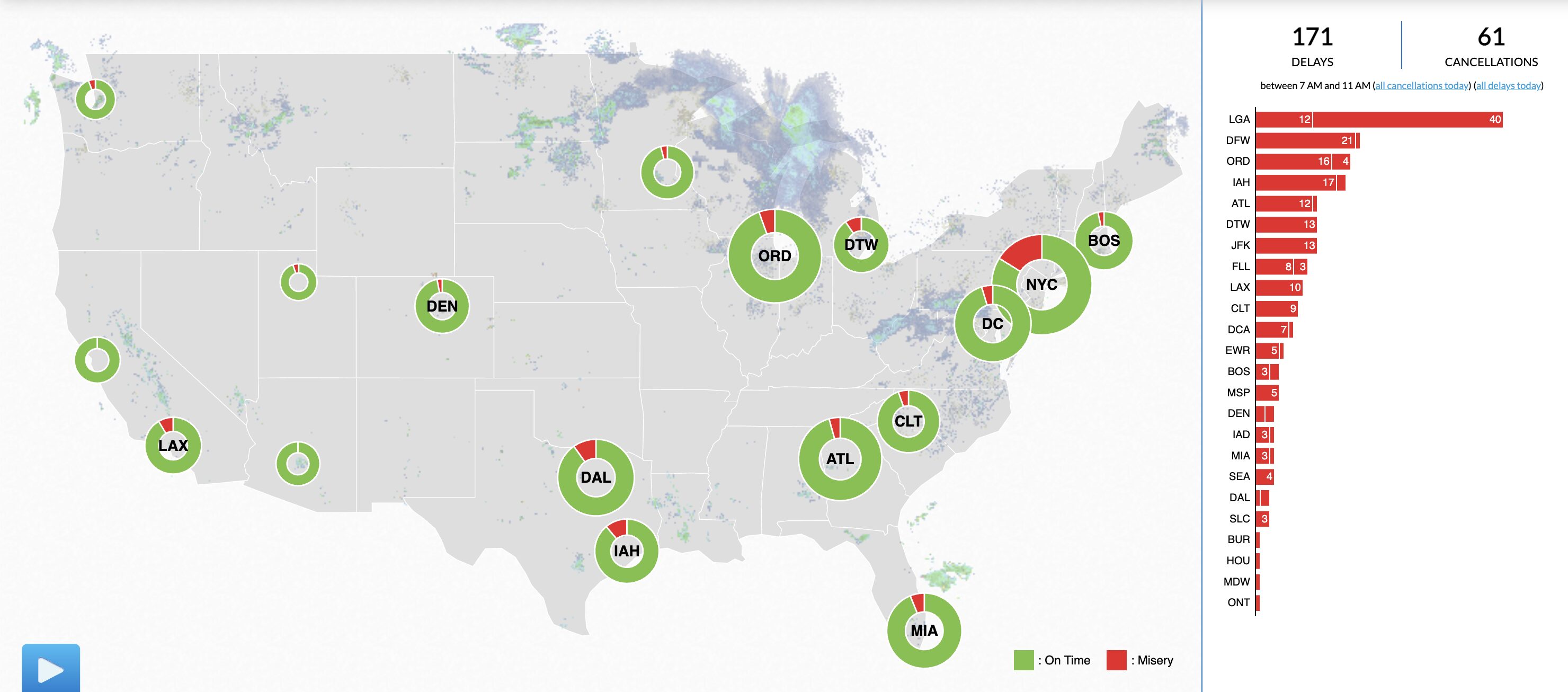
FlightAware Misery Map, March 25
One of the primary drivers of current disruptions is the spring break travel surge, which is shaping up to be one of the busiest on record. Millions of travelers are moving within a compressed timeframe, placing extraordinary pressure on airports, airlines, and air traffic control systems.
Popular destinations such as South Florida, Mexico, and the Caribbean are experiencing sharp increases in traffic, leading to congestion both in the air and on the ground. With so many travelers concentrated into a narrow travel window, even minor operational issues can quickly escalate into widespread delays and cancellations.
Critical Factors Affecting Airlines
Several critical factors are converging to disrupt commercial aviation operations.
Demand has reached unprecedented levels, with airlines preparing for approximately 171 million passengers between March and April, surpassing previous spring travel records. At the same time, external pressures, particularly rising fuel costs, are forcing commercial carriers to make difficult operational decisions.
Following the February 28 closure of the Strait of Hormuz, a key global aviation fuel corridor, jet fuel prices surged rapidly, placing immediate pressure on airline economics. In response, several major commercial carriers, including large U.S. airlines such as United, have begun reducing capacity, quietly canceling or consolidating flights on less profitable routes and adjusting schedules to manage rising costs.
For travelers, this translates into fewer available flights, increased prices, and a higher likelihood of last-minute cancellations or itinerary changes.
Compounding these challenges, TSA officers have been working without pay since the partial government shutdown began on February 14, leading to widespread staffing shortages.
More than 366 officers have resigned, and absentee rates have surged. At Houston Hobby Airport, 55% of staff called out on a single day, while Atlanta Hartsfield-Jackson International Airport reported absentee rates as high as 38%.
These shortages have led to extended security wait times and reduced operational capacity. Travelers are experiencing multi-hour delays at checkpoints, with some airports consolidating or closing screening lanes entirely.
Key Factors Driving Delays and Price Increases
TSA Workforce Shortages
TSA personnel are classified as essential employees and are required to report to work without pay during the government shutdown. While back pay is expected, the immediate financial strain has contributed to increased absenteeism and resignations.
As a result, security wait times have increased dramatically. Atlanta recorded wait times exceeding two hours, while LaGuardia reached delays of up to three hours. Some airports have reduced checkpoint operations due to limited staffing.
Fuel Cost Volatility
The Strait of Hormuz typically facilitates a significant share of the world’s aviation fuel supply, and its closure has created immediate constraints across global markets.
In response to rapidly rising fuel costs, commercial airlines are taking protective measures: raising fares, adding fuel surcharges, and, increasingly, scaling back service on select routes. In some cases, carriers are consolidating flights or reducing frequency to manage operating costs more effectively.
For travelers, this environment results in higher ticket prices, reduced availability, and a greater likelihood of schedule changes as airlines continue to adjust capacity in real time.
The Alternative: Why Private Aviation Works When Commercial Doesn’t
While commercial aviation is experiencing significant operational strain, private aviation offers a fundamentally different and more controlled travel experience.
Private Clients are not subject to TSA checkpoints, long security lines, or crowded airport terminals. Instead, they depart from private terminals (FBOs), where boarding is efficient, discreet, and typically completed within minutes of arrival.
This distinction becomes particularly valuable during peak travel periods such as spring break, when commercial terminals are operating at or beyond capacity.
Private aviation also provides greater flexibility. Operators are not constrained by rigid airline schedules or single-source fuel contracts. This allows for more adaptive routing, access to alternative airports, and strategic fuel sourcing.
While private aircraft operate within the same airspace as commercial flights, the overall travel experience remains significantly more efficient and predictable.
It is important to note that ground transportation near major airports may still experience congestion, particularly during peak travel periods. However, the ability to utilize alternative airports and avoid commercial terminals helps mitigate many of these challenges.
How to Stay Ahead of the Disruptions
Careful planning remains essential in the current travel environment:
Maintain access to essential items, including medications and travel documents, in the event of delays
Consider alternative airports to avoid congestion at major hubs
Stay informed through real-time updates and expert guidance
Allow additional time for ground transportation, particularly in high-traffic markets
Magellan Jets Is Built for Moments Like This
Magellan Jets is uniquely positioned to navigate periods of disruption through its asset-light model.
Our Jet Card programs provide an additional layer of stability, with guaranteed availability that ensures access to aircraft 365 days a year, with no blackout dates, even during peak travel periods. Additionally, Jet Card Owners are protected from volatile fuel costs. Magellan Jets absorbs all fuel price increases up to 25%, offering peace of mind and shielding our Clients from the full impact of market fluctuations.
Because we do not own aircraft, we are not limited to a fixed fleet. Instead, we source aircraft from the Magellan Jets Preferred Network, a carefully vetted group of top-tier operators, allowing us to select the most appropriate aircraft based on current conditions.
This flexibility enables us to proactively adjust travel plans, including routing through alternative airports and optimizing fuel sourcing when conditions change.
Our Flight Operations team continuously monitors operational conditions, making certain that potential disruptions are addressed before they impact our Private Clients.
“I was in a bind with all the travel hassles this weekend and Magellan stepped up and helped me get a flight quickly to help my family get home on time. Thank you.” – Magellan Jets Private Client
Frequently Asked Questions About Recent Travel Disruptions (FAQ):
Is TSA still paid during a government shutdown?
No. TSA officers continue to work without pay until funding is restored. While back pay is typically issued, the immediate financial impact contributes to staffing shortages.
Is LAX affected by the government shutdown?
Yes. Like many major U.S. airports, LAX is experiencing operational strain due to the government shutdown. As a result, travelers are seeing longer security lines, delays, and a less predictable airport experience overall.
How is the TSA shortage impacting airport operations right now?
TSA staffing shortages are reducing the number of open security lanes, increasing wait times, and creating bottlenecks at checkpoints. In high-traffic airports such as LAX, this can mean multi-hour delays, especially during peak travel periods like spring break.
Are TSA wait times increasing nationwide?
Yes. Major airports across the country, including LAX, Atlanta, and LaGuardia, are reporting increased wait times due to the same combination of high demand and reduced staffing.
Is there a way to bypass TSA wait times entirely?
Yes. Private aviation allows travelers to bypass TSA checkpoints entirely by departing from private terminals (FBOs), where security procedures are handled differently and far more efficiently.
What flights are being canceled right now?
Cancellations are occurring across a range of routes, particularly those with lower demand or tighter margins. Airlines are prioritizing efficiency by consolidating flights and reallocating resources, which can result in sudden schedule changes.
How long are TSA wait times right now?
TSA wait times currently range from 30 minutes to over 3 hours, depending on the airport and time of day. Due to staffing shortages and peak travel demand, major hubs like LAX and Atlanta are experiencing the longest delays. Travelers should arrive early, as wait times remain unpredictable.
What are TSA wait times at Logan Airport right now?
TSA wait times at Boston Logan International Airport are generally more manageable compared to heavily impacted hubs like LAX or Atlanta. While delays can still occur during peak travel periods, Logan has not experienced the same level of disruption from staffing shortages and congestion.
For travelers seeking greater certainty and efficiency, Magellan Jets offers access to the Magellan Jets Private Terminal in Bedford, allowing clients to bypass TSA lines entirely and eliminate the risk of unexpected delays.
A More Reliable Way to Fly
Commercial aviation is currently facing systemic challenges with no immediate resolution. High demand, fuel volatility, and staffing shortages continue to impact reliability and traveler experience.
Private aviation provides a more controlled, efficient, and predictable alternative, particularly during periods of peak demand.
By eliminating TSA checkpoints, avoiding crowded terminals, and offering flexible, responsive operations, private aviation allows travelers to maintain control over their schedules.
For those seeking a more reliable travel solution, Magellan Jets offers the expertise, flexibility, and service required to navigate today’s complex travel environment with confidence. Contact a Private Aviation Advisor here.
Even if you’re flying privately, the ripple effects of a U.S. government shutdown can extend into every layer of air travel. Air traffic control (ATC), customs, and security all depend on federal staffing. When funding lapses, these essential personnel are sometimes furloughed or working without pay, leading to reduced airspace capacity, longer taxi times, and possible delays for both commercial and private flights.
While luxury travelers enjoy more control over schedules and service, airspace management affects everyone, from a commercial jetliner to a Gulfstream G650.
The ATC Staffing Shortage: How It Affects Everyone
Air Traffic Control (ATC) professionals ensure that every aircraft in U.S. airspace remains safely separated and efficiently sequenced. They manage takeoffs, landings, ground movement, and en-route spacing for both private and commercial operations.
When controller staffing drops, the FAA must slow air traffic to preserve safety margins. That means longer taxi times, delayed departures, and—at times—holding patterns before landing clearance.
What’s Happening Now
According to the FAA, over half of the major control facilities are currently below full staffing levels. Flow programs and ground stops have most affected large hubs like Newark, Boston, Orlando, and across South Florida.
Even private jets are subject to these delays. As Christian Schaible, Senior Director of Safety and Joint Operations at Magellan Jets, explains:
“It doesn’t matter what plane you’re flying. ATC staffing affects everyone. A prolonged government shutdown impacts the entire aviation ecosystem.”
He continues:
“We have seen increasing delays due to staffing shortages and capacity limitations. ATC is slowing things down to make sure operations remain safe and controlled.”
Is It Safe to Fly During a Government Shutdown?
Yes. Safety is never compromised. As Schaible emphasizes:
“It’s safe to fly right now. They’re going to limit what they can handle based on who is available. You won’t see a safety detraction, but you may see operational limitations.”
The FAA prioritizes safety by reducing the number of active operations when staffing is thin. The result: slower throughput, but no reduction in oversight or control.
How Magellan Jets Protects Your Travel Experience
Even in challenging operational conditions, Magellan Jets’ model ensures reliability, communication, and cost transparency.
Real-Time Flight Operations Support
Magellan’s Flight Support team continuously monitors ATC conditions, customs availability, and weather impacts to proactively adjust itineraries.
“Our team is proactive and will work with you to handle anything unplanned,” says Schaible. “We can help find nearby airports that might be a better place to land than one that’s backed up.”
Flexibility and Communication
Because conditions evolve rapidly, Magellan clients benefit from continuous updates and expert handling of alternate airports, reroutes, and time shifts.
“Clients appreciate our ongoing communication with them to help sort their travel needs,” Schaible adds.
The Advantage of Estimated Flight Time Pricing
Unlike many competitors who bill based on actual flight time, Magellan Jets uses an Estimated Flight Time pricing model: an AI-driven algorithm that factors in aircraft type, winds, routing, and other factors to predict total time from departure to arrival.
“Even if your flight takes a longer route or experiences a brief delay, it won’t impact you in this regard” says Schaible. “Your estimated flight time is what we go by, not your actual. You’re not penalized for ATC delays.”
During a shutdown, when unpredictability is high, this approach provides pricing stability and peace of mind.
Travel Smart: Tips for Flying Private During a Shutdown
When the aviation system slows down, flexibility is your biggest advantage. Magellan Jets’ team helps clients adapt seamlessly to changing conditions, ensuring that every flight stays as smooth and efficient as possible, even during a government shutdown.
1. Be Flexible with Your Schedule
The most effective way to minimize disruption is to adjust your departure times around peak congestion. Early morning departures often face fewer ATC delays and flow programs. Allowing your itinerary to shift slightly can make a significant difference in overall travel time.
2. Consider Alternate Airports
If a major hub like Teterboro, Newark, or Los Angeles is experiencing congestion, Magellan can help you select and coordinate nearby regional airports that are more accessible. Our team will arrange ground transportation from your arrival point to your destination, maintaining the same level of comfort and efficiency throughout your journey.
3. Know the Customs Landscape for International Flights
During a shutdown, customs staffing is often limited at smaller airports.
“If you’re flying internationally, you might not be able to get a customs agent at certain times or locations, particularly at some of the smaller airports,” Schaible explains. “When staffing or hours of operations are reduced, customs may need prioritize staffing at other airports.”
Your Magellan Private Aviation Advisor can confirm customs availability before your trip and recommend the best port of entry to avoid delays.
4. Expect Some Operational Slowdowns
Flow programs and extended taxi times may still occur, especially in busy regions like South Florida (Naples, Sarasota, PBI) and the New York metro area. The good news: with Magellan’s proactive monitoring, your team will adjust your flight plan in real time to minimize inconvenience.
The Bottom Line
Partnering with a proactive provider like Magellan Jets ensures that you stay informed, protected, and moving forward during periods of uncertainty.
“A prolonged government shutdown affects everyone equally,” says Schaible, “but Magellan’s job is to make sure our clients feel the impact as little as possible.”
Frequently Asked Questions about Private Aviation & Government Shutdowns (FAQ):
Does a government shutdown affect private jet flights?
Yes. FAA and ATC staffing shortages during a shutdown affect both commercial and private flights, causing delays, longer taxi times, and possible rerouting.
Is it safe to fly private during a full or partial government shutdown?
Absolutely. The FAA maintains full safety oversight. The system slows down, but does not compromise safety.
Why are private flights delayed during a shutdown?
Fewer controllers mean fewer simultaneous flights allowed. The FAA uses “flow programs” and “ground stops” may be used to reduce operational load and maintain an acceptable margin of safety.
What is a flow program or ground stop?
A flow program helps manage the number of departures and arrivals to manage congestion and prevent controller overload. A ground stop halts departures an airport until conditions improve.
Are private flights exempt from the FAA’s mandatory flight reductions?
No. The FAA’s order to reduce flight operations by up to 10% at 40 major airports applies to all aircraft operations, including private aviation. These are system-wide capacity restrictions designed to maintain safety as air traffic controllers work without pay. Private flights operating at the 40 designated high-traffic airports are subject to the same reductions as commercial flights. However, working with an experienced operator like Magellan Jets can help you navigate these restrictions through flexible scheduling, alternative airport options, and real-time operational support.
What airports are affected by the TSA shortage?
All major airports in the United States are affected by the TSA shortage. Private terminals are exempt from TSA and therefore are not facing the same extended wait times and delays that commercial terminals are facing.
Christian Schaible is the Senior Director, Safety & Joint Operations at Magellan Jets. A former military helicopter pilot and drone operator, Christian brings extensive expertise in program management, risk analysis, and mission execution to his role. At Magellan Jets, he applies his operational insight and disciplined approach to deliver seamless, secure travel experiences for Private Clients across every season.
By Anthony Tivnan, Founder and President, Magellan Jets
The private aviation industry is evolving at an incredible pace. As we look ahead in 2026, the trends shaping how we fly are becoming clearer, driven by new technologies, shifting Client expectations, and a new generation of travelers. The 2025 holiday season gave us a preview of this future, as Magellan Jets experienced unprecedented growth that signals a fundamental shift in the market.
For example, over the Thanksgiving weekend, Magellan Jets saw a 43% increase in travel volume compared to the previous year. The Monday following the holiday saw a staggering 66% rise in flights. This surge in activity underscores a key reality: private aviation is no longer just a luxury. It has become an essential tool for individuals and businesses that value their time, demand convenience, and prioritize peace of mind for every Client.
Based on what we’re seeing, here are four key predictions for the future of private aviation in 2026 and beyond.
1. Frictionless Experiences Will Define Success
In 2026, the provider that makes it easiest for Clients to fly will win. The modern private flyer expects a seamless, intuitive, and personalized journey from the very first interaction. Clients are looking for a “one-stop-shop” mentality similar to how they interact with other services—ordering groceries, booking a car, or finding a ride instantly. They want that same ease of access when booking a private jet. The days of complicated booking processes and fragmented communication are numbered. Clients want efficiency and clarity, allowing them to focus on their destination, not the logistics of getting there.
However, technology alone is not the answer. The future lies in finding the perfect balance between automation and the human touch. Clients appreciate the ability to self-serve for simple tasks, like reviewing flight details or checking Jet Card hours. By leveraging technology to remove administrative burdens, we free up our advisors to focus on what truly matters: enhancing the Client experience. But for more complex needs or when the unexpected occurs, access to a dedicated, knowledgeable expert is non-negotiable. The most successful companies will be those that integrate technology, including AI tools, to enhance, not replace, the deeply personal and trust-based relationships that define premium service.
2. Personalization is the Ultimate Differentiator
In an increasingly crowded market where many competitors make similar claims, true differentiation will come from personalization. As luxury becomes less about material goods and more about unique experiences, the focus for ultra-high-net-worth (UHNW) Clients has shifted. Providing a safe and efficient flight is a non-negotiable, but that alone is not enough; the experience itself must be memorable.
Recent studies confirm this trend, showing that 83% of UHNW Clients plan to increase their spending on travel. This signals a clear preference for experiences over material possessions.
For us, this means the journey begins the moment a Client steps on board or even enters the terminal. Whether it’s acknowledging a special anniversary, theming a flight for a major sporting event, or curating one-of-a-kind Magellan Jets Journeys, we are committed to making every moment exceptional. This level of tailored service is what transforms a trip into an unforgettable experience.
3. A New Generation of Clients are Taking Flight
The private aviation landscape is also being reshaped by a significant demographic shift. The ‘Great Wealth Transfer’ is underway, with high levels of wealth moving from older generations to Gen X and Millennials. This is creating a new profile of private flyers with different expectations and priorities.
By 2040, Gen Z and Millennials will comprise nearly 35% of the global UHNW population, a dramatic increase from just 8% today. Meanwhile, Gen X will account for 45% of this group. These younger Clients place a high value on experiences, time, and convenience.
The current demographic of flyers is in a sweet spot where they have wealth, health, and time—and they are eager to utilize all three simultaneously. We must adapt to the preferences of this new generation of Clients.
4. Navigating Competitive Skies
While new players are entering the market, it is the credible, established players who will continue to set the standard and lead the industry forward. We are seeing the asset-light model gain substantial popularity, provided it is backed by premium inventory. Unlike brokers who might scramble to find any available aircraft our model focuses on premium aircraft without the rigidity of whole ownership.
Track records of safety, decades of operational expertise, and the trustworthiness cannot be replicated overnight. In this environment, providers who compete on price alone will struggle to deliver the quality and reliability that discerning Clients demand.
Leading the Way Forward
Looking ahead in 2026, Magellan Jets is committed to leading through innovation and expertise. We are leveraging data and AI technology to enhance our services, not as a replacement for our people, but as a tool to empower them. By combining great people, powerful technology, and a flexible asset-light model, we are building a future that prioritizes flexibility and transparency. By automating internal processes, we free up our team to focus on what they do best: building strong, lasting relationships with our Clients.
About Anthony Tivnan
Anthony Tivnan is the President and Co-Founder of Magellan Jets, which he launched in 2008 and has grown into a trusted leader in private aviation through a relentless focus on safety, service, and innovation. With more than 20 years in aviation, including a leadership role at Jets International, Anthony has built Magellan Jets into an award-winning company recognized for exceptional client experience, industry-leading satisfaction scores, and prestigious safety certifications like the WYVERN Wingman Broker distinction. He also serves on the board of the Camp Harbor View Foundation and is committed to fostering strong relationships with clients, partners, and his team.
Every year, the Super Bowl triggers a predictable surge in private aviation demand. Instead of steady, evenly spaced traffic, aircraft arrive in concentrated waves, often the day before kickoff, and depart in a rush right after the game ends. That surge puts pressure on airport capacity, air traffic control, and ground services all at once. Teams in private aviation often refer to this pattern as the Super Bowl Effect.
As Christian Schaible, Senior Director, Safety and Joint Operations at Magellan Jets, explains: “Airports operate with real limits like ramp space, staffing, and runway capacity can only support so much traffic in a short period. Super Bowl weekend pushes the system right up against those limits.”
How The Super Bowl Effect Happens
On a normal day, airports and controllers can absorb changes without you feeling it. On a Super Bowl weekend, the volume spikes so quickly that the system has to manage demand more aggressively. You’ll most commonly notice it in three ways:
1) You lose timing control
During peak event windows, you may not be able to land or depart at the exact time you prefer. Airports can require arrival and departure “windows,” which means you might need to shift by an hour (or more) to make the trip work.
Christian summarizes why timing gets tight: “On routine travel days, the system runs in the background. During major events, demand surges beyond what airports usually handle, and that’s when the constraints become visible.”
2) You feel more ATC delays, even when you plan well
Air traffic control has to space aircraft safely. When many flights funnel into the same metro area and follow the same routes, controllers often implement traffic management programs to keep the flow orderly.
Christian explains it this way: “When flights concentrate into the same arrival and departure windows, ATC has to meter the flow. That can translate into controlled delays before takeoff, enroute, or on arrival.”
3) Parking becomes the hidden bottleneck
Even if the runway can handle arrivals, the airport still needs room to park aircraft and support turnarounds. When ramps fill up, airports may restrict overnight stays, or push more flights into drop-and-go patterns.
2025 flight activity shows how dramatic the surge can be
A 2025 analysis of Super Bowl LIX (New Orleans) reported 611 business jet arrivals from Friday through Sunday prior to the game, compared with roughly ~100 private aviation flights on a typical weekend.
Another weekly activity analysis citing WingX data described the 2025 Super Bowl week as the biggest surge in business jets since 2018.
Different sources can count differently based on which airports they include and how they define business aviation activity, but the takeaway stays the same: Super Bowl travel compresses heavy demand into a short period, and constraints appear quickly.
Super Bowl LX in 2026: The Bay Area reservation program and what it means for you
For Super Bowl LX, the San Francisco Bay Area expects such high flight volume that airports have instituted a slot reservation program from Wednesday, Feb. 4 through Monday, Feb. 9.
Here’s what matters if you’re flying private:
You will likely need a confirmed arrival time and a confirmed departure time
Think of it like a reservation at a busy restaurant. If you don’t have a reservation, you may not get seated when you want. In aviation terms, that means the airport may not be able to accept your flight at the time you prefer, especially in peak hours.
This program applies broadly to general aviation flights. (Certain scheduled commercial operations and public safety flights fall under exceptions.)
You may need to adjust your schedule to match what’s available
As the game approaches, the best arrival and departure windows become harder to secure. If you want to arrive Friday afternoon, depart right after the game, you should expect competition for those times.
Parking can run out, which can change the entire trip plan
Once overnight parking reaches capacity, some airports may allow drop-and-go only. That affects you in a very direct way:
You may not be able to keep the aircraft nearby overnight.
The aircraft may need to leave the area and return later.
A drop-and-go requires reservations for both segments—your arrival and your departure—so the return plan becomes just as important as the inbound.
Even “non-slot” airports may feel busy
Airports outside the program will likely see increased traffic as travelers look for alternatives. So “we’ll just use a different airport” often becomes a crowded strategy too, especially for parking.
Slot-controlled airports
KSFO – San Francisco International
KOAK – Oakland
KSJC – Norman Y. Mineta San Jose International
KMRY – Monterey Regional
KSNS – Salinas Municipal
KHWD – Hayward Executive
KSQL – San Carlos
KPAO – Palo Alto
KNUQ – Moffett Federal Airfield
KRHV – Reid-Hillview
KSCK – Stockton Metro
KWVI – Watsonville Municipal
KAPC – Napa County
KCCR – Buchanan Field
KLVK – Livermore Municipal
KCVH – Hollister Municipal
Extended hours to support the post-game push
To help handle the departure surge, select airports will operate extended hours:
KSJC: 0000–0200 PST / 0600–2359 PST on Feb. 9
KLVK: 0700–2359 PST on Feb. 8 and 0600–2100 PST on Feb. 9
KHWD: 0700–2300 PST on Feb. 8 and 0600–2100 PST on Feb. 9
ATC initiatives you might experience
Even with airport reservations, airspace volume can still challenge ATC, especially if weather deteriorates. Crews may see:
Ground Delay Programs (GDPs)
Airspace Flow Programs (AFPs)
Ground Stops
Time-Based Metering
Miles/Minutes-in-Trail restrictions
Airborne holding
What you’ll feel as a traveler during Super Bowl week
Most issues show up in a handful of ways:
You can’t get the exact arrival/departure time you want
You see more delays as ATC meters inbound/outbound flows
Overnight parking becomes limited or unavailable
Service timelines stretch due to sheer volume
Christian’s bottom line captures it well: “You can plan early, choose the right airports, and still see delays. When volume spikes, the system has to slow down to stay safe.”
Frequently Asked Questions About the Super Bowl Effect (FAQ)
What is the Super Bowl Effect in private aviation?
The Super Bowl Effect is the surge in private flight activity around the game that causes congestion, limited parking, airport reservations, and higher odds of ATC delays.
For Super Bowl LX in 2026, how will the slot reservation program affect my trip?
It means you will likely need a confirmed arrival time and a confirmed departure time. If you don’t secure those windows early, you may need to shift your schedule or choose a different airport.
Can I still fly in last-minute for the Super Bowl?
Sometimes, but availability becomes limited quickly. You may lose preferred timing, pay more due to scarcity, or face drop-and-go-only constraints if parking fills.
What is a “drop-and-go”?
A drop-and-go means you arrive, unload, and depart shortly after, without staying overnight. If parking reaches capacity, more flights may have to operate this way, which makes your departure plan just as important as your arrival.
If an airport isn’t in the slot program, will it be easier?
Not necessarily. Demand often shifts to nearby airports, and those locations can see increased congestion and parking constraints too.
How does Magellan Jets help during Super Bowl week?
Magellan helps by coordinating early aircraft sourcing, airport access planning, and flight plan strategy so you improve your chances of getting the schedule you want and avoid preventable disruptions.
How Magellan Jets helps you stay ahead of the Super Bowl Effect
No provider can eliminate Super Bowl congestion. But smart planning reduces friction and helps protect your itinerary.
Christian explains Magellan’s operating philosophy clearly: “The biggest advantage comes from acting early: securing the aircraft, locking in airport access, and coordinating the flight plan before the region hits peak demand.”
In practical terms, Magellan helps by:
securing aircraft and airport access early
building a parking-aware airport strategy
planning the return as intentionally as the arrival
coordinating proactively with operators and ground partners to reduce surprises
Jet Card Clients benefit from fixed pricing and guaranteed availability during high volume events like the Super Bowl.