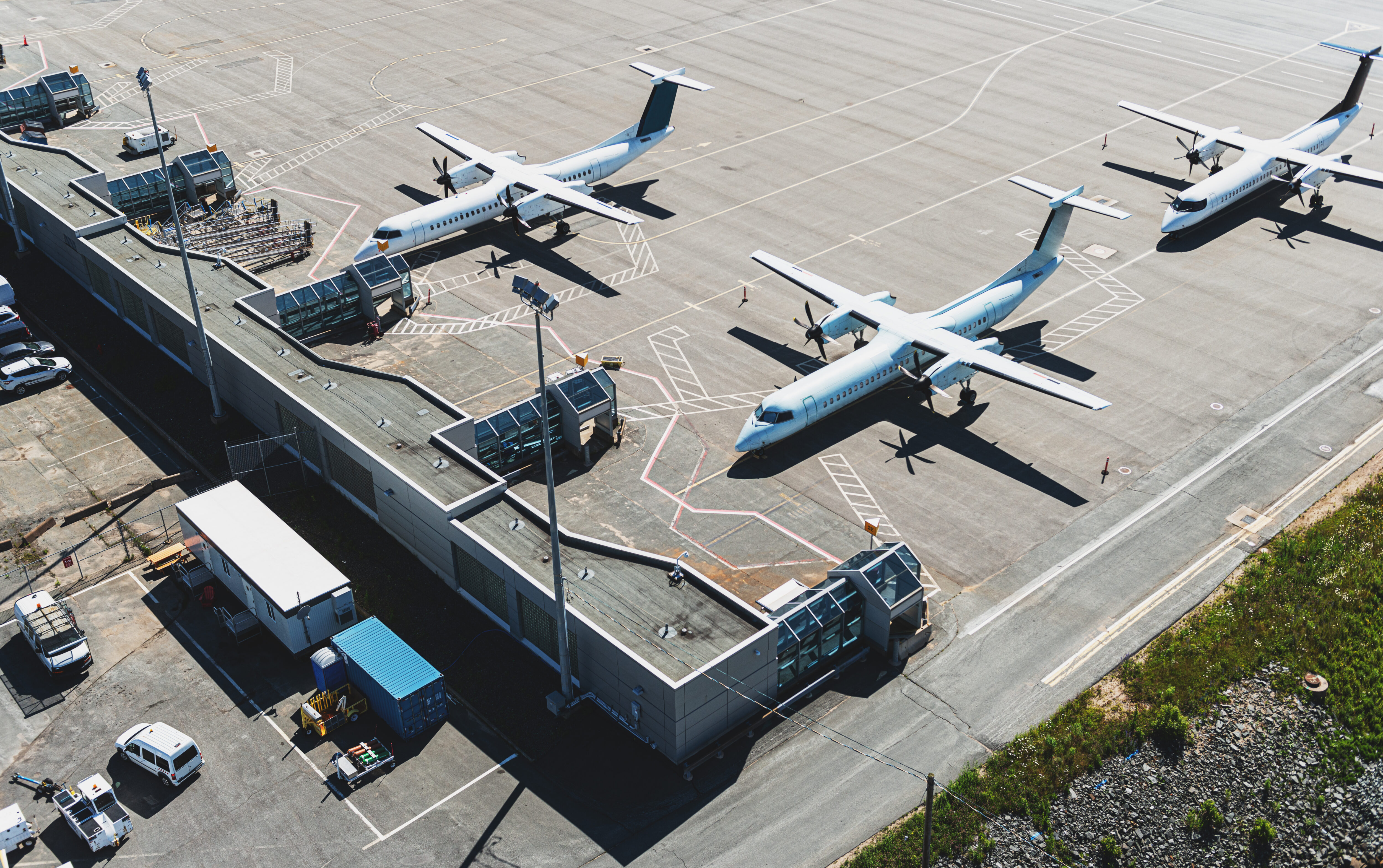
Commercial air travel is experiencing significant strain, and for those traveling right now during peak spring break season, the impact is immediate and unavoidable. Long security lines, widespread delays, flight cancellations, and rising costs are creating a challenging environment for commercial travelers nationwide.
The Perfect Storm for Airline Travel
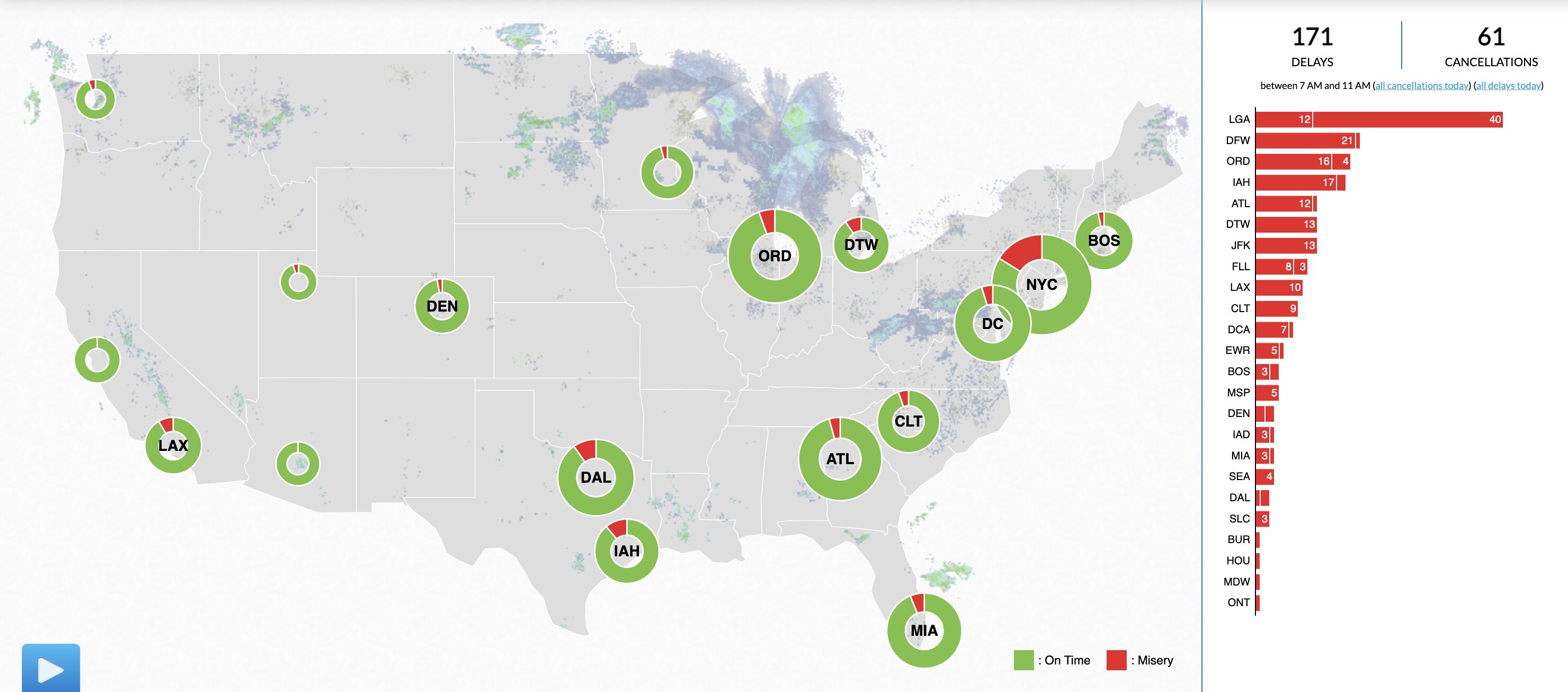
FlightAware Misery Map, March 25
One of the primary drivers of current disruptions is the spring break travel surge, which is shaping up to be one of the busiest on record. Millions of travelers are moving within a compressed timeframe, placing extraordinary pressure on airports, airlines, and air traffic control systems.
Popular destinations such as South Florida, Mexico, and the Caribbean are experiencing sharp increases in traffic, leading to congestion both in the air and on the ground. With so many travelers concentrated into a narrow travel window, even minor operational issues can quickly escalate into widespread delays and cancellations.
Critical Factors Affecting Airlines
Several critical factors are converging to disrupt commercial aviation operations.
Demand has reached unprecedented levels, with airlines preparing for approximately 171 million passengers between March and April, surpassing previous spring travel records. At the same time, external pressures, particularly rising fuel costs, are forcing commercial carriers to make difficult operational decisions.
Following the February 28 closure of the Strait of Hormuz, a key global aviation fuel corridor, jet fuel prices surged rapidly, placing immediate pressure on airline economics. In response, several major commercial carriers, including large U.S. airlines such as United, have begun reducing capacity, quietly canceling or consolidating flights on less profitable routes and adjusting schedules to manage rising costs.
For travelers, this translates into fewer available flights, increased prices, and a higher likelihood of last-minute cancellations or itinerary changes.
Compounding these challenges, TSA officers have been working without pay since the partial government shutdown began on February 14, leading to widespread staffing shortages.
More than 366 officers have resigned, and absentee rates have surged. At Houston Hobby Airport, 55% of staff called out on a single day, while Atlanta Hartsfield-Jackson International Airport reported absentee rates as high as 38%.
These shortages have led to extended security wait times and reduced operational capacity. Travelers are experiencing multi-hour delays at checkpoints, with some airports consolidating or closing screening lanes entirely.
Key Factors Driving Delays and Price Increases
TSA Workforce Shortages
TSA personnel are classified as essential employees and are required to report to work without pay during the government shutdown. While back pay is expected, the immediate financial strain has contributed to increased absenteeism and resignations.
As a result, security wait times have increased dramatically. Atlanta recorded wait times exceeding two hours, while LaGuardia reached delays of up to three hours. Some airports have reduced checkpoint operations due to limited staffing.
Fuel Cost Volatility
The Strait of Hormuz typically facilitates a significant share of the world’s aviation fuel supply, and its closure has created immediate constraints across global markets.
In response to rapidly rising fuel costs, commercial airlines are taking protective measures: raising fares, adding fuel surcharges, and, increasingly, scaling back service on select routes. In some cases, carriers are consolidating flights or reducing frequency to manage operating costs more effectively.
For travelers, this environment results in higher ticket prices, reduced availability, and a greater likelihood of schedule changes as airlines continue to adjust capacity in real time.
The Alternative: Why Private Aviation Works When Commercial Doesn’t
While commercial aviation is experiencing significant operational strain, private aviation offers a fundamentally different and more controlled travel experience.
Private Clients are not subject to TSA checkpoints, long security lines, or crowded airport terminals. Instead, they depart from private terminals (FBOs), where boarding is efficient, discreet, and typically completed within minutes of arrival.
This distinction becomes particularly valuable during peak travel periods such as spring break, when commercial terminals are operating at or beyond capacity.
Private aviation also provides greater flexibility. Operators are not constrained by rigid airline schedules or single-source fuel contracts. This allows for more adaptive routing, access to alternative airports, and strategic fuel sourcing.
While private aircraft operate within the same airspace as commercial flights, the overall travel experience remains significantly more efficient and predictable.
It is important to note that ground transportation near major airports may still experience congestion, particularly during peak travel periods. However, the ability to utilize alternative airports and avoid commercial terminals helps mitigate many of these challenges.
How to Stay Ahead of the Disruptions
Careful planning remains essential in the current travel environment:
Maintain access to essential items, including medications and travel documents, in the event of delays
Consider alternative airports to avoid congestion at major hubs
Stay informed through real-time updates and expert guidance
Allow additional time for ground transportation, particularly in high-traffic markets
Magellan Jets Is Built for Moments Like This
Magellan Jets is uniquely positioned to navigate periods of disruption through its asset-light model.
Our Jet Card programs provide an additional layer of stability, with guaranteed availability that ensures access to aircraft 365 days a year, with no blackout dates, even during peak travel periods. Additionally, Jet Card Owners are protected from volatile fuel costs. Magellan Jets absorbs all fuel price increases up to 25%, offering peace of mind and shielding our Clients from the full impact of market fluctuations.
Because we do not own aircraft, we are not limited to a fixed fleet. Instead, we source aircraft from the Magellan Jets Preferred Network, a carefully vetted group of top-tier operators, allowing us to select the most appropriate aircraft based on current conditions.
This flexibility enables us to proactively adjust travel plans, including routing through alternative airports and optimizing fuel sourcing when conditions change.
Our Flight Operations team continuously monitors operational conditions, making certain that potential disruptions are addressed before they impact our Private Clients.
“I was in a bind with all the travel hassles this weekend and Magellan stepped up and helped me get a flight quickly to help my family get home on time. Thank you.” – Magellan Jets Private Client
Frequently Asked Questions About Recent Travel Disruptions (FAQ):
Is TSA still paid during a government shutdown?
No. TSA officers continue to work without pay until funding is restored. While back pay is typically issued, the immediate financial impact contributes to staffing shortages.
Is LAX affected by the government shutdown?
Yes. Like many major U.S. airports, LAX is experiencing operational strain due to the government shutdown. As a result, travelers are seeing longer security lines, delays, and a less predictable airport experience overall.
How is the TSA shortage impacting airport operations right now?
TSA staffing shortages are reducing the number of open security lanes, increasing wait times, and creating bottlenecks at checkpoints. In high-traffic airports such as LAX, this can mean multi-hour delays, especially during peak travel periods like spring break.
Are TSA wait times increasing nationwide?
Yes. Major airports across the country, including LAX, Atlanta, and LaGuardia, are reporting increased wait times due to the same combination of high demand and reduced staffing.
Is there a way to bypass TSA wait times entirely?
Yes. Private aviation allows travelers to bypass TSA checkpoints entirely by departing from private terminals (FBOs), where security procedures are handled differently and far more efficiently.
What flights are being canceled right now?
Cancellations are occurring across a range of routes, particularly those with lower demand or tighter margins. Airlines are prioritizing efficiency by consolidating flights and reallocating resources, which can result in sudden schedule changes.
How long are TSA wait times right now?
TSA wait times currently range from 30 minutes to over 3 hours, depending on the airport and time of day. Due to staffing shortages and peak travel demand, major hubs like LAX and Atlanta are experiencing the longest delays. Travelers should arrive early, as wait times remain unpredictable.
What are TSA wait times at Logan Airport right now?
TSA wait times at Boston Logan International Airport are generally more manageable compared to heavily impacted hubs like LAX or Atlanta. While delays can still occur during peak travel periods, Logan has not experienced the same level of disruption from staffing shortages and congestion.
For travelers seeking greater certainty and efficiency, Magellan Jets offers access to the Magellan Jets Private Terminal in Bedford, allowing clients to bypass TSA lines entirely and eliminate the risk of unexpected delays.
A More Reliable Way to Fly
Commercial aviation is currently facing systemic challenges with no immediate resolution. High demand, fuel volatility, and staffing shortages continue to impact reliability and traveler experience.
Private aviation provides a more controlled, efficient, and predictable alternative, particularly during periods of peak demand.
By eliminating TSA checkpoints, avoiding crowded terminals, and offering flexible, responsive operations, private aviation allows travelers to maintain control over their schedules.
For those seeking a more reliable travel solution, Magellan Jets offers the expertise, flexibility, and service required to navigate today’s complex travel environment with confidence. Contact a Private Aviation Advisor here.
Even if you’re flying privately, the ripple effects of a U.S. government shutdown can extend into every layer of air travel. Air traffic control (ATC), customs, and security all depend on federal staffing. When funding lapses, these essential personnel are sometimes furloughed or working without pay, leading to reduced airspace capacity, longer taxi times, and possible delays for both commercial and private flights.
While luxury travelers enjoy more control over schedules and service, airspace management affects everyone, from a commercial jetliner to a Gulfstream G650.
The ATC Staffing Shortage: How It Affects Everyone
Air Traffic Control (ATC) professionals ensure that every aircraft in U.S. airspace remains safely separated and efficiently sequenced. They manage takeoffs, landings, ground movement, and en-route spacing for both private and commercial operations.
When controller staffing drops, the FAA must slow air traffic to preserve safety margins. That means longer taxi times, delayed departures, and—at times—holding patterns before landing clearance.
What’s Happening Now
According to the FAA, over half of the major control facilities are currently below full staffing levels. Flow programs and ground stops have most affected large hubs like Newark, Boston, Orlando, and across South Florida.
Even private jets are subject to these delays. As Christian Schaible, Senior Director of Safety and Joint Operations at Magellan Jets, explains:
“It doesn’t matter what plane you’re flying. ATC staffing affects everyone. A prolonged government shutdown impacts the entire aviation ecosystem.”
He continues:
“We have seen increasing delays due to staffing shortages and capacity limitations. ATC is slowing things down to make sure operations remain safe and controlled.”
Is It Safe to Fly During a Government Shutdown?
Yes. Safety is never compromised. As Schaible emphasizes:
“It’s safe to fly right now. They’re going to limit what they can handle based on who is available. You won’t see a safety detraction, but you may see operational limitations.”
The FAA prioritizes safety by reducing the number of active operations when staffing is thin. The result: slower throughput, but no reduction in oversight or control.
How Magellan Jets Protects Your Travel Experience
Even in challenging operational conditions, Magellan Jets’ model ensures reliability, communication, and cost transparency.
Real-Time Flight Operations Support
Magellan’s Flight Support team continuously monitors ATC conditions, customs availability, and weather impacts to proactively adjust itineraries.
“Our team is proactive and will work with you to handle anything unplanned,” says Schaible. “We can help find nearby airports that might be a better place to land than one that’s backed up.”
Flexibility and Communication
Because conditions evolve rapidly, Magellan clients benefit from continuous updates and expert handling of alternate airports, reroutes, and time shifts.
“Clients appreciate our ongoing communication with them to help sort their travel needs,” Schaible adds.
The Advantage of Estimated Flight Time Pricing
Unlike many competitors who bill based on actual flight time, Magellan Jets uses an Estimated Flight Time pricing model: an AI-driven algorithm that factors in aircraft type, winds, routing, and other factors to predict total time from departure to arrival.
“Even if your flight takes a longer route or experiences a brief delay, it won’t impact you in this regard” says Schaible. “Your estimated flight time is what we go by, not your actual. You’re not penalized for ATC delays.”
During a shutdown, when unpredictability is high, this approach provides pricing stability and peace of mind.
Travel Smart: Tips for Flying Private During a Shutdown
When the aviation system slows down, flexibility is your biggest advantage. Magellan Jets’ team helps clients adapt seamlessly to changing conditions, ensuring that every flight stays as smooth and efficient as possible, even during a government shutdown.
1. Be Flexible with Your Schedule
The most effective way to minimize disruption is to adjust your departure times around peak congestion. Early morning departures often face fewer ATC delays and flow programs. Allowing your itinerary to shift slightly can make a significant difference in overall travel time.
2. Consider Alternate Airports
If a major hub like Teterboro, Newark, or Los Angeles is experiencing congestion, Magellan can help you select and coordinate nearby regional airports that are more accessible. Our team will arrange ground transportation from your arrival point to your destination, maintaining the same level of comfort and efficiency throughout your journey.
3. Know the Customs Landscape for International Flights
During a shutdown, customs staffing is often limited at smaller airports.
“If you’re flying internationally, you might not be able to get a customs agent at certain times or locations, particularly at some of the smaller airports,” Schaible explains. “When staffing or hours of operations are reduced, customs may need prioritize staffing at other airports.”
Your Magellan Private Aviation Advisor can confirm customs availability before your trip and recommend the best port of entry to avoid delays.
4. Expect Some Operational Slowdowns
Flow programs and extended taxi times may still occur, especially in busy regions like South Florida (Naples, Sarasota, PBI) and the New York metro area. The good news: with Magellan’s proactive monitoring, your team will adjust your flight plan in real time to minimize inconvenience.
The Bottom Line
Partnering with a proactive provider like Magellan Jets ensures that you stay informed, protected, and moving forward during periods of uncertainty.
“A prolonged government shutdown affects everyone equally,” says Schaible, “but Magellan’s job is to make sure our clients feel the impact as little as possible.”
Frequently Asked Questions about Private Aviation & Government Shutdowns (FAQ):
Does a government shutdown affect private jet flights?
Yes. FAA and ATC staffing shortages during a shutdown affect both commercial and private flights, causing delays, longer taxi times, and possible rerouting.
Is it safe to fly private during a full or partial government shutdown?
Absolutely. The FAA maintains full safety oversight. The system slows down, but does not compromise safety.
Why are private flights delayed during a shutdown?
Fewer controllers mean fewer simultaneous flights allowed. The FAA uses “flow programs” and “ground stops” may be used to reduce operational load and maintain an acceptable margin of safety.
What is a flow program or ground stop?
A flow program helps manage the number of departures and arrivals to manage congestion and prevent controller overload. A ground stop halts departures an airport until conditions improve.
Are private flights exempt from the FAA’s mandatory flight reductions?
No. The FAA’s order to reduce flight operations by up to 10% at 40 major airports applies to all aircraft operations, including private aviation. These are system-wide capacity restrictions designed to maintain safety as air traffic controllers work without pay. Private flights operating at the 40 designated high-traffic airports are subject to the same reductions as commercial flights. However, working with an experienced operator like Magellan Jets can help you navigate these restrictions through flexible scheduling, alternative airport options, and real-time operational support.
What airports are affected by the TSA shortage?
All major airports in the United States are affected by the TSA shortage. Private terminals are exempt from TSA and therefore are not facing the same extended wait times and delays that commercial terminals are facing.
Christian Schaible is the Senior Director, Safety & Joint Operations at Magellan Jets. A former military helicopter pilot and drone operator, Christian brings extensive expertise in program management, risk analysis, and mission execution to his role. At Magellan Jets, he applies his operational insight and disciplined approach to deliver seamless, secure travel experiences for Private Clients across every season.
By Anthony Tivnan, Founder and President, Magellan Jets
The private aviation industry is evolving at an incredible pace. As we look ahead in 2026, the trends shaping how we fly are becoming clearer, driven by new technologies, shifting Client expectations, and a new generation of travelers. The 2025 holiday season gave us a preview of this future, as Magellan Jets experienced unprecedented growth that signals a fundamental shift in the market.
For example, over the Thanksgiving weekend, Magellan Jets saw a 43% increase in travel volume compared to the previous year. The Monday following the holiday saw a staggering 66% rise in flights. This surge in activity underscores a key reality: private aviation is no longer just a luxury. It has become an essential tool for individuals and businesses that value their time, demand convenience, and prioritize peace of mind for every Client.
Based on what we’re seeing, here are four key predictions for the future of private aviation in 2026 and beyond.
1. Frictionless Experiences Will Define Success
In 2026, the provider that makes it easiest for Clients to fly will win. The modern private flyer expects a seamless, intuitive, and personalized journey from the very first interaction. Clients are looking for a “one-stop-shop” mentality similar to how they interact with other services—ordering groceries, booking a car, or finding a ride instantly. They want that same ease of access when booking a private jet. The days of complicated booking processes and fragmented communication are numbered. Clients want efficiency and clarity, allowing them to focus on their destination, not the logistics of getting there.
However, technology alone is not the answer. The future lies in finding the perfect balance between automation and the human touch. Clients appreciate the ability to self-serve for simple tasks, like reviewing flight details or checking Jet Card hours. By leveraging technology to remove administrative burdens, we free up our advisors to focus on what truly matters: enhancing the Client experience. But for more complex needs or when the unexpected occurs, access to a dedicated, knowledgeable expert is non-negotiable. The most successful companies will be those that integrate technology, including AI tools, to enhance, not replace, the deeply personal and trust-based relationships that define premium service.
2. Personalization is the Ultimate Differentiator
In an increasingly crowded market where many competitors make similar claims, true differentiation will come from personalization. As luxury becomes less about material goods and more about unique experiences, the focus for ultra-high-net-worth (UHNW) Clients has shifted. Providing a safe and efficient flight is a non-negotiable, but that alone is not enough; the experience itself must be memorable.
Recent studies confirm this trend, showing that 83% of UHNW Clients plan to increase their spending on travel. This signals a clear preference for experiences over material possessions.
For us, this means the journey begins the moment a Client steps on board or even enters the terminal. Whether it’s acknowledging a special anniversary, theming a flight for a major sporting event, or curating one-of-a-kind Magellan Jets Journeys, we are committed to making every moment exceptional. This level of tailored service is what transforms a trip into an unforgettable experience.
3. A New Generation of Clients are Taking Flight
The private aviation landscape is also being reshaped by a significant demographic shift. The ‘Great Wealth Transfer’ is underway, with high levels of wealth moving from older generations to Gen X and Millennials. This is creating a new profile of private flyers with different expectations and priorities.
By 2040, Gen Z and Millennials will comprise nearly 35% of the global UHNW population, a dramatic increase from just 8% today. Meanwhile, Gen X will account for 45% of this group. These younger Clients place a high value on experiences, time, and convenience.
The current demographic of flyers is in a sweet spot where they have wealth, health, and time—and they are eager to utilize all three simultaneously. We must adapt to the preferences of this new generation of Clients.
4. Navigating Competitive Skies
While new players are entering the market, it is the credible, established players who will continue to set the standard and lead the industry forward. We are seeing the asset-light model gain substantial popularity, provided it is backed by premium inventory. Unlike brokers who might scramble to find any available aircraft our model focuses on premium aircraft without the rigidity of whole ownership.
Track records of safety, decades of operational expertise, and the trustworthiness cannot be replicated overnight. In this environment, providers who compete on price alone will struggle to deliver the quality and reliability that discerning Clients demand.
Leading the Way Forward
Looking ahead in 2026, Magellan Jets is committed to leading through innovation and expertise. We are leveraging data and AI technology to enhance our services, not as a replacement for our people, but as a tool to empower them. By combining great people, powerful technology, and a flexible asset-light model, we are building a future that prioritizes flexibility and transparency. By automating internal processes, we free up our team to focus on what they do best: building strong, lasting relationships with our Clients.
About Anthony Tivnan
Anthony Tivnan is the President and Co-Founder of Magellan Jets, which he launched in 2008 and has grown into a trusted leader in private aviation through a relentless focus on safety, service, and innovation. With more than 20 years in aviation, including a leadership role at Jets International, Anthony has built Magellan Jets into an award-winning company recognized for exceptional client experience, industry-leading satisfaction scores, and prestigious safety certifications like the WYVERN Wingman Broker distinction. He also serves on the board of the Camp Harbor View Foundation and is committed to fostering strong relationships with clients, partners, and his team.
Every year, the Super Bowl triggers a predictable surge in private aviation demand. Instead of steady, evenly spaced traffic, aircraft arrive in concentrated waves, often the day before kickoff, and depart in a rush right after the game ends. That surge puts pressure on airport capacity, air traffic control, and ground services all at once. Teams in private aviation often refer to this pattern as the Super Bowl Effect.
As Christian Schaible, Senior Director, Safety and Joint Operations at Magellan Jets, explains: “Airports operate with real limits like ramp space, staffing, and runway capacity can only support so much traffic in a short period. Super Bowl weekend pushes the system right up against those limits.”
How The Super Bowl Effect Happens
On a normal day, airports and controllers can absorb changes without you feeling it. On a Super Bowl weekend, the volume spikes so quickly that the system has to manage demand more aggressively. You’ll most commonly notice it in three ways:
1) You lose timing control
During peak event windows, you may not be able to land or depart at the exact time you prefer. Airports can require arrival and departure “windows,” which means you might need to shift by an hour (or more) to make the trip work.
Christian summarizes why timing gets tight: “On routine travel days, the system runs in the background. During major events, demand surges beyond what airports usually handle, and that’s when the constraints become visible.”
2) You feel more ATC delays, even when you plan well
Air traffic control has to space aircraft safely. When many flights funnel into the same metro area and follow the same routes, controllers often implement traffic management programs to keep the flow orderly.
Christian explains it this way: “When flights concentrate into the same arrival and departure windows, ATC has to meter the flow. That can translate into controlled delays before takeoff, enroute, or on arrival.”
3) Parking becomes the hidden bottleneck
Even if the runway can handle arrivals, the airport still needs room to park aircraft and support turnarounds. When ramps fill up, airports may restrict overnight stays, or push more flights into drop-and-go patterns.
2025 flight activity shows how dramatic the surge can be
A 2025 analysis of Super Bowl LIX (New Orleans) reported 611 business jet arrivals from Friday through Sunday prior to the game, compared with roughly ~100 private aviation flights on a typical weekend.
Another weekly activity analysis citing WingX data described the 2025 Super Bowl week as the biggest surge in business jets since 2018.
Different sources can count differently based on which airports they include and how they define business aviation activity, but the takeaway stays the same: Super Bowl travel compresses heavy demand into a short period, and constraints appear quickly.
Super Bowl LX in 2026: The Bay Area reservation program and what it means for you
For Super Bowl LX, the San Francisco Bay Area expects such high flight volume that airports have instituted a slot reservation program from Wednesday, Feb. 4 through Monday, Feb. 9.
Here’s what matters if you’re flying private:
You will likely need a confirmed arrival time and a confirmed departure time
Think of it like a reservation at a busy restaurant. If you don’t have a reservation, you may not get seated when you want. In aviation terms, that means the airport may not be able to accept your flight at the time you prefer, especially in peak hours.
This program applies broadly to general aviation flights. (Certain scheduled commercial operations and public safety flights fall under exceptions.)
You may need to adjust your schedule to match what’s available
As the game approaches, the best arrival and departure windows become harder to secure. If you want to arrive Friday afternoon, depart right after the game, you should expect competition for those times.
Parking can run out, which can change the entire trip plan
Once overnight parking reaches capacity, some airports may allow drop-and-go only. That affects you in a very direct way:
You may not be able to keep the aircraft nearby overnight.
The aircraft may need to leave the area and return later.
A drop-and-go requires reservations for both segments—your arrival and your departure—so the return plan becomes just as important as the inbound.
Even “non-slot” airports may feel busy
Airports outside the program will likely see increased traffic as travelers look for alternatives. So “we’ll just use a different airport” often becomes a crowded strategy too, especially for parking.
Slot-controlled airports
KSFO – San Francisco International
KOAK – Oakland
KSJC – Norman Y. Mineta San Jose International
KMRY – Monterey Regional
KSNS – Salinas Municipal
KHWD – Hayward Executive
KSQL – San Carlos
KPAO – Palo Alto
KNUQ – Moffett Federal Airfield
KRHV – Reid-Hillview
KSCK – Stockton Metro
KWVI – Watsonville Municipal
KAPC – Napa County
KCCR – Buchanan Field
KLVK – Livermore Municipal
KCVH – Hollister Municipal
Extended hours to support the post-game push
To help handle the departure surge, select airports will operate extended hours:
KSJC: 0000–0200 PST / 0600–2359 PST on Feb. 9
KLVK: 0700–2359 PST on Feb. 8 and 0600–2100 PST on Feb. 9
KHWD: 0700–2300 PST on Feb. 8 and 0600–2100 PST on Feb. 9
ATC initiatives you might experience
Even with airport reservations, airspace volume can still challenge ATC, especially if weather deteriorates. Crews may see:
Ground Delay Programs (GDPs)
Airspace Flow Programs (AFPs)
Ground Stops
Time-Based Metering
Miles/Minutes-in-Trail restrictions
Airborne holding
What you’ll feel as a traveler during Super Bowl week
Most issues show up in a handful of ways:
You can’t get the exact arrival/departure time you want
You see more delays as ATC meters inbound/outbound flows
Overnight parking becomes limited or unavailable
Service timelines stretch due to sheer volume
Christian’s bottom line captures it well: “You can plan early, choose the right airports, and still see delays. When volume spikes, the system has to slow down to stay safe.”
Frequently Asked Questions About the Super Bowl Effect (FAQ)
What is the Super Bowl Effect in private aviation?
The Super Bowl Effect is the surge in private flight activity around the game that causes congestion, limited parking, airport reservations, and higher odds of ATC delays.
For Super Bowl LX in 2026, how will the slot reservation program affect my trip?
It means you will likely need a confirmed arrival time and a confirmed departure time. If you don’t secure those windows early, you may need to shift your schedule or choose a different airport.
Can I still fly in last-minute for the Super Bowl?
Sometimes, but availability becomes limited quickly. You may lose preferred timing, pay more due to scarcity, or face drop-and-go-only constraints if parking fills.
What is a “drop-and-go”?
A drop-and-go means you arrive, unload, and depart shortly after, without staying overnight. If parking reaches capacity, more flights may have to operate this way, which makes your departure plan just as important as your arrival.
If an airport isn’t in the slot program, will it be easier?
Not necessarily. Demand often shifts to nearby airports, and those locations can see increased congestion and parking constraints too.
How does Magellan Jets help during Super Bowl week?
Magellan helps by coordinating early aircraft sourcing, airport access planning, and flight plan strategy so you improve your chances of getting the schedule you want and avoid preventable disruptions.
How Magellan Jets helps you stay ahead of the Super Bowl Effect
No provider can eliminate Super Bowl congestion. But smart planning reduces friction and helps protect your itinerary.
Christian explains Magellan’s operating philosophy clearly: “The biggest advantage comes from acting early: securing the aircraft, locking in airport access, and coordinating the flight plan before the region hits peak demand.”
In practical terms, Magellan helps by:
securing aircraft and airport access early
building a parking-aware airport strategy
planning the return as intentionally as the arrival
coordinating proactively with operators and ground partners to reduce surprises
Jet Card Clients benefit from fixed pricing and guaranteed availability during high volume events like the Super Bowl.
In today’s private aviation environment, in-flight connectivity is absolutely necessary for both business and personal travelers. Wi-Fi capability directly affects productivity, communication, and the overall value of time spent in the air.
Two of the most widely utilized connectivity options for private jets are Gogo and Starlink. Both provide internet access at altitude, but they are built on very different technologies and are designed to support different travel patterns. Gogo offers a multi-orbit, multi-band solution; Starlink offers a single constellation to support connectivity.
Why Wi-Fi Matters in Private Aviation
For private jet travelers, connectivity is not about casual browsing alone. It often supports time-sensitive and mission-critical activities such as confidential business communications, real-time collaboration, and continuous access to digital platforms.
The effectiveness of an in-flight Wi-Fi system depends less on advertised speeds and more on how well the system aligns with how an aircraft is actually used. Factors like route structure, aircraft category, number of passengers, and typical onboard activity all play a role.
At Magellan Jets, connectivity is viewed as one component of a broader aircraft and mission strategy, as opposed to a standalone technology decision.
Understanding Gogo Wi-Fi on Private Jets
Gogo has long been a connectivity provider in business aviation and offers multiple solutions depending on aircraft size and mission profile.
Gogo systems are purpose-designed for business aviation and offer the choice, or combination of, air-to-ground (ATG) technology through Gogo Biz, low-Earth orbit (LEO) connectivity via its Gogo Galileo terminals, or geostationary satellite (GEO) connectivity through its Plane Simple technology. Air-to-ground systems connect the aircraft to a network of cellular towers on the ground in North America, while satellite systems connect to orbiting satellites in either low-Earth orbit or far above the planet in the GEO plane.
In addition to selling hardware and software services, Gogo has strong relations with the key satellite providers, including Viasat and SES for GEO options and Eutelsat’s OneWeb constellation for LEO services.
This structure enables Gogo to customize its solutions for each aircraft’s mission, no matter where they fly globally, even at the poles.
Gogo systems are installed across a wide range of aircraft, from light and midsize jets to large-cabin platforms, and executive airliners, making them a flexible option within private aviation fleets.
Understanding Starlink Wi-Fi on Private Jets
Starlink uses a fundamentally different approach to connectivity. Instead of relying on ground towers or high-altitude satellites, Starlink operates a large constellation of low Earth orbit (LEO) satellites that fly much closer to the planet.
This lower orbital altitude can reduce signal delay and support higher data throughput, which is particularly noticeable during bandwidth-intensive activities such as video conferencing or streaming.
Starlink installations are currently more common on super-midsize, large-cabin, and ultra-long-range aircraft. The system is designed to support global travel, including remote regions and transoceanic routes, subject to aircraft certification and regulatory approvals.
Key Differences Between Gogo and Starlink Wi-Fi
Although both systems serve the same purpose, their underlying design leads to practical differences in how they perform and where they are best utilized.
Technology and Network Design
Gogo’s mix of air-to-ground and traditional satellite solutions reflects decades of developing enterprise grade solutions for business aviation. Starlink’s LEO constellation represents a newer model, emphasizing proximity and density of satellites rather than altitude. Starlink is also a consumer grade product, meaning that users are sharing the same satellite with commercial airliners, private residences, and other consumers. This could affect performance in congested areas.
Latency and User Experience
Because LEO satellites orbit closer to Earth, Starlink and Eulestat OneWeb systems generally experience lower latency. This can be beneficial for applications that require near real-time responsiveness, such as video calls. GEO-based systems may experience slightly higher latency, depending on configuration and location but deliver more consistent connectivity and can ensure capacity in certain regions is always scaled to meet demand.
Geographic Coverage
Air-to-ground connectivity is strongest over land, while satellite systems from both providers support international and oceanic travel. Actual coverage depends on the installed system, service plan, and regional regulatory permissions.
Other Considerations
There is no single Wi-Fi solution that is ideal for every private jet or every traveler. The most effective system is the one that aligns with how the aircraft is flown and how passengers use connectivity onboard.
Important considerations include:
Typical routes and geographic regions
Aircraft size and certification
Number of connected devices onboard
Business versus leisure usage
Ownership, charter, or fractional utilization
At Magellan Jets, these variables are evaluated together to ensure that onboard technology supports the overall private aviation experience rather than creating unnecessary complexity.
Frequently Asked Questions: Gogo vs. Starlink on Private Jets (FAQ)
What is the main difference between Gogo and Starlink Wi-Fi on private jets?
The primary difference lies in network design. Gogo uses air-to-ground and geostationary satellite systems, while Starlink relies on low Earth orbit satellites, which can affect latency, coverage, and installation requirements
Is Starlink faster than Gogo on private jets?
Both Starlink and Gogo offer high-throughput connectivity solutions, but the better option depends largely on the aircraft’s mission profile. For example, a light jet flying primarily in the U.S. Southwest may be best served by a Gogo air-to-ground (ATG) system, which is optimized for that type of operation. In contrast, a long-range aircraft like a Global 6500 flying internationally may benefit from a combination of GEO and LEO satellite systems, where solutions like Starlink can play a role.
Can private jet passengers stream video using in-flight Wi-Fi?
Streaming capability depends on the installed system and service plan. Some configurations support streaming and video conferencing, while others focus on business communications such as email and messaging.
Does in-flight Wi-Fi work over oceans?
Satellite-based systems from both providers can support oceanic connectivity. Air-to-ground systems are limited to land-based coverage.
Are all private jets compatible with both systems?
No. Aircraft size, certification status, and structural considerations determine which connectivity options are available for a given jet.
How should aircraft owners choose between Gogo and Starlink?
The best choice depends on travel patterns, aircraft type, and passenger expectations. Consulting with an expert helps ensure the system fits real-world use rather than marketing claims.
Stay Connected On Your Next Flight
Connectivity is now an essential part of the private aviation experience, but not all Wi-Fi systems are designed for the same type of flying. Understanding the differences between Gogo and Starlink allows travelers and aircraft owners to make informed decisions based on mission needs. Magellan Jets offers complimentary wifi on Midsize aircraft and larger for its Jet Card Owners.
The holiday season is already a stressful time to travel, but 2025 is predicted to present a whole new set of challenges. A unique calendar quirk and record-setting demand are converging to create what could be the busiest travel season ever. The good news? With the right planning and the right Private Aviation Advisor, you can still fly seamlessly through it all.
Why 2025 Will Break Travel Records
The data is undeniable:
Labor Day 2025 set the tone for this coming holiday season. According to WingX data, Part 135 traffic (private jets flying under FAA rules for on-demand charter) was up over 7% in North America this year compared to 2024.
Also according to WingX, summer 2025 as a whole saw increased Part 135 traffic globally.
The TSA just set an all-time single-day screening record: 3,096,797 people screened on June 22, 2025, and the highest daily total ever recorded. This indicates that commercial air travel has become a poor option for any traveler who values efficiency and reliability.
Now layer this record-setting traffic onto a calendar that places both December 26, 2025, and January 2, 2026, on Fridays: two classic “return days” already prone to the highest levels of congestion seen all year.
“December 26th and January 2nd both fall on a Friday this year. It’s going to complicate travel in both weeks,” explains Steve Ciancio, Senior Vice President, Private Aviation Solutions at Magellan Jets. “If you leave around noon on December 26th, expect a delay. Book earlier in the morning or later in the evening, or work with your Private Aviation Advisor to find a day that will help you circumnavigate this traffic altogether.”
Why Booking Now Matters
Yes, at Magellan Jets you can book in little as 48 hours’ notice; but waiting that long almost guarantees compromises. Here’s what you gain by planning your holiday travel ahead:
Better aircraft.
“The more time you give us, the better experience we can create, the higher quality aircraft we can provide, and the better probability of upgrading you to something in a larger cabin at no additional cost,” Ciancio says.
Avoiding repositioning costs. Operators scramble to move planes last minute, often adding costly “dead-legs” that can double hourly rates. Booking now secures better-positioned jets.
Flexibility for families. It’s common for unanticipated passenger needs to arise for Holiday trips. Early booking keeps interchange options open so you can upsize cabins when you add guests or gear.
Calendar certainty. Magellan has zero blackout days and only five Advanced Booking Days (ABDs) left in 2025. With just five days’ notice, you will not pay a premium on your flight.
Rate protection. Industry prices typically rise in Q4. Locking in a Magellan Jet Card now means you’ll fly through 2026 at 2025 pricing, saving money and securing guaranteed access. Additionally, as aircraft demand dwindles, Charter prices surge the closer you book to your departure.
What Happens If You Waitto Book
Inventory dries up. Aircraft owners usually release holiday schedules just 30–45 days out. By then, competition is fierce.
Premiums surge. Waiting means joining a bidding war for limited lift.
Operational “gotchas.” Curfews, daylight-only restrictions in the Caribbean, and weather-related airport diversions all become more costly when options are limited.
“Don’t wait until everyone’s realizing they need a jet for Christmas and New Year’s—you’re in a bidding war then,” Ciancio warns.
Pro Tips for a Stress-Free Holiday Flight
Call your Private Aviation Advisor now: Share your headcount, baggage (skis, golf clubs, strollers), and preferred dates.
Fly smart outbound: Target early-AM flights on Dec 24 or 25 to skip peak traffic or find another day entirely to avoid record-level traffic and potential delays.
Pay attention to Advanced Booking Days: With five days’ notice, you’ll avoid premiums and keep guaranteed lift.
Plan alternates: Your Private Aviation Advisor and Client Experience team is always on call to help you navigate unanticipated logistical hurdles that may come up. Aspen closures? Stage at Rifle or Eagle. Caribbean after dark? Land in St. Maarten or San Juan. Magellan clients value the peace of mind during the holidays knowing they will never be stranded.
FAQs: Holiday Private Jet Travel
Why should I book my holiday trip now if I can wait until December? Waiting means fewer aircraft options, higher repositioning fees, and no chance of complimentary upgrades. Early bookings secure better aircraft and protect against surcharges.
What are Advanced Booking Days (ABDs)? Advanced Booking Days are days where private jet operators require advanced notice to book peak travel days. Magellan’s Advanced Booking Days require five days’ notice but charges no additional premium.
What if I need to add travelers to my jet last minute? Early booking ensures interchangeability into larger aircraft. Without it, you risk being stuck with too-small cabins or no upgrade availability.
How do rate locks help me? Magellan lets clients lock 2025 Jet Card hourly rates now and fly through 2026, shielding you from typical year-end price hikes.
Can I cancel my private flight if plans change? Not all operators allow cancellation without steep fees or a complete loss of your investment. Magellan Jets Jet Cards allow cancellations outside standard windows (48 hours or five days on ABDs) without penalty; something most ad-hoc charter doesn’t offer in peak season.
How many blackout days does NetJets have? NetJets’ jet card program typically includes about 90 blackout days per year—meaning nearly one-quarter of the calendar is off-limits, including pivotal holiday travel dates. Magellan Jets offers zero blackout days, with guaranteed availability year-round.
The Bottom Line
2025 is set to be the one of the busiest holiday travel years in history, with record-breaking demand and unlucky Friday return dates. But your holiday doesn’t need to be stressful.
With early planning and the guidance of a Magellan Private Aviation Advisor, you can secure guaranteed aircraft, avoid surcharges, and even upgrade to larger cabins; all while locking today’s rates through 2026.
“A small timing change and a proper plan make all the difference,” says Ciancio. “Give us a little lead time, and we’ll engineer a much better holiday for you and your family.”
Steve Ciancio is the Senior Vice President of Private Aviation Solutions at Magellan Jets. With over a decade of private aviation experience at Magellan, Steve is recognized for his ability to translate complex operational challenges into seamless, stress-free travel experiences for clients.
Modern day business leaders require their executive travel to be seamless, reliable, and flexible. Yet, many organizations still face fragmented aviation solutions and struggle with multiple vendors, hidden fees, unpredictable availability, and mounting compliance risks.
At Magellan Jets, we believe executive private travel should enhance your business, not complicate it. That’s why we offer a single executive aviation agreement that unlocks unlimited possibilities for your team, ensuring scalability without blackout dates, surcharges, or other restrictions. Requirements for corporate travel compliance, social responsibility, and internal reconciliation, made easy.
Simplifying the Complex: One Executive Aviation Agreement
Magellan’s dedicated business solutions consolidate your company’s private travel needs into one simple, transparent structure. Gone are the days of managing multiple charters, worrying about hidden costs, or scrambling to find compliant, secure travel at the last minute.
Our clients enjoy:
Predictable, transparent pricing without peak-day surcharges or surprise fees.
Guaranteed access to all aircraft categories without blackout dates, ensuring operational agility and budget optimization even during the busiest seasons.
By moving to an asset-light, service-driven model, Magellan empowers your procurement and compliance departments to meet today’s standards of flexibility, cost control, and accountability.
How Magellan Helps Executives Fly Smarter
For companies that prioritize productivity in the air and often coordinate travel for teams or multiple executives with complex, overlapping itineraries—such as board meetings, sales leadership travel, or simultaneous executive trips—Magellan’s Business Program offers the flexibility and efficiency to meet every need. Whether it’s two executives flying to different cities or an entire leadership team gathering off-site, our customizable solutions deliver seamless, cost-effective lift for every mission.
In addition, our Flight Operations team acts as an extension of your organization, coordinating multiple movements with precision and care. No more overpaying for underutilized aircraft or managing complex logistics across different vendors.
For finance and operations teams seeking to reduce fixed overhead while maintaining maximum flexibility, this model delivers.
Availability Without Interruption: Because Business Doesn’t Pause
In business, opportunities don’t wait, and neither should your travel. Many aviation providers block availability, restrict upgrades, and impose surcharges during peak periods, leaving executives scrambling when it matters most.
At Magellan, we designed our model differently. Thanks to our exclusive network and planning expertise, there are no blackout dates for Private Clients. Whether you need an aircraft on Thanksgiving Eve, New Year’s Day, or during the Masters, we guarantee access on all categories of aircraft so you can stay ahead while others are grounded.
This commitment to reliability and responsiveness is one reason why visionary CEOs trust Magellan to move their businesses forward.
Corporate Travel Compliance Made Easy
Compliance with internal, federal, and other requirements should be inherent to your aviation partner strategy, not an afterthought.
Magellan’s corporate aviation solutions provide:
Detailed reporting customized to your company’s needs
Documented Safety Management and ERP plans
24/7, 365 in-house operations
Dynamic safety audits
We understand that safety, transparency, and accountability aren’t optional; they are paramount to every Magellan flight.
Why Magellan Jets?
At Magellan Jets, we don’t just move people; we enable and empower the most influential businesses today. Our tailored aviation programs are built on three key pillars:
Leading with Safety
Proud to be one of only five Wyvern Wingman Certified Brokers
Financially sound and debt-free — client funds are held securely and never co-mingled
Caring Deeply
Proactive flight support designed to protect your business continuity
True client advocates — we’re on your side every step of the journey
Creating Amazing
Global reach with a highly personalized touch
Tailored Private Client profiles to ensure every detail is anticipated and delivered
With Magellan, you get more than a flight. You gain a partner invested in your organization’s growth, success, and peace of mind.
Ready to simplify executive aviation and elevate your corporate travel strategy? Contact a Private Aviation Advisor today and discover how one agreement can unlock unlimited possibilities for your business.
Elevate Your In-Flight Productivity with Starlink Connectivity
In today’s business world, time spent in the air can be just as productive as time on the ground. Whether you’re leading a global team, finalizing a major deal, or overseeing operations remotely, staying connected at 40,000 feet is no longer optional; it’s essential for top business executives. Advances in Starlink wifi for private jets can help ensure new levels of connectivity in flight.
Starlink wifi is a satellite-based internet service developed by SpaceX. Available on select aircraft, Starlink delivers high-speed, low-latency internet access, allowing executives and business travelers to work seamlessly, no matter where their journey takes them.
Uninterrupted Business Operations, Anywhere
Unlike traditional in-flight Wi-Fi, which can be slow and unreliable, Starlink wifi’s satellite technology provides:
High-speed internet for video conferencing, cloud-based applications, and real-time collaboration.
Low-latency connections to ensure seamless access to corporate networks.
Global coverage, including over remote regions and transoceanic routes.
For business leaders who need uninterrupted productivity, this next-generation connectivity can be a game-changer.
Enterprise-Level Security in the Air
Handling sensitive business communications while traveling requires more than just fast internet—it requires secure internet. Starlink wifi utilizes advanced encryption protocols to safeguard data, ensuring that confidential discussions, financial transactions, and corporate strategies remain protected throughout your flight.
Is Starlink Available on Your Next Flight?
While Starlink is expanding its presence in private aviation, not all aircraft are currently equipped with this technology. If staying connected is a priority for your travels, we recommend speaking with your Private Aviation Advisor to explore your options.
At Magellan Jets, we ensure that every aspect of your flight experience is tailored to your business needs. Whether you require high-speed internet, customized workspaces, or seamless travel logistics, our team is dedicated to optimizing your journey.
Magellan for Business: Aviation Solutions for Executives
For business leaders who require reliable, efficient, and flexible travel solutions, Magellan for Business offers a range of services designed to streamline private aviation for executives, entrepreneurs, and corporations.
With Magellan for Business, you can access:
24/7/365 access to aircraft with no blackout dates, and a wide variety of fleet options
All-inclusive hourly rates, with the ability to add flight hours when needed without penalty
Ability to use multiple aircraft in a single day, ideal for complex travel itineraries such as Board of Director travel
Whether you’re flying for meetings, investor roadshows, or global business expansion, Magellan for Business ensures that every flight is as productive as possible.
Already own a fleet? Magellan Jets also offers supplemental lift to make sure you can always fly when you need to.
Stay Connected and Competitive with Magellan for Business
With Starlink’s cutting-edge technology and Magellan Jets’ tailored aviation solutions, business leaders can work without limits; anytime, anywhere.
In today’s globalized world, air travel is more essential than ever. With its convenience and speed, it’s no surprise that millions traverse the skies every day. But with this convenience comes an environmental cost.
The aviation industry, particularly private jet travel, is often under scrutiny for its carbon footprint. However, the tide is turning. Business aviation, historically seen as one of the culprits of high emissions, is now leading the way in sustainable air travel solutions.
The world of private jets is no longer just about luxury and exclusivity; it’s about pioneering change for a greener future. Business aviation stands at the vanguard of this transformation, adopting innovative technologies and methodologies to reduce its environmental impact.
the impact of business aviation
When we discuss aviation innovation, the spotlight often shines on commercial airlines. Yet, it’s the business aviation sector that frequently introduces groundbreaking changes that eventually benefit the larger aviation world. These innovations often find their way into commercial and general aviation, paving the way for a more sustainable aerospace industry.
From aerodynamic designs that reduce drag to advanced engine technologies that optimize fuel burn, business aviation is a testament to how industry needs can drive revolutionary eco-friendly advancements. The sector’s relentless pursuit of efficiency not only benefits its bottom line but also contributes significantly to lessening the environmental toll of flying.
By acting as a testing ground for novel solutions, business aviation ensures that these developments are refined, proven, and then adopted across other aviation sectors. This continuous cycle of innovation and adaptation is crucial in our collective effort to tackle climate change and make air travel more sustainable for future generations.
improving the eco-footprint of private jets
As concerns about climate change and environmental sustainability intensify, the pressure on all industries, including aviation, to reduce their carbon footprint grows. Fortunately, private jets are rising to the challenge through several cutting-edge initiatives.
Firstly, advancements in fuel efficiency and consumption have made leaps and bounds. Modern private jets are equipped with engines that can cruise at high altitudes where the air is thinner, leading to less fuel consumption and fewer emissions. Moreover, research into alternative fuels promises a future where our reliance on fossil fuels diminishes.
Emission technology, too, has seen significant evolution. Clean-burning engines and post-combustion treatments now reduce the amount of harmful particles released into the atmosphere. Additionally, aerodynamic innovations, from winglet designs to streamlined fuselages, have further minimized drag, making flights smoother and more fuel-efficient.
which jets are some of the most eco-friendly?
For those curious about the current leaders in sustainable private jet travel, several models stand out for their green credentials. These models showcase that a luxury travel experience does not have to compromise on environmental responsibility. With each flight, they’re charting a path for the industry, proving that sustainability and performance can coexist.
Embraer phenom 300e
This sleek jet doesn’t just boast of aesthetics but also of efficiency. Consuming around 19 percent less fuel than its competing light jets, the Phenom 300E exemplifies how design can marry luxury with sustainability.
dassault falcon 8x
In the realm of heavy jets, the Falcon 8X dominates with unmatched eco-credentials. It is up to 20% more fuel-efficient than other competing jets in its class. Dassault’s commitment to blending high performance with sustainability makes the Falcon 8X a symbol of progressive aviation.
pilatus pc-12 NGX
Often overlooked in the jet-dominated world, turboprops like the Pilatus PC-12 NGX are making waves in sustainable air travel. Not only is it more fuel-efficient than its main competitor, the King Air 350i, but it also consumes fuel at an impressive rate of just 55 gallons per hour.
Magellan’s commitment to sustainability
While advancements in aircraft design and technology are essential, the shift towards a greener future in aviation is also being spearheaded by manufacturers’ sustainability commitments. These commitments represent a vision that transcends immediate profits and focuses on long-term ecological stewardship.
At Magellan Jets, we have been particularly vocal about our eco-ambitions. By 2030, we pledge to power all of our flights with sustainable fuel sources. By 2040, Magellan aims to offer our clients 100% carbon-zero flights.
broader industry efforts for eco-friendly air travel
Beyond individual manufacturers and service providers, the entire aviation industry is coalescing around sustainability goals. These collective efforts mark a renaissance in air travel, where the journey is not only about reaching the destination but also about preserving our planet for future generations.
Many aviation companies now offer carbon offset programs, allowing travelers to invest in environmental projects that counterbalance their flights’ carbon emissions. This direct approach gives passengers agency in mitigating their carbon footprint.
magellan jets + Terrapass
Our collaboration with terrapass offers our guests ability to offset their air travel in any amount they deem necessary across our purely private travel portfolio.
Using materials like carbon fiber composites, the industry is producing lighter jets that require less fuel. Such innovations in materials science not only lead to fuel savings but also to extended aircraft life.
The buzz around electric, hybrid, and hydrogen-powered planes isn’t just science fiction. Several prototypes are under testing, and the industry is optimistic about these greener propulsion methods.
sustainable infrastructure
Airports and private jet facilities are also playing their part by investing in sustainable infrastructure, fromsolar-powered hangars to rainwater harvesting systems.
digital and ai-enhanced air traffic management
By optimizing flight paths in real time based on current weather conditions, traffic, and other variables, new systems can make travel more efficient. They can significantly reduce unnecessary fuel consumption, decrease flight times, and minimize emissions. This streamlined approach not only ensures safer skies but also contributes to a more sustainable environment.
enhanced pilot training and sustainable flying practices
Emphasis on eco-pilot training programs ensures that pilots are well-equipped with knowledge and techniques to operate flights in the most fuel-efficient manner possible. This includes practices like continuous descent approaches and single-engine taxiing, which can significantly reduce fuel use and emissions.
embracing the green passenger movement
An underrepresented but vital aspect of this sustainability journey is the rising consciousness among passengers. Today’s travelers are increasingly discerning, valuing eco-friendliness as much as luxury and convenience. The “Green Passenger Movement,” as some have termed it, is not just a fleeting trend but a powerful paradigm shift.
Customers now actively seek out airlines and private jet providers that prioritize sustainability. They’re keen to understand the carbon footprint of their travels and are willing to make choices that might come at a premium but ensure a smaller environmental impact. This includes opting for SAFs even if they are more expensive, participating in carbon offset programs, or choosing specific flight routes that are more fuel-efficient.
Moreover, frequent flyers are now more likely to engage with brands that have clear, actionable sustainability commitments. They’re attending seminars, forums, and exhibitions centered around eco-friendly travel, showcasing their commitment to understanding and championing the cause. This consumer-led demand is propelling companies to accelerate their green initiatives.
Ultimately, the relationship between providers and passengers has transformed. It’s no longer just transactional. It’s a collaborative partnership, working together towards a shared vision of a sustainable future in air travel.
soaring toward a sustainable horizon
In the ever-evolving landscape of aviation, the pivot toward sustainability is not just an optional route but a necessary trajectory. The compelling confluence of technological innovations, manufacturer commitments, and passenger consciousness paints a hopeful picture of the industry’s future.
The steps taken by industry giants, coupled with the discernment of today’s traveler, create a synergy that has the potential to reshape the very foundations of air travel. As passengers, we’re no longer mere spectators; we’re actively participating in shaping a greener tomorrow. The transformation of business aviation into a bastion of sustainability is a testament to human ingenuity and collective willpower.
As we soar through the skies, it’s heartening to know that our journey now aligns with the greater journey of protecting and nurturing our shared home. The horizon, it seems, is not just about distant lands but also about a brighter, more sustainable future for all. To learn more about how you can fly privately and sustainably, contact Magellan Jets today.
Magellan Jets is excited to announce the opening of our very first Private Jet Terminal at Laurence G. Hanscom Field in Bedford, Massachusetts—one of the busiest locations in the country for private jets and the preferred airport for many of our clients. It’s a unique location designed to serve the needs of our valued guests—a place for them to relax before or after a flight, enjoy refreshments, or even conduct business. Read on to learn more about Magellan’s new Bedford Private Jet Terminal!
EXPLORE OUR NEW HANSCOM FIELD PRIVATE JET TERMINAL
Like no other space at the Bedford airport
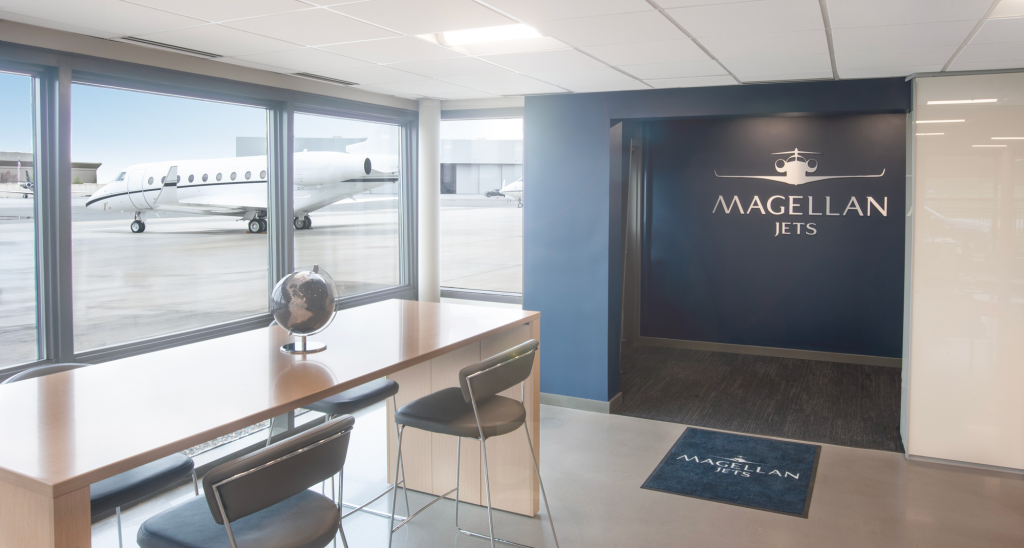
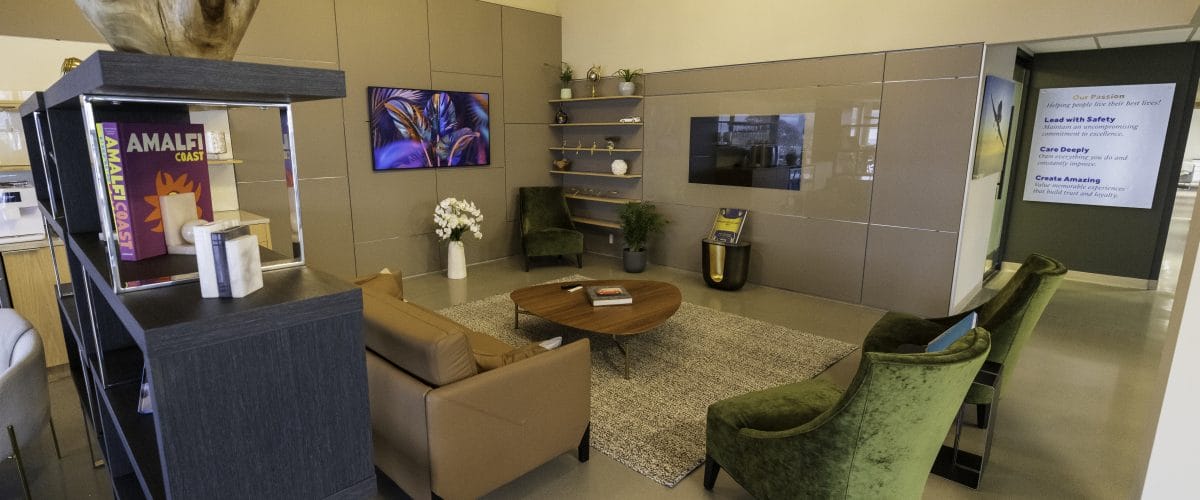
The Interior of the Magellan Jets Private Terminal at Hanscom Field in Bedford.
As Magellan Jets enters its 15th year, we’re thrilled to offer an elevated, purely private experience for guests via our first Private Jet Terminal. We plan to open a new private terminal in a new location each year, but it was important to us to begin with a location serving the Greater Boston community that we’ve been a part of since day one. The space allows us to show our guests the Magellan difference from the very moment they arrive for their flight, with Flight Support and Guest Experience staff on location and supporting them directly. It’s also going to serve as a hub for Magellan’s new Aircraft Sales & Management Division, hosting potential aircraft owners and showcasing jets.
“With the launch of our private terminal at Bedford Hanscom Field, one of our major hubs and right in our backyard, it’s the perfect opportunity to expand our service offerings by adding aircraft sales/acquisitions and management to the platform of products our customers have access to,” Magellan Jets President and co-founder Anthony Tivnan said. “This location also provides an intimate and purely private experience that is exclusive to Magellan customers, members, and guests traveling to and from the Boston area.”
https://www.youtube.com/watch?v=Ihi2NMVYWYA
Jet Card
The only Build-a-Card® in the industry, offering ultimate flexibility and consistency.
Guests at the Magellan Jets Bedford Private Terminal will enjoy a comfortable private lounge complete with refreshments, restrooms, WiFi connectivity, and an executive conference room.
Guests who visit the Bedford Private Jet Terminal will enter a space that is all their own. While there are many facilities catering to pilots, crews, and maintenance staff, ours is the only space at the Bedford airport specifically made for private jet travelers.
When they arrive, customers will pull into designated VIP parking and be met by Magellan Jets staff members who know them by name, know the details of their trip, and anticipate their every need. Inside, they’ll find:
A private lounge, where they can relax and enjoy coffee and refreshments (they can even request to stock their favorite spirits, beverages, and snacks!)
Exclusive access to a state-of-the-art executive conference room complete with WiFi connectivity, a large video screen, and telecommunications systems should the need to do business arise.
Private washrooms
Gorgeous ramp views
A secure door leading to the hangar and tarmac
Previous image
Next image
HOW TO GET TO MAGELLAN’S HANSCOM FIELD PRIVATE JET TERMINAL
Magellan’s Private Jet Terminal at Hanscom Field is located at the southeast corner of Hanscom Field on Hanscom Drive past Old Bedford Road. Just 30 minutes from downtown Boston and Boston Logan International Airport, the terminal is easily accessed via I-95 South and MA-2A East. For more detailed driving directions:
The terminal is available for use exclusively to Magellan Jets guests, members, and Jet Card Owners.
EXPERIENCE THE MAGELLAN JETS DIFFERENCE FIRSTHAND
If you regularly fly in and out of Bedford and Greater Boston, we’d love to make our private terminal your private terminal. Our Private Aviation Consultants are ready to show you how our industry-leading service & safety standards, unmatched operator network, and in-house Flight Operations specialists can elevate your private travel experience. Click the button below to explore our full suite of private aviation solutions or call 877-550-JETS (5387) to speak to one of our private aviation professionals today.