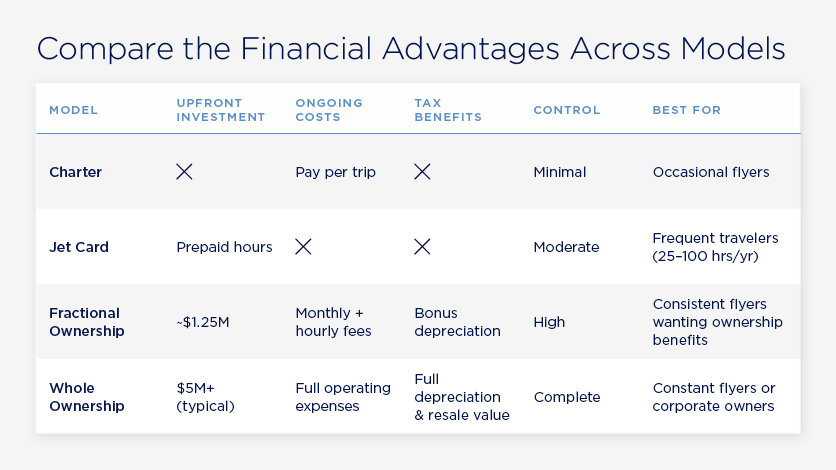
Fractional jet ownership means acquiring a share — typically one-eighth or one-sixteenth — of a specific aircraft, which entitles you to a guaranteed number of flight hours each year under a multi-year agreement. Full ownership means acquiring the entire aircraft outright and taking on every aspect of its operation, maintenance, and management. The right choice depends on how often you fly, how much operational responsibility you want, and how you think about capital.
More Private Clients are choosing shared and managed access over sole aircraft ownership than at any point in the industry’s history. That trend is not slowing down. This guide walks through the four factors that matter most (capital, usage profile, safety expectations, and control) so you can make the decision with confidence.
What Is Fractional Jet Ownership?
Fractional Jet Ownership is the acquisition of a share in a specific aircraft — commonly a 1/8 or 1/16 interest — that guarantees a set number of flight hours per year, typically 50, 75, or 100. You hold an equity stake in a real asset, and a program manager handles every operational detail: crew, maintenance, scheduling, insurance, and compliance.
Fractional programs operate under FAA Part 91 Subpart K (91K), a regulatory framework that applies commercial-level oversight to fractional operations. Part 91K requires structured pilot training programs, time-in-type minimums for all crew members, and strict maintenance standards — requirements that go beyond what standard Part 91 private operations mandate.
Key features of fractional ownership:
Long-term commitment, typically 3 to 7 years
Guaranteed aircraft access, including during peak travel periods
Predictable pricing structure with upfront capital investment, monthly management fees, and hourly usage rates
Depreciation eligibility on the aircraft share for qualifying business use
FAA Part 91K safety and operational oversight
Professional crew and full maintenance management included
For Private Clients who fly between 50 and 150 hours annually, fractional ownership delivers the benefits of having a dedicated aircraft without the full financial and operational weight of sole ownership.
What Is Full Aircraft Ownership?
Full aircraft ownership is exactly what it sounds like: you acquire the entire aircraft and assume complete responsibility for its operation, either directly or through a management company. The aircraft is yours to fly whenever and wherever you choose, subject only to weather, maintenance requirements, and crew availability.
Full ownership operates under FAA Part 91, the broadest and most permissive regulatory category for private aircraft operations. Part 91 gives owners maximum freedom to set their own operational standards, choose their own crew, and determine their own maintenance schedules. That freedom comes with a corresponding level of responsibility.
As a full owner, you are accountable for:
Hiring and vetting qualified pilots, including conducting background checks and verifying training records
Scheduling and overseeing all required maintenance inspections
Managing regulatory compliance and record-keeping
Securing adequate insurance coverage
Coordinating hangar space, fuel contracts, and ground logistics
One reality that surprises many first-time owners: downtime. Aircraft require scheduled maintenance, unscheduled repairs, and periodic inspections that can ground the plane for days, weeks, or even months. During those periods, the aircraft is unavailable — and unless you have a backup plan, so is your travel schedule.
Key features of full ownership:
Exclusive, 24/7 access to your aircraft (when it is not in maintenance)
Total control over crew selection, cabin configuration, and operational standards
High upfront capital commitment plus significant ongoing operating costs
All operational and safety responsibilities rest with the owner
Must plan for and manage aircraft downtime
Most cost-effective structure at 200 or more flight hours per year
Safety & Availability: A Critical Difference
Safety is the most consequential difference between fractional and full ownership, and the one that deserves the most careful consideration.
FAA Part 91K (fractional programs) imposes structured requirements that mirror many aspects of commercial aviation oversight:
Mandatory, recurrent pilot training programs with documented proficiency checks
Time-in-type minimums ensuring crew members have extensive experience on the specific aircraft they fly
Formalized maintenance tracking and inspection schedules
Drug and alcohol testing programs for crew
FAA Part 91 (full ownership) gives the owner discretion over nearly all operational decisions. That freedom is a genuine advantage for experienced aviation operators who want to set their own standards. It also means that safety is only as strong as the owner’s commitment to it. There is no external body auditing pilot qualifications, verifying training currency, or enforcing maintenance standards beyond the baseline regulatory requirements.
Magellan Jets’ Fractional Ownership program exceeds standard Part 91K requirements. The company holds WYVERN Wingman Broker Certification and is the only asset-light private aviation company represented on the Air Charter Safety Foundation (ACSF) Board — a position Magellan’s leadership has held, including the Chairman seat, for more than six years. Captains in the Magellan Jets Preferred Network average 9,700+ flight hours. Every operator in the network carries $100M to $300M in liability insurance coverage. Proprietary audits, rigorous pilot training protocols, and continuous maintenance oversight add additional layers of protection that go well beyond regulatory minimums.
There is also a structural safety advantage to fractional ownership that often goes unmentioned: fleet access. A full owner with a single aircraft faces a binary choice when that aircraft is grounded for maintenance — cancel the trip or charter an unfamiliar replacement on short notice. A fractional program with fleet interchange capability eliminates that risk entirely.
Cost of Fractional Jet Ownership vs Full Ownership
Understanding the true cost of each model requires looking beyond the initial capital outlay.
Fractional jet ownership costs follow a three-part structure. First, the upfront capital investment for the aircraft share, with programs like Magellan Jets’ Fractional Ownership starting at $1.25M for a 12.5% share. Second, a monthly management fee that covers crew salaries, training, insurance, maintenance reserves, and hangar costs. Third, an hourly usage rate charged only when you fly. Programs that lock hourly rates for the year — as Magellan Jets does — provide meaningful cost predictability that protects Private Clients from market fluctuations in fuel prices and operating costs.
Full aircraft ownership costs are higher and less predictable. Acquisition prices range from approximately $3M for a light jet to $75M or more for a new large-cabin aircraft. Annual operating costs typically run between $500,000 and $1.5M or more, covering crew compensation, recurrent pilot training, scheduled and unscheduled maintenance, hull and liability insurance, hangar lease, fuel, and landing and handling fees. These costs are largely fixed — they accrue whether the aircraft flies 50 hours or 500.
The break-even point: Full ownership generally becomes the more cost-efficient structure at approximately 200 or more flight hours per year. Below 150 hours annually, the fixed costs of sole ownership — crew salaries, hangar fees, insurance premiums — are spread across too few flights to justify the capital commitment. Fractional ownership is typically the stronger financial decision for Private Clients flying between 50 and 150 hours per year.
One additional cost factor worth considering: residual value risk. A full owner bears the entire depreciation curve of the aircraft and must navigate the pre-owned market at the time of disposition. This process that can take months and involve significant transaction costs. Fractional programs that offer a guaranteed share repurchase, as Magellan Jets does, remove that uncertainty entirely. You know the exit terms before you enter the agreement.
Tax and Depreciation Considerations
Both fractional and full aircraft ownership may offer depreciation benefits under current tax law. Fractional owners may be able to depreciate their share of the aircraft based on how it is used for business purposes. Full owners may have access to accelerated depreciation schedules, including bonus depreciation provisions, depending on qualifying use.
Tax treatment varies based on individual circumstances, how the aircraft is used, and current tax law. Consult a qualified tax advisor before making any ownership decision. The financial implications are significant enough to warrant professional guidance specific to your situation.
Magellan Jets Fractional Ownership: A New Standard
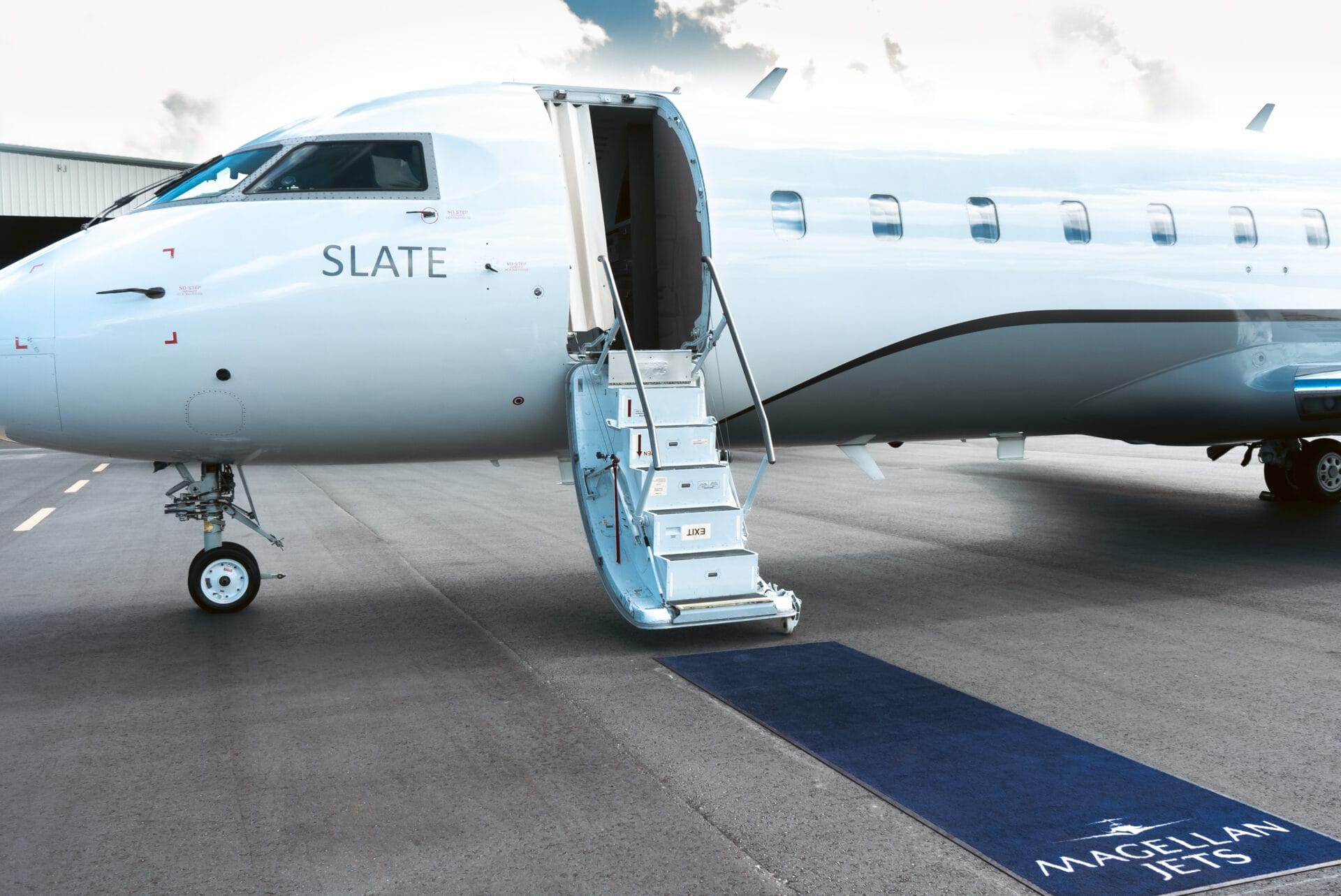
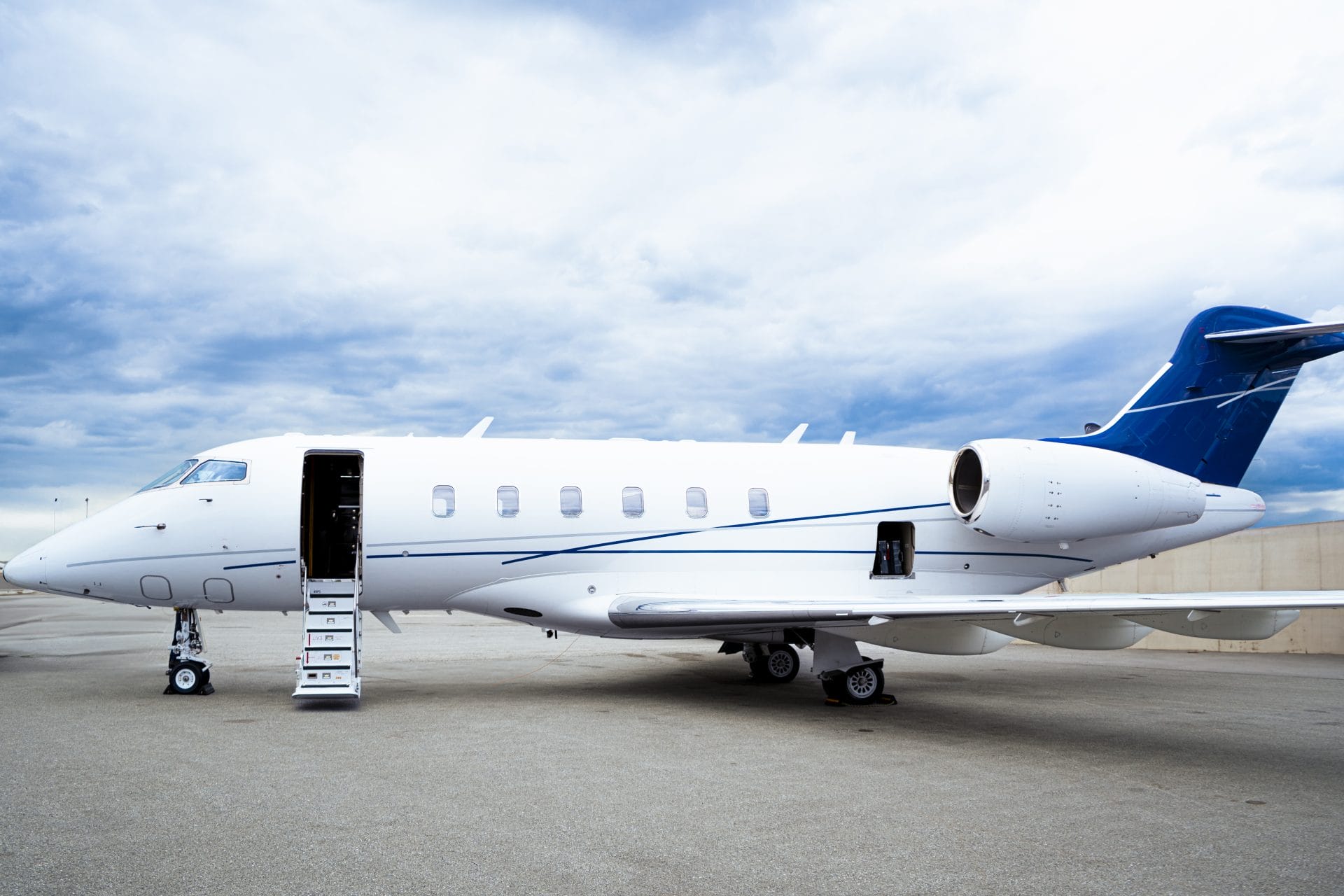
In addition to industry-leading Jet Card, Charter, and Business solutions, Magellan Jets offers a premium Fractional Ownership program built around the Bombardier Challenger 850, one of the most spacious and luxurious jets in the super-midsize category.
This program is designed for high-frequency travelers who want guaranteed access, predictable pricing, and a seamless luxury experience, without the full responsibility of sole ownership.
Magellan Jets Fractional Ownership Highlights:
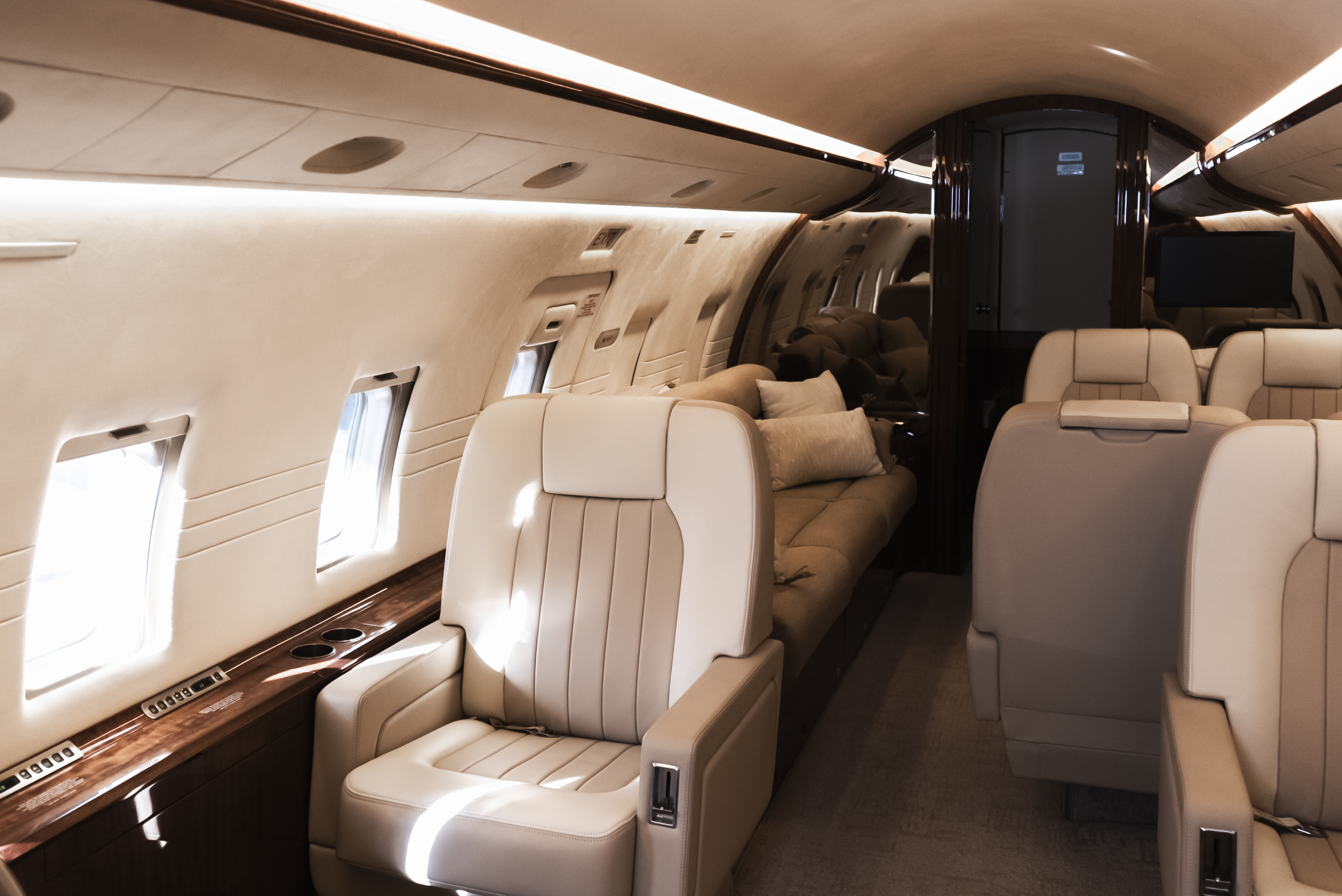
Challenger 850 with brand new interior and seating for up to 19 passengers
50 hours per year, 3-year term with flexible early exit
Uniformed attendant and crew and premium in-flight experience, including plated dining and Wi-Fi
Guaranteed availability, even during peak seasons
Guaranteed share repurchase and rollover flexibility
No blackout dates
Access to Magellan’s entire private aviation ecosystem (Jet Cards, Charter, Aircraft Sales & Management, and Business solutions)
Magellan Jets goes beyond standard 91K safety requirements, with additional proprietary audits, rigorous pilot training, and maintenance oversight that meet or exceed the most respected third-party safety ratings. Clients enjoy not just guaranteed access but peace of mind.
Fractional vs Full Ownership: How to Choose
When evaluating Fractional vs Full Ownership, ask yourself:
How often do I fly?
200+ hours annually may justify full ownership.
50–150 hours per year is often more cost-efficient with fractional.
Am I prepared to manage safety and operations?
Full ownership gives you freedom but places responsibility on you for crew vetting, maintenance, and compliance.
Fractional provides structured oversight and safety standards built in.
Can I handle downtime?
Full ownership means your aircraft could be unavailable for months during maintenance.
Fractional programs guarantee fleet access and continuity of service.
What’s my appetite for capital investment?
Full ownership requires millions upfront plus annual operating costs.
Fractional offers predictable costs with lower entry investment.
“Choosing between Fractional and Full Ownership is really about freedom and peace of mind. Full ownership gives total control, but also every responsibility. With Magellan’s Fractional program, you keep the access and luxury without the stress of running an aircraft yourself.” — Shehnaz Vollmuth, Senior Manager of Sales, Success and Development at Magellan Jets
Explore More Ways to Fly with Magellan Jets
At Magellan Jets, we offer multiple options tailored to your lifestyle and travel preferences:
Fractional Ownership: For frequent flyers seeking consistency and guaranteed access under the safety and oversight of Part 91K.
Jet Cards: Fixed-rate flying with the flexibility to switch aircraft types.
On-Demand Charter: Pay-as-you-go access to a global fleet of vetted aircraft.
Aircraft Sales & Management: Support for clients looking to buy, sell, or manage their own jets (including Part 91 support for owners).
Every Journey is Personal, and our Private Aviation Advisors are here to help you navigate your options with expert care.
Frequently Asked Questions About Fractional vs Full Ownership (FAQs):
What is the difference between fractional and full aircraft ownership?
Fractional ownership means buying a share of a jet for guaranteed hours per year under the oversight of Part 91K. Full ownership means you buy and operate the entire aircraft under Part 91, assuming full responsibility for safety and operations.
Which is more cost-effective?
For frequent flyers and companies exceeding 200+ hours annually, full ownership can provide value. For those flying 50–150 hours, fractional is typically the smarter investment.
What about safety oversight?
Full ownership gives you maximum control but requires you to vet pilots, enforce standards, and manage maintenance. Fractional providers like Magellan operate under 91K with higher safety requirements and internal audits.
Can I combine fractional or full ownership with other solutions?
Yes. Many Private Clients supplement their owned assets with Jet Cards or Charter to maintain flexibility when their aircraft is down or a different cabin size is needed. Magellan’s Fractional Ownership program actually allows you to use any amount of your 50 hours per year to fly on other Magellan Jets aircraft.
Make the Right Investment
When it comes to Fractional vs Full Ownership, the choice often comes down to how much you fly, your appetite for operational responsibility, and your safety expectations.
Magellan Jets provides solutions for every type of flyer—Fractional, Jet Cards, Charter, or Full Aircraft Management—delivered with award-winning service, industry-leading safety standards, and unmatched flexibility.
Fractional Jet Ownership and On-Demand Charter represent two distinct paths to private aviation, and the right choice depends on how often you fly, how much predictability you need, and whether the financial benefits of ownership align with your goals. Fractional ownership gives you a deeded share in a specific aircraft with guaranteed access and a fixed hourly rate, while charter lets you fly on demand with no long-term commitment. Most Private Clients flying 50 or more hours per year find fractional ownership delivers better value and consistency. Those flying fewer than 25 hours annually often prefer the flexibility of charter. Many experienced travelers combine both.
What Is Fractional Jet Ownership?
Fractional jet ownership means holding a deeded equity share in a specific aircraft. Shares are typically a 1/8 or 1/16 interest (also expressed as a 12.5% or 6.25% share). That share entitles you to a guaranteed number of flight hours each year on your aircraft type, with availability protected by contract rather than subject to market conditions.
The model originated in the 1980s when NetJets introduced the concept of selling partial interests in business jets. Today, fractional ownership programs operate under FAA Part 91K regulations, which govern fractional aircraft ownership and management. Part 91K provides a distinct regulatory framework separate from Part 135 (which covers charter operations), with specific rules around maintenance, crew rest, and operational control.
For Private Clients who fly frequently and value consistency, fractional ownership offers several distinct advantages:
Guaranteed availability with no blackout dates or peak-day surcharges
Fixed hourly rates that eliminate the pricing volatility common in the charter market
Equity ownership in a tangible asset with potential depreciation benefits
Consistent aircraft experience on every flight, with a crew familiar with your preferences
Regulatory protections under FAA Part 91K, including specific standards for maintenance and crew qualifications
The financial commitment is real. Entry points for fractional programs typically start at $1M or more, depending on the aircraft and share size. But for travelers who would otherwise spend a comparable amount on charter flights each year, fractional ownership can offer meaningful savings alongside the benefits of a deeded asset. Fractional ownership also introduces a level of operational consistency that charter cannot replicate. Your share is tied to a specific aircraft type, which means you know exactly what cabin configuration, range, and performance to expect on every flight. Crew members become familiar with your preferences over time. And because availability is contractually guaranteed, you are never competing with the open market for your own aircraft during holidays, summer Fridays, or other high-demand periods.
What Is Private Jet Charter?
On-Demand Charter is private aviation at its most flexible. You book a specific aircraft for a specific trip, pay for that flight, and carry no ongoing obligation. There is no equity stake, no long-term contract, and no monthly management fees. Charter operates under FAA Part 135, which sets strict standards for commercial air carriers including crew training, maintenance intervals, and operational oversight.
Charter is the right starting point for many Private Clients, particularly those who:
Fly fewer than 25 hours per year
Have irregular or unpredictable travel schedules
Need access to specialized aircraft for international or mission-specific trips
Want to experience private aviation before committing to a structured program
The critical variable in charter is who sources your aircraft. The U.S. has more than 3,000 licensed Part 135 operators, and quality varies enormously. The difference between an operator with meticulous maintenance records, experienced crews, and adequate insurance coverage and one that cuts corners is not visible in a booking confirmation. This is where the relationship with your private aviation provider matters most. A provider with rigorous vetting standards, direct operator relationships, and a genuine safety culture stands between you and the operators who would never meet those standards.
Charter pricing fluctuates with market conditions. During peak travel periods, available aircraft can become scarce; rates increase accordingly. Repositioning fees, fuel surcharges, and overnight charges add up. For infrequent travelers, these costs remain manageable. For frequent flyers, the cumulative expense and uncertainty often push toward a more structured solution.
Charter also offers a distinct advantage for specific mission types. If you need a heavy jet for a transatlantic crossing one month and a light jet for a 90-minute domestic hop the next, charter gives you access to the exact aircraft suited to each trip. There is no category lock, no interchange process, and no obligation to fly a larger aircraft than the mission requires. For travelers whose needs vary widely from trip to trip, this flexibility has genuine financial value.
The Magellan Jets Fractional Ownership Program
Magellan Jets launched its Fractional Ownership program in partnership with Slate Aviation, centering on the Bombardier Challenger 850, a large-cabin aircraft with transcontinental range and stand-up cabin height that seats up to 19 passengers. The program is built around a fleet of 34 aircraft and designed for Private Clients who fly 50 or more hours per year and want the financial and operational advantages of ownership without the burden of managing an aircraft outright. The structure: a 12.5% share with a starting investment of $1.25M, delivering 50 guaranteed hours per year over a 3-year term. But several features distinguish this program from traditional fractional aircraft ownership models.
Flexibility Across The Fleet
Most fractional programs lock your hours into one aircraft type. Magellan Jets takes a different approach. Fractional hours earned on the Challenger 850 can be used on other aircraft in the Magellan Jets portfolio. This includes the Phenom 300, Challenger 350, and Gulfstream G450. A fractional owner heading to a meeting in a nearby city does not need to dispatch a Challenger 850 for a 45-minute flight. The right aircraft for the mission is always available, and hours transfer across the fleet. This cross-fleet flexibility also means fractional owners are never locked out of lighter, more efficient aircraft for shorter routes. It is a meaningful operational advantage that reduces per-trip costs when the mission calls for a smaller cabin. It also keeps the Challenger 850 available for the longer journeys and group travel where its range and capacity matter most.
Protected Value
At the end of the 3-year term, Magellan Jets guarantees a 60% residual buyback of the original share value. This removes one of the largest uncertainties in aircraft ownership: the resale market. Whether you continue into a new term, transition to another solution, or exit entirely, the financial framework is established from day one.
Hours That Work For You
Unused hours do not disappear at year-end. Each year, 25% of unused hours can be rolled over to the following year or sold back. This eliminates the “use it or lose it” pressure that drives wasteful flying in many programs. It also gives Private Clients confidence that their investment retains its value even if travel plans shift.
Tax Advantages
For qualifying business use, fractional aircraft ownership may be eligible for bonus depreciation. In 2026, the applicable rate is 40%, continuing the phasedown from 100% in 2022. A tax advisor can determine how this applies to your specific situation. For many business travelers, the depreciation benefit meaningfully reduces the effective cost of ownership. Magellan Jets works alongside your financial team to ensure you have the documentation needed to support any applicable deductions.
Experience Before You Commit
Between June 24 and December 31, 2026, Magellan Jets is offering an Experience Flight promotion. Charter the Challenger 850 before making a fractional investment, and receive up to $50,000 in credit toward your share. It is a practical way to evaluate the aircraft and the experience before making a long-term decision. For a deeper comparison of fractional ownership against other ownership structures, the fractional vs. full ownership guide breaks down the operational and financial differences in detail.
On-Demand Charter With Magellan Jets
Magellan Jets sources every charter flight from the Preferred Network, a curated group of fewer than 100 operators. The vetting process evaluates maintenance programs, pilot qualifications, insurance coverage, operational history, and safety management systems.
Each trip is coordinated by a dedicated team available 24 hours a day, 365 days a year, staffed by aviation professionals who manage the details that define the experience. Every Private Client works with a dedicated Private Aviation Advisor who understands their travel history, preferences, and goals, providing continuity that a transactional booking platform cannot.
Magellan Jets holds WYVERN Wingman Broker Certification and is the only private aviation company represented on the Air Charter Safety Foundation (ACSF) Board, with leadership holding the Chairman seat for more than six years. The company operates a proactive Safety Management System (SMS) that continuously evaluates and improves safety protocols across the network. These are verifiable credentials that reflect how the company operates every day, backed by a 4.9/5 client satisfaction rating and a 90% trip perfection score.
For Private Clients who also hold a Jet Card or fractional share, On-Demand Charter serves as supplemental lift. It provides access to aircraft for trips that fall outside a program’s standard profile. An international mission requiring a specific long-range aircraft, a last-minute trip during a peak travel weekend, or a multi-leg itinerary across different regions can all be handled through charter without affecting Jet Card or fractional hours.
How To Choose Between Fractional Ownership And Charter
The decision between fractional ownership and charter is primarily a function of flight volume. Several other factors shape the right answer.
Start With Hours
If you consistently fly 50 or more hours per year, fractional ownership delivers the most predictable cost structure and guaranteed access. The fixed hourly rate, absence of peak-day surcharges, and guaranteed availability eliminate the variables that make high-volume charter expensive and unpredictable. If you fly fewer than 25 hours annually, charter is the more practical choice. The per-trip model avoids tying up capital. You retain full flexibility to fly different aircraft types on different routes without any contractual obligation.
The Middle Ground: Private Jet Cards
Travelers flying between 25 and 50 hours per year face the most nuanced decision. A Jet Card may be the right fit for this range, offering guaranteed rates, no blackout dates, and hours that never expire. Jet Cards also do not require the capital commitment of fractional ownership. The fractional ownership vs. Jet Card guide covers the specific tradeoffs in detail.
Some Private Clients in this range also weigh the tax implications. The bonus depreciation available to fractional owners (40% in 2026 for qualifying business use) can shift the break-even calculation in favor of ownership.A conversation with both a Private Aviation Advisor and a tax advisor can clarify whether the financial structure of fractional ownership makes sense at your specific usage level.
Why Many Private Clients Combine Solutions
One of the most common patterns among experienced private aviation travelers is combining two or more solutions. A fractional owner who needs to fly a shorter mission on a lighter aircraft uses Jet Card hours. A Jet Card holder who requires a specialized aircraft for an international trip books a charter. A business aviation client dispatching multiple aircraft simultaneously across different cities draws on the full portfolio.
This is the practical reality of how sophisticated travelers fly. The advantage of working with a provider that offers the full range of solutions is continuity. One relationship, one team that knows your preferences, one account structure, regardless of how your needs evolve. Client funds are fully segregated from operational accounts, never expire, and are protected until used for travel.
Explore Ways To Fly With Magellan Jets
Magellan Jets offers a complete private aviation portfolio designed to match every stage of a Private Client’s travel life:
Jet Cards — The industry’s first fully customizable Jet Card, with hours starting at a 25-hour minimum, no blackout dates, no peak-day surcharges, and hours that never expire.
On-Demand Charter — Pay-per-trip access to a global fleet of vetted aircraft with no upfront commitment.
Fractional Ownership — A 12.5% share in a Bombardier Challenger 850 with 50 guaranteed hours per year, 60% residual buyback, and cross-fleet flexibility.
Magellan for Business — Corporate and enterprise aviation with dedicated flight coordinators, real-time reporting, and multi-aircraft dispatch.
Aircraft Sales & Management — Advisory and operational management for clients looking to acquire, sell, or manage their own aircraft.
Every solution is backed by a 24/7 Client Experience team staffed by aviation professionals, the Magellan Jets Preferred Network, and client fund protections that keep your money separated from operational accounts until it is used for travel. The right solution depends on how you fly today and how your needs may change. A Private Aviation Advisor can walk through the specifics and help identify the fit.
Frequently Asked Questions About Fractional vs. Charter (FAQs):
What Is The Difference Between Fractional Jet Ownership And Charter?
Fractional jet ownership means holding a deeded equity share in a specific aircraft. Fractions come with guaranteed access, fixed hourly rates, and a multi-year term. Charter is a per-trip arrangement with no ownership stake and no long-term commitment. Fractional operates under FAA Part 91K; charter operates under Part 135. The core tradeoff is predictability and equity versus flexibility and lower upfront capital.
Which Is More Cost-Effective: Fractional Ownership Or Charter?
It depends on volume. Private Clients flying 50 or more hours per year find fractional ownership more cost-effective because of fixed hourly rates, no peak-day surcharges, and potential tax benefits including bonus depreciation (40% in 2026 for qualifying business use). Travelers flying fewer than 25 hours per year generally spend less with charter, where you pay only for flights taken. For those in between, a Jet Card often provides the best balance of guaranteed pricing and flexible commitment.
What Are The Downsides Of Fractional Ownership?
Fractional ownership requires significant upfront capital (starting at $1.25M for a 12.5% share), a multi-year commitment, and ongoing monthly management fees. The asset depreciates over time. While buyback provisions provide a floor, you may not recover 100% of your original investment. For travelers who fly infrequently or whose schedules are highly unpredictable, the commitment may exceed the benefit. It is also worth noting that fractional programs are typically tied to specific aircraft types, which may limit flexibility for specialized missions. Programs like Magellan Jets’ allow cross-fleet usage of fractional hours.
What Are The Drawbacks Of Charter Flights?
Charter pricing fluctuates with market demand, which means peak travel periods can bring higher rates and reduced availability. There is no guaranteed access to a specific aircraft type, and aircraft quality depends entirely on the operator sourcing the flight. You do not build equity, and you do not receive the tax advantages associated with asset ownership. For frequent travelers, cumulative charter costs can exceed what a structured program would have cost over the same period. The quality risk is mitigated by working with a provider that maintains strict operator vetting standards, such as Magellan Jets’ Preferred Network.
What Happens If I Don’t Use All My Fractional Hours?
In the Magellan Jets Fractional Ownership program, 25% of unused hours can be rolled over to the following year or sold back annually. This protects your investment and eliminates the pressure to fly just to avoid losing hours. It is one of the features that distinguishes the program from traditional fractional models where unused hours typically expire at year-end with no recovery option.
What If I Exceed My Fractional Hours?
Additional hours beyond your annual allotment are available at a predetermined rate. Because Magellan Jets also offers Jet Cards and On-Demand Charter, Private Clients who consistently exceed their fractional hours can layer in additional solutions through the same team and relationship, without managing multiple providers. This is one of the advantages of working with a full-service private aviation partner rather than a single-product provider.
Is Fractional Ownership Worth It?
For Private Clients flying 50 or more hours annually who value guaranteed availability, consistent aircraft quality, and the financial benefits of ownership, fractional ownership is a strong fit. The combination of fixed hourly rates, no blackout dates, potential bonus depreciation, and a guaranteed residual buyback at 60% creates a financial framework that rewards consistent use. The complete guide to fractional jet ownership covers the full decision framework.
What Is Supplemental Lift?
Supplemental lift refers to additional flights sourced outside your primary program. For a fractional owner, supplemental lift might be an On-Demand Charter for a mission requiring a different aircraft type or a Jet Card for shorter trips where a large-cabin aircraft is unnecessary. For a Jet Card holder, supplemental lift could be a charter for an international trip or a specialized mission. Magellan Jets coordinates supplemental lift through the same team and safety standards that govern your primary program, so the experience and vetting remain consistent regardless of which solution is being used for a given flight.
Choosing the Best Solution
The question is not whether fractional ownership or charter is objectively better. The question is which one fits how you actually fly. Volume, consistency, financial goals, and tolerance for variability all factor into the decision, and the answer may include elements of both. Magellan Jets exists to help you navigate that decision with clarity and without pressure. With a fleet of 34 aircraft in the Fractional Ownership program, a Preferred Network of fewer than 100 vetted operators, Jet Cards with hours that never expire, and a Client Experience team that treats every journey as personal, the right solution is the one that matches your life. Talk to a Private Aviation Advisor to explore which combination of solutions fits your travel profile.
The best jet cards pair guaranteed access with fixed, all-inclusive pricing and independently verified safety. They protect your capital, honor your hours without expiration, and place a dedicated advisor within reach at any hour. Choosing well comes down to a short list of criteria: safety standards, price transparency, availability, flexibility across cabins, and how a provider treats your money. At Magellan Jets, the 50-hour Challenger Jet Card leads the lineup for Private Clients who value a consistent cabin and coast-to-coast range. This guide explains how a jet card works, what separates a strong program from a thin one, and how to match a card to the way you actually fly.
What a Jet Card Is and How It Works
A jet card is a prepaid block of private flight hours at a fixed hourly rate. You buy hours in advance, then draw them down trip by trip with a single phone call or message to your advisor. The rate is locked, the availability is guaranteed, and the pricing is all-inclusive, so you know the number before you fly.
The model sits between two other options. On-demand charter is booked one trip at a time, while fractional ownership asks you to buy a share of a specific aircraft. A jet card gives you consistent access without the capital commitment of a share or the trip-by-trip variability of charter. For a fuller primer, read our guide on what a jet card is.
Magellan is an asset-light private aviation solutions provider. Rather than owning a fixed fleet, it sources every trip from the Magellan Jets Preferred Network: fewer than 100 vetted operators out of roughly 3,000 licensed in the United States. That structure lets an advisor match the right aircraft to each mission instead of fitting your trip to one company’s tail numbers. You can explore the full program on the Jet Card solutions page.
How to Choose Among the Best Jet Cards
Providers market themselves on price, but the best jet cards are decided on a wider set of criteria. Use this checklist to compare programs on the terms that matter once you are in the air.
Safety verification: Look for independent audits, a formal Safety Management System, and disclosed insurance limits, not marketing claims.
Pricing transparency: Confirm the rate is fixed and all-inclusive, with no peak-day surcharges or hidden repositioning fees.
Guaranteed availability: Ask about blackout dates, call-out windows, and how the provider handles high-demand days.
Fund protection: Confirm your deposit is refundable, kept separate from operating accounts, and never expires.
Flexibility: Check whether you can move across cabin categories and whether short trips carry a daily minimum.
Service depth: A dedicated advisor and Client Experience team should own your account, not a rotating call center.
Grade every provider against the same list. A low headline rate means little if it comes with surcharges, expiring hours, or thin safety disclosure. Our Jet Card recommender can help you weigh these factors against your travel pattern.
Are Jet Cards Worth It?
A jet card earns its place once you fly private consistently. The common threshold is roughly 25 or more flight hours a year, which is the point where a prepaid program tends to make sense over booking each trip separately. Below that, on-demand charter often fits better, and you can review the tradeoffs in our jet card vs charter guide.
Value shows up in more than the hourly rate. You gain locked pricing, guaranteed availability 365 days a year, and time back on every trip. For business travelers, that means predictable budgeting and reliable lift for teams. For personal travel, it means your family flies on your schedule, with the same standard of service each time.
Jet Card Pricing by Cabin and Tier
Magellan’s Jet Card is fully customizable. You purchase any number of hours at or above a 25-hour minimum, rather than being locked into rigid increments. Pricing is fixed and all-inclusive across 49 states (excluding Alaska), the Caribbean, Mexico, Canada, and within Europe. A deeper commitment unlocks a lower rate and richer benefits.
25 Hours (entry): hourly rate starting at $7,500, with 10% round-trip and long-leg savings and a 12-month rate lock.
50 Hours (flagship): hourly rate starting at $7,250, with 15% round-trip and long-leg savings, an 18-month rate lock, a 7% discount on Advantage Routes, and 4 short-leg waivers.
100 Hours (top tier): hourly rate starting at $7,000, with 20% round-trip and long-leg savings, a 24-month rate lock, a 7% Advantage Routes discount, and 8 short-leg waivers.
The 50-hour Challenger Jet Card is the flagship, and it is where most Client conversations begin. It balances a strong rate with the flexibility of Advantage Routes and short-leg waivers, which matters most for travelers who mix business and leisure.
Your card tier sets the hourly rate, while your cabin choice guides which aircraft you fly. Light jets suit short regional hops for small groups. Super-Midsize aircraft such as the Challenger 350 offer a wide, flat-floor cabin, coast-to-coast range, and room for skis or golf clubs. Heavy jets such as the Gulfstream G450 and G550 carry larger groups on transcontinental and international routes. Because the rate is all-inclusive, fuel price protection is built in, and category interchange on the Category card carries no surcharge.
Advantage Routes and Short-Leg Waivers
Two benefits reflect how Clients actually fly. Advantage Routes are Client-selected high-demand corridors with preferred pricing, set by where you travel rather than where an operator is based. They start at the 50-hour tier, and the program launched with two eastern-region corridors, expanding to 10 by Fall 2026. Sample corridors include Boston to Palm Beach, Dallas to Washington DC, and Los Angeles to New York.
Short-leg waivers reduce the daily-minimum burden on qualifying short trips. As a concrete example, a Client flying Boston to Nantucket can save up to $10,000 on a single trip through the short-leg waiver. Advantage Routes are not combinable with other discounts and do not apply on advanced booking days.
How Magellan Protects Your Jet Card Funds
Fund safety separates a durable program from a risky one. Magellan Jet Card funds are refundable, fully protected, and never co-mingled with operating accounts. Your hours never expire, so a schedule change does not cost you the capital you committed.
Safety leadership carries the same weight. Magellan holds the WYVERN Wingman Broker Certification and runs a proactive Safety Management System. It is the only private aviation company represented on the Air Charter Safety Foundation (ACSF) Board, where its leadership held the Chairman seat for more than six years. Preferred Network operators carry $100M–$300M in liability insurance, and their captains average more than 9,700 flight hours.
Category vs Premium Jet Card
Within any tier, you choose between two card types. Both carry the same fixed hourly rates, so the decision comes down to how much flexibility or consistency you want.
The Category Jet Card lets you interchange freely across Light, Midsize, Super-Midsize, and Heavy categories. De-icing and catering are add-ons, advanced booking days run as low as 40, and the standard call-out is 48 hours. It suits Clients who want to right-size the aircraft to each trip.
The Premium Jet Card gives you a dedicated aircraft type, such as the Phenom 300, Challenger 350, or Gulfstream G450 or G550. De-icing and catering are included, advanced booking days run as low as 20, and call-out can be as low as 24 hours. It suits Clients who want the same cabin experience on every flight.
Jet Card vs On-Demand Charter vs Fractional Ownership
Each model fits a different flight pattern. The table below compares them on the terms buyers ask about most. For deeper reading, see our guides on on-demand charter and fractional ownership.
Many Clients begin with a jet card and add other solutions as their travel grows. Owners and fractional shareholders also use Magellan for Supplemental Lift when an owned jet is in maintenance, needs more cabin space, or requires range beyond existing assets. Those hours never expire, and you can fly multiple aircraft in a single day. For a side-by-side view, read our fractional ownership vs jet card guide.
How Magellan Compares to Other Jet Card Providers
Searches for the best jet cards often surface a familiar set of names, each built around a different model. Knowing the distinction helps you choose on facts rather than reputation.
NetJets and Flexjet operate owned fleets and center their programs on fractional shares and lease products.
VistaJet focuses on a global membership built around its own aircraft.
Jet Linx pairs a jet card with local base memberships.
Magellan takes an asset-light approach instead. It sources each trip from the Preferred Network, which lets an advisor select the right operator and aircraft for a given mission rather than defaulting to a single owned fleet.
Behind the model is a company founded in 2008 by Joshua Marc Hebert and Anthony Tivnan, which has flown Private Clients to more than 100 countries. Magellan reports a 4.9 out of 5 Client satisfaction score and 90% trip perfection, and it has earned recognition on the Inc. 5000 and in the Robb Report “Best of the Best.”
Frequently Asked Questions About Jet Cards (FAQs):
What Is the Best Jet Card?
The best jet card is the one whose safety standards, pricing, and flexibility match how you fly. Look for independently verified safety, a fixed all-inclusive rate, guaranteed availability, and protected funds that never expire. For Private Clients who value a consistent cabin and coast-to-coast range, Magellan’s 50-hour Challenger Jet Card is the flagship choice.
Are Jet Cards Worth It?
Jet cards are worth it once you fly private consistently, generally around 25 or more hours a year. At that level, prepaid hours deliver locked pricing, guaranteed access, and predictable budgeting that trip-by-trip booking cannot match. Below that threshold, on-demand charter is usually the better fit.
How Do I Choose the Best Jet Card?
Compare providers on safety verification, pricing transparency, guaranteed availability, fund protection, and flexibility across cabins. A low headline rate matters little if it carries surcharges, expiring hours, or limited safety disclosure. Grade every option against the same criteria, then match the card to your real travel pattern.
What Fees Come With a Jet Card?
Magellan’s Jet Card uses a fixed, all-inclusive hourly rate with no peak-day surcharges and built-in fuel price protection. On the Category card, de-icing and catering are add-ons, while the Premium card includes them. Category interchange carries no surcharge, so moving between cabin sizes does not add a fee.
Do Jet Card Hours Expire?
Magellan Jet Card hours never expire. Your funds are refundable, fully protected, and never co-mingled with operating accounts. A change in your schedule does not cost you the capital you committed.
Jet Card vs Fractional Ownership: Which Is Better?
A jet card gives you guaranteed access without buying an aircraft share, while fractional ownership suits very frequent flyers who want an owned asset. Cards keep your capital flexible with protected, non-expiring hours, whereas fractional ties capital to the aircraft. Many Clients start with a card and use Supplemental Lift alongside an owned or fractional jet.
Find the Right Jet Card for the Way You Fly
The right program should fit your calendar, your cabin preference, and your standard for safety. Start with the 50-hour Challenger Jet Card, then let an advisor tailor the hours and card type to your travel. Talk to a Private Aviation Advisor.
Private aviation spans seven distinct aircraft categories, each suited to different journey profiles. Turboprops excel on short hops and unpaved runways. Very light and light jets handle regional travel with speed and efficiency. Midsize jets introduce stand-up cabins for coast-to-coast comfort. Super-midsize jets stretch transcontinental range further. Heavy jets cross oceans with room for full work or rest. Ultra-long-range jets fly nonstop between continents. VIP airliners turn the sky into a mobile boardroom – or private residence.
Understanding these categories helps you match the aircraft to your mission – whether it’s a 90-minute hop to the islands or a 14-hour crossing to Asia. This guide covers capacity, range, representative aircraft, and estimated hourly rates for each tier.
Turboprops: Versatile Access to Remote Destinations
Turboprop aircraft open doors other jets cannot reach. Their ability to operate on short runways – including grass and gravel strips – makes them ideal for island retreats, mountain resorts, and rural airfields. For Clients traveling to destinations like Nantucket, Aspen’s nearby fields, or Caribbean outposts, a turboprop often offers the most direct routing.
Turboprops seat approximately six to nine passengers in comfort. Range varies by model, but most regional missions fall within two hours of flight time. Representative aircraft in the Magellan Jets On-Demand Charter network include the Pilatus PC-12, King Air 350, and King Air B200.
Estimated hourly charter rates start from about $5,500 per hour. This is an estimated hourly rate inclusive of fuel. It does not include contingencies such as de-icing, positioning, overnight fees, or other trip-specific costs. Final pricing is confirmed at time of quote.
Very Light and Light Jets: Speed for Regional Travel
Light jets deliver jet speed without the footprint of larger aircraft. Climbing quickly to altitudes above commercial traffic, they reach cruising altitude in minutes – ideal for a morning departure that puts you in a meeting two states away before lunch.
Very light jets like the Phenom 100 carry up to five passengers with a range of roughly 1,071 nm (about two hours). Light jets such as the Phenom 300, Learjet 75, and Citation CJ series seat approximately six passengers and extend range to around 1,900–2,019 nm (roughly three hours nonstop). Ceilings reach 41,000 to 45,000 feet, placing you above most weather.
Estimated hourly rates run about $7,500–$8,500. This is an estimated hourly rate inclusive of fuel. It does not include contingencies such as de-icing, positioning, overnight fees, or other trip-specific costs. Final pricing is confirmed at time of quote.
Midsize Jets: Stand-Up Comfort Coast to Coast
The midsize category marks a turning point in cabin experience. Full stand-up headroom, enclosed lavatories, and dedicated luggage space mean arriving refreshed rather than cramped. Business travelers find room to work; families appreciate the extra space for children to move.
Midsize jets seat roughly seven to nine passengers. Ranges span from approximately 2,000 nm to over 3,400 nm – enough for transcontinental U.S. flights of four to six hours nonstop. Models available through the Magellan Jets network include the Citation Latitude (9 passengers, 2,700 nm), Citation XLS (8 passengers, ~2,000 nm), Praetor 500 (9 passengers, 3,412 nm), and Citation Sovereign (8 passengers, ~3,000 nm).
Estimated hourly rates fall between about $8,000 and $9,600. This is an estimated hourly rate inclusive of fuel. It does not include contingencies such as de-icing, positioning, overnight fees, or other trip-specific costs. Final pricing is confirmed at time of quote.
Super-Midsize Jets: Transcontinental Range, Refined Space
Super-midsize jets blend the cabin comfort of a heavy jet with the efficiency of a midsize. Flat floors, wider seats, and enhanced galley service suit travelers who need to host meetings, dine properly, or simply stretch out on longer missions.
Seating ranges from eight to 10 passengers. Transcontinental range reaches approximately 3,269–4,040 nm (roughly five to seven hours nonstop). Notable models include the Challenger 350 (9 passengers, 3,269 nm), Gulfstream G280 (10 passengers, 3,700 nm), Praetor 600 (8 passengers, 4,040 nm), and Citation Longitude.
Estimated hourly rates range from about $9,000 to $10,500. This is an estimated hourly rate inclusive of fuel. It does not include contingencies such as de-icing, positioning, overnight fees, or other trip-specific costs. Final pricing is confirmed at time of quote.
Heavy Jets: Intercontinental Capability and Full Cabin Amenities
Heavy jets bring the cabin space to work, rest, and dine as you would on the ground. Multiple seating zones allow some passengers to sleep while others conduct calls. Large baggage holds accommodate golf clubs, ski equipment, or luggage for extended trips abroad.
Capacity runs from 10 to 14 passengers. Ranges of 4,044–6,415 nm cover intercontinental routes – New York to London, Los Angeles to Hawaii – in a single leg of eight to 12 hours. Aircraft available through the Magellan Jets Jet Card and charter programs include the Challenger 650 (12 passengers, 4,044 nm), Gulfstream G450 (13 passengers, 4,425 nm), Falcon 8X (14 passengers, 6,415 nm), and Legacy 650.
Estimated hourly rates fall between approximately $11,600 and $15,200. This is an estimated hourly rate inclusive of fuel. It does not include contingencies such as de-icing, positioning, overnight fees, or other trip-specific costs. Final pricing is confirmed at time of quote.
Ultra-Long-Range Jets: Nonstop to Anywhere
When the destination is Singapore, Dubai, or Sydney, ultra-long-range jets eliminate the detour of a fuel stop. These aircraft sustain crews and Clients for 14 hours or more with sleeping quarters, full galleys, and cabin pressure optimized for reduced fatigue.
Capacity spans 14 to 19 passengers, with dedicated rest areas and often a private stateroom. Ranges extend from 6,954 nm to 8,070 nm – roughly 13 to 16 hours of nonstop flight. Ceilings reach up to 51,000 feet, and maximum cruise speeds hit 528 knots. Aircraft in this tier include the Gulfstream G650ER (16 passengers, 7,437 nm), Bombardier Global 7500 (17 passengers, 7,800 nm), Global 8000 (19 passengers, 8,070 nm), and Gulfstream G550 (18 passengers, 6,954 nm).
For guidance on chartering ultra-long-range aircraft, speak directly with a Private Aviation Advisor who can confirm availability, routing, and pricing for your specific mission.
VIP Airliners: The Ultimate in Airborne Privacy
VIP airliners convert widebody commercial aircraft into private residences. Multiple rooms – including conference areas, bedrooms, and full-size showers – allow heads of state, corporate delegations, and families traveling with staff to operate independently during flight.
Configured for up to 19 passengers in ultra-luxury layouts, VIP airliners carry ranges from 3,965 nm to 6,750 nm depending on the aircraft and configuration. Models include the Airbus ACJ319neo (19 passengers, 6,750 nm), Boeing BBJ MAX (19 passengers), and Embraer Lineage 1000E (19 passengers, 3,965 nm).
Pricing for VIP airliners varies widely by aircraft, crew requirements, and routing. A Private Aviation Advisor can provide a tailored quote.
Private Jet Category Comparison
Rates are estimates inclusive of fuel and do not include contingencies such as de-icing, positioning, overnight fees, or other trip-specific costs. Final pricing is confirmed at time of quote.
Explore the Magellan Jets Category Jet Card
The right category shifts with every trip. A Light jet suits a quick regional hop, while a Heavy jet carries the full team coast to coast. The Magellan Jets Category Jet Card gives Private Clients the freedom to fly across Light, Midsize, Super-Midsize, and Heavy aircraft, interchanging freely as group size, route, and mission change. This is the guide in practice: the right category for every journey, without owning an aircraft.
Rates stay fixed and transparent, matching the Premium Jet Card’s hourly pricing with no hidden fees and no peak-day surcharges. De-icing and catering are available as add-ons, advanced booking runs as low as 40 days, and standard call-out times are 48 hours. The Premium Jet Card instead locks you to a dedicated aircraft type, such as the Phenom 300, Challenger 350, or Gulfstream G450, with de-icing and catering included and call-out as low as 24 hours.
Every Jet Card includes guaranteed access to the Magellan Jets Preferred Network of fewer than 100 vetted operators, 24/7/365 availability, no blackout dates, fuel price protection, surcharge-free interchange, and WYVERN Wingman-certified safety standards. Cards scale by committed hours, and deeper commitments unlock better rates, Advantage Routes, and short-leg waivers:
25 hours: rates starting around $7,500/hr, with a 12-month rate lock.
50 hours: rates starting around $7,250/hr, with an 18-month lock, Advantage Route pricing, and short-leg waivers.
100 hours: rates starting around $7,000/hr, with a 24-month lock.
Frequently Asked Questions About Types of Private Jets (FAQs):
How much does a two-hour private jet flight cost?
A two-hour charter cost depends on the aircraft category and routing. Light jets, well-suited to flights of this length, run approximately $7,500–$8,500 per hour – placing a two-hour flight in the range of $15,000–$17,000 before contingencies. Midsize jets cost slightly more but offer stand-up cabins for added comfort. These are estimated hourly rates inclusive of fuel; actual pricing varies by aircraft availability, routing, repositioning, taxes, and fees. A Private Aviation Advisor confirms the exact quote for your specific trip.
How many passengers does each private jet size hold?
Capacity rises with aircraft category. Very light and light jets seat four to six passengers. Midsize jets accommodate seven to nine. Super-midsize jets hold eight to 10. Heavy jets carry 10 to 14 passengers. Ultra-long-range jets and VIP airliners seat 14 to 19 in spacious configurations that include sleeping quarters and separate work areas.
What is the difference between a light jet and a midsize jet?
Light jets prioritize efficiency on shorter routes of one to three hours, seating up to six passengers with ranges around 1,900–2,019 nm. Midsize jets add stand-up headroom, enclosed lavatories, and larger luggage holds, seating seven to nine passengers with ranges up to 3,412 nm. Choose a light jet for quick regional hops; choose a midsize jet when cabin comfort and transcontinental range matter.
Which private jets have the longest range?
Ultra-long-range jets fly the farthest. The Bombardier Global 8000 reaches 8,070 nm – enough to connect New York to Hong Kong nonstop. The Global 7500 covers 7,800 nm, and the Gulfstream G650ER reaches 7,437 nm. These aircraft are designed for 13- to 16-hour flights with onboard rest facilities, reduced cabin altitude, and full meal service.
How do I choose the right private jet for my trip?
Start with three questions: How many passengers are traveling? How far is the destination? What cabin amenities do you need? A two-hour regional flight with four passengers suits a light jet. A six-hour transcontinental trip with eight passengers calls for a super-midsize. A nonstop transatlantic crossing requires a heavy or ultra-long-range jet. Your Private Aviation Advisor matches the aircraft to your mission, budget, and preferences – ensuring you pay for exactly the capability you need.
Fractional jet ownership gives you a deeded share of a specific business jet, typically one-eighth or one-sixteenth, along with a guaranteed number of flight hours each year. You hold an equity stake in a real aircraft, fly under Part 91K federal regulations with stricter safety and crew standards than on-demand charter, and benefit from professional management that handles maintenance, crew, insurance, and scheduling on your behalf. It is the middle ground between chartering by the hour and taking on the full commitment of whole-aircraft ownership.
Whether you fly 50 hours a year or 200, fractional ownership rewards consistency. You gain predictable costs, priority scheduling, and — under current tax law — meaningful depreciation advantages that charter and jet cards cannot offer. This guide covers every dimension of the decision: how shares work, what they cost, who they serve best, how they compare to other private aviation solutions, and what makes the Magellan Jets Fractional Ownership program a distinctly different approach.
What Is Fractional Jet Ownership?
Fractional aircraft ownership means you hold a titled, deeded interest in a specific aircraft. A management company operates and maintains that aircraft, and you receive a guaranteed allotment of flight hours proportional to your share size. Most programs divide each aircraft into shares of 12.5 percent (one-eighth) or 6.25 percent (one-sixteenth). A 12.5 percent share typically guarantees around 100 occupied flight hours per year; a 6.25 percent share guarantees roughly 50 hours. The management company handles everything behind the curtain — pilots, hangars, inspections, insurance — while you fly on your schedule.
Fractional ownership is governed by Part 91K of the Federal Aviation Regulations. Part 91K imposes crew duty-time limits, drug-and-alcohol testing, and maintenance-tracking requirements that go beyond what a standard Part 91 private operator faces. For you, that translates into a measurable safety advantage over informal ownership arrangements and many charter flights. How It Works: Three Steps
Acquire your share. You select an aircraft type and share size. A share agreement defines your annual hours, the term length (commonly three to five years), and your equity position in the aircraft.
Fly on your terms. Request a flight — typically with 8 to 48 hours of notice depending on program terms — and the management company positions a crewed, maintained aircraft for your departure. Scheduling, catering, and ground logistics are handled for you.
Exit or renew at term end. When your agreement matures, you can renew for another term, sell your share on the secondary market, or exercise a residual-value buyback if the program offers one.
Why Fractional Jet Ownership Continues to Grow
The private aviation market has shifted decisively toward fractional models. According to Sherpa Report and Kubera data, fractional jet departures rose 75.5 percent from 2019 to 2025 — outpacing growth in on-demand charter over the same period. Private Jet Card Comparisons reported a 12.4 percent increase in North American fractional flight activity in the first half of 2024 alone. Fortune Business Insights values the global business jet market at $48.13 billion in 2025, with fractional programs capturing a growing share of that figure.
Several forces drive the trend:
Predictable economics. Fractional owners lock in hourly rates, management fees, and fuel-cost structures at the start of each year. There are no repositioning-fee surprises and no surge pricing during peak travel periods.
Guaranteed access. Because you hold an equity stake in a specific aircraft, you are not competing for availability on an open-market charter platform. Your hours are reserved, and your aircraft is scheduled around your needs.
Safety governance. Part 91K programs operate under federal oversight that requires crew rest limits, standardized training, and maintenance-tracking systems. This is a structural safety advantage — not a marketing claim.
Tax efficiency. Fractional shares qualify for depreciation treatment under the federal tax code, including 100 percent bonus depreciation restored by the One Big Beautiful Bill Act signed into law on July 4, 2025. Charter and jet card expenses do not offer the same equity-based deductions.
Simplified ownership. You hold a real asset without hiring pilots, negotiating hangar leases, managing maintenance schedules, or carrying insurance policies. The management company absorbs all of that complexity.
How Much Does Fractional Jet Ownership Cost?
Fractional jet ownership involves four core cost components:
Capital cost of the share. This is your equity position in the aircraft. Share prices vary by aircraft type, size, and age. For perspective, shares in the Magellan Jets Fractional Ownership program start at $1.25 million.
Monthly management fee. Covers the management company’s costs for crew salaries, hangar space, insurance, scheduled maintenance, and administrative overhead. This fee is fixed for the year, giving you budget certainty regardless of how many hours you fly.
Occupied hourly rate. Charged each time you fly, this rate covers direct operating costs — fuel, landing fees, crew per diem, and wear-and-tear reserves. Many programs publish hourly rates by service area so you can estimate trip costs before you book.
Fuel cost component. Some programs include fuel in the hourly rate; others itemize it separately. Fuel pricing can be locked or indexed — ask about the structure before you commit.
At the end of your term, most programs offer a residual-value mechanism: either a guaranteed buyback at a predetermined percentage or a fair-market-value appraisal. This means your capital is not sunk; it carries recoverable value. For a detailed conversation about share economics for your specific travel patterns, speak with a Private Aviation Advisor.
Is Fractional Jet Ownership Right for You?
Fractional ownership fits a specific profile. It rewards consistency, penalizes unpredictability, and delivers outsized value when your travel habits align with the model.
You are a strong candidate if:
You fly 50 or more hours per year on a recurring basis, with enough predictability to commit to a multi-year agreement.
You travel with groups such as family, executive teams, sports organizations, or production crews, and need cabin capacity that smaller aircraft cannot provide.
You value fixed, transparent costs and want to avoid the hourly-rate volatility of the on-demand charter market.
You want the tax advantages of aircraft equity like depreciation or Section 179 deductions, that Charter and Jet Card spending cannot provide.
You care about safety governance and prefer the Part 91K regulatory framework over standard Part 135 charter operations.
You may want to consider other solutions if:
You fly fewer than 50 hours per year. A Jet Card or On-Demand Charter offers more flexibility without a capital commitment.
Your destinations change dramatically from year to year, making it hard to predict which aircraft type or base geography serves you best.
You need access to multiple aircraft categories — light jets for short hops, heavy jets for transatlantic flights — on a single program. A Jet Card with fleet interchange may be a better fit.
Fractional Ownership vs. Jet Cards vs. Charter
Every private aviation solution trades off between commitment, flexibility, and cost predictability. Here is how the four primary options compare:
When fractional ownership fits: You fly consistently, value guaranteed access to a specific aircraft, want equity with depreciation benefits, and prefer the Part 91K safety standard. When a Jet Card fits: You fly moderate hours, want flexibility across aircraft categories, and prefer a shorter commitment without capital at risk. Explore the Magellan Jets Jet Card program for details. When on-demand charter fits: You fly infrequently or unpredictably and want zero commitment. On-Demand Charter gives you access to the full market, flight by flight. When whole ownership fits: You fly 300 or more hours per year on a single aircraft type, want total schedule control, and have the infrastructure (or management partner) to handle crew, maintenance, and compliance. Magellan Jets also offers Aircraft Sales and Management services for whole-aircraft owners.
What Are the Drawbacks of Fractional Ownership?
No private aviation solution is perfect. Fractional ownership carries limitations and understanding them before you commit protects your investment and your experience.
Significant Capital Commitment:
A fractional share ties up meaningful capital for the length of the agreement. Unlike a Jet Card deposit that you draw down flight by flight, your share capital is locked into aircraft equity until the term ends.
How Magellan Jets approaches this differently: The program offers a guaranteed residual buyback at 60 percent of your original share value at the end of the three-year term. You know your floor before you sign. That predictability removes the guesswork that comes with fair-market-value appraisals in other programs.
Multi-Year Contract:
Most fractional programs require three- to five-year commitments. If your travel patterns shift — a relocation, a career change, a strategic pivot — you may find yourself locked into an agreement that no longer matches your needs.
How Magellan Jets approaches this differently: The three-year term is the shortest standard commitment in the fractional market. And because fractional hours can be applied toward any aircraft in the Magellan Jets Jet Card fleet, your commitment adapts even if your mission profile changes.
Geographic and fleet limitations
Traditional fractional programs restrict you to a single aircraft type. If your home base is far from the aircraft’s primary operating region, repositioning costs and scheduling friction can erode the value of your share.
How Magellan Jets approaches this differently: Fractional Owners can interchange hours toward Jet Card aircraft across the full Magellan Jets fleet — from light jets to heavy-cabin widebodies. If a mission calls for a different aircraft category, your hours still work.
Shared Scheduling
You share the aircraft with other owners. During high-demand periods — holidays, major sporting events, peak travel weekends — scheduling conflicts can arise. Some programs guarantee availability with as little as four hours’ notice; others require 48 or more.
How Magellan Jets approaches this differently: With a fleet of 34 Challenger 850 aircraft across the program, depth of fleet absorbs demand spikes that would strain a smaller operation. The scheduling team proactively manages positioning so that owner conflicts are resolved before they reach you. Depreciation exposure
Aircraft Depreciation
While depreciation creates tax advantages during the term, it also means the aircraft you hold equity in will be worth less when the agreement ends. In programs without a guaranteed residual, you bear the full market-depreciation risk.
How Magellan Jets approaches this differently: The 60 percent guaranteed residual buyback transfers depreciation risk away from the owner. You capture the tax benefit of depreciation during the term and exit at a known value — the best of both sides.
Tax Benefits of Fractional Jet Ownership
Fractional jet ownership is one of the few private aviation solutions that qualifies for equity-based tax deductions. Two provisions are particularly relevant in 2026: 100% Bonus Depreciation The One Big Beautiful Bill Act (OBBB Act), signed into law on July 4, 2025, permanently restored 100 percent first-year bonus depreciation for qualified business aircraft placed in service after December 31, 2022. This means fractional owners who use their share for qualified business travel can potentially deduct the full capital cost of the share in the year it is placed in service — a powerful accelerator for after-tax economics. Before the OBBB Act, bonus depreciation had been phasing down by 20 percent per year since 2023. The permanent restoration eliminates that uncertainty and gives fractional owners a stable planning horizon.
Section 179 allows businesses to expense the cost of qualifying assets — including fractional aircraft shares — in the year of acquisition rather than depreciating them over time. The 2025 tax law increased the Section 179 cap to $2.5 million, making it a meaningful tool for fractional owners whose share cost falls within the limit.
Tax treatment depends on your specific business use, entity structure, and compliance with IRS substantiation requirements. Consult a tax advisor experienced in aviation before making any decisions based on depreciation or expensing projections. Magellan Jets does not provide tax advice, but your Private Aviation Advisor can connect you with aviation tax specialists who do.
The Magellan Jets Fractional Ownership Program
Magellan Jets Fractional Ownership is built on a joint venture with Slate Aviation, which operates and maintains the fleet of Bombardier Challenger 850 aircraft. Magellan Jets does not own or operate aircraft. It serves as the Private Clients’ trusted advisor and program architect, ensuring every element of the experience reflects the company’s standards for safety, service, and transparency.
Program Structure
Aircraft: Bombardier Challenger 850: a large-cabin, 19-seat aircraft designed for group travel, sports teams, corporate shuttles, and family trips
Fleet depth: 34 Challenger 850 aircraft across the program
Share size: 12.5 percent (one-eighth) per share, four shares per aircraft
Annual hours: 60 hours per year over a three-year term (50 hours minimum annually)
Hour carryover: Up to 25 unused hours carry from year one into year two
Starting investment: $1.25 million
Hourly rates: Locked for the year and published by service area — no hidden fees, no peak-day surcharges
Residual value: Guaranteed buyback at 60 percent of original share value at term end
Fleet Interchange
One of the program’s most distinctive features is interchange access to the full Magellan Jets Jet Card fleet. If a mission calls for a midsize jet, a super-midsize, or a different heavy-cabin aircraft, fractional hours can be applied toward those categories. Your commitment is to the program — not to a single aircraft type. Safety Credentials
Magellan Jets holds a leadership position in private aviation safety that no other solutions provider in the fractional space can match:
Air Charter Safety Foundation (ACSF) Board member — with leadership holding the Chairman seat for over six years
WYVERN Wingman Broker Certification — one of the industry’s most rigorous third-party safety audits
Safety Management System (SMS) — a proactive, data-driven approach to identifying and mitigating risk before it becomes an incident
Operators in the Preferred Network carry $100 million to $300 million in liability insurance
Client funds are never co-mingled with Magellan Jets’ operational accounts. Funds never expire and remain fully protected until used for travel. This is a structural safeguard — not a policy that can be changed at management’s discretion.
Experience Flight: Try Before You Buy (June 24 – December 31, 2026)
Considering fractional ownership but not ready to commit? Magellan Jets is offering prospective Fractional Owners the chance to charter the Challenger 850 as an experience flight before making a decision. Fly the aircraft, experience the cabin, and evaluate the fit for your travel needs. If you complete an experience flight and acquire a fractional share within 60 days, you receive a credit equal to the full invoiced cost of the flight — up to $50,000 — applied toward your first-year management fees.
Aircraft Spotlight — The Bombardier Challenger 850
The Bombardier Challenger 850 is the aircraft at the center of the Magellan Jets Fractional Ownership program, and for good reason. It fills a unique niche in business aviation: a wide-body cabin with the range and speed of a heavy jet, configured to carry up to 19 passengers in comfort.
Key Specifications
Seating: Up to 19 passengers
Range: Approximately 2,000 nautical miles — covering the U.S., Canada, and the Caribbean from Northeast and Southeast bases
Cabin width: Over 8 feet — one of the widest cabins in the heavy-jet category
Cabin height: 6 feet 1 inch — full stand-up capability
Baggage capacity: Generous external and internal baggage compartments accommodate luggage, sports equipment, and production gear
Cabin Experience
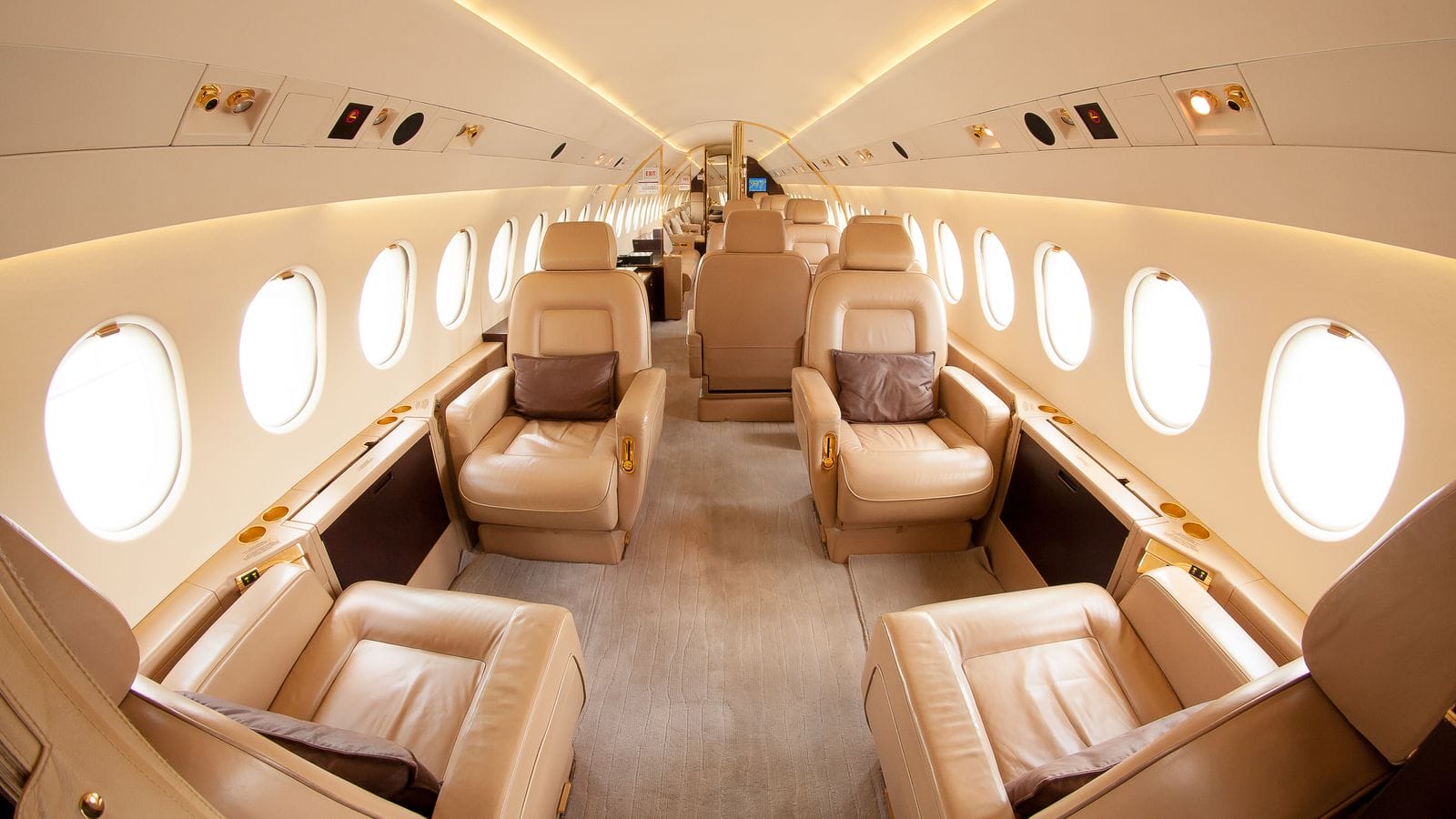
The Challenger 850’s cabin is not a standard business jet interior stretched to fit more seats. It is derived from the Bombardier CRJ-200 regional airliner platform, which means a true wide-body fuselage with flat floors, a full-width aisle, and flexible seating configurations. Depending on the mission, the cabin can be arranged for executive meetings, family travel with sleeping configurations, or high-capacity group flights.
The Challenger 850 is the right aircraft for Private Clients who regularly travel with large groups, like sports teams flying to away games, corporate leadership teams visiting multiple sites, production crews moving between locations, or extended families gathering for milestone events. If you routinely need 10 or more seats, the Challenger 850 eliminates the cost and complexity of coordinating multiple smaller aircraft. It is also ideal for anyone who values ample baggage space, their very own attendant, a full galley, and other luxurious amenities.
Frequently Asked Questions About Fractional Jet Ownership (FAQs):
What is fractional jet ownership?
Fractional jet ownership is the acquisition of a deeded equity share — typically one-eighth or one-sixteenth — in a specific business aircraft. You receive a guaranteed allotment of flight hours each year, and a management company handles operations, crew, maintenance, and insurance on your behalf. Your flights operate under Part 91K federal regulations.
How much does a fractional jet share cost?
Costs vary by aircraft type, share size, and program. In the Magellan Jets program, shares in the Bombardier Challenger 850 start at $1.25 million. Additional annual costs include a monthly management fee and an occupied hourly rate that covers direct operating expenses.
What are the main downsides of fractional ownership?
The primary drawbacks are capital commitment (your equity is tied up for the term), multi-year contracts (typically three to five years), shared scheduling during peak periods, and aircraft depreciation. Magellan Jets addresses each of these through a guaranteed 60 percent residual buyback, a three-year term (the shortest standard commitment available), fleet interchange to the Jet Card fleet, and a 34-aircraft fleet that absorbs scheduling pressure.
How does fractional ownership differ from chartering a private jet?
Charter is a pay-per-trip model with no capital commitment and no guaranteed aircraft. Fractional ownership gives you equity in a specific aircraft, guaranteed hours, Part 91K safety standards, and tax-depreciation benefits. Charter operates under Part 135, which has different crew and maintenance requirements.
What tax benefits come with fractional ownership?
Fractional owners may qualify for 100 percent bonus depreciation under the One Big Beautiful Bill Act (signed July 4, 2025) and Section 179 expensing up to $2.5 million. These deductions apply to qualified business use. Consult a tax advisor for guidance specific to your situation.
How does Magellan Jets ensure flight safety?
Magellan Jets holds a seat on the Air Charter Safety Foundation Board (with leadership serving as Chairman for over six years), maintains WYVERN Wingman Broker Certification, operates a proactive Safety Management System, and works exclusively with operators carrying $100 million to $300 million in liability insurance. Captains in the Preferred Network average 9,700 or more flight hours.
What is Part 91K and why does it matter?
Part 91K is the section of Federal Aviation Regulations that governs fractional ownership programs. It requires crew duty-time limits, drug-and-alcohol testing, standardized training, and maintenance-tracking systems that go beyond standard Part 91 private operations. For fractional owners, it provides a higher baseline of regulatory oversight than most charter arrangements.
Can I exit a fractional agreement early?
Early exit options vary by program. Most fractional agreements include provisions for selling your share on the secondary market or negotiating a buyout with the management company. Discuss exit terms in detail with your Private Aviation Advisor before signing.
Do unused hours roll over?
In the Magellan Jets program, up to 25 unused hours carry from year one into year two of the three-year term. This gives you flexibility to fly lighter in one year and heavier in the next without forfeiting hours. Other programs do not allow this.
Can I fly more hours than my share allotment?
Yes. Most programs offer supplemental hours at the prevailing hourly rate when you exceed your guaranteed allotment. In the Magellan Jets program, your advisor can arrange additional hours so you are never grounded because you have reached your cap.
Can multiple people use my fractional share?
Yes. Fractional shares are typically tied to the owner entity, not a single individual. Authorized users — family members, business partners, or employees — can fly on your hours with proper authorization.
Can I fly internationally on a fractional share?
International flights are available on most fractional programs, though they may involve additional fees for customs, immigration handling, and overflight permits. The Magellan Jets team coordinates international logistics so you do not have to manage permits, handlers, or clearance paperwork yourself.
What is the residual value of my share at the end of the term?
Residual value depends on the program. Magellan Jets offers a guaranteed buyback at 60 percent of your original share value at the end of the three-year term — removing the uncertainty of a fair-market-value appraisal.
How quickly can I access the aircraft after I acquire a share?
Once your agreement is finalized, you can typically request flights within the program’s standard notice window — often 8 to 48 hours depending on routing and scheduling. Your Private Aviation Advisor confirms availability and coordinates every detail before wheels-up.
What is the difference between a fractional program and a Jet Card?
A fractional share gives you equity in a specific aircraft with depreciation benefits and Part 91K safety governance. A Jet Card is a prepaid block of flight hours with no equity, no depreciation, and Part 135 operations. Fractional ownership suits consistent, high-volume flyers; Jet Cards suit moderate-volume flyers who want flexibility across aircraft types. Magellan Jets offers both solutions.
Does Magellan Jets own the aircraft in the fractional program?
No. Magellan Jets does not own, operate, or maintain aircraft. The Fractional Ownership program is a joint venture with Slate Aviation, which manages the fleet of Bombardier Challenger 850 aircraft. Magellan Jets serves as the Private Clients’ trusted advisor and program architect.
Ready to Explore Fractional Ownership?
The right private aviation solution depends on how you fly — where, how often, with whom, and what matters most. A Private Aviation Advisor can walk you through the Fractional Ownership program, model the economics against your travel patterns, and help you decide whether a Challenger 850 share, a Jet Card, or another approach fits your needs. Talk to a Private Aviation Advisor
If you’re evaluating private aviation programs in 2026, the comparison between Magellan Jets and NetJets has shifted significantly. NetJets, operator of more than 850 aircraft and one of the most recognized names in fractional ownership, began limiting new Jet Card and lease sales in late July 2026 to focus on its core fractional business, as reported by Forbes. Current cardholders may renew, but prospective buyers face a narrower path to entry.
Magellan Jets, by contrast, offers a complete private aviation ecosystem: Jet Cards, On-Demand Charter, Fractional Ownership, and Aircraft Sales & Management, all under one relationship, all accepting new Clients without restriction. This guide compares the Magellan Jets Jet Card to NetJets’ fractional ownership model and its Jet Card programs, so you can determine which approach fits your travel profile and financial outlook.
Jet Card vs. Fractional Ownership: A Foundational Difference
Jet Cards provide prepaid access to private aviation with guaranteed availability, defined pricing, and flexible terms. Magellan Jets is the first provider to offer a fully customizable Jet Card, built around individual Client travel patterns, aircraft preferences, and hourly commitment levels. Clients purchase any number of hours at or above a 25-hour minimum.
Traditional fractional ownership involves purchasing a share of an aircraft, with ongoing management costs and multi-year commitments. Even with that investment, aircraft access is shared among multiple owners.
The practical distinction: Jet Cards prioritize flexibility and ease of use. Fractional ownership introduces higher upfront capital, longer-term obligations, and additional cost layers that exist whether or not you fly.
Magellan Jets Jet Card vs. NetJets Fractional Ownership
Financial Structure and Risk
Magellan Jets operates an asset-light model. It does not own aircraft, and Client funds are never co-mingled with operational costs. Funds are segregated, fully protected, and never expire until used for travel.
NetJets fractional ownership requires capital investment in an aircraft share, plus ongoing management and operational fees that continue regardless of flight activity. Market depreciation on the owned share is an additional consideration.
Availability and Access
Magellan Jets Jet Card: 365-day guaranteed availability, zero blackout dates, zero peak-day surcharges
NetJets Fractional: No blackout dates, but 10 peak days annually require advance coordination
Flexibility and Usage
With Magellan Jets, hours never expire. Clients purchase any commitment at or above the 25-hour minimum and unlock additional benefits at the 50-hour and 100-hour thresholds. Access spans seven aircraft categories with no interchange fees, and multi-aircraft access (up to eight aircraft in a single day at 100 hours) supports complex travel requirements.
50 hours: Preferred hourly pricing, Advantage Routes (preferred pricing on high-demand corridors), short-leg waivers (a Client flying Boston to Nantucket can save up to $10,000 per trip), deeper discounts
100 hours: The deepest preferred pricing, maximum short-leg waiver access, strongest discounts
NetJets fractional owners are allocated access by ownership share size, and fractional programs carry 10 peak days per year. Using aircraft outside the owned category can involve interchange arrangements.
Pricing Transparency
Magellan Jets uses point-to-point pricing billed on estimated flight time. Rate lock terms protect against cost increases: 12 months at 25 hours, 18 months at 50 hours, 24 months at 100 hours. Pricing is transparent and all-inclusive on Premium Jet Cards.
NetJets fractional combines acquisition cost, monthly management fees, occupied hourly rates, and fuel surcharges into a layered structure that fluctuates with usage and market conditions.
Commitment Timeline
Magellan: Customizable hours at or above a 25-hour minimum; no multi-year lock-in required
NetJets Fractional: Typically a larger annual hour commitment across a multi-year ownership term
Magellan Jets Jet Card vs. NetJets Jet Card (Card275 and Card320)
Important context: In late July 2026, NetJets began limiting new Jet Card and lease sales, the second such pause in five years (the first occurred in 2021). Current cardholders may renew, but new buyers should verify availability. The comparisons below reflect the structure of NetJets’ Card275 and Card320 programs as they were offered prior to this change.
Availability
Magellan: 365 days, zero blackout dates, zero peak-day surcharges
NetJets Card275: 275 access days, approximately 90 blackout dates annually
NetJets Card320: 320 access days, 45 blackout dates plus 45 peak days that carry longer booking windows rather than surcharges, per Private Jet Card Comparisons
Pricing and Entry Point
NetJets Jet Card pricing (when programs were accepting new sales) started at approximately $8,600 per hour on the Phenom 300 for Card275 and approximately $11,200 per hour on the Phenom 300 for Card320, sold in 25- or 50-hour blocks, according to Private Jet Card Comparisons.
Magellan Jets offers two card types at any commitment level starting at 25 hours:
Category Jet Card: From $7,200 per hour (inclusive of fuel). Features include daily minimum of 1.3 hours, 40 advanced booking days for guaranteed availability, no peak-day surcharges, no blackout dates, and repositioning included. De-icing and catering are additional.
Premium Jet Card: From $9,375 per hour (all-inclusive: fuel, catering, de-icing, Wi-Fi). Features include daily minimum of 1 hour, 20 advanced booking days, and long-leg plus round-trip discounts.
At the 50-hour level, Advantage Routes deliver a 7% rate reduction on Client-selected high-demand corridors. Currently live on two eastern routes, expanding to seven by Fall 2026.
Notice Time
Magellan: As short as 24 hours, depending on aircraft category and membership tier
Magellan Jets provides access to seven aircraft categories with fee-free interchange, allowing Clients to match the aircraft to the mission, from a Light Jet for a short regional hop to a Heavy Jet for a transatlantic crossing. Premium Jet Card holders can select specific models: Phenom 300, Challenger 350, or Gulfstream G450/550.
NetJets operates a large owned fleet of more than 850 aircraft, according to Forbes. Its jet card programs offered a limited lineup of aircraft, with category upgrades contingent on availability. Every Magellan Jets Client receives equal booking priority, with multi-aircraft access scaling by commitment: up to four aircraft per day at 25 hours, six at 50 hours, and eight at 100 hours.
Short-Leg Waivers
Most private aviation programs apply a daily minimum flight charge regardless of actual air time. Magellan Jets’ short-leg waivers eliminate these minimums on qualifying regional routes, delivering significant savings on short missions. A Client flying Boston to Nantucket can save up to $10,000 on a single trip. Waivers scale with commitment: four at 50 hours, eight at 100 hours.
Magellan Jets charges no peak-day surcharges and no interchange fees. Pricing models are clearly delineated: Category Jet Cards itemize optional add-ons, while Premium Jet Cards bundle everything into a single hourly rate. Clients know their exposure before booking.
NetJets structured its card programs with pricing limits tied to access days, plus fees for upgrading or downgrading aircraft category mid-trip.
Which Program Should You Choose?
NetJets brings a highly structured approach, a large fleet, and long-standing presence in the market. For travelers comfortable with defined systems and standardized offerings, and who qualify for the currently limited availability, it remains a recognized option.
Magellan Jets offers the first fully customizable Jet Card, an asset-light model that protects Client funds, and a complete private aviation ecosystem. Clients never outgrow the relationship: as travel patterns evolve, they move fluidly between Jet Cards, On-Demand Charter, Fractional Ownership, and Aircraft Sales & Management through a single trusted partner.
That full suite is the point. Jet Cards deliver prepaid, flexible access with guaranteed availability for Clients who fly regularly. On-Demand Charter fits occasional or one-off trips, including complex multi-aircraft itineraries, with no long-term commitment. Fractional Ownership suits higher-frequency flyers who want an owned asset on more flexible terms than the traditional model. Aircraft Sales & Management supports Clients who already own an aircraft, or plan to, pairing acquisition guidance with day-to-day operational oversight. As needs shift, a Client moves between these solutions without ever changing partners.
For travelers evaluating options in 2026, the question is straightforward: Do you want to navigate restricted availability and multi-year ownership commitments, or would you prefer guaranteed access, flexible terms, and a partner designed around how you actually fly?
Frequently Asked Questions About NetJets vs. Magellan Jets (FAQs):
Does Magellan Jets offer more than Jet Cards?
Yes. Magellan Jets provides a complete private aviation ecosystem: Jet Cards, On-Demand Charter, Fractional Ownership, and Aircraft Sales & Management. Clients can access any solution as their needs evolve, without changing providers.
What is the difference between NetJets fractional and Jet Card programs?
Fractional ownership requires capital investment in an aircraft share with ongoing management fees, regardless of flight activity. Jet Cards provide prepaid flight hours without ownership, typically with greater flexibility and lower upfront commitment.
Which program offers better availability?
Magellan Jets guarantees availability 365 days a year with zero blackout dates and zero peak-day surcharges. NetJets Card275 restricts approximately 90 days annually; Card320 restricts 45 blackout days plus 45 peak days that carry longer booking windows rather than surcharges, per Private Jet Card Comparisons.
How much does a NetJets Jet Card cost?
When accepting new sales, NetJets Card275 started at approximately $8,600 per hour on the Phenom 300, and Card320 started at approximately $11,200 per hour, per Private Jet Card Comparisons. As of late July 2026, NetJets has limited new Jet Card sales, so pricing for new customers may not be available.
Is a NetJets Jet Card still available in 2026?
NetJets announced in late July 2026 that it is limiting new Jet Card and lease sales to focus on its core fractional ownership business, as reported by Forbes. Current cardholders may renew, but prospective buyers should confirm availability directly with NetJets.
Which Jet Card is best for occasional travel?
For travelers flying 25–50 hours annually, Magellan Jets’ Category Jet Card offers a competitive entry point with full availability and no peak-day surcharges. The 25-hour minimum provides access without requiring the capital or commitment of fractional ownership.
How quickly can I book a flight?
Magellan Jets offers call-out windows as short as 24 hours, depending on aircraft category and membership tier. NetJets requires a 48-hour callout on both card tiers for guaranteed availability.
What is a NetJets Peak Day?
Peak days are high-demand dates when NetJets applies longer booking windows and can shift departure times, with fractional owners generally receiving access priority. On Card320 the 45 peak days carry no surcharge; fractional ownership includes 10 peak days. Magellan Jets has no peak-day surcharges.
What is a Blackout Date?
A blackout date is a day when a Jet Card provider does not guarantee aircraft availability. NetJets Card275 includes approximately 90 blackout dates annually. Magellan Jets has zero blackout dates, with availability guaranteed 365 days a year.
What is an Advanced Booking Day?
Advanced booking days (ABDs) refer to the minimum notice required to guarantee availability at standard rates. Magellan Jets Category Jet Cards require 40 ABDs; Premium Jet Cards require 20 ABDs. Shorter notice may still be accommodated depending on aircraft availability.
How does a NetJets Jet Card work?
A NetJets Jet Card is a prepaid block of flight hours (typically 25) that provides access to NetJets’ fleet without aircraft ownership. Cardholders pay an upfront deposit plus hourly rates, with availability subject to blackout dates and notice requirements. Note: New sales are currently limited as of late July 2026.
Is a NetJets Jet Card worth it?
A NetJets Jet Card can suit travelers who value a large single-operator fleet and brand recognition, provided they accept blackout dates, peak-day restrictions, and 48-hour notice windows. With new sales limited as of late July 2026, travelers who want guaranteed 365-day access and flexible terms increasingly compare Magellan Jets, whose fully customizable Jet Card carries no blackout dates and no peak-day surcharges.
A private jet tax deduction is available when a qualifying aircraft is used more than 50% for legitimate business purposes and accessed through an ownership interest. Under current federal law, owners of qualifying business aircraft may claim 100% first-year bonus depreciation, while On-Demand Charter and Jet Card flyers may instead deduct qualifying flight costs as ordinary business travel. Whether private jets are tax deductible comes down to two questions: how you access the aircraft, and how rigorously you document its use. Every path below carries a different answer.
The 2025 tax law changes reset the calculus for business owners, CFOs, and high-net-worth flyers who have been weighing aviation on the margin. For the first time in years, the depreciation math and the operational reality point in the same direction. The opportunity is real, and so is the scrutiny that comes with it.
Understanding the Four Primary Models
Private aviation is not a single product. It is a spectrum of four access models, each suited to a different flight profile and a different financial posture. The tax treatment of each turns on one distinction: whether you hold an ownership interest in the aircraft or simply buy access to it. That single line separates depreciation from deduction, and it shapes every strategy that follows.
On-Demand Charter
On-Demand Charter is access by the trip, with no commitment and no capital outlay. You pay for the specific mission you fly. Cost is driven by aircraft category, trip distance, and positioning requirements, and a Private Aviation Advisor confirms exact figures for each journey.
The financial benefit is flexibility. You commit nothing until you fly, and you scale up or down as the year unfolds. On the tax side, On-Demand Charter involves no ownership, so it generates no depreciation. On-Demand Charter costs tied to a business trip may be deductible as ordinary and necessary business travel under IRC §162, subject to a separate analysis and full substantiation. Treat that as distinct from depreciation.
The Jet Card
A Jet Card is prepaid access with guaranteed availability and fixed hourly rates. You purchase hours in advance and draw against them across the year. Cost depends on aircraft category and the number of hours committed, and Magellan Jets protects Client funds so they never expire and are never co-mingled with operational accounts.
The benefit is certainty. You lock a rate, secure availability 365 days a year, and remove the trip-by-trip pricing question. Like On-Demand Charter, a Jet Card is prepaid access rather than ownership, so it produces no depreciation. Business-use flights may still be deductible as travel expenses under IRC §162 with proper records.
Fractional Ownership
Fractional Ownership gives you a deeded share of a specific aircraft, along with a defined number of guaranteed flight days each year. This is where the tax picture changes. Because you hold a real ownership interest, you hold a depreciable asset.
Fractional owners may claim depreciation on their share of the aircraft, including bonus depreciation, provided the more-than-50% business-use test is met. The deduction is prorated to the ownership percentage and to the business-use percentage. Cost is a function of share size, aircraft category, and program term, and your Private Aviation Advisor models the exact structure alongside your tax counsel.
Whole Aircraft Ownership
Whole ownership means sole title to the aircraft and full operational control. It carries the highest commitment and the widest tax opportunity. Because the entire aircraft basis sits on your books, the full depreciation schedule, including 100% first-year bonus depreciation, applies to a qualifying business aircraft.
Cost spans acquisition, crew, maintenance, and management, all of which a Private Aviation Advisor helps structure. Magellan Jets supports owners through Aircraft Sales & Management, handling acquisition and day-to-day oversight so the asset performs against both the flight schedule and the financial plan. Owners who need lift beyond their aircraft can supplement with On-Demand Charter or a Jet Card through the same relationship.
Qualifying Business Use: How a Private Jet Tax Deduction Actually Works
The largest gap in most aviation tax conversations is the qualifying-use standard. Depreciation is not triggered by buying an aircraft. It is earned by using it for business, and by proving it.
Business aircraft are treated as listed property under IRC §280F. To claim bonus or accelerated depreciation, the aircraft must be used more than 50% for qualified business use. Below that threshold, only straight-line depreciation under the Alternative Depreciation System is available, and bonus depreciation is disallowed. IRS Publication 946 sets out these rules, and the National Business Aviation Association (NBAA) covers the technical implications in further depth.
Documentation carries the claim. The IRS expects contemporaneous flight logs that record the date, route, passengers, and business purpose of every leg. As The Tax Adviser reports, substantiation, not intent, is what survives an audit.
Several rules narrow the picture further. Personal and entertainment use is non-deductible, and it reduces your business-use percentage. The deduction is prorated to that percentage. And if business use later drops below 50%, recapture can claw back depreciation you have already claimed. The IRS has expanded its corporate-aircraft audit activity, which The Tax Adviser documents, so the aircraft tax planning that holds up is the kind built on records from the first flight, not reconstructed afterward.
Strategic Tax Opportunities Under the OBBBA
The One Big Beautiful Bill Act (OBBBA, Public Law 119-21), signed July 4, 2025, reshaped the depreciation landscape for business aircraft. It permanently restored 100% first-year bonus depreciation under IRC §168(k) for qualified property, including business aircraft acquired and placed in service after January 19, 2025. The IRS has issued implementing guidance on the amended deduction.
“Permanent” here means there is no scheduled sunset under current law. It does not mean the provision is beyond change. A future Congress could revise or repeal it, so treat the current 100% rate as today’s opportunity rather than a fixed constant.
Both new and used aircraft can qualify for private jet bonus depreciation. Under the OBBBA, a used aircraft must be acquired from an unrelated party and must not have been previously used by the taxpayer. The eligibility tests are specific, and you should confirm them with a tax professional before you rely on them.
Section 179 offers a parallel path for smaller expensing. For tax years beginning in 2025, the maximum deduction is $2,500,000, with the phase-out beginning at $4,000,000 and eliminated at $6,500,000. For 2026, those figures rise to $2,560,000 and $4,090,000 under IRS Rev. Proc. 2025-32. These limits sit well below the cost of most business aircraft, so bonus depreciation typically does the heavier lifting.
One caveat deserves attention. State tax conformity to federal bonus depreciation varies, and some states decouple from IRC §168(k) entirely. Model the federal and state treatment together, and make no assumption about total savings until both are confirmed by your advisor.
The Magellan Jets Advantage
Magellan Jets is an asset-light private aviation solutions provider. It does not own or operate aircraft. Instead, it sources the right aircraft for each mission from the Magellan Jets Preferred Network, an exclusive group of fewer than 100 rigorously vetted operators out of roughly 3,000 licensed in the United States.
That structure matters for a financial decision. Because Magellan Jets holds no fleet, it has no utilization quota to fill, so every recommendation is made in the Client’s interest rather than the company’s. A Client can move from On-Demand Charter to a Jet Card, into Fractional Ownership, and on to whole ownership without leaving the relationship, matching the aviation structure to the tax structure as needs evolve.
Every Client works with a dedicated Private Aviation Advisor who coordinates the strategy and a Client Experience team who manages the details of each journey. Safety anchors the model: Magellan Jets is the sole private jet solutions provider represented on the Air Charter Safety Foundation (ACSF) Board, holds WYVERN Wingman Broker Certification, and works only with operators carrying $100M to $300M in liability insurance. The same asset-light model that protects your capital also removes the pressure to keep a fleet flying, which is what keeps safety and financial advice aligned.
Frequently Asked Questions About Private Jet Tax Deductions (FAQs):
What is 100% bonus depreciation in private aviation?
It is a provision under IRC §168(k) that lets a business deduct the full cost of a qualifying aircraft in the year it is placed in service, rather than spreading it across many years. The OBBBA permanently restored the 100% rate for qualified aircraft acquired and placed in service after January 19, 2025. Eligibility still depends on the more-than-50% business-use test.
Can you write off 100% of a private jet?
Potentially, if you own a qualifying business aircraft, place it in service after January 19, 2025, and use it more than 50% for qualified business purposes. The private jet tax write off is prorated to your business-use percentage, so personal and entertainment flights reduce it. A tax professional should confirm your specific eligibility.
Which private aviation model offers the best tax deductions?
Ownership models offer the most, because only ownership creates a depreciable asset. Whole ownership carries the full aircraft basis, and Fractional Ownership allows depreciation on your share. On-Demand Charter and Jet Cards do not generate depreciation, though their flight costs may be deductible as business travel.
Can fractional owners claim depreciation?
Yes. A fractional owner holds a real interest in a specific aircraft and may depreciate that share, including bonus depreciation, when the more-than-50% business-use test is met. The deduction is prorated to both the ownership percentage and the business-use percentage.
Do Jet Card or On-Demand Charter programs qualify for bonus depreciation?
No. Both are access rather than ownership, so neither creates a depreciable asset and neither qualifies for bonus depreciation aircraft treatment. Flights taken for business may still be deductible as ordinary business travel under IRC §162, with proper substantiation.
What qualifies as business use for a private jet deduction? Flights taken for a genuine business purpose, documented with contemporaneous logs that record the date, route, passengers, and reason for travel. Personal and entertainment flights do not count and reduce your business-use percentage. Because aircraft are listed property under IRC §280F, business use must exceed 50% to claim accelerated or bonus depreciation.
Does the “Big Beautiful Bill” give private jet owners a $6,000 tax deduction? No. The $6,000 figure is a separate senior deduction for taxpayers age 65 and older, available for tax years 2025 through 2028. It phases out above $75,000 of modified adjusted gross income for single filers and $150,000 for joint filers, and disappears entirely at $175,000 and $250,000. It has no connection to private aviation, and most high-net-worth readers are phased out of it anyway.
What makes whole ownership financially advantageous? Whole ownership places the entire aircraft basis on your books, so the full depreciation schedule, including 100% bonus depreciation, applies to a qualifying business aircraft. It also gives you complete control over scheduling, configuration, and crew. The tradeoff is the highest commitment across acquisition, crew, maintenance, and management, which is why owners pair it with Aircraft Sales & Management support.
Take Flight With a Smarter Financial Strategy
The right answer is not the model with the largest deduction. It is the model that fits how you actually fly, structured so the tax treatment follows the flight profile rather than the other way around. Ten trips a year and 150 hours a year lead to very different conclusions, and the difference between a defensible deduction and a costly one is the documentation behind it. If you are comparing aircraft alongside the numbers, our Phenom 300 versus Citation Excel comparison is a useful companion read.
A Private Aviation Advisor can map your flight profile, your ownership options, and your tax picture in a single conversation, then bring in your tax counsel to confirm the structure. Connect with Magellan Jets to build the strategy around the way you fly.
This article is general information only and does not constitute tax, legal, or accounting advice. Tax outcomes depend on your specific facts, and rules change. State tax conformity to federal bonus depreciation varies by jurisdiction. Consult your own qualified tax, legal, and accounting advisors before acting on any strategy described here.
International charter flights open direct access to destinations that commercial aviation simply does not reach. Private jets can reach roughly 5,000 public-use airports across the United States, only a portion of which host scheduled commercial airline service, according to the Federal Aviation Administration. Worldwide, private aviation extends that reach across 193 ICAO member states, from island runways in the Caribbean to executive terminals in Asia and the Middle East. This guide covers aircraft selection, customs procedures, required documentation, and what to expect when you fly internationally on a private charter.
Why Private Clients Choose International Charter Flights
The appeal of flying private across borders goes beyond cabin comfort. International charter flights deliver something commercial itineraries cannot: the freedom to move on your schedule, between airports of your choosing, with none of the layovers, connections, or overnight delays that complicate transoceanic travel.
Consider a business executive flying from New York to London for a morning meeting. A commercial flight departs the evening before, lands at dawn, and involves ground transfers through congested terminals. A private charter departs when the passenger is ready, arrives at a dedicated Fixed Base Operator (FBO) – a private terminal that handles fueling, customs, and concierge services – and clears immigration in minutes. The meeting happens; the return flight departs that afternoon. One day, not two.
For leisure travelers, the calculus is equally compelling. Remote destinations often lack commercial service entirely. Flying private to St. Barts, the Greek islands, or a safari lodge in East Africa transforms a logistical puzzle into a direct arrival. The journey becomes part of the experience rather than an obstacle to it.
Selecting the Right Aircraft for International Travel
Aircraft range determines which routes are possible nonstop. The right aircraft for an international mission depends on distance, passenger count, and what you need from the cabin en route.
Light Jets for Regional International Routes
Light jets like the Embraer Phenom 300 offer approximately 2,000 nautical miles of range. This suits shorter cross-border flights such as New York to Toronto, Miami to Nassau, or Los Angeles to Cabo San Lucas. For travelers moving between neighboring countries, light jets combine efficiency with lower hourly operating costs.
Super-Midsize Jets for Transcontinental and Transatlantic Reach
Super-midsize aircraft occupy a distinct performance tier. The Bombardier Challenger 350, with a range of approximately 3,269 nautical miles, handles coast-to-coast domestic flights and reaches into the Caribbean, Mexico, and Central America with ease. For nonstop transatlantic capability, the Embraer Praetor 600 extends that range to approximately 4,040 nautical miles – enough to connect the U.S. East Coast with Western Europe without a fuel stop.
Heavy and Ultra-Long-Range Jets for Transoceanic Missions
Long-haul international flights require heavy or ultra-long-range aircraft. The Gulfstream G650ER delivers approximately 7,400 nautical miles of range, enabling nonstop service from New York to Dubai. For the longest missions – New York to Tokyo, Los Angeles to Sydney – the Bombardier Global 7500 provides approximately 7,700 nautical miles of range along with four distinct living zones, including a private suite and full-size galley, for rest and productivity across time zones.
Aircraft Range and Route Capability
International Charter Flights: Estimated Hourly Rates
Understanding charter pricing helps Private Clients plan international travel with realistic expectations. The table below provides estimated hourly rates by aircraft category for international missions.
These are estimated hourly rates for international charter, inclusive of fuel. They do not include contingencies such as de-icing, positioning, overnight fees, international fees, catering, or ground transportation. Final pricing is confirmed at time of quote.
Customs and Immigration: What Private Clients Need to Know
Flying internationally on a private charter involves documentation and procedures distinct from commercial travel. The process is more personalized – and often faster – but requires advance coordination.
Departing the United States
When departing the U.S. on an international charter, the aircraft operator files an eAPIS (Electronic Advance Passenger Information System) manifest with U.S. Customs and Border Protection (CBP). This electronic filing transmits passenger and crew information before departure. Passengers provide passport details to the operator in advance, typically 24–72 hours before the flight.
Arriving in the United States
International flights arriving in the U.S. must land at a CBP-designated airport – either an international airport, a landing-rights airport, or a user-fee airport that has activated its customs services. Private jets clear customs at Fixed Base Operators (FBOs) rather than commercial terminals. Officers meet the aircraft on the ramp or in a dedicated customs facility at the FBO. The process typically takes 15–30 minutes for straightforward arrivals.
Arriving in Europe: The Entry/Exit System
Travelers arriving in the Schengen Area should be aware of the Entry/Exit System (EES), which became fully operational on 10 April 2026. EES replaced passport stamps with biometric registration – fingerprints and facial images – for non-EU nationals. Private jet passengers clear this process at the FBO or general aviation terminal upon arrival. The European Travel Information and Authorisation System (ETIAS), a pre-travel authorization for visa-exempt travelers, is not yet in operation, so travelers cannot apply yet; the European Union will announce the launch date several months in advance.
Required Documentation
Every passenger on an international private charter must carry a valid passport. Most countries require at least six months of validity beyond the travel dates. Depending on the destination, additional documentation may include:
Visas (where required for the destination country)
Customs declarations for items being imported
Health documentation (vaccination records where mandated)
Pet documentation (health certificates, import permits) for traveling animals
Your Private Aviation Advisor coordinates documentation requirements before departure, confirming what each destination requires and ensuring the operator has the information needed for customs filings.
Operator Standards and Safety for International Missions
International charter operations in the United States are governed by 14 CFR Part 135, the Federal Aviation Administration’s certification standard for commercial air charter. Part 135 operators meet rigorous requirements for crew training, aircraft maintenance, and operational procedures.
Magellan Jets sources aircraft exclusively from the Magellan Jets Preferred Network – fewer than 100 operators, selected from approximately 3,000 licensed in the U.S. Operators in the network carry between $100 million and $300 million in liability insurance and maintain ARGUS Platinum or WYVERN Wingman certification, the industry’s leading independent safety audits. Captains hold thousands of hours of flight experience, with specialized training for the aircraft types they command.
For international missions, operator selection also considers experience with specific routes, familiarity with destination airports, and established relationships with ground handlers and fuel providers abroad. This matters: an operator with regular Europe or Caribbean experience navigates permit requirements and ground logistics more efficiently than one flying an unfamiliar route.
Learn more about how Magellan Jets evaluates operators and maintains safety standards across every mission.
Why Choose Magellan Jets for International Charter Flights
Flying internationally requires more than booking an aircraft. It requires coordination across time zones, permits, ground handling, catering, and customs – all aligned to deliver a Private Client from origin to destination without friction.
Magellan Jets assigns every Private Client a dedicated Private Aviation Advisor who manages the entire journey. For international travel, this means:
Aircraft selection matched to the mission. Route distance, passenger count, baggage requirements, and cabin preferences determine the right aircraft – not fleet availability.
Permit and overflight coordination. Many countries require landing permits and overflight clearances. Your Advisor handles these filings in advance.
Ground handling and FBO arrangements. From fuel contracts to customs facilitation, ground services are confirmed before departure.
Catering and concierge services. International flights often involve long hours in the cabin. Catering is tailored to passenger preferences, and ground transportation is arranged at both ends.
Real-time trip monitoring. The Client Experience team tracks every flight and responds to changes – weather diversions, schedule adjustments, or destination updates – as they arise.
Magellan Jets holds WYVERN Wingman Broker Certification and serves on the Air Charter Safety Foundation (ACSF) Board. These credentials reflect a company-wide commitment to safety that extends to every operator in the Preferred Network and every international mission flown.
Popular International Charter Routes
Private Clients charter internationally for business, leisure, and often a combination of both. The following routes represent some of the most frequently requested international missions:
Transatlantic
New York (TEB) to London (LTN/FAB)
Boston (BED) to Paris (LBG)
Miami (OPF) to Nice (NCE)
Los Angeles (VNY) to London (LTN)
Caribbean and Latin America
Miami (OPF) to St. Barts (SBH)
New York (TEB) to Nassau (NAS)
Houston (HOU) to Mexico City (TLC)
Los Angeles (VNY) to Cabo San Lucas (SJD)
Transpacific and Middle East
New York (TEB) to Dubai (DWC)
Los Angeles (VNY) to Tokyo (NRT)
San Francisco (SFO) to Hong Kong (HKG)
Each route carries its own considerations: permit lead times, fuel stop options, preferred FBOs, and customs procedures at the destination. Your Private Aviation Advisor builds the itinerary around these factors.
Frequently Asked Questions About International Charter Flights (FAQs):
How much does it cost to charter a private jet internationally?
International charter pricing depends on aircraft category, route distance, and trip-specific factors. Estimated hourly rates range from approximately $8,119 per hour for a turboprop to $14,877 per hour for a heavy jet. These rates are inclusive of fuel but exclude contingencies such as de-icing, positioning fees, overnight charges, international fees, catering, and ground transportation. Final pricing is confirmed at time of quote.
Can you charter a plane internationally?
Yes. Private jets routinely fly international routes, from short cross-border hops to transoceanic missions spanning thousands of miles. Aircraft selection, operator certification, and proper documentation are the key requirements for international charter.
Can private jets fly internationally?
Private jets fly to destinations across 193 ICAO member states worldwide. Range varies by aircraft type: light jets suit regional international routes (approximately 2,000 nm), while ultra-long-range aircraft like the Bombardier Global 7500 can fly nearly 7,700 nautical miles nonstop – enough for New York to Tokyo or Los Angeles to Sydney.
What is the best private jet for international travel?
The best aircraft depends on the route. For transatlantic flights, super-midsize jets like the Embraer Praetor 600 offer nonstop U.S.–Europe capability with a comfortable cabin. For longer missions to the Middle East or Asia, heavy and ultra-long-range aircraft such as the Gulfstream G650ER or Bombardier Global 7500 provide the range and cabin amenities needed for flights exceeding 12 hours.
Do you need a passport to fly on a private jet internationally?
Yes. Every passenger on an international private charter must carry a valid passport. Most destinations require at least six months of passport validity beyond travel dates. Depending on the destination, visas or travel authorizations may also be required.
Which airports can handle international private jet arrivals?
In the United States, international private jet arrivals must land at CBP-designated airports: international airports, landing-rights airports, or user-fee airports with activated customs services. Private jets clear customs at FBOs rather than commercial terminals. Abroad, most countries designate specific airports or FBOs for general aviation customs processing.
What documents do I need for an international charter flight?
Required documents typically include a valid passport (with at least six months validity), any required visas for the destination country, and customs declarations for items being imported. Depending on the destination, health documentation or pet import permits may also apply. Your Private Aviation Advisor confirms all requirements before departure.
Start Planning Your International Charter
International charter flights represent the fullest expression of what private aviation offers: direct access to the world’s destinations, on your schedule, with every detail handled before you arrive at the aircraft. Whether you are flying to London for a day of meetings or to the Maldives for a week of restoration, the journey begins with a conversation.
Your time matters. Choosing the right private aviation solution can save hours at airports and maximize productivity in the air. Whether you’re a CEO needing consistent access or a family seeking adventure without airport hassles, understanding these options puts you in control.
When navigating the private aviation landscape in 2026, you’ll find many options to choose from. Two popular ones are Private Jet Cards and On-Demand Charter. Each offers distinct advantages depending on your travel frequency, budget, and preferences.
Ready to soar? Let’s break down what makes each option unique and which might serve your needs best.
Jet Card Fundamentals
Jet Cards work like prepaid flight accounts. You purchase hours based on your individual flying needs typically starting at a 25-hour minimum, with no ceiling, then redeem them as needed for private flights. Simple, straightforward, done.
Magellan Jets offers fixed hourly rates, so you’ll know exactly what to expect on each invoice. No surprises, no variable pricing. Just consistency you can count on for budgeting and financial planning. Most programs guarantee aircraft availability with proper notice — typically 24–48 hours — ensuring you’re never left stranded.
Frequent flyers appreciate how Jet Cards eliminate constant negotiation. Make one decision, one payment, then fly without hassle for months to come. Magellan Jets distinguishes itself with zero blackout dates, even during holidays and major events when most providers implement restrictions. Our approach eliminates peak-day surcharges too, keeping your costs predictable year-round.
What sets Magellan Jets further apart is the industry’s first customizable Jet Card, built around how individual clients actually fly. Rather than selling the same fixed product to every client, Magellan’s program is designed around your specific annual flight needs, aircraft preference, and hourly commitment level.
On-Demand Charter Essentials
On-Demand Charter means paying for each flight individually. No upfront commitment and no capital tied up. Just call when you need to fly, and pay for exactly what you use.
Flying fewer than 25 hours yearly? On-Demand Charter might make financial sense. Why prepay for hours you might not use? Magellan Jets maintains a Preferred Network comprising only the top percentage of operators nationwide. Think of it as flying with the elite of the elite: maximum safety with zero compromise.
Cost Factors
The big financial difference? Upfront investment versus pay-as-you-go. Jet Cards require capital upfront but offer stability. On-Demand Charter preserves capital but can fluctuate in price depending on a multitude of factors.
Watch for additional fees. Other providers implement peak surcharges during holidays and repositioning costs when aircraft must travel to reach you. These factors, among others, can significantly impact your final bill. Understanding the complete cost structure prevents unpleasant surprises.
Hourly Rates
Jet Card rates for Magellan Jets clients remain steady throughout your membership term. Market volatility? Fuel price spikes? Your rate stays locked. On-Demand Charter rates, meanwhile, change with market conditions and are sometimes higher or lower than comparable Jet Card rates.
High-volume flyers typically benefit from Jet Card consistency. Flying 25+ hours annually? The premium for guaranteed pricing often pays for itself. Flying less? Charter’s dynamic pricing might better serve your needs, especially when booking during off-peak periods.
Upfront Payments
Unlike the industry’s standard fixed-block model, Magellan Jets allows clients to purchase any number of hours at or above the 25-hour minimum, so your commitment reflects your actual flying needs rather than a predetermined tier. This deposit locks your rates for 12–24 months depending on your commitment level, protecting against market fluctuations and fuel price volatility.
Such payments create peace of mind for frequent flyers but present risk for occasional travelers. Many providers impose expiration dates on purchased hours, creating “use it or lose it” pressure. Magellan Jets offers non-expiring, refundable Jet Cards, eliminating concern about wasted investments.
Peak Surcharges
Holidays, major sporting events, and industry conferences can trigger surcharges with many providers, sometimes increasing costs by double-digit percentages. Magellan Jets eliminates peak-day surcharges on all Jet Cards, ensuring consistent pricing every day of the year.
Preferred Pricing on Your Most-Flown Routes
One of the most meaningful recent advances in Jet Card programming is route-specific pricing. Magellan Jets’ Advantage Routes deliver preferred pricing on the high-demand corridors clients fly most, starting with two eastern region routes and expanding to seven by Fall 2026. New corridors are added based on seasonal travel, holiday demand, and popular destinations.
At the 50-hour commitment threshold, clients receive a 7% Advantage Routes rate reduction. This kind of corridor-based pricing is only possible through an asset-light model that prices around demand rather than fleet logistics.
Short-Leg Waivers
A meaningful new benefit for regional travelers flying with Magellan Jets: short-leg waivers eliminate minimum flight charges on shorter routes. A Private Client flying Boston to Nantucket, for example, can save up to $10,000 on a single trip through this benefit. Four waivers unlock at the 50-hour threshold; eight at 100 hours. For clients who frequently fly short regional legs, this benefit alone can justify the commitment level.
Availability & Flexibility
Aircraft availability determines whether you reach your destination on schedule. Without it, even the best pricing loses value. Each option handles availability differently.
Comfort depends on flying the right aircraft. Too small means cramped conditions. Too large means paying for unnecessary capacity. Finding that perfect match ensures both comfort and value. For both Charter and Jet Card flights, our Private Aviation Advisors will match you to the ideal aircraft for your journey.
Lead Times
Need to book last minute? Jet Cards guarantee availability with just 24 hours’ notice. On-Demand Charter often requires more lead time, sometimes 72+ hours during busy periods, with no absolute guarantee.
Magellan Jets’ 24/7 Flight Support team excels at arranging urgent travel regardless of which option you choose. Our aviation experts navigate complex logistics to accommodate last-minute journeys, often securing aircraft within hours when competitors cannot.
Multiple Aircraft Options
Many Jet Card programs limit access to specific aircraft categories and charge interchange fees when you need something different. Magellan Jets offers surcharge-free interchange across all aircraft categories, so you’re never penalized for choosing the right aircraft for each mission.
Within the Jet Card program, clients also choose their aircraft pairing: Category Jet Cards (Light, Midsize, Super-Midsize, or Heavy jets) or Premium Jet Cards (Phenom 300, Challenger 350, or Gulfstream G450/550). Depending on your commitment level, you can access up to four, six, or eight aircraft per day simultaneously.
On-Demand Charter provides complete freedom to select any available aircraft for each individual journey. Flying solo to a nearby meeting? A light jet works perfectly. Taking the whole family to Europe? A heavy jet makes more sense. Charter adapts to your specific mission requirements every time.
Safety & Service Quality
Every charter operator must meet FAA Part 135 regulations, but significant quality variation exists within these standards. Magellan Jets implements rigorous additional vetting, selecting operators based on safety records, maintenance practices, and crew experience.
Our unbiased approach means we recommend the ideal aircraft and operator for each journey, rather than being limited to a pre-determined fleet. Private Clients receive tailored solutions based on their unique needs, not our inventory constraints.
From gourmet catering aligned with dietary preferences to seamless ground transportation, every detail receives careful attention. Our Private Aviation Advisors learn your preferences over time, anticipating needs before they arise.
Who Benefits Most From Each Option
Consider your travel profile:
Frequent Business Flyers (25+ hours annually) benefit from Jet Cards’ fixed rates and guaranteed availability
Corporate Teams Seeking Supplemental Lift appreciate Jet Cards as reliable backup to existing flight departments (see more about our Business Jet Card here)
Occasional Leisure Travelers (<25 hours annually) typically find greater value in On-Demand Charter’s flexibility
Variable Needs Travelers with changing requirements may benefit from access to both solutions
Looking for a Ownership and Management Solution or other specialty offering? View our full range of solutions here.
The Magellan Jets Advantage
Unlike most providers who push you toward their owned fleet, Magellan Jets remains completely independent. Our asset-light model means we never need to fill specific aircraft. We simply find the perfect option for your needs. Freedom from fleet ownership creates genuine objectivity, and it’s what makes Advantage Routes pricing possible.
When evaluating Jet Card vs. Charter options, working with unbiased experts matters. Our Private Aviation Advisors never pressure you toward one solution to meet quotas. They’ll candidly recommend Charter for infrequent flyers and Jet Cards for those needing consistent, customized access.
Many Private Clients discover their needs evolve over time. Perhaps you start with Charter for occasional journeys, then transition to a Jet Card as your flying increases. At Magellan, you can customize your hour commitment to match exactly what you need, rather than jumping to the next fixed tier. Magellan Jets offers seamless scaling between all of our options through a single point of contact.
Our approach means Private Clients receive consistent service regardless of which solution they choose. The same dedicated team handles both Jet Card and Charter journeys, ensuring your preferences remain consistent across every flight. Your favorite catering, ground transportation arrangements, and aircraft configurations follow you between programs.
Frequently Asked Questions About Charter Vs Jet Card (FAQs):
How many hours should I fly before I consider a Jet Card?
The traditional threshold sits around 25+ hours annually. Below that mark, On-Demand Charter typically provides better value unless you absolutely require guaranteed availability during peak periods.
Do Jet Cards expire?
Most providers impose 12-24 month expiration terms. Magellan Jets offers non-expiring hours with refundable deposits, eliminating pressure to “use or lose” your investment.
Are there blackout dates for On-Demand charter?
No official blackout dates exist at Magellan Jets, but extreme demand during holidays or major events creates practical limitations. Planning ahead becomes essential during these periods.
What is the best solution if I fly internationally?
International journeys typically benefit from On-Demand Charter’s flexibility in aircraft selection, however there are certainly clients who use their Jet Cards for international flights regularly. Longer ranges and varying regulations make customizing each global journey particularly valuable. Your Private Aviation Advisor will help you find the best option.
Final Thoughts on Your Private Aviation Path
Your unique travel patterns should guide your decision. Frequent flyers value Jet Cards’ consistency and guaranteed availability. Occasional travelers appreciate Charter’s flexibility.
Many savvy travelers eventually use multiple solutions: Jet Cards for predictable travel and Charter for specialized journeys. Talk to a Private Aviation Advisor at Magellan Jets for a bespoke solution tailored to your needs.
If you scroll through social media long enough, you might eventually see a glamorous private jet post promising an “empty leg deal” that looks too good to be true. A last-minute flight for the price of a commercial ticket. A spontaneous hop to Aspen or Miami for a fraction of the price.
Empty legs can offer value in very specific circumstances, but they are not flash sales, guaranteed bargains, or a shortcut to private jet travel. Understanding what empty legs actually are, and what they are not, helps travelers set realistic expectations and make smarter decisions.
Below, we break down the most common empty leg myths and explain how these flights really work.
An empty leg flight is a discounted repositioning charter. It occurs when a private jet must fly without passengers to reach its next trip. Empty leg flights cost less than a full private jet charter, yet they remain a premium option, not cheap airfare.
What Is an Empty Leg Flight?
An empty leg occurs when a private jet needs to reposition without passengers. For example, an aircraft may drop off clients in New York and need to fly to Florida for its next charter. That repositioning segment is known as an empty leg.
Because the aircraft must move regardless, operators may offer that flight at a reduced rate compared to a standard charter. The key word here is reduced, not inexpensive.
Myth #1: Empty Legs Are “Cheap” Private Jet Flights
Reality: Empty legs are discounted, but they are still a premium flight offering.
Even at a reduced rate, empty leg flights often cost tens of thousands of dollars. The aircraft, crew, fuel, insurance, maintenance, and operational oversight remain exactly the same. The discount reflects unused capacity, not a lower operating cost.
An empty leg may cost less than a full charter, but it is not comparable to commercial airfare or the prices often implied online.
Myth #2: You Can Easily Find an Empty Leg to Any Destination
Reality: Empty legs only exist where aircraft already need to go.
Empty legs are driven by existing charter demand, not traveler preference. You cannot request an empty leg to a specific city on a specific date and expect one to appear. Availability depends entirely on aircraft schedules, which change frequently.
This is why empty legs are unpredictable, highly specific, and often last-minute. The truth is, private aviation demand is at an all time high, meaning that repositioning legs are far more rare than they were ten years ago.
Myth #3: Empty Legs Are Flexible and Easy to Plan Around
Reality: Empty legs are logistically rigid.
Empty leg flights operate on fixed schedules tied to the aircraft’s next commitment. Departure times, airports, and even aircraft type are typically non-negotiable. If the primary charter changes or cancels, the empty leg may disappear with little notice.
For travelers who value certainty and control, this limitation is important to understand.
Myth #4: Empty Legs Offer the Same Experience at a Fraction of the Cost
Reality: The onboard experience may be the same, but the risk profile is different.
The aircraft, crew, and safety standards remain unchanged. However, empty legs often come with stricter terms. They are commonly non-refundable, require immediate payment, and allow little to no customization. If plans change, there may be limited options.
For some travelers, the trade-off makes sense. For others, the lack of flexibility outweighs the savings.
Myth #5: Empty Legs Are the Best Way to Fly Private
Reality: Empty legs are situational, not strategic.
Empty legs work best for travelers with very flexible schedules who happen to match the right route at the right time. They are not a reliable or repeatable way to plan private aviation.
Most frequent private flyers prioritize predictability, safety, and service consistency over chasing opportunistic discounts.
When Empty Legs Do Make Sense
Empty legs may be a good option if:
Your schedule is extremely flexible
Your destination happens to align with an available route
You are comfortable with last-minute changes or cancellations
You understand that pricing remains premium
In these circumstances, empty legs can offer value, but only with clear expectations.
Empty Legs vs. a Jet Card
Empty legs and a Jet Card solve different needs. One rewards flexibility, and the other guarantees availability. The table below compares them side by side.
A More Realistic Way to Think About Empty Legs
Empty legs are not a secret hack or loophole in private aviation. They are a byproduct of complex aircraft logistics. When viewed correctly, they can complement a broader travel strategy. When misunderstood, they often lead to frustration.
Working with an experienced aviation advisor helps ensure you understand the true costs, limitations, and alternatives before making a decision.
Browse Current Empty Legs
Empty legs can appear and disappear quickly, which is why access to accurate, real-time information matters. If you are interested in monitoring available routes, or simply want visibility into when an empty leg might align with your plans, Magellan Jets offers a transparent way to stay informed.
You can browse current empty leg flights and subscribe to receive empty leg alerts by email. New opportunities are added as aircraft schedules change.
This allows you to evaluate opportunities as they arise, with clear pricing and expert guidance. You avoid misleading social media claims and unrealistic expectations.
Frequently Asked Questions About Empty Legs
Are empty leg flights guaranteed once booked?
No. Empty leg flights depend on the aircraft’s primary charter. If that charter changes or cancels, the empty leg may also cancel.
How much cheaper is an empty leg compared to a full charter?
Savings vary, but empty legs are typically discounted. Pricing still reflects the aircraft type and operational costs.
Can I choose my departure time or destination?
Usually no. Empty legs operate on fixed routes and schedules determined by aircraft repositioning needs.
Are empty legs refundable?
Most empty leg flights are non-refundable or carry strict cancellation terms. Always confirm details before booking.
Do empty legs include the same safety and service standards?
Yes. The aircraft, crew, and safety protocols remain the same as any private charter if you book through Magellan Jets.
How far in advance are empty legs available?
Many empty legs appear within days, or even hours, of departure. Long-term planning around them is not possible.
Take Flight with a Smarter Aviation Solution
Empty legs are often misunderstood because they are oversimplified online. They are not budget private flights, guaranteed deals, or a substitute for thoughtfully planned private aviation. They are one option among many, and only the right choice under the right circumstances.
Understanding the realities of empty legs allows travelers to make informed decisions that align with their expectations, priorities, and travel needs. Contact a Private Aviation Advisor to learn what the best option is for you.