Safety is our number one priority. Every private aviation company says it. Few can prove it. At Magellan Jets, safety isn’t a tagline, it’s the structural foundation beneath every flight we operate. This guide breaks down what genuine private jet safety looks like: the standards that matter, the questions worth asking, and why the gap between a provider who says the right things and one who does them is wider than most travelers realize.
What Makes Private Aviation Safe
Private aviation has grown significantly safer over the past two decades, driven by advances in aircraft technology, crew training requirements, and risk management frameworks. But the industry is not monolithic. Safety standards vary enormously between operators, brokers, and programs — and the regulatory floor is lower than most people assume. Understanding what separates a truly safety-first provider from one that simply checks boxes starts with one framework: the Safety Management System.
Understanding the Safety Management System (SMS)
A Safety Management System is a proactive, structured approach to identifying, assessing, and mitigating aviation risk before it becomes consequence. The International Civil Aviation Organization (ICAO) defines SMS through four pillars, and the most rigorous providers in the industry build their entire culture around them.
Importantly, asset-light providers are not currently required by regulation to maintain a formal SMS. Magellan Jets does so voluntarily because a commitment to safety that only goes as far as the law requires isn’t really a commitment at all.
Pillar 1: Safety Policy & Objectives
Safety culture starts with leadership. Genuine safety policy means executive accountability, clearly defined roles at every level of operations, comprehensive documentation, and an Emergency Response Plan that is tested, not just written. Magellan Jets’ CEO and COO have each held the Chairman seat of the Air Charter Safety Foundation (ACSF) for over six consecutive years. The COO remains an active board member. That’s not a credential listed on a sales sheet. It’s a decade of active participation in shaping industry standards.
Pillar 2: Safety Risk Management
Risk management means anticipating hazards before they materialize. It requires continuous risk assessment across weather, aircraft condition, crew readiness, and route complexity. Every flight segment Magellan Jets operates is evaluated through a structured feasibility and operational review. Our System Operations Center (SOC) manages a critical 48-hour pre-flight window, continuously monitoring weather conditions, ATC directives, NOTAMs, EDCT windows, and AOG situations, addressing issues before they affect operations.
Pillar 3: Safety Assurance
Policies are only as strong as the processes that enforce them. Safety assurance requires routine audits, real-time performance monitoring, post-flight analysis, and a willingness to act on what the data shows. Magellan Jets conducts a comprehensive review of every assigned crew and operator before every flight. Real-time guest feedback is logged on every segment — and if a specific aircraft’s survey scores decline, that tail number can be removed from service immediately. Corrective Action Plans are implemented collaboratively with operators when concerns arise, with partnerships paused during remediation when necessary.
Pillar 4: Safety Promotion
A safety culture requires constant reinforcement. The best operators invest in ongoing training beyond regulatory minimums, create environments where crews report concerns without fear of reprisal, and stay engaged with industry-wide safety initiatives. Magellan Jets team members participate actively in ACSF and NTSB safety symposiums. Our Emergency Response Plan is a living document, refined through quarterly and annual training programs, ongoing operational refreshers, and continuous updates that reflect the latest industry developments.
The Magellan Jets Preferred Network: A Different Standard of Selection
Most asset-light private aviation providers work with whoever is available. Magellan Jets operates differently. The Magellan Jets Preferred Network (MJPN) is drawn from a nationwide pool of more than 2,500 U.S. operators. Fewer than 100 make the cut, which is less than 5% of all available operators. Every partner in the MJPN operates under FAR Part 135 or Part 121 Direct Air Carrier standards, and every partnership is subject to continuous auditing. Operators can be added, paused, or removed based on ongoing compliance, not just an initial review. Third-party safety auditing through ARG/US, Wyvern, and IS-BAO supplements Magellan Jets’ own proprietary approval process. These aren’t one-time certifications — they’re ongoing, independent verification that standards are being maintained. The result is a network built on long-standing partnerships, not ad-hoc arrangements. Consistency and reliability on every flight aren’t aspirational, they’re structural.
Elevated Flight Crew Requirements
FAA minimums exist for a reason. They are not the benchmark Magellan Jets uses. In partnership with Wyvern, Magellan Jets requires flight crew to meet standards that go materially beyond federal requirements:
The Captain of Aircraft Type requirement deserves particular attention. Requiring meaningful flight time on the specific aircraft being operated, not just a category, ensures deep familiarity with that aircraft’s systems and handling characteristics. It means the crew responding to any scenario isn’t learning in the moment.
Requiring both pilots to be type rated on the aircraft creates what Magellan Jets calls a fully synchronized flight deck: two pilots who bring equal technical expertise to every phase of flight.
Benchmark Passenger Protection: Insurance That Means Something
Insurance requirements in private aviation tell you a great deal about how seriously an operator takes accountability. Magellan Jets mandates enhanced liability insurance levels across the entire MJPN at levels that reflect each partner’s financial stability and long-term operational infrastructure:
Turbo-Props & Helicopters: $25,000,000
Light & Mid Jets: $50,000,000
Super Mid Jets: $75,000,000
Heavy Jets: $100,000,000
In practice, the average liability insurance across MJPN partners runs between $100M and $300M. All Magellan Jets business operators carry $100M or more. Beyond operator coverage, Magellan Jets carries an additional $50M in non-owned aircraft insurance. Certificate of Insurance verification is part of every pre-flight due diligence process. Magellan Jets is named as additional insured on all preferred operator COIs — and corporate clients can be named additionally insured as well.
Wyvern Wingman Certification: The Gold Standard in Aviation Risk Management
Magellan Jets is a Wyvern Wingman Certified Broker, which is a designation that requires vetting by an internationally accredited aviation safety auditor to confirm that policies, processes, and procedures meet Wyvern’s stringent ethical and operational standards. Wyvern certification is independently verified, and it’s one of the clearest signals available that a broker has subjected itself to scrutiny, not just internal review.
Proven Performance: The Trip Perfection Rating
Magellan Jets is the only private aviation company in the industry to measure and publish a Trip Perfection Rating. Most providers track on-time performance. The Trip Perfection Rating goes further — evaluating weather delays, ATC delays, mechanical issues, catering, ground transportation, pilot performance, supply chain, and process issues. It measures the complete picture of trip quality, not just whether the wheels left the ground on schedule.
The five-year average Trip Perfection Rating — including the disruption of COVID — is 90%+. The Net Promoter Score is 87%, well within the industry’s “Excellent” range of 70–100. These numbers aren’t marketing claims. They’re the output of real-time guest feedback logged on every flight, reviewed by an operations team with the authority to act on what it finds.
24/7/365 Flight Support
Magellan Jets’ operations team is staffed around the clock by professionals with pilot and hospitality backgrounds, always available to guests and operators alike. Every flight segment is evaluated through a structured feasibility and operational review, with enhanced scrutiny applied to international, short-notice, or non-standard flights. The team maintains specialized capability for complex itineraries: international operations, medical flights, group travel, and roadshow logistics. Safety doesn’t end at wheels up. It’s managed continuously, from initial booking through the moment you step off the aircraft.
What to Ask Any Private Aviation Provider About Safety
Whether you fly with Magellan Jets or are evaluating other options, these are the questions that separate genuine safety culture from talking points:
Do you maintain a formal Safety Management System, and do you do so voluntarily or only because it’s required?
What percentage of available operators are in your preferred network — and how are they continuously monitored?
How do your pilot hour requirements compare to FAA minimums?
What liability insurance levels do you require, and what additional coverage do you carry?
How do you measure trip quality, and what happens when performance falls short?
What does your Emergency Response Plan look like, and how often is it tested?
At Magellan Jets, we welcome every one of these questions.
Fly With Confidence
When you choose Magellan Jets, you’re not just booking a private flight. You’re engaging a team whose leadership has chaired the industry’s foremost safety foundation, whose network represents less than 5% of available U.S. operators, and whose flight crew standards begin where FAA requirements end. Your safety isn’t a priority we balance against other concerns. It’s the foundation everything else is built on. Connect with a Private Aviation Advisor to discuss how we can provide the safest, most reliable private travel solutions for your needs.
Frequently Asked Questions about Private Jet Safety (FAQs):
Is private jet travel safe?
Private aviation has one of the strongest safety records in transportation, and has become significantly safer over the past two decades. Safety outcomes vary meaningfully between operators and providers, however, which is why understanding how a provider selects aircraft, crews, and partners matters as much as any industry-level statistic.
How do I know if a private jet company is safe?
Look for third-party safety certifications (Wyvern, ARG/US, IS-BAO), voluntary adoption of a Safety Management System, transparent pilot hour requirements versus FAA minimums, and evidence of continuous operator auditing — not just one-time vetting. Ask for specific numbers, not assurances.
What is a Wyvern Wingman Certified Broker?
Wyvern is an internationally recognized aviation safety organization. Wingman certification requires independent vetting by an accredited aviation safety auditor to confirm that a broker’s policies, processes, and procedures meet Wyvern’s standards for risk management and safety practices. It is considered the gold standard in private aviation broker certification.
What is FAR Part 135, and why does it matter?
FAR Part 135 is the Federal Aviation Regulation governing on-demand charter operations. Operators certified under Part 135 — or Part 121 for Direct Air Carriers — are subject to more rigorous safety, training, and operational requirements than general aviation operators. All operators in the Magellan Jets Preferred Network are contracted under these standards.
What pilot experience should I expect on a private jet?
FAA minimums require 1,500 hours for a Captain and 250 hours for a Second in Command. Magellan Jets requires 3,000 hours for Captains and 1,000 hours for co-pilots, plus a minimum of 250 hours as Captain on the specific aircraft type being flown. Both pilots are required to be type rated on the aircraft — a standard that goes beyond FAA requirements.
What is a Safety Management System (SMS) in aviation?
An SMS is a structured, proactive framework for identifying, assessing, and mitigating aviation risk. Built around four pillars — Safety Policy & Objectives, Safety Risk Management, Safety Assurance, and Safety Promotion — a well-implemented SMS embeds safety into daily operations rather than treating it as a compliance exercise. Asset-Light Private Aviation Providers are not currently required to maintain an SMS; Magellan Jets does so voluntarily.
What liability insurance should a private jet operator carry?
Standards vary, but Magellan Jets requires a minimum of $50M for light and mid jets, $75M for super mid jets, and $100M for heavy jets. In practice, all Magellan Jets business operators carry $100M or more. Magellan Jets also carries an additional $50M in non-owned aircraft insurance beyond operator coverage.
What is the Magellan Jets Preferred Network?
The MJPN is Magellan Jets’ curated network of operator partners — drawn from more than 2,500 U.S. operators, with fewer than 100 selected. Each partner undergoes rigorous initial vetting and ongoing auditing through third-party safety organizations and Magellan Jets’ own proprietary review process. Operators can be added, paused, or removed based on continuous compliance monitoring.
What is a Trip Perfection Rating?
The Trip Perfection Rating is a proprietary Magellan Jets metric that evaluates the full quality of a flight — including weather delays, ATC delays, mechanical issues, catering, ground transportation, pilot performance, supply chain, and process factors. It is the only metric of its kind published by a private aviation company. Magellan Jets’ five-year average is 90%+, including the disruption years of COVID.
What should I do if I have a safety concern about a flight?
Contact your aviation advisor immediately. Magellan Jets’ operations team is staffed 24/7/365 and has the authority to pause or remove operators from service based on performance data. No flight departs without a pre-flight review of crew, operator, and aircraft — and every concern is taken seriously before wheels up, not after.
Benjamin O. Davis, Jr.’s leadership of the famed Tuskegee Airmen during World War II helped lead to the desegregation of the U.S. Military. In honor of Black History Month, read on to learn about this four-star general whose career spanned three wars and smashed racial barriers.
Benjamin O. Davis Paves The Way For Desegregation In The Military
FOLLOWING IN HIS FATHER’S FOOTSTEPS
Benjamin Oliver Davis, Jr. was born in Washington D.C. in 1912. His father, Benjamin O. Davis, Sr., was one of only two black officers in the U.S. Army at the time, and would eventually become the first African American General Officer in the entire U.S. Armed Forces. As a child of a military family, Davis Jr. moved around often, experiencing the racism and bigotry faced by African Americans across the country. The elder Davis, his military career stymied by segregation, instilled in his son a deep desire to fight for the end of the practice. He was determined to follow his father into military service and fight for equal inclusion for African Americans.
Davis Jr. was taken by aviation at an early age. When he was just 13, he took a ride with a barnstorming pilot at D.C.’s Bolling Field, cementing his desire to become a pilot. However, African Americans were still largely barred from flight training opportunities, so he set his focus instead on attending the U.S. Military Academy at West Point. After a few years of studying at the University of Chicago, he received a recommendation to attend West Point from Rep. Oscar S. De Priest, who was at that moment the only African American Representative in the U.S. Congress.
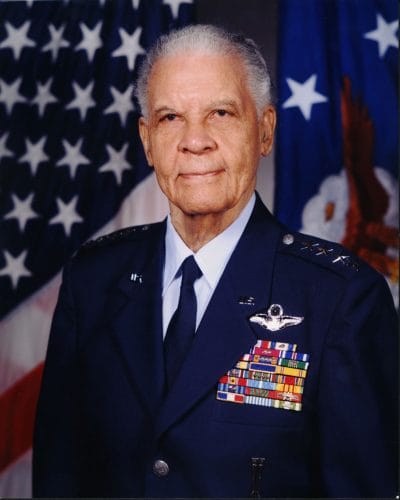
Gen. Benjamin Oliver Davis, Jr. (Public Domain photo)
At the time of his graduation, Davis Jr. was only the fourth African American graduate of West Point in its history, and the first in the 20th century—the first since the Reconstruction era. As Air Force Sustainment Center Historian Howard Halvorsen wrote, “His four years there were not pleasant;” he roomed alone, took his meals alone, and had no friends among his colleagues. He was “silenced” by the other cadets, meaning they only spoke to him on official business.
Despite the fact Davis graduated in the top 20 percent of his class in 1936, the segregation of the armed forces still kept his dream of becoming a pilot at bay. There were no Black air units, so he was denied his requests for flight training and instead sent to the infantry. When Davis Jr. was commissioned as a second lieutenant with the all-Black 24th Infantry Regiment, the Army had only two Black line officers: Both Davises, father and son. Davis Jr. would even go on to teach military science at Tuskegee Institute, a position his father had also held.
LEADING THE TUSKEGEE AIRMEN
Thanks to the collective efforts of many pioneering Black aviators and activists—and some convincing from Davis Sr., newly promoted to the rank of Brigadier General—President Franklin Roosevelt ordered the creation of an all-Black Army flying unit in 1941. As the only active Black West Point graduate, Davis Jr. was a natural choice to lead the squadron. It was more than just the realization of his dream of becoming a pilot; in leading the unit, he had an opportunity to undermine segregation and show the world that African American pilots were just as capable as white ones.
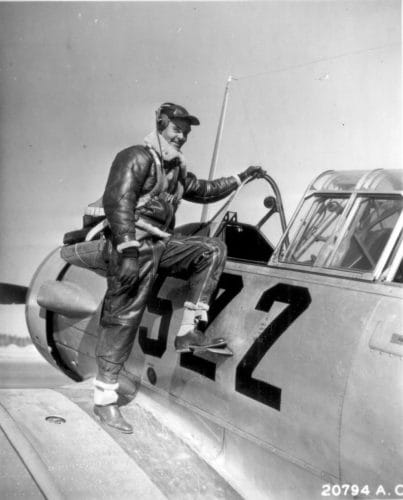
He began his flight training at Tuskegee Army Air Base in May 1941, and was the first Black officer to solo an Army Air Corps plane. On March 7, 1942, Davis Jr. and four other Black officers earned their wings. Throughout the course of the war, over 1,000 more Black cadets would graduate from the program to become “Tuskegee Airmen,” the nation’s first Black combat pilots. Davis Jr. would command the 99th Pursuit Squadron, the first and oldest of the Tuskegee Airmen units. A year later, he took command of the 332nd Fighter Group, leading all Black military aviators.
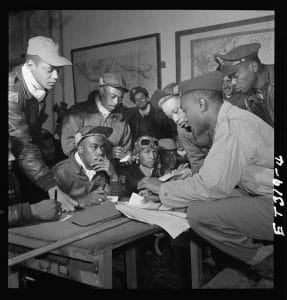
The war record of the Tuskegee Airmen of the 332nd—which included the re-named 99th Fighter Squadron and three other squadrons—is legendary. The unit supported the Allied invasion of Sicily and provided air cover for much of the fighting throughout Italy. They flew 15,000 sorties, downed 112 enemy aircraft, destroyed 273 planes on the ground, and even sunk an enemy destroyer. Davis Jr. personally led 67 of those missions, including an incredible round-trip bomber escort over Berlin in which the Tuskegee Airmen took down three of the new, faster German jet fighters without losing any fighters of their own. Davis himself was awarded the Silver Star and the Distinguished Flying Cross for his service.
Capt. Davis Jr. climbs into his aircraft in Tuskegee, Alabama in 1942. (Office of War Information/Public Domain Photo)
But Davis Jr. and the Tuskegee Airmen weren’t just fighting the Axis in the skies over Europe—they were also battling segregation, discrimination, and bigotry, sometimes from their own commanders. Davis Jr. would later write in his autobiography that “All the blacks in the segregated forces operated like they had to prove they could fly an airplane when everyone believed they were too stupid.” Shortly after the their arrival in the Mediterranean Theatre, the commander of the unit Davis and his men were attached to complained that the Black pilots were “not of the fighting caliber of any squadron in this Group;” that officer’s superior agreed, saying, “The consensus of opinion seems to be that the Negro type has not proper reflexes to make a first-class fighter pilot.” A recommendation was made to pull the Tuskegee Airmen from combat, and a War Department commission was set up to investigate.
Davis Jr. knew his men were being judged unfairly, and organized a press conference at the Pentagon to defend them. Testifying before the War Department commission, he explained the unfair odds the Tuskegee Airmen were up against, flying against experienced enemy pilots in outdated aircraft. Because they were short-staffed, they often had to fly more missions than their white counterparts, too. He argued that his men were just as eager to fight as white pilots. Thanks to his impassioned efforts, the committee found no difference in performance between white and black air units and decided to keep the Tuskegee Airmen in the fight.
Despite having to put up with these extra pressures, the unit’s stellar accomplishments paved the way for post-war desegregation, as the military could no longer make the old racist claim that African Americans were inferior soldiers.
THE AIR FORCE INTEGRATES
After the war, Davis Jr. took command of the 477th Composite Group and became base commander at Lockbourne Army Air Base in Ohio. Despite initially facing bigotry, Air & Space Forces Magazine reportsthat his professionalism won over the locals and resulted in the base becoming “a treasured part of the community.” Most of the civil servants working at the base were white, while their superiors were Black—a unique situation in America at the time. “For centuries people said whites would never work for blacks, but at Lockbourne several hundred whites worked professionally and well for Davis and the Tuskegee Airmen,” Air & Space Forces wrote.
When the Army Air Corps split off into the U.S. Air Force in 1947, Davis Jr. joined, hoping to push the new branch to desegregate. In fact, Air Force Lt. Gen. Idwal H. Edwards was already using the war record of Davis Jr. and the Tuskegee Airmen to make the argument for Black and white airmen to serve together. Finally, in 1948, President Truman ordered the desegregation of the military, and the new Air Force was the first branch to integrate. Davis Jr. was one of the leaders who helped write the Air Force’s integration plan.
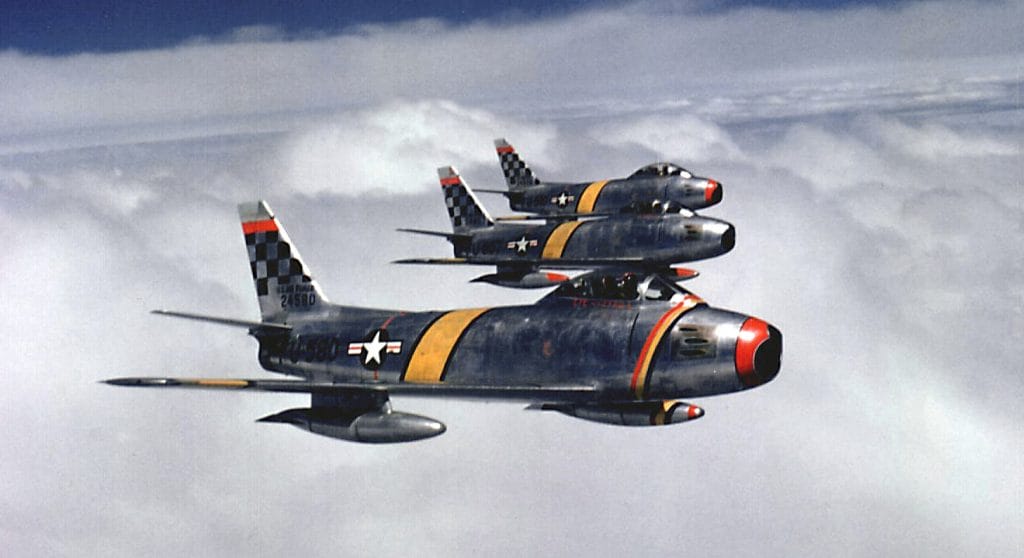
Davis Jr., then a Colonel, leads a formation of F-86F Sabres during the Korean War in 1953 (Public Domain photo)
That summer, Davis Jr. became the first Black officer to attend the Air War College, a necessary step to promotion that had previously been barred to African Americans by segregation. While his attendance represented another barrier broken, Davis Jr. still had to deal with racial discrimination; since the college was in Montgomery, Alabama, Air & Space Forces reports, many of the restaurants, shops, and services in the city were closed to him. “He and Mrs. Davis could anger the bigots among Montgomery’s whites just by driving a late-model automobile,” the magazine wrote. Once he graduated, Davis Jr. moved on to a job at the Pentagon, where he was “the impetus behind the Air Force Thunderbirds aerial demonstration team.”
Davis Jr.’s assignments over the next few years saw him leading integrated units, further proving that desegregation was a success and white soldiers would loyally follow Black leaders. After moving to Washington, he supervised white officers and enlisted men in his role as chief of Air Force Operations’ Air Defense Branch. In 1953, as the Korean War raged half a world away, he was placed in command of the 51st Fighter-Interceptor Wing, where he once again saw combat. There were thousands of men under his command, and most of them were white.
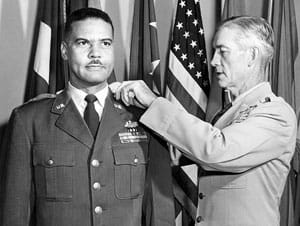
After the Korean War, Davis Jr. was transferred to Tokyo to train the Far East Air Forces. It was there in 1954 that he was awarded his first star as a Brigadier General, becoming the first African American general in the Air Force.
General Earle Everard Partridge pinning a general’s star on Benjamin O. Davis in 1954. (Public Domain photo)
COLD WAR, RETIREMENT, AND POST-MILITARY CAREER
Davis Jr. would go on to serve in a number of prestigious roles in the Air Force. First, he was made vice-commander of the 13th Air Force and transferred to Taiwan. There, he was tasked with creating an air defense force from scratch to defend the tiny island in the event the mainland Chinese Communist forces attacked. It was new territory for the seasoned general, as the unique position required “sophisticated diplomatic skills.”
Two years later, he had built a significant force to deter a possible invasion and built a strong camaraderie with the Chinese Nationalist forces. Lt. Gen. Jiang Jingguo said of Davis, “Standing on the front line of the free world, you have contributed greatly to the strengthening of the force of freedom, and to the protection of our common interests. I wish to include herewith our sincere appreciations to you for your great assistance in the air defense of this country. You have won for you far more than professional appreciations among your friends in Free China.”
In the years that followed, Davis would serve in high leadership roles in Germany, Korea, and back home at Air Force Headquarters in the United States. He received his second star as a Major General in 1959, and his third as a Lieutenant General in 1965. While commanding the 13th Air Force in the Philippines in 1967, he led some 55,000 men, many of whom were fighting in Vietnam. In 1968, he returned to the U.S. as Deputy Commander in Chief of U.S. Strike Command. He retired in 1970 after over 33 years of service.
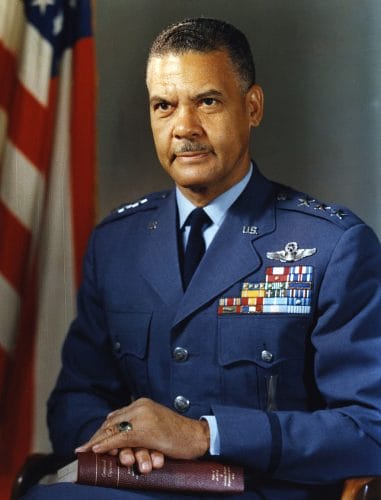
Gen. Benjamin O. Davis, Jr. in 2002, shortly after receiving his fourth star. (USAF/Public Domain Photo)
Davis held a number of important safety and leadership positions following his military service, including: Director of Public Safety in Cleveland, Ohio; Director of Civil Aviation Security, where he oversaw the federal Sky Marshal program; and as Assistant Secretary for the U.S. Department of Transportation.
There was one last honor remaining for Davis. In 1998, President Bill Clinton awarded Davis his fourth star, promoting the retired general to the rank of full General. At the ceremony, President Clinton said Davis Jr. was “a hero in war, a leader in peace, a pioneer for freedom, opportunity, and basic human dignity. He earned this honor a long time ago.”
Benjamin O. Davis, Jr. died in 2002 and is buried in Arlington National Cemetery.
William J. Powell was a tireless promoter of African American participation in the budding field of flight. In an era when daredevil pilots captured the imagination of the masses, Powell recognized that aviation also presented great opportunities for African Americans and did all he could to encourage more black fliers to take to the skies. In honor of Black History Month, read on to learn about this amazing pilot, entrepreneur, and author!
WILLIAM J. POWELL URGES AFRICAN AMERICANS TO ‘FILL THE AIR WITH BLACK WINGS’
Early life and first flight
“There is a better job and a better future in aviation for Negroes than in any other industry, and the reason is this: aviation is just beginning its period of growth and if we get into it now, while it is still uncrowded, we can grow as aviation grows.” — William J. Powell, Black Wings
William J. Powell was born in 1897 in Henderson, Kentucky. When he was just eight, his family moved to Chicago, a city that would go on to be a hub for early black aviators like Bessie Coleman and Cornelius Coffey. Powell, a talented student, was described by Air Facts Journal as “thin, lanky, and invariably well-dressed” and by National Air and Space Museum curator Von Hardesty as “a natural-born entrepreneur.” He enrolled in the engineering program at the University of Illinois at 17, but his studies were cut short by World War I.
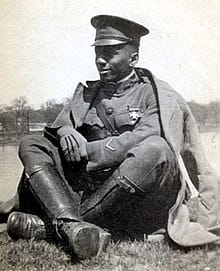
Powell served in the segregated 370th Infantry Regiment—the only regiment in the war commanded entirely by black officers—in France, where a poison gas attack left him with health issues for the rest of his life. After the war he returned to university to finish his engineering degree and found success early in his career by operating a chain of gas stations and auto parts stores on Chicago’s South Side.
William J. Powell in his U.S. Army uniform. (Public Domain photo)
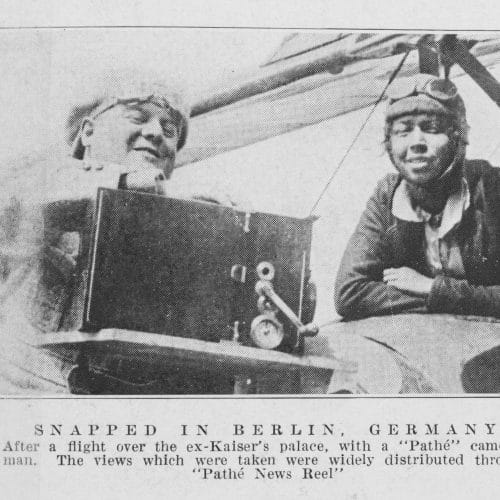
As a successful business owner, Powell had the money to travel to Paris for an American Legion convention in 1927 with other WWI veterans. Just months earlier, international aviation hero Charles Lindbergh had made history there, finishing the first non-stop flight across the Atlantic by landing at Paris’s Le Bourget Airfield. It marked the peak of aviation’s “Golden Age,” and the masses—Powell included—were fascinated by the adventures of daredevil aviators. While in Paris, Powell took a leap of faith and went to Le Bourget hoping someone would take him up in an airplane.
Powell got his wish, and by the time his plane landed after a tour over the city that included circling the Eiffel Tower, he knew he was destined to become a pilot himself. However, he wasn’t only thinking of his personal path—he saw the open blue skies and the new industry growing around aviation as an opportunity for his entire race. At that time in the 20s, African Americans were barred from many industries due to segregation and Jim Crow laws, and in addition to those racial barriers, they would soon be hit hard economically as America plunged into the Great Depression. Powell began to realize that aviation could provide a means to lift up not just an individual, but an entire community. As the African American Registry writes, “Powell meant to fly around Jim Crow … By taking hold of the embryonic flight industry, Black Americans could build their own economic independence.”
LEARNING TO FLY—AND BUILDING A COMMUNITY
“Stimulating interest in aviation among Negroes would not be such an arduous task were it not for stumbling blocks which seriously menace the Negro’s entry into any line of commercial endeavor. Skepticism, superstition, mistrust, jealousy, lack of co-operation, lack of preparation, race prejudice, and lack of finance have caused many a young Negro to turn away from some field of commercial endeavor with disgust.” — William J. Powell, Black Wings
Upon his return to the United States, Powell started applying to flight schools in the Chicago area—and even to the Army Air Corps—but was repeatedly rejected due to his race. Finally, in 1928, he was accepted into the Warren School of Aeronautics in Los Angeles. He sold his businesses, uprooted his family to California, and began his pilot’s journey.
He would eventually earn his pilot’s license in 1932, but even before completing his training, Powell began to build a strong community of African American aviators in his new home city. One thing they all had in common was a reverence for trailblazing aviator Bessie Coleman, who had drawn crowds of thousands to see her perform at airshows before her tragic death in an air accident in 1926. “Because of Bessie Coleman, we have overcome that which was much worse than racial barriers,” Powell later wrote. “We have overcome the barriers within ourselves and dared to dream.”
On this day in 1931, the Bessie Coleman Aero Club sponsored the first all-Black air show held in the United States.
📷: Club founder William Powell (right) with his Curtiss JN-4 Jenny (NASM 9A00624) pic.twitter.com/Nvi9dF7Huq
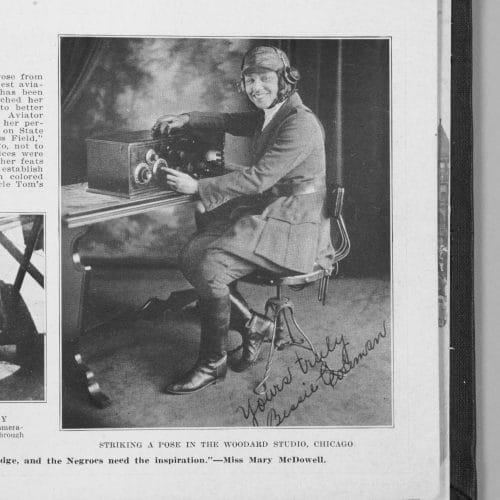
Powell formed the Bessie Coleman Aero Club in 1928 for his fellow black aviation enthusiasts and started the Bessie Coleman Flying School, making Coleman’s dream of a training center for black pilots a reality. James H. Banning, the first African American to be issued a pilot’s license in the U.S., became the school’s first instructor, and the group set to work raising awareness for black aviation.
One way Powell and his Aero Club compatriots gained attention for their field was by putting on air shows featuring black pilots and parachute jumpers. On Labor Day of 1931 at the Los Angeles Eastside Airport, they put on the nation’s first all-black air show for a crowd of 15,000. Just a few months later, they held another, calling it the “Colored Air Circus.” This time, Powell drew wider attention by making the show a benefit for Los Angeles’s unemployed community, then growing due to the Depression. This air show drew 40,000 and featured the largest formation of black aviators in the air at one time. Powell called them The Five Blackbirds, and used the success of the event to plan more air shows across the country.
WRITING “BLACK WINGS” AND RAISING NATIONAL AWARENESS
“We have lost money, we have bought airplanes, we have flown them, we have cracked them up, and we’re flying them some more, for the job must be done. No one is making us do it. We are flying of our own free will and accord, for the conquest of the air is an accomplished fact.” — William J. Powell, Black Wings
In 1934, according to the National Air and Space Museum, there were only 12 licensed African American pilots out of a total of 18,041 flying in the United States. It was against this backdrop that Powell wrote his groundbreaking semi-autobiography, “Black Wings,” to encourage more African Americans to get involved in aviation not just as pilots but as engineers, mechanics, aircraft designers/builders, and business leaders.
In “Black Wings,” Powell used the fictional character of “Bill Brown” as a stand-in for himself, writing about his struggle to become a pilot and the other early African American aviators he met. He used his story to lay out his beliefs that aviation provided African Americans a golden opportunity to “carve out [their] own destiny.” The book was dedicated to the memory of Bessie Coleman.
The book was just one of the ways Powell would seek to put black aviation on a national stage. In 1935, he produced a film called “Unemployment, the Negro, and Aviation.” The film centers on a black college graduate looking for a job but finding many avenues closed by discrimination—until one day he sees a poster featuring Powell’s call for more black aviators and decides to become a pilot. Powell also published a newsletter called Craftsmen Aero News, and enlisted famous friends including boxer Joe Louis, actress Lena Horne, and musicians Cab Calloway and Duke Ellington to drum up support for African American aviation efforts.
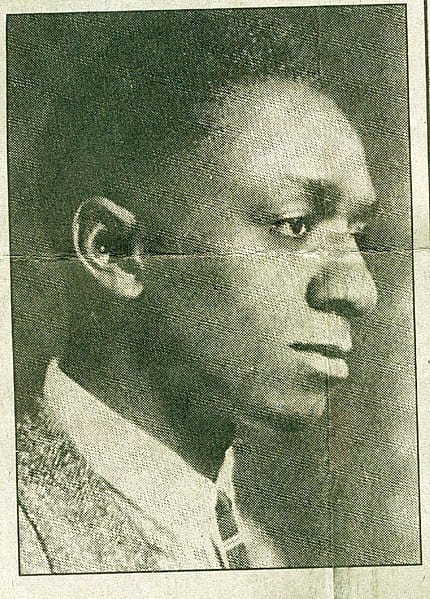
William J. Powell. (Public Domain photo)
Powell had grand plans for creating an entire black aviation industry, rather than waiting to be accepted by whites—he wrote in Black Wings, “I do not ally myself with [the] Negro who begs a White man for his job. I ally myself with that … young progressive Negro who believes [he] has the brain, the ability, to carve out his own destiny.” It was in that spirit that he created the first black-owned aircraft manufacturing company, Bessie Coleman Aero.
Black Past described Powell’s vision for an African American-led aircraft industry: “Powell envisioned Bessie Coleman Aero as a firm that would hire African Americans to design and build aircraft which would be flown by black pilots and serviced by African American mechanics. He imagined parallel black firms that would build and manage airports. These businesses, according to Powell, would serve all Americans, not just African Americans.” Sadly, the Bessie Coleman Aero project would not survive the economic turmoil of the Great Depression—along with a second firm, which Powell had also named Black Wings.
Powell died in 1942 at just 45 years old, likely from complications related to his World War I injuries. Though his life was cut short, his dream lived on—just one year after his death, the first black military pilots would take on the Nazis in the skies over Europe, serving with distinction and opening even more avenues for black aviators. Through his tireless networking, promoting, and entrepreneurship, Powell had paved the way for a new generation of African American pilots.
READ MORE ABOUT BLACK HISTORY AND AVIATION
Bessie Coleman
Cornelius Coffey
Willa Brown led a life of firsts, breaking several color barriers in aviation and politics. She was the first African American woman to earn her pilot’s license in the United States, and later became the first African American woman to run for Congressional office. In honor of Black History Month, read on to learn about this remarkable pilot, flight instructor, aircraft mechanic, and civil rights pioneer and her impact on aviation history.
Above photo: A young Willa Brown poses with aircraft in Chicago in the 30s (Public Domain Photo).
Willa Brown, Pioneering Aviator
EARLY LIFE AND AVIATION IN CHICAGO
Willa Beatrice Brown was born in Glasgow, Kentucky in 1906. Her parents moved the family to Indiana, where Willa excelled in school. She went on to graduate from what would later become Indiana State University and become the youngest teacher in the Gary, Indiana school system at age 21. Her love for teaching followed her throughout her entire life, but during the difficult years of the Great Depression, Brown also worked as a postal clerk, secretary, and lab assistant to support herself. In 1932, a position as a social worker with the Works Progress Administration would bring her to a city that was fast becoming the hub for black aviation in America—Chicago.
Brown was fascinated by aviation and by the legacy of another Chicagoan, Bessie Coleman, the first black woman to fly a plane. Though Coleman died tragically in an air accident in 1926, she had inspired the next generation of black aviators—among them John C. Robinson and Cornelius Coffey, who founded the Challenger Air Pilots Association for black pilots barred from other flying clubs as well as a flight instruction and ground school program at Harlem Field on Chicago’s southwest side.
Brown met Robinson in 1934 and joined the Challenger group shortly after, beginning her flight instruction with Robinson and Coffey as her teachers. It was a busy time for Brown, who was simultaneously studying to become a pilot, getting a Masters Mechanic Certificate from Curtiss-Wright Aeronautical University, and earning an MBA from Northwestern University.
When Brown earned her pilot’s license in 1937—airman’s certificate No. 43814—she became the first African-American woman to earn a U.S.-issued pilot’s license (her hero Bessie Coleman had been forced to get her license in France because American flight schools had not accepted women or African-Americans at the time).
AVIATRIX EXTRAORDINAIRE
Now equipped with a pilot’s license, the lifelong teacher set out to instruct more black fliers and mechanics and solidify a place for African Americans in the growing field of aviation. She would go on to teach about 2,000 students over the course of her instructor career. Along with Coffey (who she would later marry), Brown co-founded the Coffey School of Aeronautics in 1937 in the Chicago suburb of Oak Lawn. It was the first black-owned flight training school in the country, and unlike other flight schools of the era, it accepted students regardless of race or gender.
In addition to teaching flying and mechanical lessons, Brown also ran the business side of the school as well as the airfield’s luncheonette. In the words of her former student Chauncey Spencer, “Willa was persistent and dedicated. She was the foundation, framework, and builder of people’s souls. She did it not for herself, but for all of us.”
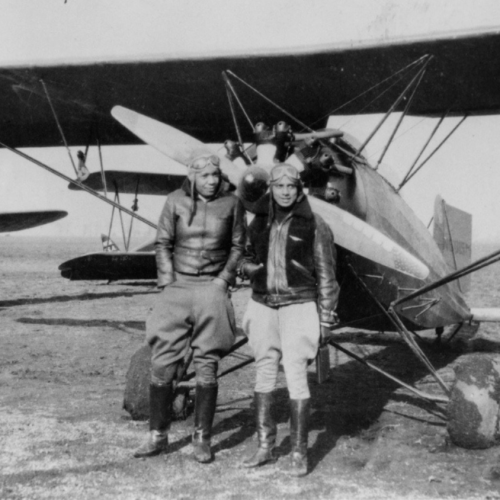
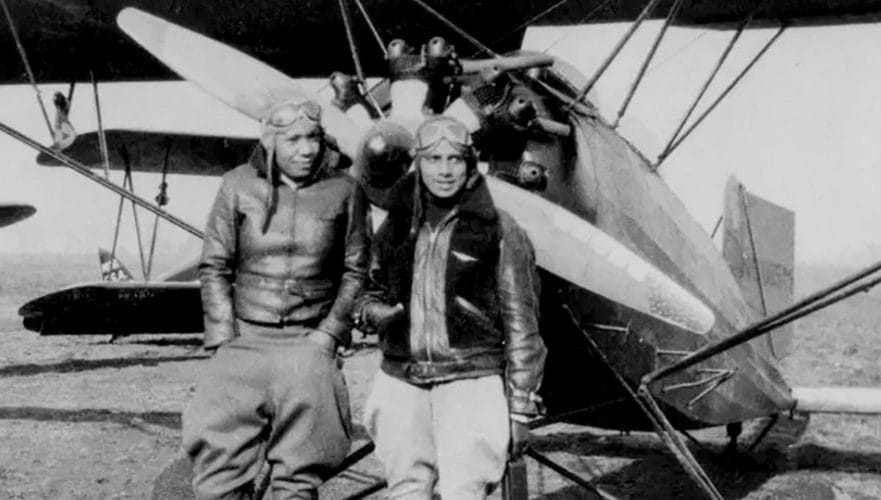
Lola Albright (left) and Willa Brown (right) pose in front of an airplane (Public Domain Photo).
The charismatic Brown worked to raise the Coffey School’s profile. To gain publicity for an airshow put on by the school, she visited the office of black-owned newspaper The Chicago Defender, where her confident manner and pilot’s uniform made quite an impact on editor Enoch Waters. “All the typewriters, which had been clacking noisily, suddenly went silent” when she entered, Waters claimed. Brown introduced herself as an “aviatrix” and told Waters all about the school’s work.
“Fascinated by both her and the idea of Negro aviators, I decided to follow up the story myself,” Waters later wrote. “So happy was Willa over our appearance that she offered to take me up for a free ride. She was piloting a Piper Cub, which seemed to me, accustomed as I was to commercial planes, to be a rather frail craft. It was a thrilling experience, and the maneuvers—figure eights, flip-overs, and stalls—were exhilarating, though momentarily frightening. I wasn’t convinced of her competence until we landed smoothly.”
With the press—and crowds of thousands of airshow spectators—thrilled by her and her students’ aerial abilities, Brown and her fellow aviators next set out to change the U.S. government’s attitude toward African American pilots.
FIGHTING FOR BLACK PILOTS IN THE MILITARY
The fight for African-American inclusion in the armed forces was an uphill battle, with black pilots still barred from serving in the 20s and 30s. A 1925 Army War College Report had called African-Americans “inferior” to their white counterparts when it came to serving in the military, and the discriminatory “findings” therein would go on to dictate Army leaders’ prevailing attitudes through the beginning of the Second World War.
While continuing to teach pilots in Chicago, Brown and Coffey co-founded the National Airmen’s Association of America in 1939 to help get more African-Americans involved in aviation and aeronautics on a national level; the group would eventually grow to over 2,000 members, with chapters across the Midwest and East Coast. Through both the NAAA and the Coffey School, Brown sought to convince the government to allow black aviation cadets to join and serve. Thanks to Brown’s growing profile and vocal support—and with the nation facing a pilot shortage on the brink of WWII—the Coffey School was chosen to train black pilots for a war-preparedness effort called the Civilian Pilot Training Program, with Brown serving as director and training coordinator.
As civil rights leaders continued to push for African American inclusion in the military, Brown wrote to none other than First Lady Eleanor Roosevelt for help. “During the past three years I have devoted full time to aviation, and for the most part marked progress has been made,” reads Brown’s letter, which you can read in its entirety here. “I have, however, encountered several difficulties—several of them I have handled very well, and some have been far too great for me to master.” The First Lady would go on to help remove some of the difficulties for black pilots that Brown alluded to, lobbying President Franklin Roosevelt to end restrictions on African-Americans serving in the military.
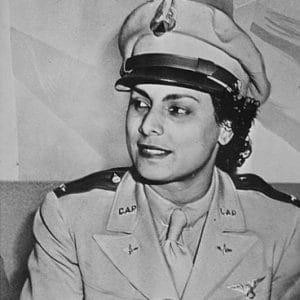
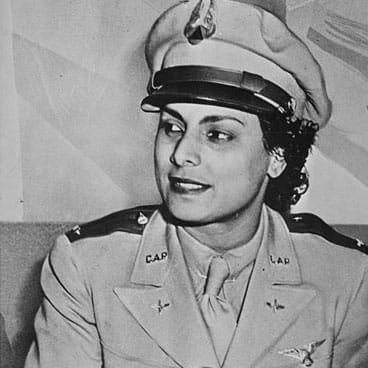
Lieutenant Willa Brown in her Civil Air Patrol uniform (Public Domain Photo).
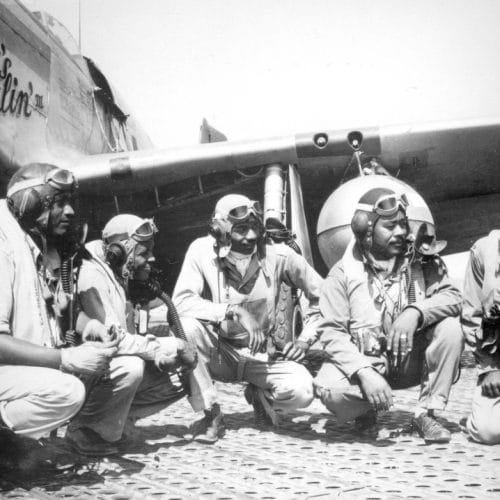
When the Army Air Corps set up a training program for black pilots at the Tuskegee Institute in Alabama, the Coffey School was selected to provide trainees. Some 200 of Brown’s students would join that program and go on to become Tuskegee Airmen, the first African-American military pilots to take on the Nazis in Europe. Despite this amazing progress, black pilots were still only allowed to serve in segregated units, which disappointed Brown and Coffey.
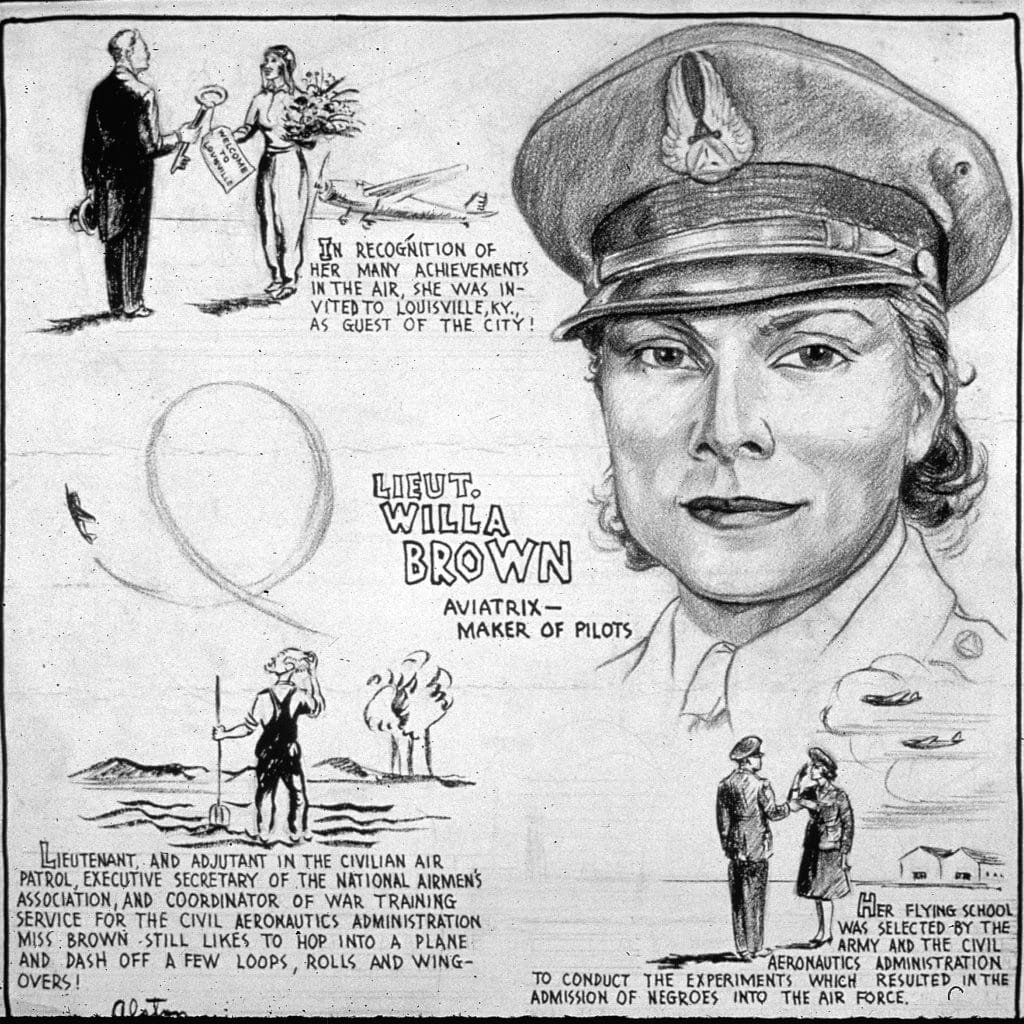
During World War Two, Brown sought to serve more directly. She attempted to join the Women’s Airforce Service Pilots, but was rejected due to her race. Undeterred, she joined the Civil Air Patrol, which helped organize civilian aviation resources for the war effort. According to the National World War Two Museum, the group “flew missions in anti-submarine and border patrols and fulfilled much-needed courier services.” Brown was commissioned as a Lieutenant, becoming the Civil Air Patrol’s first African American officer.
Finally, in 1948, the dream of Brown, Coffey, and their fellow aviators was realized: President Harry Truman ordered all branches of the military to desegregate. It wouldn’t have been possible without the tireless and persistent advocacy of Willa Brown.
MORE FIRSTS
A drawing of Lt. Willa Brown by Harlem Renaissance artist Charles Henry Alston (Public Domain Photo).
Coffey and Brown would close their school and divorce shortly after the end of the war in 1945, but Brown wasn’t yet finished breaking barriers. In 1946, she became the first African American woman to run for Congressional office, running in the primary for the Illinois 1st Congressional District. She ran again unsuccessfully in 1948 and 1950, with part of her platform including the creation of a black-owned and operated airport in Chicago and improving opportunities for African Americans in general.
She continued to teach business and aeronautics in Chicago Public Schools until her retirement in 1971. In recognition of her pioneering work in aviation, the Federal Aviation Administration appointed her to their Women’s Advisory Board in 1972 as the first black woman to serve on that committee.
Brown continued to be a leading voice in the struggle for civil rights up until her death in 1992. She’s buried in Lincoln Cemetery, sharing a final resting place with her hero and fellow aviation pioneer Bessie Coleman.
At Magellan Jets, the first of our core values is to lead with safety by maintaining an uncompromising commitment to excellence. When it comes to safety in private aviation, we know that service issues are strongly correlated to potential safety issues-so we’ve focused on three key performance metrics to elevate our service, because excellence in service equals excellence in safety. They are:
These three metrics are the result of our strong safety culture and the world’s most comprehensive service and safety management and quality assurance system. We work with only the few operators in our Magellan Jets Preferred Network (MJPN) that are able to continuously meet our rigorous standards and execute on all three of these factors.
The MJPN is a highly-selective, accredited network of premier operators that are subjected to the most rigorous Service and Safety Quality Assurance system in aviation. Every flight is thoroughly vetted by the expert FAA-certified pilots in our Flight Support Department. To earn a spot in the MJPN, private jet operators have to meet rigorous standards for health, safety, and service, including our 42-point safety inspection checklist and our 5 X 5 PureSky Safety Standard. They must be in good standing with third-party organizations like ARG/US and Wyvern, and their core values and safety cultures must align with ours.
Read on to learn why schedule stability, controllable on-time performance, and trip perfection rating are important, what you should ask your private aviation provider about them, and how Magellan Jets is uniquely positioned to keep you safe and create long-term value for your business by delivering on all three.
SCHEDULE STABILITY
Schedule stability is measured as the percentage of flights where the schedule was completed exactly as planned-without delays, aircraft or crew changes, or changes in departure time or day.
While large network providers consider 18% schedule stability to be satisfactory, Magellan Jets has had 98% schedule stability over the past 12 months.
• 8 Questions to Ask Before You Hire A Private Jet Operator When schedule stability is high, your flight experience will match your pre-planned itinerary exactly, and you will arrive at your destination on time with the crew and aircraft you wanted. You’ll have peace of mind knowing your needs are truly prioritized.
But when your provider cannot prioritize schedule stability, your personal and business goals are put at risk as you’re forced to adjust to last-minute changes. You may get frequent calls or confusing emails from your provider, or experience itinerary or booking errors, adding to your frustrations before your departure even takes place. Be sure to invest in a dependable private aviation company with a great schedule stability record, because low schedule stability will negatively impact your trip.
Ask your private jet provider:
– What is your schedule stability rating overall? – What is your schedule stability rating on high-volume days?
CONTROLLABLE ON-TIME PERFORMANCE
Controllable on-time performance is measured as the percentage of flights that depart within 15 minutes of their planned departure time.
Large network providers meet this goal 75% of the time; Magellan Jets has a controllable on-time performance rating of 97% over the past 12 months.
When controllable on-time performance is broadly defined and includes things your provider should anticipate, such as air traffic control and weather delays, your jet will be ready and waiting for you when you arrive at the private terminal. With the proper planning on your behalf by your private jet provider, the only factor that can’t be controlled is your timely arrival at the departure site. But when your provider does not take responsibility for the crucial factors that disrupt flight performance, you could be left waiting at the airport for your plane to arrive.
Ask your private jet provider:
– What is your overall controllable on-time performance percentage? – What is your controllable on-time performance during peak travel periods? – What factors do you consider controllable?
Trip Perfection Rating
Our Trip Perfection Rating is the percentage of trips flown with zero issues whatsoever. Magellan Jets is the only provider in the private aviation space that is willing to measure this metric.
Large network providers will not measure this-but Magellan Jets can proudly say we have a Trip Perfection Rating of 90% over the past 12 months.
Some providers may report their on-time rate as a sign of perfection, but delays are only one factor that can leave you unsatisfied with your flight experience. Were all seats on your jet fully operational? Was your catering order complete? Were you advised before your flight if your aircraft had enough space for your luggage? Was there enough room for you and your guests to be comfortable on your jet for the length of the trip? Was your itinerary, customs, and COVID-19 containment paperwork prepared for you in advance? Was your ground transportation arranged perfectly? Make sure whoever you choose to provide your private aviation solutions has the experience, foresight, and capability to meet each and every one of your expectations, beyond simply executing your trip. Anyone can get you from point A to point B-but it’s how you get there that makes a difference.
Ask your private jet provider:
– Do you collect clients’ post-flight feedback, such as survey scores? – What are some of the typical issues private flyers report with your company?
How does Magellan Jets manage such high ratings?
Since our business model strategically revolves around continuously auditing active aircraft, crews, and safety cultures available on the market, we’re able to focus entirely on finding the best solution to fit your needs for every flight. Simply put, our model gives us greater control over the desired outcome on each and every flight, ultimately resulting in higher satisfaction for you and your travel companions.
When it comes to quality assurance, our buying power surpasses other providers’ operational control. We’re constantly evaluating our operators, and won’t hesitate to remove any from the MJPN if they do not meet our elevated standards. In that way, we’re always optimizing our service and improving to ensure your safety, your success, and the integrity of your mission.
You’ve explored how Magellan Jets focuses on schedule stability, controllable on-time performance, and our very own Trip Perfection Rating to provide consistent, reliable, and excellent service with each and every private flight. Next, learn more about our relentless commitment to keeping our guests safe.
What makes great pilots stand out are their professional approach to the health of their crew, their passengers, and themselves. For all pilots, good health is more than a lifestyle choice, it’s mandated by federal regulations, specifically addressed in government-issued advisory circulars and various training curricula. In short, pilots must conduct a thorough self-evaluation, ensuring they’re in top physical condition before every flight. But how exactly do they minimize the impact of their own possible illnesses on their crew, their passengers, and themselves-especially during flu season? Spoiler alert: They’re always prepared.
One reason why commercial and private jet pilots, as a breed, are very proud professionals is because they must be proficient in several difficult subjects. Pilots are routinely tested and re-tested on their ability to apply their broad range of knowledge to real-world scenarios. They may not continue to exercise the privileges of their airman certificates (licenses) unless they demonstrate that their proficiency meets rigorous standards.
Knowledge of aerospace medicine allows pilots to minimize the impact of the cold and flu on themselves and others. This subject helps pilots prepare for the demands of high-performance jet operations. They master topics like high-altitude physiology, effects of fatigue, mental and physiological evaluation and assessment, and more to stay prepared for adverse emergency conditions. Here are five flu season tips from a professional pilot to stay healthy during your next trip.
Adopt a non-inflammatory diet. Commercial and private jet pilots learn early in their careers about the importance of nutrition. Junk food high in fat and sugar makes them mentally soft and their performance suffers. Pilots should concentrate on eating greens and limited while satisfying sweet cravings with fresh fruit and vegetables. Proper nourishment maintains a state of low or no inflammation in the body, better preparing it to defend against known and unknown viruses. Professional pilots must on commercial flights or private jet charters pass rigorous physicals at least every six months. As a result of the frequent check-ins, they tend to do better than most in sticking with healthy diets.
2. Drink mindfully
Drink water, slow and steady. Period. Limit caffeine to only when necessary. Top-of-their-game pilots aboard commercial and private jet aircraft occasionally rely on doses of coffee or tea. In order to defend itself from invading pathogens and viruses, a body must be hydrated, not inflamed. The same advice your doctor gives you when you’re sick-take in plenty of clear fluids-is what professional pilots do every day to cope with the impact of high-altitude physiology and the likely encounters with sick people they face every day.
3. Move your body every day
Every healthy and resilient pilot who flies commercial or private jet charters exercises at least once a day. We are not implying that every pilot is ready for an Iron Man competition, but they do try to get their steps in, and most do something to elevate their heart rate for 20 minutes or more daily. This ensures not only a favorable result when their mandated EKG results are sent to the FAA each year, but it also positions their immune systems to react better to foreign invaders. A healthy cardiovascular system speeds antibodies and white blood cells to where they are needed faster and more efficiently. They also help the body produce more defensive mechanisms when needed.
Whether it’s flu season or not, good sleeping habits are the most important factor when keeping professional pilots healthy. Many pilots experience disruptions to their circadian rhythms. Healthy pilots ensure they get at least eight hours of sleep. They try to avoid unnecessary use of caffeine, alcohol, and activities that disrupt their sleep. They are the people in your life that use room-darkening curtains and turn away from their screens at least one hour before bed time. The very first thing your doctor tells you to do when you get sick is to go home and rest (like a pilot does every day). Pilots who fly commercially or on private jets treat sleeping time as precious. They may get cranky when anything prevents proper rest-a justified attitude for someone held accountable for others’ safety and welfare.
5. See the doctor and keep up on required immunizations
The theory here is that if you modify your lifestyle to behave like a top-notch professional aviator who almost never gets sick, then you too will be ready to survive your next encounter with the flu like a pro. Before making any changes to your diet or lifestyle, you must first see your doctor. Professional pilots see medical professionals at least six times a year. This includes annual physicals and eye exams, plus visits at least twice a year with dentists and a local FAA designated medical examiner. Partner with your doctor to develop the right plan for you, as well as to stay up to date on all required immunizations.
There are few things more frustrating than having purchased a specific aircraft share or jet card, booking a flight, receiving all the details in advance and then finding out on the morning of your flight that you will be making two flights instead of one. You’ve been politely scheduled for a “tech stop” (also known as a Fuel Stop) without your knowledge or consent. Adding insult to injury, you’re flying private, paying a LOT of money, and now and you’re going to be late.
I’ve spent time with our Private Aviation Consulting and Flight Support Teams to document the top five frequently asked questions about fuel stops that Magellan Jets clients and members have asked over the past ten years. Most of these questions come early in the relationship, when prospective clients and members are unhappy with their current private aviation arrangement and are calling us to seek out a more personalized private transportation solution. We’ve used our combined experience to answer the FAQs from the point of view of a client or member.
Will my aircraft be able to make this trip all year?
Though I will usually be travelling alone or with one other person, what will the range of the aircraft be if I need to put a person in every seat?
If the aircraft can perform my routing all year long and with every seat occupied, why do I need a fuel stop today?
Can I interchange or upgrade to an airplane that will go non-stop? Will you advise me when I need to do so.
So, I have to make a fuel stop anyway. How long is this going to take?
Don’t be duped by aggressive salesmen, glossy brochures, or promises about how fleet size and “bigger is better” makes the difference in safety and maintenance. Simply ask our questions and seek short, uncomplicated answers.
1. Will my aircraft be able to make this trip all year?
A small cabin or light jet that is advertised to carry you, your best friend, and your golf clubs from New York to Central Florida will not be able to make that trip non-stop all the time. A mid-cabin aircraft flying coast-to-coast will not be able to go non-stop all the time. A very impressive-looking jet will not be able to go from Aspen to Chicago all the time.
What gives? The weather. The Jets Stream is the culprit. The fast-moving river of air in the atmosphere that moves our weather systems from the West to the East in the Northern Hemisphere presents planes with headwinds time many times stronger in the winter than prevailing winds in the Summer.
What about the Aspen to Miami trip? For high-altitude airports, warm temperatures are problematic. Hot summer temperatures severely degrade aircraft performance, requiring the airplane to be lighter in order to make a safe takeoff. Fuel is heavy. Take less fuel, get more along the way, make it to Miami.
2. Though I will usually be travelling alone or with one other person, what will the range of the aircraft be if I need to put a person in every seat?
More people equals less range. Most aircraft are sold on ranges based on four people and cruise speeds less than high-speed cruise. Especially when presented with winter headwinds, many small or light jets can require a fuel stop – depending on the number of passengers and the amount of baggage.
When requesting a trip that may require a fuel stop, consider requesting an upgrade or an interchange to a mid-size jet or larger.
3. If the aircraft can perform my routing all year long and with every seat occupied, why do I need a fuel stop today?
Sometimes things don’t go as planned. Should the crew have to plan the route around this week’s storm of the century, or if there is an operational reason that the crew needs to fly at a lower altitude, the airplane will burn more fuel. In most cases the crew will know in advance, with enough time to advise you of the fuel stop. There are a pair of circumstances when a fuel stop can be required with little or no notice:
If the departure or destination airport is experiencing some kind of problem that requires a partial runway closure, the crew will need to plan as though they are using a shorter runway – sometimes requiring less fuel and resulting in a fuel stop. How is this possible? Private jets have access to over 3000 public-use airports in the United States. Most of them are much smaller than the 10,0000-ft runways in major metro areas. With the majority of the airports equipped with only one runway, at times portions of the runway are closed for maintenance.
If the aircraft experiences a temporary maintenance issue. Today’s planes are equipped with multiple redundant systems. As a result, aircraft can be dispatched with one or more minor systems (such as long-range navigation) inoperative, so long as redundant systems are working. There are several systems that when off-line may require the crew to operate at a lower altitude, therefore burning more fuel and possibly requiring a fuel stop.
4. Can I interchange or upgrade to an airplane that will go non-stop? Will you advise me when I need to do so?
Maybe. It depends on who is providing you with your private jet. Ride sharing? No. Never. Charter? Unlikely. Your own airplane? Only if you have a jet card backup that allows interchanges (we have a solution for that). Fractional? Maybe. Will they will be carefully watching your flight or busy booking one of the other 5000+ “owners”? Maybe not. But that fractional salesperson will be excellent at the one-minute apology. Practice makes perfect.
We would be delighted to arrange an aircraft that is appropriate for your mission. It is our mission to understand your needs and match the right aircraft to go to work for you. Advising you on the best option and procuring it at the best possible price is what we do.
5. So, I have to make a fuel stop anyway. How long is this going to take?
It’s up to the crew. A proficient crew can execute a safe fuel in as little 30 minutes of ground time.
If you are forced to make a fuel stop, try to make the best of it. When travelling internationally, ensure that on the way home the fuel stop coincides with your customs stop and put the 30 minutes of the fuel stop to work for you. If you are traveling in a small or light jet with seven of your closest friends and their dogs, use the opportunity to get out and stretch your legs while the crew cleans the aircraft and refreshes the on-board snacks.
Allow us the pleasure of worrying about fuel stops for you. It is our job to work for you and only you and consider all of the above questions on your behalf. Ensuring that you have been presented with the best options long before the day of travel and helping you make the best of an unplanned stop is our job and we love what we do.
Todd Weeber Your Personal VP of Services and Support