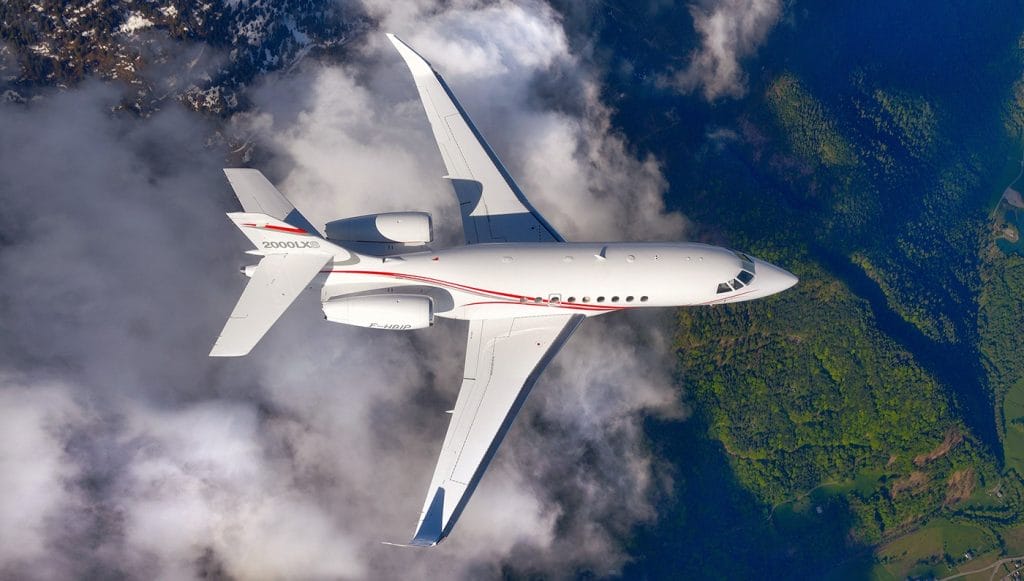
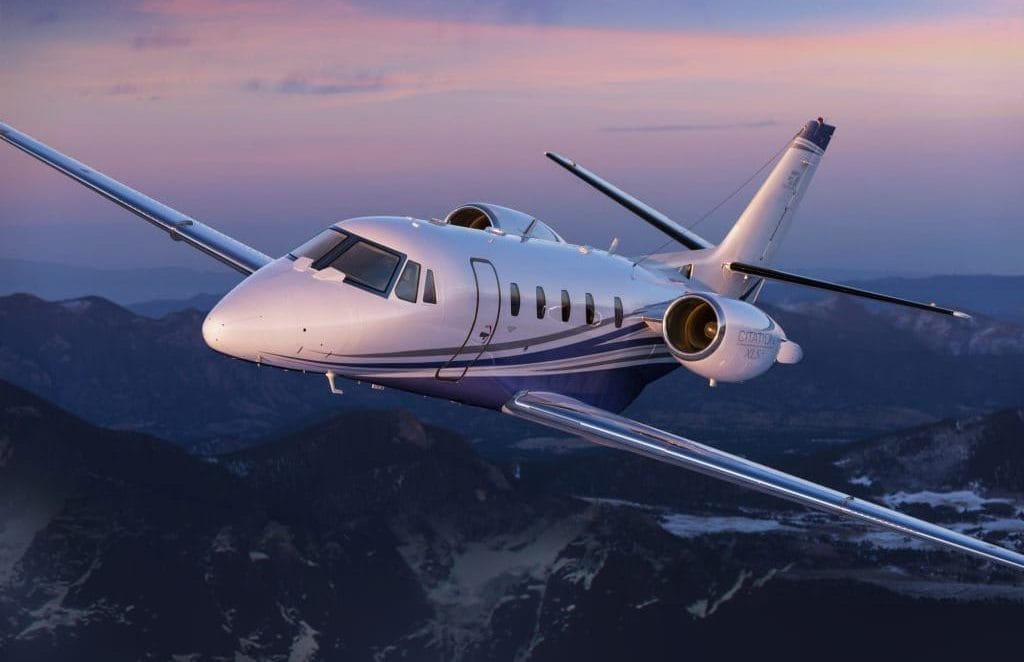
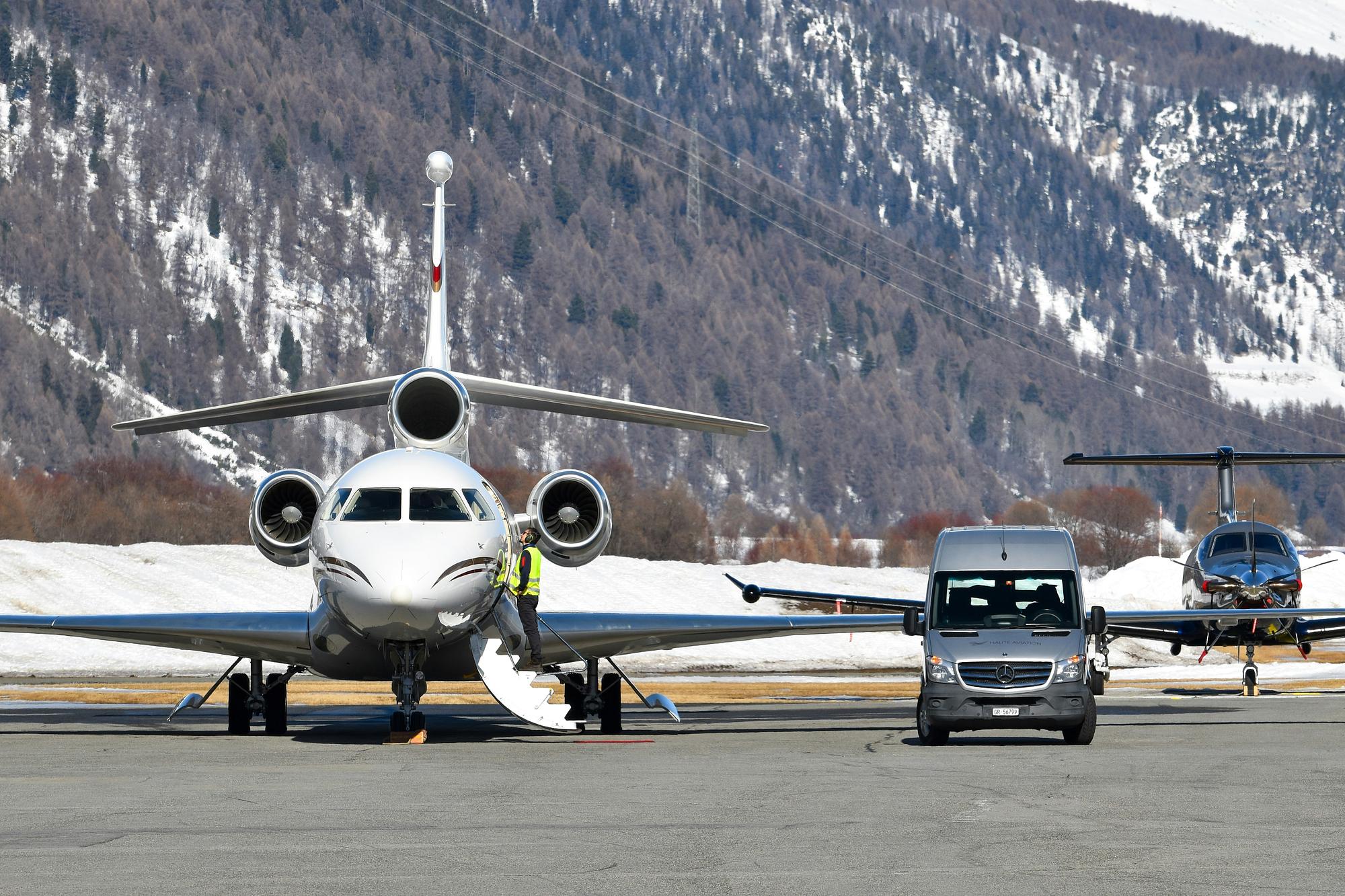
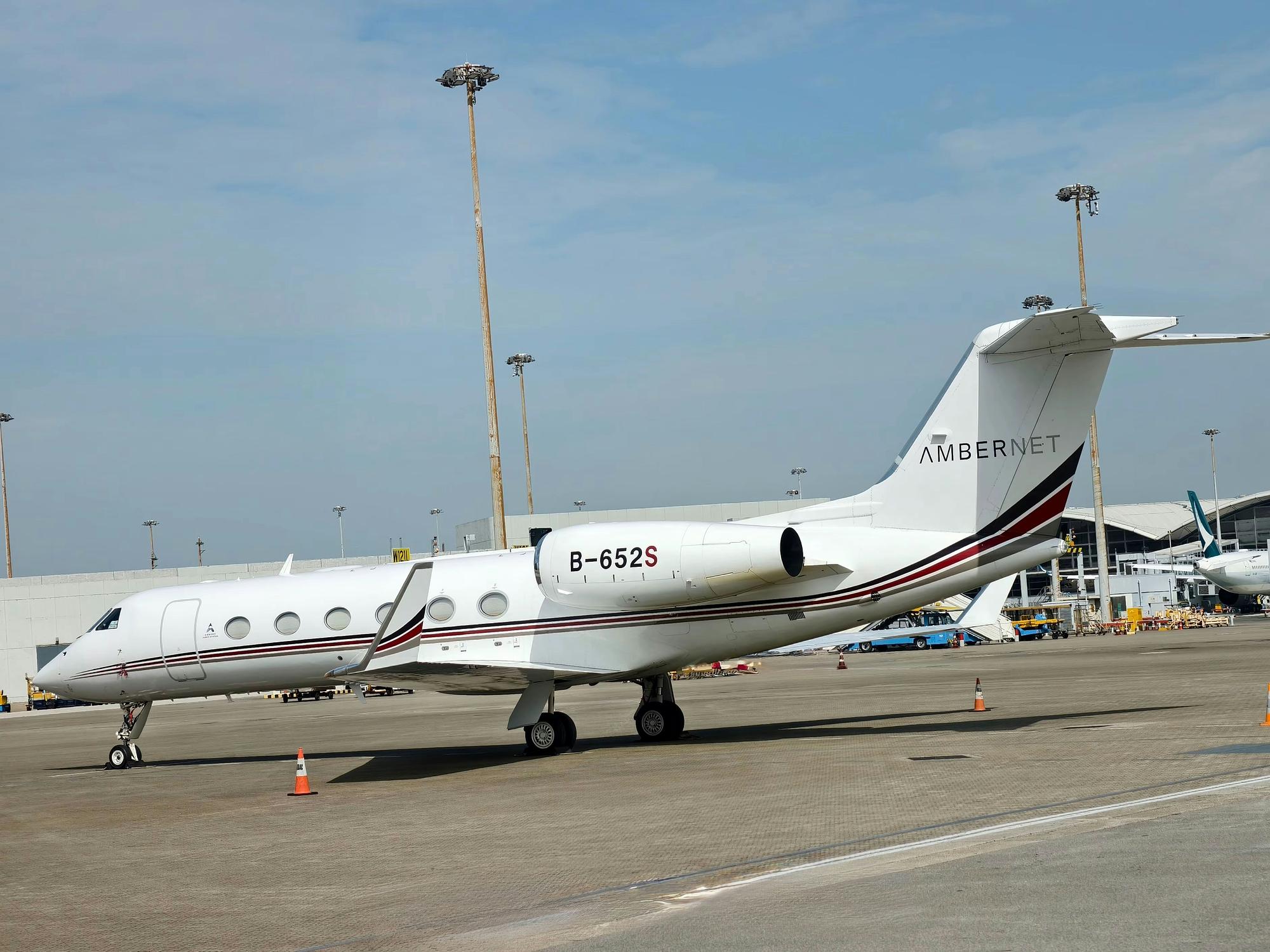
The Dassault Falcon 2000LXS is a super-midsize business jet with a widebody cabin, a range of 4,100 nautical miles, and short-field performance that reaches airports many comparable jets avoid. It carries up to 10 passengers and flies nonstop across the Atlantic. At maximum takeoff weight, the Falcon 2000LXS needs only 4,675 feet of runway.
The Falcon 2000LXS at a Glance
Dassault engineered the Falcon 2000LXS around one goal: transatlantic reach without heavy-jet runway demands. The result is a genuinely versatile aircraft, at home on business travel, family trips, and international missions. Its widebody cross-section gives passengers room to stand, move, and work, while twin engines keep operating economics disciplined.
Dassault introduced the 2000LXS at the 2012 NBAA convention and began deliveries in 2013, according to Dassault Aviation. The variant added more capable engines and full-length inboard leading-edge slats, sharpening both short-field performance and payload. For Private Clients, that pairing translates into access closer to the destination rather than a longer drive from a larger airport.
The mission profile is broad. The Falcon 2000LXS suits corporate travel, family trips with pets, group golf and ski getaways, and international routings without changing aircraft. As flying patterns shift, Private Clients move between On-Demand Charter and a Jet Card through the same relationship, so the aircraft grows with the need rather than forcing a compromise.
The Falcon 2000LXS range of 4,100 nautical miles is the number most Private Clients care about first. It connects city pairs such as New York and London, or Chicago and Rome, without a fuel stop. Normal cruise sits near Mach 0.80, with a maximum of 437 knots, roughly Mach 0.86, when the schedule is tight.
Altitude matters as much as speed. The Falcon 2000LXS climbs to 47,000 feet, above most commercial traffic and weather, which steadies the ride and shortens flight times. Two Pratt & Whitney Canada PW308C engines, each producing about 7,000 pounds of thrust, deliver that performance while holding fuel burn in check.
Short-field capability is where this aircraft separates itself. A takeoff distance of 4,675 feet at maximum weight opens runways that longer-legged jets simply cannot use, so you land nearer your final destination. That is real time saved on the ground, on both ends of the journey.
Inside the Falcon 2000LXS Cabin Interior
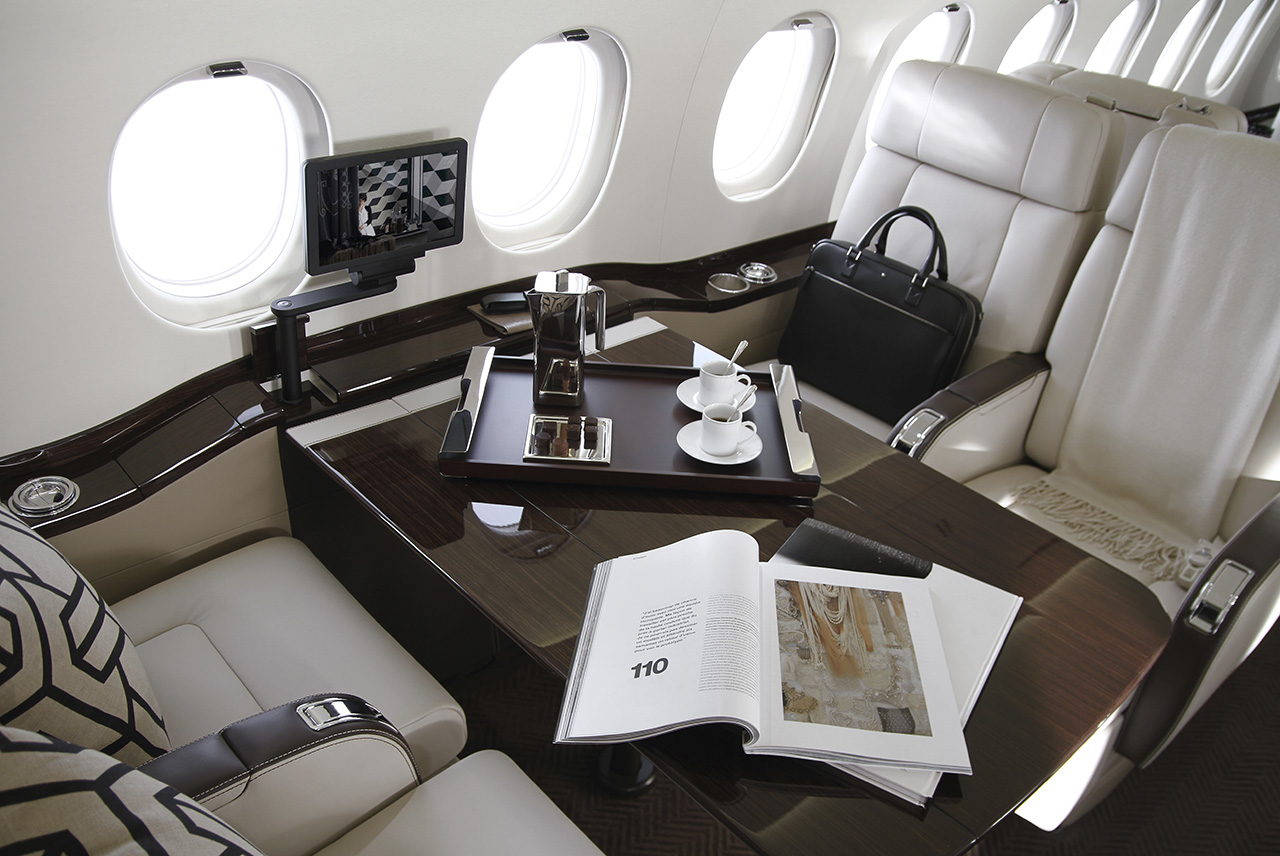
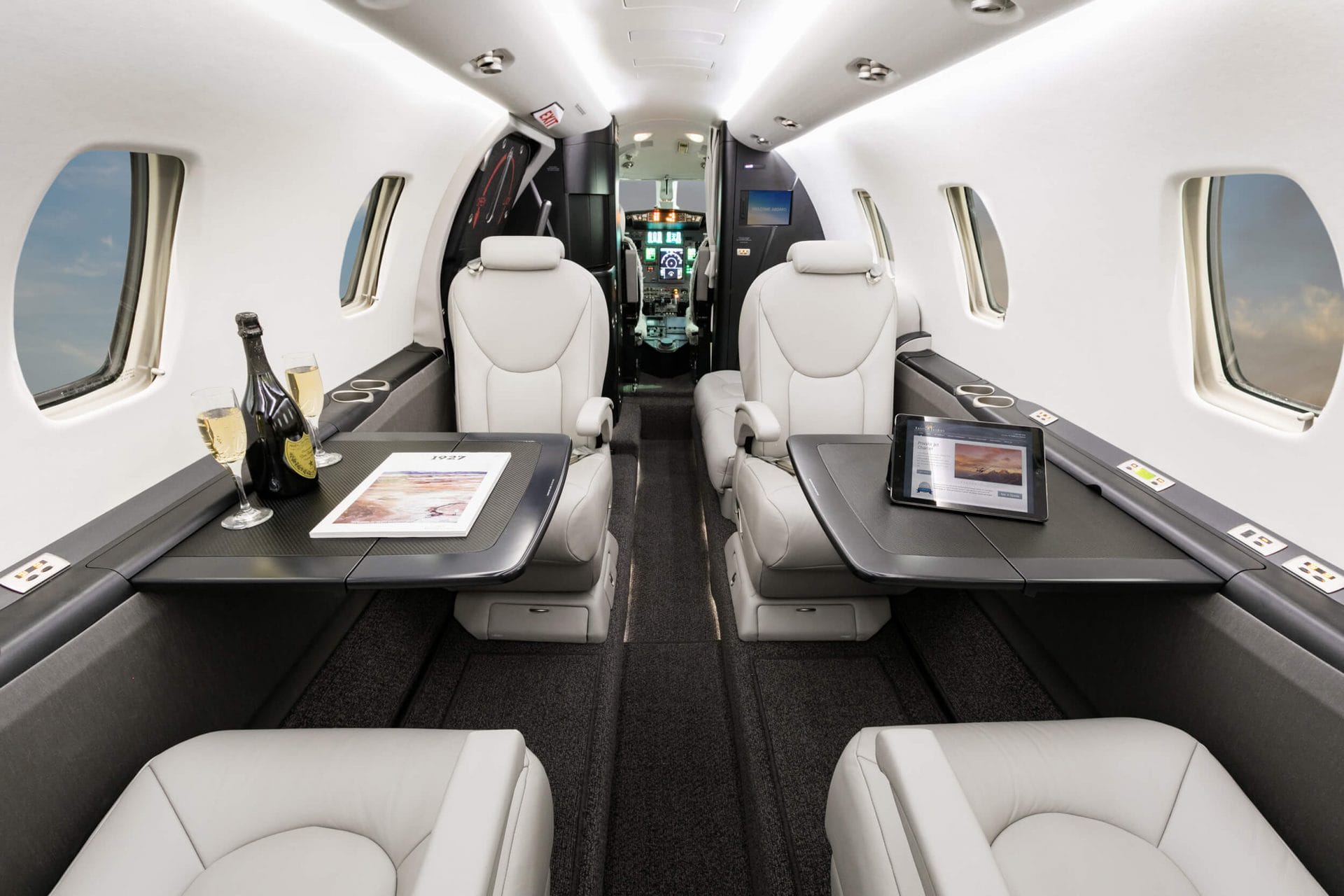
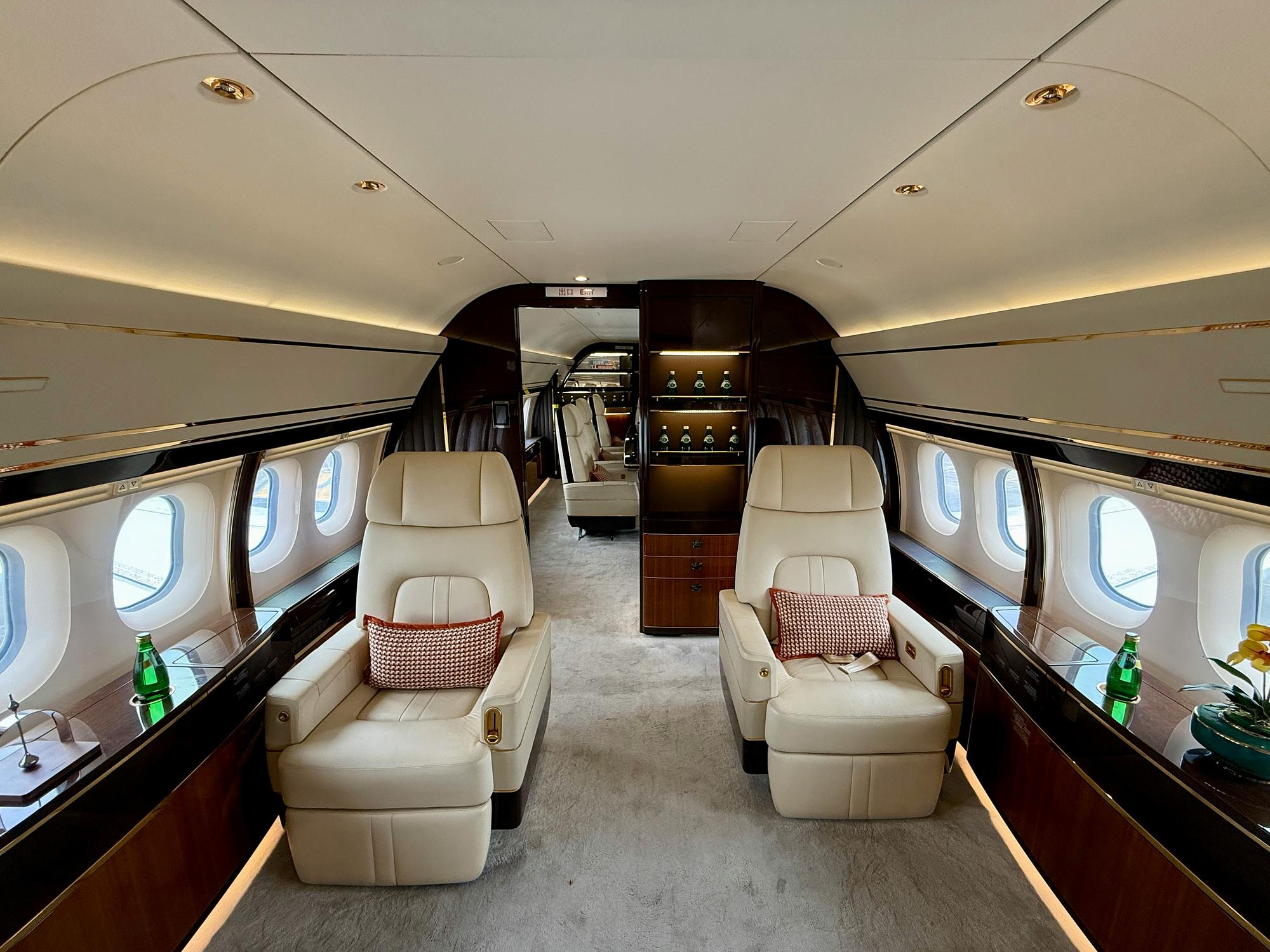
The Falcon 2000LXS interior is built on a true widebody cross-section, rare in this class. The cabin measures 26 feet 2 inches long, 7 feet 7 inches wide, and 6 feet 2 inches high, for 1,028 cubic feet of usable volume. Passengers stand upright and move freely on a flat floor.
Seating configurations carry up to 10 passengers, typically arranged in club groupings that convert for work, conversation, or rest. A pressurization differential of 9.3 psi keeps the cabin altitude low, so you arrive less fatigued after a long leg. Stay productive from wheels-up to touchdown, then step off ready for what follows.
Baggage capacity of 139 cubic feet handles luggage for a full cabin, including golf clubs and ski equipment. On board, a dedicated Client Experience team coordinates catering, ground transportation, and the details that make each journey personal.
Falcon 2000LXS Cockpit and Avionics
The Falcon 2000LXS cockpit is built around the EASy II flight deck, Dassault’s Honeywell Primus Epic-based avionics suite. It consolidates flight, navigation, and systems data into a clear, integrated display that reduces pilot workload and supports precise decision-making. An optional FalconEye Combined Vision System blends synthetic and enhanced imagery for sharper situational awareness in low visibility, as detailed by Dassault Falcon.
Advanced avionics are more than a feature list. They advance the value Magellan Jets leads with: safety. Every aircraft in the Magellan Jets Preferred Network is flown by highly vetted operators, and technology like EASy II supports the disciplined, safety-first operations our Private Clients expect.
Falcon 2000LX vs Falcon 2000LXS
The Falcon 2000LX and Falcon 2000LXS share the same widebody cabin and comparable long-range capability, which is why the two are often confused. The distinction is in performance at the margins. The LXS introduced enhanced Pratt & Whitney Canada PW308C engines and full-length inboard leading-edge slats.
Those slats improve low-speed handling, which shortens takeoff and landing distances and lifts payload flexibility. In practice, the LXS reaches more constrained airports and carries a fuller cabin over demanding legs. For Private Clients choosing between the two, the LXS is the more capable short-field performer.
Frequently Asked Questions About the Dassault Falcon 2000LXS (FAQs):
How Far Can the Falcon 2000LXS Fly Nonstop, and Can It Cross the Atlantic?
Yes. The Falcon 2000LXS has a range of 4,100 nautical miles, enough to fly nonstop across the Atlantic on routes such as New York to London. It comfortably covers transcontinental legs across the United States as well.
What Are the Falcon 2000LXS Specs, Cabin Dimensions, and Passenger Capacity?
The cabin measures 26 feet 2 inches long, 7 feet 7 inches wide, and 6 feet 2 inches high, with 1,028 cubic feet of volume and 139 cubic feet of baggage space. It seats up to 10 passengers. The aircraft cruises at up to 437 knots, climbs to 47,000 feet, and takes off in 4,675 feet at maximum weight.
What Is the Difference Between the Falcon 2000LX and Falcon 2000LXS?
The Falcon 2000LXS added enhanced Pratt & Whitney Canada PW308C engines and full-length inboard leading-edge slats. Those upgrades improve short-field performance and payload compared with the Falcon 2000LX, while the two share a similar cabin and long-range profile.
What Cockpit and Avionics Does the Falcon 2000LXS Use?
The Falcon 2000LXS uses the EASy II flight deck, a Honeywell Primus Epic-based avionics suite. An optional FalconEye Combined Vision System adds blended synthetic and enhanced vision for greater situational awareness in low visibility.
How Much Does It Cost to Charter a Falcon 2000LXS?
Charter estimates for super-midsize aircraft generally run about $10,000 per hour for domestic flying, rising toward roughly $12,700 per hour on international trips. Treat these as estimates only. The rate is inclusive of fuel; it does not include contingencies such as de-icing, positioning, overnight fees, catering, ground transportation, or international fees. Your exact price depends on route, schedule, aircraft, and availability, and a Private Aviation Advisor confirms it at time of quote. You can fly the aircraft through On-Demand Charter or a Jet Card.
Experience the Falcon 2000LXS With Magellan Jets
The Falcon 2000LXS earns its place for a specific traveler: someone who needs transatlantic range, a widebody cabin, and the freedom to use runways a heavy jet cannot. If that describes your next journey, Magellan Jets sources the right Dassault Falcon 2000 for the mission. Magellan Jets coordinates travel with highly vetted, FAA-approved operators and does not own or operate aircraft. Talk to a Private Aviation Advisor to plan your next journey aboard the Falcon 2000LXS.
Magellan Jets does not own or operate aircraft. It coordinates every journey through the Magellan Jets Preferred Network of highly vetted operators, using FAA Part 135, the regulation governing on-demand charter operations, and FAA Part 91K, which governs fractional ownership. That asset-light model means every recommendation is made in your best interest, not to fill a fleet.
Few choices shape a journey more than the aircraft beneath you. The Cessna Citation Latitude and the Cessna Citation Longitude are two of the most requested jets in their classes, and each answers a different ambition. Here is the short version. The citation longitude range reaches 3,500 nm, while the Citation Latitude range covers 2,700 nm. The Latitude is the graceful choice for regional and coast-to-coast flying. The Longitude is the jet you call on when the mission asks for true transcontinental reach, a larger cabin, and more cruise speed.
Both aircraft carry the same quiet confidence that has made the Citation name familiar in private aviation for decades. They share a six-foot flat-floor cabin, the same Garmin G5000 flight deck, and a reputation for reliability that operators trust. Where they part ways is in scale and stamina. Understanding that difference is the difference between a jet that merely fits your calendar and one that expands what your calendar can include.
Citation Latitude Overview (Midsize)
The Cessna Citation Latitude earned its following by making the midsize cabin feel generous. When it entered service in 2015, it introduced a flat floor and a stand-up cabin at a sensible operating cost. That combination put a genuinely comfortable jet within reach of more Private Clients. It is why the Latitude remains a staple across the On-Demand Charter fleet today.
Step aboard and the cabin measures 21 ft 8 in long, 6 ft 4 in wide, and 6 ft 0 in tall, with 587 cu ft of interior volume. It seats up to nine passengers with two crew, and its 127 cu ft baggage hold swallows golf bags, ski gear, and full-length garment bags without negotiation. The Citation Latitude range of 2,700 nm links most major domestic city pairs nonstop, from New York to Los Angeles or Miami to Seattle in favorable conditions.
Under the wing sit two Pratt & Whitney Canada PW306D1 engines producing 5,907 lb of thrust each, pushing a normal cruise of 368 kn up to a ceiling of 45,000 ft. The Citation Latitude wingspan of 72.3 ft gives the aircraft stable, unhurried manners in the air. For a fuller look at the specification sheet, our Citation Latitude aircraft page lays out the details.
What draws Private Clients back to the Latitude is how relaxed the cabin feels for its class. Large oval windows fill the space with natural light, and the seats recline into a genuinely restful position for a midday flight. Picture a design team flying New York to Aspen, or a family repositioning from Boston to Palm Beach. On those missions the aircraft delivers comfort and range in equal measure, without the higher hourly cost of a larger cabin.
Citation Longitude Overview (Super-Midsize)
If the Latitude is about comfortable efficiency, the Citation Longitude is about range and presence. This is the longitude aircraft that stretches the Citation identity into the super-midsize class. It entered service in 2019 as Textron Aviation’s flagship in the segment, and it was built for the traveler whose meetings are separated by continents rather than states.
The headline figure is the citation longitude range of 3,500 nm, roughly 800 nm more than the Latitude. That additional reach changes the map. City pairs that force a fuel stop in a smaller jet open up nonstop, and the cabin that carries you there is larger in every dimension that matters. The Longitude cabin measures 25 ft 2 in long with 755 cu ft of volume, and its 112 cu ft baggage compartment stays accessible in flight.
Two Honeywell HTF7700L engines deliver 7,665 lb of thrust each, lifting the aircraft to a 45,000 ft ceiling at a 449 kn normal cruise. The Citation Longitude wingspan of 68.9 ft is slightly tighter than the Latitude’s, yet the aircraft carries more, flies farther, and moves faster. You can review the full Citation Longitude specs on our Citation Longitude aircraft page.
Presence is the word travelers reach for after their first Longitude flight. The extra cabin length shows in the aisle, the seating, and the sense of space over a five-hour leg. Picture an executive team crossing the country for a morning board meeting, or a family heading west for the holidays. The Longitude turns a long travel day into productive, comfortable time in the air. That is the quiet luxury of the super-midsize class.
Citation Latitude vs. Longitude: Full Specs Comparison Table
The clearest way to read the citation latitude vs longitude question is side by side. The figures below reflect validated manufacturer specifications for each aircraft.
Citation Longitude Range and Performance in the Real World
Range is where the two aircraft separate most decisively, and it deserves an honest read. The citation longitude range of 3,500 nm is real, and it unlocks nonstop city pairs the Latitude simply cannot reach. New York to London sits close to the edge of that book value in still air, which is precisely why nuance matters here. Published range assumes ideal conditions, a light payload, and cooperative winds.
In practice, a headwind across the North Atlantic, a full cabin, or a warm day at altitude will trim usable range. So the candid advisor’s answer is this. The Longitude is an outstanding transcontinental jet for the mainland United States and comfortable regional international flying, and it can cross the Atlantic on favorable eastbound routings from the Northeast. It is not a jet that reaches London from anywhere in the country in any weather, and it is not a mainland-to-Hawaii aircraft. Those missions belong to long-range and ultra-long-range cabins.
The Citation Latitude range of 2,700 nm is best understood as a domestic and near-international tool. It connects the coasts, reaches the Caribbean, and handles most business city pairs without a fuel stop. On speed, the Longitude’s 449 kn normal cruise trims meaningful time off longer legs against the Latitude’s 368 kn, so the farther you fly, the more that difference compounds in hours saved.
Translating those numbers into routes helps. The Latitude comfortably links Chicago to Los Angeles, New York to Denver, or Dallas to the Bahamas nonstop in typical conditions. The Longitude extends that map to legs like Los Angeles to New York against winter headwinds, Seattle to the Northeast, or Teterboro to select European destinations on the right day. When a route sits near the limit of a midsize jet, the Longitude is usually the aircraft that keeps it nonstop.
Cabin, Comfort, and Baggage
Comfort is the quiet reason travelers return to these two jets. Both aircraft carry the same six-foot flat-floor cabin, and that single design decision does more for a long day of travel than any brochure feature. A flat floor means you walk the aisle without stooping or stepping over a dropped center section. That matters as much for a parent with a toddler as it does for an executive stretching between meetings.
That geometry also makes both cabins genuinely accommodating. Families spread out, pet-friendly charters travel easily, and passengers with mobility considerations board and move with dignity. The Latitude’s 587 cu ft feels open for a midsize jet. The Longitude’s 755 cu ft adds real elbow room, wider seating arrangements, and a longer cabin for stand-up movement over multi-hour legs.
Baggage tells its own story. The Latitude offers 127 cu ft of hold, which is generous for its class and ideal for gear-heavy trips. The Longitude carries 112 cu ft, and it keeps that compartment accessible in flight, so a laptop bag or a change of clothes stays within reach at altitude. If you are still weighing which cabin size suits your travel pattern, our guide to choosing the right jet category walks through the trade-offs in plain terms.
The details add up over a full travel day. Both cabins pair natural light from generous windows with quiet acoustics that let a conversation carry without effort. On the Longitude, the added length gives the galley and lavatory more breathing room, which is precisely what you want on the transcontinental legs the aircraft was built to fly. Small margins in space become large margins in comfort the longer you are aboard.
Avionics and Flight Deck
Confidence in a private jet starts in the cockpit, and here the two aircraft speak the same language. Both the Citation Latitude and the Citation Longitude fly behind the Garmin G5000 flight deck, an integrated avionics suite built around large high-resolution touchscreen controllers.
For Private Clients, the practical benefit is consistency. Crews trained across the Citation family work within a familiar interface, which supports precise flight planning, clear situational awareness, and smooth handling in busy airspace. The shared platform is one reason both aircraft hold such a steady reputation among the vetted operators in the Magellan Jets Preferred Network.
That reliability carries real weight for a traveler. A modern, integrated flight deck supports smoother descents into weather, more accurate arrival timing, and fewer surprises on the days when airspace is crowded. The technology stays in the background where it belongs, and the result is a calm, predictable flight from taxi to touchdown. For anyone comparing the citation latitude vs longitude on merit, the shared avionics remove one variable from the decision entirely.
Chartering a Citation Latitude or Longitude
Access to these aircraft does not require ownership, and that is the point. Magellan Jets is a private aviation solutions provider. We do not own or operate aircraft. Instead, we source each flight through the Magellan Jets Preferred Network of fewer than 100 vetted operators. This asset-light model matches the right tail to your mission rather than pushing you toward a single fleet.
Charter pricing is quoted by category. As an estimate, a Citation Latitude in the Mid Jet category runs about $8,550/hr, while a Citation Longitude in the Super-Midsize category runs about $9,816/hr. This is an estimated hourly rate for Mid Jet and Super-Midsize charter, inclusive of fuel. It does not include contingencies such as de-icing, positioning, overnight fees, or other trip-specific costs. Final pricing is confirmed at time of quote.
How you access those hours is a separate and worthwhile question. On-Demand Charter suits travelers with variable schedules who want to select the aircraft trip by trip. A Jet Card suits those who fly often enough to value fixed rates and guaranteed availability. An advisor can map your flying pattern to the option that fits, whether that means the Latitude, the Longitude, or a mix across the year.
The asset-light model matters more than it first appears. Because Magellan does not own or operate aircraft, an advisor has no incentive to steer you toward a fleet that must be kept flying. Every recommendation follows your mission, and every operator in the Preferred Network is vetted before a Client ever steps aboard. That independence is the difference between being sold an aircraft and being matched to the right one.
Which Citation Fits Your Mission
The right aircraft follows the way you actually travel. Start with your typical routes, your usual party size, and how much of your flying crosses the country versus staying regional. From there, the choice tends to make itself.
Choose the Citation Latitude if most of your flying is regional or coast-to-coast, your group runs small to medium, and efficiency drives the decision. It carries up to nine passengers in a comfortable midsize cabin. It also holds the most baggage of the pair, and covers 2,700 nm nonstop. For a golf foursome heading to Scottsdale or a family run to the Caribbean, the Latitude is an elegant, sensible answer.
Choose the Citation Longitude when reach and cabin size lead. The 3,500 nm range, the larger 755 cu ft cabin, and the faster 449 kn cruise make it the stronger companion for coast-to-coast red-eyes, transcontinental business travel, and select international legs. Executives running full cross-country schedules, or groups that want room to work and rest on longer flights, will feel the Longitude’s advantages most on the routes that stretch a smaller jet.
Many Private Clients ultimately use both, and there is wisdom in that. The Latitude handles the frequent regional trips where its efficiency shines, and the Longitude steps in for the long-haul days that demand more range and room. An advisor can build a travel plan that draws on each aircraft as the calendar requires. You always fly the jet the mission actually calls for, rather than the one you happen to own.
Frequently Asked Questions About the Citation Latitude and Longitude (FAQs):
Can a Citation Longitude Fly Across the Atlantic?
In the right conditions, yes. The Citation Longitude’s 3,500 nm range supports transatlantic flying on favorable eastbound routings, such as the Northeast United States to parts of Western Europe. It is not a jet that guarantees a nonstop from any U.S. city to London in any weather, so route planning and winds decide each trip.
Can a Citation Longitude Fly to Hawaii?
Not reliably from the mainland. The overwater distance from the West Coast to Hawaii pushes past the practical limit of a 3,500 nm jet once winds and reserves are factored in. That mission is better suited to a long-range or ultra-long-range aircraft, which an advisor can source for you.
What Is the Range of the Citation Longitude, and How Does It Compare to the Latitude?
The Citation Longitude range is 3,500 nm, while the Citation Latitude range is 2,700 nm. That is roughly 800 nm of additional reach, which translates to more nonstop city pairs and fewer fuel stops on long legs. Both figures assume favorable conditions, so real-world range varies with payload and winds.
What Is the Difference Between the Citation Latitude and Longitude?
The Latitude is a midsize jet, and the Longitude is a super-midsize jet. The Longitude flies farther at 3,500 nm versus 2,700 nm. It also cruises faster at 449 kn versus 368 kn. The Longitude offers a larger 755 cu ft cabin against the Latitude’s 587 cu ft. The Latitude counters with a slightly larger 127 cu ft baggage hold and lower operating costs.
How Many Passengers Does Each Seat?
Both the Citation Latitude and the Citation Longitude seat up to nine passengers with two crew. Typical charter configurations arrange those seats differently, but the certified capacity is the same for both aircraft.
Which Is Better for Cross-Country vs. Transcontinental Business Travel?
For coast-to-coast domestic flying, both aircraft perform well, and the Latitude is the efficient pick. For demanding transcontinental schedules, especially red-eyes and legs near the edge of range, the Longitude’s added speed, range, and cabin size make it the stronger choice.
Do Both Use the Same Cockpit Technology?
Yes. Both aircraft fly behind the Garmin G5000 integrated avionics suite, with touchscreen controllers and modern flight-planning tools. That shared platform supports crew familiarity and consistent handling across the Citation family.
Your Next Flight Starts With a Conversation
The Latitude and the Longitude are both great private jet options. The better one depends entirely on your routes, your people, and your ambitions. That is a conversation worth having with someone who flies these decisions every day. Talk to a Private Aviation Advisor and let us match the right Citation to your next mission.
Two of the most-requested private jets sit just one cabin class apart. The Phenom 300 vs. Citation Excel decision comes down to a single question: which aircraft matches the mission in front of you. One is a light jet that out-ranges its class, and the other is a midsize jet built for more people and more room. This guide reads the validated numbers so you can choose with confidence.
Two Jets, Two Missions: How the Phenom 300 and Citation Excel Differ
The Phenom 300 is a light jet, and the Citation Excel/XLS is a midsize jet. That single class difference shapes range, cabin size, passenger capacity, cruise speed, and hourly cost. A light jet is built for efficient regional and coast-to-coast trips with a compact cabin.
A midsize jet gives up a little airport access in exchange for more room and more seats. Neither aircraft is better in the abstract. The right answer depends on the mission you fly most often.
Phenom 300 vs. Citation Excel: Specifications Side by Side
The table below sets the two jets against each other on the numbers Private Clients ask about most, drawn from Magellan Jets Aircraft Specifications.
Charter rates are estimates inclusive of fuel and exclude contingencies such as de-icing, positioning, overnight fees, catering, and ground transportation, with final pricing confirmed at time of quote.
Range and Runway: Where the Phenom 300 Punches Above Its Class
Here the lighter aircraft surprises people. The Phenom 300 flies up to 2,019 nm, farther than the Citation Excel/XLS at 1,989 nm. For an East Coast Private Client, that range reaches most transcontinental city pairs nonstop.
The Phenom 300 also needs less runway. Its FAA takeoff field length is 2,220 ft, against 2,739 ft for the Citation Excel/XLS (Magellan Jets Aircraft Specifications). Shorter field performance opens airports closer to your destination, such as Teterboro Airport (KTEB) outside New York or Hanscom Field (KBED) near Boston.
The Phenom 300 series is the world’s best-selling light jet for the 14th consecutive year. That ranking is based on 2025 delivery data. The record translates into broad availability and a deep operator base across charter fleets.
Cabin, Capacity, and Comfort: The Citation Excel’s Advantage
The Citation Excel/XLS answers with space. Its cabin stands 5 ft 7 in tall, against 4 ft 9 in in the Phenom 300 (Magellan Jets Aircraft Specifications). That taller ceiling lets most passengers stand and move freely.
Cabin volume tells the same story: 422 cu ft in the Citation Excel/XLS versus 324 cu ft in the Phenom 300. The midsize jet seats up to eight passengers, two more than the Phenom’s six. It carries 90 cu ft of baggage against 85 cu ft.
Even so, the Phenom 300 holds the largest baggage capacity in the light-jet class. The Citation Excel/XLS belongs to the Cessna Citation line, the world’s most-delivered series of business jets, prized for reliability and short-field performance. For a Private Client flying with family or a full team, that room earns its keep.
Speed and Ceiling: Reading the Real Numbers
Speed favors the midsize jet. The Citation Excel/XLS holds a normal cruise of 433 kn, faster than the Phenom 300 at 383 kn. On a long transcontinental leg, that 50 kn edge trims time from the schedule.
Both jets share the same service ceiling of 45,000 ft. Flying that high lets crews climb above most weather and commercial traffic. That supports smoother, more direct routing on either aircraft.
What It Costs to Charter Each Jet
Light jet charter for the Phenom 300 starts from an estimated $7,544 per hour. Midsize jet charter for the Citation Excel/XLS starts from an estimated $8,550 per hour. Each rate is inclusive of fuel.
These estimates exclude contingencies such as de-icing, positioning, overnight fees, catering, and ground transportation, with final pricing confirmed at time of quote. The higher midsize rate reflects the larger cabin, greater capacity, and faster cruise. Whether that premium is worth it depends on your passenger count and route.
The Detail Most Comparisons Miss: You Don’t Have to Choose
The Phenom 300 vs. Citation Excel comparison usually ends with “it depends on your trip.” The more useful insight is that you do not have to fly the same jet every time. Magellan Jets is an asset-light private aviation solutions provider offering Jet Cards, On-Demand Charter, Fractional Ownership, and Aircraft Sales & Management.
Because it owns no fleet, Magellan Jets sources each mission from the Magellan Jets Preferred Network of fewer than 100 vetted operators. Every recommendation serves the Private Client’s interest.
The Premium Jet Card gives a Private Client a dedicated Phenom 300. Its callout window, the minimum notice before a flight, runs as low as 24 hours, with de-icing and catering included.
The Jet Card program also offers the Category Jet Card. It lets a Private Client interchange across Light, Midsize, Super-Mid, and Heavy jets as the mission changes.
Safety underwrites every option. Magellan Jets holds WYVERN Wingman certification, a third-party aviation safety designation, and sits on the Air Charter Safety Foundation (ACSF) Board. Its operators carry $100 million to $300 million in liability insurance, and its captains average 9,700+ flight hours.
The Phenom 300 and Citation Excel/XLS are not rivals so much as two answers to two missions. Choose the Phenom 300 when range and airport access lead. Choose the Citation Excel/XLS when cabin room, capacity, and speed matter most.
The sharper decision is often the program, not the airframe, since the right provider puts either jet within reach. To fly the right one on any given day, Contact a Private Aviation Advisor.
Frequently Asked Questions About the Phenom 300 vs. Citation Excel
Which jet has more range, the Phenom 300 or the Citation Excel?
The Phenom 300 flies up to 2,019 nm, slightly farther than the Citation Excel/XLS at 1,989 nm (Magellan Jets Aircraft Specifications). For most regional and transcontinental trips, both aircraft cover the distance nonstop.
Which cabin is larger?
The Citation Excel/XLS has the larger cabin. It offers 422 cu ft of volume and stands 5 ft 7 in tall (Magellan Jets Aircraft Specifications). The Phenom 300 offers 324 cu ft and stands 4 ft 9 in. The Citation Excel/XLS also seats up to eight passengers rather than six.
Is the Phenom 300 or the Citation Excel faster?
The Citation Excel/XLS cruises faster, at a normal cruise of 433 kn compared with 383 kn for the Phenom 300 (Magellan Jets Aircraft Specifications). Both jets share a service ceiling of 45,000 ft.
Which jet can use smaller airports?
The Phenom 300 can access more small airports. It needs an FAA takeoff field length of 2,220 ft, shorter than the 2,739 ft the Citation Excel/XLS requires (Magellan Jets Aircraft Specifications). That opens more runways close to your destination.
How much does it cost to charter each jet?
Light jet charter for the Phenom 300 starts from an estimated $7,544 per hour. Midsize jet charter for the Citation Excel/XLS starts from an estimated $8,550 per hour, inclusive of fuel. Both estimates exclude contingencies such as de-icing, positioning, and catering, with final pricing confirmed at time of quote.
The Cessna Citation Sovereign is a midsize business jet that delivers transcontinental range, a stand-up cabin, and genuine short-field capability in a single airframe. For Private Clients who need to connect the coasts nonstop (Boston to Los Angeles, New York to Seattle) while traveling with up to eight passengers and luggage for a week, the Sovereign remains one of the most practical aircraft in its category.
What Makes the Citation Sovereign a Private Aviation Staple
The Citation Sovereign (Model 680) is an American business jet developed by Cessna as part of the Citation family. It first flew in 2002 and earned FAA certification in 2004. Cessna produced the original Sovereign from 2004 through 2013, when the upgraded Sovereign+ succeeded it.
Where many midsize jets force a tradeoff between cabin space and range, the Sovereign sidesteps the compromise. Its 3,010-nautical-mile range covers virtually any domestic routing, and the cabin volume – 571 cubic feet – provides enough room for productive work or genuine rest over a five-hour flight. Baggage capacity of 135 cubic feet means golf clubs, skis, or luggage for an extended trip fit without concern.
The aircraft appeals to executives, families, and groups traveling with pets or gear. Its short-field performance opens access to smaller regional airports, reducing ground time and extending where private aviation can realistically take you.
Cabin and Comfort: Room to Work and Rest
The Sovereign’s cabin measures 25 feet 3 inches long, 5 feet 7 inches high, and 5 feet 5 inches wide. Most configurations seat up to eight passengers in a double-club arrangement, with four forward-facing seats and four aft-facing seats that can swivel to create workspaces or conversation areas.
Standing headroom distinguishes the Sovereign from smaller light jets. Passengers move freely through the cabin without ducking, and the extra vertical space reduces the fatigue that accumulates on longer flights. The 135 cubic feet of baggage capacity is among the most generous in the midsize category. This is enough for extended trips or bulky equipment.
For families traveling with small pets, the Sovereign’s cabin proportions and pressurized baggage compartment provide flexibility that tighter light jets cannot match.
Citation Sovereign Performance and Range
The Sovereign cruises at 459 knots with a maximum range of 3,010 nautical miles – enough to fly New York to Los Angeles, Chicago to Anchorage, or Miami to Seattle nonstop. Two Pratt & Whitney Canada PW306C turbofans, each producing roughly 5,770 pounds of thrust, deliver reliable power across a wide envelope of altitudes and temperatures.
Service ceiling reaches 47,000 feet, allowing the aircraft to climb above weather and most commercial traffic for a smoother, more fuel-efficient cruise.
What sets the Sovereign apart operationally is its short-field capability. Takeoff field length of approximately 3,640 feet grants access to regional airports that larger jets cannot use. For Private Clients who need to reach destinations like Aspen, Nantucket, or Teterboro without repositioning to a larger hub, this performance opens meaningful flexibility.
Citation Sovereign Specs at a Glance:
The Flight Deck: Precision for Professional Crews
Pilots value the Sovereign for its well-integrated cockpit and manageable workload. The original aircraft featured the Honeywell Primus Epic avionics suite, which combined flight management, navigation, and engine data on four large-format displays.
With the Sovereign+ upgrade in 2013, Cessna introduced the Garmin G5000 avionics suite – a touchscreen-based system that simplified workflows and reduced pilot fatigue on long missions. The G5000 brought synthetic vision, advanced weather radar integration, and enhanced situational awareness to an already capable platform.
For charter operations, a well-equipped cockpit translates to safer, more predictable flights. Crews familiar with the Sovereign appreciate its straightforward handling characteristics and the redundancy built into its systems.
Citation Sovereign vs. Sovereign+: Key Differences
The Citation Sovereign+ arrived in 2013 as a refined evolution of the original. Winglets improved aerodynamic efficiency, extending range to approximately 3,163 nautical miles – an additional 150 miles over the standard Sovereign. The Garmin G5000 avionics replaced the Honeywell Primus Epic, modernizing the flight deck.
Performance differences are incremental rather than transformative. The Sovereign+ climbs faster and burns slightly less fuel at altitude, but both variants share the same cabin dimensions, seating capacity, and short-field capability. For most charter missions, either aircraft delivers comparable comfort and utility.
Citation Sovereign vs. Citation X
Private Clients sometimes compare the Sovereign to the Citation X, Cessna’s high-speed flagship. The X is faster – it ranks among the fastest civilian jets ever built – but the tradeoff is a narrower cabin and less baggage space.
The Sovereign offers a more comfortable midsize cabin with cross-country range and superior baggage capacity. For travelers prioritizing cabin comfort, room for gear, or the ability to bring a smaller pet, the Sovereign is often the more practical choice. It is also a more cost-effective transcontinental option when speed is not the primary concern.
Chartering a Citation Sovereign With Magellan Jets
Magellan Jets sources Citation Sovereign aircraft through its Preferred Network, an exclusive group of fewer than 100 rigorously vetted operators. Every operator in the network carries liability insurance of $100 million to $300 million, meets WYVERN Wingman certification standards, and undergoes continuous safety audits.
For Private Clients who fly occasionally, On-Demand Charter provides access to the Sovereign without a long-term commitment. Those who fly more frequently may find a Jet Card offers predictable pricing and guaranteed availability.
The estimated hourly rate for midsize charter is approximately $8,550. This is an estimated hourly rate for midsize charter, inclusive of fuel. It does not include contingencies such as de-icing, positioning, overnight fees, or other trip-specific costs. Final pricing is confirmed at time of quote.
Because Magellan Jets operates an asset-light model, Private Clients receive recommendations based on their needs, not on fleet utilization pressures. A Private Aviation Advisor can help determine whether the Sovereign, Sovereign+, or another midsize aircraft is the right fit for a specific mission.
Frequently Asked Questions About the Citation Sovereign (FAQs):
How many passengers can the Citation Sovereign seat?
The Citation Sovereign seats up to eight passengers in a typical double-club configuration. Four seats face forward and four face aft, with swivel capability to create workspaces or conversation areas.
What is the range of a Citation Sovereign?
The Citation Sovereign has a range of 3,010 nautical miles. This covers most domestic U.S. routings nonstop, including transcontinental flights like New York to Los Angeles or Boston to Seattle.
How much does it cost to charter a Citation Sovereign?
Magellan Jets estimates the hourly rate for midsize charter at approximately $8,550, inclusive of fuel. This does not include contingencies such as de-icing, positioning, overnight fees, or other trip-specific costs. Final pricing is confirmed at time of quote.
What is the difference between the Citation Sovereign and the Sovereign+?
The Citation Sovereign+ adds winglets for improved aerodynamic efficiency, extending range to approximately 3,163 nautical miles. It also replaces the original Honeywell Primus Epic avionics with the Garmin G5000 touchscreen suite. Cabin dimensions and seating capacity remain the same.
What airports can the Citation Sovereign access?
With a takeoff field length of approximately 3,640 feet, the Citation Sovereign can operate from shorter runways that larger jets cannot use. This opens access to regional airports like Aspen, Nantucket, Teterboro, and hundreds of smaller fields across the country.
How does the Citation Sovereign compare to the Citation X?
The Citation X is faster but has a narrower cabin and less baggage capacity. The Citation Sovereign offers a more comfortable midsize cabin with cross-country range, superior baggage space (135 cubic feet), and better short-field performance. It is also a more cost-effective transcontinental option for travelers who prioritize comfort over speed.
Book Your Next Mission with Magellan Jets
The Citation Sovereign has earned its place as a midsize workhorse for good reason. Cross-country range, a stand-up cabin, generous baggage capacity, and access to smaller airports combine in an aircraft that handles the demands of serious travelers. Whether the mission is a multi-day business trip, a family ski vacation, or a quiet weekend getaway, the Sovereign delivers without compromise.
Talk to a Private Aviation Advisor to discuss how the Citation Sovereign fits your travel profile, and to receive a quote tailored to your specific journey.
The Cessna Citation X is a super-midsize business jet built for travelers who measure time in minutes, not miles. Cruising at up to Mach 0.935, the Citation X and its successor, the Citation X+, held the title of the world’s fastest certified civilian aircraft from 2014 until December 2025. With a range exceeding 3,100 nautical miles, a service ceiling of 51,000 feet, and seating for up to eight passengers in executive configuration, the Citation X remains one of the most capable transcontinental business jets ever produced. Cessna manufactured the aircraft from 1996 through 2018, delivering approximately 339 airframes to owners worldwide.
For Private Clients who need to cross the country in a single morning or reach a meeting on the opposite coast before dinner, the Citation X offers something rare: speed without compromise. This is the aircraft that set coast-to-coast records, introduced Rolls-Royce power to the Cessna lineup, and pioneered avionics that would shape business aviation for a generation. Here’s what most travelers don’t know about it.
1. The Citation X Held the Civilian Speed Record for Over a Decade
Speed is the Citation X’s defining characteristic. From 2014 until 2025, the Citation X+ was the fastest certified civilian aircraft in the world, cruising at a maximum operating Mach number of 0.935 – roughly 717 mph. That record stood for more than a decade until Bombardier’s Global 8000, certified at Mach 0.95, entered service in December 2025.
The numbers translate directly into time saved. On a cross-country flight from Los Angeles to New York, the Citation X can complete the journey in approximately four hours and 15 minutes under typical conditions – shaving 45 minutes to an hour off what comparable super-midsize jets require. That margin means arriving in time for a morning meeting that otherwise would have demanded an overnight stay.
Cessna proved the aircraft’s speed in October 2014, when a Citation X+ set an official National Aeronautic Association record flying from Seattle to Miami – a distance of 2,375 nautical miles – in four hours and 52 minutes. The jet maintained an average speed of Mach 0.916 across the two-day record attempt. For travelers comparing transcontinental options, the Citation X remains the benchmark for how quickly a super-midsize cabin can move.
2. It Was the First Cessna Powered by Rolls-Royce Engines
When Cessna engineers designed the Citation X in the early 1990s, they faced a fundamental challenge: producing enough thrust to sustain near-supersonic cruise speeds while maintaining the fuel efficiency a business jet requires. The solution marked a departure from company tradition.
The Citation X became the first Cessna aircraft to carry Rolls-Royce engines – specifically, the AE 3007C series turbofans. Each engine produces between 6,442 and 6,764 pounds of thrust on the original Citation X, depending on the production sub-variant (AE 3007C or AE 3007C1). The updated Citation X+ upgraded to the AE 3007C2 variant with full-authority digital engine control (FADEC), delivering 7,034 pounds of thrust per engine and improving both performance and fuel efficiency.
This powerplant choice gave the Citation X its signature capability. The Rolls-Royce engines provide the sustained thrust needed to cruise at Mach 0.92 while burning fuel at rates competitive with slower aircraft in the category. For operators, that combination means fewer fuel stops and more direct routings on long-range missions.
3. The Citation X Cockpit Evolved Dramatically From 1996 to 2018
Aviation technology advanced considerably during the Citation X’s 22-year production run, and the cockpit tells that story clearly. Understanding the difference matters when chartering, as flight deck capabilities affect everything from weather routing to operational flexibility.
The original Citation X, produced from 1996 through 2013, featured the Honeywell Primus 2000 integrated avionics suite. The flight deck displayed information across five 7-by-8-inch CRT screens – state-of-the-art for its era but a generation behind current glass cockpit technology. The system delivered reliable performance and remains fully capable for domestic operations.
When Cessna introduced the Citation X+ in 2014, the cockpit transformation was substantial. The upgraded aircraft replaced the Primus 2000 with the Garmin G5000 avionics suite, featuring three 14-inch widescreen displays and four touchscreen controllers. The G5000 provides synthetic vision, georeferenced charts, and advanced weather integration that pilots consistently praise for reducing workload during complex approaches.
Both versions remain in active charter service. Private Clients who prioritize the latest avionics technology can request a Citation X+ specifically. Those focused purely on speed and cabin experience will find either variant delivers the aircraft’s core value proposition.
4. The Citation X Arrived with a Famous First Owner
When Cessna delivered the first production Citation X in July 1996, the buyer wasn’t a Fortune 500 corporation. It was Arnold Palmer.
The legendary golfer had been a Cessna customer for decades, and taking delivery of the inaugural Citation X continued that relationship at its highest level. Palmer’s endorsement carried weight in the aviation community, signaling that the aircraft’s performance claims were more than marketing – they represented genuine capability that one of the sport’s most discerning travelers chose for his own missions.
The aircraft had flown for the first time in December 1993, with FAA type certification following in June 1996. Palmer’s delivery marked the beginning of a 22-year production run that would see approximately 339 Citation X and X+ aircraft enter service worldwide.
5. You Can Still Charter a Citation X Despite Production Ending in 2018
Cessna ended Citation X production in 2018, but the aircraft remains readily available for charter. The 339 aircraft built continue to serve owners and operators, with many maintained to exacting standards and configured for charter service.
Why did production end? Market dynamics shifted. Customers increasingly sought larger cabins, and Cessna’s development resources moved toward the Citation Longitude, which offers more interior space at the expense of top-end speed. The Citation X’s niche – maximum velocity in a super-midsize package – narrowed as travel patterns evolved.
For Private Clients who value speed above all, the Citation X’s availability through charter represents an opportunity. Through Magellan Jets’ access to the Preferred Network of vetted operators, Citation X aircraft can be sourced for missions where the aircraft’s specific capabilities apply – transcontinental business travel, time-sensitive journeys, or simply the experience of flying one of aviation’s most distinctive designs.
Citation X Interior: Cabin Comfort at 51,000 Feet
Step aboard a Citation X and the cabin immediately signals that speed hasn’t come at the expense of comfort. The interior measures 23 feet 8 inches long, 5 feet 7 inches wide, and 5 feet 5 inches tall – dimensions that allow most passengers to stand upright and move freely through the aisle.
The standard executive configuration seats eight passengers in a club arrangement: four forward-facing seats paired with four rear-facing seats, creating two natural conversation areas. The layout works particularly well for small teams traveling together, with facing seats enabling productive discussions throughout the flight. Certified capacity extends to 12 passengers in certain configurations, though most charter operations optimize for the eight-seat arrangement that balances comfort with capability.
Total cabin volume reaches 538 cubic feet in the original Citation X and 593 cubic feet in the Citation X+, both figures generous for the super-midsize category. The external baggage compartment provides 82 cubic feet of storage – enough for golf bags, skis, or the luggage a family of four needs for an extended trip.
At the rear of the cabin, a fully enclosed lavatory provides privacy on longer missions. In-flight connectivity, entertainment systems, and catering vary by operator and specific aircraft. Magellan Jets’ Client Experience team coordinates these details before departure, ensuring the cabin is configured precisely for each journey.
Cabin Comfort Across Missions
The Citation X interior proves most valuable on transcontinental flights, where passengers spend four to five hours aboard. The cabin altitude – lower than commercial aircraft due to the 51,000-foot service ceiling – reduces fatigue, and the smooth ride above most weather systems makes the time genuinely productive.
For Private Clients flying coast-to-coast regularly, the Citation X cabin offers a meaningful advantage. Work continues uninterrupted. Rest comes easier. And arrival feels more like the start of a day than recovery from travel.
Citation X Range and Mission Capability
Understanding the Citation X’s range puts its capabilities in practical context. The original Citation X reaches up to 3,125 nautical miles under optimal conditions. The Citation X+ extends that figure to approximately 3,400 nautical miles.
These numbers translate into specific real-world routings. The Citation X handles any domestic U.S. mission nonstop, including transcontinental routes like New York to Los Angeles or Boston to Seattle. It reaches Hawaii from the West Coast, the Caribbean from the Eastern Seaboard, and most Canadian and Mexican destinations from virtually any U.S. departure point.
However, the Citation X is not a transatlantic aircraft. The distance from New York to London exceeds 3,000 nautical miles before accounting for winds and reserves, placing true transatlantic capability beyond the aircraft’s range envelope. Private Clients with international charter requirements spanning oceans typically choose heavy jets or ultra-long-range aircraft for those specific missions.
The 51,000-foot service ceiling merits attention here. Flying above most commercial traffic and weather systems, the Citation X operates in cleaner air with more direct routing options. That altitude capability contributes to both the speed advantage and the smooth, quiet ride passengers experience aboard.
How the Citation X Compares to Other Super-Midsize Jets
Selecting the right aircraft for a mission involves balancing speed, cabin space, range, and economics. The Citation X occupies a specific position in the super-midsize category that suits certain travel patterns better than others.
Citation X vs. Citation Sovereign
The Citation Sovereign offers a compelling counterpoint within Cessna’s own lineup. The Sovereign provides a larger cabin – wider, taller, and configured for up to 12 passengers – along with greater baggage capacity. These advantages make it preferable for larger groups or missions where cabin comfort outweighs time savings.
The trade-off is speed. The Sovereign cruises at approximately 460 knots compared to the Citation X’s 525+ knots. On a coast-to-coast flight, that difference adds roughly 30 to 45 minutes to travel time. For Private Clients traveling alone or in small groups where every minute matters, the Citation X wins. For those prioritizing space or traveling with more than six people, the Sovereign deserves consideration.
Citation X in the Broader Super-Midsize Field
Against competitors like the Bombardier Challenger 350 or Gulfstream G280, the Citation X’s speed advantage remains its calling card. No other aircraft in the category approaches its maximum cruise Mach number. The trade-off involves cabin width – some competitors offer slightly more shoulder room – and range variations that matter primarily on specific international routings.
Magellan Jets’ Private Aviation Advisors help match aircraft to missions. Through On-Demand Charter, Private Clients access Citation X aircraft when speed is paramount and alternative super-midsize options when other factors take priority. The Magellan Jets aircraft page details the full range of aircraft categories available.
What It Costs to Charter a Cessna Citation X
Charter pricing depends on multiple factors: the aircraft category, distance, positioning requirements, and timing. For the Citation X, which operates in the super-midsize category, pricing reflects both the aircraft’s capabilities and the economics of operating a high-performance jet.
Chartering a Citation X starts from an estimated $8,550 per hour. This is an estimated hourly rate, inclusive of fuel. It does not include contingencies such as de-icing, positioning, overnight fees, catering, or other trip-specific costs. Final pricing is confirmed at time of quote.
Several factors influence total trip cost beyond the hourly rate. Positioning – moving the aircraft from where it’s based to where you need it – adds time that affects pricing. Overnight fees apply when crews must remain away from home base. De-icing in winter months, international handling fees, and catering requests contribute to the final figure.
For Private Clients who fly regularly, Jet Cards provide predictable pricing and guaranteed availability. The super-midsize category, which includes the Citation X, offers access to aircraft suited for coast-to-coast travel and missions requiring both speed and cabin comfort.
Speaking with a Private Aviation Advisor clarifies pricing for specific missions. They provide quotes that account for your departure point, destination, timing, and preferences. These are the variables that determine what a particular journey actually costs.
Frequently Asked Questions About the Cessna Citation X (FAQs):
How much does it cost to charter a Citation X?
Chartering a Citation X starts from an estimated $8,550 per hour, inclusive of fuel. This is an estimated rate and does not include contingencies such as de-icing, positioning fees, overnight expenses, or catering. A Private Aviation Advisor can provide a quote for your specific mission.
Can the Citation X fly coast-to-coast nonstop?
Yes. The Citation X handles any U.S. transcontinental route nonstop, including New York to Los Angeles or Boston to Seattle. It is not a transatlantic aircraft – the distance to Europe exceeds its range envelope when accounting for winds and fuel reserves.
Why was the Citation X discontinued, and can you still charter one?
Cessna ended Citation X production in 2018 as market preferences shifted toward larger cabins. The approximately 339 aircraft built remain in service, and many are available for charter through operators in the Magellan Jets Preferred Network.
How many passengers does the Citation X seat?
The Citation X typically seats eight passengers in executive club configuration. The aircraft is certified for up to 12 passengers in certain layouts, though most charter configurations optimize for comfort with eight seats.
What made the Citation X+ the fastest jet of its size?
The Citation X+ cruised at up to Mach 0.935, powered by Rolls-Royce AE 3007C2 turbofan engines producing 7,034 pounds of thrust each. This speed held the record for the fastest certified civilian aircraft from 2014 until December 2025, when the Bombardier Global 8000 took the title at Mach 0.95.
Does the Citation X have a lavatory?
Yes. The Citation X features a fully enclosed lavatory at the rear of the cabin. This private facility makes the aircraft well-suited for transcontinental flights lasting four hours or more.
Experience the Citation X With Magellan Jets
The Cessna Citation X represents a specific philosophy: that reaching your destination faster creates value beyond the hours saved. For Private Clients whose schedules demand transcontinental mobility measured in mornings rather than days, the Citation X delivers.
Magellan Jets sources Citation X aircraft through the Preferred Network – fewer than 100 rigorously vetted operators out of more than 2,500 licensed in the United States. Every operator meets Magellan’s highest safety standards, which include WYVERN Wingman certification and require liability insurance coverage of $100 million to $300 million. Your Private Aviation Advisor handles the details, from aircraft selection to in-flight catering, so the journey aligns precisely with your expectations.
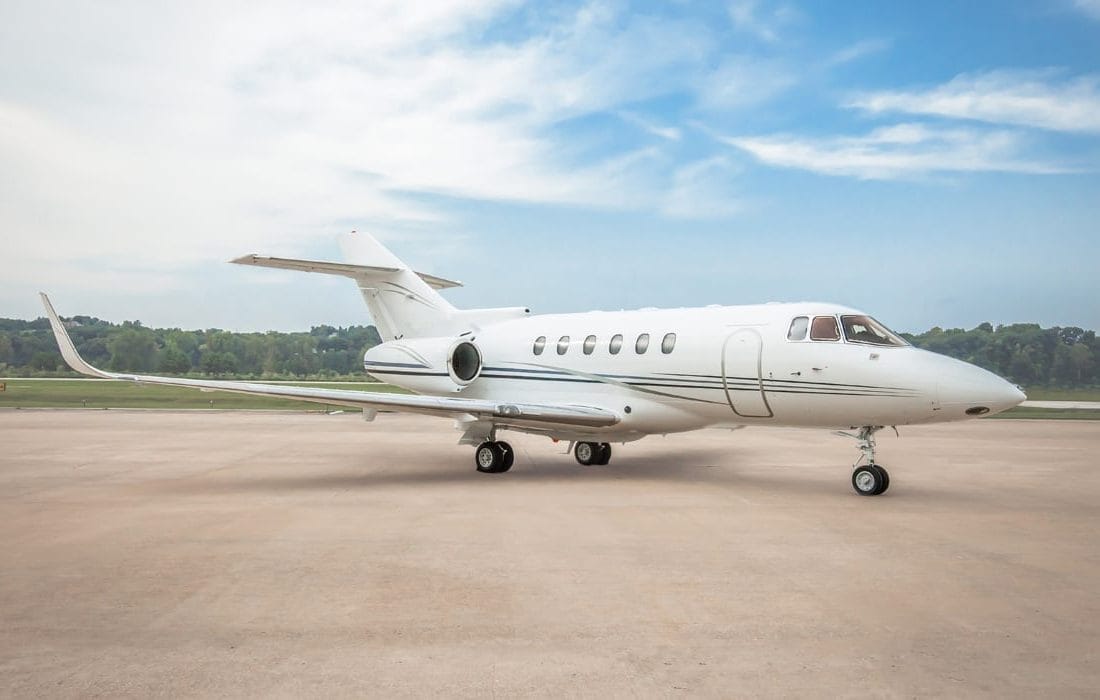
The Bombardier Challenger 300 is a super-midsize jet with a spacious 930-cubic-foot cabin, 3,340 nautical miles of range, and 106 cubic feet of baggage space – ideal for coast-to-coast travel with gear, pets, or a full group. The Beechcraft Hawker 800XP is a midsize jet with 2,620 nautical miles of range and a more compact cabin, best suited for travelers who prioritize range over cargo capacity. Both seat up to eight passengers.
When Private Clients ask which aircraft fits their next mission, the conversation often centers on two questions: how much space do you need, and how far are you going? The Challenger 300 and Hawker 800XP represent two distinct answers. One delivers a wide, flat-floor cabin that swallows skis, golf bags, and larger pets without compromise. The other offers proven reliability and respectable range for those traveling light. Understanding the difference shapes the kind of journey you’ll experience – and that’s worth getting right before you book.
Bombardier Challenger 300: The Super-Midsize Benchmark
Step aboard a Challenger 300 and the first impression is space. The cabin stretches 23 feet 7 inches long, rises 6 feet 1 inch high, and spans 7 feet 2 inches wide. It is one of the most generous interiors in the super-midsize category. That 930 cubic feet of cabin volume translates to room for a productive meeting, an uninterrupted nap, or simply the freedom to move.
With 106 cubic feet of baggage capacity, the Challenger 300 accommodates the gear-heavy trips other aircraft strain to handle. Skis, golf clubs, large suitcases, a dog crate – they all fit. For families relocating between homes or executives traveling with presentation materials and luggage for a week, this aircraft removes the “what do we leave behind?” calculation entirely.
Range completes the picture. At 3,340 nautical miles, the Challenger 300 connects Boston to Los Angeles, New York to Aspen, or Miami to San Francisco without a fuel stop. Its high-speed cruise of 459 knots (approximately 528 mph) and 45,000-foot service ceiling mean you arrive faster and above most commercial traffic and weather.
This is one of the most versatile super-midsize jets available and is equally suited to business missions and leisure escapes where comfort and capacity matter.
For frequent flyers seeking this class of aircraft, the Challenger 300/350 Jet Card membership offers guaranteed access and transparent pricing across the Magellan Jets Preferred Network.
Beechcraft Hawker 800XP: Midsize Range and Reliability
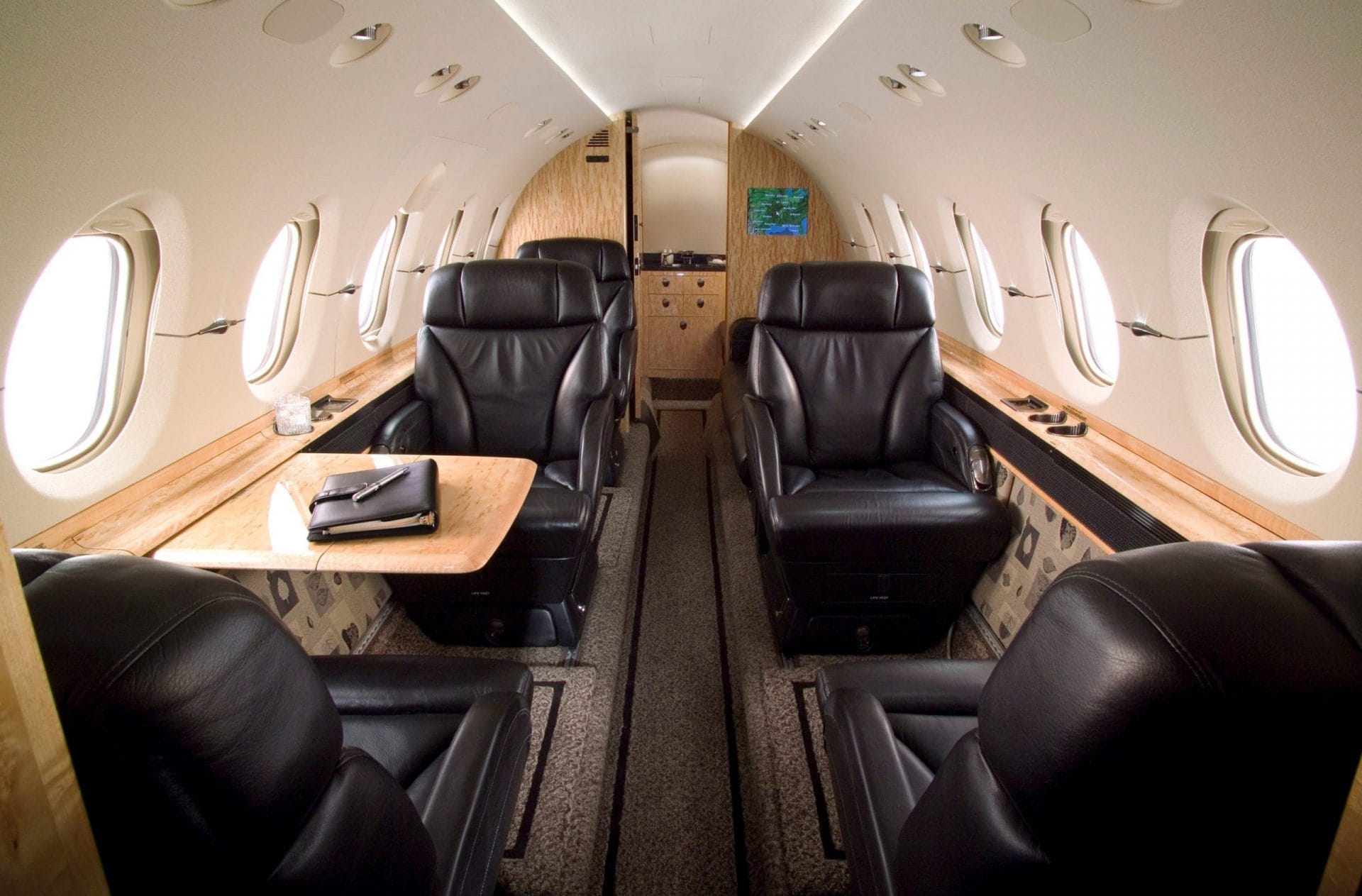
The Hawker 800XP earned its reputation the hard way, through decades of reliable service. This midsize jet delivers a cabin measuring 21 feet 3 inches long, 5 feet 8 inches high, and 6 feet wide, providing 551 cubic feet of interior volume. It’s a comfortable space for six to seven passengers traveling without bulky cargo.
Where the Hawker 800XP distinguishes itself is range for its class: 2,620 nautical miles connects most North American city pairs without issue. You can fly New York to Denver, Chicago to Phoenix, or Atlanta to Los Angeles nonstop. High-speed cruise reaches 430 knots (approximately 495 mph) with a 41,000-foot ceiling.
Baggage capacity sits at 48 cubic feet – adequate for carry-ons, briefcases, and moderate luggage, but not the aircraft for a family moving ski gear or golf equipment for four. The Hawker 800XP suits travelers who pack efficiently and value proven performance over cabin volume.
For longer trips where passengers travel light and cabin atmosphere matters more than cargo space, the Hawker 800XP remains a respected choice in the midsize category.
Private Clients who fly frequently on midsize aircraft may benefit from the Midsize Jet Card, which locks in preferred rates and availability.
Challenger 300 vs Hawker 800XP: Side-by-Side Comparison
Which Private Jet Should You Charter?
The right aircraft depends on how you travel, not just where you’re going.
Choose the Challenger 300 when:
You’re flying coast-to-coast (New York to Los Angeles, Boston to San Francisco, Miami to Seattle)
You’re traveling with substantial baggage – ski equipment, golf clubs, full-size suitcases for extended trips
A larger pet is joining the journey
You need a flat-floor cabin with room for eight passengers to work and move comfortably
Speed matters – the Challenger 300’s 459-knot cruise saves time on longer routes
Choose the Hawker 800XP when:
Your group is six or fewer passengers traveling with light luggage
The route falls within 2,500 nautical miles – transcontinental is comfortable, but range is the limiting factor for longer distances
You prefer a proven midsize platform with decades of operational history
Budget matters – the hourly rate differential between midsize and super-midsize can add up over multiple trips
Estimated Charter Costs: Challenger 300 vs Hawker 800XP
Charter pricing varies by itinerary, positioning, aircraft availability, and trip-specific factors. The figures below provide directional guidance based on Magellan Jets’ estimated hourly rates for each aircraft category:
Challenger 300 (Super-Mid category): Estimated ~$9,700 per hour
Hawker 800XP (Midsize category): Estimated ~$8,700 per hour
These are estimated hourly rates inclusive of fuel. They do not include contingencies such as de-icing, overnight fees, repositioning, catering, ground transportation, or other trip-specific costs. Final pricing is confirmed at time of quote by your Magellan Jets Private Aviation Advisor.
On a five-hour transcontinental flight, the hourly difference translates to approximately $5,000 in additional cost for the Challenger 300 – a meaningful premium, but one that buys substantially more cabin volume, baggage space, range, and speed.
Frequently Asked Questions About Challenger 300 vs Hawker 800XP (FAQs):
Can a Challenger 300 cross the Atlantic?
The Challenger 300’s 3,340-nautical-mile range supports many transatlantic routes under favorable conditions. City pairs like New York to Shannon (Ireland), Boston to Lisbon, or Teterboro to the Azores fall within range. Winds, payload, and weather affect feasibility for any specific mission – your Magellan Jets Private Aviation Advisor confirms route viability during trip planning.
Can a Challenger 300 fly nonstop from New York to London?
New York to London spans approximately 3,000–3,500 nautical miles depending on specific airports. Under ideal conditions – favorable winds, lighter passenger load – the Challenger 300 can make this crossing. Most transatlantic charters on super-midsize aircraft include a technical fuel stop (often in Newfoundland, Iceland, or Shannon) as standard practice. Your Private Aviation Advisor assesses each routing individually.
Is the Hawker 800XP a good private jet?
Yes. The Hawker 800XP has earned its reputation through decades of reliable service. Its 2,620-nautical-mile range, comfortable six-to-seven passenger cabin, and proven systems make it a respected choice for midsize charter. It is best suited for travelers who prioritize range and cabin comfort over baggage capacity.
Is the Challenger 300 reliable?
The Bombardier Challenger 300 is considered one of the most dependable super-midsize jets in service. Its airframe, engines, and avionics benefit from a mature design with strong manufacturer support. The aircraft remains a popular choice for On-Demand Charter and Jet Card programs precisely because operators can count on its dispatch reliability.
How many passengers do the Challenger 300 and Hawker 800XP seat?
Both aircraft seat up to eight passengers with two crew members. The Challenger 300 offers more cabin space per passenger (930 cubic feet versus 551 cubic feet), which affects comfort on longer flights.
Find the Right Aircraft for Your Next Journey
Whether your trip calls for the Challenger 300’s expansive cabin and coast-to-coast range or the Hawker 800XP’s efficient footprint for shorter missions, the right choice starts with a conversation about how you travel.
Magellan Jets’ Private Aviation Advisors source aircraft from the Magellan Jets Preferred Network. The Network holds fewer than 100 rigorously vetted operators out of roughly 3,000 licensed in the U.S. Every recommendation reflects your itinerary, your timeline, and your priorities.
The Challenger 350 jet is the direct evolution of the Challenger 300, sharing the same 23 ft 7 in cabin and CL-30 type rating but delivering more thrust, redesigned winglets, and updated avionics. Both are super-midsize jets capable of coast-to-coast missions across North America. The 300 was built from 2003 to 2014; the 350 launched in 2014 and was superseded by the Challenger 3500 in 2022.
If you’ve flown aboard a Challenger 300 or are considering your first flight on a Challenger 350, the two jets may look nearly identical on the ramp. They share a common lineage, common cockpit credentials, and a cabin that remains one of the most generous in the super-midsize category. Yet the differences matter when you’re matching an aircraft to a specific mission – or deciding whether to request a 350 over a 300 through On-Demand Charter or a Jet Card.
This comparison covers what Private Clients and aviation professionals need to know: specs, range, cabin dimensions, engine performance, and how each jet fits into Bombardier’s current lineup.
The Challenger 300: A Super-Midsize Standard
Bombardier introduced the Challenger 300 in 2003 as a clean-sheet design aimed at bridging the gap between midsize and heavy jets. Over its eleven-year production run, the 300 earned a loyal following among operators and Private Clients alike. It offered a flat-floor, stand-up cabin without the operating costs of a larger aircraft.
Challenger 300 Key Specifications
Category: Super-Midsize
Passengers: 8
Cabin: 23 ft 7 in long × 7 ft 2 in wide × 6 ft 1 in tall; 930 cu ft volume
Baggage: 106 cu ft
Range: 3,340 nm
Max cruise speed: 459 kn (~528 mph)
Ceiling: 45,000 ft
Engines: 2× Honeywell HTF7000, 7,000 lbs thrust each
Wingspan: 63.8 ft
Crew: 2 pilots
The 300’s range of 3,340 nm covers transcontinental missions with ease – Los Angeles to New York, Miami to Seattle, or Boston to Denver with reserves. Its 45,000-ft ceiling lets it cruise above most commercial traffic, and its 459-knot cruise speed keeps flight times competitive with larger jets.
Production ended in 2014 when the Challenger 350 took its place. The 300 remains popular on the secondary market and is widely available for charter through operators in the Magellan Jets Preferred Network.
The Challenger 350 Jet: What Changed
When Bombardier launched the Challenger 350 in 2014, the goal was evolution rather than revolution. The airframe, cabin cross-section, and systems architecture carry over from the 300, but three changes stand out: the engines, the winglets, and the avionics.
Challenger 350 Jet Key Specifications
Category: Super-Midsize
Passengers: Up to 9
Cabin: 23 ft 7 in long × 7 ft 2 in wide × 6 ft 1 in tall; 930 cu ft volume
Baggage: 106 cu ft
Range: 3,269 nm
Max cruise speed: 459 kn (~528 mph)
Ceiling: 45,000 ft
Engines: 2× Honeywell HTF7350, 7,323 lbs thrust each
Wingspan: 69.0 ft (redesigned winglets)
Avionics: Collins Pro Line 21 Advanced
Crew: 2 pilots
More Thrust, Better Climb Performance
The Honeywell HTF7350 engines produce 7,323 lbs of thrust per engine – roughly 4.6% more than the HTF7000 engines in the 300. That additional power translates to improved hot-and-high performance, shorter runway requirements at challenging airports, and faster time-to-altitude.
Redesigned Winglets
The 350’s most visible change is its wingspan. At 69.0 ft, the 350’s wingspan is more than five feet greater than the 300’s 63.8 ft, thanks to redesigned winglets. These winglets reduce induced drag, improve fuel efficiency, and contribute to better short-field performance. They also give the 350 a distinctive silhouette that Private Clients often recognize on approach.
Collins Pro Line 21 Advanced
Bombardier upgraded the flight deck with Collins Pro Line 21 Advanced avionics, featuring synthetic vision, enhanced situational awareness displays, and streamlined pilot workload. For passengers, the practical benefit is a crew better equipped to navigate challenging weather and congested airspace.
Cabin Experience: What It’s Like Onboard
Both the Challenger 300 and Challenger 350 share the same flat-floor stand-up cabin: 6 ft 1 in of headroom, 23 ft 7 in of length, and 7 ft 2 in of width. Private Clients walk freely, stretch, and work without ducking through transitions or stepping over obstacles. Large windows line both sides, drawing natural light deep into the cabin and keeping even midday transcons bright and open.
The Challenger 350 adds a Collins Pro Line 21 Advanced cabin management system, giving passengers direct control of lighting zones, temperature, and entertainment from touchscreen interfaces at each seat. Noise levels remain remarkably low in both aircraft, thanks to Bombardier’s acoustic insulation engineering. Side-ledge storage runs beneath the windows, offering convenient compartments for devices, documents, and personal items without cluttering the main cabin area. The result is a working or relaxing environment that justifies the super-midsize category’s reputation for comfort.
Operating Efficiency and Range in Practice
The Challenger 350’s HTF7350 engines produce 7,323 lbs of thrust each, a measurable step up from the Challenger 300’s HTF7000 engines at 7,000 lbs. Paired with redesigned winglets that extend the wingspan to 69.0 ft (compared to the 300’s 63.8 ft), the 350 delivers improved fuel efficiency and stronger performance from short runways and high-elevation airports. Both aircraft cruise at 459 kn (approximately 528 mph) and reach a ceiling of 45,000 ft, keeping Private Clients above weather and commercial traffic.
In practice, these numbers mean coast-to-coast capability on domestic missions. A Los Angeles–New York trip, a Miami–Aspen ski run, or a Teterboro–Las Vegas roundtrip all fall comfortably within either jet’s range. The Challenger 300 covers 3,340 nm; the 350 reaches 3,269 nm. Both handle transcontinental routes without refueling stops. The 350’s edge appears on challenging departures: shorter fields, thinner air, hotter tarmac. Where the 300 performs well, the 350 performs with margin to spare.
The Challenger 350 remained in production until 2022, when Bombardier introduced the Challenger 3500 as its successor. Today, the 350 is widely available for charter and remains one of the most requested super-midsize jets in the Magellan Jets Preferred Network.
Head-to-Head Specs Comparison: Challenger 300 vs 350
Challenger 300
Category: Super-Midsize
Passengers: 8
Cabin length: 23 ft 7 in
Cabin width: 7 ft 2 in
Cabin height: 6 ft 1 in
Cabin volume: 930 cu ft
Baggage capacity: 106 cu ft
Range: 3,340 nm
Max cruise speed: 459 kn (~528 mph)
Ceiling: 45,000 ft
Engines: 2× Honeywell HTF7000
Thrust per engine: 7,000 lbs
Wingspan: 63.8 ft
Avionics: Collins Pro Line 21
Type rating: CL-30
Crew: 2 pilots
Production: 2003–2014
Challenger 350
Category: Super-Midsize
Passengers: Up to 9
Cabin length: 23 ft 7 in
Cabin width: 7 ft 2 in
Cabin height: 6 ft 1 in
Cabin volume: 930 cu ft
Baggage capacity: 106 cu ft
Range: 3,269 nm
Max cruise speed: 459 kn (~528 mph)
Ceiling: 45,000 ft
Engines: 2× Honeywell HTF7350
Thrust per engine: 7,323 lbs
Wingspan: 69.0 ft
Avionics: Collins Pro Line 21 Advanced
Type rating: CL-30
Crew: 2 pilots
Production: 2014–2022
Which Should You Charter?
For most Private Clients, the differences between the Challenger 300 and 350 come down to mission specifics and personal preference rather than capability. Both aircraft cover the same routes, seat similar passenger counts, and offer nearly identical cabin environments.
Choose the Challenger 300 When:
Availability or positioning makes it the more practical option for your departure date
Your mission falls well within its 3,340-nm range
Cabin finishes and model year are less important than schedule and cost
Choose the Challenger 350 Jet When:
You want the latest cabin interiors and avionics
Your departure airport has elevation or temperature factors where extra thrust helps
You prefer newer aircraft in your charter profile
Both jets are available through Magellan Jets’ On-Demand Charter and Jet Card programs. A Private Aviation Advisor can help identify which aircraft best fits your specific trip.
Real-World Missions: Where Each Jet Excels
For coast-to-coast business travel – New York to Los Angeles, Boston to San Francisco – both the Challenger 300 and Challenger 350 deliver nonstop capability, ample workspace, and arrival times that outpace commercial alternatives by hours. Teams of six to eight Private Clients travel together without compromise.
The 350 earns its advantage on missions involving shorter or higher-elevation runways. Aspen, Telluride, Sun Valley, and similar mountain destinations benefit from the 350’s enhanced takeoff performance. For family trips within North America and the Caribbean – spring break in the Turks and Caicos, summer in Nantucket – both aircraft carry the full party plus luggage in a cabin designed for comfort over long sectors.
When a mission stretches beyond North America – nonstop transatlantic to London, Paris, or Geneva – Private Clients should consider stepping up to a heavy jet. The super-midsize category handles most domestic and Caribbean itineraries with ease; transcontinental Europe requires the range and endurance of a larger aircraft. Through Magellan Jets’ On-Demand Charter service, Private Clients access the right aircraft for every journey, whether that means a Challenger for a week of domestic meetings or a Gulfstream for an overseas closing.
Where the Challenger 3500 Fits
In 2022, Bombardier introduced the Challenger 3500 as the successor to the 350. The 3500 retains the same proven airframe and CL-30 type rating but adds a redesigned cabin with new seating, larger windows in certain configurations, and an updated environmental control system. It is currently in production and represents the latest iteration of the Challenger 300/350 lineage.
For Private Clients who value the newest interiors and technology, the Challenger 3500 is an option worth discussing with your Private Aviation Advisor. For those prioritizing availability and mission fit, the 300 and 350 remain excellent choices and are more widely available across the charter market.
Challenger 350 Charter Cost
Charter pricing for the Challenger 350 jet – or the Challenger 300 – varies by route, season, and trip-specific factors. As a general reference, the estimated hourly rate for Super-Midsize charter is approximately $9,816 per hour.
This is an estimated hourly rate for Super-Midsize charter, inclusive of fuel. It does not include contingencies such as de-icing, positioning, overnight fees, or other trip-specific costs. Final pricing is confirmed at time of quote.
Magellan Jets’ safety standards apply to every aircraft sourced through the Preferred Network, whether you fly a Challenger 300, 350, or another super-midsize jet. Every operator is vetted against rigorous criteria, and every trip is backed by the company’s 24/7 support.
Frequently Asked Questions About the Challenger 300 vs Challenger 350 (FAQs):
How much is a Challenger 350 jet?
For charter, the estimated hourly rate for a Super-Midsize jet like the Challenger 350 is approximately $9,816 per hour, inclusive of fuel. This estimate does not include de-icing, positioning, overnight fees, or other trip-specific costs. Final pricing is confirmed at the time of quote. Magellan Jets does not publish aircraft purchase or sale prices in this context.
Can a Challenger 350 fly to Europe or cross the Atlantic?
The Challenger 350’s range of 3,269 nm is not sufficient for nonstop transatlantic crossings from the U.S. East Coast to most European destinations. However, with a fuel stop in Iceland, Greenland, or the Azores, the 350 can complete transatlantic missions. For nonstop service to Europe, a heavy jet or ultra-long-range aircraft is typically required.
Is the Challenger 300 and 350 the same type rating?
Yes. Both aircraft share the CL-30 type rating, meaning pilots certified on one can fly the other without additional training. This commonality benefits operators and contributes to the availability of both jets in the charter market.
What is the difference between a Challenger 350 and Challenger 3500?
The Challenger 3500, introduced in 2022, is the successor to the 350. It shares the same airframe and CL-30 type rating but features a redesigned cabin with new seating, updated environmental controls, and refinements to passenger amenities. The 3500 is currently in production; the 350 is no longer manufactured but remains widely available for charter.
How fast does a Challenger 350 go?
The Challenger 350 has a maximum cruise speed of 459 knots, or approximately 528 mph. This is identical to the Challenger 300’s cruise speed.
How many passengers does the Challenger 350 seat?
The Challenger 350 seats up to 9 passengers in a typical charter configuration. The Challenger 300 seats 8. Both offer a cabin that is 23 ft 7 in long, 7 ft 2 in wide, and 6 ft 1 in tall – one of the most spacious in the super-midsize category.
What is the Challenger 350 wingspan?
The Challenger 350 has a wingspan of 69.0 ft, more than five feet greater than the Challenger 300’s 63.8-ft wingspan. The difference comes from redesigned winglets that improve fuel efficiency and short-field performance.
Can the Challenger 300 fly New York to London?
No. The Challenger 300’s range of 3,340 nm falls short of the roughly 3,450 nm required for a nonstop New York-to-London flight. With a fuel stop – typically in Iceland or eastern Canada – the 300 can complete the journey. For nonstop transatlantic flights, a heavy jet such as a Gulfstream G450 or G550 is a better fit.
Find the Right Jet for Your Next Mission
Whether you’re comparing the Challenger 300 and 350 for a specific trip or exploring which super-midsize jet fits your travel profile, a conversation with a Private Aviation Advisor can clarify your options. Magellan Jets’ team can match the aircraft to your route, passenger count, and schedule – drawing from the Preferred Network’s inventory of vetted operators.
Choosing between the Hawker 800XP and the Cessna Citation Excel comes down to mission profile. Both are proven midsize jets, but the Hawker 800XP vs. Citation Excel comparison reveals distinct strengths: the Hawker offers a larger cabin and longer range (up to 2,540 nautical miles), making it the choice for longer legs and larger groups. The Citation Excel counters with strong short-runway access, 90 cubic feet of baggage capacity, and a lineage (the XLS and XLS+) that remains in active production. Both are available through On-Demand Charter and Jet Card programs.
Hawker 800XP vs. Citation Excel: How They Compare at a Glance
The Hawker 800XP descends from the British Aerospace HS.125 line and was built by Raytheon (later Hawker Beechcraft) between 1995 and 2005. It remains a cabin-space benchmark in the midsize category, with a longer fuselage and wider interior than most direct competitors.
The Citation Excel, certified in 1998 under the Cessna Model 560XL designation, was engineered for a different priority: accessing shorter runways that heavier midsize jets cannot reach. Its lineage continues today in the Citation XLS+, giving operators and Clients access to factory support and ongoing upgrades.
The core trade-off: cabin volume and range favor the Hawker; runway flexibility and baggage volume favor the Excel.
The Hawker 800XP: A Spacious Midsize Benchmark
The Hawker 800XP seats up to eight passengers in a cabin measuring about 21.3 feet long, 6.0 feet wide at its widest point, and 5.7 feet tall. That combination of length and width places it among the most spacious midsize interiors of its era. Passengers can move comfortably, work across from one another, or configure the cabin for rest on longer flights.
Range is the Hawker’s calling card. With four passengers and NBAA IFR reserves (the industry-standard range measurement that accounts for fuel reserves, an alternate airport, and a 45-minute hold), the 800XP can cover up to 2,540 nautical miles nonstop. That connects city pairs like New York to Denver, Boston to Miami, or Los Angeles to Chicago without a fuel stop.
Two Honeywell TFE731-5BR turbofans, each producing about 4,660 pounds of thrust, power the aircraft to a high-speed cruise of 447 knots. Service ceiling reaches 41,000 feet, where the 800XP can climb above most commercial traffic and weather.
The flight deck features a Honeywell SPZ-8000 avionics suite with a five-screen EFIS (electronic flight instrument system, which replaces traditional analog gauges with digital displays). While the SPZ-8000 was state-of-the-art when these aircraft were delivered, many in-service Hawkers have been upgraded with modern glass cockpits.
Production ended in 2005 after approximately 426 deliveries. The 800XP is no longer manufactured, but well-maintained examples remain active on the pre-owned and charter market. Clients who prioritize cabin space and range over access to factory-new airframes will find strong options in this fleet.
Baggage volume is 48 cubic feet, adequate for soft bags and a few hard cases but noticeably smaller than the Excel’s hold.
The Cessna Citation Excel: Short-Runway Access and Baggage Room
The Citation Excel was designed around a specific mission: midsize performance with light-jet runway requirements. Two Pratt & Whitney PW545 turbofans give the Excel the thrust to operate from runways that would ground heavier midsize aircraft. That opens access to mountain airports, island strips, and regional fields closer to final destinations.
The cabin seats up to seven passengers (the later XLS and XLS+ seat up to eight). Interior dimensions measure 18.4 feet long, 5.6 feet wide, and 5.4 feet tall, with a total cabin volume of 422 cubic feet. The proportions are tighter than the Hawker, but Cessna optimized the layout for efficiency.
Where the Excel stands out: baggage. The 90-cubic-foot baggage compartment is nearly double the Hawker’s capacity. For Clients traveling with golf clubs, ski equipment, or pets in large carriers, that difference can determine whether an aircraft works for the mission.
Range is 1,839 nautical miles using NBAA IFR reserves. High-speed cruise is 433 knots, and service ceiling reaches 45,000 feet. The Excel will not match the Hawker on transcontinental routes, but for regional and mid-range flights, the performance gap narrows considerably.
The Citation Excel was FAA-certified in 1998. Cessna (now Textron Aviation) succeeded it with the Citation XLS in 2004 and the Citation XLS+ in 2008. The XLS+ remains in production today, which means factory parts, service bulletins, and avionics upgrades continue to flow. Clients who value that support infrastructure often favor the Excel lineage.
Side-by-Side Specifications
Note: Range figures use NBAA IFR reserves (fuel for the planned flight, an alternate airport, and a 45-minute hold). Actual range varies with passenger count, baggage weight, winds, and atmospheric conditions.
Which Midsize Jet Is Right for Your Mission?
The answer depends on where you fly, how often, and what you bring.
Choose the Hawker 800XP when:
Range is a priority. The 2,540-nautical-mile envelope covers more city pairs nonstop, reducing fuel stops and total travel time.
Your group is larger. Eight passengers travel comfortably, with room to work or rest.
Cabin space matters. The Hawker’s wider, taller, and longer interior accommodates taller passengers and more flexible seating arrangements.
Choose the Citation Excel when:
Your destinations include short or challenging runways. Mountain airports, coastal strips, and regional fields are within reach.
You travel with significant baggage. Golf trips, ski weekends, or traveling with large pet carriers benefit from 90 cubic feet of hold space.
Factory support and parts availability are important. The XLS+ production line keeps the Excel family current.
Both aircraft are available through Magellan Jets’ On-Demand Charter and Jet Card programs. Every operator in the Magellan Jets Preferred Network is held to rigorous safety standards, including independent third-party auditing and a formal Safety Management System (a structured framework for managing operational risk). Your Private Aviation Advisor can match the aircraft to your specific mission, whether that means a single On-Demand Charter flight or a Jet Card with guaranteed availability.
What It Costs to Charter a Midsize Jet
Both the Hawker 800XP and Citation Excel fall into the midsize (Mid Jet) charter category. Because this comparison is not tied to a specific route, the general estimated hourly rate applies: an estimated $8,550 per flight hour.
This is an estimated hourly rate for midsize (Mid Jet) charter, inclusive of fuel. It does not include contingencies such as de-icing, positioning, overnight fees, catering, or other trip-specific costs. Final pricing is confirmed at the time of quote, and your Private Aviation Advisor can provide an exact figure for your mission.
For Clients who fly regularly, a Jet Card locks in rates and guarantees availability without the commitment of aircraft ownership. For occasional travelers, On-Demand Charter offers access to the same aircraft categories on a per-trip basis.
Frequently Asked Questions About the Hawker 800XP vs. Citation Excel (FAQs):
What is the main difference between the Hawker 800XP and the Citation Excel?
The Hawker 800XP offers a larger cabin and longer range, while the Citation Excel provides superior short-runway access and nearly double the baggage space. The Hawker suits longer flights and larger groups. The Excel is ideal for regional trips to challenging airports with substantial luggage.
Which has longer range?
The Hawker 800XP has the longer range at up to 2,540 nautical miles with four passengers and NBAA IFR reserves. The Citation Excel reaches up to 1,839 nautical miles under the same conditions. The Hawker can cover more transcontinental routes nonstop.
How many passengers can each carry?
The Hawker 800XP accommodates up to eight passengers. The original Citation Excel seats up to seven, while the later XLS and XLS+ variants seat up to eight. Both aircraft offer comfortable midsize interiors for business or leisure travel.
Is the Hawker 800XP still in production?
No. Production of the Hawker 800XP ended in 2005 after approximately 426 aircraft were delivered. The 800XP is available only on the pre-owned and charter market. Well-maintained examples with updated avionics remain popular in the midsize category.
Is the Citation Excel still in production?
The original Citation Excel is no longer produced, but its successor, the Citation XLS+, remains in active production by Textron Aviation. This means factory support, parts availability, and avionics updates continue for the entire Excel family.
How much does it cost to charter a midsize jet like these?
The estimated hourly rate for a midsize (Mid Jet) charter is $8,550, inclusive of fuel. This does not include variable costs such as de-icing, overnight fees, positioning, catering, or international fees. Your Private Aviation Advisor can provide an exact quote based on your specific route and requirements.
Find the Right Aircraft for Your Next Mission
The Hawker 800XP and Citation Excel represent two distinct approaches to midsize private aviation. One prioritizes cabin volume and transcontinental range. The other prioritizes runway flexibility and baggage capacity. The right choice depends on how you travel, where you go, and what you need to bring.
Magellan Jets’ Private Aviation Advisors can help you identify the aircraft that fits your mission profile, whether that means a Hawker for cross-country legs or an Excel for a weekend in Aspen. Every aircraft in the Preferred Network meets the same safety and service standards.
When comparing the Cessna Citation X vs. Challenger 300, the decision hinges on what you value most in a super-midsize charter. The Citation X delivers exceptional speed – its X+ variant reaches Mach 0.935, the mark that long made it the fastest civilian production jet, matched only recently by the Gulfstream G700 in 2024. The Bombardier Challenger 300 counters with a wider, taller cabin, more baggage capacity, and roughly 200 additional nautical miles of range. Both seat up to eight passengers and remain proven charter workhorses, even though production has ended on each. Your ideal aircraft depends on the mission: tight schedules favor the Citation X; coast-to-coast comfort and luggage-heavy trips favor the Challenger 300.
Citation X vs. Challenger 300 at a Glance
Before diving into nuance, a side-by-side view clarifies the core trade-offs. The table below reflects current specifications; earlier sources sometimes confused knots with miles per hour, so the figures here are corrected.
Both aircraft occupy the super-midsize category. Yet the numbers reveal distinct philosophies: the Citation X prioritizes altitude and velocity, while the Challenger 300 invests its engineering budget in cabin volume and range.
Speed: The Citation X’s Defining Edge
The Citation X was built to move. At roughly 525 knots, it cruises faster than any other super-midsize jet, and the Citation X+ variant pushed that ceiling to Mach 0.935 – a mark that stood as the fastest in civilian production until the Gulfstream G700 matched it in 2024 and the Bombardier Global 8000 surpassed it at Mach 0.95 in 2025. For travelers whose calendars do not flex, that speed translates into tangible time savings.
A typical transcontinental leg – say, Teterboro to Van Nuys – runs close to 2,100 nautical miles. The Citation X completes it in roughly four hours; the Challenger 300 adds about 30 minutes. Over a year of frequent travel, those half-hours compound. Executives connecting back-to-back meetings on opposite coasts often find the Citation X’s velocity decisive.
Speed also interacts with altitude. The Citation X’s 51,000-foot ceiling places it above most commercial traffic and weather, shortening routing and smoothing the ride. The Challenger 300’s 45,000-foot ceiling is respectable but leaves it sharing airspace with more congestion on busy corridors.
Range and Everyday Reach
The Challenger 300’s 3,340-nautical-mile range edges out the Citation X’s 3,125 nm. In practical terms, both aircraft cover any coast-to-coast U.S. mission nonstop. The Challenger 300’s extra reach matters on specific routes: Hawaii from the West Coast, deep Caribbean itineraries, or pushing into Central America without a fuel stop.
Neither jet reliably crosses the North Atlantic nonstop. Flights from the East Coast to London or Paris require a fuel stop (Gander, Reykjavik, or the Azores are common) or a step up to a heavy or ultra-long-range aircraft. If transatlantic nonstop capability is essential, Magellan Jets can source a Gulfstream G550 or similar through its On-Demand Charter solution – one of several options within a full private aviation portfolio that includes Jet Cards, Fractional Ownership, and Aircraft Sales & Management.
For domestic and short-haul international missions, however, both jets deliver ample range. The decision between them rarely turns on nautical miles unless your regular routes consistently push the 3,000 nm threshold.
Cabin Comfort and Space
Step inside a Challenger 300 and the difference is immediate. At 7 ft 2 in wide and 6 ft 1 in tall, the cabin offers nearly flat-floor stand-up headroom for most passengers and a sense of openness unusual in the super-midsize class. The 930 cu ft of cabin volume – roughly 73% more than the Citation X – allows for a genuine in-flight office layout or a comfortable rest area on longer legs.
The Citation X cabin, at 5 ft 5 in wide and 5 ft 7 in tall, is tighter. Passengers above six feet will notice the lower ceiling. Seat-to-seat shoulder room is noticeably less. For solo travelers or couples on quick hops, that may be irrelevant. For groups of four to eight or trips where productivity matters, the Challenger 300’s cabin earns its keep.
Seating configurations vary by operator, but both jets commonly accommodate club-four seating plus additional aft seats or a divan. The Challenger 300’s width allows wider seats and more aisle space, easing movement during flight. Its larger windows also let in more natural light, an underrated comfort factor on longer missions.
Baggage and Practical Payload
The Challenger 300’s 106 cu ft of baggage space outpaces the Citation X’s 82 cu ft. That 24 cu ft difference is the equivalent of two extra full-size suitcases or a set of golf clubs. For ski trips, extended vacations, or executives traveling with presentation materials and samples, the Challenger 300 offers useful margin.
Both aircraft load baggage through external compartments, so stowing and retrieving luggage is straightforward. Neither requires the trade-offs common in smaller jets, where bags sometimes compete with passengers for cabin space.
Payload capacity matters beyond bags. The Challenger 300’s generous payload allows full passengers and full fuel on most missions. The Citation X occasionally requires a trade-off between range and passengers on longer legs – something your Private Aviation Advisor will clarify during trip planning.
Flight Deck and Avionics
Both aircraft fly with modern, integrated glass cockpits. The Challenger 300 launched with the Rockwell Collins Pro Line 21 suite, featuring four large LCD displays, synthetic vision options, and advanced flight-management systems. Most in-service Challenger 300s have received software and hardware upgrades over time.
The Citation X originally shipped with Honeywell Primus 2000 avionics, later upgraded in the X+ model to the Garmin G5000 suite – a touchscreen-driven, highly intuitive system favored by pilots. Operators have retrofitted older Citation X airframes with updated avionics, so the specific panel varies by tail number.
For charter passengers, the practical impact is minimal: both platforms support datalink, TCAS II, TAWS, and the modern safety technologies that operators in the Magellan Jets Preferred Network maintain as baseline. The real avionics differentiation occurs at the operator level, not the airframe level. Magellan’s safety standards ensure every aircraft sourced meets rigorous avionics and maintenance criteria regardless of model.
What It Costs to Charter Each Jet
Super-midsize charter starts from an estimated $9,816 per hour. This is an estimated hourly rate for Super-Midsize charter, inclusive of fuel. It does not include contingencies such as de-icing, positioning, overnight fees, or other trip-specific costs. Final pricing is confirmed at time of quote.
The Citation X and Challenger 300 typically fall within a similar hourly range, though specific quotes depend on aircraft availability, positioning, and trip details. Speed differences can offset hourly costs: a faster flight in a Citation X may result in fewer billable hours even if the hourly rate edges higher.
Magellan Jets offers multiple ways to access super-midsize aircraft. On-Demand Charter provides maximum flexibility for occasional travelers. For those flying 25 hours or more annually, a Jet Card locks in rates and guarantees availability – including peak days when charter inventory tightens. Private Clients flying 100+ hours may find Fractional Ownership or full ownership through Aircraft Sales & Management a better fit. A Private Aviation Advisor can model the economics for your specific travel pattern.
The Verdict: Matching the Jet to Your Journey
The Citation X and Challenger 300 serve different priorities, and neither is universally superior. Choose the Citation X when speed is the deciding factor – when shaving 30 minutes off a transcontinental leg means catching a meeting, making a connection, or simply spending less time in transit. Its higher ceiling adds routing efficiency and ride comfort in turbulent weather.
Choose the Challenger 300 when cabin space, baggage, and range take precedence. Longer missions with full passenger loads, trips requiring extra luggage, or flights where in-cabin productivity matters favor its wider, taller cabin and additional 200 nm of reach.
Both aircraft remain widely available in the charter market. Bombardier ended Challenger 300 production in 2014 after roughly 457 deliveries; most remain active in charter fleets, and the line continues through the Challenger 350 and Challenger 3500 (for a deeper comparison, see Challenger 300 vs. Challenger 350). Cessna delivered the first Citation X in 1996 and concluded with the Citation X+ in 2018 after about 338 aircraft; the Citation Longitude now carries the brand’s super-midsize flag. Hundreds of both models fly regular charter missions today.
The right jet is the one matched to your mission. A Private Aviation Advisor can review your routes, travel patterns, and preferences to recommend the aircraft – or combination of aircraft across trips – that fits. Explore the full Magellan Jets aircraft experience or start a conversation today.
Frequently Asked Questions About the Citation X vs. Challenger 300 (FAQs):
Which jet is faster, the Citation X or the Challenger 300?
The Citation X is faster. It cruises at roughly 525 knots (~604 mph), while the Challenger 300 cruises at approximately 459 knots (~528 mph). The Citation X+ variant reaches Mach 0.935, a speed that long ranked it the fastest civilian jet in production, a title the Gulfstream G700 matched in 2024 and the Bombardier Global 8000 surpassed in 2025.
Which super-midsize jet has more range?
The Challenger 300 has greater range at 3,340 nautical miles compared to the Citation X’s 3,125 nm. Both aircraft cover any U.S. coast-to-coast mission nonstop, but the Challenger 300’s extra reach helps on routes to Hawaii, the deep Caribbean, or Central America.
Which cabin is bigger, the Citation X or the Challenger 300?
The Challenger 300 cabin is substantially larger. It measures 7 ft 2 in wide and 6 ft 1 in tall with 930 cu ft of volume – compared to the Citation X’s 5 ft 5 in width, 5 ft 7 in height, and 538 cu ft volume. The Challenger 300 offers near-flat-floor stand-up headroom and more spacious seating.
Can the Citation X or Challenger 300 fly transatlantic nonstop?
Neither jet reliably crosses the North Atlantic nonstop. Eastbound flights from the U.S. to Europe typically require a fuel stop in Gander, Reykjavik, or the Azores. For true transatlantic nonstop capability, a heavy or ultra-long-range aircraft like a Gulfstream G550 is a better fit – and Magellan Jets can source one through On-Demand Charter.
Which is cheaper to charter, the Citation X or the Challenger 300?
Both fall within the super-midsize category, which starts from an estimated $9,816 per hour. Specific charter rates depend on aircraft availability, positioning, and trip details. The Citation X’s speed advantage may reduce total flight hours on longer legs, partially offsetting any hourly rate difference.
Is the Challenger 300 still available for charter?
Yes. Bombardier ended Challenger 300 production in 2014 after delivering roughly 457 aircraft; approximately 454 remain in service. The model continues as the Challenger 350 (2014) and Challenger 3500 (2022), and all three variants are widely chartered through operators in the Magellan Jets Preferred Network.
The Falcon 2000 vs Gulfstream G450 comparison pits two exceptional aircraft against each other – but they belong to different categories, serve different missions, and suit different traveler profiles. Choosing between them is less about which is better and more about which is right for you.
The direct answer: The Dassault Falcon 2000 is a super-midsize jet offering efficient transcontinental range (up to 4,100 nm in the LXS variant) with seating for up to 10 passengers – ideal for smaller groups prioritizing operating economy and runway flexibility. The Gulfstream G450 is a heavy jet with a substantially larger cabin (1,658 vs 1,028 cu ft), room for up to 13 passengers, and 4,425 nm of range – the choice for larger groups or those who value maximum cabin space for overnight flights and onboard meetings.
Falcon 2000 vs Gulfstream G450: Specifications at a Glance
Cabin Experience: Refined Efficiency vs. Expansive Comfort
The Falcon 2000’s cabin reflects Dassault’s philosophy of thoughtful proportion. At 7 ft 7 in wide, it is actually four inches wider than the G450 – a difference you notice when settling into a club seat or working at the drop-down table. The fuselage cross-section traces back to the Falcon 900 trijet, a lineage that gives the aircraft an established, refined feel.
Where the G450 dominates is sheer volume. Its 45 ft 1 in cabin stretches nearly 20 feet longer than the Falcon 2000’s 26 ft 2 in interior. That additional space typically configures into three distinct zones – forward club seating, a mid-cabin work area, and an aft lounge or berthing section. For executive teams traveling together or families seeking room to spread out, the difference is unmistakable.
Both cabins stand 6 ft 2 in tall, comfortable for most passengers to move about freely. The G450’s Honeywell Primus Epic PlaneView flight deck keeps the cockpit modern; the Falcon 2000LXS counters with the EASy II avionics suite, known for its pilot-friendly design. Private Clients rarely see these systems – but they benefit from the safety margins and operational flexibility they enable.
Range and Speed: Transcontinental Reach vs. Ocean-Crossing Capability
The Falcon 2000 family spans several variants, from the original model (approximately 3,130 nm range) to the current-production LXS (approximately 4,100 nm). That upper figure covers routes like New York to Los Angeles, Boston to London’s closer alternates, or Miami to São Paulo with favorable winds.
The G450’s 4,425 nm range adds roughly 325 nm to the envelope – enough to open certain transatlantic routings or extend legs that would otherwise require a fuel stop. It also cruises faster, reaching 476 knots versus the Falcon’s 437 knots. On a coast-to-coast flight, that speed advantage translates to roughly 20–25 minutes saved.
Yet the Falcon 2000 holds an advantage of its own: a 47,000 ft ceiling compared to the G450’s 45,000 ft. At those altitudes, the aircraft rides above most weather and competing traffic. Pilots often cite this when explaining the Falcon’s reputation for smooth, efficient flights.
Mission Profiles: Which Aircraft Fits Your Travel Pattern?
Choose the Falcon 2000 when your typical group runs four to six passengers, your routes stay within North America or reach to the Caribbean and northern South America, and operating efficiency matters alongside comfort. The super-midsize category also unlocks shorter runways, expanding your access to regional airports near coastal retreats or mountain destinations.
Choose the G450 when you regularly travel with eight or more passengers, conduct onboard meetings that require space to spread out, or fly routes that push past 4,000 nm. The additional baggage capacity (169 vs 139 cu ft) also suits extended trips with golf clubs, skis, or presentation materials.
Neither choice is wrong. They serve distinct purposes. A Private Client who flies quarterly to Europe with a full team has different needs than one who travels monthly between New York and Aspen with a spouse.
Chartering the Falcon 2000 or G450 With Magellan Jets
Magellan Jets coordinates charter access to both the Falcon 2000 and G450 through the On-Demand Charter program. Working with rigorously vetted operators in the Magellan Jets Preferred Network, Private Aviation Advisors match each journey to the right aircraft – whether that means a super-midsize Falcon for a quick transcontinental hop or a G450 for a longer leg with a larger group.
Estimated hourly charter rates:
Dassault Falcon 2000 (Super-Midsize): starting from an estimated $9,816/hr
Gulfstream G450 (Heavy Jet): starting from an estimated $12,989/hr
These are estimated hourly rates, inclusive of fuel. They do not include contingencies such as de-icing, positioning, overnight fees, catering, or other trip-specific costs. Final pricing is confirmed at time of quote.
For Private Clients who fly 25 hours or more annually, the Jet Card program locks in rates and guarantees availability with call-out windows as short as 24 hours. The Magellan Jets portfolio also extends to Fractional Ownership and Aircraft Sales & Management – ensuring that as your travel patterns evolve, your aviation partner evolves with you.
Frequently Asked Questions About the Falcon 2000 vs. Gulfstream G450 (FAQs):
Is the Falcon 2000 a heavy jet?
No. The Dassault Falcon 2000 is classified as a super-midsize jet. While the current LXS variant’s range of approximately 4,100 nm approaches heavy-jet territory, its cabin volume (1,028 cu ft) and passenger capacity (up to 10) place it firmly in the super-midsize category.
Which has the longer range – the Falcon 2000 or the G450?
The Gulfstream G450 offers approximately 4,425 nm of range compared to the Falcon 2000LXS’s 4,100 nm. That 325 nm difference can determine whether certain transatlantic routings require a fuel stop.
Which has the bigger cabin?
The G450’s cabin is substantially larger at 1,658 cu ft versus 1,028 cu ft for the Falcon 2000. The G450’s 45 ft 1 in cabin length is nearly 20 feet longer than the Falcon’s 26 ft 2 in interior. However, the Falcon 2000 is four inches wider (7 ft 7 in vs 7 ft 3 in).
How much does it cost to charter each aircraft?
Estimated hourly charter rates start from $9,816/hr for a super-midsize Falcon 2000 and $12,989/hr for a heavy-jet G450. These rates are inclusive of fuel but exclude positioning, de-icing, catering, and other trip-specific costs. Final pricing is confirmed at time of quote.
Which should I choose for a transatlantic trip?
For most transatlantic missions, the G450’s combination of longer range (4,425 nm), faster cruise speed (476 knots), and larger cabin for overnight comfort makes it the stronger choice. The Falcon 2000LXS can reach closer European destinations with favorable winds, but the G450 provides more margin and more space for long-haul travel.
The best aircraft is the one that fits your mission, your group, and your standards for comfort. Whether you lean toward the Falcon 2000’s efficient elegance or the G450’s expansive capability, your Private Aviation Advisor can map both options to your specific routes and preferences.