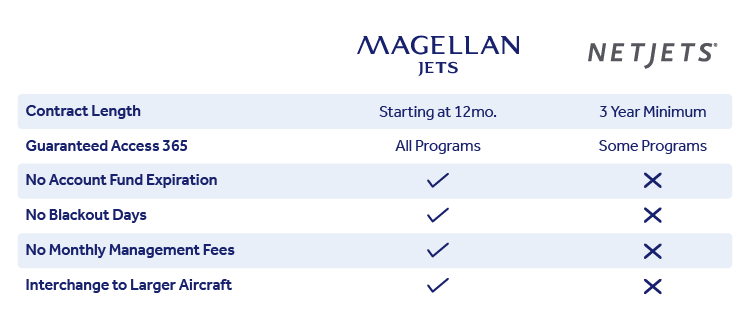
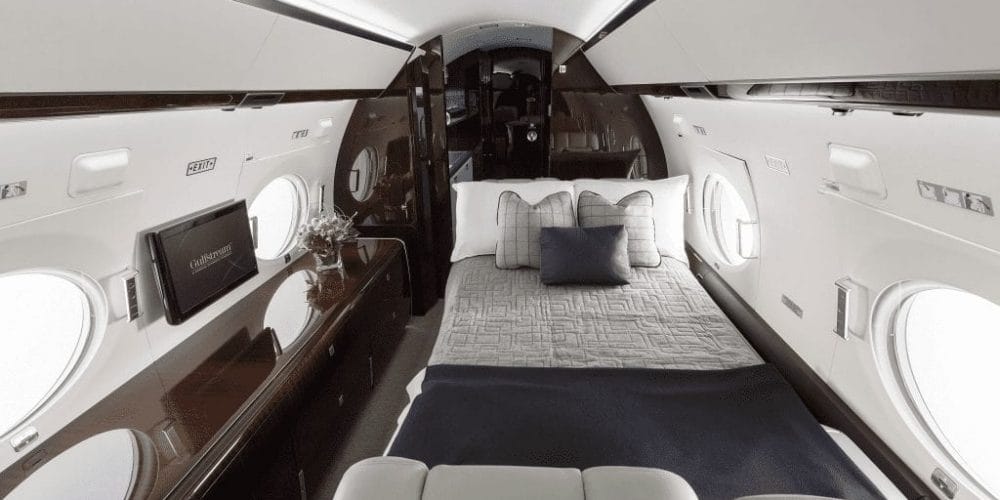
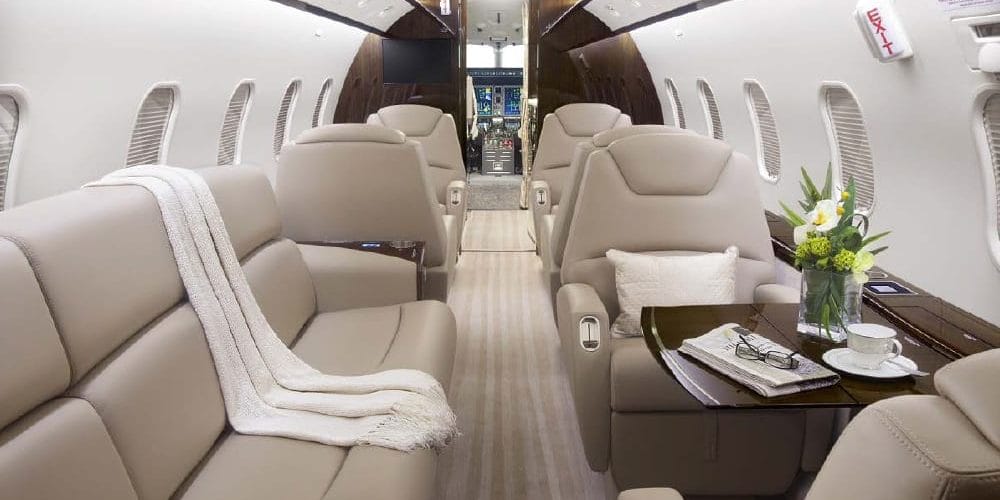
When comparing private jet companies, it’s important to do your research to ensure your provider is well equipped to service all your personal and business travel needs. In today’s post-COVID environment, this doesn’t just mean comparing program terms and benefits; it now includes exploring how well each private aviation provider can guarantee certainty in your travel plans in an industry wracked by economic constraints, aircraft & crew availability issues, the supply chain crisis, and the ongoing pandemic. We’ve compiled this updated Magellan Jets vs. NetJets comparison for 2022 to help you evaluate key aspects of the two companies’ services.
We’ve broken this guide down into the following sections:
NetJets, a subsidiary of Berkshire Hathaway, is one of the first names in modern private aviation and has provided private jet services since its founding in 1964 as Executive Jet Airways. NetJets’ business model involves owning its own fleet of about 800 jets and selling fractional shares or leases on those aircraft. With this model, clients’ funds are used for operations across the entire company, including aircraft maintenance, monthly management fees, the salaries of their 7,000-some employees, and other expenses. It’s akin to having customers invest in an entire airline.
Magellan Jets, founded in 2008, is a proudly lean, privately owned company with zero debt. As we oversee a global network of operators and crews and do not own a fleet ourselves, we never have to use our clients’ investment to cover things like aircraft maintenance. In fact, client funds are never mixed with operational funds-Magellan Jets guests fly with peace of mind knowing they’ve invested solely in their own travel experience, rather than the running of an entire fleet.
types of private jet programs offered
With their introduction of the fractional aircraft ownership model in 1986, NetJets broadened access to the world of private jets, offering shares of the dedicated aircraft in their fleet. Nearly four decades later, fractional shares continue to be the company’s most popular product. Their fractional program requires a minimum commitment of 36 months and is designed for customers flying a larger volume-50 hours a year or more.
Though NetJets previously offered jet cards in 25-hour increments, the company suspended all jet card sales in August of 2021; in April 2022, NetJets announced they would not bring back jet cards for the remainder of 2022. Instead, for those flying less than 50 hours, NetJets recently began offering 25-hour leases, which require no up-front cost but lock customers into either a three- or five-year commitment.
Magellan Jets, on the other hand, offers greater flexibility with a full suite of private aviation solutions-industry-leading jet card ownership, award-winning private jet membership, and on-demand charter services-designed to fit any customer’s needs. While many other companies were forced to alter or suspend their programs or waitlist customers throughout 2021, Magellan Jets has proudly kept all programs available to new and existing customers.
In addition to on-demand charter services, Magellan offers both jet-specific and category-inclusive Jet Cards in 25-hour increments, as well as a pay-as-you-go Private Jet Membership that allows private jet travelers to lock in their fixed rate and fly as much or as little as they desire. Magellan’s Jet Card Owners and Members enjoy shorter contract lengths than NetJets customers, with Jet Card and Membership contracts lasting just 12 months.
fleet vs. network
When comparing themselves to charter broker programs, NetJets touts the consistency of experience they provide when flying on the different aircraft in their fleet. However, NetJets’ fixed fleet model, which sees many thousands of customers sharing a fleet of only a few hundred jets, simply isn’t optimized for the challenges of high demand seen across today’s private aviation marketplace. When demand for flights can’t be met, NetJets cannot guarantee that every client will fly on a NetJets fleet tail number, let alone the tail number they bought. In scenarios like these, clients with larger shares will receive aircraft priority which can result in those with smaller shares being forced to fly off-fleet on a chartered flight. Essentially, many NetJets customers are paying a premium-30 percent or more compared to the charter market-just to be brokered out. At that rate, why not just fly with a charter broker?
Magellan, however, is more than just a broker-we source aircraft from our highly selective matrix of aircraft, operators, and crews: the Magellan Jets Preferred Network (MJPN). This important framework was created to uphold Magellan’s industry-leading standards, which ensure an elevated level of service and go far beyond what’s required for keeping guests and crew healthy and safe. From this premier network of over 2,500 carefully selected aircraft and over 11,250 specifically chosen crew members, our in-house team of FAA-certificated pilots and aviation professionals secures the perfect assets to fit your exact flight requirements.
When matching you with the perfect private aviation solution, Magellan Jets is not limited to what’s available in a fleet-as a customer in this industry, we are able to pull from our vast global network of the safest and most reliable crews and aircraft to meet your needs. Thanks to the MJPN, Magellan is able to provide elevated, safe, and personalized service-and thanks to our size and infrastructure, that service is arranged by people who are intimately familiar with you and your flight patterns.
safety
Fleet-based operators may contend that flying with an off-fleet provider comes with concessions in safety; with Magellan Jets, that couldn’t be further from the truth. Magellan is an industry leader when it comes to safe flying, and we’ve been experts in off-fleet safety and service since 2008. Several members of our executive leadership team are currently serving or have served in top roles in organizations including the National Business Aviation Association, National Air Transportation Association, and Air Charter Safety Foundation. We don’t simply follow and exceed safety requirements-we have a direct hand in driving the conversation around private jet safety and raising standards for the entire business aviation industry.
Both NetJets and Magellan Jets have expert Safety Management Systems (SMS) in place, but there are a few key differences.
One difference is that Magellan conducts dynamic, real-time auditing on each flight to ensure compliance with our SMS-a level of diligence a large fleet-based provider like NetJets simply cannot perform. This auditing includes advanced airplane, pilot, and crew screening so you know who you are flying with every time, as well as enhanced COVID-19 protocols. Magellan guests enjoy the peace of mind that comes with knowing their flight is managed and overseen by a dedicated member of our Flight Support Department. These highly trained aviation professionals perform risk assessment, deviation planning, and many other behind-the-scenes due diligence tasks that are critical to every trip-including a rigorous 42-point safety inspection.
With a fleet-based operator like NetJets, crews and aircraft are often pushed to the max to manage the fleet’s busy schedule. This situation is exacerbated by the post-pandemic “new normal” of high demand and low availability, which leads to increased pilot and crew fatigue. That’s why Magellan has a minimum crew-to-aircraft ratio and dynamically audits to optimize maintenance and crew schedules. We require operators to employ at least two sets of crews per aircraft so they can be rotated and properly rested to prevent fatigue, further reducing the risk of service or safety issues.
Another difference between NetJets and Magellan is that Magellan’s SMS is a Service and Safety Management System. We know that service issues are strongly correlated to potential safety issues, and strongly believe that excellence in service equals excellence in safety. When evaluating operators for your flight, we look closely at whether they’ve maintained an uncompromising commitment to service excellence. We’re the only provider in the private aviation space willing to measure Trip Perfection Rating, or the percentage of trips flown with zero issues whatsoever-a rating we’ve kept at near 100 percent even through the pandemic, with zero cases of covid being transmitted on our flights. As our industry deals with an increase in delays, service interruptions, and schedule changes, Magellan’s elevated safety and service standards have ensured the majority of our clients have been shielded from these issues
Aircraft Availability And Access
NetJets may have a dedicated fleet of brand-new aircraft, but customers aren’t always guaranteed 365-day access to fly on these or the off-fleet brokered aircraft brought in to meet demand. That’s because NetJets’ programs feature many blackout days, peak travel dates, and other high-volume dates that all translate to the same thing: your travel plans need to be flexible. While NetJets’ fractional shares offer fewer blocked-off dates, the company’s 25-hour lease offerings have a total of 45 blackout days per year as well as an additional 45 peak days that require advanced scheduling to fly. With NetJets, if you want to be able to fly 365 days a year, you’ll need to make an investment of at least 50 hours or own a fractional share. Additionally, on peak days, NetJets cannot guarantee customers the ability to upgrade to larger aircraft or use multiple aircraft on the same day.
Magellan Jets, however, is focused on giving clients the freedom and flexibility to fly whenever they need. Magellan’s Jet Card and Private Jet Membership programs feature zero blackout dates-guests have guaranteed access to private jets 24/7, 365, and can even utilize multiple aircraft for daily use.
Backup And Recovery
Any frequent private jet flyer knows the headaches and frustrations that can occur if your aircraft suddenly goes A.O.G. due to mechanical issues, scheduling/routing mismatches, or crews calling fatigue. Considering the strain on private aviation, you need to be sure your provider has a proper recovery plan for your flight. Both NetJets and Magellan Jets guarantee trip recovery, but NetJets’ focus on fleet optimization means they will always try to use their own fleet assets to recover a trip as it is more cost effective to do so. NetJets’ unfavorable ratio of customers to aircraft results in fewer jets for recovery (plus, the closest NetJets-owned aircraft could be far away), meaning guests could be stuck waiting for hours. Meanwhile, those who don’t wait to wait for a NetJets fleet option end up on off-fleet charter flights while still paying NetJets rates.
With Magellan, in the event a mechanical or scheduling issue occurs on your flight, our Magellan Jets Preferred Network allows us to look for the next best and closest option among the safest and most reliable operators. We understand the importance of having a proper recovery plan in place, so we ensure that our Jet Card Owners and Members have a recovery flight option at no additional cost.
As we mentioned above, flying with a fleet-based operator like NetJets means that your funds go toward supporting that fleet-you’re basically investing in an airline. Roughly 30 percent more expensive than other leading private jet providers, NetJets requires significant upfront investments in addition to other fees. In particular, fractional owners end up getting locked into lengthy contract terms on assets that depreciate, and their funds expire at the end of their contract.
When determining your return on investment of working with NetJets, you must also take a closer look at your effective hourly rate. Numerous costs are unbundled to make their rates seem competitive, but that isn’t the case when you factor in overlooked costs like NetJets’ monthly management fees and peak day surcharges.
Magellan Jets, on the other hand, provides full pricing transparency-whenever a guest receives an hourly rate, there are never any hidden fees that will inflate a price tag. Our clients are never burdened by monthly maintenance fees, and Jet Card Owners and Premium Members will never pay more to fly on peak travel days. Additionally, Magellan guests’ funds on account never expire. In all, guests can expect the lowest financial risk and lowest possible incremental spend when flying with Magellan Jets.
Ready to explore Magellan’s full suite of private aviation programs? Call 877-550-5387 to speak to a consultant today, or click the button below to learn more about our Jet Card Ownership, Private Jet Membership, and Charter options.
Please let us know if you have suggestions on how we could improve this competitive review. We’ve relied on the internet, former NetJets clients, and third parties to source these insights, as competitors are often reluctant to share information.
The Tuskegee Airmen were the United States’ first African-American military pilots. They flew missions against the Axis powers during WWII while simultaneously battling racism, bigotry, and intolerance from their own side. In honor of Black History Month, read on to learn about this highly decorated group of black combat aviation pioneers.
The Tuskegee Airmen: America’s First Black Combat Pilots
Origin and training
As war in Europe loomed on the horizon, the U.S. faced a pilot shortage. Black pilots were ready and willing to serve, but still faced barriers to admittance and training because the U.S. military was still a segregated force. When the government announced an experimental program to train civilian pilots for the military, prominent black newspapers, civil rights leaders, and the NAACP advocated for African American pilots to be included, but they ran into resistance.
Finally, in 1941, a Howard University student named Yancey Williams sued the War Department because the Army Air Corps had refused to admit him due to his race. This lawsuit opened up military aviation to African Americans to the first time-however, even though figures like Cornelius Coffey pushed for full integration and said they would “rather be excluded than to be segregated,” the Corps would only accept black pilots into all-black units. Now, black pilots came from all over the country for military training.
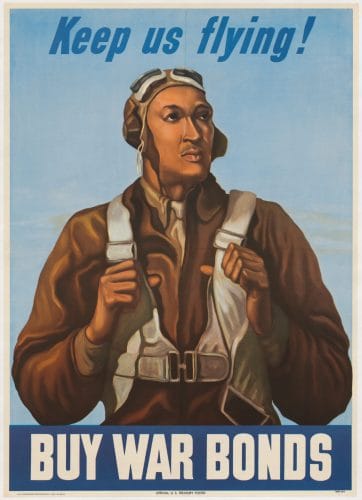
A 1943 poster created by the US Treasury Department during WWII depicting Robert W. Diez, an African American Tuskegee Airman, pleading for Americans to buy war bonds. (Collection of the Smithsonian National Museum of African American History and Culture)
The Army Air Corps soon established a training center for the black pilots at the Tuskegee Army Air Field in Tuskegee, Alabama. It was near the Tuskegee Institute (now Tuskegee University), the historic black school founded by Booker T. Washington, which had become one of the country’s centers for training black aviators. The Institute provided the facilities for the pilots and aircraft, while the Air Corps provided planes, uniforms, and educational material in addition to ground and flight training.
Five men graduated from the first class out of an original 13, including Captain Benjamin O. Davis, Jr., who was then one of the only two black officers in the entire military. Davis would go on to become the first black man to hold the rank of General in the U.S. Army-but before that, he was given command of the first all-black Air Corps unit, the 99th Pursuit Squadron.
The ‘Red Tails’ Go To Europe
The 99th shipped out to North Africa in 1943. The Allies had just pushed the Germans and Italians out of the continent and were preparing to invade Sicily and later mainland Europe. The Tuskegee Airmen’s first mission would be to bomb and strafe the small island of Pantelleria in between Sicily and Tunisia. Their missions over the enemy-held island would contribute to a historic feat-as Air Force Magazine notes, “the aerial offensive marked the first time in history that an enemy land force was compelled to surrender in the absence of an accompanying ground invasion.” Not long after, Tuskegee Airman Lt. Charles B. Hall became the first member of the squadron to down an enemy aircraft.
At this time, the squadron came under political pressure after its partnered white units complained about the 99th’s performance. Soon, publications like Time Magazine would publicly question their effectiveness. Davis traveled back to Washington, D.C., where he held a news conference at the Pentagon to speak up in defense of his unit. As the website We Are The Mighty writes, there was a lot the complainers had left out-like how the squadron was based further from the front lines than their white peers, excluded from mission briefings, and made to fly older P-40 Warhawk fighters that were slower than German planes. This episode was indicative of the prejudice the unit would regularly face.
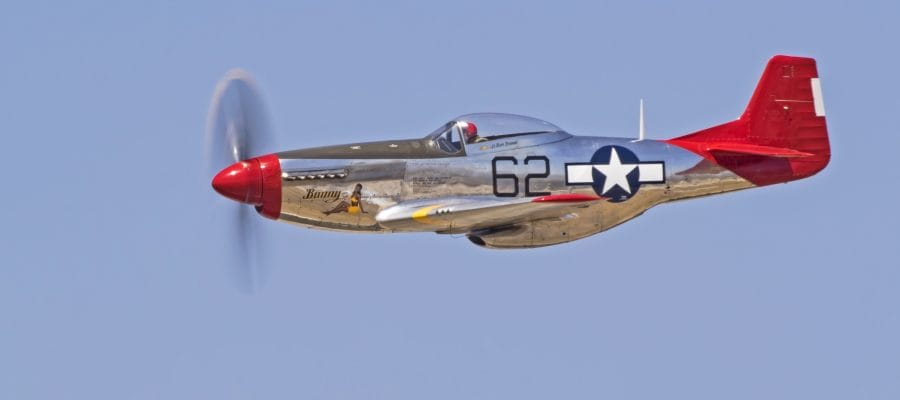
A P-51 Mustang featuring the Tuskegee Airmen’s famed “Red Tails” livery, at an air show in California in 2017. (iStockphoto)
When the 99th was sent back to Italy, they became part of the all-black 332nd Fighter Group. The 332nd was made up of three more squadrons of Tuskegee graduates, the 100th, 301st, and 302nd. These units began flying the famed P-51 fighter, painting the tails and nose cones red-leading to the unit’s nickname, the “Red Tails.” While fighting in Italy, the Tuskegee Airmen helped provide air cover for the Allied landings at Anzio, Italy, and provided safe escort for the lumbering bomber aircraft of the 15th Air Force. The 99th would receive two Presidential Unit Citations for their distinguished performance in the Italian theater. Among their incredible accomplishments was the sinking of a German naval destroyer in the harbor at Trieste, Italy; According to the National Museum of the Tuskegee Airmen, 302nd Fighter Squadron Lt. Gynne Pierson sank the large ship using only his plane’s machine guns.
Late in the war, in March of 1945, the 332nd was flying a bomber escort when they encountered German fighters utilizing brand-new jet engines. Despite being outmatched by the new technology, the Tuskegee Airmen managed to down three of the jets and damage five more without losing any aircraft of their own. Incredibly, the Tuskegee Airmen units flew 200 of 205 of these types of escort missions without the loss of a single bomber.
‘Fighting Two Wars’
As the Tuskegee Airmen National Historical Museum states on its website, “These airmen fought two wars-one against a military force overseas and the other against racism at home and abroad.” They fought for what many called “The Double V Victory,” victory against both fascism and racism. At the time, the racism they faced was institutionalized; much of the military establishment, for example, still believed the results of a 1920s War Department report stating “that blacks weren’t intelligent or disciplined enough to fly a plane.” The Tuskegee pilots underwent training in areas of the country plagued by deeply rooted racism. Tuskegee Airman Connie Nappier told Connecticut Explored that, while attending basic training in Biloxi, Mississippi, one fellow cadet was found killed after he went into town alone and didn’t come back.
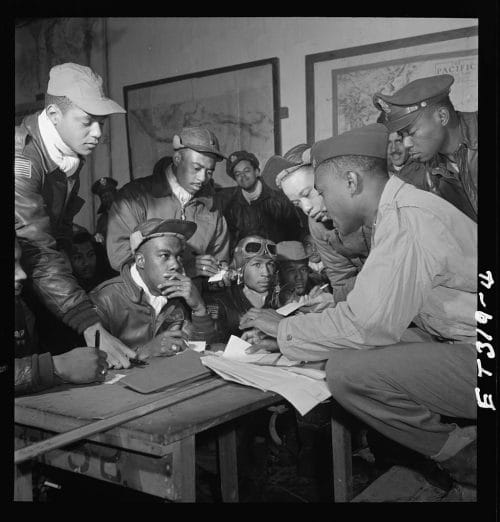
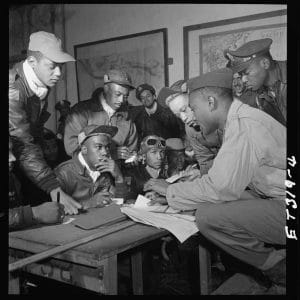
Several Tuskegee Airmen attend a mission briefing in Ramitelli, Italy in March 1945. (Wikimedia Commons/Toni Frissell collection at the Library of Congress)
Chief Master Sgt. of the Air Force George Porter, who served in WWII as a Tuskegee Airman aircraft mechanic, told NPR that racial prejudice made it harder to do his job-“because when we would order parts, they wouldn’t send us the parts, but we learned how to repair our own parts.” Another Tuskegee Airman, Walter Suggs, said many commanders expected the program to fail, saying “they kind of put them in that situation, the Afro-Americans, so they would fail.”
After the war, the pilots who had served in Tuskegee Airmen units still fought for acknowledgement. In 1949, the Tuskegee Airmen of the 332nd Fighter Group won the newly formed U.S. Air Force’s inaugural “Top Gun” gunnery competition, a feat for which Military.com notes they weren’t recognized for decades.
Legacy
According to the Tuskegee Museum, a total of 992 pilots graduated from the program at Tuskegee Army Air Field between 1942 and 1946, while History.com notes the program also trained “nearly 14,000 navigators, bombardiers, instructors, aircraft and engine mechanics, control tower operators and other maintenance and support staff.”
During the war, Tuskegee Airmen flew a total of 1,578 missions and 15,553 combat sorties, downed 112 enemy aircraft, and knocked out nearly 1,000 rail cars, significantly damaging the German war effort. They lost 66 pilots killed in action or in accidents and 84 pilots killed in training and non-combat missions. During the war, 32 Tuskegee Airmen were taken prisoner. The unit was highly decorated with 744 air medals, including 150 Distinguished Flying Crosses, one Silver Star, fourteen Bronze Stars, and eight Purple Hearts.
Historic story markers placed at the observation deck on the hill overlooking Morton Field at the Tuskegee Airmen National Historic Site in eastern Alabama. (iStockphoto)
The combat record and civil rights advancements made by the Tuskegee Airmen had an impact on President Truman’s 1948 order to desegregate the military. Lt. Roger Terry, one of the officer charged in the “Freeman Field Mutiny,” said the Tuskegee Airmen’s struggle helped pave the way for those who came after. “We feel-and I think I speak for most of the guys-that it was our advantage that we gave to the Negro people, that there would be no discrimination in the Army Air Force from that time on-at least officially.”
The Tuskegee Airmen’s former training center at Moton Field in Tuskegee, Alabama is now a National Historic Site. In 2008, surviving Tuskegee Airmen attended the Inauguration of President Barack Obama, who has written that “My career in public service was made possible by the path heroes like the Tuskegee Airmen trail-blazed.”
Cornelius Coffey’s pioneering efforts to make flight training available to African Americans helped to desegregate the skies and encouraged thousands of black pilots into aviation in both the military and civilian sectors. In honor of Black History Month, read on to learn about the man who broke racial barriers to establish the first African-American flight school and the first black-owned airport in the country.
Above photo: Lola Albright and Willa Brown at Chicago’s Harlem Airport, where Coffey and Brown ran their flight school. (Records of the Federal Aviation Administration, National Archives)
Getting off the ground
Cornelius Coffey was born in Newport, Arkansas in 1903, just a few months after the Wright Brothers achieved their first powered flight and captured the imagination of the world. In 1916, when Coffey was just 13 years old, he took his first airplane ride with a barnstorming pilot and was drawn to flying from that day forward. He would later say he believed aviation was a field where the intense racial barriers and segregation of the time would not hold him back.
In 1925, Coffey moved to Chicago to study to be an automobile mechanic. It was there he met his friend John Robinson, another African American who dreamed of one day being able to fly. The two men applied to flight schools across the country, but were constantly denied because of their race-so, they resorted to teaching themselves. In a vacant Chicago lot loaned to them by a Black businessman, Coffey and Robinson used their mechanical knowledge to build a one-seat airplane powered by a motorcycle engine and taught themselves to fly.
While employed as auto mechanics by a white Chevrolet dealer named Emil Mack, Coffey and Robinson continued applying to aviation mechanic schools. Both were accepted into Chicago’s Curtiss Wright School of Aviation, but were dismissed after showing up to their first day of classes when the school discovered they were black. With help from Mack, Coffey and Robinson threatened to sue the school for being denied admittance due to their race. Eventually the school relented, Coffey and Robinson were admitted, and they graduated as two of the top students in their class. Both returned to the school to teach all-black classes-and Coffey became the first African-American man to hold both a pilot’s and a mechanic’s license.
The Challengers
During the Great Depression years, Chicago served as a hub for black pilots wishing to take to the skies-and one of the main reasons was the headway Coffey and his collaborators made in establishing a community of black pilots. In the city that pioneering black aviator Bessie Coleman had called home, Cornelius Coffey and John Robinson established the Challengers Air Pilots’ Association, a group of black fliers who sought to expand the still-limited opportunities for African American aviation enthusiasts. The group took its name from the Curtiss Challenger airplane engine, a popular engine at the time. In 1931, they began the tradition-still carried on today-of flying over Bessie Coleman’s grave as a tribute to the woman who inspired many of them to fly.
After graduating top in his class from an aviation mechanics program in Chicago, Cornelius Coffey was still unwelcome at local airstrips. So he and several other black aviators opened their own airfield and flight school. #BHM#BlackHistoryMonth https://t.co/GkgK9HX9QNpic.twitter.com/7Qd1bKoqL2
The pilots of the Challengers group were, however, still barred from most area airstrips. When Akers Airport, the only field that would accept them, closed, the group established their own airfield. According to Smithsonian Magazine,
In 1931, the group, joined by one or two white pilots from Akers, bought a half-mile-wide tract of land in Robbins, an all-black town southwest of Chicago. There they buried boulders, dropped trees, roughly leveled the terrain, and cobbled together a hangar from second-hand lumber. When they finished, their small fleet of disparate craft-a Church Mid-Wing, an International F-17, and a WACO 9-was parked under the roof at what historians consider the first black-owned airport in the United States.
In 1930s Chicago, pioneering Black aviators improvised, innovated, and overcame societal barriers to fulfill their dreams of flight. Discover their story in the latest episode of our @AirSpacePod: https://t.co/oOCpJmf2Q3
— National Air and Space Museum (@airandspace) June 13, 2021
Completed in 1933, Robbins Airport was only operational for a few months; it was destroyed by a powerful storm later that year. The Challenger group was then invited by a man named Fred Schumacher to use the lower end of his new airport on Harlem Avenue, which later became known as Harlem Airport. Finally, the black aviators had a place to fly-but the pilots were still forced to park their planes in separate hangers from the white pilots and keep on their end of the airfield.
The First Black Flight School
In the mid-30s, Robinson left the United States for Ethiopia, where he used his flying skills to fight against the invading Italian fascist army. Back in Chicago, Cornelius Coffey worked as a mechanic for Schumacher, re-certifying the overhauled aircraft used by the white pilots on the other side of the airfield. Then, in 1938, he established The Coffey School of Aeronautics, the first black-owned and certified flight school in the country.
Coffey hired other pioneering black aviators to teach at his school-including a former student of his, Willa Brown, who was later to become his wife. Brown had been the first African-American woman to earn her pilot’s license in the U.S., but she would be far from the last-as Coffey later noted, “Every 10 students that I took, I had one white student and one girl student in that unit.”
With World War II on the horizon, the U.S. government sensed a need for an increase in military pilots. The Civilian Pilot Training Program was created in 1939 to train new fliers for the Army Air Corps, which was the predecessor to the U.S. Air Force. Coffey and Brown wanted to make sure black aviators were included, so they renamed the Challenger Air Pilots’ Association to the National Airman’s Association (NAA) and focused their group on the goal of getting black pilots into the military. To draw attention to their cause, the NAA organized a publicity flight to Washington, D.C. As a result, seven black pilot training sites were included as part of the government’s training program; Coffey’s school was the only one not associated with a college or university.
A Lasting Impact On Aviation
Between 1938 and 1945, more than 1,500 black students passed through Coffey’s school. Many of those pilots went on to join the famed Tuskegee Airmen, the first African American air units to fight against the Nazis in Europe. Coffey, whose school was integrated, initially spoke out against these segregated flying units, saying, “We’d rather be excluded than to be segregated.”
After WWII, Coffey enjoyed a long career as a pilot, mechanic, and teacher. He retired from instructing in 1969, but kept busy as an aircraft inspector for decades. He designed and patented a carburetor heating system that helped keep aircraft flying in inclement weather by preventing icing, and similar devices continue to be used today. Coffey continued to fly until 1992 and passed away two years later at the age of 91. In Chicago, pilots encounter his legacy daily when they use the “Cofey Fix,” an aerial navigation intersection named after him that is located over Lake Calumet and helps guide entry into Midway Airport.
Pioneering aviator Bessie Coleman pursued her dream of taking to the skies against all odds, shattering aviation’s racial and gender barriers in the process. In honor of Black History Month, read on to learn about the incredible exploits of “Queen Bess,” the first African-American and Native American woman to earn a pilot’s license.
Life And Legacy Of Bessie Coleman
A Dream To Fly
Born to sharecroppers in Atlanta, Texas in 1892, Bessie Coleman grew up helping her parents pick cotton along with her 12 siblings. Determined to get an education and rise above her station, Coleman graduated high school and even attended a semester of college at Langston University before heading to Chicago as part of “The Great Migration” from the South along with millions of other African Americans. There, she worked as a manicurist while living with her older brothers.
An avid reader, Coleman was dazzled by stories of daredevil aviators, the rock stars of their time, returning from the fighting in Europe in WWI. At a moment when racism was rampant-Chicago experienced one of the worst race riots in history in the summer of 1919-she began to imagine herself entering the field of aviation as a way of inspiring and benefiting African Americans everywhere. When Coleman’s older brother who had served in France returned home with stories of women in more liberal Europe flying airplanes, Coleman became determined to become a pilot herself.
She began applying to aviation schools across the U.S., but was repeatedly denied, as they all refused access to both African Americans and women. But Coleman didn’t give up-as she said, “I refuse to take no for an answer. If I can create the minimum of my plans and desires, there shall be no regrets.” Half a world away, she found a school willing to teach her to fly.
Journey Overseas
Seeking additional help, Coleman reached out to Robert Abbott, owner of an influential black newspaper called the Chicago Defender. She convinced Abbott, known as “the father of black journalism,” that it was important to have a black woman pilot. Impressed (and recognizing a great story in the making), he suggested she enroll at a flying school in France.
After teaching herself French, Bessie Coleman set sail for Paris in November of 1920. She trained for months at the Ecole d’Aviation des Freres Cadron, a prestigious flight school run by plane designers and aviators Gaston and Rene Caudron. In the early days of flying, aviation was still extremely dangerous, and Coleman persisted even after witnessing the deaths of several of her fellow students. When she arrived back in the United States in September 1921, she brought with her the international pilot’s license she had earned as well as a commitment to encouraging more African Americans to fly.
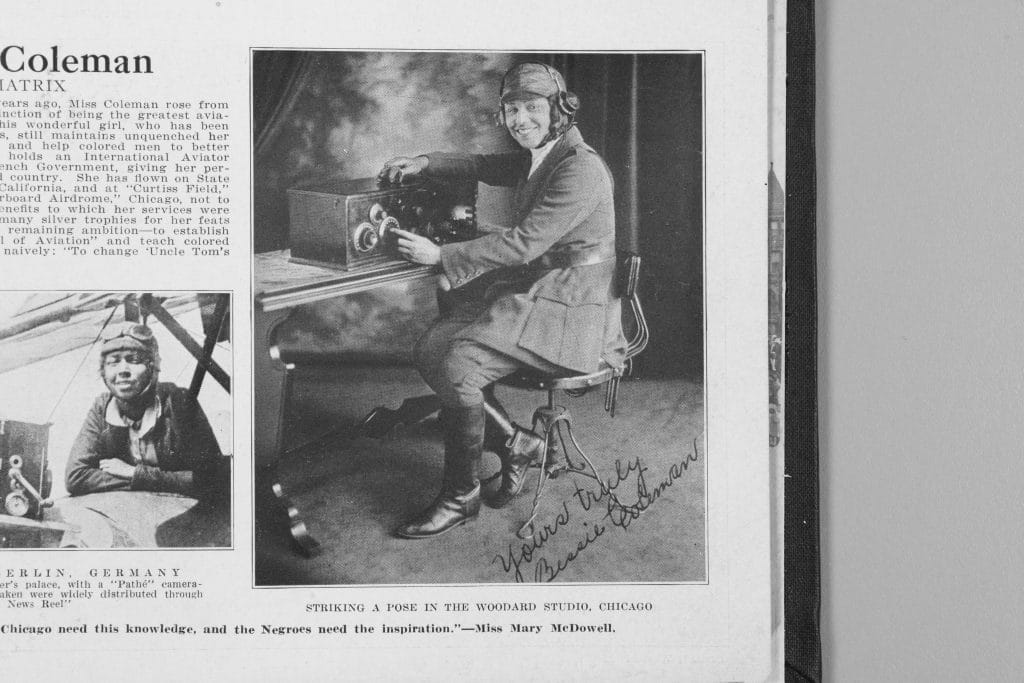
Bessie Coleman in her flying uniform. (New York Public Library Public Domain Archive)
What she found was a country still unwilling to hire her or even sell her a plane. But she saw an opportunity in the “barnstorming” craze-if she was to find employment, Coleman knew she would have to learn to pull off the dangerous stunt tricks performed by aerial acrobats at barnstorming exhibitions across the country. So, she went back to Europe, this time training with veteran WWI flying aces and legendary Dutch airplane designer Anthony Fokker.
Returning stateside, Coleman began a series of thrilling air shows where she performed for thousands of people, both black and white. With her new skills-and with the Defender celebrating her performances-Coleman’s fame took off.
Coleman steadfastly pursued her dream and lived her own independent, unorthodox life-including firing male managers and refusing movie roles she felt were demeaning, reportedly saying “No Uncle Tom stuff for me,” in reference to playing a subservient Black woman. Like her contemporary Amelia Earhart, Coleman was not afraid to be different. She was a fearless personality who defied odds and stepped on toes to claim her space as an aviator.
While she was largely ignored by the mainstream press, she was a star in the pages of the Defender and other black newspapers, gathering legions of fans to whom she was known as “Queen Bess” or “Brave Bess.” She was an expert at self-promotion, making appearances in a military-style uniform with an officer’s belt, leather boots, and leather helmet and goggles-and often embellished her already-impressive story during interviews. She performed incredible barnstorming stunts like tailspins and loop-the-loops for large crowds, made public appearances where she encouraged other African Americans to fly, and, in the midst of Jim Crow, “refused to perform in airshows where blacks were not allowed to use the front entrance.”
Even after crashing her brand-new Curtiss JN-4D “Jenny” biplane in 1923, she was undeterred. She was pulled unconscious from the wreckage and spent three months in the hospital, having broken a leg and several ribs. Her message to the world from her hospital bed was, “Tell them all that as soon as I can walk I’m going to fly! And my faith in aviation and the use it will serve in fulfilling the destiny of my people isn’t shaken at all.”
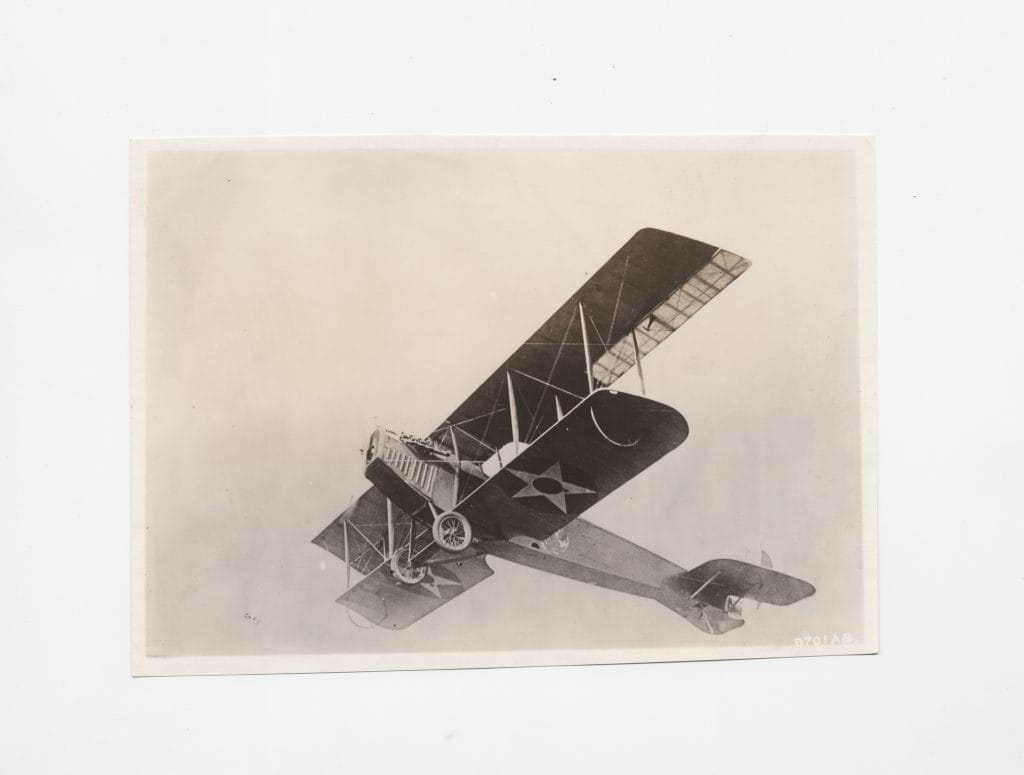
A Curtiss JN-4D “Jenny” Biplane like the ones flown by Bessie Coleman. (New York Public Library Public Domain Archive)
A Tragic Final Flight
In April of 1926, Bessie Coleman had finally raised enough money for another brand-new airplane, and took it for a test ride in Jacksonville, Florida. A white mechanic, William Willis, was flying the plane while Coleman scouted the land below for a good spot to perform a parachute jump. In what was later found to be an accident, a loose wrench jammed the JN-4D’s controls and threw the plane into a nosedive at 3,000 feet. Without a seatbelt, Coleman was thrown from the plane and killed when it flipped over. Willis was killed when the plane crashed into the ground.
After just five years, Coleman’s trailblazing aviation career was tragically cut short. PBS says about 10,000 mourners paid their final respects to Coleman, and in Chicago, her funeral services were presided over by famed activist Ida B. Wells.
A Lasting Legacy
The National Aviation Hall of Fame notes that Coleman only received the attention she truly deserved after her tragic death, but it’s undeniable that her accomplishments in early aviation paved the way for generations of future black aviators. Her dream of opening an aviation school for African Americans was realized in 1929, when Lt. William J. Powell founded the Bessie Coleman Aero Club in Los Angeles in her memory, allowing both men and women to apply.
If you fly into O’Hare International Airport in Chicago, the city Coleman called home, you’ll find yourself on Bessie Coleman Drive. To this day, during an annual ceremony, pilots fly over Lincoln Cemetery and drop flowers on her grave. The tradition was started in 1931 by a group of pioneering black aviators called the Challenger Pilots’ Association of Chicago; this early flight club included several other African-American aviation legends who carried on Coleman’s mission, including Cornelius Coffey, Janet Bragg, and Willa Brown.
Celebrating Black History: Elevate Every Journey with Magellan Jets
Here at Magellan Jets, we honor the rich legacy of Black pioneers in aviation and beyond.
Experience private aviation with a company that values every journey. Contact us today to talk about our full range of private aviation solutions.
As Other Companies Suspended Programs, Magellan Remained Focused On Providing Customers With Safety And Certainty
BOSTON, MA – January 31, 2022 – Magellan Jets thrived throughout 2021, helping private travelers navigate the challenges of business aviation in COVID’s “new normal.” As a result, Magellan grew gross revenue to $80 million in 2021 and is projecting $115 million for 2022.
The year also saw Magellan expand jet card ownership and private jet membership while simultaneously guiding customers through a difficult period of high demand, limited aircraft availability, and evolving federal, state, & international COVID-19 safety regulations. Magellan not only kept all programs open, but also actively onboarded new clients to all products while still maintaining a strict dedication to a historic Trip Perfection Rating-the percentage of trips flown with zero issues whatsoever-of nearly 100 percent.
Combining its proprietary in-house customer support team with the industry-leading Magellan Jets Preferred Network of owner-operators, Magellan was able to achieve growth when others in the market retrenched. These efforts, along with a detailed focus on execution and a commitment to exceptional service, helped Magellan exceed its 2021 financial forecast. This performance was greatly attributed to an increase in jet card revenue by 156 percent and the growth of new customer jet card sales by 38 percent.
“Our growth and execution this year is a direct result of our seasoned staff and owner-operator partners working together to exceed customer expectations” said Magellan Jets CEO Joshua Hebert. “The challenges we faced-unprecedented demand, ongoing pandemic, supply chain crisis-are the same problems facing the entire private aviation industry, but Magellan has been able to stand out and succeed by tailoring ourselves to customers’ needs and over communicating every step of the way.”
With zero debt, strong revenue, and long-standing relationships with operators, Magellan was able to provide flights for customers while maintaining a leading commitment to safety. Magellan also continued to develop and invest in COVID-19 protocols, including the development of the 5 x 5 Puresky Safety Standard, a new, multilayered safety protocol to ensure the wellbeing of guests and crew. The company increased sales, marketing, and customer support staff while investing more heavily than ever in customer access technology.
“We are extremely grateful to our Magellan Jets family and to our partners across aviation as a whole, all of whom worked tirelessly throughout a pandemic and a busy holiday season to guarantee exceptional service for guests through some of the most difficult conditions the industry has ever faced,” said Magellan Jets President Anthony Tivnan.
Explorer and Premium membership revenue grew by 434% in 2021, and the Explorer membership won Robb Report’s 2021 “Best of the Best” award.
Magellan was first in the industry to begin communicating openly about the challenges that were approaching in Q4, kick-starting a series of direct video messages to customers regarding market conditions in 2021. In these updates, Tivnan walked guests through exactly what to expect during unprecedented times, and recommended steps they could take to ensure the best experience.
“As customer advocates, we’re honored to sit on the same side of the table as our guests and look out for their best interests,” said Tivnan. “We knew it was important to keep customers appraised of the difficulties across the industry, set realistic expectations, and show what we were doing to mitigate disruptions and ensure they had the safest and most enjoyable experience possible.”
Magellan also continued to educate readers on a variety of topics across the private aviation sphere to help them make informed decisions about their travel, including:
Lastly, Magellan expanded its network of top companies, brands, and collaborators to help create unforgettable experiences across the globe. Magellan’s guests have access to a portfolio of the most elite destination and experience options, including over 50 bucket-list locations, 15 countries, 20 private islands, 450 private villas, and 25 luxury hotels.
For more information on Magellan’s jet card ownership, private jet membership, or on-demand private charter services, please visit www.magellanjets.com or call 877-550-JETS.
The best private jet membership on the market is flexible enough to handle last-minute changes to your flight plans, and dependable enough to allow you to book during the busy holiday travel season without compromising on your safety, service, or satisfaction. It’s built to withstand the unexpected-whether that means ensuring a backup option when mechanical issues arise, or promising access to aircraft even in the middle of private aviation’s industry-wide availability crunch. It gives you peace of mind knowing you’ll have a consistent, safe, and purely private travel experience, no matter what.
A private jet membership from Magellan Jets does all of this and more. That’s why Robb Report honored our program with their Best of the Best 2021 Award, calling it “one of the most innovative and consumer-friendly jet programs in the year.”
Our Premium and Explorer-level memberships are the ultimate tool for dealing with the unexpected and planning ahead risk-free-after all, these programs were conceived during the height of the global pandemic, specifically designed to provide private travelers with certainty during the most uncertain of times. Read on to find out what our private jet membership guarantees, and how smart travelers use membership as insurance against unpredictability.
Why You Need Our Robb Report ‘Best of the Best 2021’ Award-Winning Private Jet MembershiP
clear, consistent pricing at fixed hourly rates
With a Magellan Jets membership, there are no hidden costs, fuel surcharges, or repositioning fees, so you’ll know exactly what you’re paying for. With a modest initial investment, you’ll lock in fixed, all-inclusive hourly rates on light, mid, super-mid, and heavy-cabin jets for a full year, paying as you go for as much or as little flying as you need. You’ll be able to budget for your private travel without worrying about incidental costs or dealing with the fluctuating, market-based pricing you’ll encounter when booking on-demand private charter flights.
THE RIGHT AIRCRAFT TO FIT Your MISSION
Membership with Magellan means you’ll be flying on only the newest, safest, most reliable, and most popular aircraft available. They’ll be sourced directly from our Magellan Jets Preferred Network-our thoroughly vetted, continuously audited network of top-tier operators and crews. Explorer Membership guarantees aircraft with a 2000-or-newer year of manufacture, while Premium Membership ensures you’ll be flying on jets made since 2007.
But membership doesn’t lock you into one specific aircraft or aircraft type-it’s flexible enough to be a solution for all your travel needs. Our aviation experts will match you with a jet that meets your passenger, cabin size, or range requirements on a trip-by-trip basis. You’ll have access to aircraft across four different categories, so whether you’re taking a short flight to a business meeting in the next state over or bringing your entire family on an overseas getaway, a Magellan membership has you covered.
THE FREEDOM TO FLY WHENEVER YOU NEED TO
With many private aviation programs, there are “blackout days” on the calendar around certain holidays, busy travel seasons, or other periods of high volume. On these dates, you’ll either have to pay extra to fly or simply not be able to find a flight at all, leaving you inconvenienced at the very time you need a private aviation solution the most. That’s why our private jet memberships have no blackout days and no surcharges for flying on peak travel days. Magellan Jets members don’t have to worry about scheduling trips during high-demand periods.
A Guaranteed backup and recovery plan
If you frequently fly private, you probably already know the hassle that mechanical issues can cause. In addition to having to deal with long mechanical-related delays, you may also have to pay for a replacement jet that might have to be flown in from a location hours away. Our private jet membership includes a guaranteed backup and recovery plan, meaning we’ll work with you to find a solution and ensure you have a recovery flight option at no additional cost. When the unexpected takes your aircraft offline, your Magellan Jets membership will prove a smart investment.
Becoming a Magellan Jets member is a quick and easy process. With your initial investment, you’ll be able to start booking your purely private membership flights within as little as one day. First, you’ll be guided through a simple onboarding session by a guest excellence team member, who will walk you through the details of your membership. Next, we’ll activate your exclusive membership app account, so you can request flights seamlessly from the convenience of your smartphone. And that’s it-you’ll be flying at your fixed member rate in no time.
Ready to introduce a new level of certainty to your private travel? Call 877-550-5387 to speak to our private aviation experts, or click below to learn more about our Premium and Explorer memberships.
Father’s Day is fast approaching. Looking for the best getaways for the dad who loves to hit the links? A private jet offers safe, seamless access to the finest fairways across the country-and the personalized, worry-free experience of a private flight with Magellan Jets means dad will enjoy the same level of tranquility in the sky as when he’s teeing off on the green. Here are our 10 best golf trips by private jet:
The Broadmoor first opened to guests in 1918. Since then, Jack Nicklaus won his first national title and major championship there in 1959, Annika Sorenstam won her first U.S. Women’s Open there in 1995, and it hosted the 2008 and 2018 U.S. Senior Opens. Aside from this rich history, the resort offers two courses designed by Donald Ross and Robert Trent Jones, Sr. that meander through the foothills of Colorado Springs’ Cheyenne Mountains. The East Course features wide, tree-lined fairways, while the West Course’s more challenging terrain includes multi-level greens and an abundance of difficult hazards. The Broadmoor resort offers unmatched Rocky Mountains lodging and activities like horseback riding and mountain biking.
The nine courses that anchor the golf resort billed as “America’s St. Andrews” and “The cradle of American golf” are steeped in history. Pinehurst’s first course, designed by Donald Ross, opened 120 years ago, and their newest, a nine-hole short course dubbed The Cradle, is “the most fun 10 acres in all of golf” according to The Golf Channel. For lodging, the resort’s Carolina Villas offer perfect privacy and luxury for golf groups, with private, separately-keyed guest rooms sharing a spacious living room and amenities like marble bathrooms, balconies, and patios.
Less than 200 miles off the coast of Florida is the #1-ranked course in the Bahamas, the Donald Steel and Tom Mackenzie-designed course at The Abaco Club on Winding Bay. The course combines a Scottish-style links design with a lush Caribbean landscape including dunes, palm trees, seaside, and sand. Abaco says the course, full of pot bunkers and sloping greens, is designed to play “firm and fast.” Private lodging options include luxurious state homes and cozy oceanfront cottage villas for the ultimate island experience once you’ve hit the links.
This exclusive, unique course was first designed as a private club for hotel and casino mogul Steve Wynn, and is now open to guests staying at MGM Resorts International locations. The truly one-of-a-kind golf experience begins with a private limousine to the course from the resort. Shadow Creek’s Tom Fazio-designed course is an oasis in the middle of the Nevada Desert, ringed by mountains and dotted with waterfalls and lush greenery. Since it opened in 1990, it has been called “the most luxurious US golf course” by Forbes, and has hosted “The Match: Tiger vs. Phil” in 2018 and the CJ Cup in 2020.
If dad loves following professional golf as much as he loves hitting the links himself, he probably dreams of playing the legendary club that has hosted the Master’s Tournament each year since 1934. Designed by Bobby Jones and Alister MacKenzie, each hole at this storied course has its own name-Tea Olive, Flowering Crab Apple, Pink Dogwood-and though PGA fans may know them well, few actually get to play there. Augusta is one of the most exclusive courses in the world; membership is by invitation, and only members can play the course.
Indian Wells Golf Resort, Palm Springs, California
The 36 holes at Indian Wells Golf Resort have received many accolades over the years, and are renowned for their natural beauty. The Players Course is lauded for its stately palms and views of the surrounding mountains; the Celebrity Course, meanwhile, features floral-lined fairways and many water features in the form of flowing streams, babbling brooks, and waterfalls connecting split-level lakes. The nearby Miramonte Resort & Spa offers a Villa Suite with a private entrance and garden terrace, offering spaciousness and privacy in a desert paradise.
Home of The Player’s Championship every March, TPC Sawgrass has 36 Pete Dye-designed holes to play between the Players Stadium Course and Dye’s Valley Course. The Stadium Course was designed to be a championship-caliber course accessible to golfers of all levels. Fans will recognize the Stadium Course’s famed 17th hole, known as “The Island Green”-a green almost completely surrounded by water. TPC Sawgrass even offers the Tour Player Experience, which will let dad enjoy behind-the-scenes touches and play through just as his favorite PGA players do with a completely personalized VIP package.
Bandon Dunes Golf Course and Resort, Bandon, Oregon
Four of Bandon Dunes‘ Scottish-style links courses made Golf Digest’s list of 100 greatest public courses. The rugged Pacific Northwest coastal landscape offers fantastic oceanfront golf with unforgettable scenery. Architect David McLay Kidd sought to use the area’s native dunes to challenge and reward skilled golfers on courses perched on high bluffs above the Pacific Ocean. Dad and his friends can stay in the resort’s private Grove Cottages, perfectly designed for groups of four, with four private rooms sharing a parlor and patio.
Looking to book a trip to these or any other golf destinations, for dad or yourself? Nothing matches the safety, comfort, efficiency, and privacy of a private flight to your golf outing. Magellan Jets offers jet card ownership, pay-as-you-go membership, and on-demand charter through our network of the safest, most reliable aircraft and crews. Call our private aviation consultants at 877-550-5387, or click below to explore our portfolio of private aviation solutions.
EXPLORE WAYS TO FLY
Bookings across the private aviation industry have surged, affecting the availability of private jet travelers’ preferred aircraft, crews, and ground transportation. While some competitors may have peak travel days as part of their programs, Magellan Jets does not; our jet card owners and pay-as-you-go members have the benefit of assured aircraft availability and call-out times as low as eight hours. High flight volume during the spring and summer can cause headaches for private flyers who haven’t secured their travel in advance. Magellan Jets recommends booking your private flights early to ensure you get the most out of your travel experience. When you book early, you will:
Magellan Jets works with only a select group of the highest quality aircraft and flight crews, sourced from our Magellan Jets Preferred Network. We operate the world’s most comprehensive service and safety management and quality assurance system, providing real-time, world-wide audit status of over 2,500 carefully selected aircraft and over 11,250 specifically chosen crew members. When you book your private travel early, you’ll take the full advantage of the infrastructure and team that will work to secure the aircraft and crew that best fit your travel needs.
PERSONALIZE YOUR IN-FLIGHT EXPERIENCE
Whether you’re traveling to reconnect with family, to get away for a holiday weekend, or for a special event such as a birthday or anniversary, Magellan Jets’ Guest Experience team is dedicated to ensuring your perfect experience begins as soon as you step foot on your aircraft. Book private flights early to ensure more time for us to get to know you, and to allow us to prepare thoughtful, tailored in-flight experiences for you, your family, your guests-and even your pets! From providing multi-course meals with your favorite champagne vintage to throwing surprise parties for your children and beyond, advance notice helps us make your in-flight experience one to remember.
ENSURE SEAMLESS GROUND TRANSPORTATION
It isn’t just aircraft availability that is affected by high travel volume-ground transportation is becoming hard to book, too, and that doesn’t look to change anytime soon. Forbes has referred to the situation as a “car rental apocalypse,” and reported that, for one customer looking for a last-minute SUV rental, $700 a day was the lowest price they could find. This is in part because rental car agencies were hit hard by the COVID-19 pandemic and sold off large portions of their fleet, leaving them unprepared once travel began to pick back up. Booking as early as possible gives us more advance time to secure your ground transportation, so you can get where you’re going once you land.
Our Guest Experiences team won’t stop at making your in-flight experience perfect. Think of us as your own personal, purely private travel agency, showing you where to go and what to see once you’ve arrived at your destination. Advance booking allows for a smooth and seamless onboarding process to introduce you to all the incredible amenities at your disposal. Just as booking early helps lock down your preferred in-flight experience, it also ensures we tap into the best in accommodations and activities at your destination on your behalf, whether that means providing assistance with planning a memorable itinerary, making restaurant or hotel reservations, arranging private tours, or simply booking a spa day or tee time.
Access Added Benefits Through Top Hospitality Brands
Magellan Jets is proud to work with a network of top companies, brands, and collaborators to elevate your travel experience. Guests who fly with Magellan will enjoy a variety of exclusive and complimentary benefits with our partners around the globe-from yacht credits with IYC, operator of the world’s largest yacht charter fleet, to a full-day cabana at the Beach Club at Lovango, the U.S. Virgin Islands’ newest luxury resort. Book now to take advantage of our partners’ offers before they expire.
With private jet charter, travelers are at the whim of market pricing when booking their flights. When demand rises, you will end up paying more for your trip. Booking far in advance ensures you’ll take advantage of lower rates, rather than paying more for the same trip when booking last minute.
Utilize Your Full booking Platform At Your Fingertips
When you fly with Magellan Jets, you’ll get exclusive access to our app, allowing you to book and manage trips seamlessly in just a few clicks. Your app is your safe, secure portal to view your itinerary, select catering and ground transportation, and further edit the details of your flight-all at the convenience of your phone. When you book early, you’ll have all your flight information available in your app weeks before your departure date.
Book Ahead, Enjoy peace of mind
Magellan is dedicated to providing the purely private aviation solutions that are the best fit for our guests. Advance booking helps us match you to the best aircraft, experiences, accommodations, and more-and helps you by ensuring peace of mind amid a surge in travel volume. Ready to book ahead? Call our private aviation consultants now, or click below to search flights today.
If you’re looking for private jet options that provide maximum comfort and cabin space as well as superb long-range performance, the Gulfstream G450 and Bombardier Challenger 300 are both excellent choices-though both aircraft offer slightly different experiences. Below, we’ll compare the Gulfstream g450 vs. the Challenger 300 the stats and capabilities of these two aircraft to help you decide which best fits your mission.
Gulfstream G450 Vs. Challenger 300: A Side-by-Side Comparison
Gulfstream G450 Overview
If you want to travel longer distances non-stop with a larger group, the G450 is a great option-especially if you need to stay connected and ready for your next meeting while in the air. This heavy jet was designed for business productivity, and its seven-channel satellite communication system with satellite phone, Wi-Fi, printer, and fax are perfect features for the global company that needs to stay linked to the rest of the world. The cabin also comes complete with advanced sound suppression technology for a quieter flight experience. Its impressive maximum range and high cruise speed put international destinations at your fingertips faster than ever before, and with 100% oxygen pumping through the cabin every two minutes, you’ll arrive feeling rested and ready.
Challenger 300 Overview
The Bombardier Challenger 300 is a leader among super-midsize jets in fuel efficiency, speed, and range. Typically transporting eight passengers, the Challenger 300 can handle non-stop, coast-to-coast legs at high speed and with a low operating cost. It can depart from shorter airfields than many jets in its category, opening up even more destinations. In its roomy cabin, each fully-adjustable seat features fold-out work or dining tables, plus individual power plugs.
Range
*Range capabilities taken from manufacturer specifications when flying with 8 passengers and NBAA IFR reserves.
Gulfstream G450
4,350 nm
Challenger 300
3,100 nm
The Gulfstream G450 has a much longer range, by about 1,250 nautical miles. While the Challenger 300 can handle cross-country trips like New York to Los Angeles, the G450 can tackle international missions such as New York to Sao Paolo or Seattle to Tokyo.
Take Off/Landing Distance
Gulfstream G450
Take Off Distance Average: 5,600 ft
Landing Distance Average: 2,663 ft
Challenger 300
Take Off Distance: 4,810 ft
Landing Distance: 2,600 ft
Passengers
Gulfstream G450
Typically Seats: 12
Challenger 300
Typically Seats: 8
Cabin Size
Gulfstream G450
Cabin Length: 45 ft
Cabin Width: 7 ft 4 in
Cabin Height: 6 ft 2 in
Cabin Volume: 1525 cubic ft
Cabin Door Height: 5 ft
Cabin Door Width: 3 ft
Challenger 300
Cabin Length: 29 ft
Cabin Width: 7 ft 2 in
Cabin Height: 6 ft 1 in
Cabin Volume: 860 cubic ft
Cabin Door Height: 6 ft 2 in
Cabin Door Width: 2 ft 2 inThe G450’s cabin is significantly longer, with a larger entry door.
Baggage Volume
Gulfstream G450
169 cubic ft (internal)
Challenger 300
106 cubic ft (internal)
Baggage capacity may vary based on the specific jet configuration and passenger amount.
Avionics
Gulfstream G450
The G450 features Gulfstream’s PlaneView avionics system on four large LCD displays, controlled by the pilots via a cursor in their seats’ armrests. Additionally, the G450 includes the Kollman enhanced vision system (EVS), which uses a nose-mounted infrared camera to help pilots spot terrain and runway lights at night or in inclement weather.
Challenger 300
The flight deck features Rockwell Collins Pro Line 21 avionics system, displayed across four LCD screens. The system comes standard with an Engine Indication and Crew Alerting System. This gives pilots engine performance information such as fuel flow, oil and turbine temperatures, and environmental control information. Other systems included in the Challenger 300 include the Enhanced Ground Proximity Warning System and Traffic Collision Avoidance System.
The Gulfstream G450 and Challenger 300 offer different experiences in range, cabin space, and passenger capacity, but you can’t go wrong when choosing between these two exemplary aircraft. Need more help deciding which jet is the right match for you and your journey? Contact a Private Aviation Advisor today.
EXPLORE WAYS TO FLY WITH MAGELLAN
Sustainable aviation fuel, or SAF, is one of the most promising and exciting solutions to reducing carbon emissions from flights. As the aviation industry moves to decarbonize all aspects of air travel, SAFs are one of the tools the sector is utilizing to help meet its climate action goals. Private business aviation is poised to become more environmentally friendly through the increased adoption of SAFs, and the private jet sector has the potential to drive enthusiasm for SAFs across the entire aviation industry. But what are SAFs? Here’s everything you need to know about sustainable aviation fuels, including:
Sustainable Aviation Fuels, or SAFs, are a cleaner, greener alternative to the fossil fuel used by most jets. SAFs allow the aviation industry to reduce its carbon footprint, because they come from sustainable, renewable sources.
HOW MUCH CAN SAFS SAVE IN CARBON EMISSIONS?
SAFs can be up to 80% less carbon-intensive over their life cycle than fossil jet fuels, according to the Air Transportation Action Group. In fact, the International Air Transportation Association says the CO2 absorbed by crops used to make SAFs is roughly equal to the amount produced during jet flights, which would make SAFs roughly carbon neutral; but, carbon emissions from the rest of the process-transportation, processing, refining, and distribution-must be taken into account.
WHAT ARE SUSTAINABLE AVIATION FUELS MADE FROM?
SAFs are made from a variety of processes using sustainable feedstocks (raw materials used to make fuels). Those include municipal solid waste, like product packaging, food scraps, and newspapers; excess agricultural, forestry, or wood waste; used cooking oil; and energy crops, like fast-growing grasses and algae. There are even emerging methods to produce SAFs without using biological material, instead utilizing renewable electricity or the sun’s energy to break up water and carbon dioxide molecules-but according to Aviation Benefits Beyond Borders, the non-biological alternative is currently “prohibitively expensive and needs further development.”
ARE SUSTAINABLE AVIATION FUELS SAFE?
Yes. In order to be approved for use, SAFs have to go through strict testing-first in a laboratory, then on the ground, and finally, in the air during actual flight-to be certified for safe use by the American Society for Testing and Materials. Currently, SAF is blended up to 50% with fossil jet fuels to ensure it is safely compatible with existing jet fueling systems. That’s because some of the less environmentally friendly chemicals in fossil jet fuel are included on purpose to prevent fuel leaks in older engines. Since this isn’t a problem with newer engines, Aviation Benefits Beyond Borders says the blend limits will eventually increase as older technology is phased out, until they reach 100% SAF.
CAN SAFS BE USED IN ANY AIRCRAFT?
Yes. SAFs are a “drop-in fuel,” meaning they can be used, stored, and distributed in the same manner and using the same existing infrastructure as fossil jet fuel. This is because SAFs are nearly chemically identical to fossil jet fuel, and can be blended with it.
HOW DO SAFS FIGURE INTO CURRENT CLIMATE ACTION GOALS?
Currently, aviation produces about 781 million tons of CO2 per year, about 2% of global manmade carbon emissions. The amount of CO2 emissions from aviation is only expected to grow; The aviation industry is set to double the number of passengers carried by 2050, and according to a U.S. Department of Energy report, global demand for jet fuel is expected to increase from 106 billion gallons in 2019 to 230 billion gallons in 2050. The aviation industry has set a goal of halving their net CO2 emissions by 2050 compared to 2005 levels, so SAFs, which produce up to 80% less CO2 over their lifecycle, offer enormous potential for reaching that goal.
WHO IS CURRENTLY USING SAFS?
More and more commercial airlines, like Lufthansa, JetBlue, and United Airlines, are making commitments to use SAFs, and some airlines, like Lufthansa, even offer passengers the ability to “buy” SAFs when they book their flights paying for the appropriate amount of the sustainable fuel to offset their trip’s CO2 emissions. In 2016, Norway’s Oslo Airport became the first airport in the world to offer airlines the ability to refuel with SAFs, using Finnish provider Neste’s 50-50 blend of fossil jet fuel and SAF. Aviation Benefits Beyond Borders tracks data on SAF use; to date, over 320,000 commercial flights have used SAFs since 2011, and six airports can currently boast a regular supply of SAFs.
What Role Does Private Business Aviation Have To Play?
Companies that prioritize sustainability and own or use private jets have the chance to set an example for the rest of the aviation industry, with National Business Aviation Association VP of Communications Dan Hubbard calling them important drivers of sustainability changes. For example, NBAA CEO Ed Bolan notes that winglets, vertical extensions of an aircraft’s wings that help improve fuel efficiency and cruising range, were introduced first in private jets before becoming an airline staple. Even though private flights account for a smaller amount of fossil jet fuel consumption, Commercial Aviation Alternative Fuels Initiative Executive Director Steve Csonka said the business aviation community’s enthusiasm for SAFs will help drive the sustainable fuel’s production to increase. With that potential in mind, the Business Aviation Coalition for Sustainable Aviation Fuel has even released a guide detailing how leaders in the business aviation community can incorporate SAFs.
WHAT ARE THE OTHER BENEFITS OF USING SAFS?
In addition to CO2 emission reduction, the use of SAFs can reduce sulfur oxide and nitrogen oxide emissions. According to SkyNRG, SAFs also have a higher energy density than fossil jet fuel, and have an improved fuel efficiency of 1.5-3%, meaning jets using SAFs have more range or higher payload capabilities. And, since the feedstocks used to make SAFs can be grown in more places than fossil fuels can be drilled, SAFs could reduce the cost of fuel for aviation providers-and help them gain market security by having a more diverse supply of fuel sources.
WHAT ARE THE BARRIERS TO WIDER SAF USE?
Limited availability of SAFs remains the biggest obstacle. NBAA CEO Ed Bolen laid out the next steps for wider SAF adoption in business aviation at a panel discussion in December 2020, saying, “Now that we know sustainable aviation fuel works … How do we make it more available, and how do we increase adoption?” The global supply chain network for sustainable aviation fuels is still growing-but as technological innovations continue in the industry, they are expected to become more and more economically viable. Aviation Benefits Beyond Borders says remaining challenges to wider SAF implementation include locking down a supply of sustainable feedstock for making the fuels, ensuring that SAFs are priced competitively with existing fossil jet fuels, and compelling governments to make policy changes to incentivize the SAF industry to grow in scale.
With Magellan Jets, The Future Of GReen Travel Is here now
New industry commitments and innovations are making sustainable aviation fuels more competitively priced and widely available, but you don’t have to wait to reduce your carbon footprint. If you’re looking for a purely private solution to your air travel needs and are concerned about your impact on the environment, inquire nowto discuss offsetting your travel with our private aviation consultants-and read more below about our ability to offer carbon offsets on all charter flights, memberships, and jet cards.