Benjamin O. Davis, Jr.’s leadership of the famed Tuskegee Airmen during World War II helped lead to the desegregation of the U.S. Military. In honor of Black History Month, read on to learn about this four-star general whose career spanned three wars and smashed racial barriers.
Benjamin O. Davis Paves The Way For Desegregation In The Military
FOLLOWING IN HIS FATHER’S FOOTSTEPS
Benjamin Oliver Davis, Jr. was born in Washington D.C. in 1912. His father, Benjamin O. Davis, Sr., was one of only two black officers in the U.S. Army at the time, and would eventually become the first African American General Officer in the entire U.S. Armed Forces. As a child of a military family, Davis Jr. moved around often, experiencing the racism and bigotry faced by African Americans across the country. The elder Davis, his military career stymied by segregation, instilled in his son a deep desire to fight for the end of the practice. He was determined to follow his father into military service and fight for equal inclusion for African Americans.
Davis Jr. was taken by aviation at an early age. When he was just 13, he took a ride with a barnstorming pilot at D.C.’s Bolling Field, cementing his desire to become a pilot. However, African Americans were still largely barred from flight training opportunities, so he set his focus instead on attending the U.S. Military Academy at West Point. After a few years of studying at the University of Chicago, he received a recommendation to attend West Point from Rep. Oscar S. De Priest, who was at that moment the only African American Representative in the U.S. Congress.
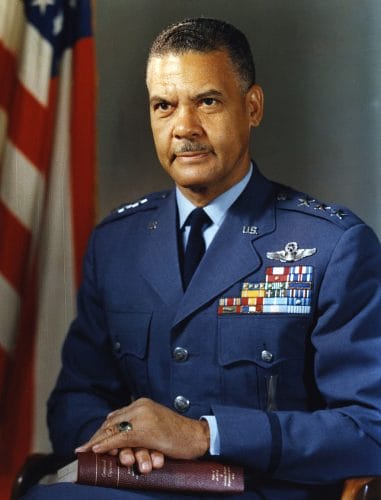
Gen. Benjamin Oliver Davis, Jr. (Public Domain photo)
At the time of his graduation, Davis Jr. was only the fourth African American graduate of West Point in its history, and the first in the 20th century—the first since the Reconstruction era. As Air Force Sustainment Center Historian Howard Halvorsen wrote, “His four years there were not pleasant;” he roomed alone, took his meals alone, and had no friends among his colleagues. He was “silenced” by the other cadets, meaning they only spoke to him on official business.
Despite the fact Davis graduated in the top 20 percent of his class in 1936, the segregation of the armed forces still kept his dream of becoming a pilot at bay. There were no Black air units, so he was denied his requests for flight training and instead sent to the infantry. When Davis Jr. was commissioned as a second lieutenant with the all-Black 24th Infantry Regiment, the Army had only two Black line officers: Both Davises, father and son. Davis Jr. would even go on to teach military science at Tuskegee Institute, a position his father had also held.
LEADING THE TUSKEGEE AIRMEN
Thanks to the collective efforts of many pioneering Black aviators and activists—and some convincing from Davis Sr., newly promoted to the rank of Brigadier General—President Franklin Roosevelt ordered the creation of an all-Black Army flying unit in 1941. As the only active Black West Point graduate, Davis Jr. was a natural choice to lead the squadron. It was more than just the realization of his dream of becoming a pilot; in leading the unit, he had an opportunity to undermine segregation and show the world that African American pilots were just as capable as white ones.
He began his flight training at Tuskegee Army Air Base in May 1941, and was the first Black officer to solo an Army Air Corps plane. On March 7, 1942, Davis Jr. and four other Black officers earned their wings. Throughout the course of the war, over 1,000 more Black cadets would graduate from the program to become “Tuskegee Airmen,” the nation’s first Black combat pilots. Davis Jr. would command the 99th Pursuit Squadron, the first and oldest of the Tuskegee Airmen units. A year later, he took command of the 332nd Fighter Group, leading all Black military aviators.
The war record of the Tuskegee Airmen of the 332nd—which included the re-named 99th Fighter Squadron and three other squadrons—is legendary. The unit supported the Allied invasion of Sicily and provided air cover for much of the fighting throughout Italy. They flew 15,000 sorties, downed 112 enemy aircraft, destroyed 273 planes on the ground, and even sunk an enemy destroyer. Davis Jr. personally led 67 of those missions, including an incredible round-trip bomber escort over Berlin in which the Tuskegee Airmen took down three of the new, faster German jet fighters without losing any fighters of their own. Davis himself was awarded the Silver Star and the Distinguished Flying Cross for his service.
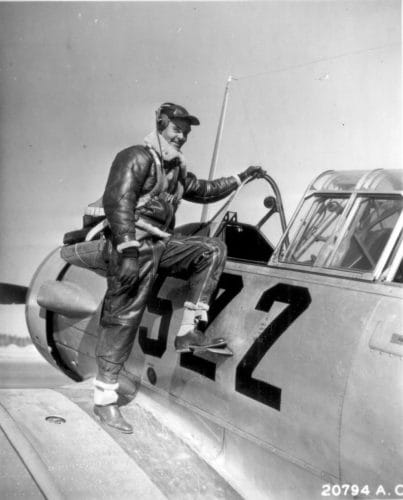
Capt. Davis Jr. climbs into his aircraft in Tuskegee, Alabama in 1942. (Office of War Information/Public Domain Photo)
But Davis Jr. and the Tuskegee Airmen weren’t just fighting the Axis in the skies over Europe—they were also battling segregation, discrimination, and bigotry, sometimes from their own commanders. Davis Jr. would later write in his autobiography that “All the blacks in the segregated forces operated like they had to prove they could fly an airplane when everyone believed they were too stupid.” Shortly after the their arrival in the Mediterranean Theatre, the commander of the unit Davis and his men were attached to complained that the Black pilots were “not of the fighting caliber of any squadron in this Group;” that officer’s superior agreed, saying, “The consensus of opinion seems to be that the Negro type has not proper reflexes to make a first-class fighter pilot.” A recommendation was made to pull the Tuskegee Airmen from combat, and a War Department commission was set up to investigate.
Davis Jr. knew his men were being judged unfairly, and organized a press conference at the Pentagon to defend them. Testifying before the War Department commission, he explained the unfair odds the Tuskegee Airmen were up against, flying against experienced enemy pilots in outdated aircraft. Because they were short-staffed, they often had to fly more missions than their white counterparts, too. He argued that his men were just as eager to fight as white pilots. Thanks to his impassioned efforts, the committee found no difference in performance between white and black air units and decided to keep the Tuskegee Airmen in the fight.
Despite having to put up with these extra pressures, the unit’s stellar accomplishments paved the way for post-war desegregation, as the military could no longer make the old racist claim that African Americans were inferior soldiers.
THE AIR FORCE INTEGRATES
After the war, Davis Jr. took command of the 477th Composite Group and became base commander at Lockbourne Army Air Base in Ohio. Despite initially facing bigotry, Air & Space Forces Magazine reportsthat his professionalism won over the locals and resulted in the base becoming “a treasured part of the community.” Most of the civil servants working at the base were white, while their superiors were Black—a unique situation in America at the time. “For centuries people said whites would never work for blacks, but at Lockbourne several hundred whites worked professionally and well for Davis and the Tuskegee Airmen,” Air & Space Forces wrote.
When the Army Air Corps split off into the U.S. Air Force in 1947, Davis Jr. joined, hoping to push the new branch to desegregate. In fact, Air Force Lt. Gen. Idwal H. Edwards was already using the war record of Davis Jr. and the Tuskegee Airmen to make the argument for Black and white airmen to serve together. Finally, in 1948, President Truman ordered the desegregation of the military, and the new Air Force was the first branch to integrate. Davis Jr. was one of the leaders who helped write the Air Force’s integration plan.
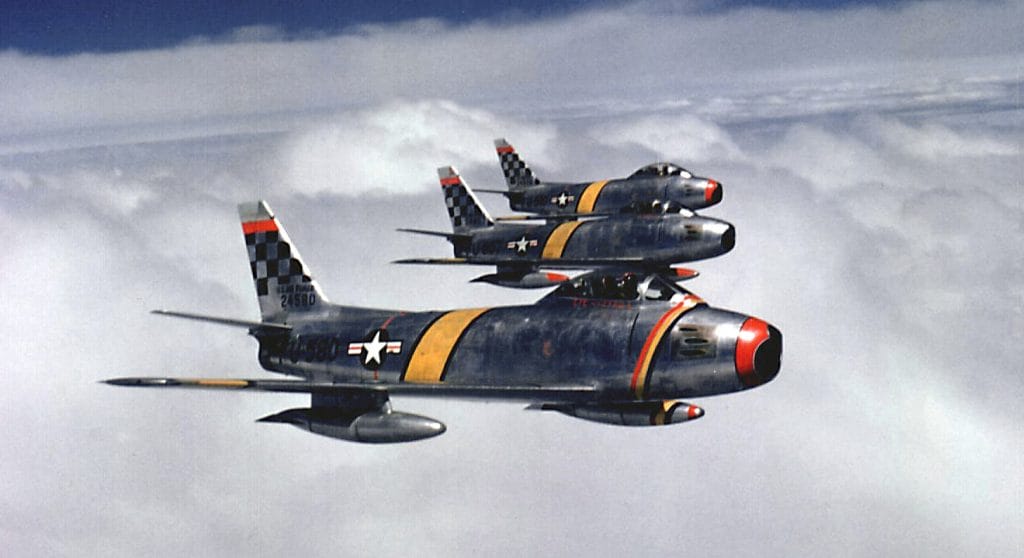
Davis Jr., then a Colonel, leads a formation of F-86F Sabres during the Korean War in 1953 (Public Domain photo)
That summer, Davis Jr. became the first Black officer to attend the Air War College, a necessary step to promotion that had previously been barred to African Americans by segregation. While his attendance represented another barrier broken, Davis Jr. still had to deal with racial discrimination; since the college was in Montgomery, Alabama, Air & Space Forces reports, many of the restaurants, shops, and services in the city were closed to him. “He and Mrs. Davis could anger the bigots among Montgomery’s whites just by driving a late-model automobile,” the magazine wrote. Once he graduated, Davis Jr. moved on to a job at the Pentagon, where he was “the impetus behind the Air Force Thunderbirds aerial demonstration team.”
Davis Jr.’s assignments over the next few years saw him leading integrated units, further proving that desegregation was a success and white soldiers would loyally follow Black leaders. After moving to Washington, he supervised white officers and enlisted men in his role as chief of Air Force Operations’ Air Defense Branch. In 1953, as the Korean War raged half a world away, he was placed in command of the 51st Fighter-Interceptor Wing, where he once again saw combat. There were thousands of men under his command, and most of them were white.
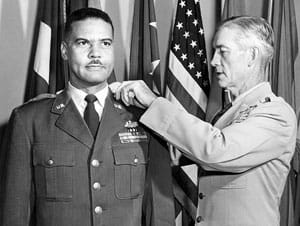
After the Korean War, Davis Jr. was transferred to Tokyo to train the Far East Air Forces. It was there in 1954 that he was awarded his first star as a Brigadier General, becoming the first African American general in the Air Force.
General Earle Everard Partridge pinning a general’s star on Benjamin O. Davis in 1954. (Public Domain photo)
COLD WAR, RETIREMENT, AND POST-MILITARY CAREER
Davis Jr. would go on to serve in a number of prestigious roles in the Air Force. First, he was made vice-commander of the 13th Air Force and transferred to Taiwan. There, he was tasked with creating an air defense force from scratch to defend the tiny island in the event the mainland Chinese Communist forces attacked. It was new territory for the seasoned general, as the unique position required “sophisticated diplomatic skills.”
Two years later, he had built a significant force to deter a possible invasion and built a strong camaraderie with the Chinese Nationalist forces. Lt. Gen. Jiang Jingguo said of Davis, “Standing on the front line of the free world, you have contributed greatly to the strengthening of the force of freedom, and to the protection of our common interests. I wish to include herewith our sincere appreciations to you for your great assistance in the air defense of this country. You have won for you far more than professional appreciations among your friends in Free China.”
In the years that followed, Davis would serve in high leadership roles in Germany, Korea, and back home at Air Force Headquarters in the United States. He received his second star as a Major General in 1959, and his third as a Lieutenant General in 1965. While commanding the 13th Air Force in the Philippines in 1967, he led some 55,000 men, many of whom were fighting in Vietnam. In 1968, he returned to the U.S. as Deputy Commander in Chief of U.S. Strike Command. He retired in 1970 after over 33 years of service.
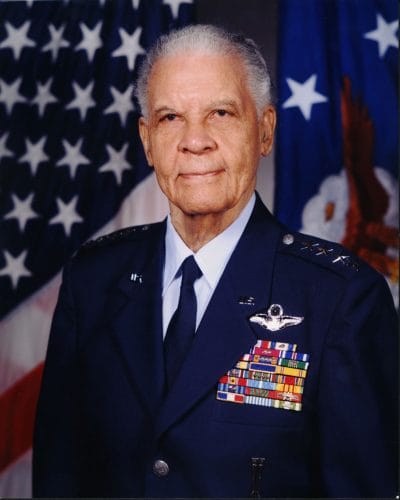
Gen. Benjamin O. Davis, Jr. in 2002, shortly after receiving his fourth star. (USAF/Public Domain Photo)
Davis held a number of important safety and leadership positions following his military service, including: Director of Public Safety in Cleveland, Ohio; Director of Civil Aviation Security, where he oversaw the federal Sky Marshal program; and as Assistant Secretary for the U.S. Department of Transportation.
There was one last honor remaining for Davis. In 1998, President Bill Clinton awarded Davis his fourth star, promoting the retired general to the rank of full General. At the ceremony, President Clinton said Davis Jr. was “a hero in war, a leader in peace, a pioneer for freedom, opportunity, and basic human dignity. He earned this honor a long time ago.”
Benjamin O. Davis, Jr. died in 2002 and is buried in Arlington National Cemetery.
William J. Powell was a tireless promoter of African American participation in the budding field of flight. In an era when daredevil pilots captured the imagination of the masses, Powell recognized that aviation also presented great opportunities for African Americans and did all he could to encourage more black fliers to take to the skies. In honor of Black History Month, read on to learn about this amazing pilot, entrepreneur, and author!
WILLIAM J. POWELL URGES AFRICAN AMERICANS TO ‘FILL THE AIR WITH BLACK WINGS’
Early life and first flight
“There is a better job and a better future in aviation for Negroes than in any other industry, and the reason is this: aviation is just beginning its period of growth and if we get into it now, while it is still uncrowded, we can grow as aviation grows.” — William J. Powell, Black Wings
William J. Powell was born in 1897 in Henderson, Kentucky. When he was just eight, his family moved to Chicago, a city that would go on to be a hub for early black aviators like Bessie Coleman and Cornelius Coffey. Powell, a talented student, was described by Air Facts Journal as “thin, lanky, and invariably well-dressed” and by National Air and Space Museum curator Von Hardesty as “a natural-born entrepreneur.” He enrolled in the engineering program at the University of Illinois at 17, but his studies were cut short by World War I.
Powell served in the segregated 370th Infantry Regiment—the only regiment in the war commanded entirely by black officers—in France, where a poison gas attack left him with health issues for the rest of his life. After the war he returned to university to finish his engineering degree and found success early in his career by operating a chain of gas stations and auto parts stores on Chicago’s South Side.
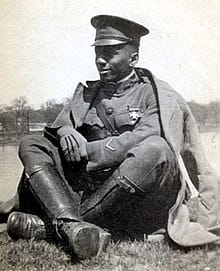
William J. Powell in his U.S. Army uniform. (Public Domain photo)
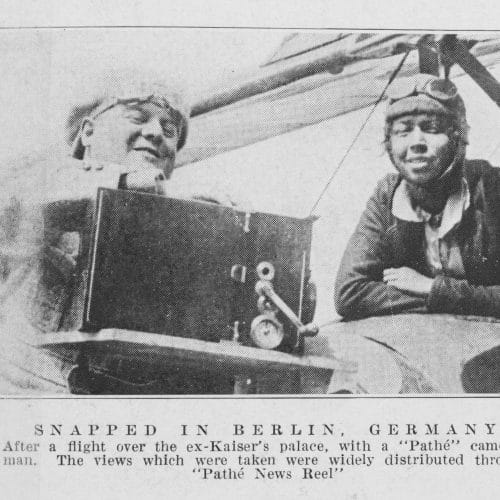
As a successful business owner, Powell had the money to travel to Paris for an American Legion convention in 1927 with other WWI veterans. Just months earlier, international aviation hero Charles Lindbergh had made history there, finishing the first non-stop flight across the Atlantic by landing at Paris’s Le Bourget Airfield. It marked the peak of aviation’s “Golden Age,” and the masses—Powell included—were fascinated by the adventures of daredevil aviators. While in Paris, Powell took a leap of faith and went to Le Bourget hoping someone would take him up in an airplane.
Powell got his wish, and by the time his plane landed after a tour over the city that included circling the Eiffel Tower, he knew he was destined to become a pilot himself. However, he wasn’t only thinking of his personal path—he saw the open blue skies and the new industry growing around aviation as an opportunity for his entire race. At that time in the 20s, African Americans were barred from many industries due to segregation and Jim Crow laws, and in addition to those racial barriers, they would soon be hit hard economically as America plunged into the Great Depression. Powell began to realize that aviation could provide a means to lift up not just an individual, but an entire community. As the African American Registry writes, “Powell meant to fly around Jim Crow … By taking hold of the embryonic flight industry, Black Americans could build their own economic independence.”
LEARNING TO FLY—AND BUILDING A COMMUNITY
“Stimulating interest in aviation among Negroes would not be such an arduous task were it not for stumbling blocks which seriously menace the Negro’s entry into any line of commercial endeavor. Skepticism, superstition, mistrust, jealousy, lack of co-operation, lack of preparation, race prejudice, and lack of finance have caused many a young Negro to turn away from some field of commercial endeavor with disgust.” — William J. Powell, Black Wings
Upon his return to the United States, Powell started applying to flight schools in the Chicago area—and even to the Army Air Corps—but was repeatedly rejected due to his race. Finally, in 1928, he was accepted into the Warren School of Aeronautics in Los Angeles. He sold his businesses, uprooted his family to California, and began his pilot’s journey.
He would eventually earn his pilot’s license in 1932, but even before completing his training, Powell began to build a strong community of African American aviators in his new home city. One thing they all had in common was a reverence for trailblazing aviator Bessie Coleman, who had drawn crowds of thousands to see her perform at airshows before her tragic death in an air accident in 1926. “Because of Bessie Coleman, we have overcome that which was much worse than racial barriers,” Powell later wrote. “We have overcome the barriers within ourselves and dared to dream.”
On this day in 1931, the Bessie Coleman Aero Club sponsored the first all-Black air show held in the United States.
📷: Club founder William Powell (right) with his Curtiss JN-4 Jenny (NASM 9A00624) pic.twitter.com/Nvi9dF7Huq
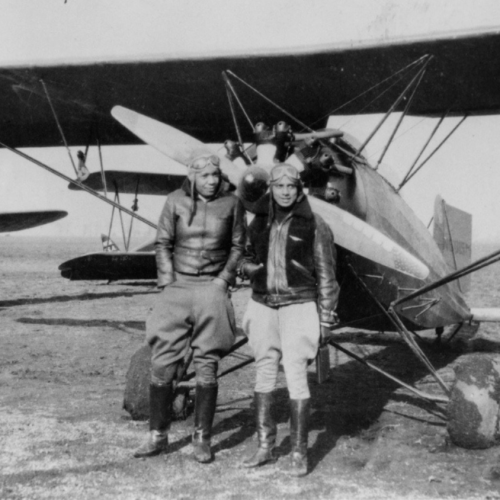
Powell formed the Bessie Coleman Aero Club in 1928 for his fellow black aviation enthusiasts and started the Bessie Coleman Flying School, making Coleman’s dream of a training center for black pilots a reality. James H. Banning, the first African American to be issued a pilot’s license in the U.S., became the school’s first instructor, and the group set to work raising awareness for black aviation.
One way Powell and his Aero Club compatriots gained attention for their field was by putting on air shows featuring black pilots and parachute jumpers. On Labor Day of 1931 at the Los Angeles Eastside Airport, they put on the nation’s first all-black air show for a crowd of 15,000. Just a few months later, they held another, calling it the “Colored Air Circus.” This time, Powell drew wider attention by making the show a benefit for Los Angeles’s unemployed community, then growing due to the Depression. This air show drew 40,000 and featured the largest formation of black aviators in the air at one time. Powell called them The Five Blackbirds, and used the success of the event to plan more air shows across the country.
WRITING “BLACK WINGS” AND RAISING NATIONAL AWARENESS
“We have lost money, we have bought airplanes, we have flown them, we have cracked them up, and we’re flying them some more, for the job must be done. No one is making us do it. We are flying of our own free will and accord, for the conquest of the air is an accomplished fact.” — William J. Powell, Black Wings
In 1934, according to the National Air and Space Museum, there were only 12 licensed African American pilots out of a total of 18,041 flying in the United States. It was against this backdrop that Powell wrote his groundbreaking semi-autobiography, “Black Wings,” to encourage more African Americans to get involved in aviation not just as pilots but as engineers, mechanics, aircraft designers/builders, and business leaders.
In “Black Wings,” Powell used the fictional character of “Bill Brown” as a stand-in for himself, writing about his struggle to become a pilot and the other early African American aviators he met. He used his story to lay out his beliefs that aviation provided African Americans a golden opportunity to “carve out [their] own destiny.” The book was dedicated to the memory of Bessie Coleman.
The book was just one of the ways Powell would seek to put black aviation on a national stage. In 1935, he produced a film called “Unemployment, the Negro, and Aviation.” The film centers on a black college graduate looking for a job but finding many avenues closed by discrimination—until one day he sees a poster featuring Powell’s call for more black aviators and decides to become a pilot. Powell also published a newsletter called Craftsmen Aero News, and enlisted famous friends including boxer Joe Louis, actress Lena Horne, and musicians Cab Calloway and Duke Ellington to drum up support for African American aviation efforts.
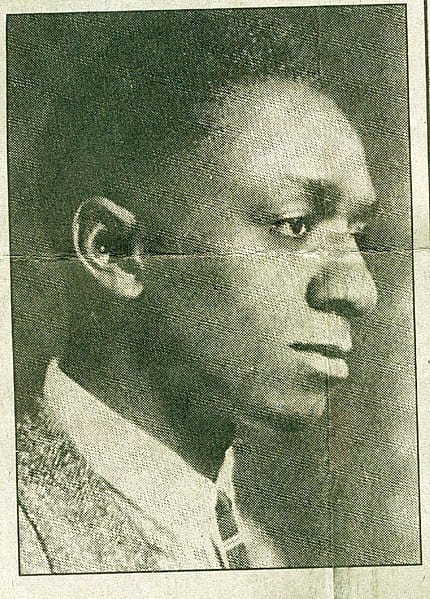
William J. Powell. (Public Domain photo)
Powell had grand plans for creating an entire black aviation industry, rather than waiting to be accepted by whites—he wrote in Black Wings, “I do not ally myself with [the] Negro who begs a White man for his job. I ally myself with that … young progressive Negro who believes [he] has the brain, the ability, to carve out his own destiny.” It was in that spirit that he created the first black-owned aircraft manufacturing company, Bessie Coleman Aero.
Black Past described Powell’s vision for an African American-led aircraft industry: “Powell envisioned Bessie Coleman Aero as a firm that would hire African Americans to design and build aircraft which would be flown by black pilots and serviced by African American mechanics. He imagined parallel black firms that would build and manage airports. These businesses, according to Powell, would serve all Americans, not just African Americans.” Sadly, the Bessie Coleman Aero project would not survive the economic turmoil of the Great Depression—along with a second firm, which Powell had also named Black Wings.
Powell died in 1942 at just 45 years old, likely from complications related to his World War I injuries. Though his life was cut short, his dream lived on—just one year after his death, the first black military pilots would take on the Nazis in the skies over Europe, serving with distinction and opening even more avenues for black aviators. Through his tireless networking, promoting, and entrepreneurship, Powell had paved the way for a new generation of African American pilots.
READ MORE ABOUT BLACK HISTORY AND AVIATION
Bessie Coleman
Cornelius Coffey
When comparing private jet companies, it’s important to do your research to ensure your provider is well equipped to service all your personal and business travel needs. In today’s post-COVID environment, this doesn’t just mean comparing program terms and benefits; it now includes exploring how well each private aviation provider can guarantee certainty in your travel plans in an industry wracked by economic constraints, aircraft & crew availability issues, the supply chain crisis, and the ongoing pandemic. We’ve compiled this updated Magellan Jets vs. NetJets comparison for 2022 to help you evaluate key aspects of the two companies’ services.
We’ve broken this guide down into the following sections:
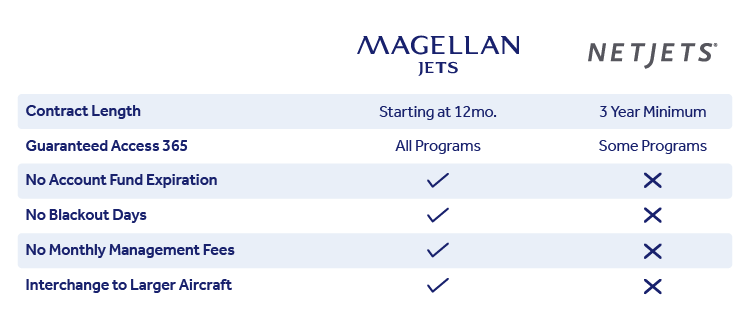
NetJets, a subsidiary of Berkshire Hathaway, is one of the first names in modern private aviation and has provided private jet services since its founding in 1964 as Executive Jet Airways. NetJets’ business model involves owning its own fleet of about 800 jets and selling fractional shares or leases on those aircraft. With this model, clients’ funds are used for operations across the entire company, including aircraft maintenance, monthly management fees, the salaries of their 7,000-some employees, and other expenses. It’s akin to having customers invest in an entire airline.
Magellan Jets, founded in 2008, is a proudly lean, privately owned company with zero debt. As we oversee a global network of operators and crews and do not own a fleet ourselves, we never have to use our clients’ investment to cover things like aircraft maintenance. In fact, client funds are never mixed with operational funds-Magellan Jets guests fly with peace of mind knowing they’ve invested solely in their own travel experience, rather than the running of an entire fleet.
types of private jet programs offered
With their introduction of the fractional aircraft ownership model in 1986, NetJets broadened access to the world of private jets, offering shares of the dedicated aircraft in their fleet. Nearly four decades later, fractional shares continue to be the company’s most popular product. Their fractional program requires a minimum commitment of 36 months and is designed for customers flying a larger volume-50 hours a year or more.
Though NetJets previously offered jet cards in 25-hour increments, the company suspended all jet card sales in August of 2021; in April 2022, NetJets announced they would not bring back jet cards for the remainder of 2022. Instead, for those flying less than 50 hours, NetJets recently began offering 25-hour leases, which require no up-front cost but lock customers into either a three- or five-year commitment.
Magellan Jets, on the other hand, offers greater flexibility with a full suite of private aviation solutions-industry-leading jet card ownership, award-winning private jet membership, and on-demand charter services-designed to fit any customer’s needs. While many other companies were forced to alter or suspend their programs or waitlist customers throughout 2021, Magellan Jets has proudly kept all programs available to new and existing customers.
In addition to on-demand charter services, Magellan offers both jet-specific and category-inclusive Jet Cards in 25-hour increments, as well as a pay-as-you-go Private Jet Membership that allows private jet travelers to lock in their fixed rate and fly as much or as little as they desire. Magellan’s Jet Card Owners and Members enjoy shorter contract lengths than NetJets customers, with Jet Card and Membership contracts lasting just 12 months.
fleet vs. network
When comparing themselves to charter broker programs, NetJets touts the consistency of experience they provide when flying on the different aircraft in their fleet. However, NetJets’ fixed fleet model, which sees many thousands of customers sharing a fleet of only a few hundred jets, simply isn’t optimized for the challenges of high demand seen across today’s private aviation marketplace. When demand for flights can’t be met, NetJets cannot guarantee that every client will fly on a NetJets fleet tail number, let alone the tail number they bought. In scenarios like these, clients with larger shares will receive aircraft priority which can result in those with smaller shares being forced to fly off-fleet on a chartered flight. Essentially, many NetJets customers are paying a premium-30 percent or more compared to the charter market-just to be brokered out. At that rate, why not just fly with a charter broker?
Magellan, however, is more than just a broker-we source aircraft from our highly selective matrix of aircraft, operators, and crews: the Magellan Jets Preferred Network (MJPN). This important framework was created to uphold Magellan’s industry-leading standards, which ensure an elevated level of service and go far beyond what’s required for keeping guests and crew healthy and safe. From this premier network of over 2,500 carefully selected aircraft and over 11,250 specifically chosen crew members, our in-house team of FAA-certificated pilots and aviation professionals secures the perfect assets to fit your exact flight requirements.
When matching you with the perfect private aviation solution, Magellan Jets is not limited to what’s available in a fleet-as a customer in this industry, we are able to pull from our vast global network of the safest and most reliable crews and aircraft to meet your needs. Thanks to the MJPN, Magellan is able to provide elevated, safe, and personalized service-and thanks to our size and infrastructure, that service is arranged by people who are intimately familiar with you and your flight patterns.
safety
Fleet-based operators may contend that flying with an off-fleet provider comes with concessions in safety; with Magellan Jets, that couldn’t be further from the truth. Magellan is an industry leader when it comes to safe flying, and we’ve been experts in off-fleet safety and service since 2008. Several members of our executive leadership team are currently serving or have served in top roles in organizations including the National Business Aviation Association, National Air Transportation Association, and Air Charter Safety Foundation. We don’t simply follow and exceed safety requirements-we have a direct hand in driving the conversation around private jet safety and raising standards for the entire business aviation industry.
Both NetJets and Magellan Jets have expert Safety Management Systems (SMS) in place, but there are a few key differences.
One difference is that Magellan conducts dynamic, real-time auditing on each flight to ensure compliance with our SMS-a level of diligence a large fleet-based provider like NetJets simply cannot perform. This auditing includes advanced airplane, pilot, and crew screening so you know who you are flying with every time, as well as enhanced COVID-19 protocols. Magellan guests enjoy the peace of mind that comes with knowing their flight is managed and overseen by a dedicated member of our Flight Support Department. These highly trained aviation professionals perform risk assessment, deviation planning, and many other behind-the-scenes due diligence tasks that are critical to every trip-including a rigorous 42-point safety inspection.
With a fleet-based operator like NetJets, crews and aircraft are often pushed to the max to manage the fleet’s busy schedule. This situation is exacerbated by the post-pandemic “new normal” of high demand and low availability, which leads to increased pilot and crew fatigue. That’s why Magellan has a minimum crew-to-aircraft ratio and dynamically audits to optimize maintenance and crew schedules. We require operators to employ at least two sets of crews per aircraft so they can be rotated and properly rested to prevent fatigue, further reducing the risk of service or safety issues.
Another difference between NetJets and Magellan is that Magellan’s SMS is a Service and Safety Management System. We know that service issues are strongly correlated to potential safety issues, and strongly believe that excellence in service equals excellence in safety. When evaluating operators for your flight, we look closely at whether they’ve maintained an uncompromising commitment to service excellence. We’re the only provider in the private aviation space willing to measure Trip Perfection Rating, or the percentage of trips flown with zero issues whatsoever-a rating we’ve kept at near 100 percent even through the pandemic, with zero cases of covid being transmitted on our flights. As our industry deals with an increase in delays, service interruptions, and schedule changes, Magellan’s elevated safety and service standards have ensured the majority of our clients have been shielded from these issues
Aircraft Availability And Access
NetJets may have a dedicated fleet of brand-new aircraft, but customers aren’t always guaranteed 365-day access to fly on these or the off-fleet brokered aircraft brought in to meet demand. That’s because NetJets’ programs feature many blackout days, peak travel dates, and other high-volume dates that all translate to the same thing: your travel plans need to be flexible. While NetJets’ fractional shares offer fewer blocked-off dates, the company’s 25-hour lease offerings have a total of 45 blackout days per year as well as an additional 45 peak days that require advanced scheduling to fly. With NetJets, if you want to be able to fly 365 days a year, you’ll need to make an investment of at least 50 hours or own a fractional share. Additionally, on peak days, NetJets cannot guarantee customers the ability to upgrade to larger aircraft or use multiple aircraft on the same day.
Magellan Jets, however, is focused on giving clients the freedom and flexibility to fly whenever they need. Magellan’s Jet Card and Private Jet Membership programs feature zero blackout dates-guests have guaranteed access to private jets 24/7, 365, and can even utilize multiple aircraft for daily use.
Backup And Recovery
Any frequent private jet flyer knows the headaches and frustrations that can occur if your aircraft suddenly goes A.O.G. due to mechanical issues, scheduling/routing mismatches, or crews calling fatigue. Considering the strain on private aviation, you need to be sure your provider has a proper recovery plan for your flight. Both NetJets and Magellan Jets guarantee trip recovery, but NetJets’ focus on fleet optimization means they will always try to use their own fleet assets to recover a trip as it is more cost effective to do so. NetJets’ unfavorable ratio of customers to aircraft results in fewer jets for recovery (plus, the closest NetJets-owned aircraft could be far away), meaning guests could be stuck waiting for hours. Meanwhile, those who don’t wait to wait for a NetJets fleet option end up on off-fleet charter flights while still paying NetJets rates.
With Magellan, in the event a mechanical or scheduling issue occurs on your flight, our Magellan Jets Preferred Network allows us to look for the next best and closest option among the safest and most reliable operators. We understand the importance of having a proper recovery plan in place, so we ensure that our Jet Card Owners and Members have a recovery flight option at no additional cost.
As we mentioned above, flying with a fleet-based operator like NetJets means that your funds go toward supporting that fleet-you’re basically investing in an airline. Roughly 30 percent more expensive than other leading private jet providers, NetJets requires significant upfront investments in addition to other fees. In particular, fractional owners end up getting locked into lengthy contract terms on assets that depreciate, and their funds expire at the end of their contract.
When determining your return on investment of working with NetJets, you must also take a closer look at your effective hourly rate. Numerous costs are unbundled to make their rates seem competitive, but that isn’t the case when you factor in overlooked costs like NetJets’ monthly management fees and peak day surcharges.
Magellan Jets, on the other hand, provides full pricing transparency-whenever a guest receives an hourly rate, there are never any hidden fees that will inflate a price tag. Our clients are never burdened by monthly maintenance fees, and Jet Card Owners and Premium Members will never pay more to fly on peak travel days. Additionally, Magellan guests’ funds on account never expire. In all, guests can expect the lowest financial risk and lowest possible incremental spend when flying with Magellan Jets.
Ready to explore Magellan’s full suite of private aviation programs? Call 877-550-5387 to speak to a consultant today, or click the button below to learn more about our Jet Card Ownership, Private Jet Membership, and Charter options.
Please let us know if you have suggestions on how we could improve this competitive review. We’ve relied on the internet, former NetJets clients, and third parties to source these insights, as competitors are often reluctant to share information.
The Tuskegee Airmen were the United States’ first African-American military pilots. They flew missions against the Axis powers during WWII while simultaneously battling racism, bigotry, and intolerance from their own side. In honor of Black History Month, read on to learn about this highly decorated group of black combat aviation pioneers.
The Tuskegee Airmen: America’s First Black Combat Pilots
Origin and training
As war in Europe loomed on the horizon, the U.S. faced a pilot shortage. Black pilots were ready and willing to serve, but still faced barriers to admittance and training because the U.S. military was still a segregated force. When the government announced an experimental program to train civilian pilots for the military, prominent black newspapers, civil rights leaders, and the NAACP advocated for African American pilots to be included, but they ran into resistance.
Finally, in 1941, a Howard University student named Yancey Williams sued the War Department because the Army Air Corps had refused to admit him due to his race. This lawsuit opened up military aviation to African Americans to the first time-however, even though figures like Cornelius Coffey pushed for full integration and said they would “rather be excluded than to be segregated,” the Corps would only accept black pilots into all-black units. Now, black pilots came from all over the country for military training.
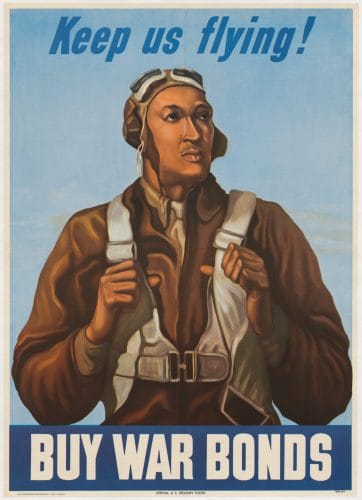
A 1943 poster created by the US Treasury Department during WWII depicting Robert W. Diez, an African American Tuskegee Airman, pleading for Americans to buy war bonds. (Collection of the Smithsonian National Museum of African American History and Culture)
The Army Air Corps soon established a training center for the black pilots at the Tuskegee Army Air Field in Tuskegee, Alabama. It was near the Tuskegee Institute (now Tuskegee University), the historic black school founded by Booker T. Washington, which had become one of the country’s centers for training black aviators. The Institute provided the facilities for the pilots and aircraft, while the Air Corps provided planes, uniforms, and educational material in addition to ground and flight training.
Five men graduated from the first class out of an original 13, including Captain Benjamin O. Davis, Jr., who was then one of the only two black officers in the entire military. Davis would go on to become the first black man to hold the rank of General in the U.S. Army-but before that, he was given command of the first all-black Air Corps unit, the 99th Pursuit Squadron.
The ‘Red Tails’ Go To Europe
The 99th shipped out to North Africa in 1943. The Allies had just pushed the Germans and Italians out of the continent and were preparing to invade Sicily and later mainland Europe. The Tuskegee Airmen’s first mission would be to bomb and strafe the small island of Pantelleria in between Sicily and Tunisia. Their missions over the enemy-held island would contribute to a historic feat-as Air Force Magazine notes, “the aerial offensive marked the first time in history that an enemy land force was compelled to surrender in the absence of an accompanying ground invasion.” Not long after, Tuskegee Airman Lt. Charles B. Hall became the first member of the squadron to down an enemy aircraft.
At this time, the squadron came under political pressure after its partnered white units complained about the 99th’s performance. Soon, publications like Time Magazine would publicly question their effectiveness. Davis traveled back to Washington, D.C., where he held a news conference at the Pentagon to speak up in defense of his unit. As the website We Are The Mighty writes, there was a lot the complainers had left out-like how the squadron was based further from the front lines than their white peers, excluded from mission briefings, and made to fly older P-40 Warhawk fighters that were slower than German planes. This episode was indicative of the prejudice the unit would regularly face.
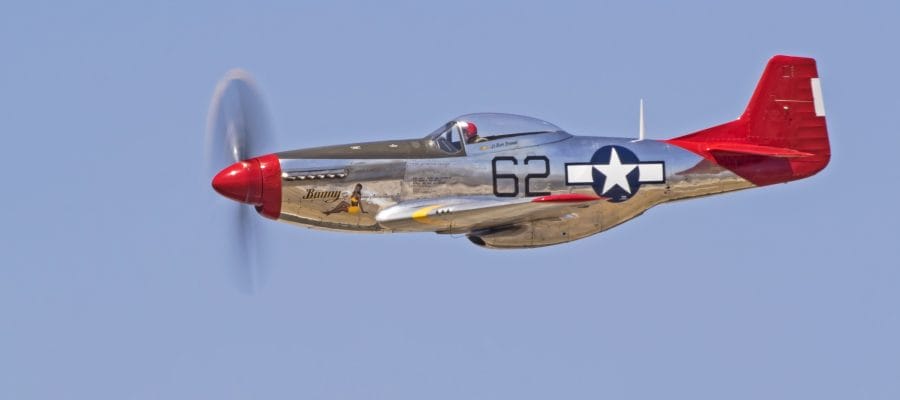
A P-51 Mustang featuring the Tuskegee Airmen’s famed “Red Tails” livery, at an air show in California in 2017. (iStockphoto)
When the 99th was sent back to Italy, they became part of the all-black 332nd Fighter Group. The 332nd was made up of three more squadrons of Tuskegee graduates, the 100th, 301st, and 302nd. These units began flying the famed P-51 fighter, painting the tails and nose cones red-leading to the unit’s nickname, the “Red Tails.” While fighting in Italy, the Tuskegee Airmen helped provide air cover for the Allied landings at Anzio, Italy, and provided safe escort for the lumbering bomber aircraft of the 15th Air Force. The 99th would receive two Presidential Unit Citations for their distinguished performance in the Italian theater. Among their incredible accomplishments was the sinking of a German naval destroyer in the harbor at Trieste, Italy; According to the National Museum of the Tuskegee Airmen, 302nd Fighter Squadron Lt. Gynne Pierson sank the large ship using only his plane’s machine guns.
Late in the war, in March of 1945, the 332nd was flying a bomber escort when they encountered German fighters utilizing brand-new jet engines. Despite being outmatched by the new technology, the Tuskegee Airmen managed to down three of the jets and damage five more without losing any aircraft of their own. Incredibly, the Tuskegee Airmen units flew 200 of 205 of these types of escort missions without the loss of a single bomber.
‘Fighting Two Wars’
As the Tuskegee Airmen National Historical Museum states on its website, “These airmen fought two wars-one against a military force overseas and the other against racism at home and abroad.” They fought for what many called “The Double V Victory,” victory against both fascism and racism. At the time, the racism they faced was institutionalized; much of the military establishment, for example, still believed the results of a 1920s War Department report stating “that blacks weren’t intelligent or disciplined enough to fly a plane.” The Tuskegee pilots underwent training in areas of the country plagued by deeply rooted racism. Tuskegee Airman Connie Nappier told Connecticut Explored that, while attending basic training in Biloxi, Mississippi, one fellow cadet was found killed after he went into town alone and didn’t come back.
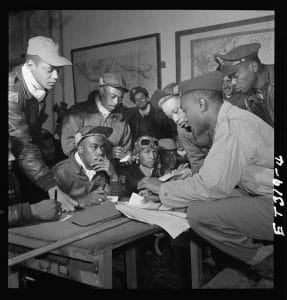
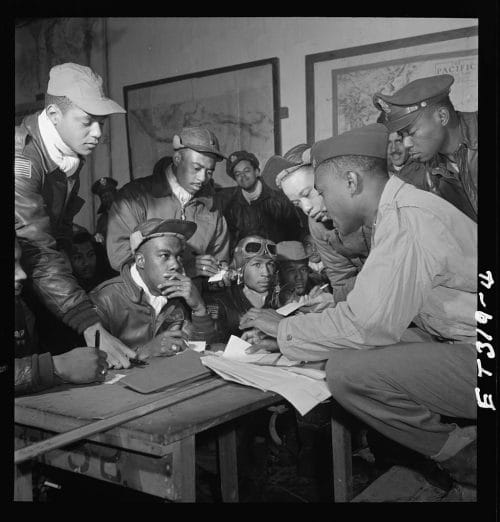
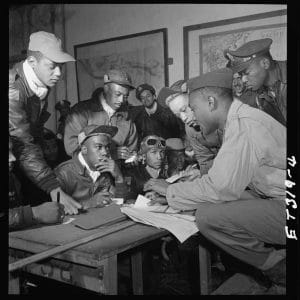
Several Tuskegee Airmen attend a mission briefing in Ramitelli, Italy in March 1945. (Wikimedia Commons/Toni Frissell collection at the Library of Congress)
Chief Master Sgt. of the Air Force George Porter, who served in WWII as a Tuskegee Airman aircraft mechanic, told NPR that racial prejudice made it harder to do his job-“because when we would order parts, they wouldn’t send us the parts, but we learned how to repair our own parts.” Another Tuskegee Airman, Walter Suggs, said many commanders expected the program to fail, saying “they kind of put them in that situation, the Afro-Americans, so they would fail.”
After the war, the pilots who had served in Tuskegee Airmen units still fought for acknowledgement. In 1949, the Tuskegee Airmen of the 332nd Fighter Group won the newly formed U.S. Air Force’s inaugural “Top Gun” gunnery competition, a feat for which Military.com notes they weren’t recognized for decades.
Legacy
According to the Tuskegee Museum, a total of 992 pilots graduated from the program at Tuskegee Army Air Field between 1942 and 1946, while History.com notes the program also trained “nearly 14,000 navigators, bombardiers, instructors, aircraft and engine mechanics, control tower operators and other maintenance and support staff.”
During the war, Tuskegee Airmen flew a total of 1,578 missions and 15,553 combat sorties, downed 112 enemy aircraft, and knocked out nearly 1,000 rail cars, significantly damaging the German war effort. They lost 66 pilots killed in action or in accidents and 84 pilots killed in training and non-combat missions. During the war, 32 Tuskegee Airmen were taken prisoner. The unit was highly decorated with 744 air medals, including 150 Distinguished Flying Crosses, one Silver Star, fourteen Bronze Stars, and eight Purple Hearts.
Historic story markers placed at the observation deck on the hill overlooking Morton Field at the Tuskegee Airmen National Historic Site in eastern Alabama. (iStockphoto)
The combat record and civil rights advancements made by the Tuskegee Airmen had an impact on President Truman’s 1948 order to desegregate the military. Lt. Roger Terry, one of the officer charged in the “Freeman Field Mutiny,” said the Tuskegee Airmen’s struggle helped pave the way for those who came after. “We feel-and I think I speak for most of the guys-that it was our advantage that we gave to the Negro people, that there would be no discrimination in the Army Air Force from that time on-at least officially.”
The Tuskegee Airmen’s former training center at Moton Field in Tuskegee, Alabama is now a National Historic Site. In 2008, surviving Tuskegee Airmen attended the Inauguration of President Barack Obama, who has written that “My career in public service was made possible by the path heroes like the Tuskegee Airmen trail-blazed.”
Cornelius Coffey’s pioneering efforts to make flight training available to African Americans helped to desegregate the skies and encouraged thousands of black pilots into aviation in both the military and civilian sectors. In honor of Black History Month, read on to learn about the man who broke racial barriers to establish the first African-American flight school and the first black-owned airport in the country.
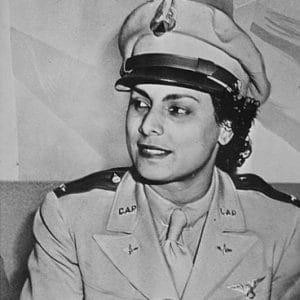
Above photo: Lola Albright and Willa Brown at Chicago’s Harlem Airport, where Coffey and Brown ran their flight school. (Records of the Federal Aviation Administration, National Archives)
Getting off the ground
Cornelius Coffey was born in Newport, Arkansas in 1903, just a few months after the Wright Brothers achieved their first powered flight and captured the imagination of the world. In 1916, when Coffey was just 13 years old, he took his first airplane ride with a barnstorming pilot and was drawn to flying from that day forward. He would later say he believed aviation was a field where the intense racial barriers and segregation of the time would not hold him back.
In 1925, Coffey moved to Chicago to study to be an automobile mechanic. It was there he met his friend John Robinson, another African American who dreamed of one day being able to fly. The two men applied to flight schools across the country, but were constantly denied because of their race-so, they resorted to teaching themselves. In a vacant Chicago lot loaned to them by a Black businessman, Coffey and Robinson used their mechanical knowledge to build a one-seat airplane powered by a motorcycle engine and taught themselves to fly.
While employed as auto mechanics by a white Chevrolet dealer named Emil Mack, Coffey and Robinson continued applying to aviation mechanic schools. Both were accepted into Chicago’s Curtiss Wright School of Aviation, but were dismissed after showing up to their first day of classes when the school discovered they were black. With help from Mack, Coffey and Robinson threatened to sue the school for being denied admittance due to their race. Eventually the school relented, Coffey and Robinson were admitted, and they graduated as two of the top students in their class. Both returned to the school to teach all-black classes-and Coffey became the first African-American man to hold both a pilot’s and a mechanic’s license.
The Challengers
During the Great Depression years, Chicago served as a hub for black pilots wishing to take to the skies-and one of the main reasons was the headway Coffey and his collaborators made in establishing a community of black pilots. In the city that pioneering black aviator Bessie Coleman had called home, Cornelius Coffey and John Robinson established the Challengers Air Pilots’ Association, a group of black fliers who sought to expand the still-limited opportunities for African American aviation enthusiasts. The group took its name from the Curtiss Challenger airplane engine, a popular engine at the time. In 1931, they began the tradition-still carried on today-of flying over Bessie Coleman’s grave as a tribute to the woman who inspired many of them to fly.
After graduating top in his class from an aviation mechanics program in Chicago, Cornelius Coffey was still unwelcome at local airstrips. So he and several other black aviators opened their own airfield and flight school. #BHM#BlackHistoryMonth https://t.co/GkgK9HX9QNpic.twitter.com/7Qd1bKoqL2
The pilots of the Challengers group were, however, still barred from most area airstrips. When Akers Airport, the only field that would accept them, closed, the group established their own airfield. According to Smithsonian Magazine,
In 1931, the group, joined by one or two white pilots from Akers, bought a half-mile-wide tract of land in Robbins, an all-black town southwest of Chicago. There they buried boulders, dropped trees, roughly leveled the terrain, and cobbled together a hangar from second-hand lumber. When they finished, their small fleet of disparate craft-a Church Mid-Wing, an International F-17, and a WACO 9-was parked under the roof at what historians consider the first black-owned airport in the United States.
In 1930s Chicago, pioneering Black aviators improvised, innovated, and overcame societal barriers to fulfill their dreams of flight. Discover their story in the latest episode of our @AirSpacePod: https://t.co/oOCpJmf2Q3
— National Air and Space Museum (@airandspace) June 13, 2021
Completed in 1933, Robbins Airport was only operational for a few months; it was destroyed by a powerful storm later that year. The Challenger group was then invited by a man named Fred Schumacher to use the lower end of his new airport on Harlem Avenue, which later became known as Harlem Airport. Finally, the black aviators had a place to fly-but the pilots were still forced to park their planes in separate hangers from the white pilots and keep on their end of the airfield.
The First Black Flight School
In the mid-30s, Robinson left the United States for Ethiopia, where he used his flying skills to fight against the invading Italian fascist army. Back in Chicago, Cornelius Coffey worked as a mechanic for Schumacher, re-certifying the overhauled aircraft used by the white pilots on the other side of the airfield. Then, in 1938, he established The Coffey School of Aeronautics, the first black-owned and certified flight school in the country.
Coffey hired other pioneering black aviators to teach at his school-including a former student of his, Willa Brown, who was later to become his wife. Brown had been the first African-American woman to earn her pilot’s license in the U.S., but she would be far from the last-as Coffey later noted, “Every 10 students that I took, I had one white student and one girl student in that unit.”
With World War II on the horizon, the U.S. government sensed a need for an increase in military pilots. The Civilian Pilot Training Program was created in 1939 to train new fliers for the Army Air Corps, which was the predecessor to the U.S. Air Force. Coffey and Brown wanted to make sure black aviators were included, so they renamed the Challenger Air Pilots’ Association to the National Airman’s Association (NAA) and focused their group on the goal of getting black pilots into the military. To draw attention to their cause, the NAA organized a publicity flight to Washington, D.C. As a result, seven black pilot training sites were included as part of the government’s training program; Coffey’s school was the only one not associated with a college or university.
A Lasting Impact On Aviation
Between 1938 and 1945, more than 1,500 black students passed through Coffey’s school. Many of those pilots went on to join the famed Tuskegee Airmen, the first African American air units to fight against the Nazis in Europe. Coffey, whose school was integrated, initially spoke out against these segregated flying units, saying, “We’d rather be excluded than to be segregated.”
After WWII, Coffey enjoyed a long career as a pilot, mechanic, and teacher. He retired from instructing in 1969, but kept busy as an aircraft inspector for decades. He designed and patented a carburetor heating system that helped keep aircraft flying in inclement weather by preventing icing, and similar devices continue to be used today. Coffey continued to fly until 1992 and passed away two years later at the age of 91. In Chicago, pilots encounter his legacy daily when they use the “Cofey Fix,” an aerial navigation intersection named after him that is located over Lake Calumet and helps guide entry into Midway Airport.
Pioneering aviator Bessie Coleman pursued her dream of taking to the skies against all odds, shattering aviation’s racial and gender barriers in the process. In honor of Black History Month, read on to learn about the incredible exploits of “Queen Bess,” the first African-American and Native American woman to earn a pilot’s license.
Life And Legacy Of Bessie Coleman
A Dream To Fly
Born to sharecroppers in Atlanta, Texas in 1892, Bessie Coleman grew up helping her parents pick cotton along with her 12 siblings. Determined to get an education and rise above her station, Coleman graduated high school and even attended a semester of college at Langston University before heading to Chicago as part of “The Great Migration” from the South along with millions of other African Americans. There, she worked as a manicurist while living with her older brothers.
An avid reader, Coleman was dazzled by stories of daredevil aviators, the rock stars of their time, returning from the fighting in Europe in WWI. At a moment when racism was rampant-Chicago experienced one of the worst race riots in history in the summer of 1919-she began to imagine herself entering the field of aviation as a way of inspiring and benefiting African Americans everywhere. When Coleman’s older brother who had served in France returned home with stories of women in more liberal Europe flying airplanes, Coleman became determined to become a pilot herself.
She began applying to aviation schools across the U.S., but was repeatedly denied, as they all refused access to both African Americans and women. But Coleman didn’t give up-as she said, “I refuse to take no for an answer. If I can create the minimum of my plans and desires, there shall be no regrets.” Half a world away, she found a school willing to teach her to fly.
Journey Overseas
Seeking additional help, Coleman reached out to Robert Abbott, owner of an influential black newspaper called the Chicago Defender. She convinced Abbott, known as “the father of black journalism,” that it was important to have a black woman pilot. Impressed (and recognizing a great story in the making), he suggested she enroll at a flying school in France.
After teaching herself French, Bessie Coleman set sail for Paris in November of 1920. She trained for months at the Ecole d’Aviation des Freres Cadron, a prestigious flight school run by plane designers and aviators Gaston and Rene Caudron. In the early days of flying, aviation was still extremely dangerous, and Coleman persisted even after witnessing the deaths of several of her fellow students. When she arrived back in the United States in September 1921, she brought with her the international pilot’s license she had earned as well as a commitment to encouraging more African Americans to fly.
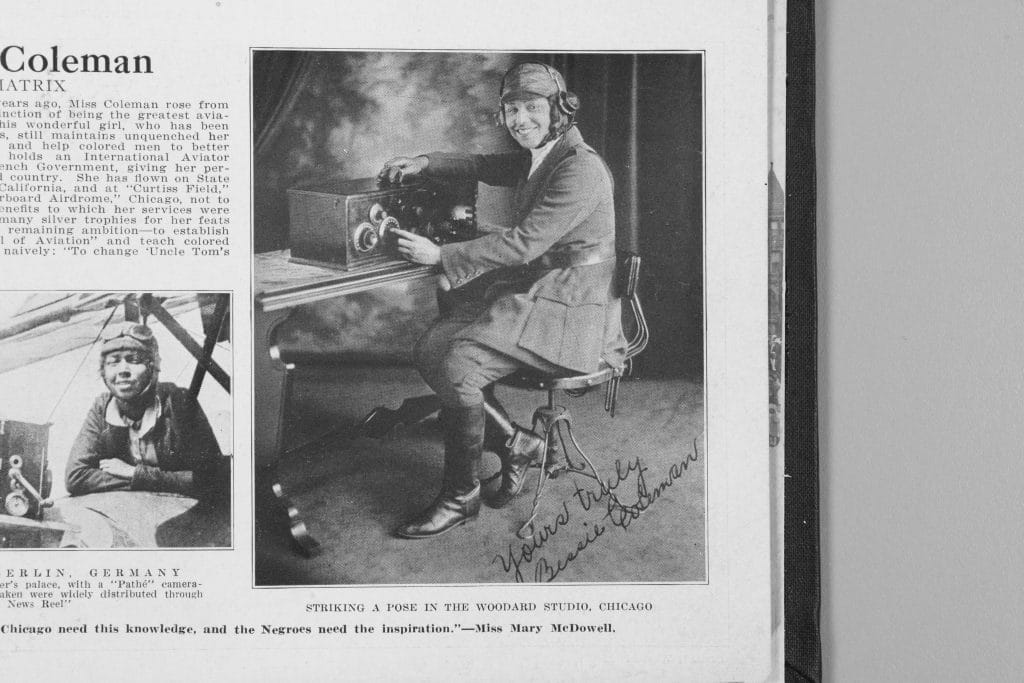
Bessie Coleman in her flying uniform. (New York Public Library Public Domain Archive)
What she found was a country still unwilling to hire her or even sell her a plane. But she saw an opportunity in the “barnstorming” craze-if she was to find employment, Coleman knew she would have to learn to pull off the dangerous stunt tricks performed by aerial acrobats at barnstorming exhibitions across the country. So, she went back to Europe, this time training with veteran WWI flying aces and legendary Dutch airplane designer Anthony Fokker.
Returning stateside, Coleman began a series of thrilling air shows where she performed for thousands of people, both black and white. With her new skills-and with the Defender celebrating her performances-Coleman’s fame took off.
Coleman steadfastly pursued her dream and lived her own independent, unorthodox life-including firing male managers and refusing movie roles she felt were demeaning, reportedly saying “No Uncle Tom stuff for me,” in reference to playing a subservient Black woman. Like her contemporary Amelia Earhart, Coleman was not afraid to be different. She was a fearless personality who defied odds and stepped on toes to claim her space as an aviator.
While she was largely ignored by the mainstream press, she was a star in the pages of the Defender and other black newspapers, gathering legions of fans to whom she was known as “Queen Bess” or “Brave Bess.” She was an expert at self-promotion, making appearances in a military-style uniform with an officer’s belt, leather boots, and leather helmet and goggles-and often embellished her already-impressive story during interviews. She performed incredible barnstorming stunts like tailspins and loop-the-loops for large crowds, made public appearances where she encouraged other African Americans to fly, and, in the midst of Jim Crow, “refused to perform in airshows where blacks were not allowed to use the front entrance.”
Even after crashing her brand-new Curtiss JN-4D “Jenny” biplane in 1923, she was undeterred. She was pulled unconscious from the wreckage and spent three months in the hospital, having broken a leg and several ribs. Her message to the world from her hospital bed was, “Tell them all that as soon as I can walk I’m going to fly! And my faith in aviation and the use it will serve in fulfilling the destiny of my people isn’t shaken at all.”
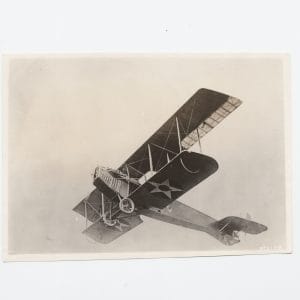
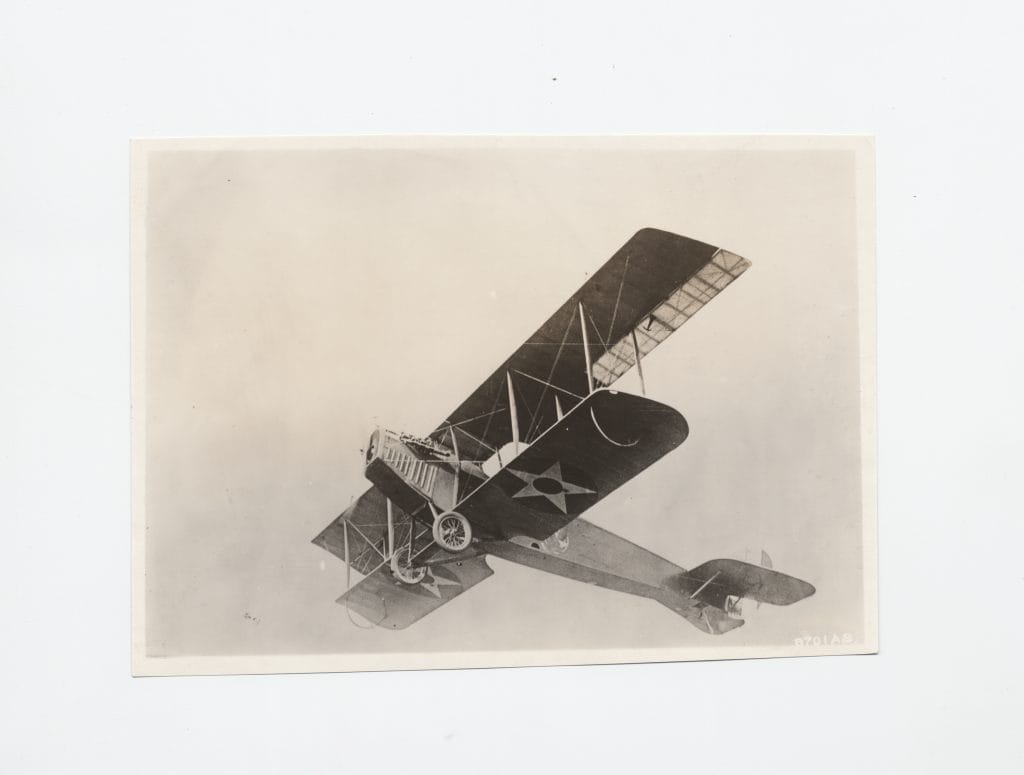
A Curtiss JN-4D “Jenny” Biplane like the ones flown by Bessie Coleman. (New York Public Library Public Domain Archive)
A Tragic Final Flight
In April of 1926, Bessie Coleman had finally raised enough money for another brand-new airplane, and took it for a test ride in Jacksonville, Florida. A white mechanic, William Willis, was flying the plane while Coleman scouted the land below for a good spot to perform a parachute jump. In what was later found to be an accident, a loose wrench jammed the JN-4D’s controls and threw the plane into a nosedive at 3,000 feet. Without a seatbelt, Coleman was thrown from the plane and killed when it flipped over. Willis was killed when the plane crashed into the ground.
After just five years, Coleman’s trailblazing aviation career was tragically cut short. PBS says about 10,000 mourners paid their final respects to Coleman, and in Chicago, her funeral services were presided over by famed activist Ida B. Wells.
A Lasting Legacy
The National Aviation Hall of Fame notes that Coleman only received the attention she truly deserved after her tragic death, but it’s undeniable that her accomplishments in early aviation paved the way for generations of future black aviators. Her dream of opening an aviation school for African Americans was realized in 1929, when Lt. William J. Powell founded the Bessie Coleman Aero Club in Los Angeles in her memory, allowing both men and women to apply.
If you fly into O’Hare International Airport in Chicago, the city Coleman called home, you’ll find yourself on Bessie Coleman Drive. To this day, during an annual ceremony, pilots fly over Lincoln Cemetery and drop flowers on her grave. The tradition was started in 1931 by a group of pioneering black aviators called the Challenger Pilots’ Association of Chicago; this early flight club included several other African-American aviation legends who carried on Coleman’s mission, including Cornelius Coffey, Janet Bragg, and Willa Brown.
Celebrating Black History: Elevate Every Journey with Magellan Jets
Here at Magellan Jets, we honor the rich legacy of Black pioneers in aviation and beyond.
Experience private aviation with a company that values every journey. Contact us today to talk about our full range of private aviation solutions.
Leading With Safety
At Magellan Jets, the first of our core values is to lead with safety by maintaining an uncompromising commitment to excellence. When it comes to safety in private aviation, we know that service issues are strongly correlated to potential safety issues-so we’ve focused on three key performance metrics to elevate our service, because excellence in service equals excellence in safety. They are:
These three metrics are the result of our strong safety culture and the world’s most comprehensive service and safety management and quality assurance system. We work with only the few operators in our Magellan Jets Preferred Network (MJPN) that are able to continuously meet our rigorous standards and execute on all three of these factors.
The MJPN is a highly-selective, accredited network of premier operators that are subjected to the most rigorous Service and Safety Quality Assurance system in aviation. Every flight is thoroughly vetted by the expert FAA-certified pilots in our Flight Support Department. To earn a spot in the MJPN, private jet operators have to meet rigorous standards for health, safety, and service, including our 42-point safety inspection checklist and our 5 X 5 PureSky Safety Standard. They must be in good standing with third-party organizations like ARG/US and Wyvern, and their core values and safety cultures must align with ours.
Read on to learn why schedule stability, controllable on-time performance, and trip perfection rating are important, what you should ask your private aviation provider about them, and how Magellan Jets is uniquely positioned to keep you safe and create long-term value for your business by delivering on all three.
SCHEDULE STABILITY
Schedule stability is measured as the percentage of flights where the schedule was completed exactly as planned-without delays, aircraft or crew changes, or changes in departure time or day.
While large network providers consider 18% schedule stability to be satisfactory, Magellan Jets has had 98% schedule stability over the past 12 months.
• 8 Questions to Ask Before You Hire A Private Jet Operator When schedule stability is high, your flight experience will match your pre-planned itinerary exactly, and you will arrive at your destination on time with the crew and aircraft you wanted. You’ll have peace of mind knowing your needs are truly prioritized.
But when your provider cannot prioritize schedule stability, your personal and business goals are put at risk as you’re forced to adjust to last-minute changes. You may get frequent calls or confusing emails from your provider, or experience itinerary or booking errors, adding to your frustrations before your departure even takes place. Be sure to invest in a dependable private aviation company with a great schedule stability record, because low schedule stability will negatively impact your trip.
Ask your private jet provider:
– What is your schedule stability rating overall? – What is your schedule stability rating on high-volume days?
CONTROLLABLE ON-TIME PERFORMANCE
Controllable on-time performance is measured as the percentage of flights that depart within 15 minutes of their planned departure time.
Large network providers meet this goal 75% of the time; Magellan Jets has a controllable on-time performance rating of 97% over the past 12 months.
When controllable on-time performance is broadly defined and includes things your provider should anticipate, such as air traffic control and weather delays, your jet will be ready and waiting for you when you arrive at the private terminal. With the proper planning on your behalf by your private jet provider, the only factor that can’t be controlled is your timely arrival at the departure site. But when your provider does not take responsibility for the crucial factors that disrupt flight performance, you could be left waiting at the airport for your plane to arrive.
Ask your private jet provider:
– What is your overall controllable on-time performance percentage? – What is your controllable on-time performance during peak travel periods? – What factors do you consider controllable?
Trip Perfection Rating
Our Trip Perfection Rating is the percentage of trips flown with zero issues whatsoever. Magellan Jets is the only provider in the private aviation space that is willing to measure this metric.
Large network providers will not measure this-but Magellan Jets can proudly say we have a Trip Perfection Rating of 90% over the past 12 months.
Some providers may report their on-time rate as a sign of perfection, but delays are only one factor that can leave you unsatisfied with your flight experience. Were all seats on your jet fully operational? Was your catering order complete? Were you advised before your flight if your aircraft had enough space for your luggage? Was there enough room for you and your guests to be comfortable on your jet for the length of the trip? Was your itinerary, customs, and COVID-19 containment paperwork prepared for you in advance? Was your ground transportation arranged perfectly? Make sure whoever you choose to provide your private aviation solutions has the experience, foresight, and capability to meet each and every one of your expectations, beyond simply executing your trip. Anyone can get you from point A to point B-but it’s how you get there that makes a difference.
Ask your private jet provider:
– Do you collect clients’ post-flight feedback, such as survey scores? – What are some of the typical issues private flyers report with your company?
How does Magellan Jets manage such high ratings?
Since our business model strategically revolves around continuously auditing active aircraft, crews, and safety cultures available on the market, we’re able to focus entirely on finding the best solution to fit your needs for every flight. Simply put, our model gives us greater control over the desired outcome on each and every flight, ultimately resulting in higher satisfaction for you and your travel companions.
When it comes to quality assurance, our buying power surpasses other providers’ operational control. We’re constantly evaluating our operators, and won’t hesitate to remove any from the MJPN if they do not meet our elevated standards. In that way, we’re always optimizing our service and improving to ensure your safety, your success, and the integrity of your mission.
You’ve explored how Magellan Jets focuses on schedule stability, controllable on-time performance, and our very own Trip Perfection Rating to provide consistent, reliable, and excellent service with each and every private flight. Next, learn more about our relentless commitment to keeping our guests safe.
Flying private isn’t the only way to enjoy an elevated experience in the skies-some travelers opt to fly first class on commercial flights. As we’ve covered before, there are many ways to fly private and to optimize transit time for productivity and comfort. However, while the private jets vs. first class experiences are comparable to some degree, flying private and flying commercial serve different purposes. When does flying private make sense over flying first class, and vice versa?
PRIVATE JETS VS. FIRST CLASS: WHAT’S THE DIFFERENCE?
THE EXPERIENCE: PRIVATE JETS VS. FIRST CLASS
When it comes to private jets vs. first class commercial flights, both travelers can expect to be treated to personalized, focused service aimed at ensuring that the in-flight experience is a comfortable and positive one. However, from there, the similarities are few.
In a first class seat, travelers are reserved a certain section of the plane. It’s usually among a group of 20 or more others. Overall, the level of service the traveler experiences here-as well as the amount of privacy you have, your freedom and the comfort level of your seat and surroundings-can vary widely across airlines and aircrafts. Some airlines provide a highly accommodating experience. Meanwhile, others merely provide a small area of the airplane equipped with larger seats.
Still, in some cases, it makes sense for businesses to opt for first class instead of a private flight. For example, if the business is only sending a few executives on a flight. In some cases, it may be more cost-effective to purchase first class. And when time isn’t of the essence or when connectivity in the air isn’t necessary, a charter may not be needed.
There’s also range to consider. First-class seats may be a better option for flying overseas, as the cost of chartering a jet that can make the long, cross-country haul may be much higher than the situation warrants.
WHY FLY PRIVATE?
For many travelers and corporations, flying private makes more business sense. One perk is that flying private circumvents crowds, airport security and other inconveniences of flying commercial.
Moreover, when chartering a flight, the schedule is completely flexible. It’s dependent upon the traveler’s needs, and travelers receive the utmost privacy, discretion, freedom, and comfort. Executives are free to use a private flight as a sort of conference room in the sky. Thus, making more efficient use of their time in the air.
Plus, on charter flights, highly attentive service is the standard. Travelers can expect to find their flight stocked with amenities tailored to their needs. They’ll also discover a comfortable environment in which they can work, nap, chat, enjoy leisure time, or otherwise prepare for their destination however needed.
When flying private on a regular basis, it may make sense to invest in a jet membership. These provide a set rate and hours to use on business or leisure travel. Many businesses also invest in pre-purchasing hours on a specific jet, or a jet card. By ensuring access to the aircraft with as little as 8 hour notice, this ensures their employees have a productive environment between meetings and in-person obligations.
Even private aircraft owners sometimes opt to charter a flight. They may require a specific aircraft or schedule to meet needs that are out of their ordinary. For example, if they are traveling a longer distance or flying a larger group than usual. In that case, a jet membership may again make sense because it grants a specified number of hours on a specified aircraft.
TRAVEL IN THE NEW LANDSCAPE
In the wake of the COVID-19 pandemic, commercial airlines have been struggling, but business aviation continues to prove its value. According to Business Traveler USA, a recent study “found those companies that harness business aviation weathered recessions better and recovered quicker.” Commercial aviation is no match for the value proposition of traveling privately. Flying private minimizes passengers’ exposure to harm, because of the smaller group setting in a controlled environment-removed of contact with strangers. Additionally, private aviation is known for consistent, strictly enforced safety standards, providing 360-degree protection for those flying private. From the onset of the pandemic, Magellan Jets has continuously educated and provided advice on how to stay healthy while traveling. We also implemented the 5 x 5 PureSky Safety Standard, ensuring the wellbeing of those who use our private aviation services.
As an alternative to the variable cost of on-demand charter market flights, a private jet membership provides consistency with guaranteed access to aircraft and locked-in hourly rates for a set term, as well as other benefits. Magellan Jets Membership, for example, offers guaranteed access to four categories of aircraft with 48 hours’ notice and the ability to fly as much or as little as needed. Overall, memberships allow travelers to have all the benefits of a purely private experience without the risks and costs associated with ownership.
Will private jets replace commercial flying?
It’s no secret that commercial aviation has taken a hit due to the coronavirus situation. When it comes time for a return to business, it may take a while for airlines to get up to speed. Additionally, many flyers may even be weary of using commercial aviation. That may be due to the inherent risks of long security lines at airports as well as tight quarters on a large aircraft with strangers.
Private aviation will be the premier solution as we transition back to normal, as it is already safely serving people’s needs during this time of uncertainty. Private travelers have access to more than 5,000 terminals and fixed-based operators (FBOs), much more than the 500 available to commercial aviation.
Also, with a private jet, there are far fewer surfaces that need cleaning with each trip. As a result, private jet membership offers faster turnaround times and more thorough disinfecting. Plus, you are exposed to far fewer people than at an airport due to the exclusivity and smaller size of FBOs. However, in many circumstances, you can have your ground transportation drive you directly to your plane, further mitigating contact with others.
As for our jet card owners, members, and charter clients, travelers who fly with us can also expect other enhanced safety measures. Not only is our safety task force diligently monitoring all flights, passengers, and crew, but we’ve enacted a multilayered system called the 5×5 PureSky Safety Standard to ensure the health and well-being of all guests and partners.
How much do Private Jet memberships cost?
A private jet membership usually includes an initial investment, which locks in hourly rates for a set term of one year. An annual renewal fee can extend those terms. Magellan Jets Memberships lock in your rates for 12 months with an initial investment of $16,500 for Premium Members and $10,500 for standard memberships. Both programs also feature 48-hour callout times with no blackout dates or peak travel surcharges.
How do businesses use memberships?
During these times, many companies are opting for the safety and reliability of private aviation. Instead of exposing executives and employees to the risks of commercial travel, private jets allow critical personnel to fly safely. Private jets provide safe, essential transportation to keep the economy moving.
As for private jet memberships specifically, they’re often the most responsible choice for businesses. Not only do they allow for ultimate productivity onboard, but they also offer convenience and flexibility. Memberships give businesses access to the perfect aircraft for their missions, whenever they are needed.
Memberships don’t just provide a safe alternative to commercial flying-they are more sensible investments for businesses as well. Memberships at Magellan Jets provide flexibility in aircraft to meet your needs, allowing you to interchange freely between types in order to ensure the perfect aircraft for every mission. Businesses that fly with Magellan Jets will also be able to find solutions for clean and secure meeting spaces. We can help you secure FBO conference rooms or other locations for critical meetings.
Magellan Jets’ membership programs are the premier solutions for businesses and individuals in need of essential travel. Members have the ability to fly as much or as little as they need, with a guaranteed solution ready to go with as little as 48 hours’ notice.
A private jet membership is the ultimate way to travel. Members receive transparency through all-inclusive, locked-in hourly pricing with no blackout dates or peak-day surcharges. Also, your membership doesn’t begin until your first flight, which means we’ll always be here when you’re ready. Plus, in times of uncertainty, members don’t even have to be onboard to use their membership to provide safe transportation for loved ones or colleagues.
With perfect survey scores delivered on nearly every Magellan Jets experience, our members fly with peace of mind knowing they’re in safe hands. We pride ourselves on ensuring the best and safest experience with every flight. Our dedicated Private Aviation Consultants, Guest Excellence Team, and Flight Support Department of FAA-certificated pilots are available around the clock to meet all of your needs.
Before you select an aircraft for your next trip, it’s important to understand the differences between the various private jet categories. In particular, important details like where you’re traveling to and how many passengers are flying with you should be factored in by your private travel provider to determine which aircraft is the right fit for your mission. Use this guide to learn about the different categories and how they can impact your travel experience.
Private Jet Aircraft Categories: Understanding The Differences
HEAVY
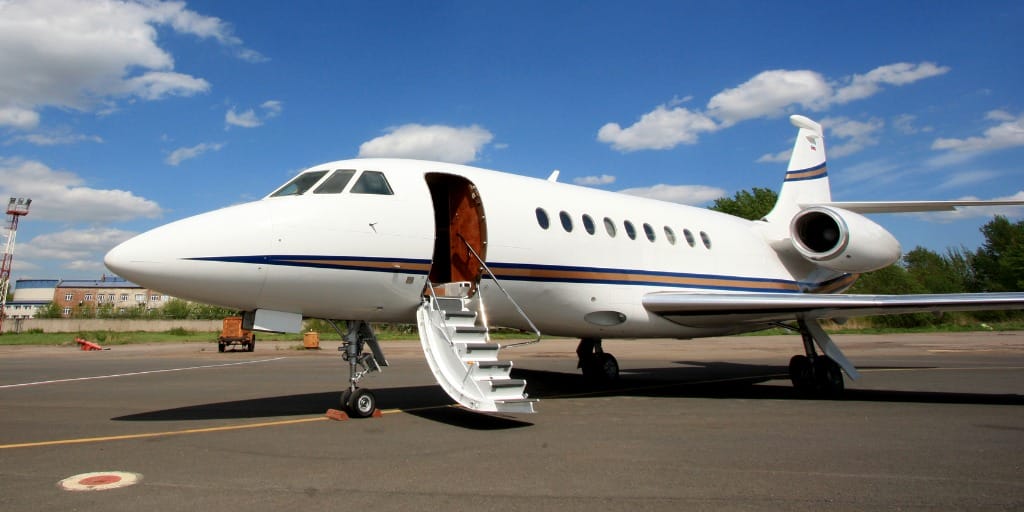
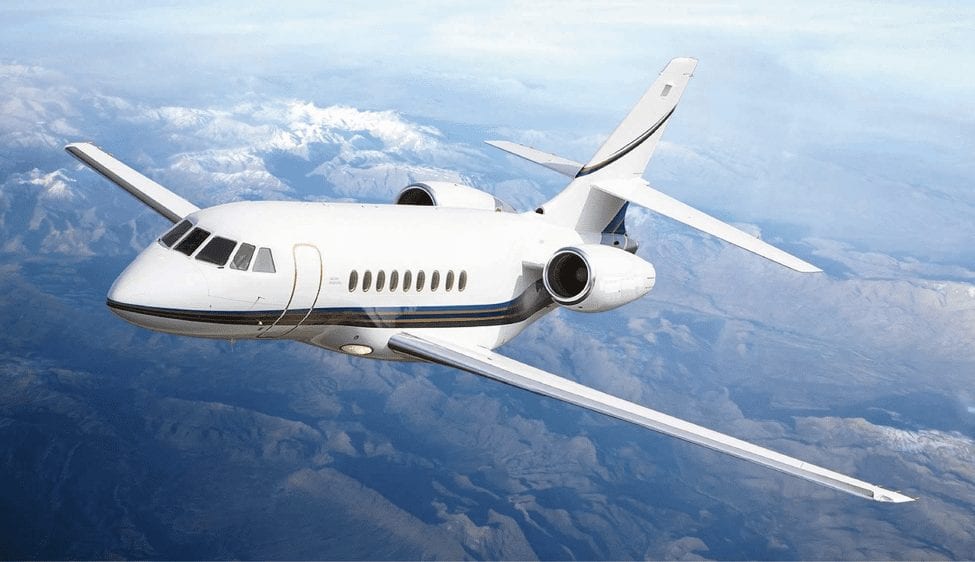
Ideal for business travel and intercontinental flights, heavy jets provide the ultimate in comfort and luxury. Aircraft like the Gulfstream 450 and Falcon 2000 have long-range capabilities and offer large cabin space configured to keep businesses productive and help guests relax. Overall, the high performance and capabilities of heavy jets make them the perfect choice for lengthy trips.
Flight Time Range: Depending on the number of passengers onboard, a heavy jet can fly approximately 4.6-8.6 hours before needing a fuel stop.
Passenger Seating: Heavy jets can typically accommodate 4-12 passengers.
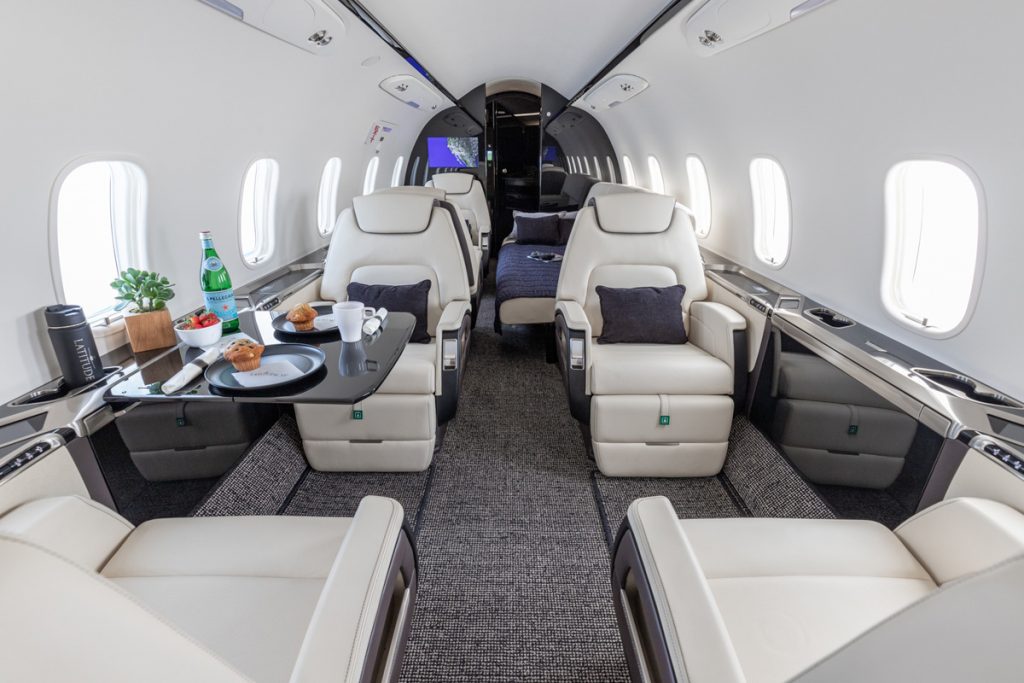
Built for speed and power, super mid jets are the optimal choice for flying across the continent in comfort. Aircraft like the Challenger 300 and Citation X feature not only wide, roomy cabins and luggage space, but also a level of fuel efficiency unmatched by other private jet categories. If you’re considering traveling coast to coast with a larger group, a super mid may be your best option.
Flight Time Range: Depending on the number of passengers onboard, a super mid jet can fly approximately 4.7-6 hours before needing a fuel stop.
Passenger Seating: Super mid jets can typically accommodate 4-8 passengers.
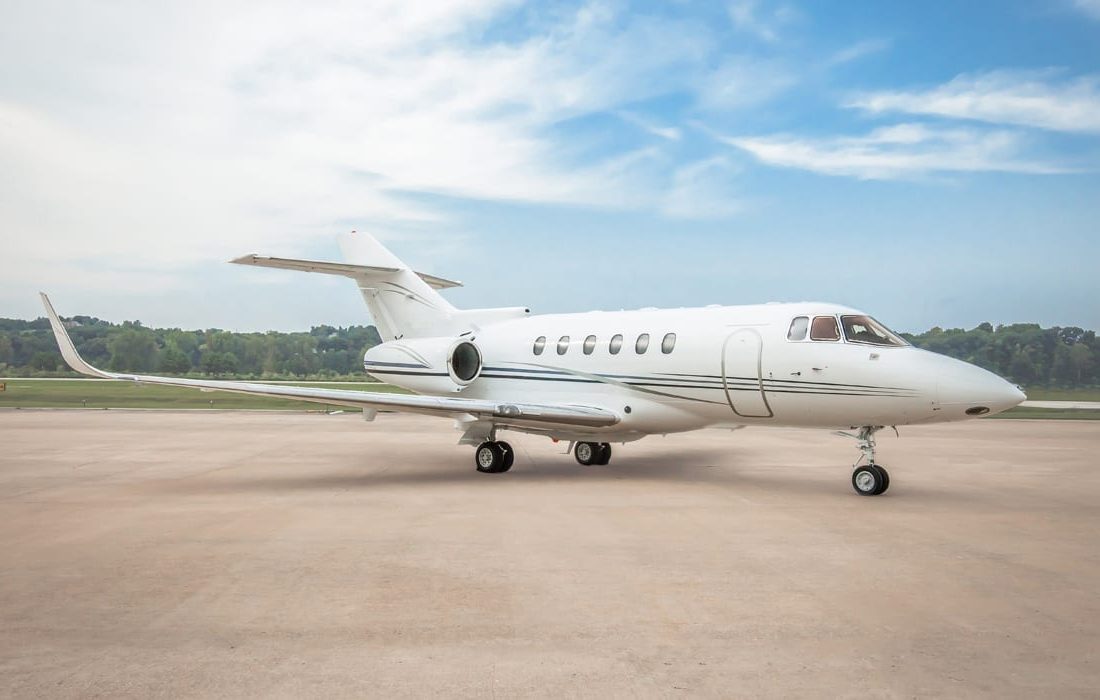
Although mid jets aren’t the fastest or most powerful of the private jet categories, they are ideal for certain missions. Aircraft like the Hawker 800XP and Citation XL offer less cabin space than super mid jets, as they were created to serve smaller groups traveling shorter distances. Consider booking a mid-sized option for relatively quick trips like West Palm Beach to Nantucket.
Flight Time Range: Depending on the number of passengers onboard, a mid jet can fly approximately 3.8-4.3 hours before needing a fuel stop.
Passenger Seating: Mid jets can typically accommodate 2-7 passengers.
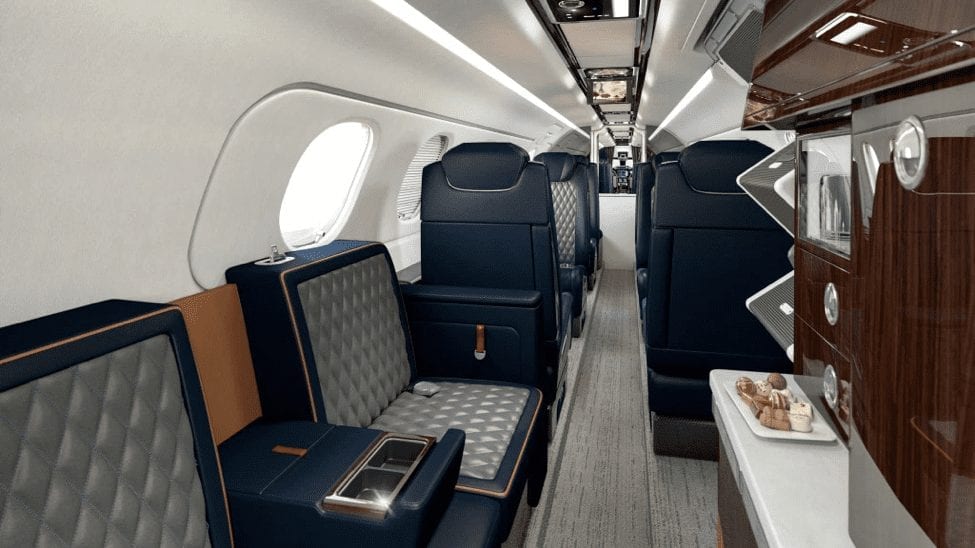
Small but fast, light jets are the perfect aircraft for business executives and guests on the go. Featuring smaller cabins and shorter range capabilities, aircraft like the Hawker 400XP and Phenom 300were built to serve quick hop missions, like New York to Washington D.C. Consider a light jet option for small groups on city-to-city trips.
Flight Time Range: Depending on the number of passengers onboard, a light jet can fly approximately 2.3-3.4 hours before needing a fuel stop.
Passenger Seating: Light jets can typically accommodate 2-6 passengers.